there will be no rulers and there will be no rule.
All will uphold the virtues of their choosing.
Neither light nor dark will be banished for they form the night sky and the stars – the womb of Old Mother Universe.
Eating, drinking, fasting, will all be allowed for all states of the cauldron must be embraced – empty and full and there will be no divisions between the ones who drink and the ones who stir as this was the root of the original disaster.
There will be no good and there will be no bad.
We will exist in a world before sin existed.
The before that 365 plants come from and art and who we bring to life with our songs.
There will be room for men and women and all between.
It will be accepted that we all are monsters.
The monstrous will be raised on high with the dragons, spiralling, spiralling down, descending into darkness, sleepily drunk on mead.
We will be visible and invisible.
No-one will see that we wear our habits like invisible cloaks as we got about our daily lives.
No-one will see the Monastery of Annwn because it lies beyond doors and walls and no-one will read the forbidden books in our personal libraries
because they lie unwritten on the dark shelves of our souls.
Of all the plants I have always found grasses the least enchanting.
Garden lawns, roadside verges, the turfs of sports fields and bowling greens. Amenity grasslands where the diverse species are reduced to ‘grass’.
I’ve disliked grasses when they’re tame and when they’re wild and misbehave.
I’ve hated the grass on the green in Greencroft Valley more than the weeds for taking over the wildflower meadow, reducing floral diversity to the homogenous greenery beloved of local councils and small-minded humans.
I’m allergic to grass. It makes me itch and its pollen triggers my hay fever.
Yet the grass family, the Poaceae, the fifth largest plant family on this planet, is an essential food source for humans and for a variety of other mammals including the animal I am closest to, the horse, who evolved along with grasses 55 million years ago, its long teeth evolving as it moved away from fruit.
In my new job as a Graduate Ecologist I have been training to carry out Extended Phase One Habitat Surveys and this involves learning to assess whether a grassland is neutral, acid, or calcareous; unimproved, semi-improved, improved or poor, based upon the species present.
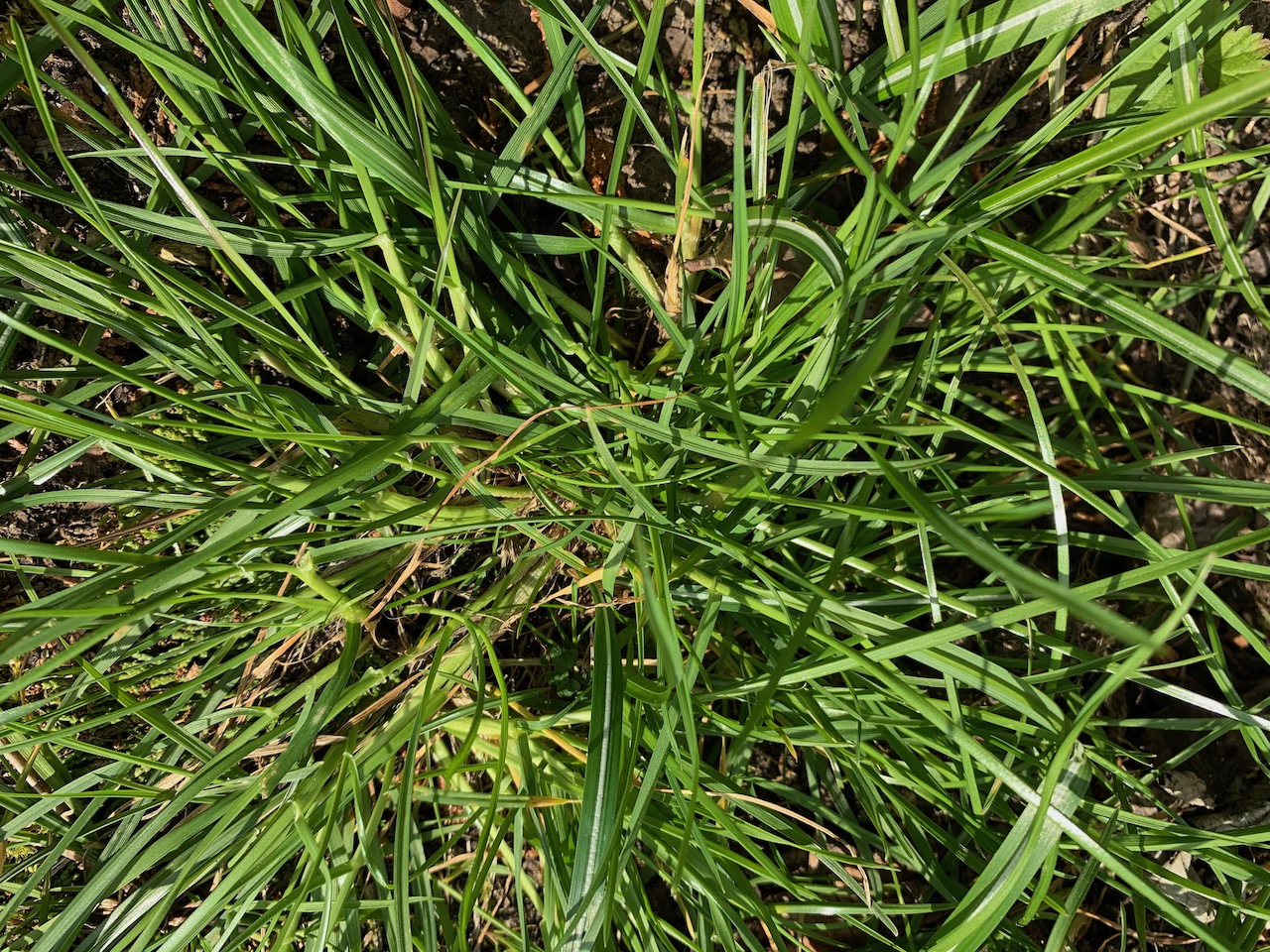
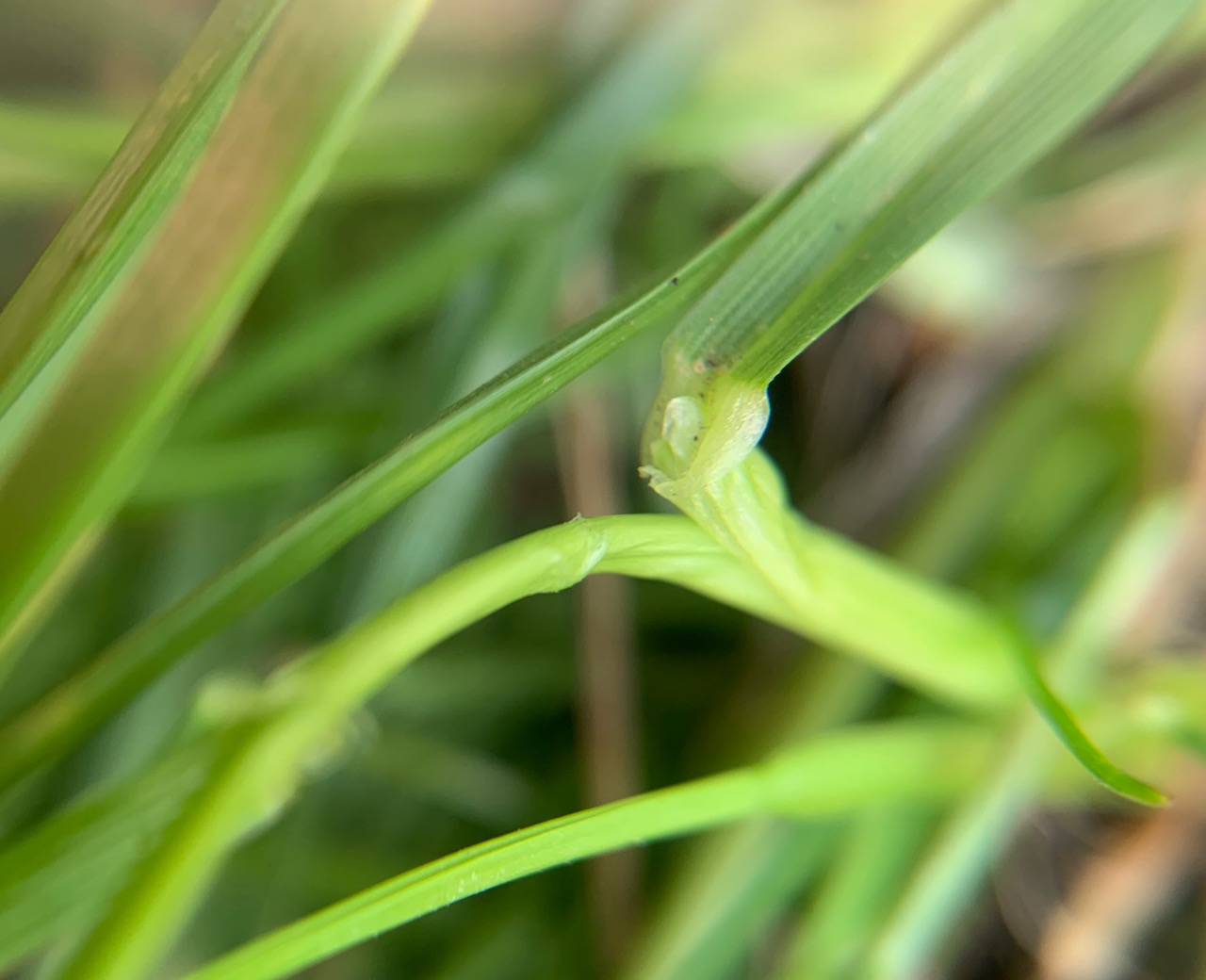
To tell individual grasses from grass you need to get familiar with their structure: roots, rhizomes or stolons, sheath and blade, nodes, culm, the inflorescence and its spikelets, awned and unawned, the number of florets and, within each floret, the glumes, anthers, stigma, lemma, and palea. Then, importantly, there’s the ligule, where the blade meets the sheath, which can be long and pointed, short and blunt, a ring of hairs, and sometimes has auricles.
It’s difficult but not impossible. And, fortunately, I have an eye for detail and am quick to pick up on the general feeling, often called the ‘jizz’ of another being.
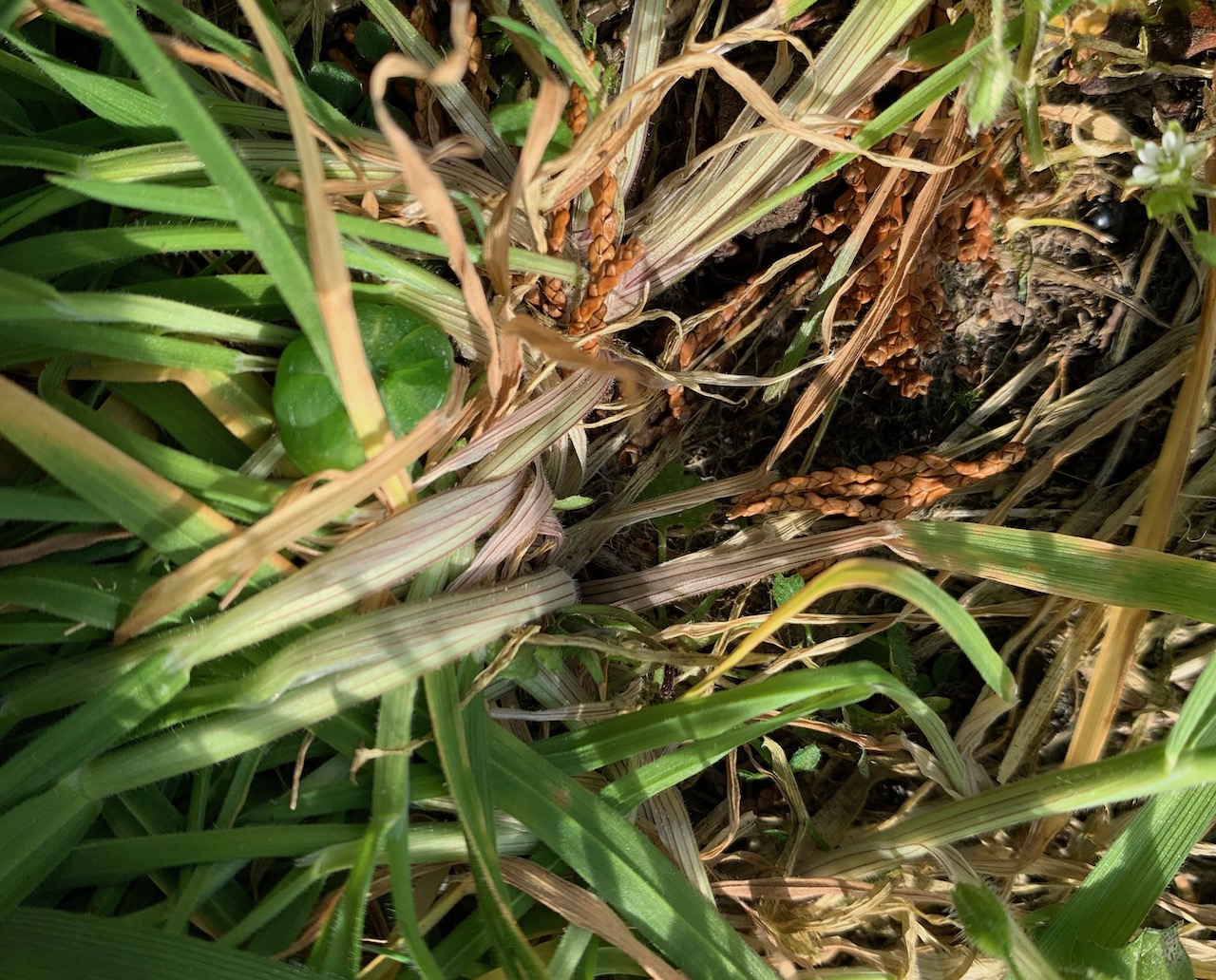
As I’ve learnt the names and distinguishing features of the different grasses: Yorkshire fog (Holcus lanatus) with its ‘striped pyjamas’ at the base of the stems, common couch (Elymus repens) with its spikelets broadside like fairy couches, perennial rye grass (Lolium perenne) with its silvery underside, cock’s foot (Dactylus glomerata) named for the shape of its inflorescences and a huge plant with flat stems growing in tussocks, contrasting with the fine wiry leaves of the delicate red fescue (Fesca rubra) and the unforgettable creeping soft grass (Holcus mollis) with its ‘hairy knees’ I have come to see them as individuals and not as the antagonistic homogenous mass I called grass.
I have a long way to go until I know grasses but, at least, I’m taking the first steps.
So, to You, finally I turn, still not knowing truly who You are,
remembering how, twenty years ago, my philosophy tutor criticised me for prioritising the sublime over the beautiful.
Yes- the sublime is Him – the power within and beyond the land, in Annwn, in the cold mountains, the ice of the Ice Age, all that threatens to tear the body, the mind, the soul apart, yet, like Rilke’s angels, disdains entirely to destroy us.
And yes – the beautiful is You – the power who arrives after the winter, after the Ice Age, You who brought the flowering plants after your mother brought the mosses many aeons ago.
After being torn apart You are the one who heals after the awe, after the awful, after near-death, the out-breath of the Awen – Life.
I have always avoided the beautiful, drawn instead to the darkness where beauty cannot be seen because it is too painful.
That’s why You come veiled to Your suitors in Your white dress, why only He can undress You, fully understands you…
To them You are always riding away on Your white winged horse.
In their longing they do not see the gifts of the flowers You leave in your steps, Your beauty unveiled in every hoof print.
They long only to tame You, yoke You, at the mounting block.
I shall not be like them, seeking to master You, possess You, instead I shall come with reverence for Your veil, Your veiled ones, with a patience for every flower, not forcing them to reveal their secrets.
I, who have served Death, will learn to put Life beside Him as a Goddess.
It was a long, long time ago when I was criticised for prioritising the sublime over the beautiful. It has always stuck with me. I avoided our modern conception of beauty because it is so confused, so tainted, by the glossy photographs we see in magazines.
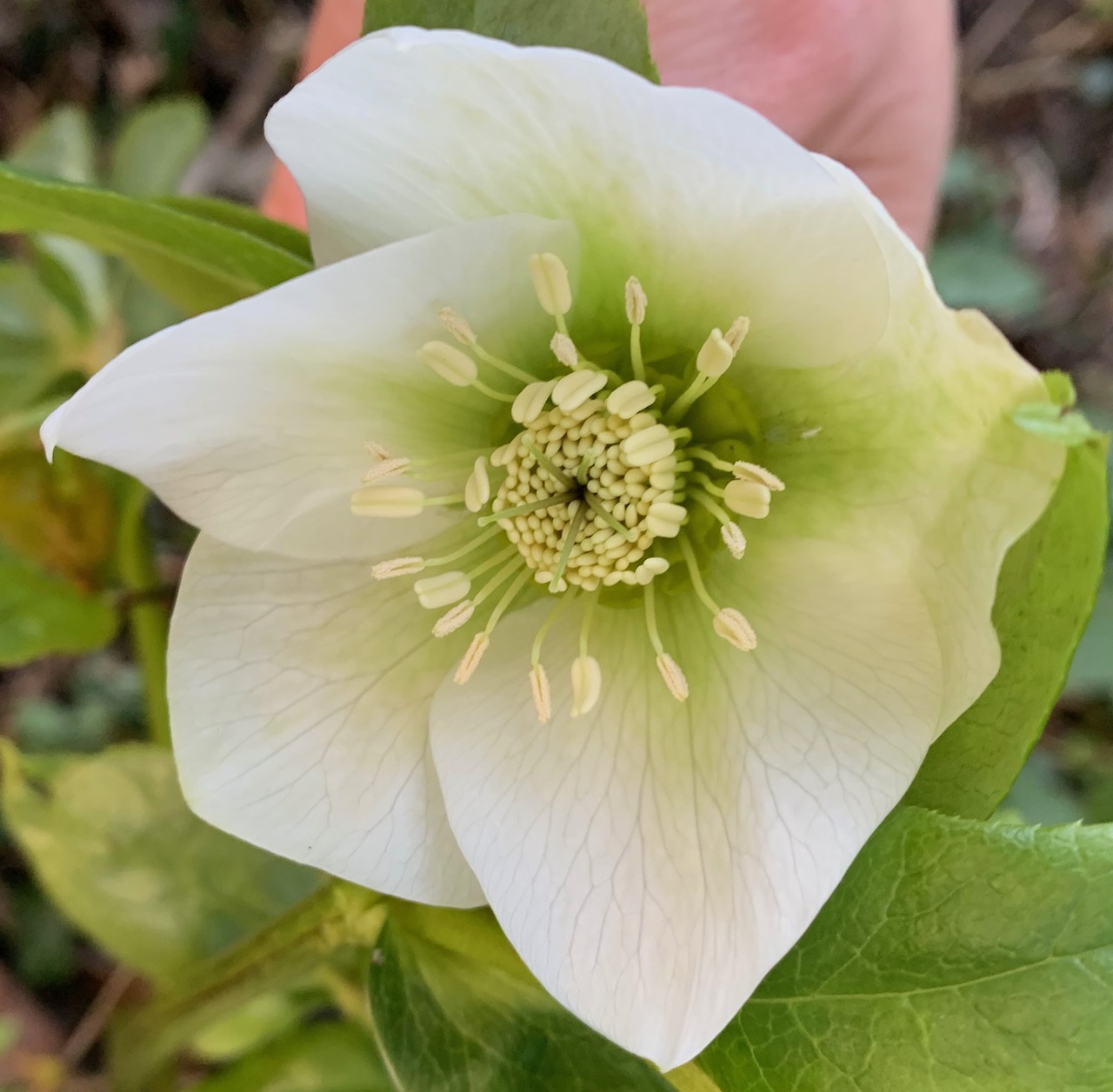
In the Welsh myths Creiddylad is described as ‘the most magnanimous maiden in the Islands of Britain’. She is generous, forgiving, She is the sister of Gwyn ap Nudd, King of Annwn, and His beloved. He is Otherness, She is Hereness, She is Presence, She is what we might call mindfulness today amongst the flowers.
I spent seven years with Him and now I am called to walk with Her in my new role as an ecologist.
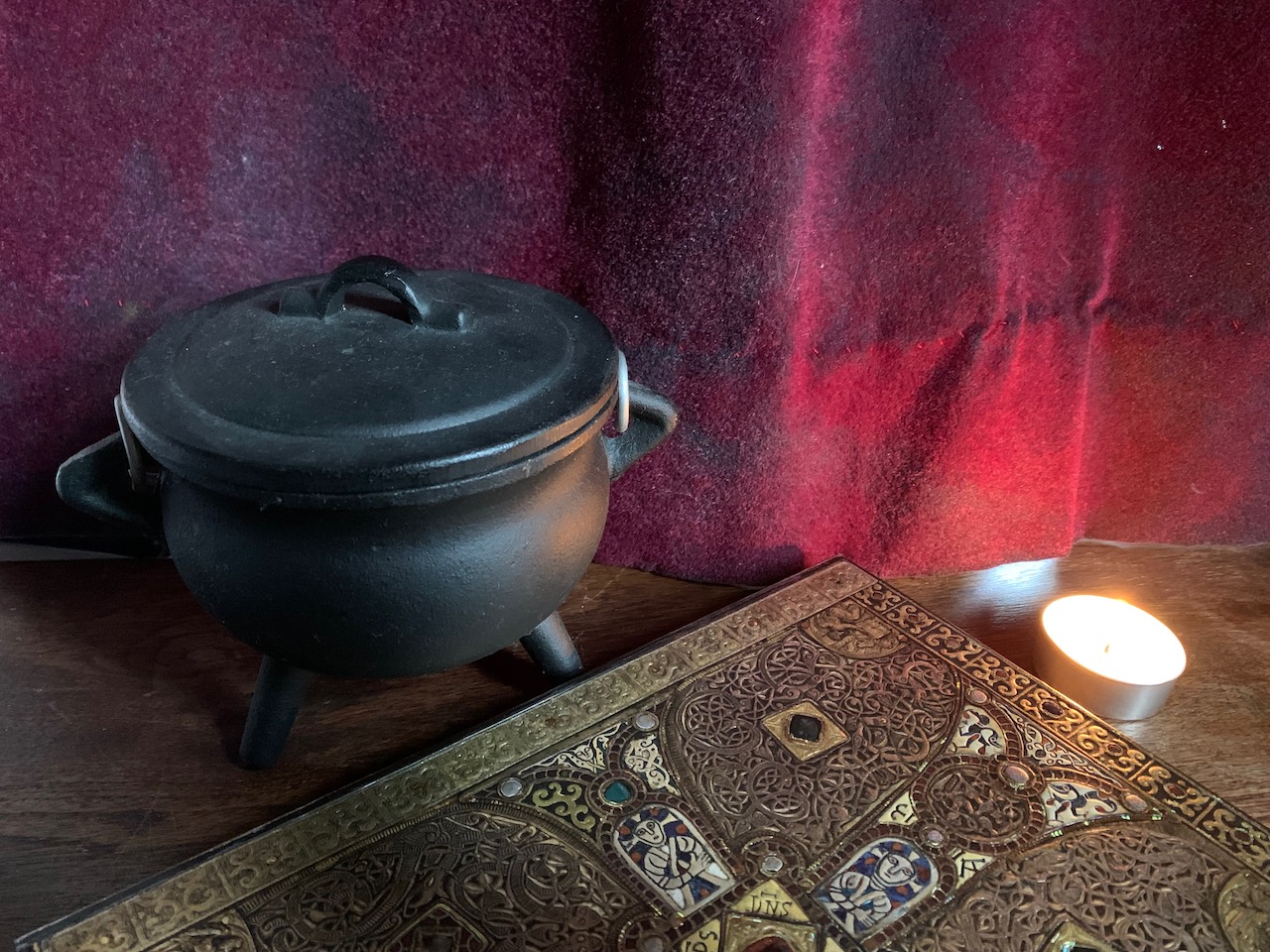
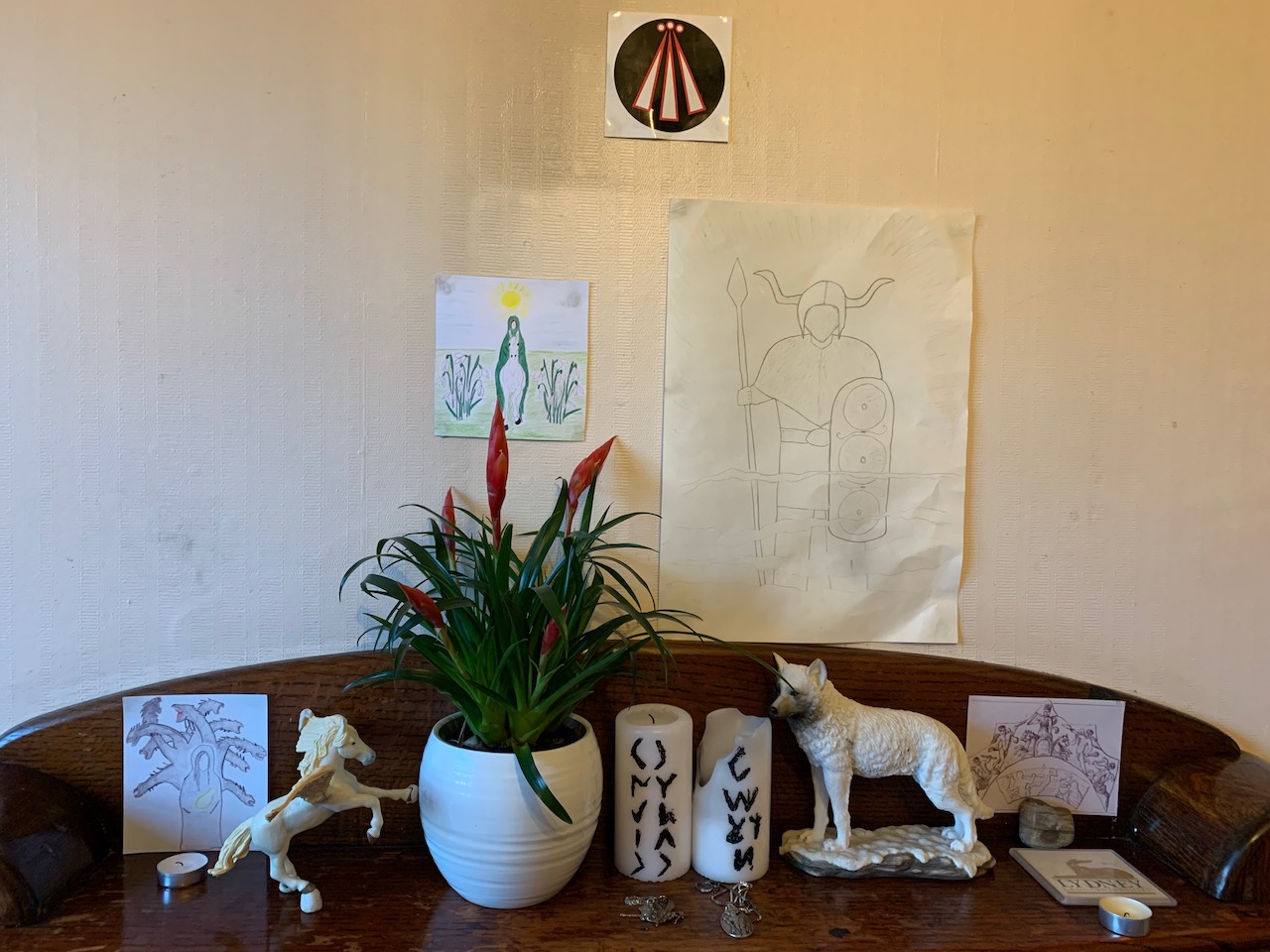
My rearrangement of my altar reflects these changes as I give Gwyn and Creiddylad equal space. The plant is, oddly, a Bromeliad, from the tropical Americas, which I sensed She liked when I did our weekly food shopping at Morrisons. It represents the fact that neither plants nor gods know any boundaries.
I. ‘Ecology’ from the Greek oikos and logos seems to suggest there is a logic to our home.
And ‘home’ from ham (like in Penwortham), from the German heim, from the Norse heimr ‘abode, world, land,’ is so much more than a haus.
Hiraeth is the Welsh word for the longing for a home.
II. Do the Welsh gods want this English awenydd to untangle the threads, to follow this longing back to when she started asking questions about her home:
“Why did only one group of snowdrops from the hundred bulbs we planted in Greencroft Valley ever come up?”
“Why did the bluebells take so many years to appear?”
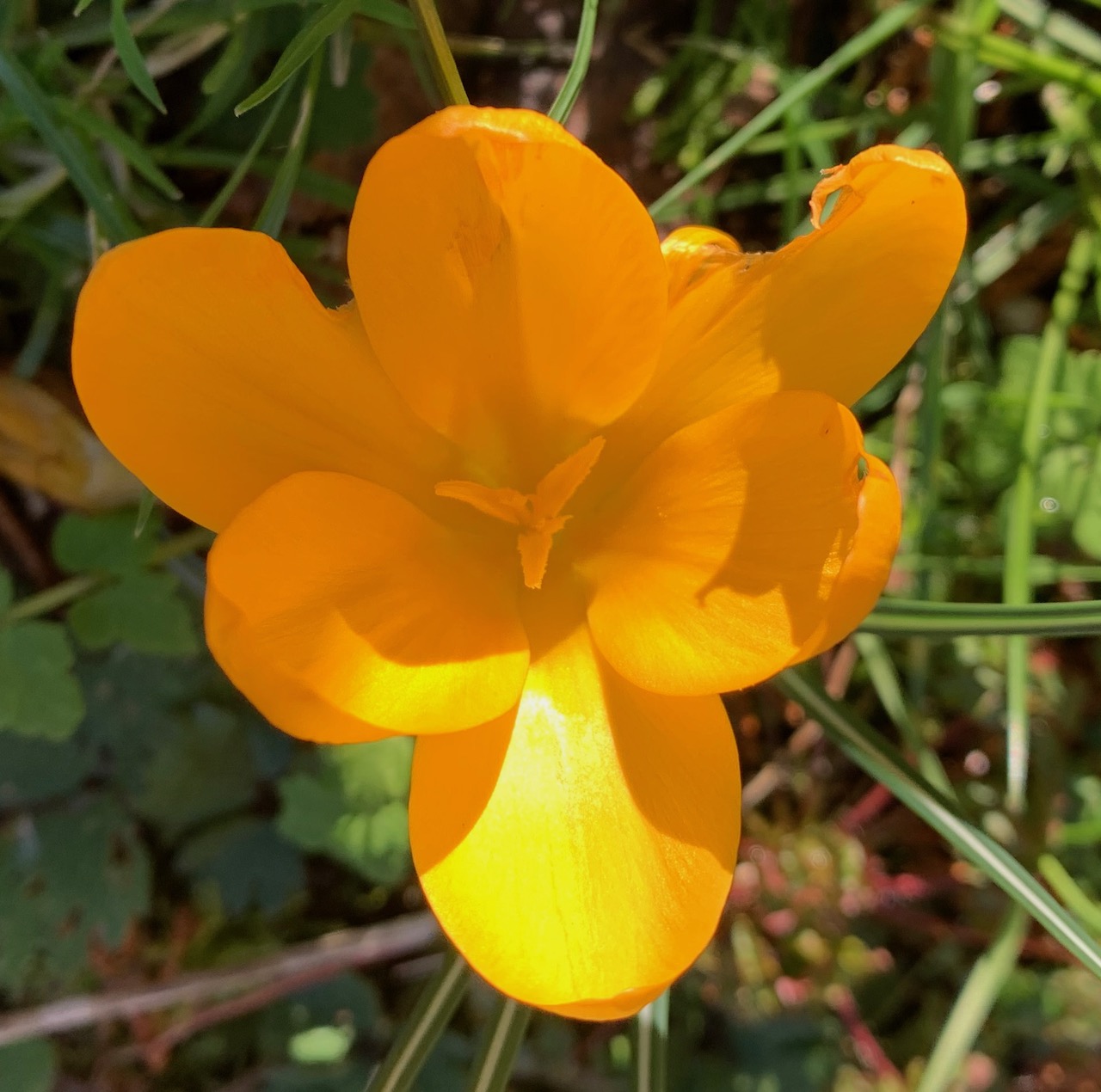
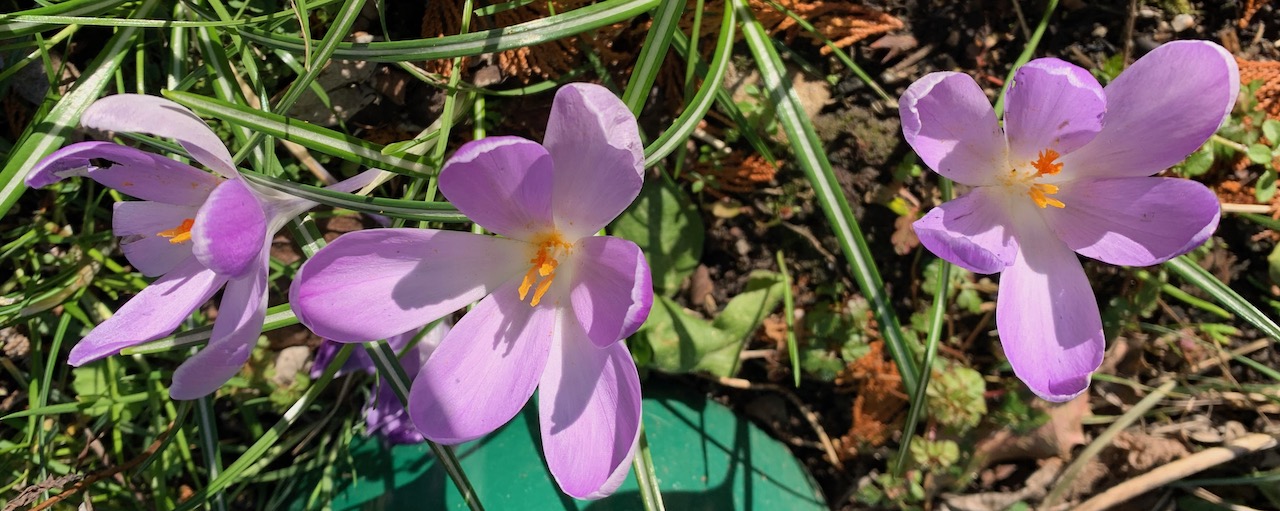
“How do the crocuses spread around the garden?”
“Why do the starlings disappear come back greedier?”
“Why did the mouse come in May and make a nest of my feathers?”
“What is it with spiders and September?”
III. Do we ask science to explain because we are no longer able to talk to the creatures because we have forgotten their language?
Because we have forgotten how to speak and share our home?
Did we know the answers to these questions long ago when we were more at home rather than longing?
Is it the ecologist’s task to call us home
with all the words in her repertoire – Anglo-Saxon, Brythonic, Latin, Greek?
IV. In the Norse myths Heimdallr guards against the threats to the home such as invaders, Ragnarok, the end of the world.
One blast on his horn will blow a warning.
Is it the ecologist’s task to be a horn-blower?
To sound the alarm and call us back?
*This poem is a series of reflections on my transition from working many miles away restoring the Manchester Mosslands to my new job as a Graduate Ecologist much closer to home. I am seeing it as a form of homecoming.
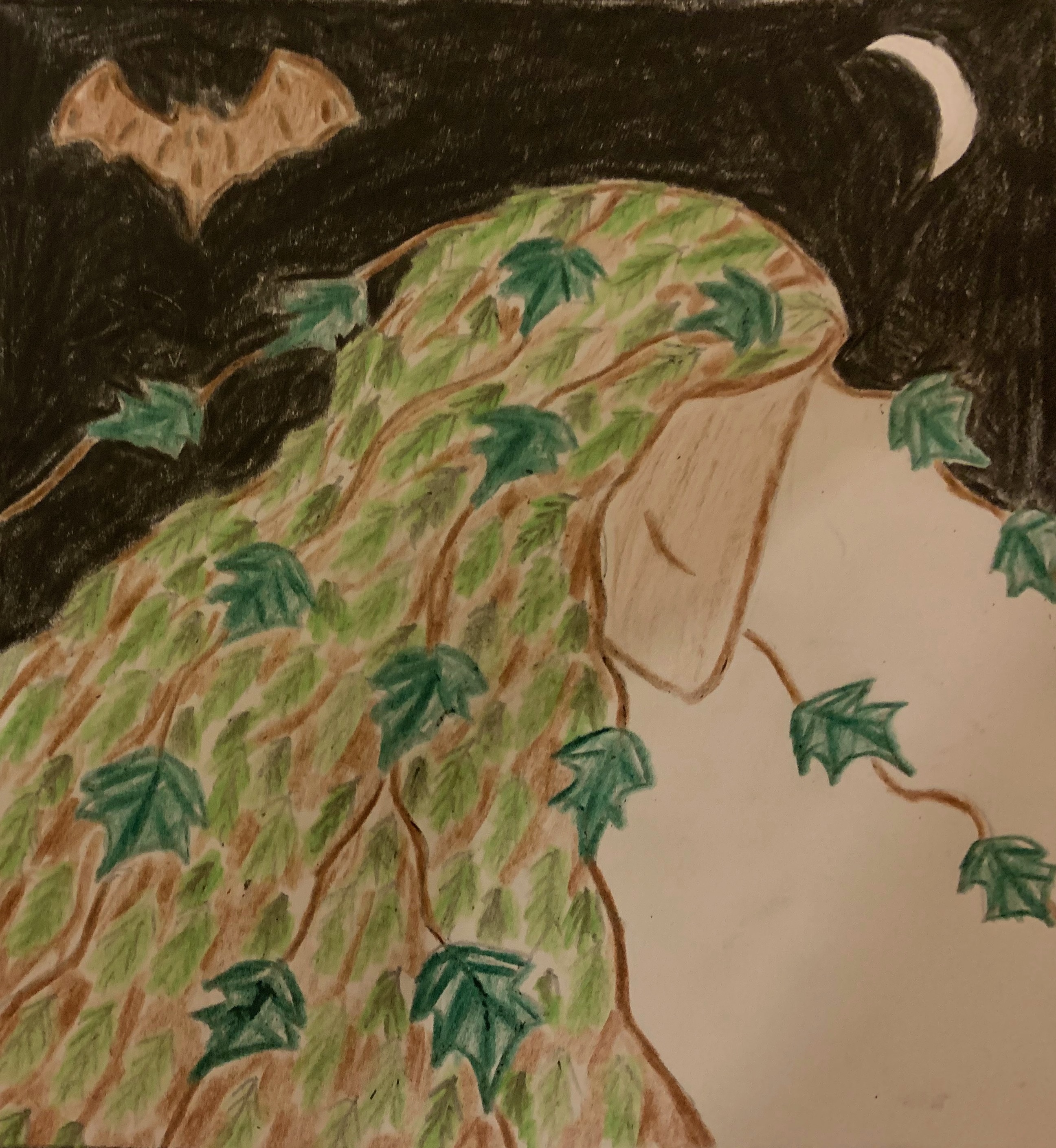
I shall follow the threads of her hair – her hair is verdant.
I shall follow the bats to her lair – my Lady Verdant.
I shall follow the ancient pathways to Peneverdant.
I shall meet her there ivies in my hair – my Lady Verdant.
*A poem and image for Anrhuna, the goddess who I believe to be the mother of my patron god, Gwyn ap Nudd, appearing in her localised form as the Lady of Peneverdant.
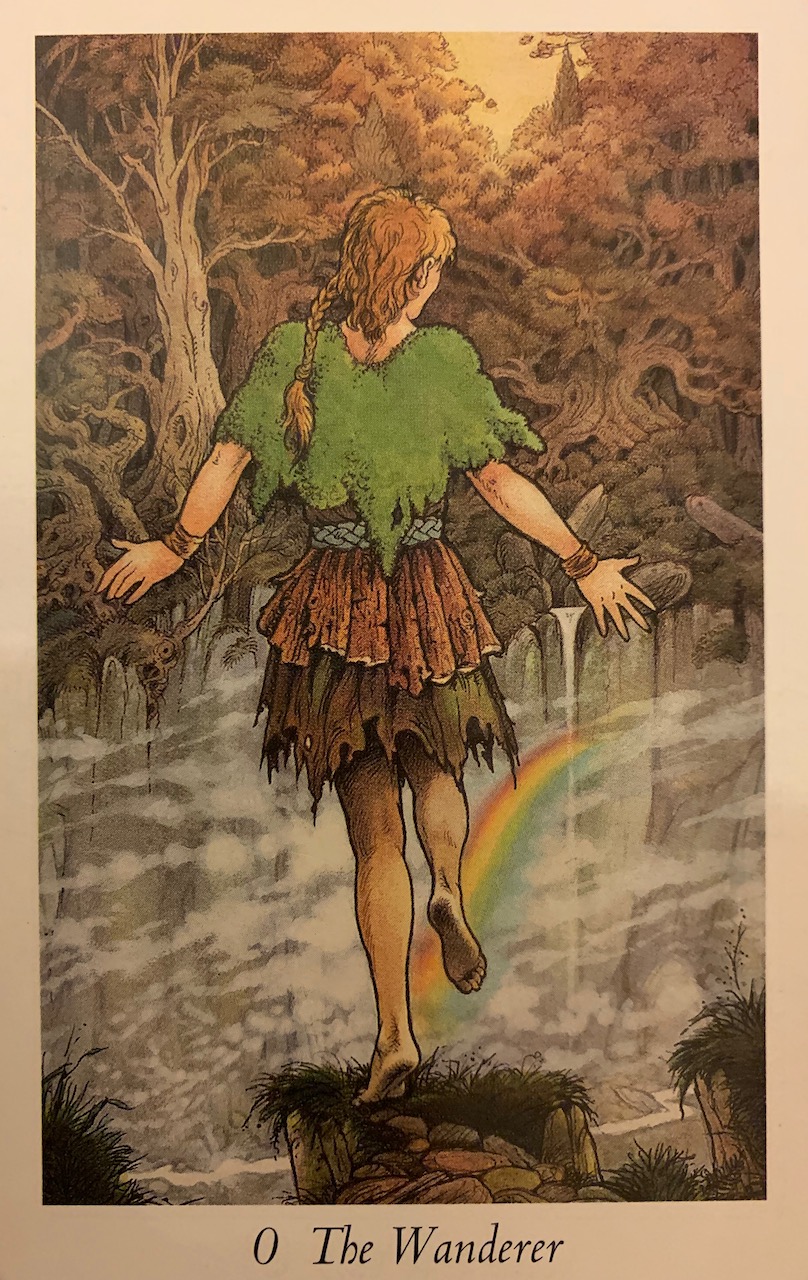
‘A Rainbow Bridge that rises and greets your foot… will carry you over the void as you step, trusting and empowered, into the unknown…’ – 0 The Wanderer, The Wildwood Tarot
I stand with one foot on Astley Moss,
rising onto tiptoe, the other raised, flexed, heel up, toe down,
like the hoof of a winged horse.
I still know little about where I came from and less about where I am going.
There is little comfort or security in the shifting mists below, haunted by the ghosts,
the bog bodies, the severed heads, the voice of Worsley Man.
They are all telling me, compelling me to move on, unlike restless spirits.
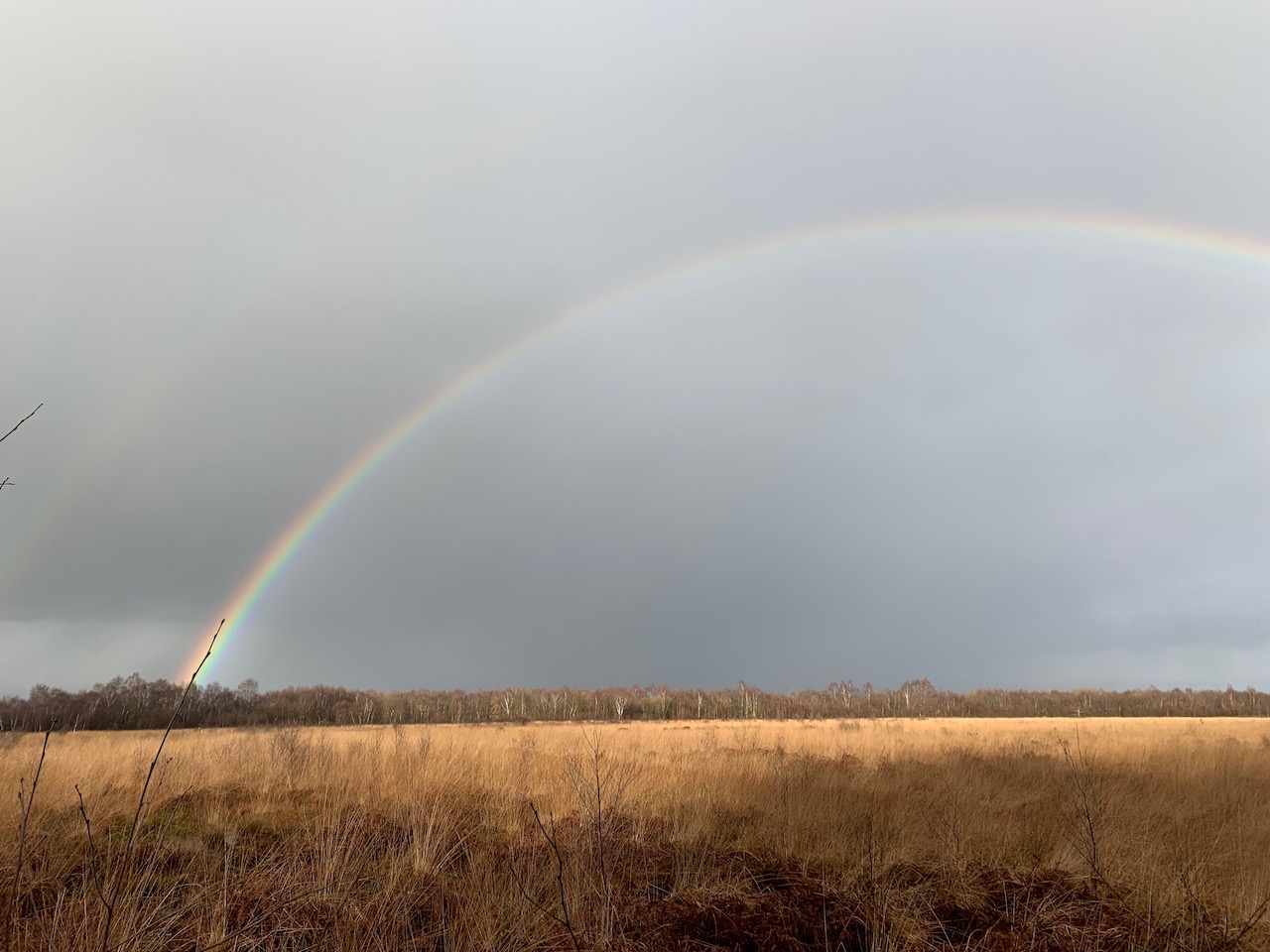
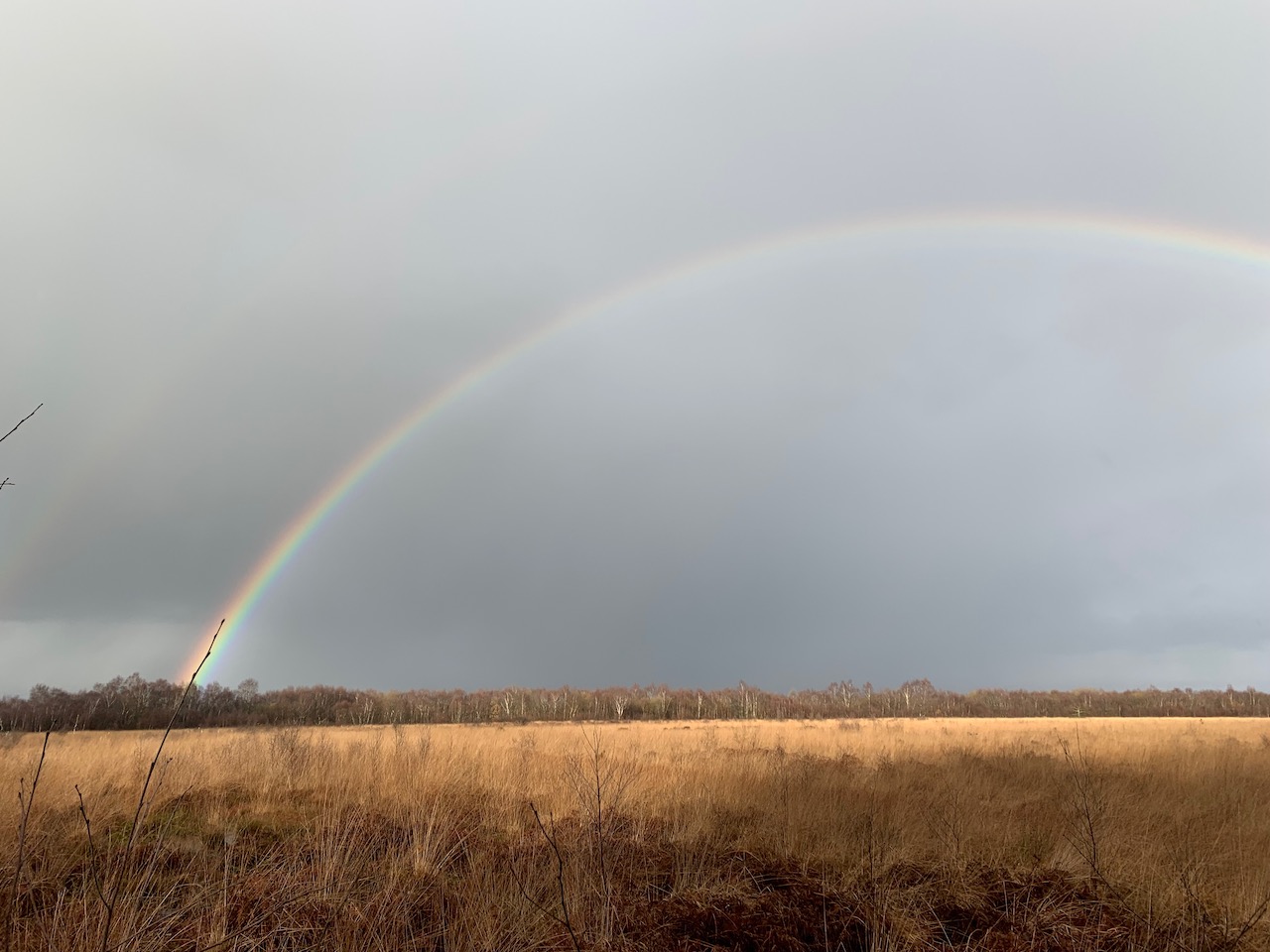
I am reminiscing about the day I drove into the end of the rainbow on the M6, throwing up splashes of rain like fairy gold.
‘Do Not Look Back.’
I hear His arcane commandment.
My wings are spread and deep within I know it is time to move on.
In November 2019 I gave up my supermarket job and started volunteering with the Lancashire Wildlife Trust with the aim of progressing to a career in conservation. This led to a voluntary conservation internship at Brockholes Nature Reserve and then to paid work as a Greater Manchester Wetlands Trainee.
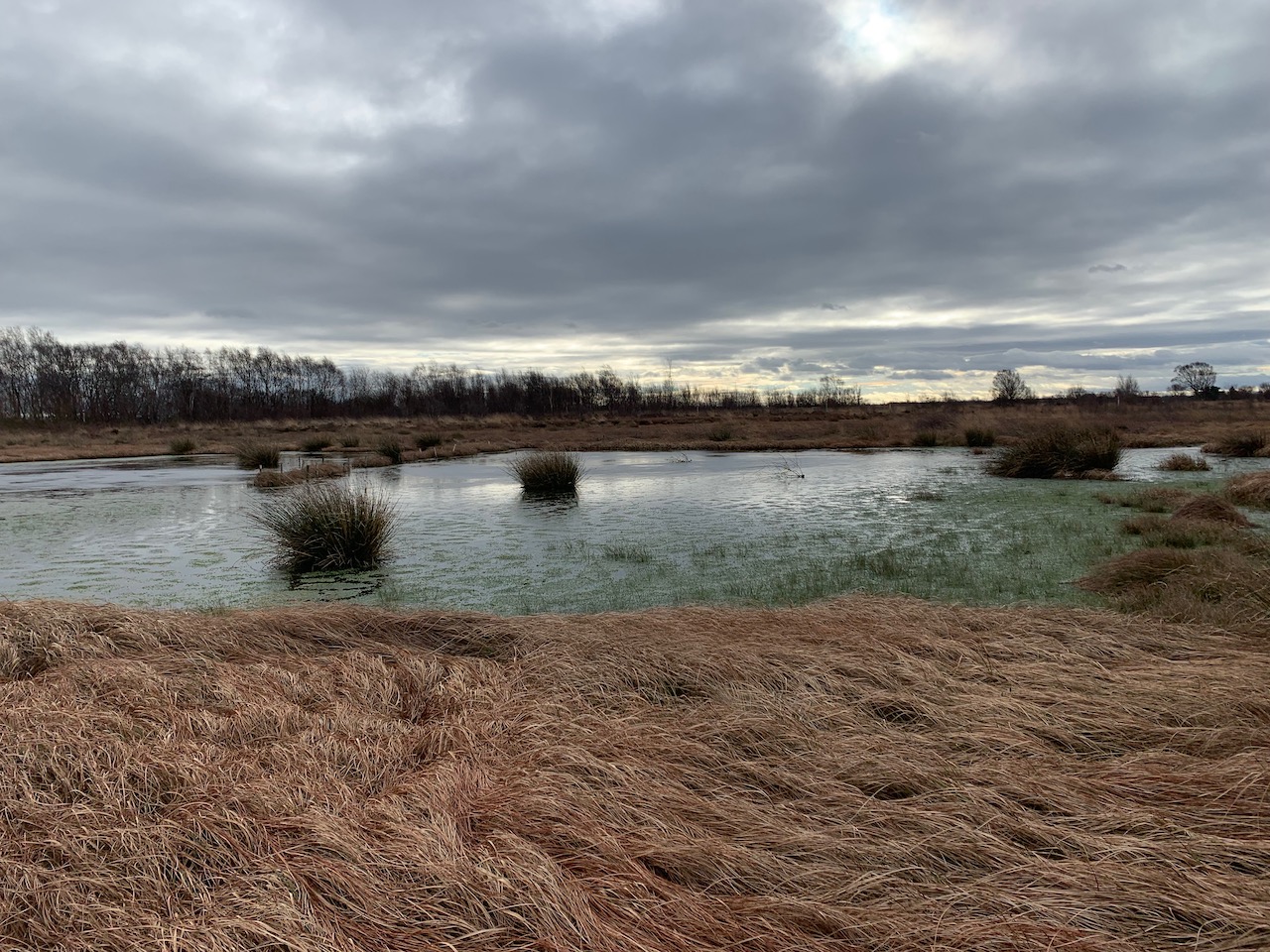
I was based on the Manchester Mosslands, which include the last remnants of Chat Moss – Little Woolden Moss, Cadishead Moss, Astley Moss, and Rindle Moss, and a couple of others such as Highfield Moss and Red Moss.
The long drive, up to a 70 mile round trip, an hour each way, longer in heavy traffic, came as a shock to the system after cycling to my local nature reserves.
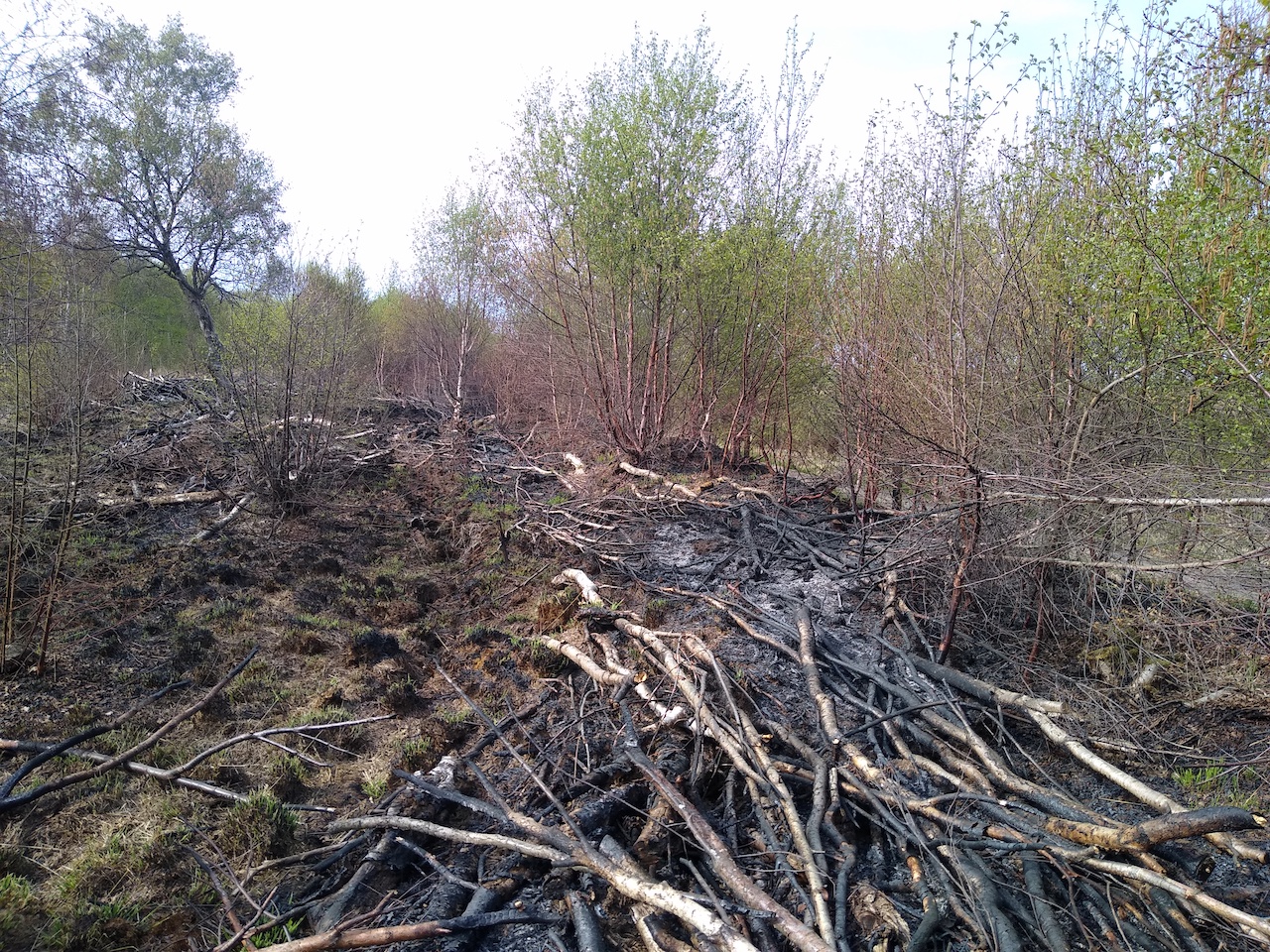
Over the course of my year-long contract I have faced many challenges, learnt new skills, and had some valuable and transformational experiences. On my first day I was introduced to a piece of fire damaged wet heath and set the task of delivering its restoration and, following training in vegetation surveys, monitoring its progress.
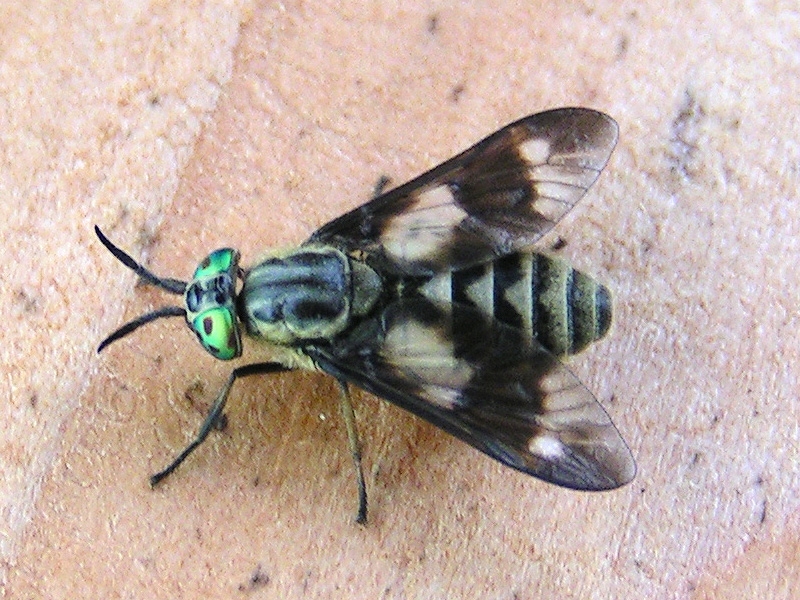
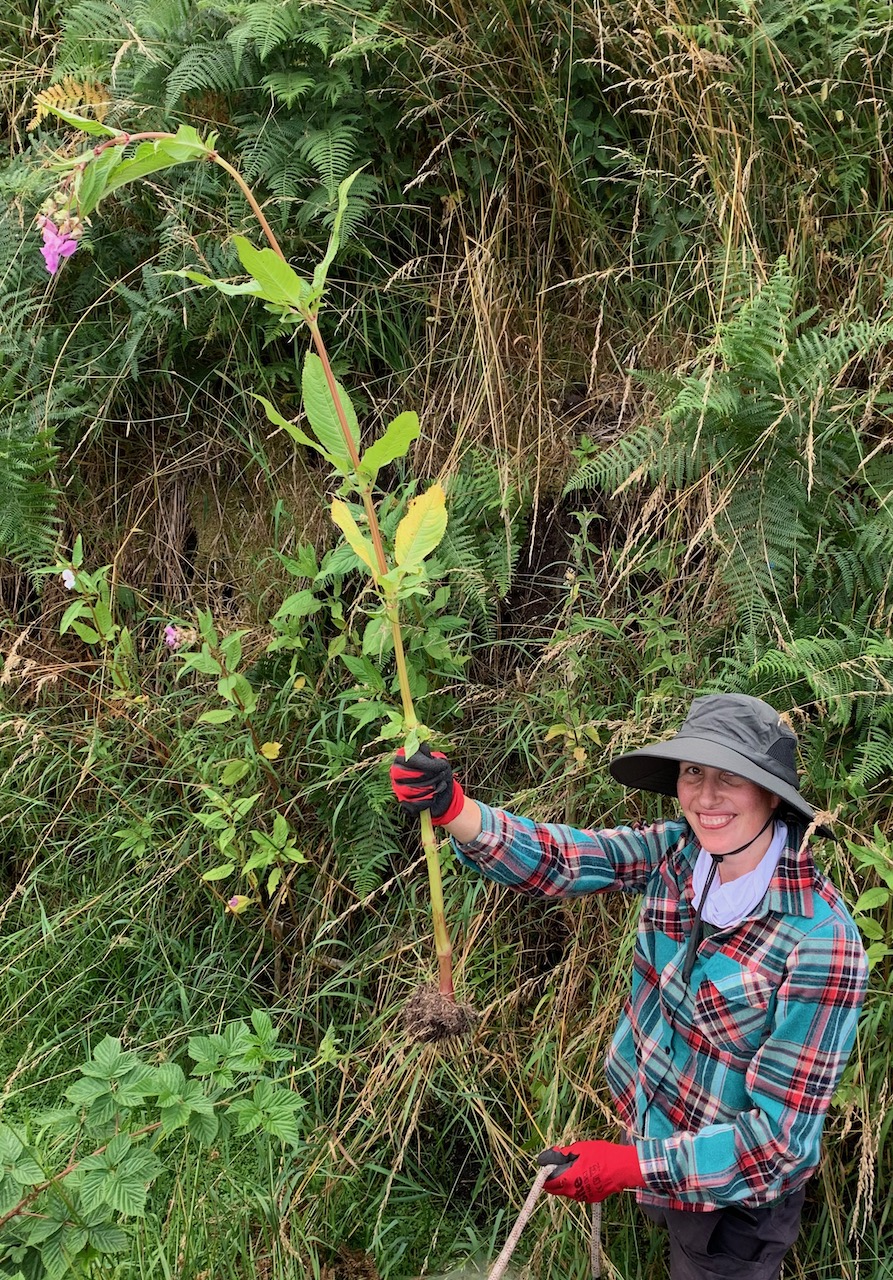
I progressed from helping with volunteer work parties to leading them. Over a long, hot summer we pulled bracken, bashed Himalayan Balsam, and fixed fences. Making the beginner’s mistake of going out in shorts and t-shirt, I had a run in not only with midges, mosquitoes, and horseflies, but the particularly nasty and disarmingly pretty twin-lobed deerfly. This led to itching for days and blisters on my legs I got popped at the doctors. Since then, following advice, I have worn a horse-fly proof shirt and trousers.
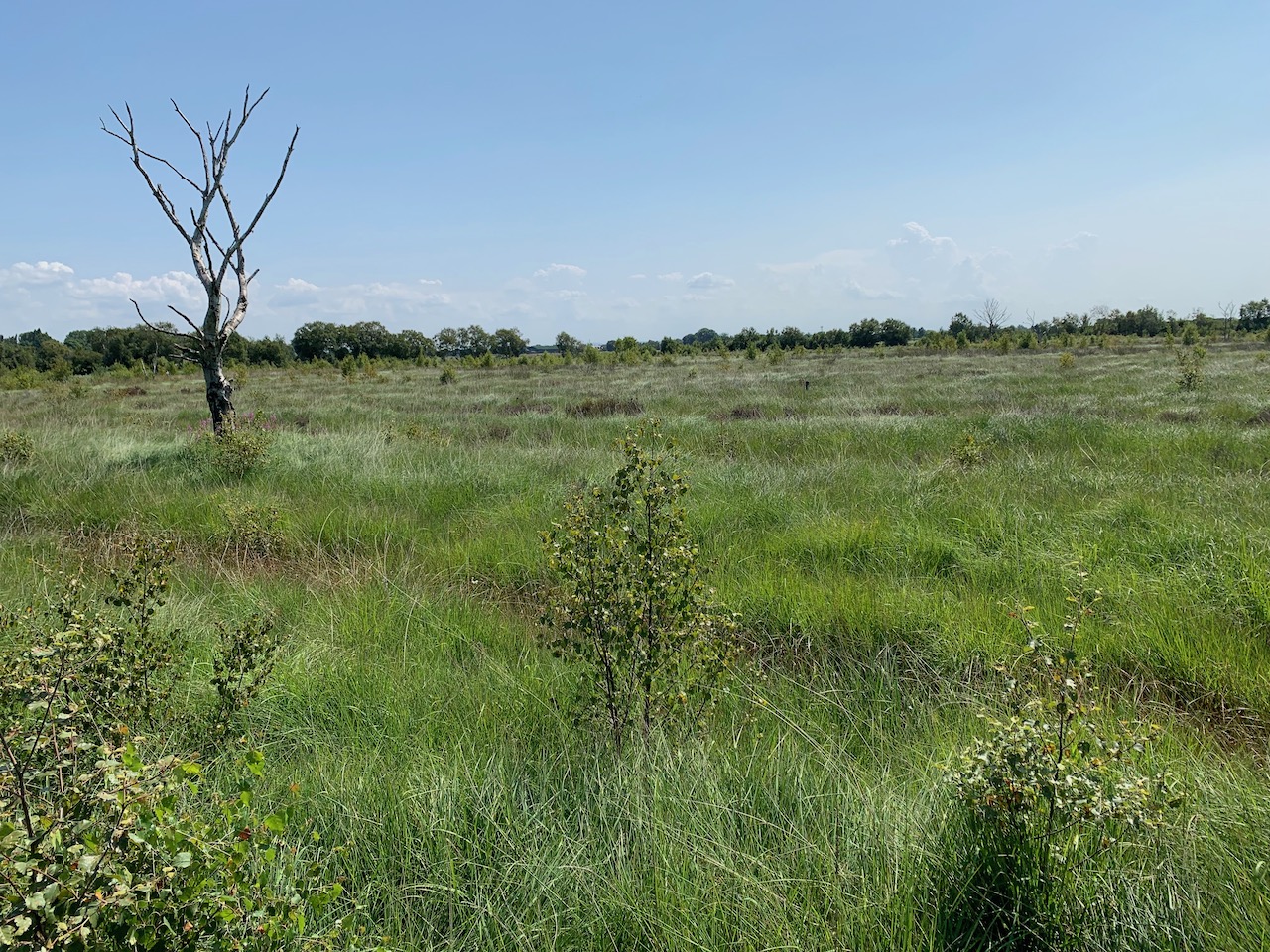
One of my toughest challenges was carrying out a site assessment for Cadishead Moss and updating the management plan. Through this I started getting my head around the JNCC and NVC habitat classifications. I was delighted to find that, since the original management plan was written in 2011, this area of degraded lowland raised bog was showing signs of recovering following the scrub clearance, bunding, and revegetating work.
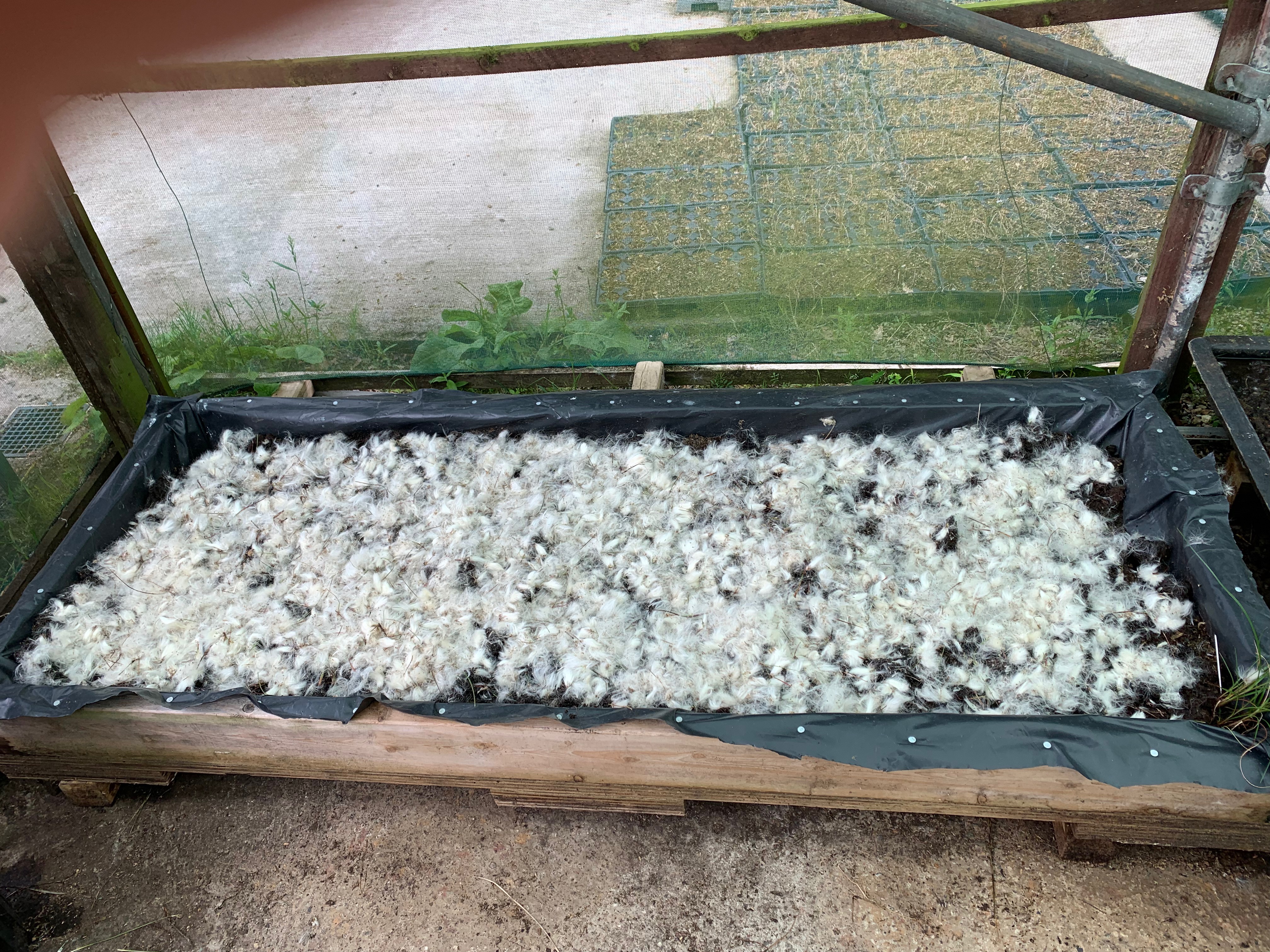
Having enjoyed planting peatland plants I learnt to grow them at Prince’s Park Garden Centre. This involved harvesting cottongrass seed sustainably from the mosslands and sowing it.
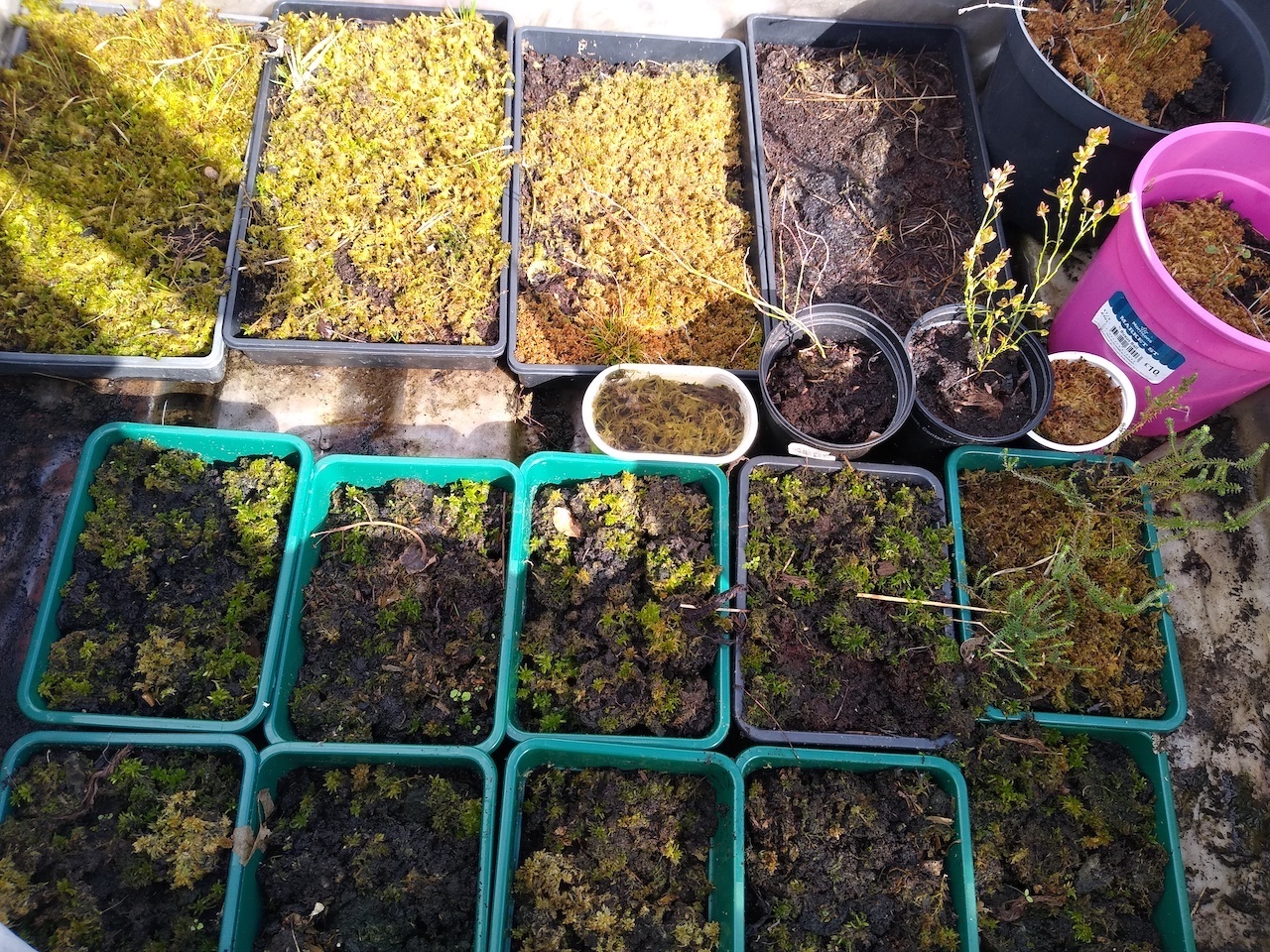
I took cuttings from and propagated heather, cross-leaved heath, and other specialist bog plants, and collected Sphagnum to create bog-in-a-boxes. This resulted in an introductory booklet on peatland plants. I also led an AQA in Peatland Conservation and Horticulture for adults with learning disabilities. It was fulfilling to see them progress and see their expressions when they got to the mosslands to plant what they had grown.
I was allowed to pursue a personal interest by researching the prehistoric archaeology of Chat Moss, producing articles, and giving an online talk. I wrote and recorded a series of poems called ‘Ghost Wolf Rises’ for a poetry trail in New Moss Wood and had the opportunity to perform at the Deep Peat event.
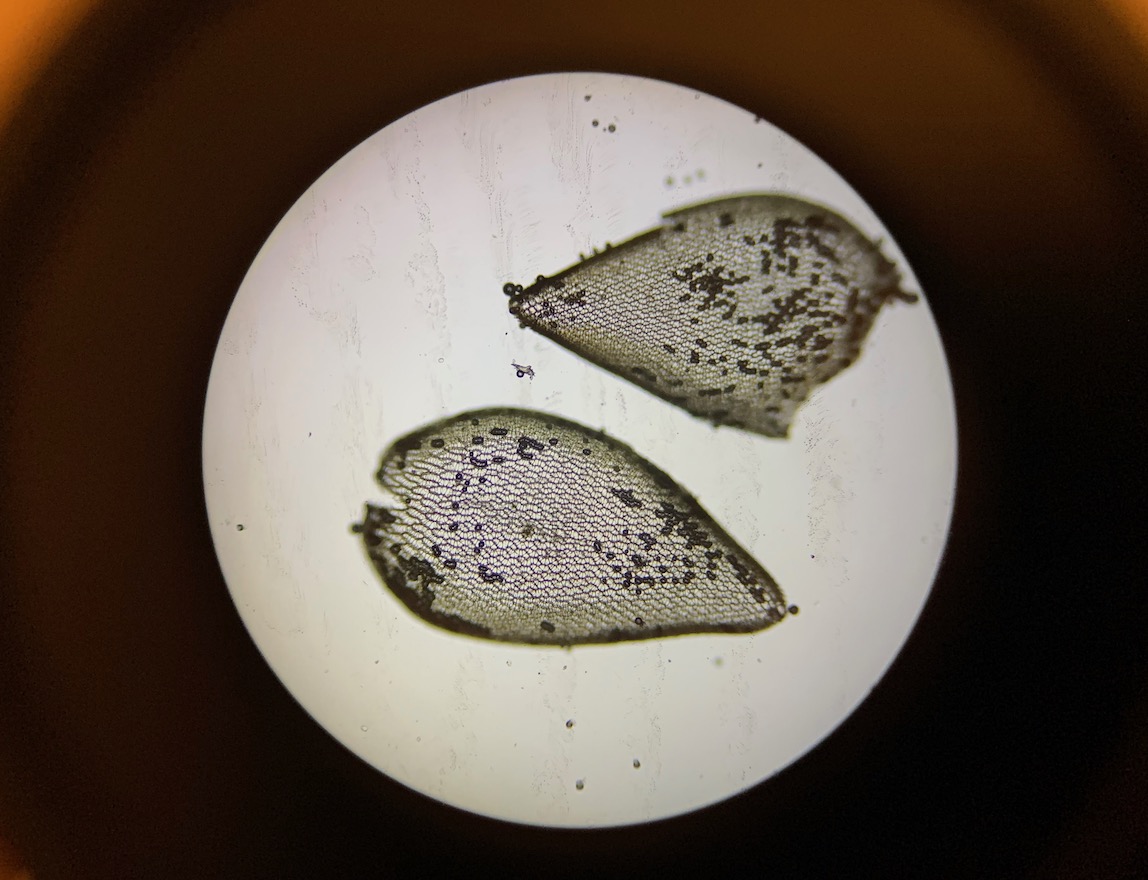
A personal highlight has been learning to identify Sphagnum mosses with Anna Keightley, a volunteer with the Sphagnum Squad and a post-doctoral research associate at Manchester Metropolitan University. Following this I shared my knowledge through running training sessions for volunteers.
The aspect of the role I struggled with the most was project management. When I was asked to plan and deliver some contract planting I enjoyed making the maps (once I’d got to grips with QGIS*) but struggled with the delivery due to my insecurities about managing people, uncertainties around contractor availability, and delays with plant deliveries.
At this point I noticed that, on the mosslands, due to the landscape scale nature of the work, there is a lot more project management than on other nature reserves. I noticed my colleagues taking on increasing amounts and realised this may not be the path for me.
Ascertaining I was autistic half way through also led to a confidence crisis. How, aged forty, as someone with a life-long neuro-developmental difference, could I hope to compete with young, neurotypical people in such a competitive job industry?
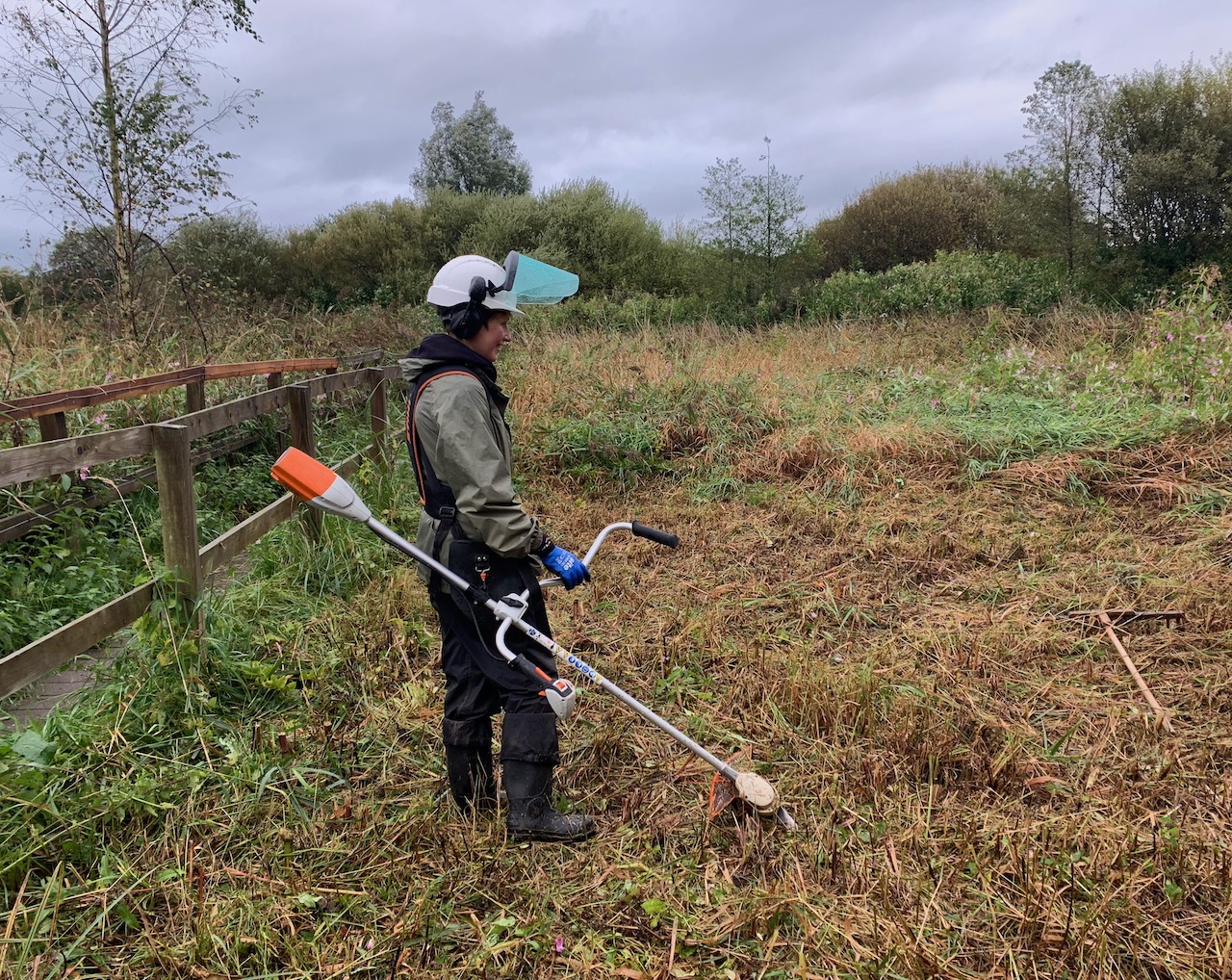
However, in spite of my fears about my abilities to use machinery as an autistic person, I gained my LANTRA qualifications in using a brushcutter, a clearing saw and pesticides.
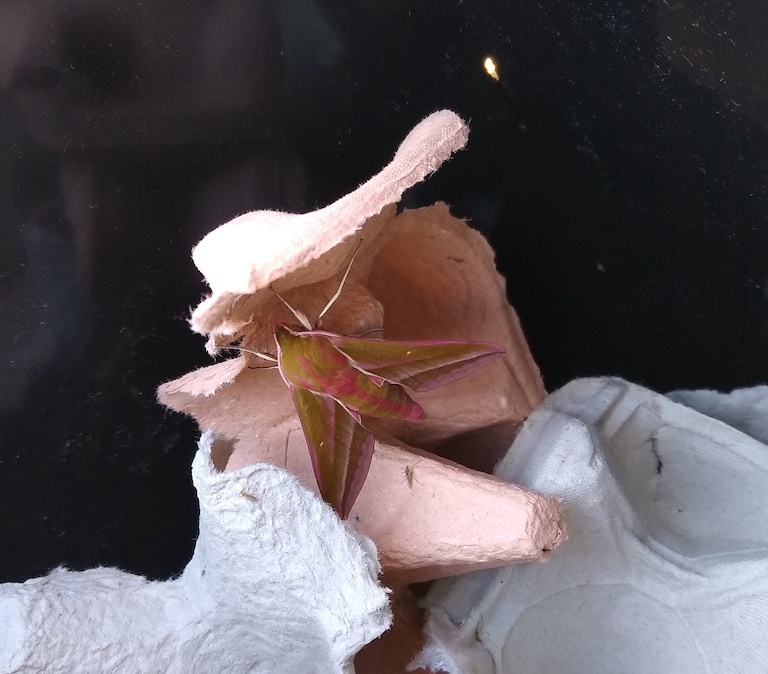
Over the course of my traineeship I took an increasing interest in surveying and monitoring. I surveyed for moths, butterflies, and bog bush crickets (who we also tried to catch for a reintroduction project – not easy!). I attended a spider identification workshop with Richard Burkmar at Rixton Clay Pits and began working with him to set up spider surveys on Little Woolden Moss and worked on our survey methodologies.
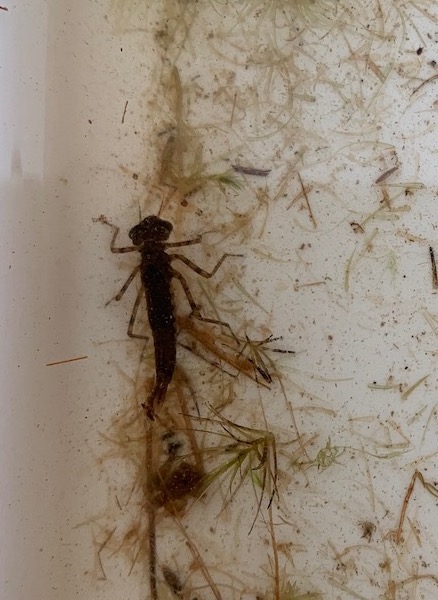
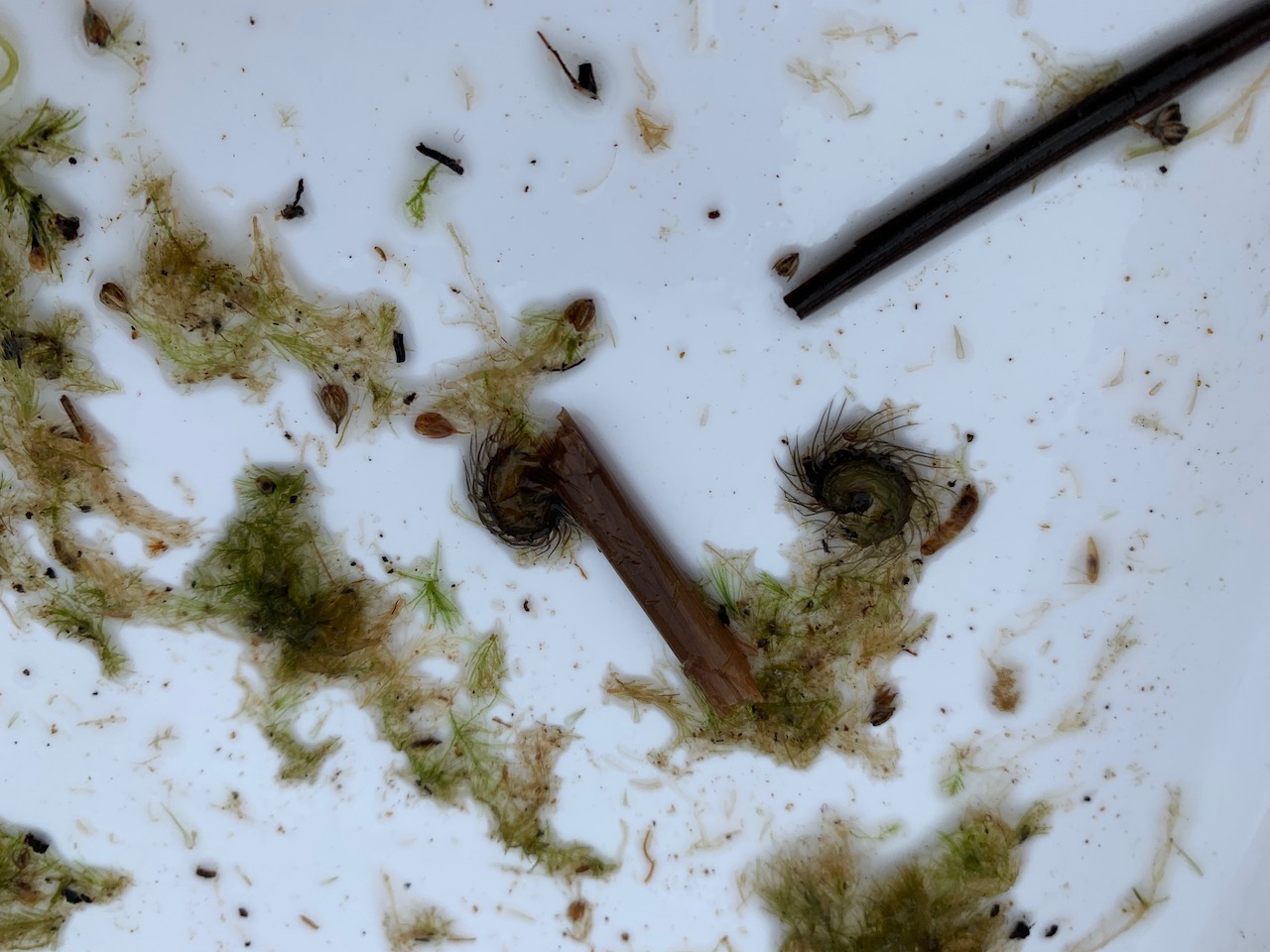
I gained experience of setting up Eyes on the Bog and carried out habitat assessments for the feasibility of reintroducing the White-faced Darter dragonfly. For the latter we surveyed for aquatic invertebrates and, as well as dragonfly nymphs, water boatmen, and others we discovered what might be larvae of the rare cranefly Phalocrocera replicata.
At this time, when I realised no jobs were going to come up on the mosslands before the end of my traineeship, I began applying elsewhere. I applied for a seasonal nursery worker job, a job as a neighbourhood operative on local parks, and sent my CV to a few local ecological consultancies in the hope that they might have seasonal survey work.
To my surprise two consultancies got back to me soon afterwards. One, Ecology Services in Longton, just three miles cycling distance from my home, swiftly arranged an interview, then, two days later, offered me not only seasonal work but a full-time permanent position as a Graduate Ecologist on a generous wage.
So, I am destined to be an ecologist. This isn’t something I predicted at the outset of my traineeship, but it became a possibility as my passion for surveying and learning about various species and the ways they interact with their habitats developed.
It fits with my interest in botany and bryology and spiritual calling as an awenydd to deepen my relationship with the natural world by learning the names of the plants and creatures, their distinguishing features, visible and microscopic, the processes by which they interact with their environment, the poetry of small things.
I am also considering complementing my new job by pursuing a part-time MSc in Biological Recording and Ecological Monitoring at Manchester Metropolitan University. This provides a grounding in research methods and opportunities to specialise in areas such as mosses and invertebrates.
A period of upheaval and self-doubt has been followed by confirmation of my ability to gain a Graduate Ecologist position and that I’m a good fit for the MSc.
I’m currently in transition, working the last fortnight of my traineeship, before beginning my ecologist position on March the 3rd. I am grateful to my line manager, Jamie Lawson, the Peat Team, the volunteers, and all at Prince’s Park, for what I have learnt on the mosslands and am looking forward to moving on into my new role.
*This online geographic information system is notoriously difficult and counterintuitive and learning it has been a source of both pleasure and woe.
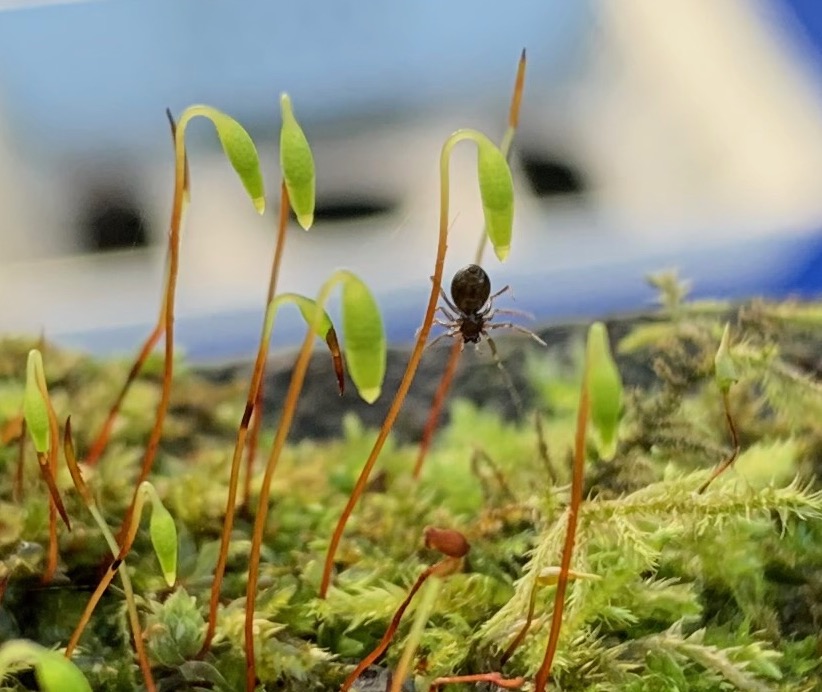
Yesterday I went for a New Year’s Eve walk with a friend around Longton Brickcroft Nature Reserve. The first thing I saw, on the gate on the way on in, was a small patch of moss with a tiny spider stringing a thread between the sporophytes. I think the moss is Creeping feather-moss (Amblystegium Serpens), but I’m not sure about the spider. The presence of palps shows its a male and I suspect it belongs to the Linyphiidae ‘Money Spiders’, likely one of the species impossible to identify without a microscope.
It felt like an omen of a mossy and spidery New Year.
If had to name two things that have claimed me this year over the course of my traineeship I would say they are Sphagnum mosses and spiders. I’ve said quite a bit about Sphagnum in previous posts so here I intend to make my main focus spiders.
The first thing I’d like to say about spiders is they’re always about, everywhere, in every habitat we can name, from woodlands to moorlands, to grasslands to mosslands, they’re in our gardens, houses, and cars. They can be found (or turn up unwanted) at any time of the year. They say you’re never less than six feet from a rat, well, in my experience, I’d say you’re far more likely to be less than six feet from a spider!
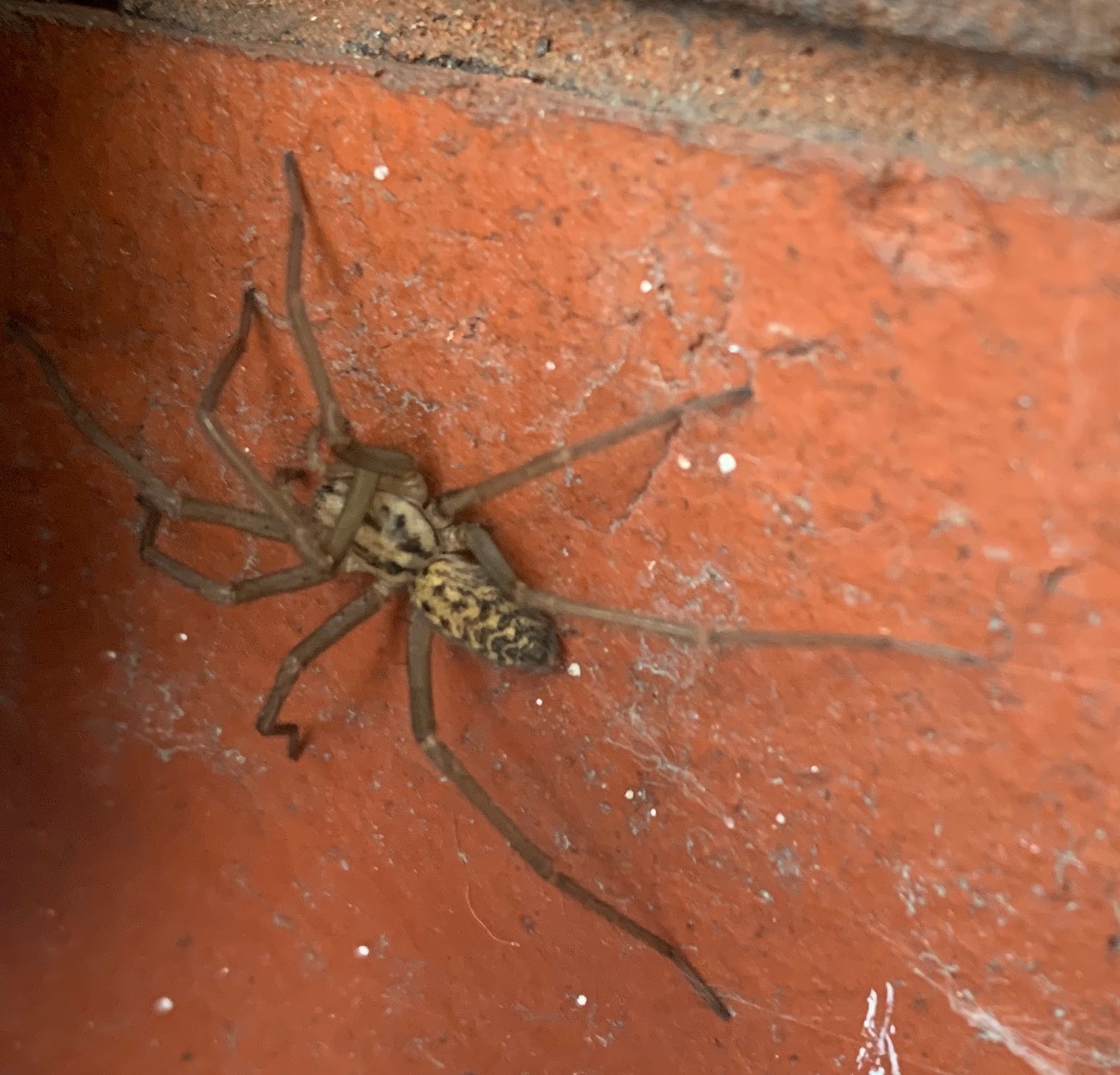
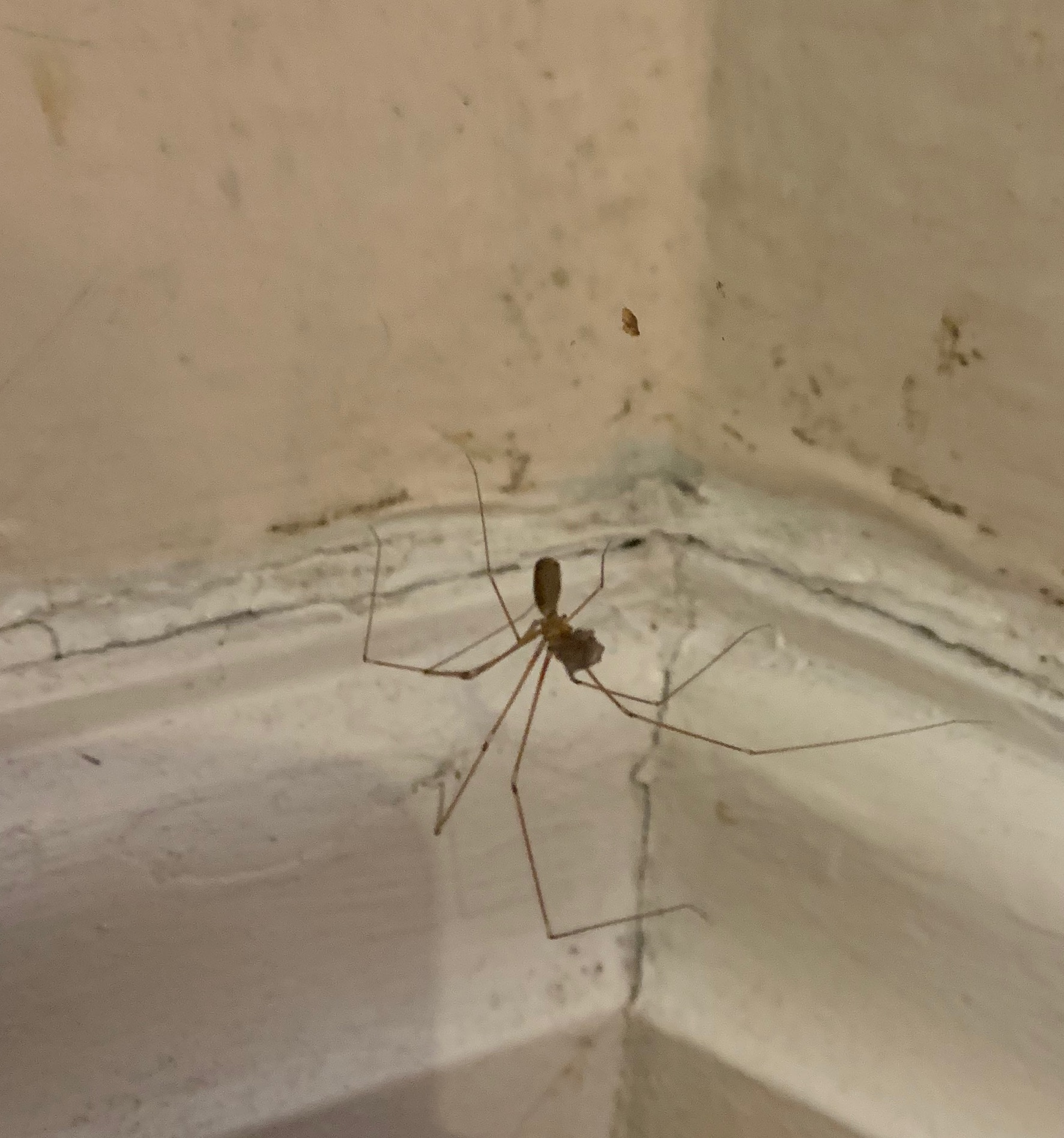
I used to be afraid of spiders. Like so many people particularly of the large-bodied, long-legged house spiders of the Tegeneria genus who would often scuttle across the fire place and occasionally get caught by the cats or would show up in the bath together with the gangly-legged daddy long-legs spiders (Pholcus phalangiodes).
I don’t know why I was afraid of spiders. On some level I think it’s instinctual, but it’s also societal. As a child if you see adults screaming and running away from spiders you learn they’re something to worry about. For me I think it’s the fear of something so strange, so alien, running onto me, coming up close, the shock. The interruption to my ‘safe space’. And also the fear of damaging these strange beings in ill-fated attempts to put them out, as I’ve done in the past, then the horror of putting them out of their misery. Unless I’m confident I can catch them without harming them I now tend to let them be.
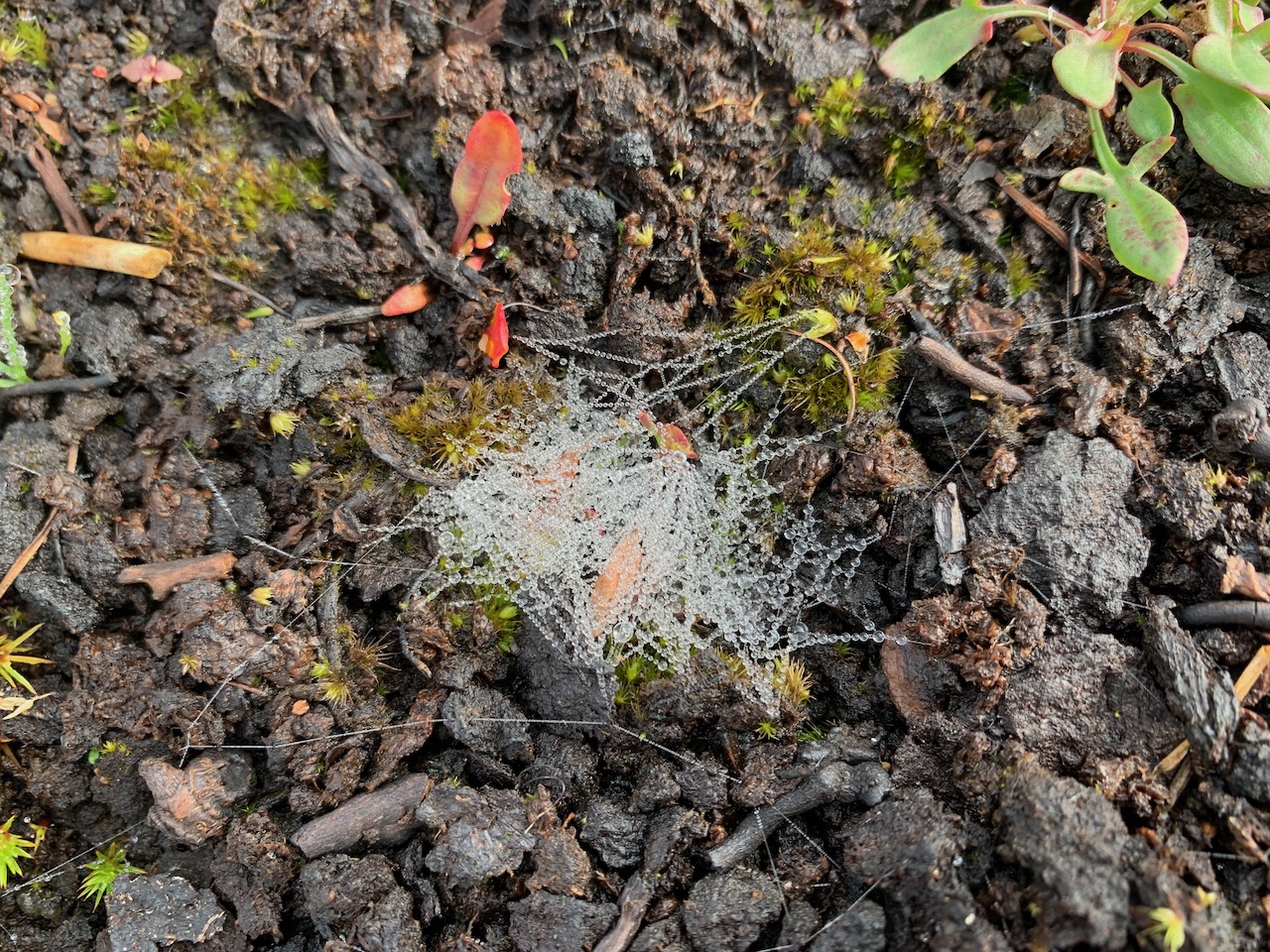
Recently fear has turned to fascination as I’ve started noticing them more and learning about them. This began in February when I was out planting with the Lancashire Wildlife Trust contract team on Little Woolden Moss. In areas of bare peat I frequently noticed strings and sometimes a lattice-work of spider-silk. On the last day the air was filled with threads and with tiny ballooning spiders. Like the carriers of a message.
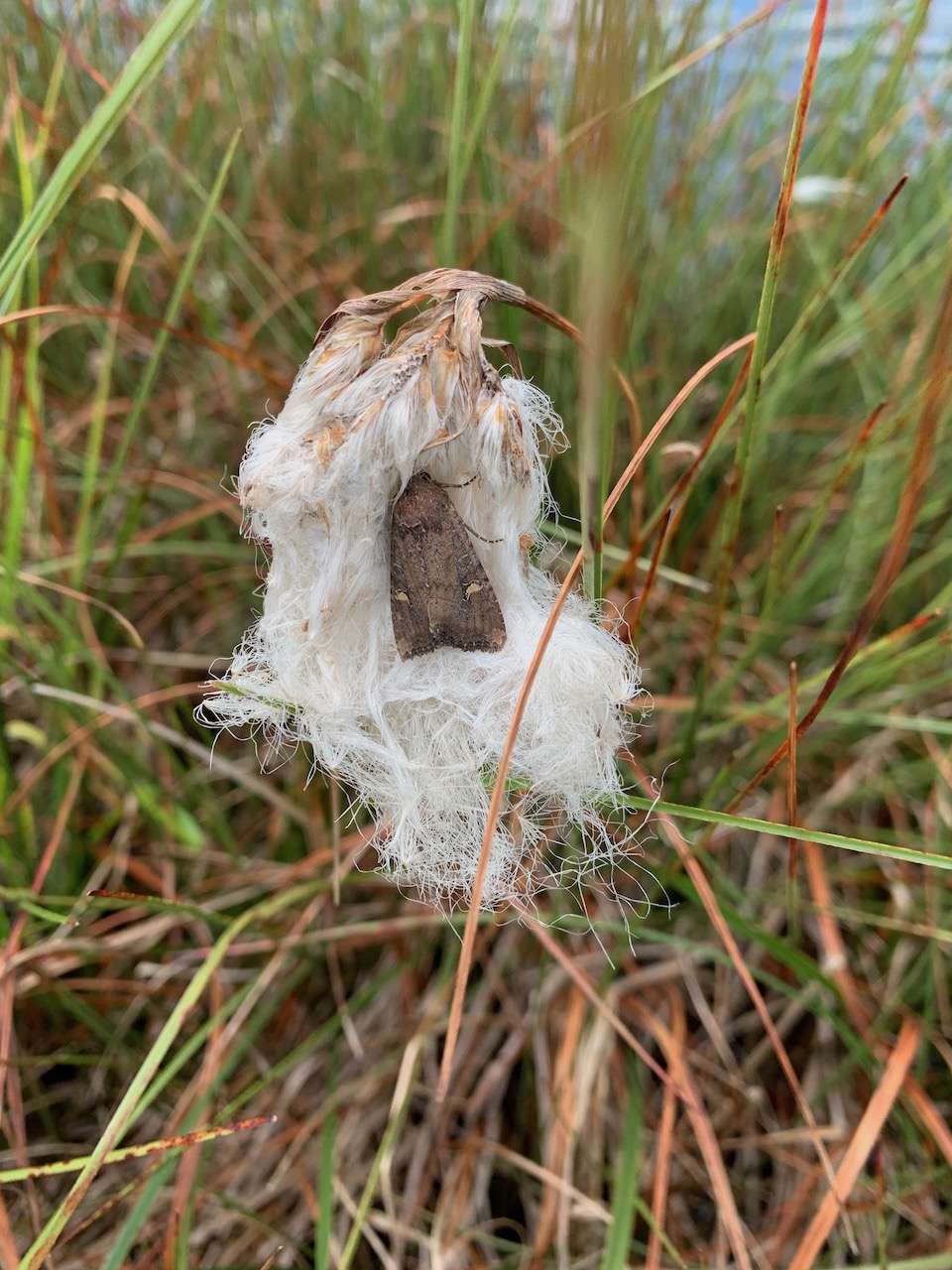
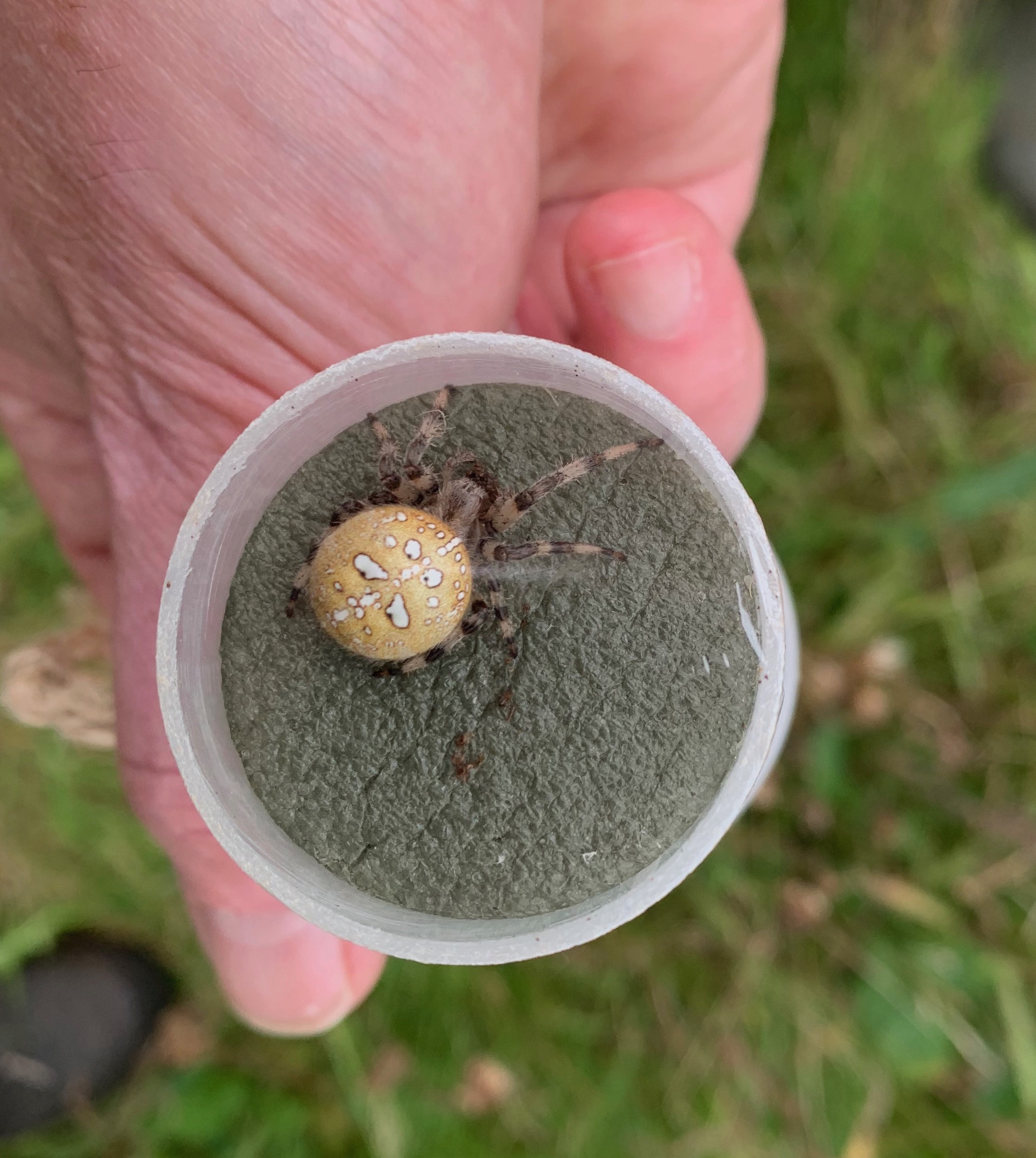
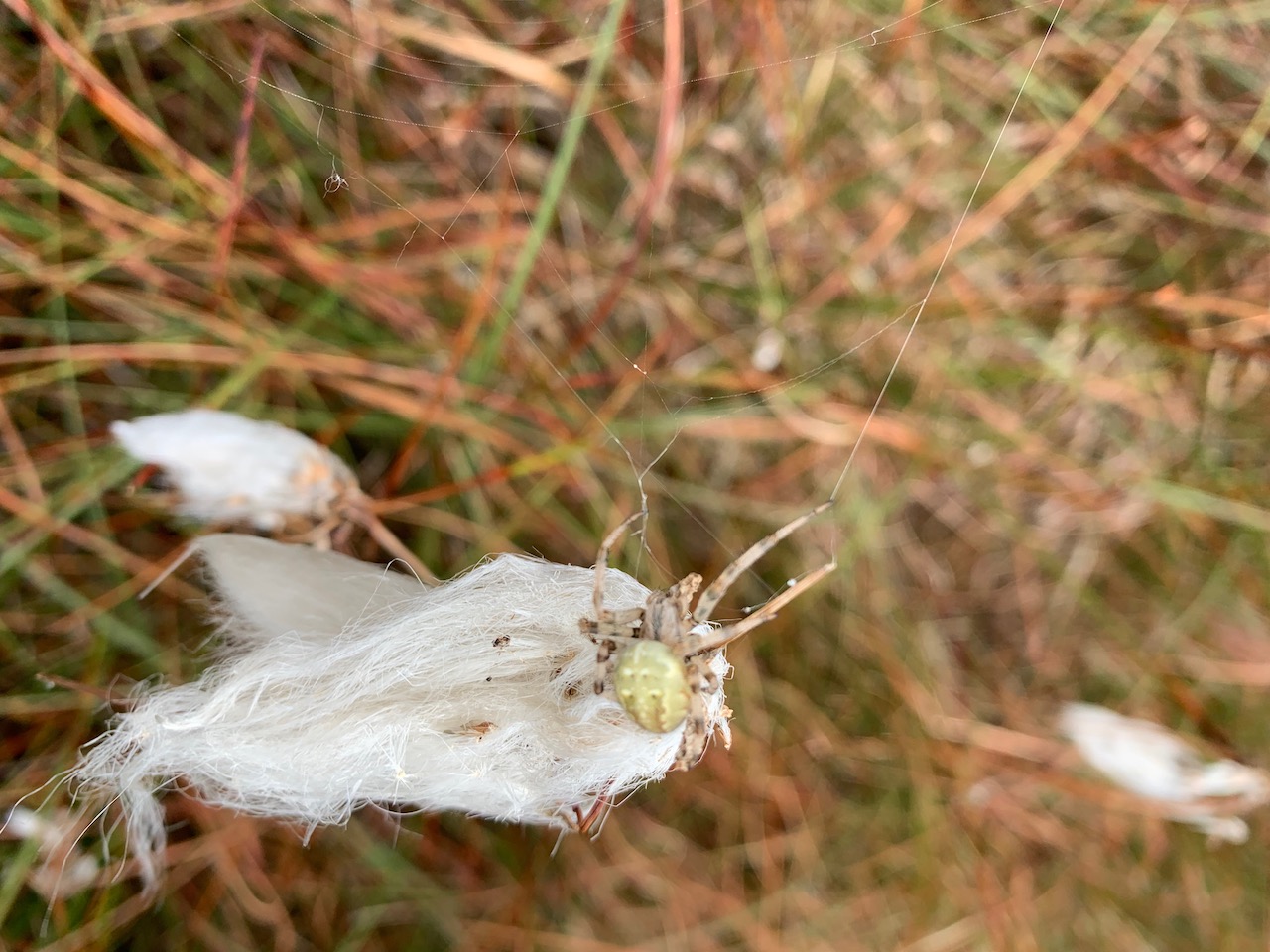
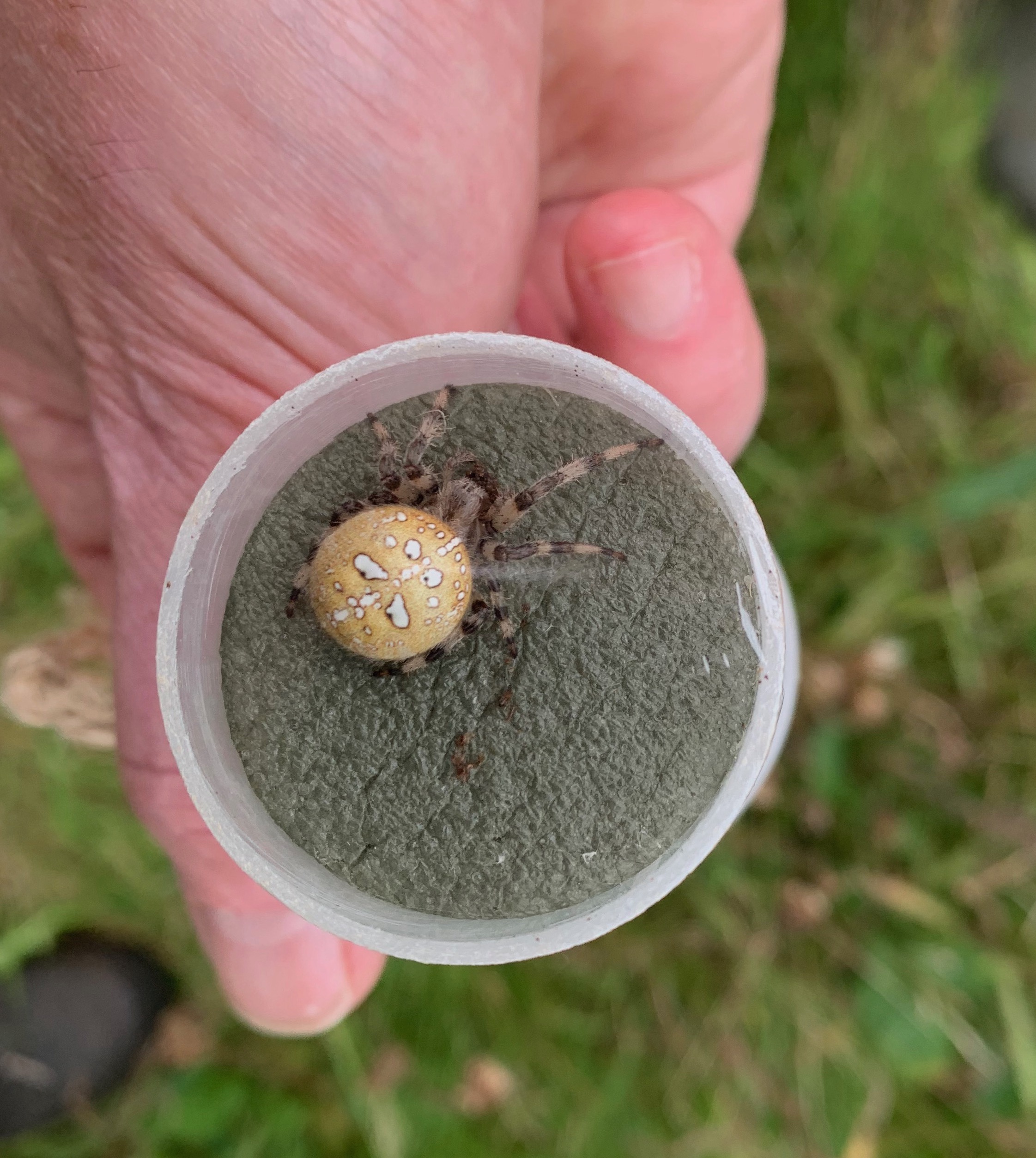
Fast-forward to August and, now a trainee, I am gathering cottongrass seed for the purpose of growing cottongrass sustainably at Prince’s Park Garden Centre. As I work I am aware that I am surrounded by webs and that in almost all of the cottongrass heads is a spider! Many of them are big, four-spotted, and vary in colour from orange to brown to green. They’re spooky and beautiful. I have to remove them from my clothes and tip them out of my bag at the end. Still, some end up coming home. I later learn they are Four-spotted Orb-weavers (Adraneus quadratus) and the cottongrass heads are their retreats.
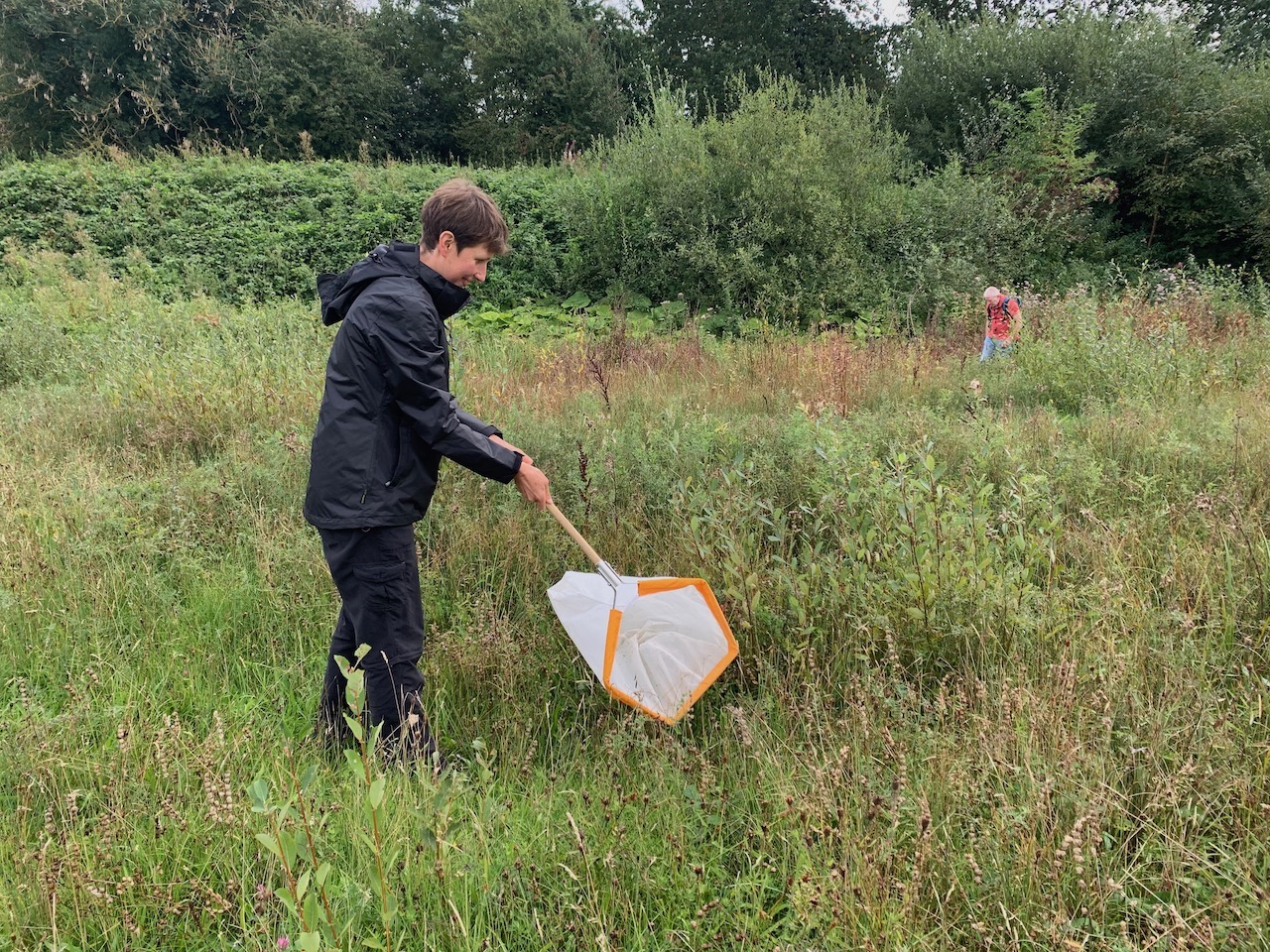
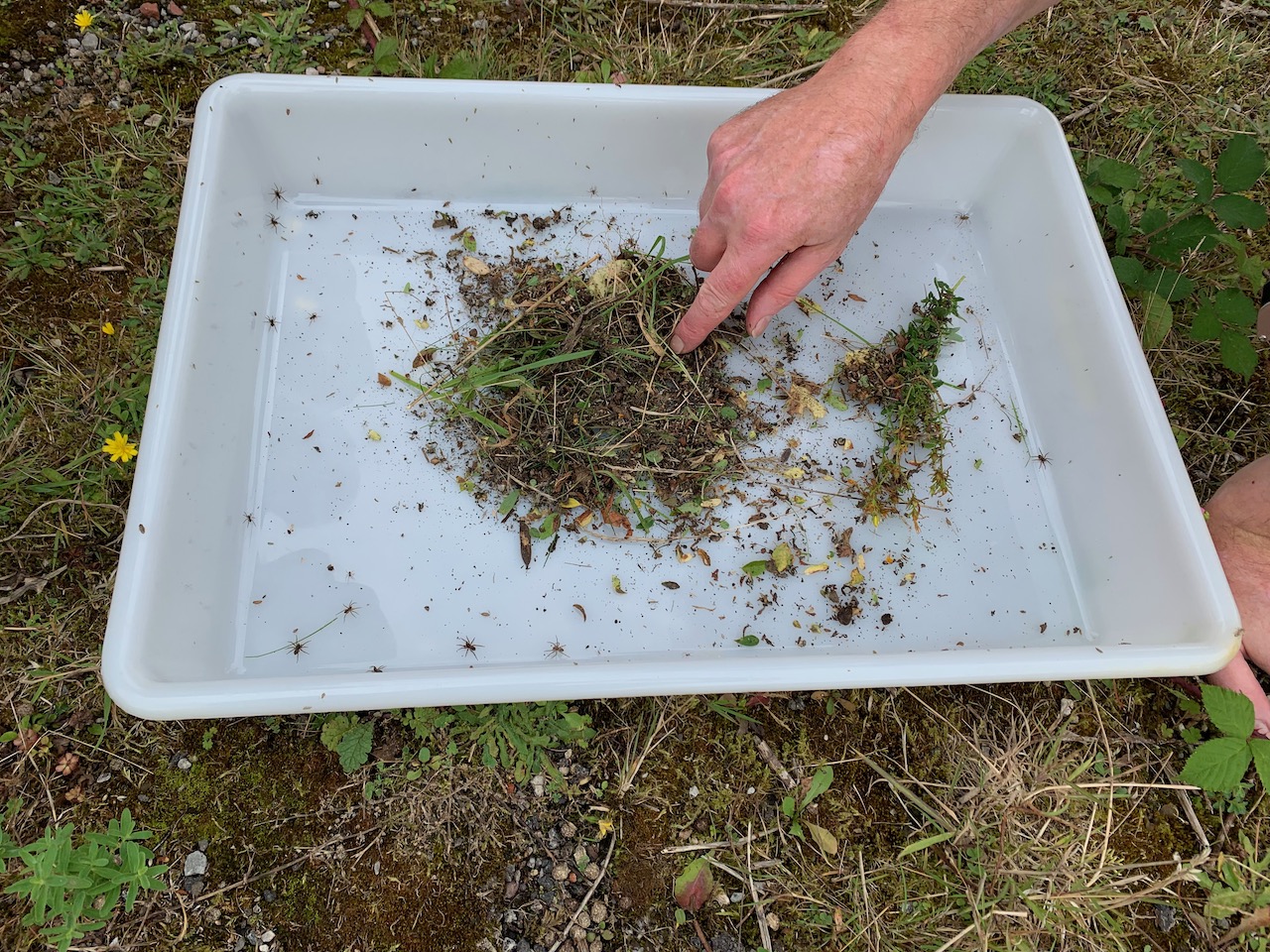
These encounters with spiders lead me to attend a workshop on identifying spiders in the field with Richard Burkmar, at Rixton Clay Pits, which is just down the road from Little Woolden Moss. I learn that, of the 650 species of spider in Britain, it is possible to identify around 200 with a hand lens or with the naked eye. Richard introduces us to collection techniques such as vacuum sampling, sweep netting, beating, and grubbing, and shows us how to catch the spiders in a spi-pot to examine them more closely.
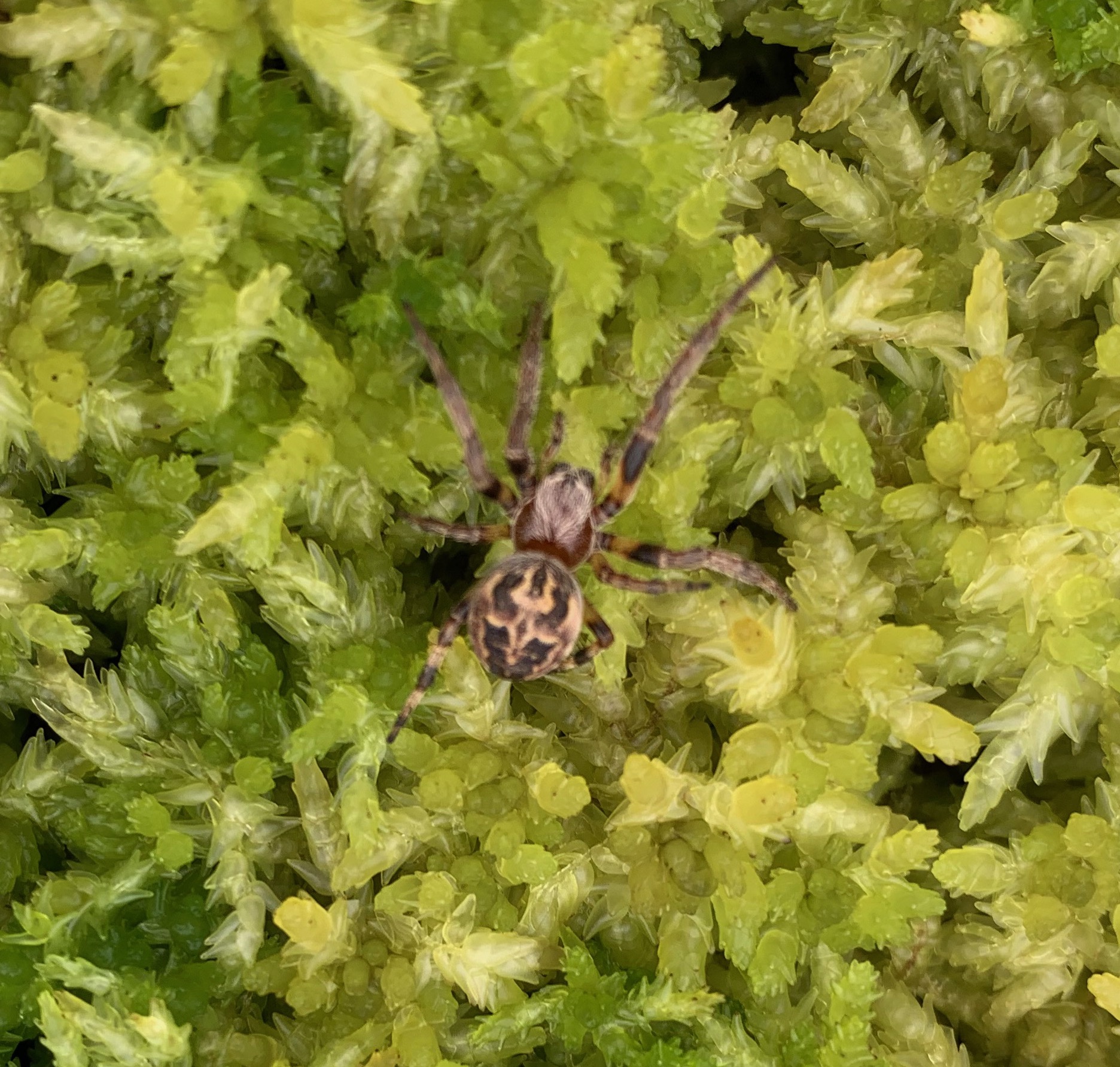
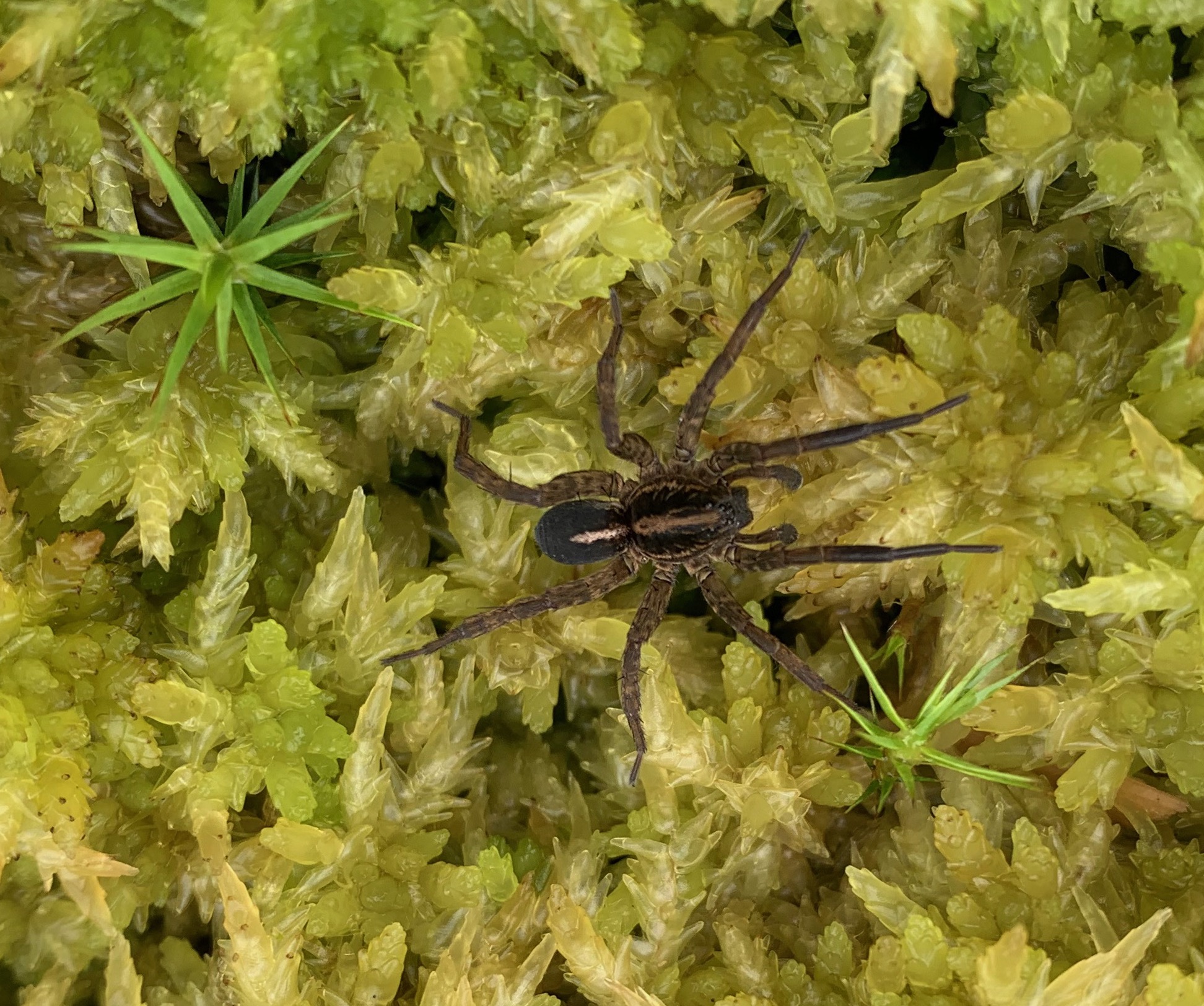
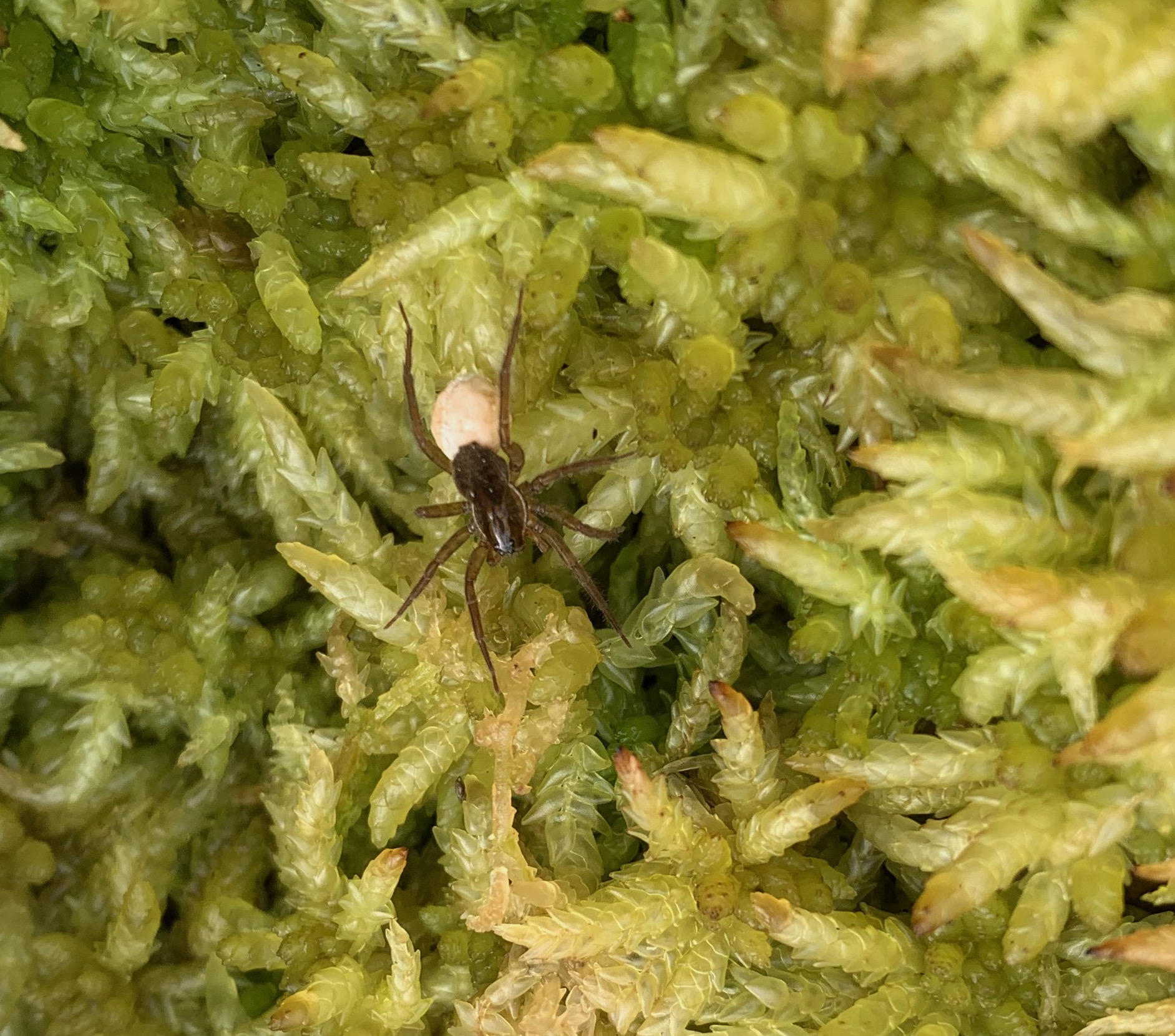
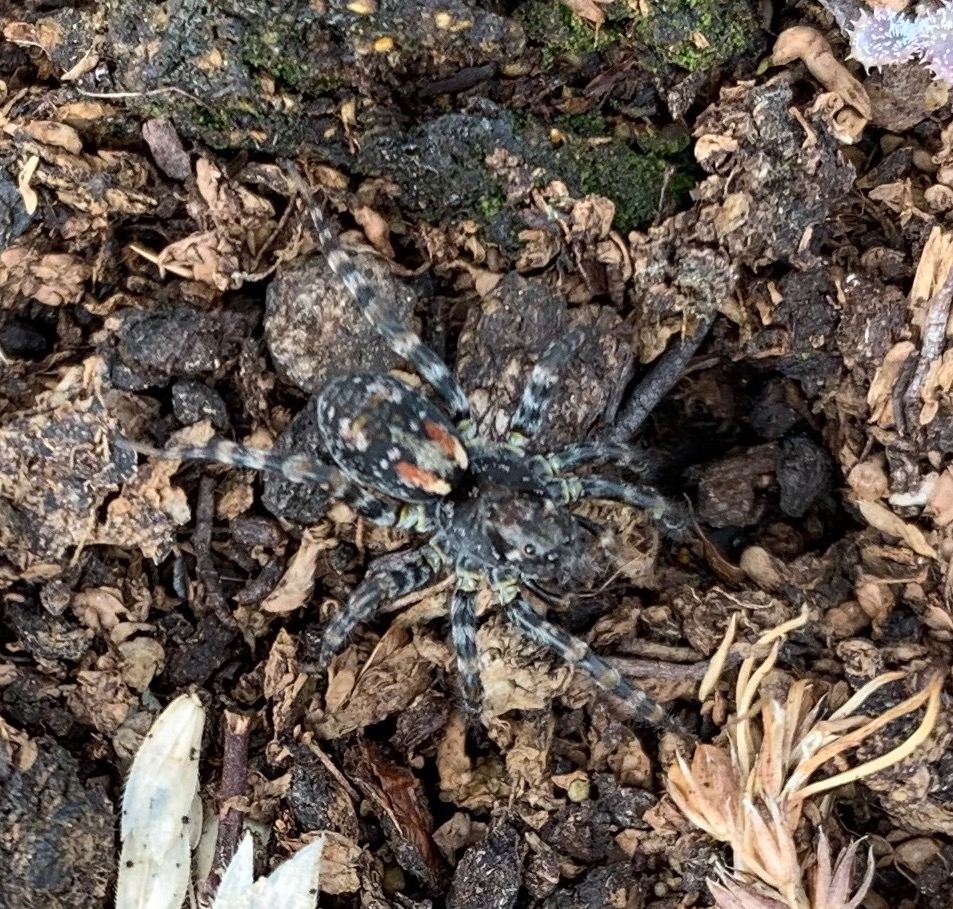
With Richard’s help I manage to identify a few spiders on Little Woolden Moss. These include Larinoides cornutus (an orb-web spider) and three wolf spiders – Trochosa ruricola, a spider of the Pirata genus, and Arctosa perita. The latter is interesting because it prefers dry, sandy habitats such as the Sefton coast. Here, on the peatlands, it favours bare peat. This master of camouflage has adapted its colour to fit its surroundings.
I find out that Richard has been conducting spider surveys on the lowland bogs of Lancashire and Cheshire for over ten years and he generously shares his publications and spreadsheets with myself and the mossland team. I learn that spiders are not only valuable in themselves, but indicators of the health of a peat bog and, as predators, of the wealth of its invertebrate population. This seeds the idea of carrying out spider surveys across Little Woolden Moss, which is in different stages of the restoration process, over the course of five years to see how the management affects spider populations.
I have written the survey methodology and am in the process of planning a training session with Richard for volunteers in spring next year along with arranging dates for the surveys. Although my traineeship ends in March and I am unsure if I will be able to stay on on the peatland team I intend to otherwise commit to these surveys as a volunteer. And likewise with the Sphagnum surveys. Whatever happens in this unstable and competitive job-world I have two favourite things to look forward to next year.
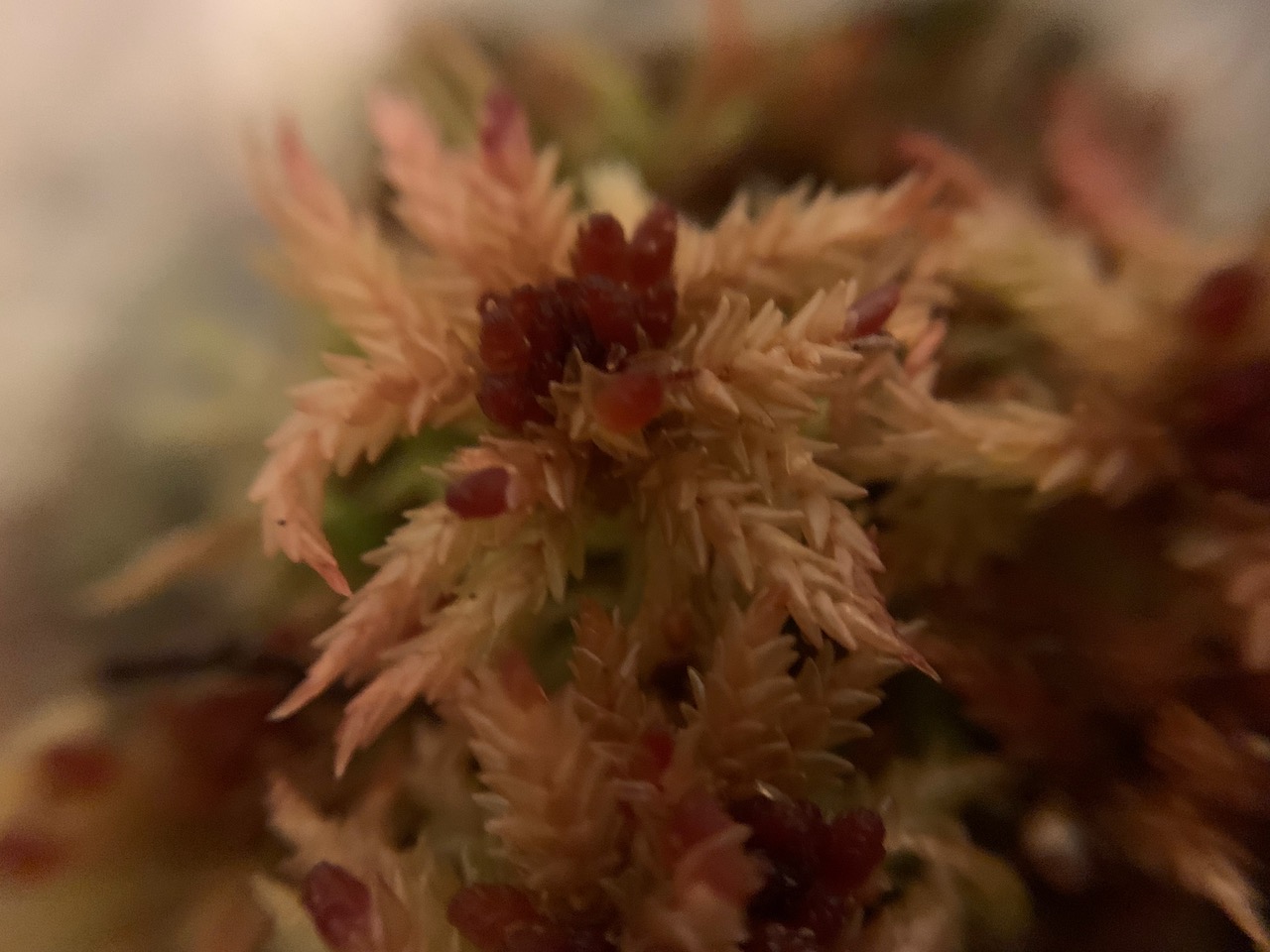
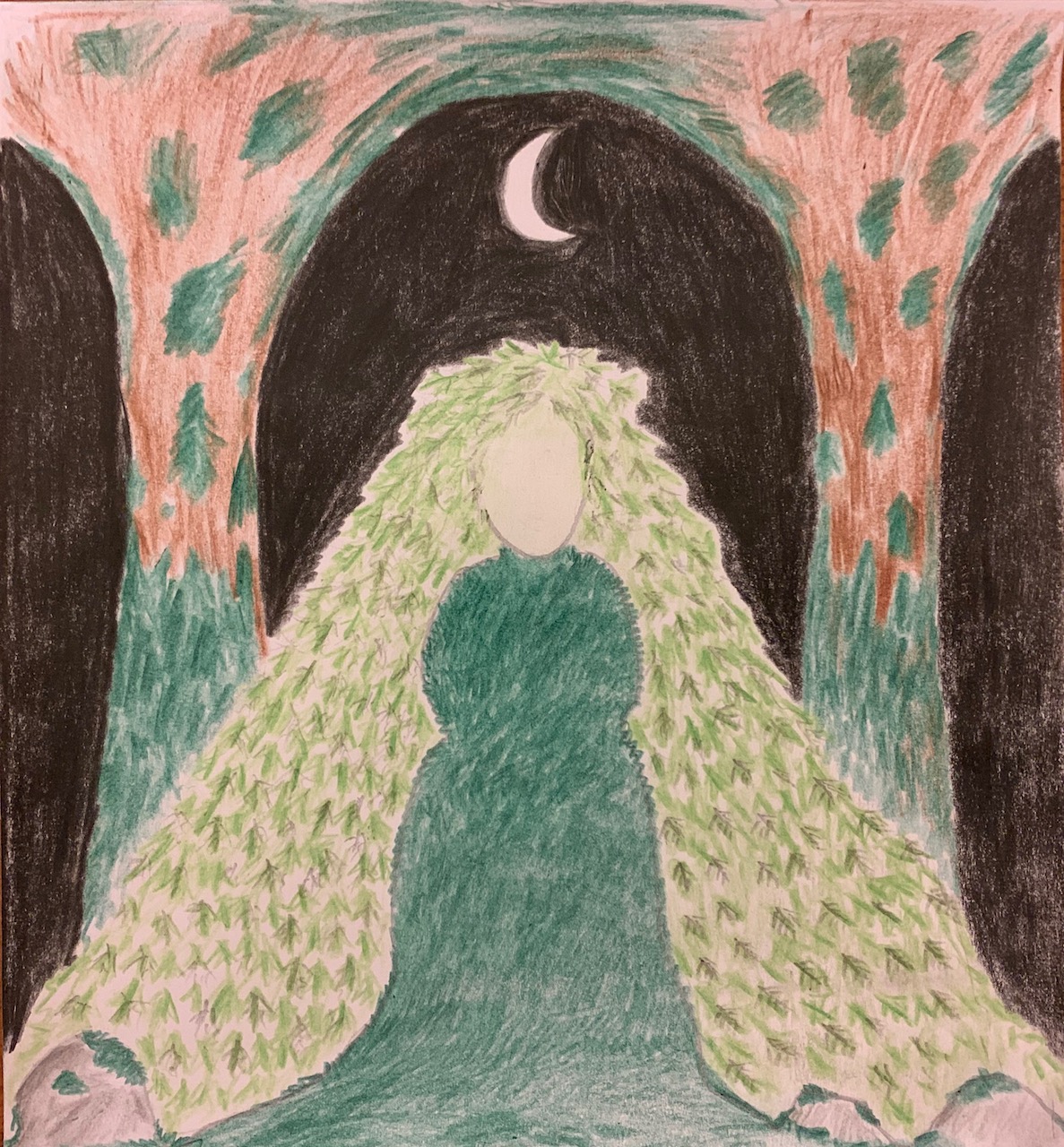
This is an image of Anrhuna in her guise as ‘the Mother of the Moss’ through which she has been speaking strongly to me over the past year. Anrhuna is not known from Brythonic lore but has presented herself to me and a couple of other awenyddion as an ancient goddess, who is the mother of my patron god, Gwyn ap Nudd. It’s my intuition that she was the driving force behind the earliest colonisation of the land by mosses.
 The Sanctuary of Vindos