The last few months have driven home how important our relationship with water is. We’re all troubled by concerns about there being not enough or too much and the impact of this on human and other-than-human persons.
Water has long been held sacred throughout spiritual traditions. From animistic, polytheistic and shamanic perspectives, water and all our watercourses (‘natural’ and man-made) are inspirited. Through practices including shamanic journeying we can connect with and build relationships with water spirits.
Have you ever wanted to make a connection with the spirit of your local brook or the river God or Goddess of your watershed? With the spirit of a pond, a lake, a canal, with the spirits of your drains and the sewers? Have you got questions and concerns you want to take to them?
If so, I am currently offering shamanic guidance sessions which will focus on journeying to water spirits at a discount rate of £20 an hour (reduced from £30).
For many thousands of years, the people of Britain were animists and polytheists who believed the land was sacred, inspirited, alive with Gods and spirits. Prominent landforms, in particular rivers, were venerated as Deities.
Some of the Brythonic names of our river Deities were recorded by the Roman geographer, Ptolemy, in his Geography (2 CE). These include Sabrina (from sabra ‘boundary’) for the river Severn, Clota ‘the Pure One’ for the river Clyde, and Belisama ‘Most Shining One’ for the river Ribble. ‘Old Father Thames’ is a later folkloric name for the Thames, which might derive from Tamesis ‘river’.
The river Ribble, whose Goddess is Belisama, ‘Most Shining One’
Votive offerings of metalwork from the Bronze Age and stretching into the medieval period provide evidence for the veneration of river Deities. Famous examples include the Battersea Shield and Waterloo helmet from the river Thames and hundreds of Bronze Age swords and spears from the river Trent. Metalwork, such as a Bronze Age spearhead, has also been found in the river Ribble.
Up until the 19th century, people were directly dependent on rivers for drinking and washing water, food, and transport. Springs, flowing into streams, into rivers, provided clean, pure water for drinking. Clothes were taken to chosen watercourses (such as Swill Brook) to be washed. Fishing and fish garths provided an important source of food. With the land being wooded, or wet and boggy, it was far easier to travel by canoe.
Rivers and their Deities were perceived to be both nurturing and cleansing and dark and destructive. This is seen in Belisama’s veneration as a shining and mighty Goddess who is reputed to take a life every seven years. The river Dart is viewed to be even more dangerous, taking a life every year. “River of Dart, oh River of Dart, every year thou claimest a heart.” Some believe these folkloric sayings date back to human sacrifice and others that they reflect the dangers of accidents or the pull of suicide. Having lived near the Ribble most of my life, I have seen Her taking lives with increasing frequency.
River Deities might be seen as the ‘mothers’ or ‘fathers’ of Their watershed and Their tributaries as Their offspring. This is how I perceive Belisama and Her ‘daughters’ – rivers such as the Darwen and the Douglas and my local streams, such as Fish House Brook, Penwortham Brook and Mill Brook.
Over fifteen years ago, before I learnt Belisama’s name, I was called to walk the Ribble Way from the source, Ribble Head, to the estuary at Longton Marsh. Looking back, I feel this was a form of introduction. As I learnt more about Paganism, I began paying greater attention as I walked and cycled my local stretch from Riversway Docklands to Brockholes Nature Reserve, to meditate on Her banks, to pray to Her and make offerings of songs and poetry.
It was a while until She appeared to me in an anthropomorphic form as a shining and mighty Goddess. I find this is the case even now. Often I hear Her song. But she’s usually too busy being a river to make a visionary appearance.
Belisama gifted me a poem, an address to the city called ‘Proud of Preston’ written in her voice and this was made the Preston Guild Poem in 2012. I wondered if this meant She was destined to be my patron Goddess, that I was destined to be Belisama’s bard. But it turned out not. Vindos claimed me.
I have spent many an hour walking the Ribble, pausing, watching the wildlife. Herons standing patient, single-legged, each with their own territory. Cormorants shooting straight as bullets or standing like pirates on abandoned jetties. Flocks of black-headed gulls. Raucous herring gulls swooping to snatch up chips. Goosander diving. Widgeon whistling. Mute swans. Pink-footed geese and Bewick’s and whooper swans returning.
I am lucky enough to live on a tidal stretch of the Ribble where I can observe the tides moving both out and in. I’ve observed flooding on Avenham Park, the nearby fields, and Penwortham Holme and the building of the flood defences.
Paying attention as I walk and cycle is a continuing service to Belisama. I regularly provide a greater service to one of Her daughters, Fish House Brook, who flows through Greencroft Valley. She is named for the Fish House, near where she meets the Ribble, where many fish were once caught. Sadly, Her earlier name is unknown but perhaps it relates to silver fishes.
I litter pick the valley that She runs through. When I first started doing this, Her course was dammed with fallen branches filled with litter, including food waste, which was heaving with maggots and other leech-like things. Clearing this away was disgusting but worth the effort as She flowed free and clean again.
Unfortunately there have been issues with waste water being mis-piped into drain water that have led to Her pollution, but slowly, through collaboration with United Utilities, this has been improved and Her waters are clearer.
Now Greencroft Valley is better cared for and fewer people drop litter, we have decided to leave branches in Fish House Brook to ‘slow the flow’ as increased rain fall over the winter leads to higher risks of flooding.
This is the story of my relationship with Belisama and Her daughters. If you would like to get to know the Deity of your local river you could try a similar process. Firstly, find out the name of the main river of your watershed. It could be that research turns up the name of its Deity, or it can be derived from the etymology. For example, there are no ancient records for the river Lune, which first appears in the Domesday Book (1086), buts its etymology, from *lǭn ‘healthy’ or ‘pure’ is suggestive of a name such as ‘the Healthy One’.
Next, begin walking the river, or the tributaries that are nearest to you. Pay attention with both your outer and inner senses. Notice the speed and patterns of the water, their timbre, their sound, how they change in different weather. Get a sense of their language. How they speak to you. Get to know the wildlife, the distinguishing features, the calls of the birds, their life cycles. Take time to sit and meditate. Pray. Make offerings. Create and offer art. Where safe you could also remove litter from the river and its banks.
Nurture your relationship and you will be nurtured in turn as reciprocity is re-established, flowing from the source, through many bends, out to the estuary.
A couple of weeks ago, I shared a post about ‘Spirits of the Water Sources’. Today, I’m going to be looking at the other side of our relationship with water spirits – those who have been assigned to carrying away our waste.
In this article, I will cover the history of latrines and sewers in Britain and discuss how people related to, or failed to relate to, the spirits of these facilities. I will then share a little about the sewers of my locality and their spirits.
Prehistoric Latrines
It’s difficult to know what the earliest hunter-gatherer people did with their excrement. Because they were highly mobile and of small numbers, it’s possible to imagine that, when they set up camp, they chose a suitable place on the land and everything disintegrated and returned to nature.
There is potential evidence for latrines from the Neolithic settlement at Skara Brae. Each dwelling contains a small cell with running water beneath that might have been used as a toilet (although its exact use is debated).
This is the first instance I know of in which water is used to carry waste away from a settlement. My guess is that, in these times, for an animistic culture, certain areas of land and certain water courses were seen as less sacred than others. These lesser places and waters were delegated as latrines.
It’s possible there were rites for setting up a latrine in which the spirits of the land or waters were invoked, asked for permission, and thanked. Also, perhaps, for when the latrine was used as well.
Romano-British Latrines and Sewers
When the Romans conquered Britain and built their fortresses, these included latrines. Back in Rome, they had their own complex drainage and sewer system, the Cloaca Maxima. This was associated with a goddess named Cloacina, ‘the Purifier’, to whom offerings of coins were made in the drains.
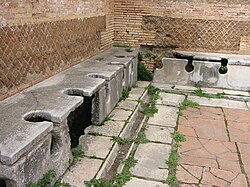
The latrines at Roman forts in Britain consisted of long, open rooms with wooden or stone benches with keyhole-shaped openings. At Housesteads, there were twenty seats and at Vindolanda, where the oldest wooden toilet seat can still be viewed, sixteen. Using the toilet was a social occasion.The waste was flushed away with rainwater from a cistern or with hot water from the baths. It then ran into sewers and into the nearest watercourse.
Roman toilets, from Ostia, Rome, as no British images available.
There is no evidence that Cloacina was venerated in Britain. However, coins and other objects such as gaming counters and beads have been found in the drains of Roman fortresses such as Eboracum and Vindolanda. Some of these are likely to be accidental losses but some might have been offerings to local purification deities who presided over the sewers and the drains.
Medieval Privies
When Christianity replaced animistic beliefs, there was a shift in perception away from our bodies, bodily functions and waste products being part of the course of nature and the spirits who dealt with them being purifiers worthy of respect. Instead, they became viewed as sinful and corrupt.
In the Bible, in Kings 10:27, when the Temple of Baal is destroyed, it is turned into a latrine and this act of desecration is seen to rob it of its sanctity. Going to the toilet became shameful and was done in private, in privies.
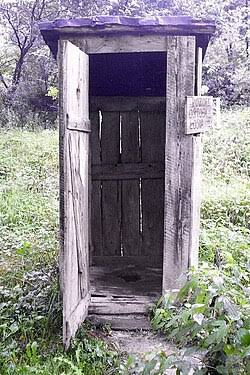
Outhouse
During the medieval period, privies were the most common form of latrine. These were outhouses built on the land of farms or in the backyards of houses. In towns and villages, a number of people shared a privy. It was a basic building with a hole in the floor and a cesspit beneath to collect waste. This was collected by night soil men, who took it to spread on the fields.
In medieval castles, there were garderobes, toilets built into the castle walls, from which the waste dropped down a chute into the moat or a cesspit. People also used chamber pots during the night, which they emptied into cesspits or water courses or added to the manure on their middens.
Only the monasteries had sewers. The toilet block, known as a reredorter (from rere ‘rear’ and dorter ‘dormitory’) was behind the sleeping quarters and was built over a flowing stream or a sewer channel, which led to a nearby river.
Waste was a dirty thing to removed from sight and mind by the men of the night. The purificatory spirits were no longer invoked. Yet, still, they served. As did those were called to dig out the cesspits and fertilise the fields.
Industrial Stink and the Sewage System
As the towns grew, in the industrial period, as an increasing number of people moved to dwell them in them in order to work in the mills and factories, human waste became a major problem. More people came to share limited latrines and the cesspits spilled and contaminated the water sources.
People emptied their chamber pots into the rivers or drains on the streets. Roads and water courses ran black with filth. It reeked. Diseases, such as cholera and typhoid, ran rife. Life expectancy was as low as nineteen.
The growing popularity, amongst the rich, of the flushing toilet didn’t help. The earliest flush toilet was designed for Queen Elizabeth by her godson, John Harrington, in 1596. In 1775 Alexander Cumming produced the widely recognised design with the U-bend to keep solids and their odour in their place.
In 1948 the Public Health Act was instituted to tackle sanitation issues. It was decreed that every house should have a water closet. Unfortunately, the use of flush toilets led to the water courses being overwhelmed more quickly.
The first sewers were constructed in Liverpool, between 1848 and 1862, in accordance with a programme created by James Newlands. Following the 1858 ‘Big Stink’ of London, Joseph Bazelgette constructed a sewer system with six main interceptors, incorporating stretches of London’s already culverted or ‘lost’ rivers to take the waste to the Thames estuary. Manchester and Preston developed sewers around this time.
Building of London sewage system in the 1860s
The development of Preston’s sewers was carried out by Preston Corporation Waterworks in tandem with the installation of piped drinking water. Water sources culverted underground such as the River Syke and the Moor Brook were used to carry surface run-off, industrial waste and sewage into the river Ribble. This was compounded by waste from other mill towns just as dirty, such as Blackburn and Darwen, coming down the river Darwen, and from Wigan coming down the river Lostock.
The pollution and the works would have had a major impact on the water sources and their spirits, whose presence was unacknowledged and unappeased.
Wastewater Treatment Works
The waste was removed from the towns only to pollute the rivers. Thus, it was soon realised that it needed to be treated before it was discharged.
The earliest wastewater treatment works was set up in 1864, at Beckton, in London. This used settling tanks to remove solids before discharging the liquids. In 1887, chemical methods to separate liquid and sludge were developed.
In 1894, Davyhulme Sewage Works opened outside Manchester. This pioneered the Active Sludge Process, invented by Edward Ardern and William Lockett, in 1914. In the first stage, bacteria and protozoa, powered by oxygen, break down pollutants. In the second stage, clarification, the biological flocs settle and are pumped back into the process whereas clear liquid remains. This is repeated until all the flocs have been processed and the water is clear. This technique is still used worldwide to this day.
At a modern wastewater treatment plant there are typically four stages. The first is screening to remove items like nappies, sanitary towels and cotton wool. The next, primary treatment, or sedimentation, is where the sludge settles to the bottom in large tanks and oils and grease are skimmed from the top. Secondary treatment is biological breakdown via the Active Sludge Process. Tertiary treatment involves filtering out any last remaining particles and disinfection by UV light or chemicals like chlorine to kill harmful bacteria. The effluent is then tested and released back into the watercourses. The solids are made into ‘cake’ for fertiliser or used to generate electricity.
In 1893, a sewage farm was developed at Freckleton to take the sewage from Preston and Fulwood and the waste was spread on the fields. The site was later replaced by the Preston Wastewater Treatment Works at Clifton Marsh. This currently receives the waste from Preston, my home town of Penwortham, and the surrounding area. The Walton-le-Dale Wastewater Treatment Works was established in 1891 and still caters for that area.
Preston Wastewater Treatment Works
When my house was built, in the 1940s, it would have been constructed with sewers leading, via Penwortham Pumping Station at Crookings Lane, to the Preston Waste Water Treatment Works.
What kind of purificatory spirits govern the processes of sedimentation, biological breakdown, filtering and disinfection is a question unasked and unanswered.
Storm Spills and the Preston Interceptor Tunnel
The development of better wastewater treatment has led to our rivers being cleaner. We’re still not there yet. In 2010, Preston’s 19th century sewage system was still emitting storm spills into the Ribble at times of heavy rain.
This resulted in £114m project delivered by KMI+ for United Utilities to build a 3.5km interceptor tunnel capable of carrying and storing 40 million litres of water. This tunnel is famously wide enough to drive a car down. New storm tanks were also built to hold the water at Preston Waste Water Treatment works.
What new spirits abide in these tunnels and holding systems?
Journeying with the Spirits of the Sewers
The history of the sewers is intrinsically bound up with our rivers. The goddess of the river Ribble is called Belisama, ‘Most Shining One’. I see her tributaries as her daughters. Many of these rivers and brooks, such as the river Syke and the Moor Brook have been culverted to form drains and sewers.
Additional tunnels have been built, subverting, changing the older courses. Do the same spirits flow in these channels or have new ones become? Is there a purificatory deity who presides over the drains and sewers of this watershed?
I took these questions when I journeyed to the spirits of my local sewage system. I didn’t get that much an answer. Journeying down our toilet, with my guides, we came out into a sewer where the sewage was flowing slowly. Every now and then its reluctant flow was punctuated by the splash of another flush, another push. The spirit was equally sluggish and uncommunicative.
Contrastingly, we met a male brown rat and then ran into a female and her young in a nest of toilet paper. A larger rat-headed more humanoid spirit appeared and said, “As your population grows, as our sewers grow, we grow too.”
When I asked if there was a purifier present, the rat spirit just laughed and told me, “There is no purifier, no purity, nothing is pure in these sewers.”
We traversed the tunnels and arrived at the water treatment works. There, I gained a sense of the liveliness of the bacteria going about their work and the steady rhythms of the machines – the scrapers ceaselessly rotating, gathering the sludge that settles at the edges, pushing it to the centre for removal. I intuited the mechanical agency of the spirit but received no messages.
However, at the end, the message from Belisama and her daughters was loud and clear. “Your waste does not belong to the waters but to the land.”
There’s a premise at the heart of capitalist culture – that we are free to do what we want. That’s why we get a world dominated by the likes of Trump, multinational corporations and billionaires.
My life has been driven by own ambitions, modest in comparison. Firstly, desiring to be a professional writer. Something I promised my God to give up. Still, I broke my promise again and again. And the last time failed rather spectacularly after spending three insomniac months writing an epic novel. It was accepted by a publisher. It didn’t work out. I self-published. An emotional rollercoaster. And I only sold one lousy copy. Lesson learnt.
Over the past couple of years, I have completed a shamanic apprenticeship and striven towards making a living as a shamanic practitioner. This has gone a lot better than my writing. Yet, work is sporadic. There are no signs that I will ever make a viable living from it.
It seems there are three types of people who make a living from shamanic work. Firstly, ‘big name’ shamanic practitioners and teachers, who often run shamanic schools. Secondly, psychotherapists who combine psychotherapy and shamanism. Thirdly, holistic healers who offer shamanism alongside Reiki, massage and other therapies.
All these people, unless they are very well established, rely on self-promotion on social media. The sacrifice of my time, energy, and peace and presence of mind to unethical social media organisations is not one I am prepared to make.
Thus, I have come to accept that I cannot have what I want. That it is not the will of the Gods or the Universe that I be a professional writer or shamanic practitioner.
And in that there is a sense of liberation – of freedom from my own desires.
I’ve surrendered to the fact that I need to return to regular work that gives me enough time for writing and to see shamanic clients. And work has quickly appeared with an old employer for whom I worked as a cleaner taking me back on.
And there is a freedom in saying, “Show me the work that needs to be done and I’ll do it.” Maybe that’s cleaning a house, a school or an office. Maybe it’s writing an article or a book. Maybe it’s guiding someone in making a connection with their spirits or doing an extraction healing or a soul retrieval. Maybe it’s litter picking or cutting back the bramble in Greencroft Valley.
I have accepted there are many ways in which I can be of service and that to primarily have the comfort of leading a laptop lifestyle is not my destiny.
Over the past few years, I have been learning from the yogic tradition and Thich Nhat Hahn’s Plum Village school of mindfulness and incorporating insights into my practice of ‘being present for Vindos’. It’s made me much more aware of how I have been a slave to my wants, to my desires, to my habits. Of how clinging only brings more pain.
There’s a Buddhist analogy where a monkey gets its hand trapped in a cage by reaching in to grab a banana. It refuses to let go, even though it knows it will die when the trapper comes. My ambition to make a living from my vocation has been that thing. I’ve finally found the courage to let go of the banana.
I’ve finally found freedom in surrender to the will of Vindos, to the will of the Universe. To being able to say, from my heart and my soul, “Your will be done.”
The recent heat waves, here in the UK and across Europe, and the drought in southern England, have got me thinking about how deeply I appreciate our water sources and the continuing miracle of having water on tap.
Here, in the Penwortham and Preston area, we’ve had piped water for around two centuries. And it has come at the great cost of our natural water sources being drained, ruptured, subverted, closed off, drying up.
The Wells and Springs of Penwortham and Preston
There were once numerous wells and springs in Penwortham and Preston. On Castle Hill, Penwortham, St Mary’s Well and St Anne’s Well. In Preston, Lady Well, Spa Well (on Spring Row, near Spar Bath where springs were abundant), Main Sprit Weind Well, Ashton Quays Well, and the Dolphin Fountain.
Their abundance has its basis in our underlying geology. Deep beneath is a primary aquifer composed of Permian and Triassic sandstone which is nationally recognised as a high-quality drinking water source. Above, flanking the river Ribble and its tributaries, are secondary aquifers formed from bedrock blanketed by river alluvium and glacial meltwater sand and gravel. These provide pockets of groundwater and interact with river base flows. Contrastingly, the surrounding soil is clay, and acts as an aquitard.
The spring and well waters of Penwortham and Preston flowed from secondary aquifers. St Mary’s Well, which was renowned for its clear pure water as a holy well with healing qualities, ran dry after the aquifer was shattered when the river Ribble was moved 500m south, close to Castle Hill, during the building of the Riversway Docklands. The wells of Preston were drained, covered, and built over after piped water was introduced.
In my locality, on the 1840 OS map, there are three wells close to Fish House Brook in the area now known as Greencroft Valley. By the time of the 1890 OS map, they have disappeared. It was common for local farms and houses, such as Malt Kiln Farm and Hurst Grange, to have their own wells.
1840s OS mapCovered well at Hurst Grange Park now part of the path
As far as I know, the source of Fish House Brook was never used for drinking water. This is likely because it was dark and peaty, flowing off Penwortham Moss somewhere near the present-day southern end of Bank Parade.
The continuing presence of groundwater close to the surface was recently revealed around 10 years ago during the demolition of the Maltings and building of the new houses on Maltings Way and Birch Tree Drive. They broke the secondary aquifer, which continues to leak to this day, down the woodland bank in Greencroft Valley and into Fish House Brook. This has led to the water-logging of the soil and the death of many trees, mostly birch.
Greencroft Valley leak crossing the path into Fish House BrookDead trees due to water logging
Preston Corporation Waterworks
The industrialisation of Preston and some of Penwortham began in the 18th century with Preston’s first cotton mill being opened in 1777. As the town grew, more water than local wells could provide was needed. In 1815, an Act of Parliament led to the formation of the Preston Improvement Commissioners to tackle civil infrastructure and organise a reliable public water supply. Water was first piped from Alston Springs. In 1835, Grimsargh Reservoir and Upper Dilworth reservoir were built to provide further supplies. The waterworks consisted of aqueducts, pumping stations and a network of pipes.
Present-day Valley Road pumping station providing water to Penwortham
In 1844, due to concerns about the cleanliness of the water, Preston Corporation took over the waterworks. Around this time, the local wells were closed. Following the cholera outbreak in London, in 1854, St Mary’s Well was capped. The local supply was soon replaced with piped water.
Further reservoirs were built around Longridge – Alston 3 (1842), Spade Mill 1 (1862), Alston 2 (1899), Alston 3 (1931), Spade Mill 2 (1936). In 1932, Stocks Reservoir, in Bowland, was built to supply regional districts including Blackburn and the Fylde coast and began also to feed Preston.
Stocks Reservoir (Wikipedia Commons)
In 1959, Preston Corporation Waterworks was subsumed into Preston and District Water Board. It was then amalgamated into North West Water in 1974. In 1995, North West Water merged with NORWEB to become United Utilities.
The Alston and Spade Mill reservoirs fell out of use until 2020. Due to increasing demand, the 9.7km Alston and Spade Mill pipeline was built to reconnect the four reservoirs into the network of pipes supplying the region, providing 38,000 million of litres a day – enough for 90,000 homes.
Spirits of the Water Sources
From the times the first hominids walked the land until the last couple of centuries, water sources such as springs, wells, streams and rivers, have been viewed as sacred. They were seen as inspirited as evidenced by the names of deities, such as Belisama ‘Most Shining One’, goddess of the river Ribble, and folkloric legends of spirits of the wells and well maidens who tended them. These may have given rise to the common name ‘Lady Well’. Many of the well spirits were replaced with Christian saints with similar qualities.
During the industrial period, this sense of sanctity was lost. Water was commodified. People were severed from their connection with local water sources. We became used to having water on tap. Paid for. Paying the companies who had engineered its delivery rather than offering to its true source.
Sadly, most of the old sources are covered over, dried up. Fish House Brook, my closest water source, now emerges from its culvert through a concrete pipe. Still, it is still possible to visit, to pray, to sing, to commune, to make offerings.
Present-day source of Fish House Brook
When I consulted the Spirit of Fish House Brook on the matter she said:
‘You have broken our ability to self-regulate, to filter. You like straight lines. We like to meander. Your pipelines are like catheters – lead to blockage and disease.’
Spirits of the Taps and Pipelines
We have three sets of taps in our house and one tap outside. All have their own personalities. Our kitchen tap drips. The bath taps are cranky. They grunt and groan. A bath or shower is never quite the right temperature. The taps of our new sink are far more congenial and friendly. The outdoor tap, to which the hose pipe is attached, is prone to surge and spit and leak.
My journeys to the pipes have been characterised by a feeling of the frustration of waters used to flowing, never stopping, by their own will and volition, getting contrarily pumped along, on demand, or forced to wait.
There’s a sense of irritation at our clumsiness, at our ineptitude. An “Is it any wonder we burst your pipes?” “Is it any wonder you get infections like the cryptosporidium at the Franklaw Water Treatment Plant at Garstang?”
When I wonder who the ‘we’ are, my logical mind reminds me of the reservoirs and underground sources, but the waters spirits tell me they are “one”. I might call them “the spirits of the north west waters,” if I wish.
The pipes, like the taps, have their spirits too, their personalities. Bound up with them are their makers, their users, the places their materials come from. We have old lead pipes, hopefully, now, with another mineral deposit to be safe.
When I have a drink, a bath or a shower, something I have been doing automatically and without much thought since I was very young, I now do my best to give a word of thanks to the spirits of the waters, the taps, the pipes. To our artificial water sources and the still-living waters that flow within.
My article, ‘The Dream Temple of Nodens,’ has been published in the latest issue of Sacred Hoop. It provides an exploration of the history and archaeology of the temple to Nodens at Lydney and the evidence for a tradition of dream incubation centring on Nodens as an ancient British God of healing dreams. This issue of this long-standing shamanic magazine also contains articles on dreaming the land, working with ancestors, plant medicines and much more.
Pantheon The Welsh is a book in the Collective Ink Books Pantheon collection by Welsh Folk Witch, Mhara Starling. It is the first book I know of that focuses on the Welsh pantheon, as a whole, rather than, more widely, the Celtic Gods.
And there is a reason for this. Starling admits that the claim that the Welsh Gods are Gods is controversial. Within academia, they are largely viewed as mythic and folkloric characters and there has been a great deal of argument about whether they are Gods. As Starling notes, some scholars argue that the names of a few of the Welsh Gods being cognate with those of ancient Gods (ie. Maponos / Mabon and Nodens / Nudd) suggests they are of divine status. However, others argue that such continuity cannot be proved. There is no evidence of shrines to modern Welsh goddesses such as Ceridwen.
A stronger argument, which Starling puts forward, is that many temples to the Welsh Gods and covens and polytheistic groups who revere them exist today. To support this, she provides a chapter on ‘Apotheosis’, a term derived ‘from the Greek apotheoun which means “to make a God of”.’ Her core claim is that the Welsh Gods have now been elevated to divine status and that the evidence of modern cults who venerate them is irrefutable.
And the inspiration of the Welsh Gods sings through the chapters of this book. In Part One, Starling covers History, Cosmology, Magic, Apotheosis, Seasonal Celebrations and Putting it into Practice. In Part Two, she provides a catalogue of the Welsh Deities and discusses Spirits Seen and Unseen.
Starling does an excellent job of making the often difficult and occasionally baffling literary material engaging and accessible without losing the profundity.
I love the following description of her approach: ‘I often view the Deities of Wales as complex jigsaw puzzles in many ways. In order to gain a clear, precise picture of who they are, we must find all the scattered pieces found in the myths, the poems, the Triads, the etymologies of their names, their links to other characters, and even sometimes elements of belief and lore found in folk traditions. Pulling these pieces together offers us a fuller picture of who they are and how we might approach them today.’
This is exactly what she does in this book. Throughout the pages, she demonstrates deep research-based and experiential knowledge of these Deities. For example, when speaking of Arianrhod, she shows how the representation of this Goddess as a ‘wicked stepmother’ in the Fourth Branch of The Mabinogi is one-sided. Drawing on material from The Triads of the Island of Britain and the writings of Sir Ifor Williams, she provides a poetic translation of her name as ‘The still point at the centre of the turning wheel’. She reveals her to be a more complex Goddess, ‘an initiatrix’ around whom the heavenly Deities such as her sons and consort and our lives turn.
I particularly enjoyed the section on Cosmology. Starling points out that many find Welsh lore frustrating as there is ‘no fixed and objective cosmology’ or ‘creation myth’ because the ‘sources we have available to us are rooted in a period of time when Wales had already embraced Christianity.’
Starling goes on to show that, in spite of this, Welsh myth and folklore are deeply rooted in beliefs about Annwfn ‘The Very Deep’, the Otherworld and Awen, ‘divine inspiration’, which flows from and is seen to be shaped in Annwfn. Far from these concepts being remote and of a by-gone age, Awen inspires bards to this day and the Deities of Annwfn continue to appear in folklore and to manifest in the lives of modern Pagans and Polytheists.
There is also some deep discussion of the nature of magic. Starling introduces concepts I was unaware of and find fascinating. Speaking of transformative magic in The Mabinogi, she explains the difference between magic that changes someone’s Rhith, ‘outward form’ and Anian, someone’s ‘inner nature, core or soul’. She uses this to explain the differences between Pwyll and Arawn exchanging shapes but keeping their own nature and Gwydion and Gilfaethwy taking on both the form and the nature of various animals.
She also notes that magic has ‘two different expressions’. ‘The magic of the Otherworld tends to be subtle and part of the Otherworldly denizens’ very nature.’ This struck very close to my soul. It has long been my intuition that the Deities of Annwfn are magic. She contrasts this with the more explicit, ceremonial magic that is practiced by ‘Earthly magicians’ such as Gwydion.
Starling also provides a good grounding for newcomers in Welsh history and language (including pronunciation) and tips for avoiding cultural appropriation.
This is a brave book in which Starling is not afraid to voice her personal opinions*. It is written with a good deal of love and devotion for the Welsh Gods. I would recommend it to both new and long-time Pagans and Polytheists and anybody interested in Welsh Deities and their lore.
*As a heads-up there is a rather long rant about Mabon’s fabricated associations with the Autumn Equinox in his section!
You can pick up a copy of Pantheon The Welsh from Collective Ink Books HERE.
One of the signs that the end of summer is approaching in my locality is the seeds of willowherb. Willowherb species (Epilobium and Chamerion) have been present in Britain since the Late Glacial Interstadial (13,000 years ago) and began spreading vigorously again at the end of the last Ice Age.
There are eight species of willowherb native to Britain: broad-leaved willowherb (Epilobium montanum), spear-leaved willowherb (Epilobium lanceolatum), pale willowherb (Epilobium roseum), great willowherb (Epilobium hirsutum), hoary willowherb (Epilobium parviflorum), marsh willowherb (Epilobium palustre), square-stalked willowherb (Epilobium tetragonum), and rosebay willowherb (Chamerion angustifolium).
As the Latin names, such as montanum ‘of the mountain’ and palustre ‘of the marsh’ suggest, this ubiquitous plant has evolved to survive in many habitats.
American willowherb (Epilobium ciliatum) was introduced in 1891 and New Zealand willowherb (Epilobium brunnescens) in 1904.
Of these species, three are common in my locality of suburban Penwortham: broad-leaved willowherb, great willowherb and rosebay willowherb.
Broad-leaved willowherb is one of the smaller, most versatile, well-known and well-spread of the willowherbs. Growing from 20 – 60cm, it is typically found on mountains, in woodlands, on walls and on rocks. It grows all over our garden – in cracks in the paving stones, in flower beds; ever the opportunist, it even crashes into the pots of other plants.
Its leaves have short stalks. They are opposite, oval to lanceolate, and are characterised by a broad base. The flowers are on terminal racemes. They are pink, with four notched petals. The stigma has four lobes. They measure 6 – 9mm. The stem is rounded and almost hairless. The seed pods are downy capsules 4 – 8cm long. When the capsules split, they release thousands of tiny seeds, (1mm long and 0.5mm wide) borne on tufts of long, silk white hairs called comas. These act as parachutes carrying them away on the wind to new destinations.
Great willowherb is much larger, growing from 80 – 150cm. It is found on riverbanks, in fens, marshes and damp meadows, preferring neutral soils. Near me, it grows on the edges of ditches and streams in the Meadows, on the edges of the meadow areas in Greencroft Valley and in the meadows themselves. It also scattered around Preston Junction Nature Reserve.
Its leaves are lanceolate and clasping. Its flowers, on terminal racemes, are a deep purple-pink and notched. The stigma, again, has four lobes. They measure 15 – 23mm. The stems are round and downy. The seed pods are 5 – 9cm long.
Rosebay willowherb is the giant of them all. It can grow up to 2m high. It is most often found on wasteland and locally occurs on former and current railway banks. It occurs in abundance at Preston Junction Nature Reserve. It is one of the few native plants that stands its ground to Himalayam Balsam.
Contrastingly, its lanceolate leaves are arranged alternately and spirally on its round, hairless stems. Its flowers, rose-purple, 20 – 30mm, grow in racemes on spikes. Its four-lobed stigmas bend down. Its seed pods are 4 – 10cm and can release as many as 80,000 hair-borne seeds from just one plant!
The wispy white seed-fluff replacing the passionate pinks marks the end of summer. Willowherb, a perennial, will then enter dormancy. Its seed will go on.
Willowherb is versatile and enduring and quite often a pioneer species. Famously, during the Second World War, rosebay willowherb colonised sites of bombings, leading to it becoming known as bombweed or singerweed. It is also known as fireweed because it springs up red in the wake of fires.
With global heating accelerating at a staggering rate and wildfires raging across the world, including here in the UK, it is looking like we will be seeing more of fireweed, more of its seeds, through summer and its end.
“I will go on,” says this plant whose seed bank is now huge, “I will go on.”
*If you enjoy my writing please consider supporting me on Patreon HERE.*
I currently have the privilege of tending a garden. My relationship with our garden is quite unique for I have lived here, in the same house with my parents, since I was four years old, with only a couple of brief periods of living away. I’m forty-four now. So I’ve been here almost forty years.
I’ve played in the garden, ignored the garden, done bits and bobs, but only since the health of my parents has deteriorated and Covid struck, have I taken gardening and building a relationship with the garden spirits seriously. I’ve had successes and failures and learnt quite a few things along the way.
Here, I will provide an account of the processes I’ve been through and provide some guidance for others on working with spirits of the garden.
What is a Garden?
For anybody setting out to get to know the spirits of their garden, it’s helpful to know what a garden is. According to the Oxford English Dictionary, it is ‘an enclosed piece of ground used to grow flowers, fruit, or vegetables.’
Thus, a garden is born by the act of enclosing pre-existing land. Often, a garden belongs to a house and is one amongst many in a row on a street. Sometimes, gardens are created as stand-alone green spaces, such as allotments, community gardens, botanical gardens and garden areas in parks.
The History of the Land
Because a garden is an enclosed piece of ground on pre-existing land, it is helpful to get to know what the land was used for prior to its enclosure. You can do this by looking at old Ordnance Survey maps and at your local tithe map (1).
The OS maps for 1910 and 1890 show that there was an orchard on this land. The deeds to our house record it as cherry orchard. In Lancashire, both sweet cherry (Prunus avium) and sour cherry (Prunus cerasus) were grown. In next door’s garden there is a sweet cherry tree – perhaps a descendant. Sweet cherry seedlings are always trying to grow in our garden.
The 1840 OS map and the local tithe map, from 1839, show beforehand it was meadow. It was known as Golden Bank Croft. The land belonged to Malt Kiln Cottage and Farm and was owned by Richard Palmer, who leased it to William Mayor and his son, Robert Mayor, who is listed as owning the field. The large, irregular field patterns suggest that they date back to the medieval period.
The ‘Bank’ refers to the bank of Fish House Brook, which is culverted beneath the gardens of the houses across the road, Bank Parade. It then flows through Greencroft Valley and north to enter the river Ribble at Fish House Bridge. The source of Fish House Brook lies 100m to the south of my house.
I thus see the presiding land spirits to be the Spirit of Fish House Brook and the Spirit of Greencroft Valley, for they are the powers who have resided here long before we spoke those names and created meadows, houses and gardens.
It is likely that Golden Bank Croft was farmed as hay meadow. The way this worked was that fields were grazed as pasture over the winter, then in spring the cattle were shut out and the grasses were let grow and cut in the summer.
Typical species of a lowland hay meadow in Lancashire include grasses such as: sweet vernal grass (Anthoxanthum oderatum), meadow foxtail (Alopecurus pratensis), crested dog’s tail (Cynosurus cristatus), red fescue (Festuca rubra) and Yorkshire fog (Holcus lanatus) and wildflowers such as: ox-eye daisy (Leucanthemum vulgare), bird’s-foot trefoil (Lotus corniculatus), common knapweed (Centaurea nigra), yellow rattle (Rhinanthus minor), great burnet (Sanguisorba officinalis), meadow vetchling (Lathrus pratensis), and meadow buttercup (Ranunculus acris). Remnants of some of the more pervasive of these species are found in our lawn and on local parks and green spaces.
I perceive the guardian spirit of my home and garden to be the former guardian of Golden Bank Meadow and the surrounding land on this side of the brook.
It is likely that, before it was enclosed as meadow, this area would have been mixed deciduous woodland, dominated by oak, with some patches of carr wood. This is suggested by the old oak trees that are remnants of former hedgerows in Greencroft Valley and by place-names such as Broad Oak, Oak Avenue, Oaklands Drive, the Oaks, Alderfield, the Carrs and Carr Wood.
The History of the Garden
The history of a house and garden is usually passed on from its previous owners. This is how we learnt our house was built during the 1940s. If you don’t have this information, you can check the Ordnance Survey maps.
I believe our garden, when we moved in, in 1985, was close to the original design. It had a lot of conifers, shrubs and ornamental plants. All the conifers have been removed due to poor condition and my dad dug most of the plants up.
A few things have survived. A pair of apple trees. Camellia, lilac and eschalonia that have grown to tree-like proportions. Fuchsia and astilbe. Cloves in a pair of pots. Of my dad’s blunders only the raspberry patch remains.
When I was a child, I was far more interested in my toy horses and make-believe equine worlds than I was in the garden. I dug up the lawn to make water jumps and banks for my Playmobile cross country and show jumping competitions and ran round leaping courses made of garden canes myself.
I loved wild nature, which led me to conservation volunteering aged thirty. I didn’t care much for gardens or gardening until I developed a passion for growing native wildflowers. This expanded to include cultivated plants and fruit and vegetables when I began volunteering at Let’s Grow Preston.
Still, I ignored our garden, as I didn’t see it as ‘mine’. This changed when Covid struck and all my volunteer work parties got cancelled. By that time, it was in a state of neglect due to the deteriorating health of my parents.
Building a Relationship with a Garden
My relationship with our garden started off thorny. Quite literally. The cultivated blackberry bushes at the top of our garden had taken over the path. I battled them back. I battled the ‘weeds’. I was angry with the garden for growing so wild and I was angry with my parents for their neglect. The spirits named me ‘Mrs Angry Gardener’. We didn’t start out very well.
Yet, as time went on, with the help of Creiddylad (2) I learnt to listen better to the garden and its needs and to the intelligence of the plants. When my comfrey plant spread from its pot down the side by the compost bin, I allowed it to grow there to provide food for pollinators and to add to the compost. I let honesty grow toward the back of the garden. When the blackberries died, I created a fern garden on advice from Creiddylad and Gwyn (3), populating it with ferns and hart’s tongue growing elsewhere as ‘weeds’.
I replaced the flower beds with a wildflower patch, growing ox-eye daisy, ragged robin, red campion, common knapweed and foxgloves from seed. I added betony and common agrimony from an ecology colleague and blue geraniums from Let’s Grow Preston and Newgate Nursery (bees love them).
When the red campion became dominant in the wildflower patch and threatened to take over the garden, I began picking the seedlings to grow to plant in Greencroft Valley and translocating the larger plants there.
As time has gone on, I have come to know the spirit of the garden better, if something comes up in ‘the wrong place’, to ask its purpose, where else it could go. I have become more one with the movement and succession of plants.
Prayers and Offerings
My personal approach to prayers and offerings is one of practicality and simplicity. I speak morning prayers of praise and evening prayers of thanks. I treat watering and feeding the garden as an offering, doing it prayerfully. When I place items on the compost heap at the bottom of the garden, I feel it is an offering of sorts for the fay who abide in the ferns and the lilac.
I used to make offerings of mead to Gwyn and the garden spirits beneath one of the apple trees. When the hellebores wilted, I found out that alcohol damages trees and plants. It causes dehydration, strips protective layers and kills beneficial soil bacteria. Herbal tea now forms a more suitable alternative. I also, occasionally, offer fruit. This gives nutrients back to the ground. However, I don’t do this often, due to sightings of a brown rat.
Our spirits appreciate arrangements of stones, such as my mum’s ‘god stones’ (4), as shown by the mosses and lungwort who have grown around them.
Others might prefer more elaborate ceremonies and rituals. Always check in with the spirits first make sure that what you want aligns with what they want.
Shamanic Journeys and Dreams
It is also possible to journey to the spirits of the garden. On my journeys, I have not come across a single ‘spirit of the garden’ who has presented in an anthropomorphic or phytomorphic form. Yet, I have heard a ‘voice’ that seems to speak with the deeper being of the wider area.
I have been shown that I’m a mere instrument in the greater design of the land. A mid-wife and foster-mother to the plants, a nurturer, a waterer. That my existence and doings here are transient against the ancientness of this place and of its inhabitants, some who outdate humans by millions of years.
I have been shown that willowherb (Epilobium) will never stop spreading and horse tail (Equisetum) will maintain its vast subterranean system beneath the earth for millennia. My existence here is more ephemeral than the so-called ephemeral plants who will continue in their seed whereas, with me, my line ends.
As I have built a deeper relationship with the garden, it has appeared more often in my dreams. I have dreamt the Leylandii are back again. I have dreamt strange bees and wasps. I have dreamt a pond in the middle of the back lawn that my parents will never allow but might be created by a future owner.
Presence and Listening
Of all things, I have found that the main need of our garden has been that I pay attention and listen. That, instead of being in my head, listening to my internal chatter, I am embodied and present amongst the trees, plants and creatures.
In this state, I am more at one with the garden, more attentive to its needs. I notice things better. For example, how the types of bees on the oregano – honey bee (Apis mellifera) and white-tailed bumblebee (Bombus lucorum) – differ from the types of bee on the common knapweed – red-tailed bumblebee (Bombus lapidarius), common carder bee (Bombus pascuorum) and hairy-footed flower bee (Anthothora plumipes). I notice a hornet mimic hoverfly (Volucella zonaria) for the first time and wonder what its appearance means.
Taking the time and effort to be present and listen, whether whilst gardening or sitting or standing still, for me forms the foundation of good relationship. It also opens the door to deeper mysteries and more intimate disclosures from the spirits. Thus, Blake’s ‘Heaven in a wildflower’ can be found in any garden.
*If you enjoy my writing please consider supporting me on Patreon HERE.*
Footnotes
(1) Tithe maps were created following the Tithe Commutation Act of 1836 to replace the ancient system of paying tithes in goods with monetary taxes. (2) An ancient British and Welsh goddess of sovereignty and fertility who I perceive to be connected with flowers. (3) Gwyn ap Nudd, ‘White son of Mist’, earlier known as Vindos, is the King of Annwn / Faerie and Creiddylad is his queen. (4) The stones, in order, from the top left, represent Creiddylad, Nodens, Anrhuna, Vindos / Gwyn, Maponos / Mabon and Gwythyr.
I am excited to announce the publication of my new novel, The Lost Shrine of Nodens. The concept is based upon the two Romano-British silver statuettes dedicated to Nodens, an ancient British god of healing and dreams, which were found on Cockersand Moss in Lancashire. They suggest a lost shrine to Nodens may have existed nearby.
This is the blurb:
The Lost Shrine of Nodens is a an epic dystopian fantasy novel set in Lancashire in the not-so-distant future. It follows the stories of a group of damaged people in need of healing in a damaged world.
Chesney Liddell is an eco-kid with a family history of leukaemia who is trying to create a better future. Lorraine Winter is the most feared and hated girl in Penwortham and leads the Winter Crew in their deadly rivalry against the Summers. Caught between Summer and Winter are Val and Carson Robinson and Chesney is trapped with them. Chesney is in love with Val and Lorraine wants to kill Carson.
Carson is plotting to win free. He is trying to become a rock star and it’s rumoured his inspiration comes from a deal with an underworld god. As he and his band pull everybody into the trajectory of their descent it’s unclear who will return. Their only chance of survival lies with finding the lost shrine of the ancient British healing god, Nodens.
This 135,000 word epic was written in a grief-fuelled sleepless maelstrom over a three month period after I gave up being Sister Patience and the Monastery of Annwn. I certainly will not be doing it again! Two of my beta-readers have described it as ‘a wild ride’.
The print copy can be purchased for £22.79 through Lulu HERE.
The digital version can be purchased for £7.06 through Lulu HERE.
I have also properly self-published The King of Annwn.
The print copy can be purchased for £10.45 through Lulu HERE.
The digital version can be purchased for £4.76 through Lulu HERE.