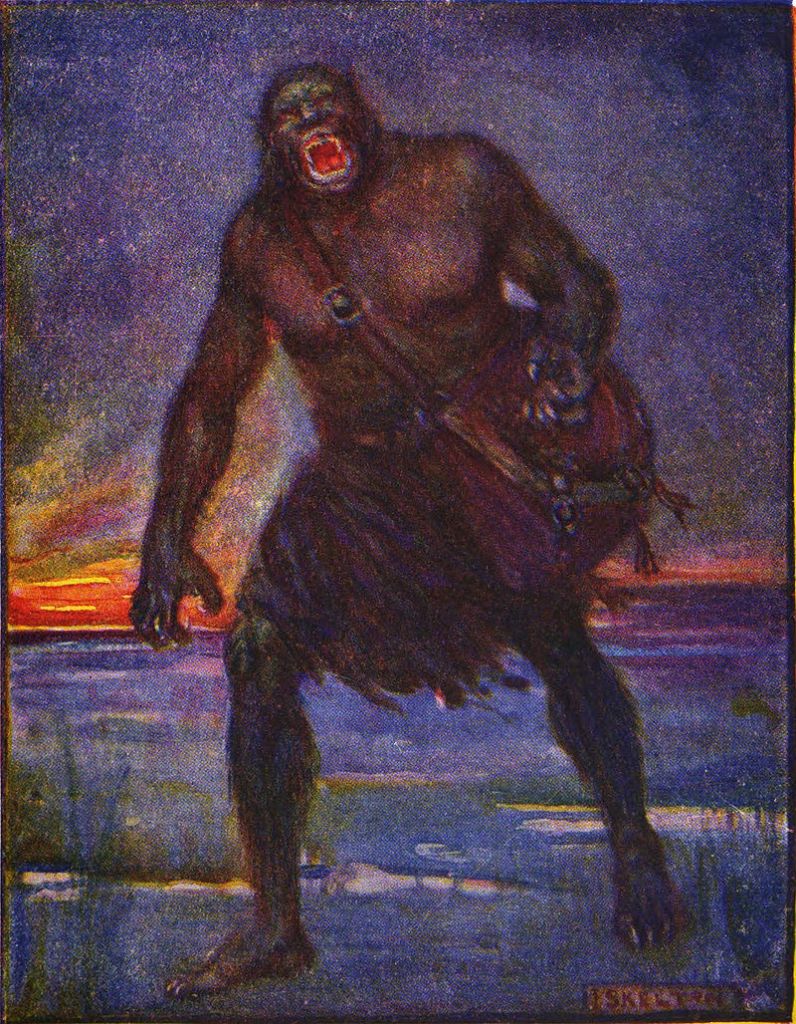
In Beowulf, after the protagonist has defeated the monstrous Grendel in the hall of Heorot, he travels beyond the safety of its walls to the mere from which the monsters come to slay Grendel’s mother.
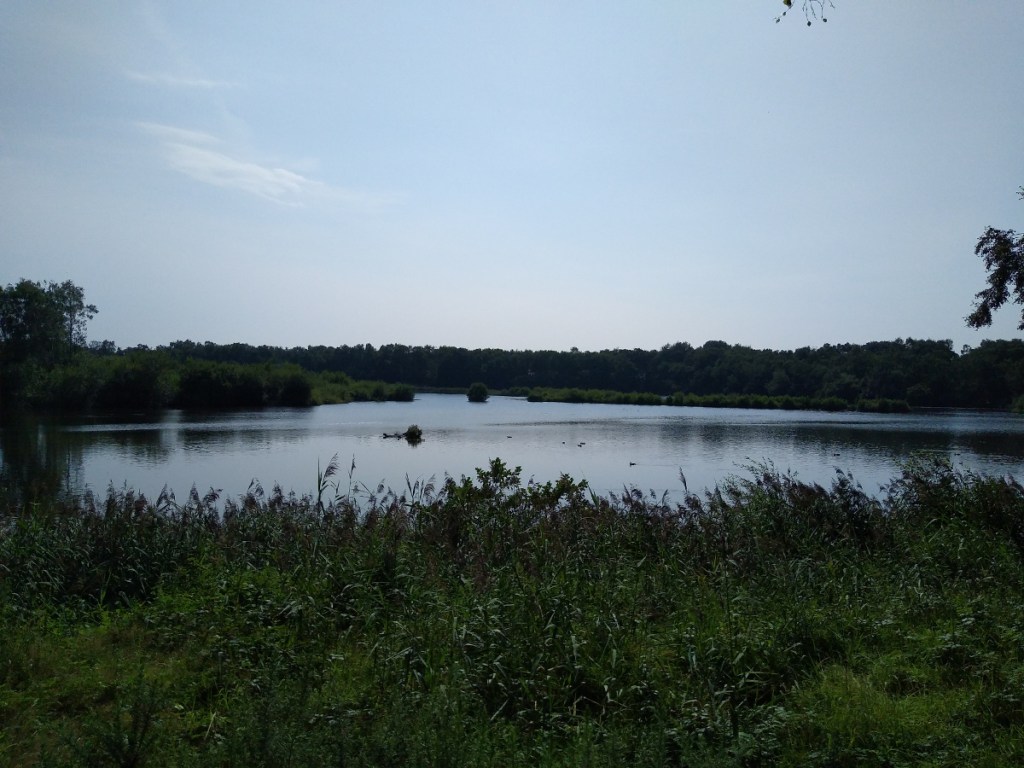
Beforehand, Hrothgar, King of the Danes, whose hall Beowulf is defending, describes ‘the haunted mere’:
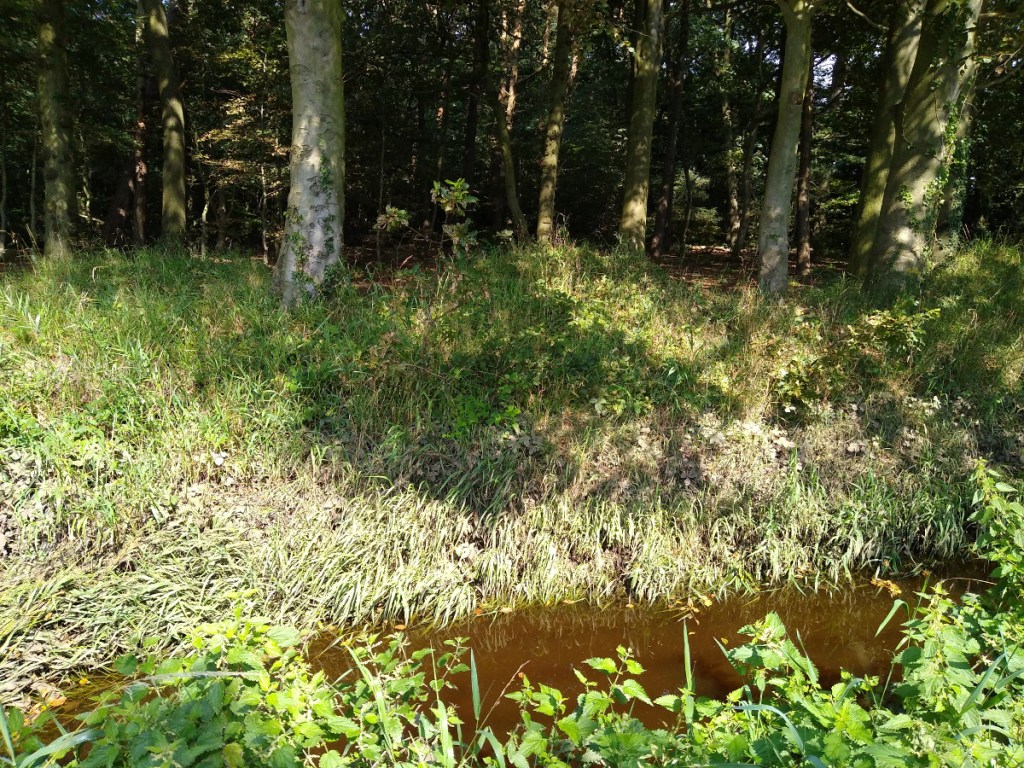
‘a frost-stiffened wood waits and keeps watch above a mere; the overhanging bank is a maze of tree-roots mirrored in its surface. At night there, something uncanny happens: the water burns. And the mere-bottom has never been sounded by the sons of men.’
When Beowulf and his warriors arrive they find:
‘… The water was infested with all kinds of reptiles. There were writhing sea-dragons and monsters slouching on slopes of the cliff, serpents and wild things…’
These quotes reflect a view of the wild land beyond the hall as uncanny and peopled by monsters. Beowulf is set in sixth century Scandinavia, but was composed in East Anglia during the seventh century and written down in the tenth century. I believe it was popular amongst the Anglo-Saxons due to the similarities between the landscapes and beliefs in Scandinavia and England.
Grendel is described as a ‘dark death shadow / who lurked and swooped in the long nights / on the misty moors’. The ‘shadow-stalker’ comes ‘In off the moors, down through the mist bands… greedily loping’. His mother is a ‘monstrous hell-bride’, a ‘hell-dam’, a ‘swamp thing from hell’, ‘a tarn-hag in all her terrible strength’, a ‘she-wolf’, and a ‘wolf of the deep’ who lurks in the mere. We find repeated associations between monsters and an untamed landscape viewed as hellish.
No doubt the descriptions of the Danish landscape and its monsters resonated with the people of East Anglia with its extensive fenlands and lowland moors and bogs and its many meres – Trundle Mere, Whittlesey Mere, Stretham Mere, Soham Mere, Ug Mere, and Ramsey Mere, now sadly drained.
It’s likely the Anglo-Saxons and the Brythonic people whose culture they replaced here in Lancashire viewed the Region Linnuis, ‘the Lake Region’, where Martin Mere (at twenty miles in diameter once the largest lake in England), Shoricar’s Mere, Renacres Mere, Gettern Mere, and Barton Mere once lay, as similarly haunted, before they were all drained with the bogs and marshes.
In the fourteenth century Middle English story Sir Gawain and the Green Knight the protagonist battles against an array of monsters as he travels north ‘into the wilderness of the Wirral’ and beyond.
‘He had death-struggles with dragons, did battle with wolves, Warred with wild trolls that dwelt among the crags, Battled with bulls and bears and boars at other times, And ogres that panted after him on the high fells.’
Memories of Grendel-like monsters might be retained in Lancashire’s rich boggart lore. Boggarts are malevolent spirits who haunted the bogs then later the farmhouses when the land was drained. Some merely caused mischief, scaring children with their penny-whistle like voices, breaking pots and pans or curdling milk but others made livestock lame or ill and even killed animals and humans.
King Arthur’s Pit, on the shore of Martin Mere near Holmeswood Hall, was haunted by ‘boggarts and ghouls’. There are traditions of ‘shadowy night-time figures passing marl-pits near the old mere edge’.
Roby records the story of a ‘mermaid’ or ‘meer-woman’ abducting a baby from its natural father then leaving the child with a fisherman who gives him to a Captain Harrington to be fostered. This puts me in mind of the monstrous claw that steals a foal and, implicitly, Pryderi in the First Branch of The Mabinogion then leaves the boy in the care of Teyrnon who raises him as a foster-father.
Coupled with Martin Mere’s associations with the nymph, Vyviane, disappearing into the lake with the infant Lancelot du Lac (who is said to give his name to Lancashire) and with Arthur’s sword we might intuit these stories originate from the presence of a female water deity or monster who stole children.
During the digging of the sluice to drain Martin Mere ‘human bodies entire and uncorrupted’ were found and its seems possible they were deliberately deposited in the water. From the surrounding area we have evidence of bog burials at North Meols and, further afield, Lindow and Worsley Man. Lindow Man was sacrificed, dying a ‘three fold death’, and others may have been sacrifices to water deities.
Bog burials took place from the Bronze Age through the Romano-British period in Britain and were common across Germany and Denmark showing shared practices and beliefs surrounding wet places.
Unfortunately we do not know for certain who these sacrifices were to or how these people perceived their deities. It is clear that by the sixth century, due to the influence of Christianity, both Grendel and his mother and the wild landscape they inhabited had been heavily demonised.
This is evidenced by the Christianised explanation of the origins of these ‘fatherless creatures’ as springing from the exile of Cain for killing Abel with ‘ogres and elves and evil phantoms / and the giants too’.
The pagan beliefs of the Danes are referred to and condemned in Beowulf:
‘Sometimes at pagan shrines they vowed offerings to idols, swore oaths that the killer of souls might come to their aid and save the people. That was their way, their heathenish hope; deep in their hearts they remembered hell.’
Yet these explanations come up against the conflicting belief these ‘huge marauders’ are ‘from some other world’ and that their origin ‘hidden in a past of demons and ghosts’, defies explanation.
The grendelkin, like the later boggarts, occupy liminal places in the landscape and between the worlds. A wonderful verb, scripan, ‘meaning a sinewy and sinister gliding movement’ is used to describe the way they move and may also apply to the way they shift between the worlds. The dobbie, our northern British waterhorse, a similar kind of being, ‘is described as a big, black, horrible, misshapen thing that “slips about”’ and is ‘more likely to be seen out of the corner of the eye’.
Here, in Lancashire, the deities of the lake were not slain by a dark age ‘hero’ but met a slower, more ignominious end at the hands of the wealthy landowners who drained the mere. The first was Thomas Fleetwood who secured an Act of Parliament in 1694. He employed 2,000 workers to dig the 1.5 mile channel known as the Sluice to the coast at Crossens. His draining of the mere was completed by 1697.
Fleetwood died in 1717 and the following is written on his monument in the church in Churchtown:
‘He wished his bones to be here laid, because he made into dry and firm land the great Martinesian Marsh, by the water having been conveyed through a fosse to the neighbouring sea – a work, which, as the ancients dared not to attempt, posterity will hardly credit… These labours having been accomplished, he at length, alas! Too soon, laid down and died, on the 22nd April, A.D. 1717, in the 56th year of his age.’
Fleetwood’s success was short lived. The flow of the water was not strong enough to prevent the Sluice from silting up and the floodgates were breached leading to winter flooding. In 1778 Thomas Eccleston employed Mr. Gilbert (who built the Bridgewater Canal) to redesign and rebuild the drainage system, which again was successful for a while, until the mere was inundated by the Douglas.
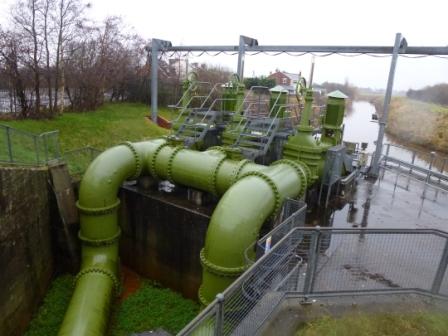
So continued the cycle of rebuilding and flooding until the new pumping station at Crossens was built in 1961 which is capable of 373,000 gallons per minute and is already running to full capacity at peak times.
This leads me to wonder whether the deities of the mere and its monsters are dead or merely waiting beyond the lumbs and deeps of the mere bottom in places ‘never sounded by the sons of men’.
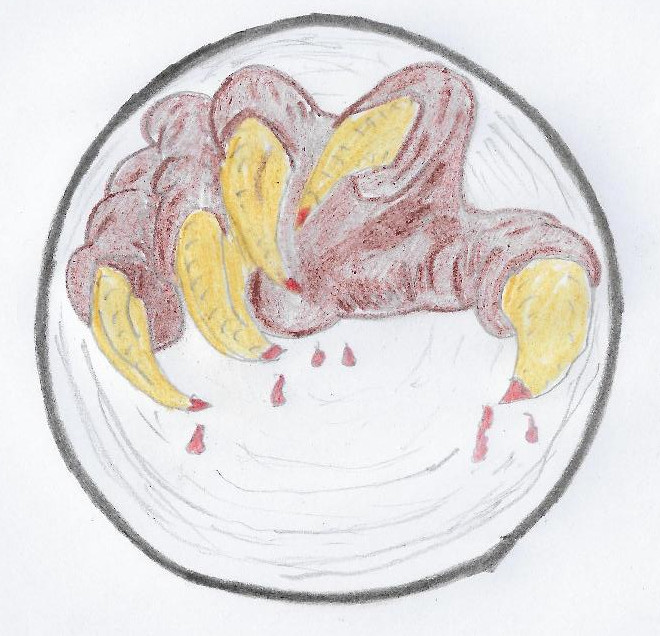
‘after the noise an enormous claw comes through the window, and grabs the foal by the mane. Teyrnon draws his sword and cuts off the arm at the elbow… by the door there is a small boy.’ The Second Branch
I’m just reaching out for your foal, for your first-born son. I like to see blood on my claws. I like the taste although I do not eat them.
I just want you to know there is a hole in your reality bigger than the sun.
That nothing is safe.
Nothing.
You are not the only one who feels terror.
I know you long for my blood – to lick it from your blade when you have nailed my arm above your window.
The exchange must be complete.
You try to close the window again.
How long can I go on reaching out when it only ends in pain?
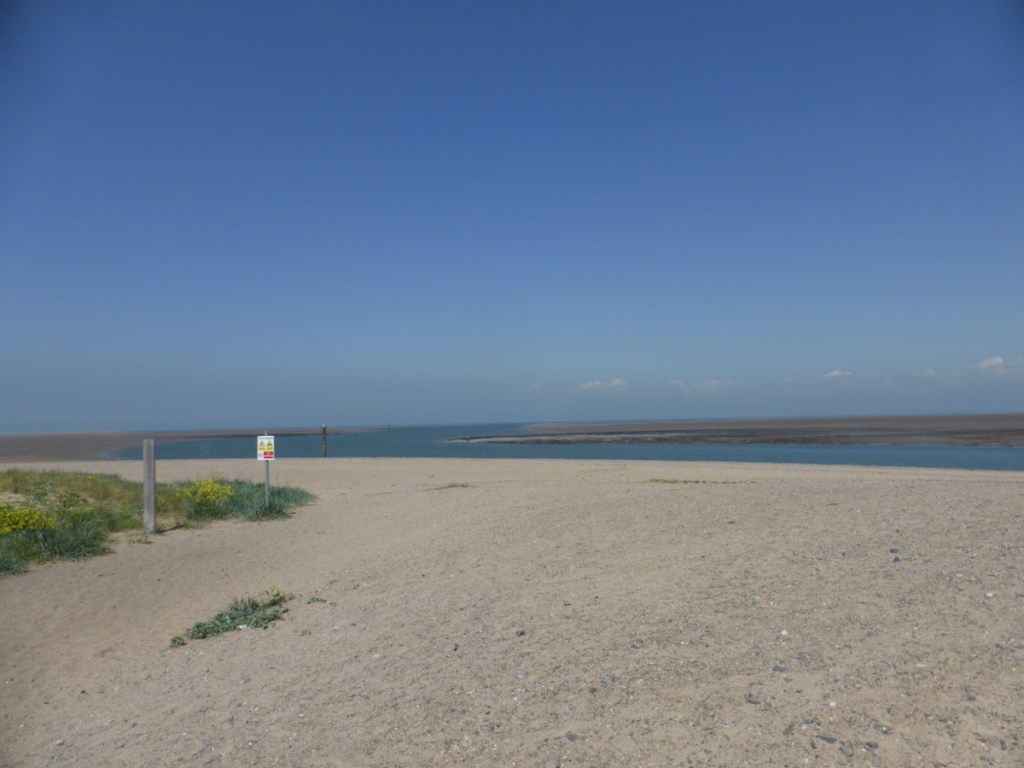
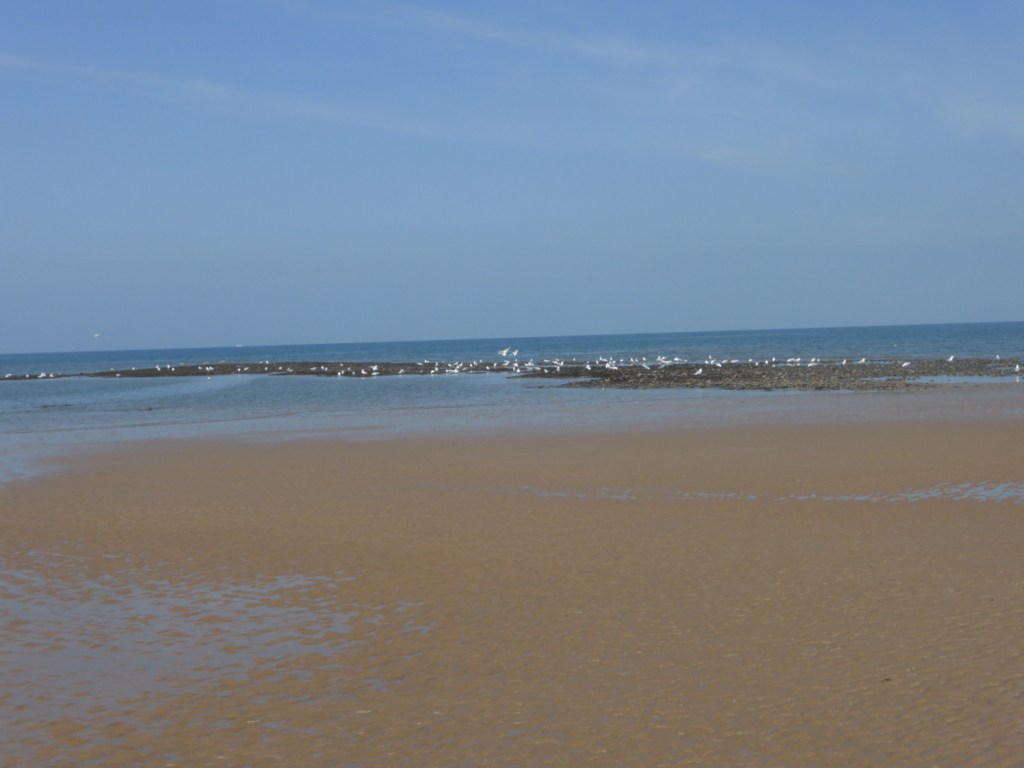
I have recently been revisiting the theory that Sétanta (later Cú Chulainn), a hero and perhaps a deity the Irish myths, was associated with the Iron Age Setantii tribe of northern Britain. Writing in 2CE the Roman geographer, Ptolemy, refers to Portus Setantiorum ‘the Port of the Setantii’, which was located at the mouth of the river Wyre, and also to Seteia, the river Mersey. This suggests the Setantii occupied the lowlands of present-day Cheshire and Lancashire from the Mersey to the Wyre.
The etymology of Setantii is one of much debate. Graham Isaac suggests it is emended from sego ‘strong’ and Andrew Breeze that is corrupted from ‘the Celtic *met “cut, harvest”, as in Welsh medaf “I reap”, Medi “September” (when corn is cut), Middle Irish methel “reaping party”’. Breeze notes these people were not ‘harmless agriculturalists’ and ‘Welsh literature indicates a bloodier sense’. Medel means ‘reaper’ ‘killer, mower down (of enemies in combat)’. The warrior-prince Owain Rheged is referred to by Taliesin as medel galon ‘a reaper of enemies’. Thus Metantii or Setantii is best translated as ‘reapers (of men), cutters down (in battle)’ and Meteia or Seteia as ‘reaper’.
In Celtic and Manx Folklore John Rhys puts forward the theory that Sétanta Beg means ‘the Little Setantian’, which we might translate as ‘reaping one’, and this would certainly fit with his ferocity in battle.
Rhys associates both Sétanta and Seithenin with the lost lands between Ireland and Wales. In Welsh legend Seithenin caused the flooding of the lands of Gwyddno Garanhir (1) when he failed to close the flood gates due to his liason with Mererid, the ‘fountain cup-bearer’, whose waters were loosed. Traditionally this story is associated with Cantre’r Gwaelod, ‘the Bottom Hundred’, ‘the shallows of Cardigan Bay’. Yet this area extended ‘northwards… off the coast of Cheshire and Lancashire, and occupied Morecambe Bay with a dense growth of oak, Scotch fir, alder, birch, and hazel’.
Gwyddno had two ports – Porth Wyddno (Borth) in Wales and ‘Porth Wyddno in the North’, one of Three Chief Ports in The Triads of the Island of Britain, which was likely Portus Setantiorum.
Holder theorises that Sétanta derives from Setantios and he was originally a Celtic god. Is it possible his mythos, the best developed of all the Irish deities, originated from the people who occupied the lost lands off the Lancashire coast and were later known as the Setantii?
Sétanta’s Birth and Boyhood
The stories of Sétanta/Cú Chulainn were written down by medieval Irish scribes during the 12th century in The Book of the Dun Cow and The Book of Leinster andare now firmly embedded in the Irish landscape. He is associated with Ulster, the Ulstermen, and their king, Conchobar.
‘The Birth of Cú Chulainn’ is a story with much mythic depth. Conchobar rules Ireland from Emain Macha. The plain is devastated by a flock of magical birds, ‘nine-score’ ‘each pair… linked by a silver chain’. Conchobar, his daughter and charioteer, Deichtine, and nine other charioteers hunt them. A heavy snow falls and they are forced to seek refuge in a storehouse where they are welcomed to feast by its owner. His wife is in labour and Deichtine helps her give birth to a son. At the same time a mare gives birth to two colts outside. Deichtine nurses the boy and he is given the colts.
Afterwards Conchobar and his company find themselves east of the Bruig (Newgrange) ‘no house, no birds, only their horses and the boy and his colts’. Deichtine takes the boy to Emain Macha and continues to nurse him but, to her heart break, he dies. Afterwards she drinks a ‘tiny creature’ from a copper vessel. That evening the god, Lug, appears to her and tells her she is pregnant by him and must call their son Sétanta. Because she is engaged to Sualtam mac Róich and fears he may suspect she slept with Conchobar she aborts the child, then becomes pregnant by Sualtam and bears a son. He is called Sétanta and thus has both thisworldly and otherworldly fathers – Sualtam and Lug. His dual paternity, like that of Pryderi, son of Pwyll and Arawn in the Welsh myths, marks him as a ‘special son’.
Lug is an Irish deity who is descended from Cian of the Tuatha Dé Danann, the Irish gods, and Eithne, daughter of Balor, one of the monstrous Formorians ‘Undersea Dwellers’. Sétanta’s descent from a human woman on one side and gods and giants on the other goes a long way to explain his superhuman qualities.
As a mere boy he is described as going to play with the others and fending off fifty javelins with his toy shield, stopping fifty hurling balls with his chest, and warding off fifty hurleys with his one hurley.
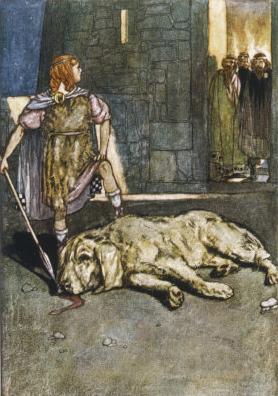
Sétanta receives the name Cú Chulainn after being attacked by a hound belonging to Culann the smith. He puts an end to it in a grotesque manner. ‘The lad struck his ball with his hurley so that the ball shot down the throat of the hound and carried its insides out through its backside. Then he grabbed two of its legs and smashed it to pieces against a nearby pillar stone’. As recompense to Culann, he offers to be Culann’s hound and guard Muirthemne Plain until a pup has been raised to take his place. From then he is known as Cú Chulainn – the Hound of Culann.
Training with Scáthach
Cú Chulainn trains with the warrior-woman Scáthach ‘the Shadow’ at Dún Scáith ‘The Fortress of Shadows’ on the Isle of Skye in Scotland. From her he learns the arts of war including ‘the apple-feat, the thunder-feat, the blade-feat, the foen-feat, and the spear-feat, the rope-feat, the body-feat, the cat’s feat, the salmon-feat of a chariot-chief, the throw of the staff, the jump over […], the whirl of a brave chariot-chief, the spear of the bellows, the boi of swiftness, the wheel-feat, the othar-feat, the breath-feat, the brud geme, the hero’s whoop, the blow […], the counter-blow, running up a lance and righting the body on its point, the scythe-chariot, and the hero’s twisting round the points of spears’.
Most fearsome is his use of the barbed spear known as the gae bolga: ‘thrown from the fork of the foot; it made a single wound when it entered a man’s body, whereupon it opened into thirty barbs, and it could not be taken from a man’s body without the flesh being cut away around it’.
During this period Cú Chulainn battles against Scáthach’s rival, another warrior-woman called Aife, defeats her, and offers to spare her life but only on the condition that she bears him a son.
The story of Cú Chulainn’s training with Scáthach shows links with Britain and the existence of a tradition where male warriors were trained by warrior women. This is also found in the Welsh myths where Peredur is trained by the Nine Witches of Caer Loyw and it might be suggested that Orddu, the Very Black Witch, of Pennant Gofid, in the North, fulfilled a similar role.
The Battle Rage of Cú Chulainn
After his training Cú Chulainn’s feats are many and his greatest is defending Ulster and the Brown Bull single handedly against the armies of Connacht whilst the Ulstermen are laid up with the Curse of Macha (1). This is recorded in The Tain. After putting them off by magic, picking them off with guerilla tactics and fighting against them in single combat he defeats them in three great massacres.
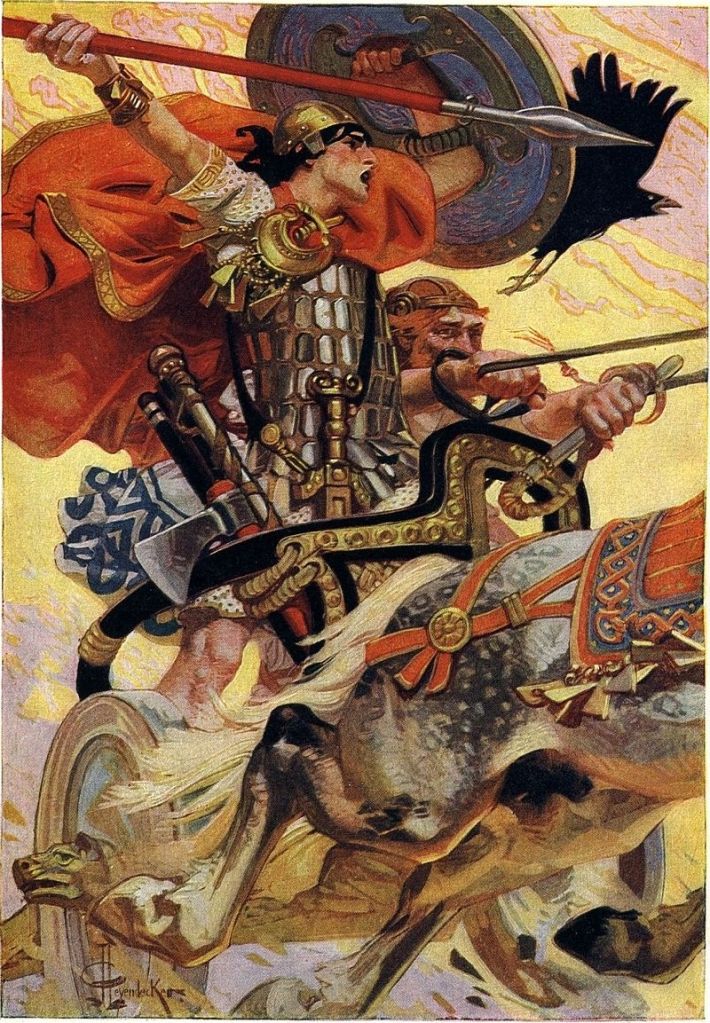
Here we witness his ability to cause incredible violence. With ‘his scythed chariot that glittered with iron tangs, blades, hooks, hard prongs and brutal spikes, barbs and sharp nails on every shaft, strut, strap and truss’ he drives into the ranks ‘three times encircling them with great ramparts of their own corpses piled sole to sole and headless neck to headless neck’, slaying ‘seven-score and ten kings’.
When he fights, Cú Chulainn is taken over by a battle rage known as his ‘warp spasm’ or ‘torque’. Its vivid descriptions, no doubt a delight to storytellers, driven to greater exaggerations, are worth citing.
‘The first Torque seized Cú Chulainn and turned him into a contorted thing, unrecognisably horrible and grotesque. Every slab and every sinew of him, joint and muscle, shuddered from head to foot like a tree in a storm or a reed in a stream. His body revolved furiously inside his skin. His feet and his shins and his knees jumped to the back; his heels and his calves and his hams to the front. The bunched sinews of his calves jumped to the front of his shins, bulging with knots the size of a warrior’s clenched fist. The ropes of his neck rippled from ear to nape in an immense, monstrous, incalculable knobs, each as big as the head of a month-old child.
Then he made a red cauldron of his face and features: he sucked one of his eyes so deep into his head that a wild crane would find it difficult to plumb the depths of his skull to drag that eye back to its socket; the other popped out on to his cheek. His mouth became a terrifying, twisted grin. His cheek peeled back from his jaws so you could see his lungs and liver flapping in his throat… The hero’s light sprang from his forehead… thick, steady, strong as the mast of a tall ship was the straight spout of dark blood that rose up from the fount of his skull to dissolve in an otherworldly mist…’
In his battle fury Cú Chulainn is described as warped and monstrous and these transformations may derive from his Formorian heritage. This is hinted at in a further passage: ‘Cú Chulainn torqued himself a hundredfold. He swelled and bellied like a bladder full of breath until he arched up over Fer Diad like a monstrously distorted rainbow, tall and horrible as a Formorian giant or a deep-sea merman’.
He also displays the ability to call up otherworldly spirits. His ‘roar of a hundred warriors’ is ‘echoed by the goblins and ghouls and sprites of the glen and the fiends of the air, for their howls would resound before him, above him, and around him any time he shed the blood of warriors and heroes’. ‘The clouds that boiled above him in his fury glimmered and flickered with malignant flares and sultry smoke – the torches of the Badb.’ This puts us in mind of the Scream over Annwn.
Even when he displays his ‘true beauty’ he is otherworldly with his hair in three layers, dark, blood-red and yellow, ‘four dimples in each cheek – yellow, green, blue and purple. Seven brilliant gems gleamed in each regal eye. Each foot had seven toes and each hand seven fingers, the nails or claws or talons of each with the grip of a hawk or griffin… He held nine human heads in one hand, ten in the other’.
Sétanta/Cú Chulainn is depicted a monstrous reaper of men and as a hunter of heads. Head-hunting was common amongst the Celtic peoples, particularly the Setantii, which is evidenced by the large number of severed heads ritually buried across their territories. It has been noted, whilst there is an absence of chariot burials in Ireland, there are many in northern Britain. So there is, at least, an argument that this otherworldly figure, like a giant or merman, originates from the people who once occupied the drowned lands between Britain and Ireland and may have been a Setantian god or hero.
The Tragedies of Cú Chulainn
Amidst the relentless violence endemic to a warrior culture whose greatest aim was winning everlasting fame through battle prowess we find some moving scenes based around Cú Chulainn’s relationships. When Cú Chulainn is badly wounded during his battle against the armies of Connacht his otherworld father, Lug, appears to fight his battle for three nights and days whilst he heals.
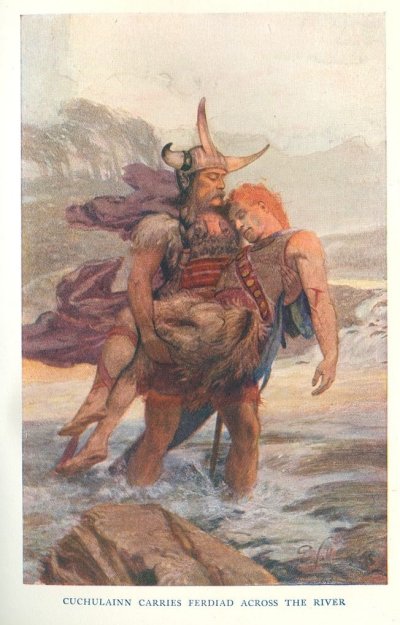
Tragically Cú Chulainn kills his son by Aife because he does not know who he is until he sees his ring. In an equally tragic scene Cú Chulainn faces and kills his foster-brother who was also possibly his lover, Fer Diad, with whom he trained with Scáthach. Their relationship is described in poignant verse:
Two hearts that beat as one, we were comrades in the woods, men who shared a bed and the same deep sleep after heavy fighting in strange territories. Apprentices of Scáthach, we would ride out together to explore the dark woods.
After many days of battle with various weapons Cú Chulainn puts an end to Fer Diad with the gae bolga.
His lament is heart wrenching:
Sad is the thing that became Scáthach’s two brave foster-sons – I wounded and dripping with gore, your chariot standing empty.
Sad is the thing that became Scáthach’s two brave foster-sons – I leak blood from every pore and you lie dead forever.
Sad is the thing that became Scáthach’s two brave foster-sons – you dead, I bursting with life. Courage has a brutal core.
It puts me in mind of the lines spoken by Gwyn, our British death-god and gatherer of souls, who is doomed to live on whilst the warriors of Britain perish in ‘The Conversation of Gwyn ap Nudd and Gwyddno Garanhir’ (2), which perhaps speaks of a shared origin to these poems.
Cú Chulainn’s love life also contains tragedy. His main lover is Emer but their relationship is put into jeopardy when Cú Chulainn goes to hunt her one of two magical birds ‘coupled with a red-gold chain’. He shoots but does not kill one. They turn out to be fairy women and, when he falls asleep against a stone, they take revenge by beating him with horsewhips until ‘there is no life left in him’.
He takes to his sick bed for a year and learns the only cure is to help one of them, Fand, to battle against her enemies. They fall in love and sleep together yet she is the wife of the sea-god, Manannan. Cú Chulainn returns to Emer but both are heart-broken. Cú Chulainn wanders the mountains neither sleeping nor drinking (3) until Manannan shakes his cloak between Cú Chulainn and Fand so she is forgotten.
Cú Chulainn’s death is fittingly tragic. His old enemy, Queen Medb of Connacht conspires to kill him with the sons of her enemies. He is tricked into breaking his geis of not eating the meat of his sacred animal, the dog, and by this he is weakened. He is killed by Lugaid, the son of Cú Roí, another otherworldy figure with whom he battles and defeats to win a maiden called Blathnat (4).
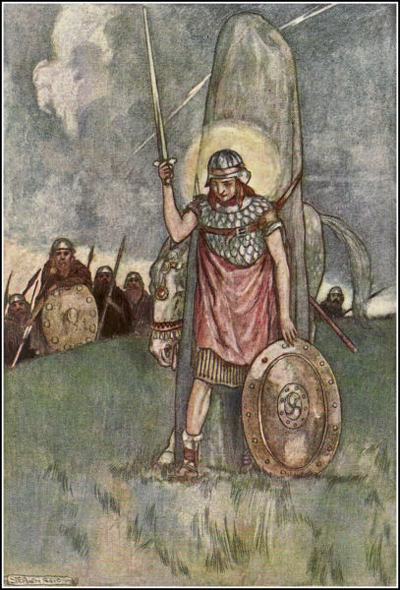
With a magical spear destined to kill three ‘kings’, Lugaid kills Láeg, Cú Chulainn’s charioteer, Liath Macha, Cú Chulainn’s horse and finally Cú Chulainn himself. Mortally wounded, Cú Chulainn ties himself to a standing stone so he can die on his feet facing his enemies. They remain afraid of him even after his death, not daring to approach until a raven lands on his shoulder. This symbolises he has been beaten by the only opponent worthy of defeating him, the death goddess, the Morrigan (5).
A Hero of the Setantii?
Here I have provided only glimpses into the rich mythos surrounding Sétanta/Cú Chulainn: his birth and dual paternity, his naming as Culann’s Hound, his training with Scáthach, his feats as a warrior, his love life (which features a number of women and possibly a man), and his death.
As we have seen, these stories are now firmly embedded within the Irish landscape. However, we know that many centuries ago Britain and Ireland were near joined together and that the gods, the Tuatha Dé Danann and the Children of Don, share many similarities. Nodens/Nuada, the king of the gods, was worshipped on the Lancashire coast and his son, Gwyn, might have conversed here with Gwyddno. Lug(us) was the patron god of Carlisle (Luguvalium) further north. If he was venerated here it would make sense his son, Sétanta/Setantios, was also viewed also an important deity or hero.
The evidence suggests there is at least a possibility the stories of Sétanta originated from the lost lands off the coast of Lancashire where gods and giants gave birth to monsters, that this monstrous and beguiling head-reaping hero was one of the deities of the Setantii, the reapers of men.
(1) After Macha raced against the horses of the king of Ulster and won she gave birth and screamed that for five days and four nights any man who heard her would be afflicted by her labour pains. She then died. Her curse was passed on for nine generations. Macha’s name was given to Emain Macha. (2) I was there when the warriors of Britain were slain From the east to the north; I live on, they are in the grave.
I was there when the warriors of Britain were slain From the east to the south; I live on, they are dead. (3) His state resembles geilt/wyllt ‘mad’ or ‘wild’ in the Welsh and Irish myths where we find Suibhne Geilt and Myrddin Wyllt taking on bird transformations and Cynedyr Wyllt ‘nine times wilder than the wildest beast on the mountain’. (4) ‘The contention of Corroi and Cocholyn’ (Cú Roí and Cú Chulainn) is referred to in the medieval Welsh poem ‘The Death Song of Corroi’ in The Book of Taliesin and the beheading game Cú Chulainn plays with Cú Roí perhaps depicts a conflict with the Head of the Otherworld, here known as Gwyn. (5) The Morrigan appears earlier in the stories as young prophet then fights against him as an eel, a she-wolf, and a hornless red heifer. After the battle she tricks him into healing her when she appears as a one-eyed hag milking a cow with three teats by drinking from each which heals her three wounds.
SOURCES
Andrew Breeze, ‘Three Celtic Toponyms: Setantii, Blencathra, and Pen-Y-Ghent, Northern History, XLII: 1, (University of Leeds, 2006) Ciaran Carson (transl.), The Tain, (Penguin, 2008) Eoin Mac Neill, Varia. I, Eriu, Vol. 11, (Royal Irish Academy 1932) Greg Hill, (transl.) ‘The Conversation of Gwyn ap Nudd and Gwyddno Garanhir’, https://awenydd.cymru/the-conversation-between-gwyn-ap-nudd-and-gwyddno-garanhir/ Jeffrey Ganz, Early Irish Myths and Sagas, (Penguin, 1981) John Rhys, Celtic and Manx Folklore: Volume One, (Project Gutenberg, 2017) Rachel Bromwich (ed), The Triads of the Island of Britain, (University of Wales Press, 2014) Sioned Davies (transl.), The Mabinogion, (Oxford University Press, 2007)
With thanks to Wikipedia for the images of Cú Chulainn. The photographs of the former site of Portus Setantiorum near the mouth of the river Wyre and the coast from Rossall Point where the remnants of the forest have been seen are my own.
from Ceunant Coch. I feel like Blaenau Ffestiniog.
No, the mountains above slate hearts torn out.
Where have we hidden it this time in this never ending
shadowplay of shifting guises not knowing whose hand
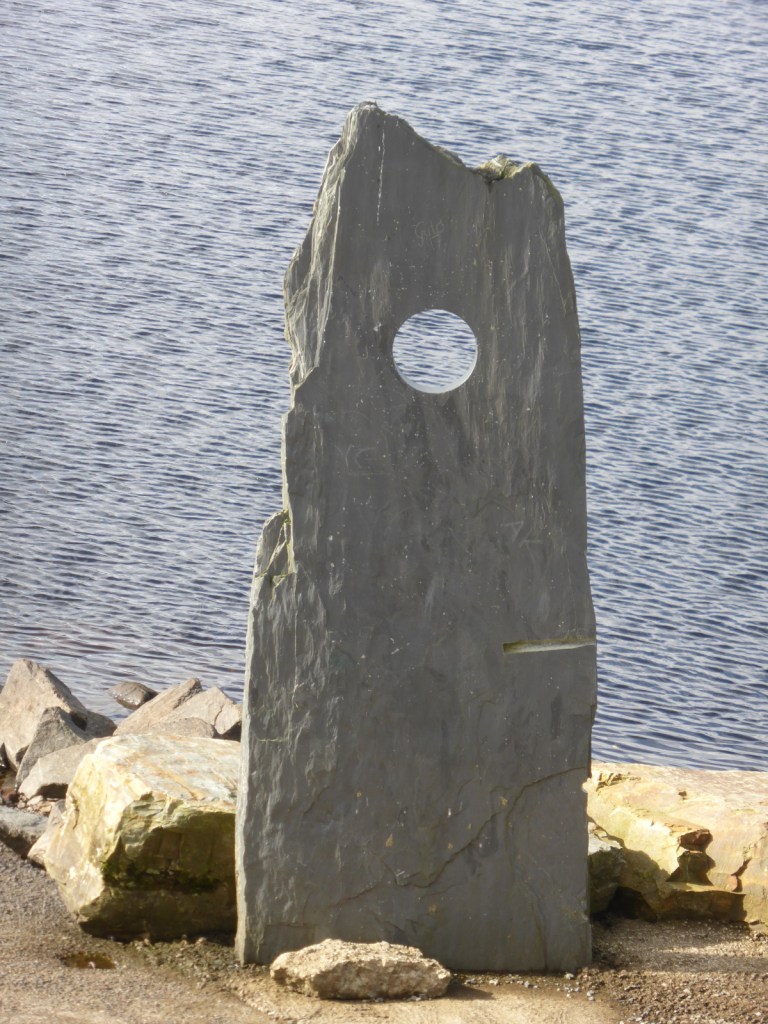
reaches through the hole in the slate into another world
and drags something back to make us whole?
This poem is based on the battle between Lleu Llaw Gyffes and Gronw Pebyr in the Fourth Branch of The Mabinogi. In it I believe the King of Annwn takes the guise of Gronw to defeat Lleu. In an additional identity exchange, in this poem, I found myself in the role of Annwn’s king becoming Gronw.
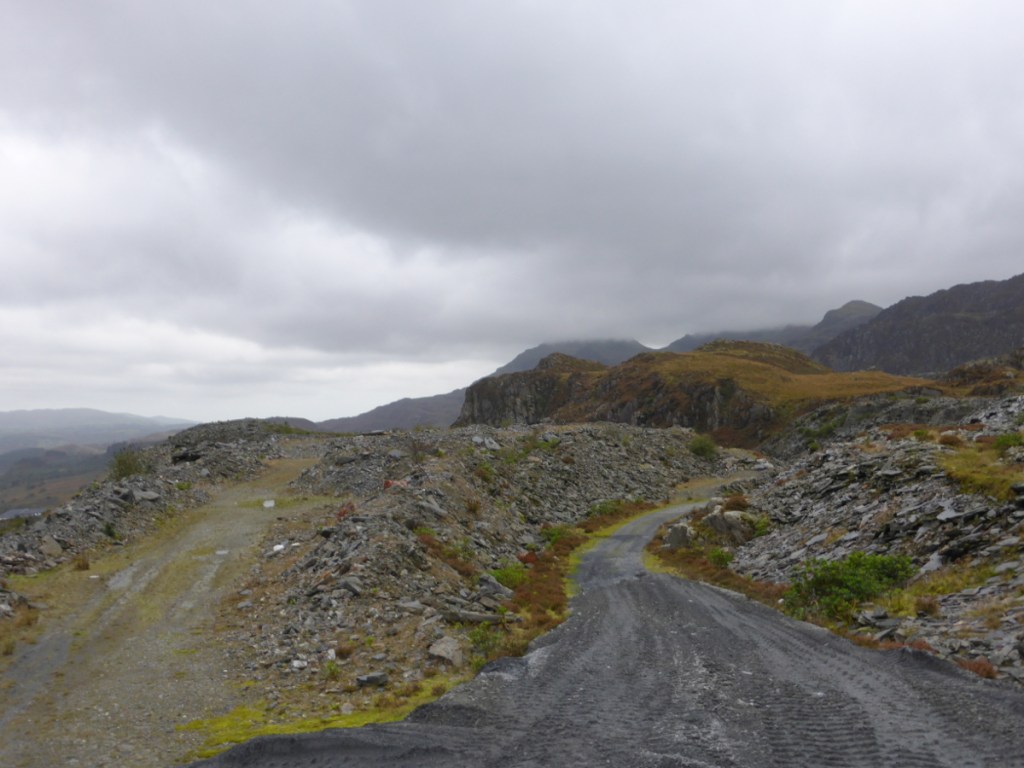
The battle took place on the bank of Afon Cynfal near Bryn Cygergyr ‘the Hill of the Blow’. Llech Ronw ‘the Slate of Gronw’ is a stone found in 1934 on the bank of the Cynfal. It was washed down from Ceunant Coch and now stands on Afon Bryn Saeth. I haven’t visited Llech Ronw. The pictured stone is the replica at Llyn Trawsfynydd and the accompanying photograph is of the mountains above Blaenau Ffestiniog.
Over the harvest period I have been reflecting on the strange birth and death of Lleu Llaw Gyffes, the Welsh cognate of the Irish Lugh, who was the instigator of Lughnasadh. Will Parker speculates that a proto-Celtic myth underlies their stories. In this article I am going to focus on the story of Lleu in the Fourth Branch of The Mabinogi and look at how other medieval Welsh texts and parallels with the Irish Lugh might help us understand his birth and death and elucidate his mythos.
A ‘Virgin Birth’
The Fourth Branch is set in Gwynedd, in North Wales, and concerns the Children of Don. Don is a mother goddess cognate with the Irish Dana, mother of the Tuatha Dé Danann. Whilst the Tuatha Dé Danann are represented as gods the Children of Don are euhemerised as humans with magical qualities. In this story Math is Don’s brother and her children include Arianrhod, Gwydion, and Gilfaethwy.
At the beginning of the story we are told Math ‘could not live unless his feet were in the lap of a virgin, except when the turmoil of war prevented him’. Gilfaethwy falls in love with his virgin footholder, Goewin, and being unable to sleep with her makes him ill. Gwydion plots with Gilfaethwy to cause a war by stealing pigs from Pryderi, in South Wales. Whilst Math is away fighting, Gwydion helps Gilfaethwy to take Goewin ‘against her will’ in Math’s bed in Caer Dathyl.
When Math finds out he is understandably furious and punishes Gwydion and Gilfaethwy by using his wand to turn them into animals – stags, boar and wolves, alternating male and female, who give birth to three sons. Afterwards Math requires a new virgin footholder and Gwydion suggests Arianrhod.
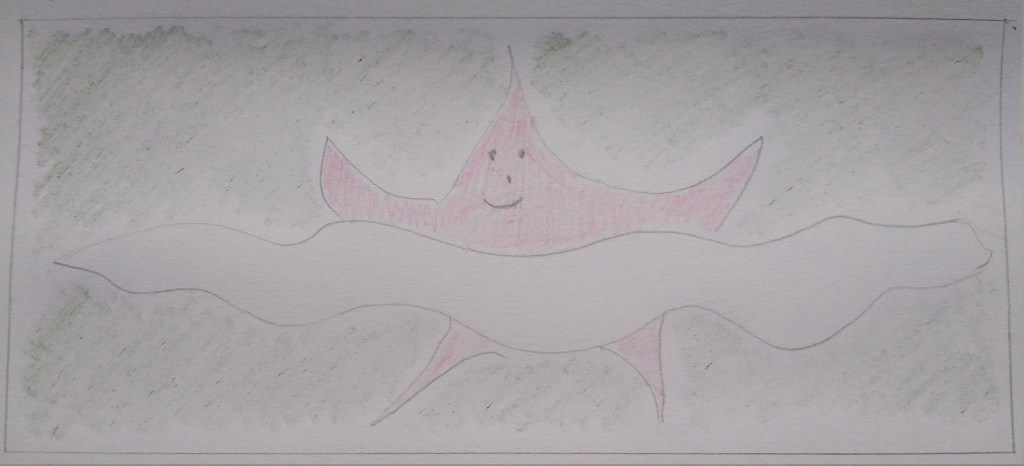
As a test of her virginity Arianrhod is challenged to step over Math’s wand. The wand breaks and she drops a ‘large, sturdy, yellow-haired boy’ and ‘a small something’. Before anyone else sees this strangeness Gwydion wraps it in ‘a sheet of brocaded silk’ and hides it in ‘a small chest at the foot of his bed’.
This pethan, ‘small something’, has placental qualities. It wakes Gwydion with a cry. When he opens the chest it reveals itself as a small boy, waving his arms, throwing away the sheets.
This perhaps represents a second birth, to Gwydion, who raises the boy as a father figure, with the aid of a wet nurse. He grows quickly, sturdy as an eight-year-old at only four years old. On top of his uncanny transformation the boy’s quick growth marks him out as strange and supernatural. Thus is recorded the ‘virgin birth’ of Lleu as a strange something from a virgin who is not a virgin.
It seems implicit Gwydion knows Arianrhod is not a virgin and he knowingly chooses to induce the birth. The reason behind his knowledge is made clearer by lines from a poem by Lewys Môn. He refers to Arianrhod, the ‘chaste one, white-armed and wise’, as the ‘pillow’ of Math, ‘the same as the snow, / a man could not live without her’. This shows a tale exists in which Arianrhod is Math’s footholder. The similarities suggest Gilfaethwy or Gwydion raped her and made her pregnant. If Gwydion fathered Lleu this would explain why he is so keen to smuggle away and raise the boy.
Yet, if Gwydion openly took Arianrhod against her will it seems likely that, even if she was too afraid to name and shame him, she would have made some effort to avoid the virginity test. This raises the possibility that Gwydion may have impregnated Arianrhod some other way without her knowing. As he is well known for his abilities as a magician it seems likely he did it by magic.
John Carey draws parallels between the conception of Lleu and the conception of Setanta (later Cu Chulainn) by Lugh. In the latter, whilst the king, Conchabar, is away from court, his unmarried daughter becomes pregnant by drinking a ‘small creature’ and Lugh appears in a dream to tell her she will give birth to his child. Due to be married, she induces a miscarriage on her wedding night.
It seems possible Gwydion got Arianrhod pregnant in a similar way. When I meditate on the scene I see him putting his wand into a glass of water and the wand seeming to bend due to the refraction of the light rays and this linking imagistically to the broken wand in the later virginity test. Arianrhod’s ‘dropping’ of the boys contrasts with labour and is suggestive of a magically induced miscarriage. The disappearance of the first boy, Dylan of the Wave, to the sea may represent him being washed away.
Gwydion’s magical causation of Lleu’s ‘virgin birth’ is incredibly sinister and ethically suspect. We need to look ahead and to a variety of sources to divine the dark purpose behind his misdoings.
The Three Fates
In response to her ‘shame’ Arianrhod puts three fates on the boy: he will never have a name, weapons, or a wife. Gwydion, through further manipulations, helps the lad to overcome the fates. Disguised as shoemakers they travel to Caer Arianrhod and trick Arianrhod onto the boat to get a shoe fitted. When the boy strikes a wren, who lands on the deck, ‘in the leg, between the tendon and the bone’ she exclaims ‘it is with a skilful hand that the fair one has hit it’ and hence he is called Lleu Llaw Gyffes ‘the fair-haired one with the skilful hand’. To gain Lleu’s weapons the pair return again to Caer Arianrhod, this time disguised as storytellers, and Gwydion conjures an illusion of attacking ships. This tricks Arianrhod into arming them to help defend the fortress. Gwydion and Math get around the conjunction that Lleu will ‘never have a wife from the race that is on this earth at present’ by conjuring a maiden from the flowers of oak, broom, and meadowsweet.
These fates are obviously put on Lleu to prevent him from making the transition from boyhood to manhood. Yet it seems unfair Arianrhod chooses to punish the innocent boy rather than Gwydion. One argument may be that she punishes Gwydion by attempting to thwart his plans for the boy. However, in the Fourth Branch, we find out little about the boy’s destiny except his ‘death’ and revenge.
To make better sense of the origin of the fates and Gwydion’s purpose we must turn to the Irish myths. The birth of Lleu’s Irish cognate, Lugh, is equally strange. Lugh is the son of Cian of the Tuatha Dé Danann, and of Ethniu, daughter of Balor of the Formorians. The Formorians ‘Undersea Dwellers’ are a race of monstrous giants who oppose the Tuatha Dé Danann. Thus Lugh is part god, part giant.
An Irish folktale from Tory Island relates how Lugh is born. A druid prophecies to Balor that his grandson will kill him, thus he locks his only daughter, Eithne, in the Tór Mór (‘Great Tower’). Cian enters the tower with the aid of a fairy woman called Biróg and seduces Eithne. It seems likely enchantment is involved in entering the tower and the seduction of the giant’s daughter. She gives birth to triplets, who Balor wraps in a sheet and casts into a whirlpool. Two die but one is rescued by Biróg.
Here we find many similarities with the birth of Lleu. Both Arianrhod and Eithne are isolated as virgins and both Gwydion and Cian use magic in some way to bring about a ‘virgin birth’. In both stories one or two children are washed away but the ‘special son’ is kept by the father and a female helper (the wet nurse and Biróg) and a ‘sheet’ is involved, representing a secondary birth.
After his grandson is born Balor attempts to prevent his prophesied death by refusing him a name (to hamper his development) and a wife (Balor is prophesied to be killed on his grandson’s wedding night). Here we find the purpose behind the fates – to stop Lugh from killing his grandfather.
If the three fates on Lleu originally served the same function who, then, is his grandsire? From the Fourth Branch we know Arianrhod’s mother is Don, but the identity of her father is not recorded. It may be suggested he is Beli Mawr because Beli is named as the consort of Don (or Anna) in the Welsh genealogies and Nodens/Nudd/Lludd, whose Irish cognate is Nuada, the king of the Tuatha Dé Danann, is the son of Beli Mawr. This suggests the other children of Don were fathered by Beli.
Beli may be a later name of the Celtic god, Belenos, who is also known as Bel and depicted as a giant (he gives his name to places such as Belgrave in Leicester and Belthorn in Lancashire). The name Bel means ‘Shining’ and he is usually seen as a sun-god associated with the fire festival Beltane.
If Beli, the father of the Children of Don, was seen as an oppressive figure to be slain by Lleu, this would place this story in a similar context to the Greek myths in which Uranus is killed by his son, the titan, Cronus, and he by his son, Zeus, resulting in the imprisonment of the titans in Tartarus. The slaying of Balor by Lugh and Beli by Lleu would be our Celtic equivalents of the titanomachy.
This highlights a division between the primitive gods/giants and the skilled culture gods. Having a skill is the defining feature of the Tuatha Dé Danann and constitutes the difference between the dé ‘gods’ and the andé ‘ungods’ who are known in Gaul as the andedion and in Wales as the spirits of Annwn.
Whereas, in the Irish myths, the Formorians are a different race, in the Welsh myths the ‘ungods’ are of the Children of Don. Beli is their grandfather and Gwyn, son of Nudd, is the King of Annwn.
Thus it seems the purpose behind Gwydion’s plotting is to bring into being a ‘special son’ who will kill the primeval forefather of his kindred and establish the hegemony of the culture gods over the Annuvian.
Lleu the Giant Slayer
The prophesied death of Balor at the hands of Lugh is found in a number of the Irish stories. In ‘The Battle of Moytura’ Balor kills Nuada, the king of the Tuatha Dé Danann. Lugh travels to their court and is granted entry on account of his many skills and offers to fight with them against the Formorians.
Balor has a poisonous eye that is capable of stopping hosts in their thousands from offering ‘resistance to warriors’. The moment four men pull the ring on its lid and open it Lugh fires a slingstone from his slingshot into the eye and kills the giant. In other tales Balor has a burning eye and Lugh throws a spear through the seven or nine shields covering it to slay his grandfather.
I have received the personal gnosis that the sun is ‘the Eye of Bel’. Most of us know from experience that it is impossible to stare into the sun without being near-blinded so I wonder whether this lies behind the conception of the eye of Balor and its power to stop hosts in their thousands.
Whilst the sun is essential to the growth of crops and the harvest too much heat brings drought and famine. The story of Lugh slaying Balor may have arisen in response to such a scenario.
No Brythonic stories exist about Lleu slaying a giant with a single burning or poisonous eye. However, we do find parallels between ‘The Battle of Moytura’ and ‘The Battle of the Trees’. The former is fought between the Tuatha Dé Danann and the Formorians and the latter by the Children of Don against giants including Brân the Blessed and the monsters of Annwn. In ‘The Battle of Moytura’ druidesses ‘enchant the trees and sods of the earth’ into ‘a host under arms’ and in ‘The Battle of the Trees’ Gwydion conjures a battalion of trees from ‘language and materials of the earth’. It seems likely that, here, Lleu ‘radiant his name, strong his hand, / brilliantly did he direct a host’ triumphed over his grandfather, Beli, and fulfilled the prophesy. If so the account has been lost.
After the first Battle of Moytura, Taltiiu, the foster mother of Lugh, cut the trees down, thus clearing the plain for the harvest. When she died Lugh founded the festival of Lughnasadh in her name. After the second Battle of Moytura four harvest festivals are established. It seems possible that after the Battle of the Trees the trees were cut down and a harvest festival began.
The Riddle of Lleu’s Death
A strange set of conditions surrounds the death of Lleu, making him near-impossible to kill. In the Fourth Branch we learn he ‘cannot be killed indoors… nor out of doors… on horseback, nor on foot’. Here we find similarities with other near-invincible heroes such as Achilles, who was dipped in the river Styx by his mother, making him invulnerable except where she held him at his heel.
The origin of these conditions is never explained. My guess is they result from the circumstances of Lleu’s birth or a spell of Gwydion’s and their purpose is to prevent him from being killed in battle. Their riddling quality shares a kinship with the magic that surrounds Brân, who is only defeated by Amaethon in the Battle of the Trees after Gwydion guesses his name from his alder shield.
In the Fourth Branch Lleu not only discloses the riddle of his death to his wife, Blodeuedd, ‘Flower Face’, but unwittingly, naively, dare I say it, stupidly, tells her the answer too. This proves disastrous as Blodeuedd asks the question because she is plotting to kill Lleu with her lover, Gronw.
To provide some background, after Lleu and Blodeuedd marry, he assumes rule of Ardudwy from Mur Castell. Lleu makes the mistake of visiting Math at Caer Dathyl and leaving Blodeuedd alone. Whilst he is away she hears a hunting horn and sees a mysterious huntsman chasing a stag with a hounds and learns he is Gronw Pebr, lord of Penllyn. That night Gronw turns up at the gates of her court.
Blodeuedd invites Gronw in and they feel a mutual attraction: ‘From the moment she looked there was no part of her that was not filled with love for him. And he gazed at her, and the same thought came to him.’ That night they sleep together and, as the nights go on, find it immensely difficult to part. Realising the only way their affair can continue is by killing Lleu they plot to bring about his death.
Thus Bloduedd asks Lleu how he can be killed and he shares not only the riddle of his death, but its answer. Firstly a magical weapon is required: ‘It is not easy to kill me with a blow. You would have to spend a year making the spear that would strike me, working on it only when people were at Mass on Sunday.’
The conditions can only be defeated ‘By making a bath for me on a riverbank, and constructing an arched roof above the tub, and then thatching that well and watertight. And bringing a billy-goat… and standing it beside the tub; and I place one foot on the back of the billy-goat and the other on the edge of the tub. Whoever should strike me in that position should bring about my death’.
The answer to the riddle is stranger than the riddle itself and contains elements of the comedic and parodic. The sense of parody is heightened when Blodeuedd asks Lleu to help her recreate the scene due to her concern about him dying. She builds the bath house, has the goats rounded up, bathes Lleu, and helps him onto the bath tub and the goat. In this position he is struck by Gronw’s spear.
I’m not sure if Lleu’s naivety in being lured to his death is supposed to be tragic or comic or both. I am led to suspect this particular variant of the tale is the work of a Christian interlocutor who aimed to make a mockery of Lleu and the pre-Christian mythos that surrounded him. It seems possible Lleu was represented, a little like Jupiter Dolichenus, standing on a goat holding a spear or bolt of lightning, and the Christians made a mockery this image in order to undermine his majesty.
If this is the case the goat scene may not be the true answer to the riddle. We catch a glimpse of an alternative after Lleu is struck by Gronw’s spear. He does not die but, instead, gives a ‘horrible scream’, flies up in the form of an eagle, and is not seen again by Blodeuedd and Gronw (who seize Ardudwy).
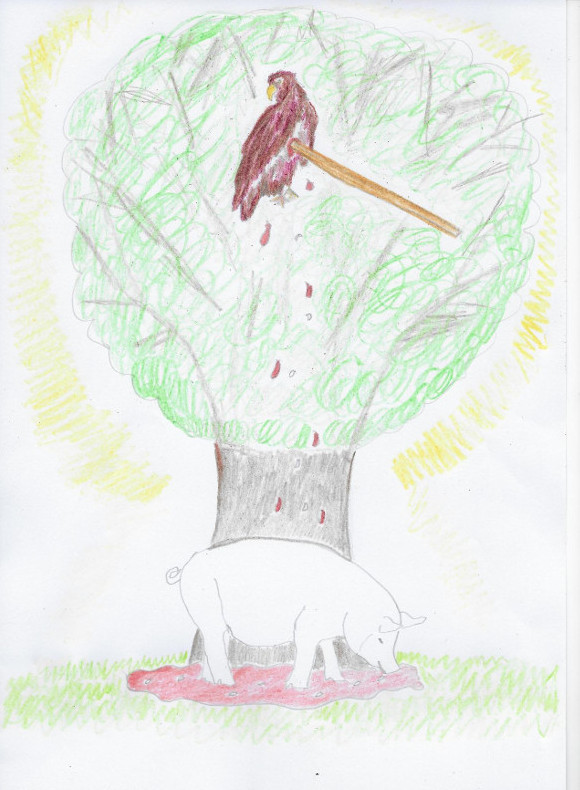
Lleu departs to an oak, dripping rotten flesh and maggots, which are eaten by a hungry sow beneath. In an oak Lleu is neither indoors or outdoors, on horseback or on foot, thus we find another answer.
The Eagle on the Oak
The image of the wounded Lleu-as-Eagle on the oak with the sow eating his flesh is numinously charged. Lleu’s transformation from a man into an eagle as a result of his wounding is suggestive of initiatory death and soul flight. This shares similarities with other initiatory and sacrificial traditions.
Following battle trauma Myrddin Wyllt was torn out of himself and flew (likely as his namesake, the merlin) to the forest of Celyddon where he learnt the arts of poetry and prophecy. Odin pierced his own side with a spear and hung on Yggdrasil, the World Tree, for nine nights sacrificed ‘himself to himself’ to gain knowledge of the runes. We also think of Jesus, wounded by a spear, on the holy rood.
The oak is likely to be Daronwy, ‘the oak of Goronwy’, ‘the radiance of Goronwy’s men’. Goronwy is another name of Gronw. Daronwy appears in the poetry of Taliesin as the tree who holds the greatest of mysteries and the oak’s associations with the druids, ‘oak knowers’ is well known. It may be our Brythonic World Tree. In the Fourth Branch it is described as occupying a liminal position between ‘between two lakes’ and having magical qualities – it cannot be wetted by rain or melted by heat. Lleu’s initiation on this sacred oak may have been central to the druidic tradition. However its meaning and what he experienced on the tree has been lost to centuries of Christianity.
One clue perhaps lies in the identity of the sow. She, like Lleu, has numinous qualities. Gwydion is told by the swineherd (possibly a magical figure himself): ‘Every day when the pen is opened she goes out. No one can grab her, and no one knows where she goes, any more than if she sank into the earth.’
The sow’s ability to evade capture and the reference to her sinking into the earth have an aura of the Annuvian. It may be suggested here we find Henwen, ‘Old White’, the goddess Ceridwen in sow-form. Her eating of Lleu’s flesh and the maggots (who share a resemblance with him as a ‘small something’) represent him being absorbed into her cauldron of rebirth in Annwn and into her womb.
Lleu is rescued by Gwydion, who sings him down from the oak with three englyns, onto his knee. They may represent his descent from soul flight through three worlds. Gwydion refers to Lleu possessing ‘nine attributes’ which may originate from lessons learnt on the tree over nine nights. Gwydion strikes Lleu with his wand to transform him back into his own form. We are told he is ‘wretched’ ‘nothing but skin and bone’. He is taken to Math’s physicians at Caer Dathyl to be healed.
Gwydion’s own familiarity with oak knowledge is suggested by his name. It derives from gwydd which is linked to gwybod ‘to know’ and contains the meanings ‘knowledge’, ‘tree(s), branches, twigs; forest, woods, shrub(s)’, ‘weaver of songs’ and gwyddon refers to a ‘sorcerer or sage’. Its root is *uueid ‘to know’ and this is found in uates ‘seer’ and also in druid ‘oak knower’. We have already seen that he has the ability to conjure trees from ‘language and the materials of the earth’.
It thus seems to be no accident that Gwydion’s plotting leads to the immolation of Lleu on the World Tree. His initiation might be seen as a necessary step on his journey to maturity.
The Death of the King of Annwn
Following his ‘death’ at Gronw’s hands Lleu takes revenge. He demands the chance to throw a spear at Gronw on the spot he was killed, on the bank of the River Cynfael, near the Hill of the Blow. Gronw stands behind a stone, but Lleu’s spear pierces through it to kill his rival. Lleu then takes possession not only of Penllyn but, presumably, Caer Dathyl, for he becomes lord of Gwynedd.
By killing Gronw and winning the lordship of Gwynedd, Lleu comes to maturity. Parallels might be found with Lugh slaying Balor and taking the place of Nuada as the king of the Tuatha Dé Danann.
Behind this battle of euhemerised lords lies a deeper conflict between the Brythonic ‘gods’ and ‘ungods’. Gronw, the mysterious huntsman, who visits Blodeuedd at night and is inexplicably attractive, has all the qualities of the King of Annwn. In the First Branch, Pwyll, prince of Dyfed, accidentally fed his hounds on a stag pulled down by the white red-eared hounds of the Annuvian king, Arawn. As recompense Pwyll exchanged identities with Arawn and fought his yearly battle against his rival, Hafgan, killing him by following Arawn’s instructions to strike only one blow at a ford.
The end of the book mirrors the beginning. Here we find the King of Annwn taking the guise of Gronw to fight what might have been a yearly battle on a river bank in this world against Lleu. We recall Lleu mentioned: ‘It is not easy to kill me with a blow’. Yet with one blow of his magical spear, crafted when people are at Mass, outside Christian rule, in the timelessness of Annwn, he succeeds in bringing about the ‘death’ of Lleu-as-a-man and his transformation into Lleu-as-Eagle. Annwn is traditionally a place of initiation and the King of Annwn an author of initiatory experiences.
It seems the agency of the King of Annwn, as much as that of Gwydion, results in Lleu’s oak knowledge. He appears to challenge Lleu’s claim to his name, his weapons, and his wife. Following his initiation, Lleu wins, killing him, sending him to his death, back to Annwn, from whence he came.
It seems possible stories existed in which Lleu killed the King of Annwn in the Battle of the Trees. This was brought about by Amaethon, another son of Don, who stole a roebuck, a greyhound, and a plover from Annwn, rousing the fury of Arawn who is referred to in the poem as ‘the wealthy battle dispenser’.
Arawn may be another name of Gwyn, who also appears as a giant by the names of Ogyrven and Einnegen, thus Lleu slays his cousin in the Battle of the Trees and likely his grandfather, Beli, too.
Lleu’s story is one of overcoming, with the aid of Gwydion, the monstrous within the Children of Don and within himself (unleashed as eagle by the King of Annwn and reined in by the magician).
Yet our stories show any attempt to repress the Annuvian can never wholly succeed. Annwn’s king wears many guises, fights many battles, dies many deaths, always returns in some form to challenge and initiate.
Conclusion – The Strangeness of Lleu
From his strange birth as a ‘small something’ to his stranger ‘death’ in eagle form on the World Tree, for me, Lleu remains somewhat amorphous, difficult to picture, to relate to, and to empathise with. I don’t know whether this is because of his sheer stupidity in the Fourth Branch or because I’m devoted to his adversary, the King of Annwn, and tend to favour monsters over shining heroes.
If there is an illuminating feature about Lleu for me it is not his triumph over Beli or the King of Annwn with his slingshot or lightning spear but the strangeness within him which he tries to repress.
SOURCES
Edwin Hopper (transl.), ‘The Battle of Moytura’, http://www.edwinhopper.com/03%20The%20Battle%20of%20Moytura.pdf John Carey, ‘A British Myth of Origins?’, History of Religions, Vol.31, No.1 (The University of Chicago Press) Marged Haycock (transl), Legendary Poems from the Book of Taliesin, (CMCS, 2007) R. A. S. Macalister (transl.), The Book of Invasions, https://www.maryjones.us/ctexts/leborgabala.html Sioned Davies (transl.), The Mabinogion, (Oxford University Press, 2007) Will Parker, The Four Branches of the Mabinogi, (Bardic Press, 2005)
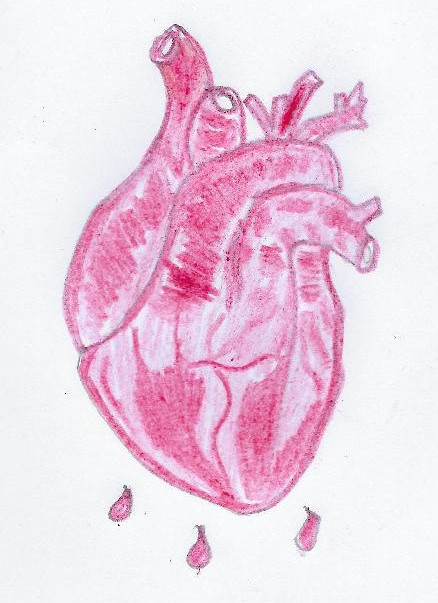
‘Gwyn son of Nudd… forced Cyldedyr to eat his father’s heart… Cyledyr went mad.’ How Culhwch Won Olwen
We have eaten the hearts of our ancestors.
We have bitten them down in pieces. We have choked on them, retched on them, tried to refuse to eat them at our peril.
We have swallowed them whole.
We have made them palatable with condiments – ketchups squeezed from blood and mustards from bile.
We have been unable to stop eating even when told to stop.
We have seen our faces with blood dripping from our mouths on the front of the newspapers and pointed our fingers at everyone else – those heartless heart-eaters.
We have blamed the gods who told us to do it.
We have gone mad with grief and guilt.
We have wandered the Forest of Celyddon with Cyledyr, with Culhwch, with Myrddin Wyllt, tried to become poets and we have failed.
We have not heard your whisper in the woods~ in the little cavern within our right atrium, thought of the hunger of the future.
I have no children so to who will you feed my heart?
In the Irish myths we find a giant named Balor whose name derives from the common Celtic *Boleros ‘the Flashing One’. He is best known for the destructive power of his eye, which burns or poisons.
In ‘The Second Battle of Mag Tuired’ Balor fights on the side of the Formorians ‘underworld giants’, who come from beneath the earth or sea, to fight against the culture gods, the Tuatha Dé Danann.
Balor has ‘a destructive eye’ which is ‘never opened except on the battlefield’ by four men pulling a ring on the lid. We are told that any host which looked into his eye, even if there were thousands, ‘would offer no resistance to warriors’. Its ‘poisonous power’ originates from an accident. When Balor’s father’s druids ‘were brewing magic’ the fumes ‘affected the eye’ and ‘the venomous power of the brew settled in it.’
Balor kills the king and battle leader of the Tuatha Dé Danann, Nuadu Silverhand. Yet the moment the lid on his eye is raised Lug Lormanslech (who is elsewhere known as Lug Lámfada ‘of the Long Hand’) kills him by firing a slingstone from his slingshot into his eye and causing him to fall backwards and kill twenty-seven men. Lug later takes the place of Nuada as king of the Tuatha Dé Danann
In ‘Balor on Tory Island’ he has a burning eye which is covered by nine leather shields or seven coverings which he removed one by one: ‘With the first covering the bracken began to wither, with the second the grass became copper-coloured, with the third the woods and timber began to heat, with the fourth smoke came from the trees, with the fifth everything grew red, with the sixth it sparked. With the seventh, they were all set on fire, and the whole countryside was ablaze!’ Balor is killed by Lug, with a a red spear crafted by Gavidin Gow, which pierces through all the coverings.
In this Formorian giant it is possible to find some parallels with the British giants and forces of Annwn ‘the Deep’, the Otherworld or Underworld. Llasar, described as ‘a huge, monstrous man’ with ‘yellow-red hair’ and ‘an evil, ugly look about him’ emerges from ‘the Lake of the Cauldron’. The scream of a dragon causes men to lose their strength and makes the land and its inhabitants barren.
There are also similarities between Battles of Mag Tuired and ‘The Battle of the Trees’. Like the Tuatha Dé Danann, the Children of Don, Lleu (cognate with Lug) ‘radiant his name, strong his hand’, the magician-god, Gwydion, and the plough-god, Amaethon, battle against the forces of the King of Annwn and these include giants such as Bran the Blessed and Annuvian monsters.
However, neither Nodens/Nudd (cognate with Nuada) or Boleros (who would be cognate with Balor) are mentioned. This leaves me wondering whether we had a similar story in which Nodens was killed or injured by Boleros and Lugus/Lleu triumphed over the giant and his destroying eye.
A similar story about how Boleros gained the destructive powers of his eye would certainly fit with narratives in which the cauldron which brews the awen and revives the dead also produces poison.
The tale of Boleros of the Burning Eye is one of the stories I am striving to re-imagine in my new book.
Gwythyr ap Greidol ‘Victor son of Scorcher’ appears in the medieval Welsh story Culhwch and Olwen as the rival of Gwyn ap Nudd ‘White son of Mist’ for the love of Creiddylad ‘Heart’s Desire’. That he is a fitting opponent for Gwyn and consort for Creiddylad, who are the son and daughter of the ancient British god Lludd/Nudd/Nodens, suggests he is also an important British deity.
Strip away the Christian veneer from Culhwch and Olwen and we have a story in which Gwyn (Winter’s King) and Gwythyr (Summer’s King) battle for Creiddylad (a fertility goddess). On Nos Galan Gaeaf, Winter’s Eve, Gwyn abducts Creiddylad to Annwn* and Gwythyr rides to Annwn and attempts to rescue her and is imprisoned. The abduction of Creiddylad and imprisonment of Gwythyr explain the coming of winter. On Calan Mai, the First Day of Summer, Gwythyr battles Gwyn for Creiddylad, wins, and she returns with him to Thisworld and together they bring fertility to the land. This explains the coming of summer. Gwyn and Gwythyr may earlier have been seen to slay one another on Nos Galan Gaeaf and Calan Mai and take it in turns to enter a sacred marriage with Creiddylad, who acted as a powerful sovereignty figure rather than just a maiden to be fought over.
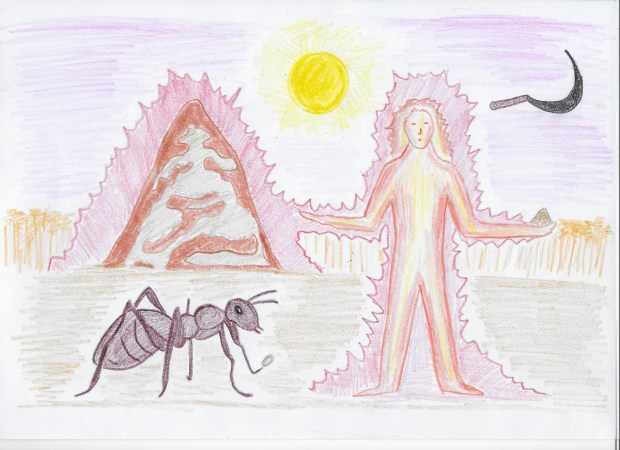
It is clear from this tale that Gwythyr is our ancient British god of summer. In another episode in Culhwch and Olwen we catch a glimpse of Gwythyr’s associations with fire and sunshine. As he is walking over a mountain he hears ‘weeping and wailing’ and sees its source is a burning anthill. He cuts the anthill off at ground level and rescues the ants from the blaze. We do not know what caused the fire. Did their nest, which ants orientate toward the sun, a little like solar panels, in a summer day, absorb too much heat? Or was the fire caused by Gwythyr’s scorching feet? We have seen that one translation of his father’s name, Greidol, is Scorcher, and we know wildfires break out in the summer. Here we see the dangers of fire and the sun and Gwythyr’s attempt at remediation.
The ants go on to help Gwythyr to gather nine hestors of flax seed which was sown in ‘tilled red soil’, in a field that has remained barren, so it can be ploughed into a new field, to provide the linen for Olwen’s veil in preparation for her marriage to Culhwch. It is possible to read Gwythyr’s association with seed being linked to the ‘male’ side of fertility and with doing the groundwork for the arrival of summer for his bride, Creiddylad, might also require a linen veil for her wedding dress.
The ancient Britons used fire to clear the forest to plant hazel trees and wildfires bring about new growth – in Gwythyr’s associations with fire and seed we find these processes.
These stories show that Gwythyr is a god of summer, fire, and generation in Thisworld who is opposed to Gwyn, a god of winter, ice, and the destructive forces of Annwn, the Otherworld. On the surface one is a bringer of life and the other a bringer of death yet their relationship is one of interdependence. It is necessary they take it in turns to enter a sacred marriage with Creiddylad as an eternal summer or an endless winter would have equally deadly consequences for both worlds.
As Gwythyr’s story was passed on through the oral tradition he and his father were depicted as allying with Arthur against Gwyn and the ‘demons’ of Annwn and playing a role in their demise. Thus Gwythyr is associated with other culture gods like Amaethon, the Divine Ploughman, and Gofannon, the Divine Smith, who help the Christian king to civilise the wild and shut out the Annuvian.
This process may be traced back to the Neolithic revolution when farming began to replace the hunter-gatherer lifestyle, the cultivation of seed hunting and foraging, the grain god (Gwythyr) the hunter (Gwyn). Christians did their best to eliminate the veneration of Gwyn by depicting him and his spirits as demons yet they continued to be loved in folk culture as the fairies and their king.
The stories of Gwythyr, by name, did not survive in the folk tradition, but it possible to find a likeness between him and other grain gods** who die a ritual death at the end of the harvest – when Gwyn, the harvester of souls, reaps down his rival and Gwythyr and the seed return to Annwn.
From the Neolithic period our society as a whole has favoured Gwythyr over Gwyn. We have created an eternal summer with the fire of Gwythyr in the engines of industry creating a society in which the cold and darkness of winter has been eliminated by electric lighting and central heating. Crops grow all year round under artificial lights. This has unsurprisingly led to global heating, to the climate crisis, to the scorching fires on Winter Hill where I perceive Gwythyr battling his rival. Ironically, and tellingly, these two great gods and the great goddess they battle for have been forgotten.
Yet, slowly, the worship of Gwyn and Creiddylad is reviving amongst modern polytheists. I know few who venerate Gwythyr and believe this is because his stories have been subsumed by those of other grain gods. This is a shame, for Gwythyr’s stories contain deep wisdom relating how fire, sun, summer and seed have played a role in the climate crisis from a polytheist perspective.
As a devotee of Gwyn, committed to the otherside, to the Annuvian, to redressing the balance, Gwythyr is a god whose powers I acknowledge through the summer and during the harvest period although I do not worship him. I would be interested to hear how and whether other polytheists relate to Gwythyr at this time.
*Annwn has been translated as ‘the Deep’ and the ‘Not-World’ and is the medieval Welsh Otherworld or Underworld. **Such as Lleu Llaw Gyffes/Lugus and John Barleycorn.
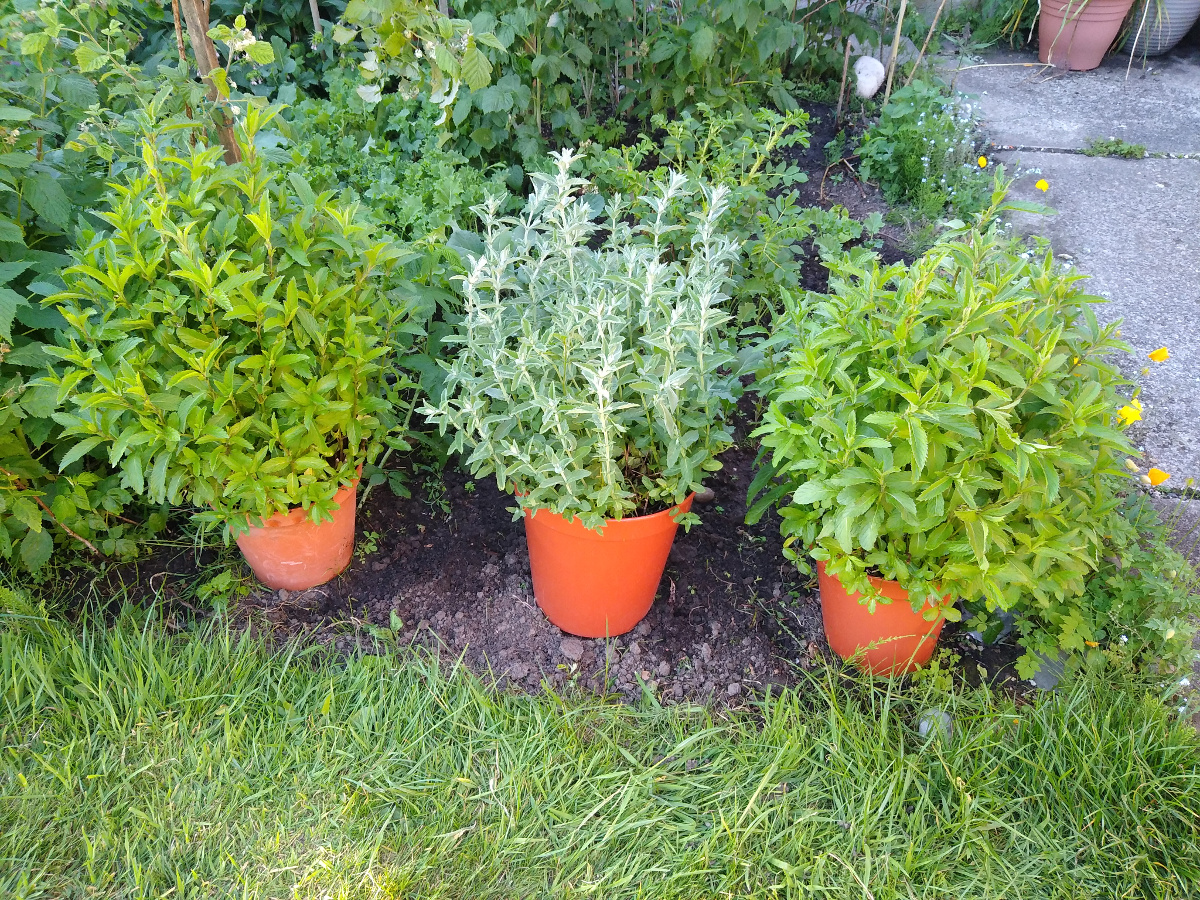
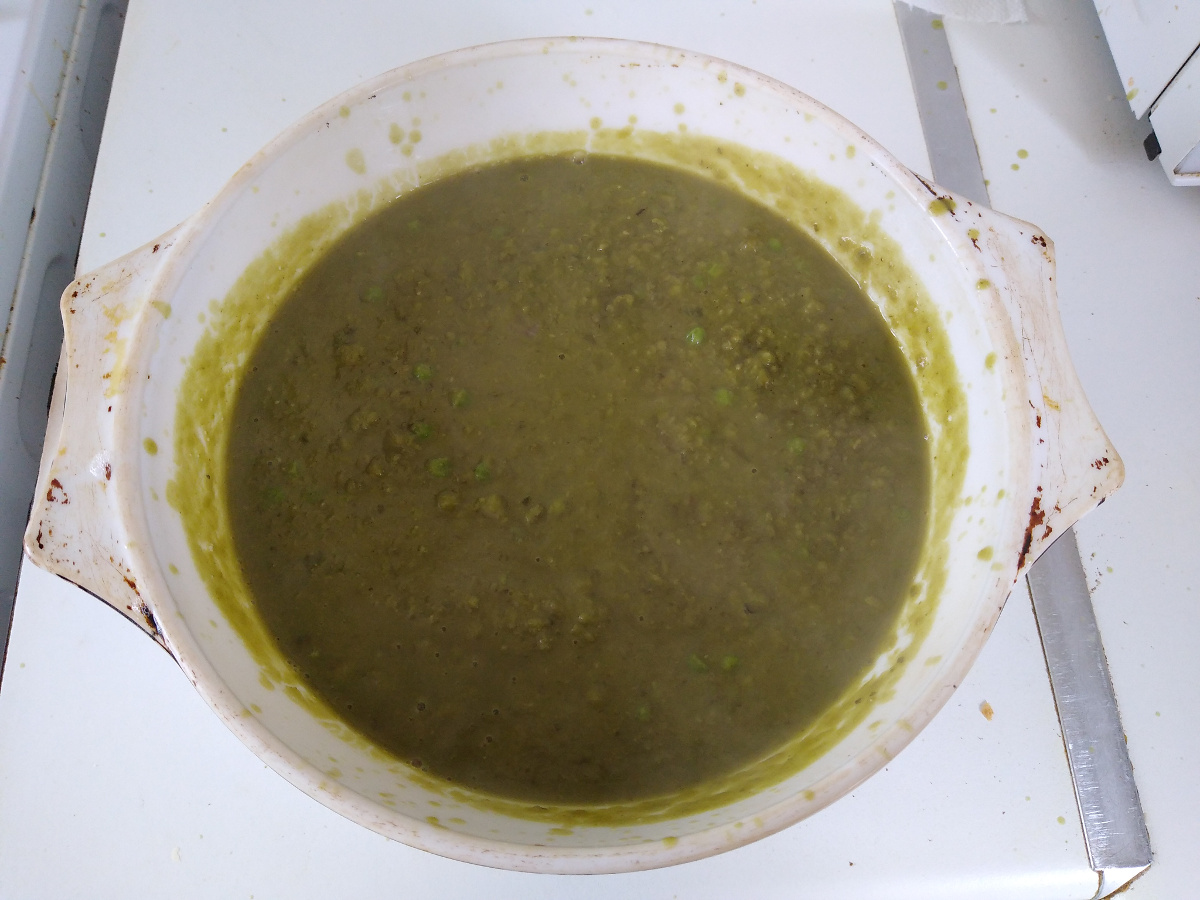
For me the lockdown has been a safe bubble and has had a number of benefits. I’ve had the opportunity to cultivate a better relationship with my immediate reality at home, where I live with my parents. I’ve been doing more gardening and this has included food growing. We are now self-sufficient in lettuce, green vegetables, and fresh herbs. This has fitted with having more time to cook with them, to make tasty meals from scratch, my favourites being pea and mint soup and minty lamb stew.
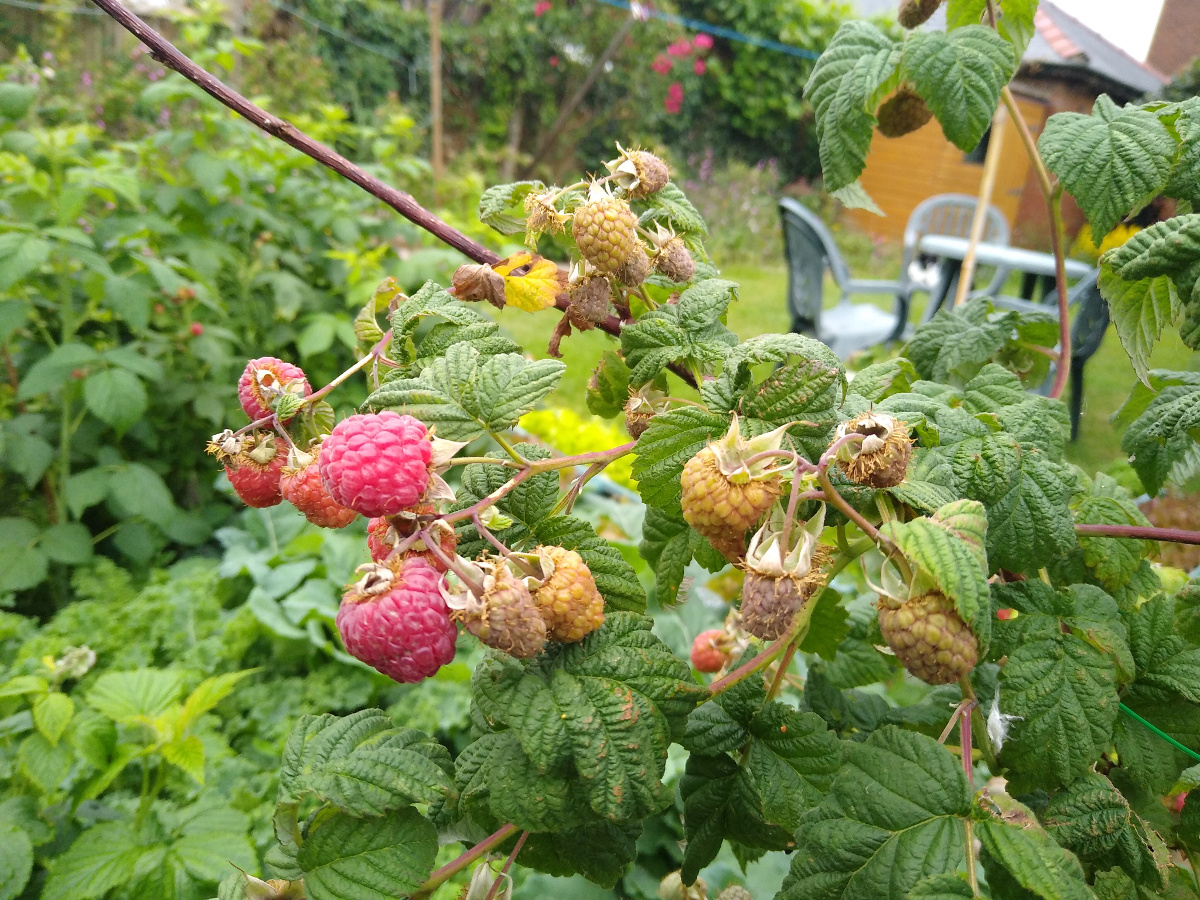
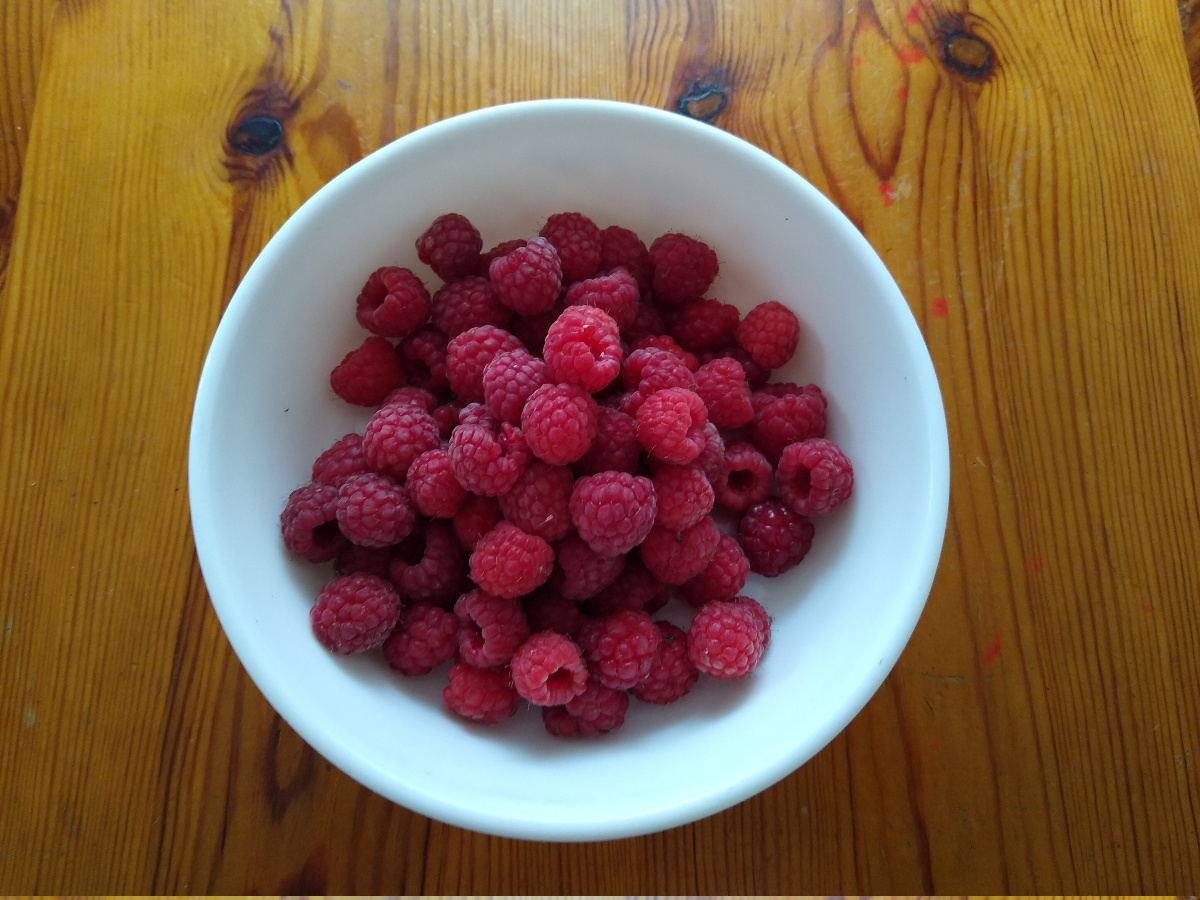
The raspberries long ago strayed from their patch and ramble freely around the garden and they have gifted us a brilliant crop this year in spite of the rain.
I’ve had the time and space to begin repairing my mental health. I’ve struggled with anxiety all my life and, since my late teens, used alcohol as a way of self-medicating. I stopped drinking in January and, over the last few months, have completed a series of counselling sessions through the Minds Matter service.
This has resulted in me finding out that the source of my anxiety is likely having Asperger’s and that’s why I struggle with loud, noisy social situations, whether in public or online, and thrive on time alone or in quiet company, working on the land, in devotion to my gods, and nurturing my creativity.
In the place of alcohol, which obliviated my worries only temporarily, I’ve developed some worry management strategies. This has included keeping a worry diary and assessing whether a worry is practical or hypothetical. If it’s practical I have problem solving techniques to deal with it, and if hypothetical, a technique of setting it aside for a worry period so it doesn’t interfere with the rest of my day. This has made my worries seem less overwhelming thus I’m less worried about worry itself. Other small dietary changes like excluding caffeine and cane sugar have helped too.
The most major result is the realisation that my mental health limitations make it more important to focus on my gift – my awen, my creativity. This has led to my next book, The Dragon’s Tongue, in which I explore a myth of origins personal to me and my deities.
From the safety of my bubble I’ve been watching the lockdown ease. The shops, the hairdressers, the pubs opening, the traffic building up. I barely ever buy clothes, decided to clip my hair off, have stopped drinking, and rarely borrow my dad’s car, preferring to walk or cycle, so this hasn’t affected me much (although the busyness of the roads has made walking and cycling more unpleasant).
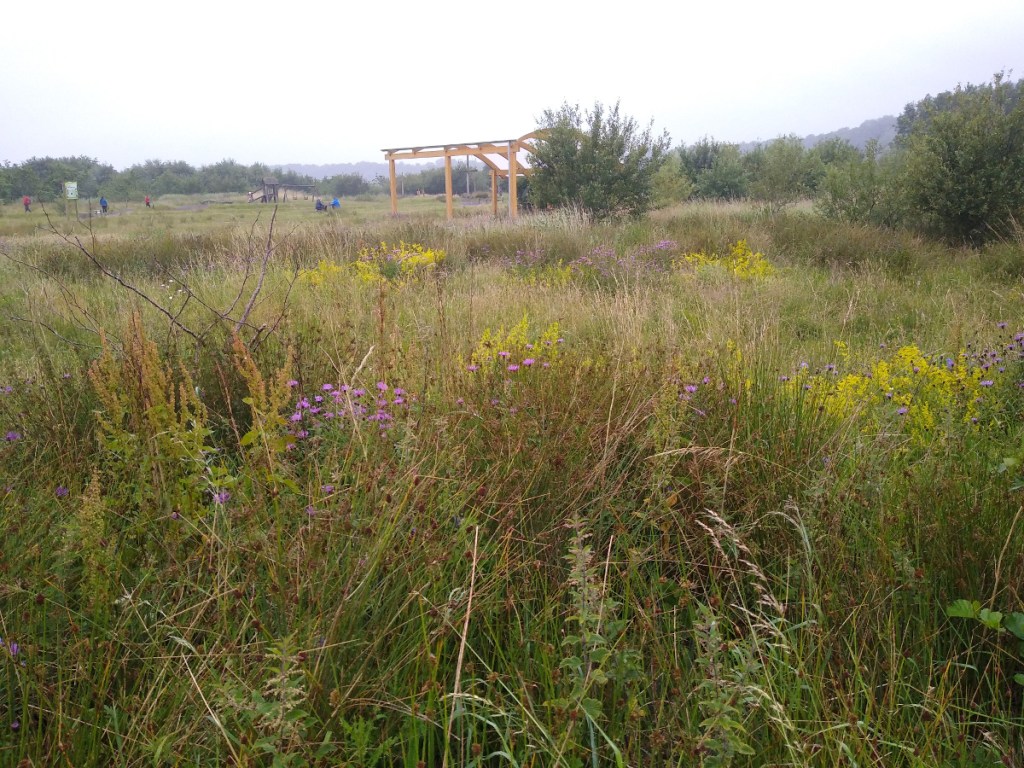
Yesterday, however, my bubble finally went pop. I cycled to Brockholes Nature Reserve for the first time since its reopening for a walk. My long term plan for finding paid work that doesn’t have a negative impact on my mental health has been getting a job in conservation which involves working outside alone or in the quiet company of other staff and volunteers. I was due to begin an internship at Brockholes to gain the necessary experience before the lockdown began and it was postponed.
On arrival I was pleased to see the meadows in flower with a mixture of lady’s bedstraw, thistle, vetch, ox-eye daisies, red campion, ragged robin, bird’s foot trefoil and other wild flowers.
Yet when I walked past the office I saw and spoke to the reserve manager, who informed me there have been staffing cuts. Everything is up in the air at the moment. If I was still to take the internship there would be less work and my opportunities would be limited to ‘income projects’ with less conservation.
The prospect of finding paid work with the Lancashire Wildlife Trust or any other conservation organisation is looking bleak. As is finding employment in any sector aside from key work. The future, due to coronavirus and the environmental crisis is a great unknown, with little chance of ‘normal’, much less ‘better’.
Still, I’m going to continue with my internship and other conservation volunteering whether it leads to paid work or not as I value the work of the Wildlife Trust and it is a way of serving my land and gods.
And I’m going to pull my bubble back around myself for a while and continue to use this opportunity to ‘tend to my domain – myth, gods, and the soul’, as my deity advised this morning.
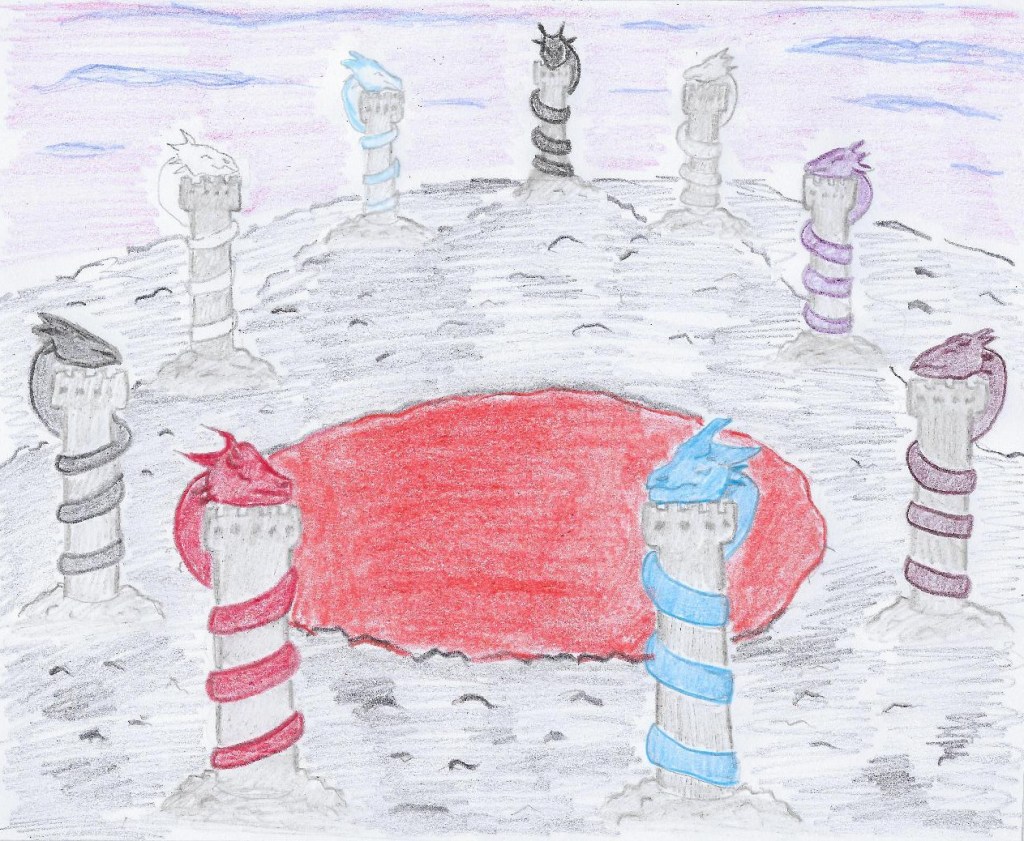
Nine towers of stone. Around each coils a wyrm. No way in – no door, lock, key, but a single row of windows at the top where I think I glimpse the face of a madman. They are old as the grey mountains. I want to claim they were built by the haulers of scree, the wyrms summoned and bound by the might of magicians or that they came of their own free will raising the towers from some secret land underground that has never been seen. Share rumours of a sibylline prophetess who consulted the wyrm’s heads but whose words are not recorded in dusty books in an arcane language eaten by bookworms. But no explanation rings true or exists. I feel like banging my head against the stone demanding an answer from the inexplicable unblinking eyes and long stony tongues silent as the purple skies. I cannot accept this vision defeating poetry.
I wrote the poem above a couple of years ago and the vision it is based on has stuck with me. It’s only since I started writing my new mythic book, The Dragon’s Tongue, that I realised that the nine towers correspond to the nine heads of the Dragon Mother Anrhuna and that when she was killed her nine heads were bound on the towers so the creator gods had power over the nine elements (stone, earth, magma, fire, air, wind, water, mist, and ice). I’ve finally got round to trying to draw the scene, which I find helps.
 The Sanctuary of Vindos