The Dragon’s Tongue

How Can I

speak of dragons
when dragons from the world are gone?

How can I
be your inspired one
when the myths of the gods are lost?

To sing them back from the void before creation
I will need a dragon’s tongue!

Lord of Annwn
grant me the strength
by the breath of dragons
to write this book.
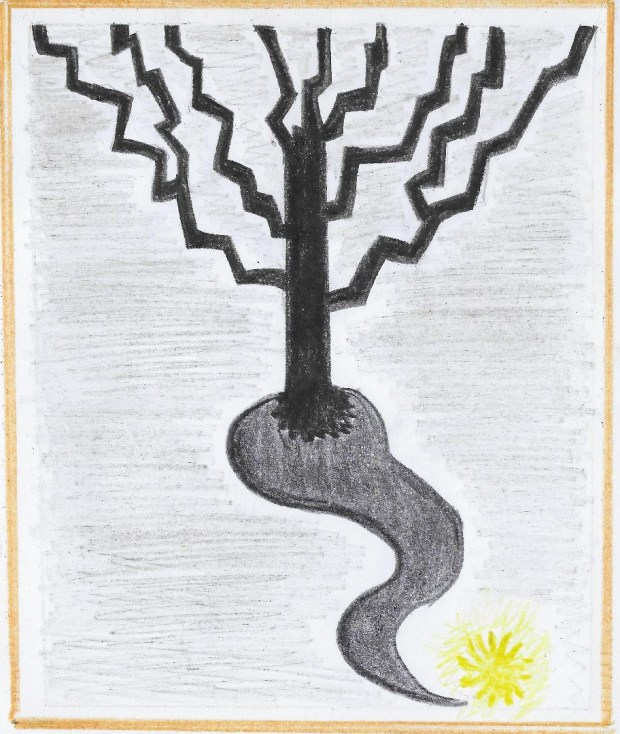
Over the past few weeks I have known possession by the awen; the inspiration, the divine breath that flows from Annwn, the breath of the gods, the breath of dragons; like I have never known it before.

It’s come after a couple of fallow years; sowing, reaping, dissatisfaction with flawed and failed crops.

I was beginning to fear that, after making my lifelong vows to Gwyn ap Nudd, to serve him as his awenydd, that the awen had dried up. What irony! A tiny part of me had begun to wonder if I’d made a mistake. Whether my powers of discernment were off. Whether he’d been having a laugh with me.

But my soul, to him eternally present, spoke otherwise. Only now I’ve realised I’d experienced a time of labouring, harrowing, preparing the ground for the oak to rise and the lightning to strike. For my fall from the tree amidst this collective shattering of the grounds of our society brought about by COVID-19 and into Annwn, the Deep, where I was to find the Prophet with the Dragon’s Tongue.

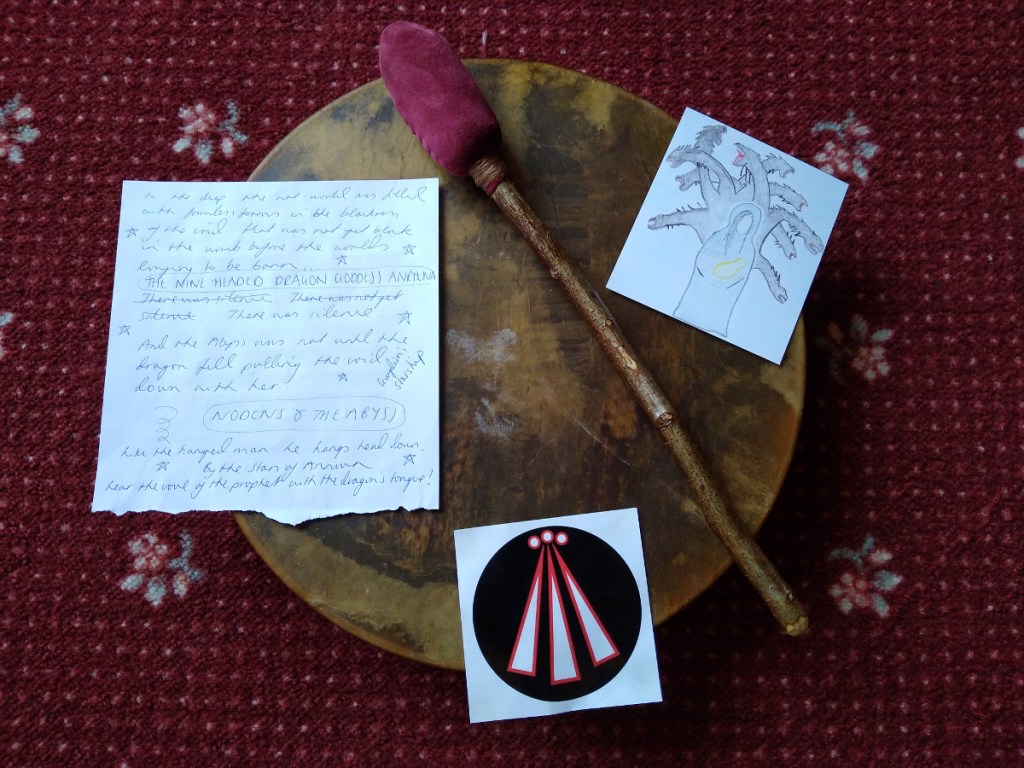
Thus has been born my next mythic book – The Dragon’s Tongue. Much of it has been gifted to me at dawn, in response, I believe to my evening prayers, in particular to Gwyn, Gwyn’s father, Nodens, Lord of Dream, Gwyn’s mother, Anrhuna, Dragon Mother of Annwn, and Gwyn’s beloved, Creiddylad.

You will probably not be surprised when I say their stories are central, with those of the dragons, and their conflict with the Children of the Stars*. There isn’t much evidence for dragons in the Brythonic/Welsh myths aside for an episode where Lludd/Nudd/Nodens ends a plague by ending the battle between two dragons and another where they appear, red and white, in a vision of Merlin Emrys. But there is the red dragon is on the Welsh flag and dragons are all around us in our folklore.

I’ve been reading mythic literature, journeying with the deep gods, the dragon-gods, long enough to know, when you get to the bottom of any myth, as Gordon White says, it is ‘dragons all the way down’.

I have long wanted to write the story of Anrhuna, the forgotten Dragon Mother, and also a creation myth. I have wanted what is lacking in the Brythonic/Welsh stories penned by medieval Welsh scribes. Something polytheistic, something penned by an inspired one of the gods, that provides insights into the mysteries of creation, of life, death, and rebirth, without the patriarchal Christian overlay.

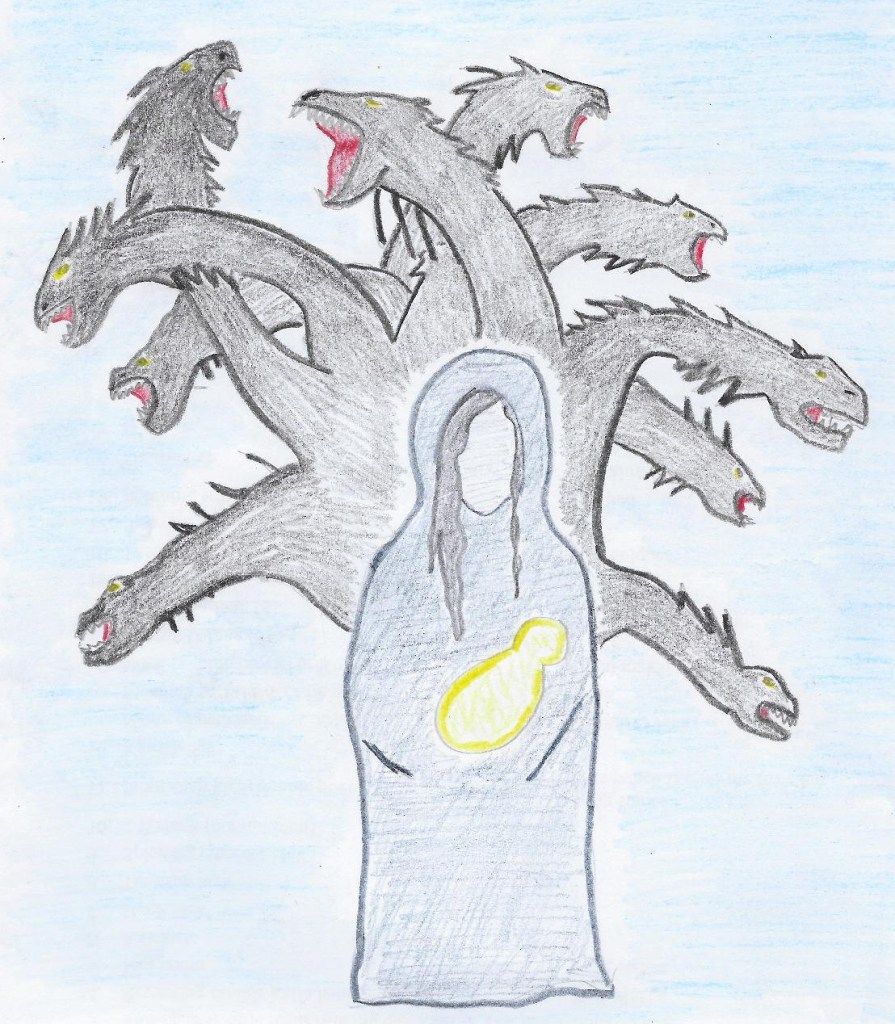
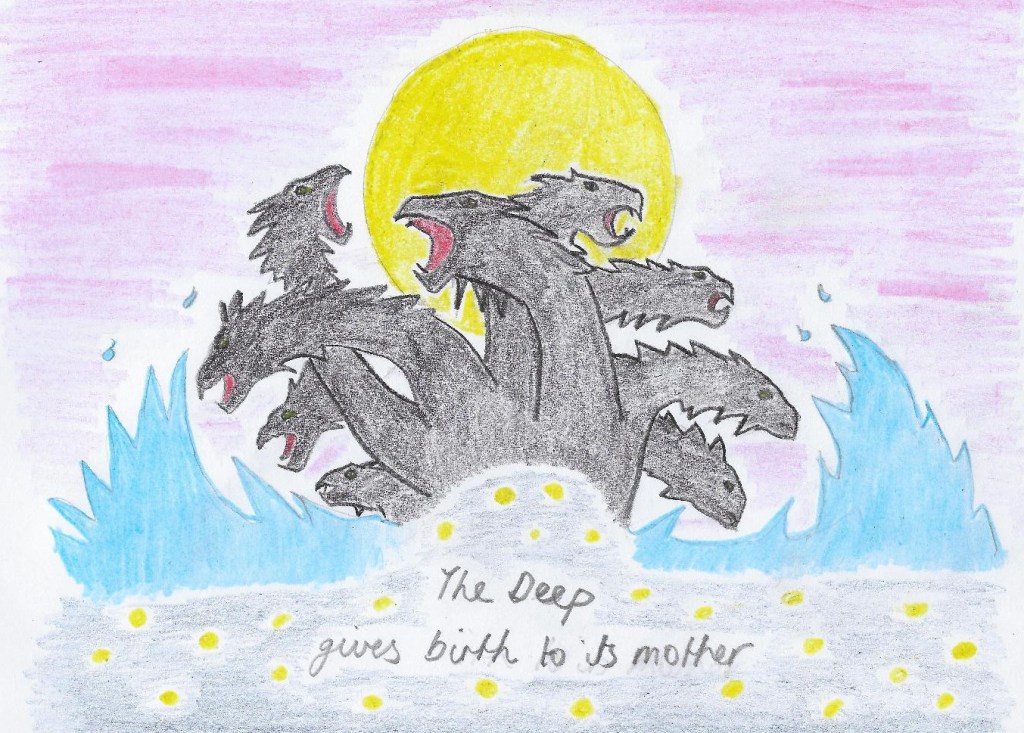
Finding nothing else I realised I would have to do it myself. Following being gifted with the voice of the Prophet with the Dragon’s Tongue I started in the beginning, in the Deep, with Old Mother Universe and her Cauldron and how a dragon slipped from it and fell into the Abyss. How, from formlessness, she gave birth to the elements in dragon-form to form the world (yes – the world was made by dragons and not by God or some other demiurge). How the Children of the Stars slew Anrhuna, cut off her nine dragon heads with their long necks, and bound them on the Towers of the Wyrms…

From this flowed the story of the conflict between the Children of Annwn and the Children of the Stars, a tale of love and war, the mysteries of birth, death, and rebirth, of the coming of the Black Dragon.

After I swore to Gwyn that I would complete it beneath the leaning yew, where I met him, I got most of the first draft written over those days of thunder. When the lightning from the Spear of Lugus which killed Anrhuna lit the skies, when the rain poured, when the energy was strange and high.

This, I believe, would not have been possible if we were not in lockdown due to COVID-19. If I had not had this time without the pressures of finding paid work by volunteering with the Wildlife Trust and helping organise local poetry nights. If I had not stopped drinking, got off social media, started counselling for my anxiety and found out its root is having Asperger’s, which has helped me to stop blaming myself for my failures in ‘the real world’ and to cultivate space for my gods and my soul.

The birth of this book has restored by faith in my gods and through it I finally feel reborn as Gwyn’s awenydd. The first draft is complete, but is far from perfect, and I am predicting it may take months, even a year or so to firm it up. But, it has been born, and I am incredibly excited about it.

So if you’re interested watch this space and if you’re really interested you can find out more about my creative processes and see unseen work, including some of the drafts, by supporting me on Patreon HERE.

*My name for the Children of Bel(i) and Don.
Last Night

was the night
you were furthest
away from the world
like a distant asteroid
– like Pluto.

From now
you’re coming back
– your land of ice and darkness
will thaw and the mists will make it beautiful again.

From the coffin where you dream of nuclear winter
you will step into a new suit of armour.

Summer is a’coming to Annwn
and winter is already
on its way here.

This poem is based on my gnosis that whilst it is summer in Thisworld it is winter in the Otherworld. It is addressed to Gwyn ap Nudd, a Brythonic ruler of the Otherworld and Winter’s King, who is killed by his rival, Gwythyr ap Greidol, Summer’s King, on Calan Mai, and sleeps through the Summer.

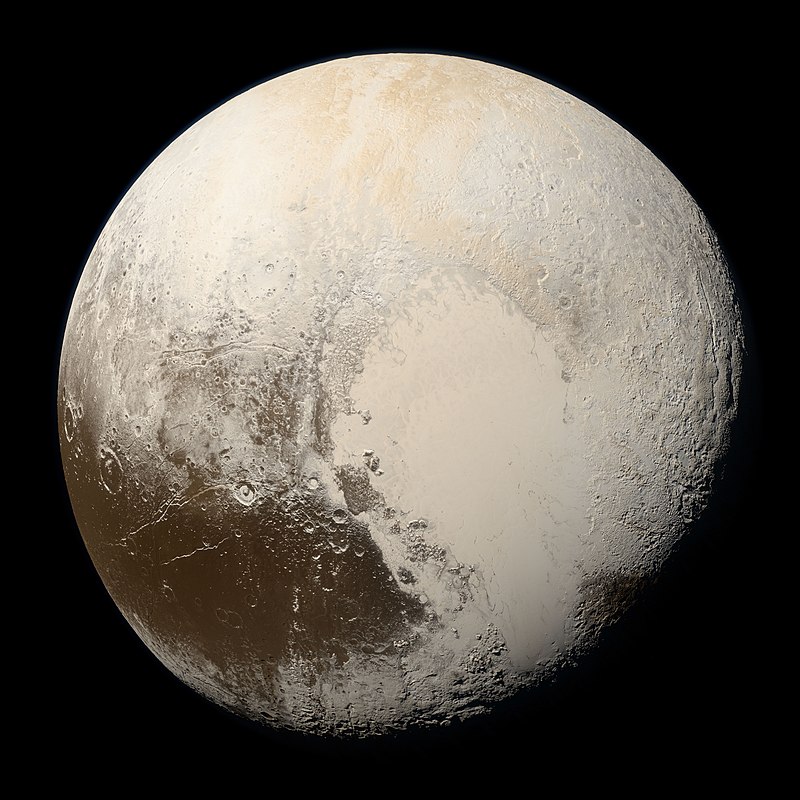
After I received this poem in a vision this morning I looked up Pluto, a planet named after the Roman King of the Underworld and saw that, in Japanese its name is Meiōsei – ‘Star of the King of the Underworld’. I thought this was very beautiful and apt for the planet that rules my birth sign, Scorpio, much as Gwyn, my patron god, is the ruling force in my life.

I then returned to an essay by Brian Taylor called ‘Photographing the Underworld? A Note of NASA’s Pluto Fly-by’ which has had a big influence on me. Here he speaks of how the photographing of Pluto ‘ruler of occultation, and protector of the integrity of mystery’ may have been saved from being an act of ‘casual intrusion’ by the plutonium powered spaceship carrying the ashes of Clyde Tombaugh ‘discoverer of Pluto’ (as a kind of offering to the underworld gods?).

Brian also speaks of how he ‘traced the exteriorisation of Pluto in the history of the nuclear era, and found the planet’s signature etched into the geography of the discovery region, most notably in an extraordinary spatial co-incidence. Pluto was discovered in 1930 at the Percevall Lowell Observatory in Flagstaff Arizona. Ten years later Plutonium was manufactured at the Lawrence Livermore Laboratory in California, and five years after that the first atomic bomb was detonated at the Trinity Test Site north of Alamagordo in New Mexico. Curiously these three sites fall in an almost perfect straight line, about a thousand miles long, that maps the connection between the planet and the nuclear project on to the land in the most unexpectedly graphic way.’

Coincidentally I have been returning to these themes, which I touched on in The Broken Cauldron, in the later sections of the new book I am writing, which explores more deeply the influence of the gods within the modern world and Gwyn’s connections with nuclear war and nuclear winter.

At the bottom of the essay I saw an old comment I left for Brian in 2015 mentioning a dream I had about Gwyn and nuclear winter, leading me to recall it. Brian notes that the spaceship made closest contact with Pluto on a dark moon and the moon was dark last night.

The Spirit of the Depths and the Service of the Soul

My soul, where are you? Do you hear me? I speak, I call you – are you there? I have returned. I am here again.’
Carl Jung

In his Red Book Carl Jung speaks of refinding his soul and rebuilding his relationship with her after a period of soul loss. He was called to do this by ‘the spirit of the depths’ who is opposed to ‘the spirit of this time’:

‘The spirit of this time would like to hear of use and value… that other spirit forces me nevertheless to speak beyond justification, use, and meaning… He took away my belief in science… my understanding and all my knowledge and placed them at the service of the inexplicable and the paradoxical. He robbed me of speaking and writing for everything that was not in his service.’

Jung records how the spirit of the depths opened his eyes to vision – to his soul, the things of the soul, and the soul world. This spirit forced Jung to stop treating his soul as a ‘scientific object’ and told him to ‘call upon her as a living and self-existing being. I had to become aware that I had lost my soul.’

Once he reached that awareness Jung called out to his soul and encountered her as a person and as a living landscape. She appeared to him in a number of guises (all female) – as Salome, as the spirit of a dead girl (who forced him to eat her liver!), as a serpent, and as a ‘small white bird’. She showed him a variety of visions, some of which predicted the First World War, some beautiful, most Hellish. She appeared to him as a desert, and, it may be argued, as the many places in Hell he explored.

Jung learnt that he is merely the ‘symbol and expression’ of his soul. She taught him that everything he does and says ‘comes from and belongs to me’. Ultimately he entered ‘the service of the soul’.

***

Jung’s words are of interest not only because they contain a great deal of mystical depth and wisdom but because they remind me of my own calling to serve Gwyn ap Nudd, a god of Annwn (‘the Deep’ – the soul world in the Brythonic tradition) and to restore my relationship with my own soul.

Like Jung I was called away from service to ‘the spirit of the times’ by ‘the spirit of the depths’.

From doing something ‘of use and value’ to the ‘inexplicable’ and ‘paradoxical’ – to ‘the service of the soul’. This happened when I decided to write my PhD thesis on ‘Imagination’ in William Blake’s prophetic books rather than trending topics and in my choice to write books based on personal visions that challenge the grounds of already obscure Brythonic/Welsh myths rather than a ‘how to’.

It’s only since I’ve accepted I’m never going to be able to make a living from such work and stopped using social media to publicise it I’ve managed to make space to journey and write more deeply.

Over the past month I’ve begun a quest, like Jung’s, for ‘a myth to live by’, that has been calling me even further away from the myths that others recognise from the medieval Welsh texts. To visions of my gods that are more direct, unfiltered by Christianised narratives, but less recognisable and hence relatable (unless, as I hope, I ultimately succeed on touching, through the personal, on the universal…).

In this space, as a way of repairing my own soul loss, I have been reconsidering my relationship with my soul. This began the day I met Gwyn leading the fairy funeral procession on Fairy Lane in my home town of Penwortham. Unlike in the original legend in which the fairies were tiny black-clad men clad with red caps they were taller than me and dressed in Victorian funeral garments. Gwyn, who I didn’t recognise, was wearing a black hat and leaning on a walking cane, his only recognisable feature being his long, silky white hair. As in the original the ‘fairies’ carried a coffin. And, like the hapless protagonist, I looked into the coffin and saw my own corpse. Only she looked ‘other’. Gwyn told me “a part of your soul is trapped in Annwn” before revealing his identity.

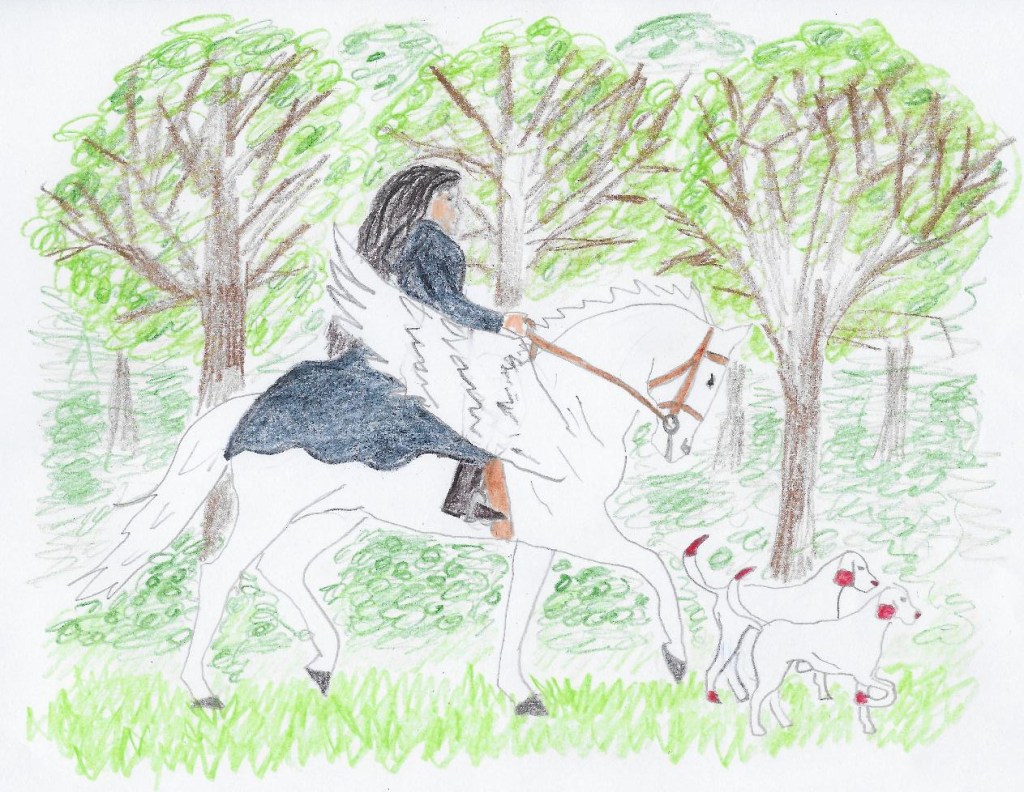
When I started journeying to Annwn with Gwyn I was reunited with this lost part of my soul. She appears as a warrior-huntress (who I am and/or watch) aboard my white winged mare with hounds. She’s everything I’m not – practical, courageous, able to fight, hunt her own food, survive in the forest.

At first I wondered whether this is simply facile wish fulfilment. Shouldn’t I, a suburban muppet, be more like my usual bumbling, clumsy, scatter-brained self? To this Gwyn replied with a resounding “No!” and told me this is the exact form my soul needs to take to get work done in his world.

I wasn’t completely certain she was my soul at first and I’m still not sure she’s the whole of my soul. Yet I haven’t found any other parts yet. I’ve has inklings in intuitions and dreams of past lives as a soldier and a nun but they feel like past selves my soul has inhabited rather than soul parts.

There is also the dark magician who sometimes shows up in my dreams and who I’ve chased through a number of books and who I’ve always kind of wanted to be if only I was good at magic. I spent a while wondering if he is my animus* but have reached the conclusion he has his own enigmatic existence, that dark magicians don’t give away their secrets, and accepted him as a guide of sorts.

In contrast to Jung I’ve found that my soul rarely speaks to me. For the past eight years since I’ve journeyed with/as her she hasn’t said a word and it’s only since reading Jung I’ve tried to speak to her. This resulted in her telling me to ‘be silent’ and ‘to come’ (to see what she had to show me). This demonstrates it’s not that she can’t speak but she’s not very talkative. I’m guessing this may be because I’m so full of words and chatter and her silence compensates like with our other qualities.

I think it’s possible that my white winged mare and perhaps my hounds are also parts of my soul. I believe my mare has been with me since birth and am tentatively referring to her as ‘my soul animal’ or ‘my spirit animal’ (as opposed to ‘a spirit animal’) to avoid terms from other cultures such as power animal’ or ‘totem animal’. This manifested early on in me galloping round and round the playground on my own pretending to be a horse when the other children were playing games. Eventually I started horse riding and spending all my time at a local riding school working for rides, training as a riding instructor, and later returning to a career in horses after finishing my PhD.

And with horses there were always yard dogs – labradors, terriers, the crazy cocker spaniel I shared a mobile home with. Unlike with horses I’ve never had my own dog (my parents are cat people) so I’ve never got to know dogs that intimately. Whilst I generally feel at one with my horse I often feel like I’m full of yappy excitable hounds jumping up and down inside me that refuse to calm down. Like the dogs that come and shake all over me or out me when I’m meditating I find them annoying. Whilst I’ve only got one horse** my first hound guide was an old shaggy wolf hound and he was replaced by two young Hounds of Annwn when I decided to make my lifelong dedication to Gwyn.

So my current view contrasts with Jung’s in that my soul appears as many parts at once. Also my soul is both male and female – my huntress is female, my mare is female, and both my hounds are male.

My main challenge in this deepening ‘service of the soul’ is learning to trust my soul. Putting aside my feelings of bitterness and resentment that my soul will never earn me any money and my fears that by following my soul away from known Brythonic mythology I may lose my already small audience.

But what are these fears compared to losing one’s soul?

*Mainly because Jung states that that men have a female anima and women have a male animus – a gendered binary logic that doesn’t ring true to me.
**Ok there’s ‘the dark horse’ but I think he’s a water-horse, a land spirit, rather than a part of my soul.

The Mother of the Son

Spoke the Prophet with the Dragon’s Tongue,
The Voice of the Goddess with Nine Dragon Heads:
“The Dragon Goddess shall be slain and in Human Form
She shall be reborn as the Mother of the Son.

In His darkest dreams the King of Annwn will tear
Out the Eye of Bel, He will tear down the Sun and put it
Inside the Belly of His Dead Mother and the Queen of Annwn
Will shape for Her Dead Mother a new Earthen Form

And They will send Her in a boat to Portus Setantiorium
Where She will be met on the Western Shore with Reedlights
And up the River of Belisama will sail to Ribel-Castre
And there the Eye of Bel will once again be reborn

As Maponos ‘the Son’ to Matrona ‘the Mother’.
Yes! Throughout Belisama’s Vale in the Sacred Groves
At the Springs and Wells and the Roaring Fords at the Roman
Altars and in the Temples They shall be Honoured.

At the birth of every child She shall appear Threefold
To Breathe the Blessings of the Awen into the Infant Mouth.
As the Three Mothers of Destiny She shall be Revered
In all the Holy Places in the Hills and Vales of the Old North.

And she shall appear Ninefold the Dragon Daughter
Of the King of Annwn as Morgana and her Sisters breathing
Life into His Cauldron before spiralling into Serpent Forms.
And the Nine shall be Recoiled in Circles of Stone.

And when the Priests of Christendom come armed
With Book and Vestment and Mitre treading widdershins
Around our Holy Wells with splashings of Unholy Water
But failing with their Prayers to undo our Spells.

Henceforth she will be known as Mary in Nine Churches
In Belisama’s Vale: at Peneverdant, at Prestatun, at Wahltun,
At Euxtun, at Leyeland, at Sceamlburgh, at Bamber Brig,
At Ruhford, at Fernihough, she will be Honoured.

At Cockersand Abbey as Mary of the Marsh
As the Magdalen in Maudlands in Nine Times Nine Churches
Across the Islands of Prydain and beyond she will be Honoured,”
Spoke the Prophet with the Dragon’s Tongue.

This poem was written as an early experiment in writing in the voice of ‘The Prophet with the Dragon’s Tongue’ in a Blakean style and brings together some of the mythic overlayerings of mother figures I have perceived within my landscape, in the Brythonic myths, and in visions and journeys.

I recognise this will not accord with everybody else’s perception of these deities and is very much a personal revelation. And, of course, I won’t be attempting to imitate Blake again, which I knew before setting out is impossible and foolhardy. I see it as a first step on the way to creating a myth to live by.


Anrhuna – The Dragon Mother

In previous posts I have spoken about how I’ve come to know Anrhuna ‘the Lady of Peneverdant’ or ‘the Mother of the Marsh’ as the ancient British mother goddess associated with marshlands and healing waters who was replaced by Saint Mary the Virgin at the well and church on Castle Hill in Penwortham.

As the mother of Vindos/Gwyn (a ruler of Faerie/Annwn whose presence at Castle Hill may be attested by a local fairy funeral legend) by Nodens/Nudd/Lludd, I have more recently been getting to know her as ‘the Mother of Annwn’ and in this guise she appears to me as a nine-headed dragon.

This is an image I have never come across in Brythonic mythology. However, stories of dragons abound across Britain and Nodens/Nudd/Lludd and Vindos/Gwyn are associated with them. In the Temple of Nodens at Lydney is a mosaic of two sea serpents and Nodens is depicted on a mural crown with ‘icthyocentaurs’ with serpent tails. Plus, as Lludd, he stops the battle of two dragons. Gwyn’s dog, Dormach, is depicted with two serpent tails and Robert Graves calls Gwyn ‘the Serpent Son’.

At the Temple of Nodens, who is surrounded by the watery subliminal imagery of the dream world and where sick people received healing dreams, a statue of a mother goddess holding a cornucopia was found. Pilgrims offered her pins for aid in childbirth. This may be a representation of Anrhuna. Maybe, just maybe, the two sea serpents are Anrhuna and Nodens in more primordial forms. In this context the appearance of Anrhuna, Mother of Annwn ‘the Deep’, as a dragon makes more sense.

Yet her myths are lost. I have recently returned to the Babylonian creation epic, Enuma Elish, which features a dragon-goddess called Tiamat, who shares similarities with Anrhuna, to look for clues. Tiamat is a goddess of the salt sea. Her name may be cognate with the semitic tehom (‘the deep’ or ‘the abyss’) and she appears as a dragon or sea serpent. After she gives birth to the gods they turn on her. Against them she births an army of monster-serpents and puts her son, Kingu in the lead. Following a primal battle she is slain by the storm god, Marduk, and the world is created from her remains.

I’ve long found the following lines about Tiamat’s birthing of monsters beautiful and awe-inspiring:

Ummu-Hubur [Tiamat] who formed all things,
Made in addition weapons invincible; she spawned monster-serpents,
Sharp of tooth, and merciless of fang;
With poison, instead of blood, she filled their bodies.
Fierce monster-vipers she clothed with terror,cc
With splendor she decked them, she made them of lofty stature.
Whoever beheld them, terror overcame him,
Their bodies reared up and none could withstand their attack.
She set up vipers and dragons, and the monster Lahamu,
And hurricanes, and raging hounds, and scorpion-men,
And mighty tempests, and fish-men, and rams;
They bore cruel weapons, without fear of the fight.
Her commands were mighty, none could resist them;
After this fashion, huge of stature, she made eleven [kinds of] monsters.
Among the gods who were her sons, inasmuch as he had given her support,
She exalted Kingu; in their midst she raised him to power.

I’ve wondered whether we once had a story in which Anrhuna gave birth to Monsters of Annwn such as the Great Scaled Beast, the Black Forked Toad, and the Speckled Crested Snake who feature in ‘The Battle of the Trees’. This depicts a conflict between the forces of Annwn and the Children of Don and perhaps records a primordial battle between monsters and culture gods that shaped the world. The parallels suggest Anrhuna gave the kingship of Annwn to her son and made him leader of her armies.

I am currently exploring these ideas in early drafts of my next book ‘The Gods of Peneverdant’. You can find out more about what is going on behind the scenes in my monthly newsletter and see unseen work by supporting me on Patreon HERE.

Who am I?

I am not Taliesin enthroned in Caer Siddi where bardic words are a fountain of wine and mead and are served like sweet pastries and Turkish Delight on golden platters by a whirl of wisp-like spirits.

I am not Myrddin alone and starving in the Forest of Celyddon amongst the gwyllon with icicles for hair and a lean wolf beside him. By pine and root and name of plant and bone of bird laying to rest the skeletons of Arfderydd, healing rib by rib by the wisdom of awen.

I am not Orddu in her cave listening to the slow drip of water counting down to her preordained death.

I am not Afagddu on the shoreline. I have not swallowed stones. I have never tricked a fisherman.

I am not the Dark Magician in his high tower in the woodland at the back of the world where people come and go like the mists whilst his intentions, like the tower, forever remain concealed.

I am not the Nun in her cloister, the Bride of Christ with wedding bells in her head suffocating in his tomb.

I am not the Priestess of Avalon who serves my god lighting candles at the White Spring.

I am a suburban poet. I am Gwyn’s awenydd. I am not quite a hermit. I am possibly almost a mystic.

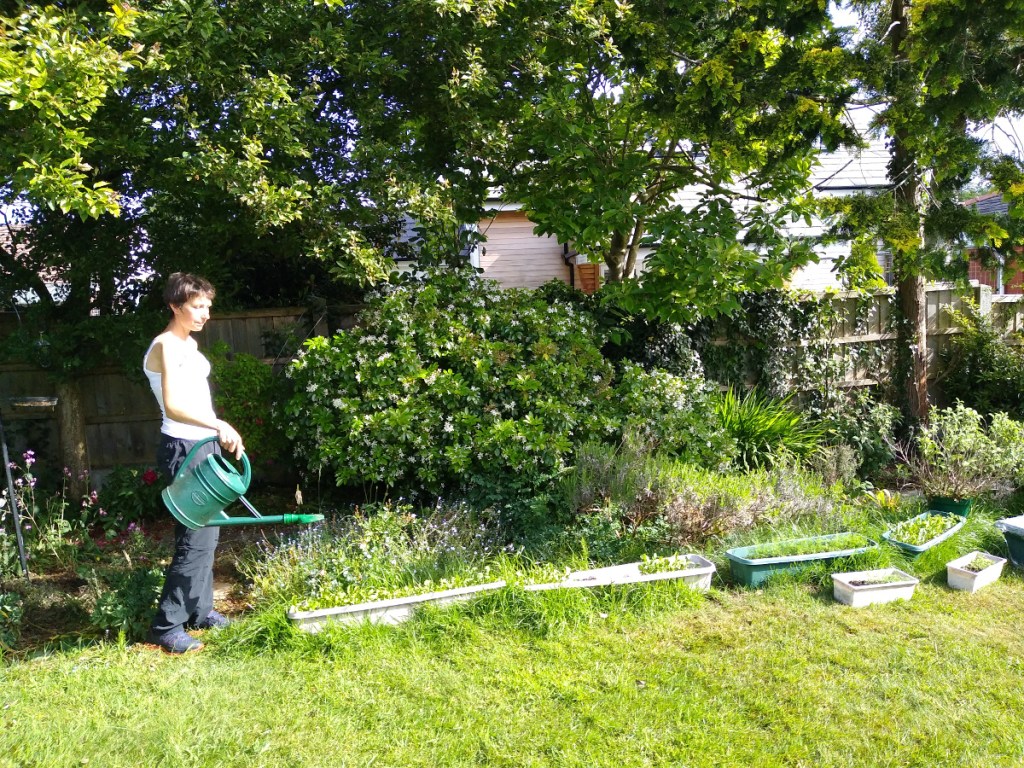
I am a between person. I am at home and not at home here in Peneverdant. I am in Creiddylad’s Garden. I like the slowness of the watering can. I like chloroplasts and slipping into them to learn of light and dark reactions, to become part of the Calvin-Benson Cycle. I like garden gnomes.

Perhaps one day I will wear a robe and shave my head or perhaps I will go naked in spite of the neighbours and the gaps in the garden fence or perhaps I will disappear like a mason bee into a bug hotel.

I know that, one day, like everything in this garden, I will be compost. Food for stinging nettles and beetles.

I am the key to the mysteries for which I have not found the lock yet.

I am the book in my hand that is not yet written.

The Gifts of Solitude

The past few weeks, following my discovery it’s likely I have Asperger’s, have been difficult and revealing, but ultimately rewarding and healing. I feel like this revelation has come at the right time, during this period of lockdown, when I have time alone to process it.

Learning more about autism I have gained some valuable insights for others. I discovered the story of Matthew Tinsley* who, like me, used alcohol as ‘a coping strategy against the extreme anxiety caused by being autistic and living in a non-autistic, social, flexible world.’ ‘His diagnosis gave him the knowledge to realise his own anxiety as an autistic person, and his need to reduce the demands upon him.’

I also watched Chris Packham’s ‘Asperger’s and Me’**. In this programme Chris shares his experiences of sensory overwhelm, struggles with social relationships, and his obsession with the natural world. I was particularly disturbed by his visits to the US to find out more about remedies to eradicate autism and agreed with his conclusion that for many autistic people the best treatment is to be allowed to spend time alone. Chris is blessed with being able to live on his own in a house in the woods.

Looking back at the past I can now see that the periods when I experienced the highest levels of anxiety were those when I was putting the greatest demands to be in social situations upon myself. At the time I was writing and editing for Gods & Radicals and forcing myself to go out to protests and engage in a lot of political debate online I got so ill with anxiety and IBS I didn’t dare go anywhere that wasn’t within 20 minutes of a toilet ‘just in case’ and that lasted for a couple of years.

I also got very stressed when I combined taking an admin job that I found overwhelming (I had mistakenly taken it presuming it would mainly be managing a website and producing posters and a newsletter and hadn’t realised it involved dealing with spreadsheets and… administration… duh!) with a leading role in applying for and gaining funding to organise a series of local events called ‘The Wild and Rural Lives of Poems’. These lines from a poem written at the time describe the effect:

After the late night meeting
my head was pale and flashing
a tawdry halo a broken circuit
a worn out lighthouse
behind my eyes…

I did those things for the right and the wrong reasons. I went to the anti-fracking protests because I genuinely wanted to stand up for the landscape I love – I didn’t want to see Belisama’s river poisoned, more aquifers shattered like the aquifer beneath Castle Hill, more damage to the underworld. I wanted to create beautiful and magical events. But I was also aspiring to fit with a model of the ideal pagan/poet – socially and politically engaged and doing outward service to my community because I felt insecure about the value of my own work, which is more personal and mystical.

Repeatedly I’ve made the mistake of thinking to be a good awenydd and polytheist to my gods I should have a role in a religious community and be promoting the awenydd path and Brythonic polytheism. This drive again, came from good and bad motives, and had mixed results. During my time with Dun Brython we produced some valuable articles and shared some enjoyable meet-ups. Yet we never achieved our aim of growing the group and developing a shared practice due to lack of interest.

At Awen ac Awenydd we’ve done good work collecting and sharing information on the path and personal testimonies on our website and in our anthology ‘The Deep Music’. Yet I failed, after three attempts, to organise a physical meeting in the North West of England. The strain of administering the Facebook group, never knowing what arguments I might have to deal with, outweighed the benefits.

The time arrived to acknowledge it is best for me to be solitary, like many of the awenyddion of the past. Myrddin in his forest, Orddu in her cave, Afagddu hanging out his black wings on the shoreline. That, as I’ve always known, I’m not cut out to be a Taliesin – a celebrity bard.

These insights are the gifts of solitude. Having worked through them I have reached the stage where I can begin, as my gods keep telling me, to focus on ‘my gift’ – my awen. Learning I’m autistic and will always struggle with social relationships has given this imperative the additional strength and urgency needed to blast away my lack of belief in my path born from the arguments about cultural appropriation and my failure to learn Welsh, master the medieval texts, and prove myself a ‘proper’ awenydd.

In my solitude, free of demands, praying, journeying, drumming, drawing, writing, I’ve been thrown back on a far more raw and primal relationship with the awen and with my gods little mediated by the Welsh scribes. Visions of the deep and its deities from before Welsh was spoken, Brythonic, ancient British, before there were humans to speak at all. Of the Annuvian, of the depths, of the Other.

The gift of a mythos that is deeply personal and that I hope to say a little more about soon.

*https://network.autism.org.uk/good-practice/case-studies/autism-and-alcohol
**https://www.youtube.com/watch?v=IjdEJdr-vfs

The Mothers of Destiny

I.

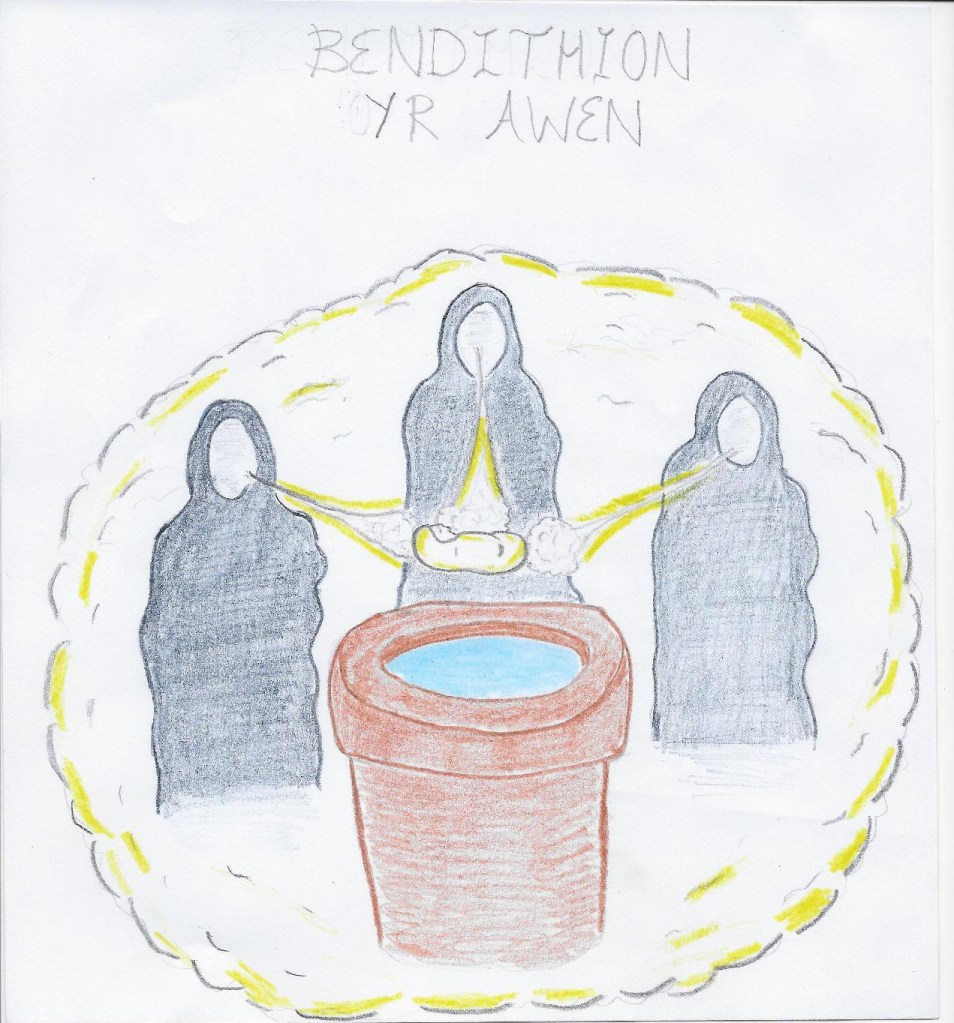
Bendithion yr Awen

I undertake a fool’s quest to understand the origins of the breath of life and in my foolishness am granted an answer. I find myself amongst a crowd singing with them as three Mothers of Destiny breathe the awen (which is at once inspiration and one’s fate) into a baby.

It is suspended over a baptismal font that reminds me of the Roman altar to the Mothers at Lund Church near Springfields around five miles away from me.

Our voices are pre-Roman, Roman, post-Roman, of all the women who have sung their blessings to a child in this ancient gathering place and in churches where Matrona ‘the Mother’ appears as Mary and the Matronae as Faith, Hope and Charity.

They rise and fall as we sing: “Awen bendithion yr awen bendithion yr awen bendithion…”

II.

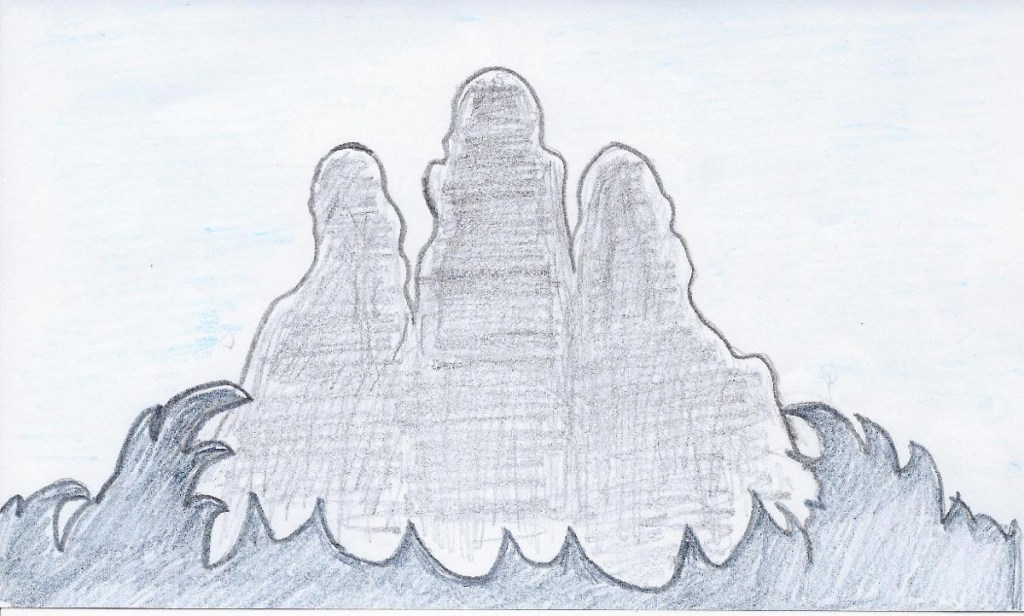
Sea Maidens

My fool’s quest continues as I cannot, now, resist returning to the mothers to pose the question of my own destiny. They appear as three sea maidens, stormy, stony-faced, amidst a sea of raging waters.

III.

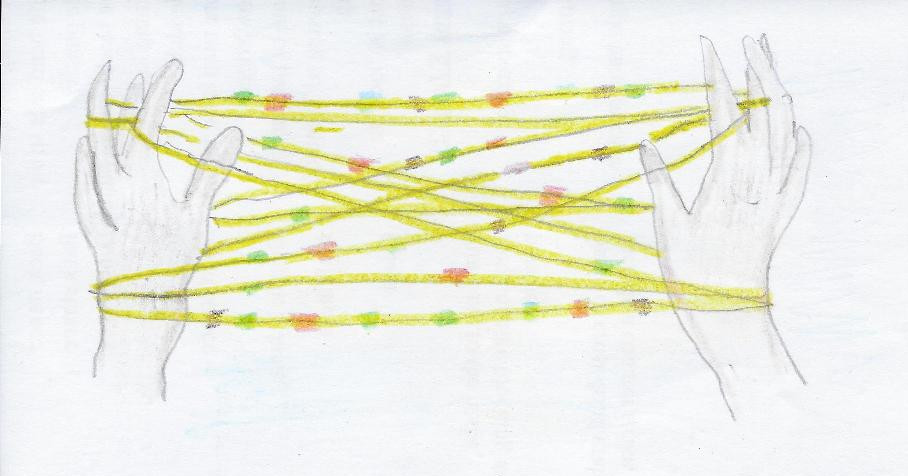
The Web of my Destiny

The goddess in the middle shows me ‘the Web of my Destiny’. She holds it between her hands like a cat’s cradle. It shimmers golden and pulsates with coloured jewels of energy. She tells me that a small tweak can change everything. I realise that making a cat’s cradle is a two-way process, between a person and the gods, and it’s my turn.

The Buttercup Meadows

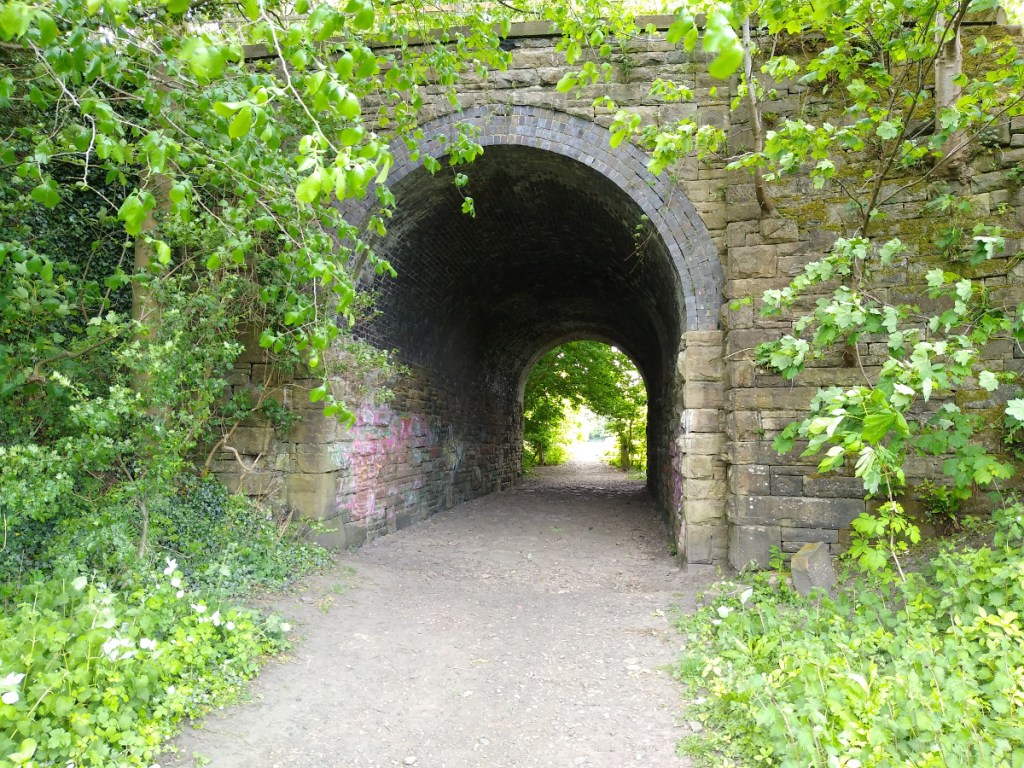
The tunnel
leads to Paradise.

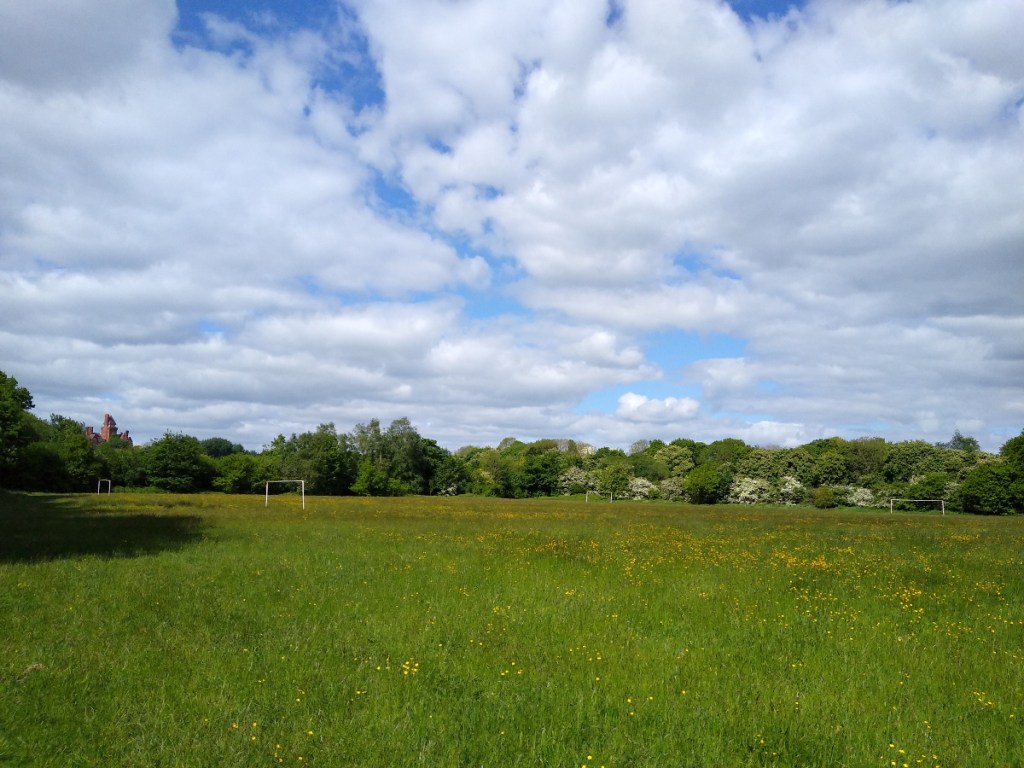
To the buttercup meadows
where the goalposts
have no goals.

Although the bike sheds
and the mural of St Teresa
in her ecstasy are gone
her sigh lingers on.

The last gasp of a steam train
on the railway lines
overgrown.

The smoke no longer stains
the city walls.

I walk here like a dog
without a master

thrown by life’s curve balls

whilst he sleeps in
deep Annwn.

In the future
will I be your guide dog
or the one that went barking
into the unknown?

The Well of Life

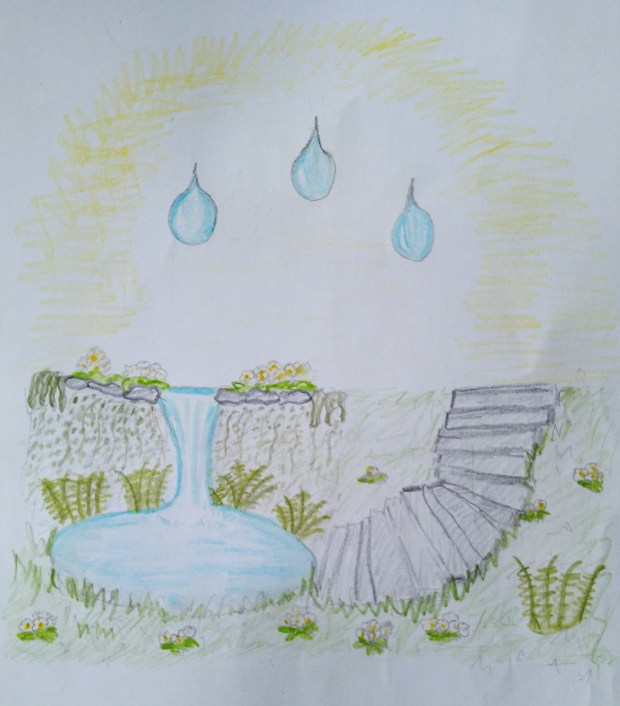
‘From the Well of Life Three Drops Instilled’
John Milton

This image is based on a combination of the lines above from John Milton’s Paradise Lost, a sketch of St Mary’s Well in Penwortham by Edwin Beattie (which can be viewed HERE), and the following words written about it by James Flockhart in 1854:

‘On the road which leads from Penwortham Bridge to the Church, at some distance before reaching the avenue leading to the entrance, there is a narrow pathway by which the traveller, after descending a few rude steps, may reach the fields on the left hand. At the bottom of the steps, a little to the right, is a spring of clear water flowing into a sort of natural basin, surrounded by brushwood, near which I have seen primroses and other wild flowers blooming in the greatest luxuriance. This well, like others in the olden time, had its patron saint. It was one of those acts of piety practised by our forefathers to acknowledge the inestimable value of water by dedicating all springs to some saint, but more particularly to the Virgin Mother of our Saviour, as being emblematical of purity. The well at Penwortham, in accordance with this custom, is said to have been dedicated to ” Our Blessed Ladye,” and to have been formerly remarkable for working extraordinary cures; and it is even believed by some to possess this power at the present day; in fact, I have heard many people in the neighbourhood say, that to wash the hands in its water is a certain antidote to evil.’

St Mary’s Well, at the foot of Castle Hill in Penwortham, dried up between 1884 and 1888 when the aquifer was shattered by the moving of the river Ribble during the creation of Riversway Dockland. As a Well of Healing and a Well of Life, which I believe was sacred to an older goddess named Anrhuna before it was re-dedicated to Mary, it continues to exist in Peneverdant, which for me is becoming a mythic reality of Penwortham much as Avalon is to Glastonbury and Blake’s Jerusalem is to London.