Food Noise, Noise, and Meditation

A few months ago, I learnt how the new weight loss jabs not only help people to lose weight but dampen ‘food noise’. I hadn’t heard of ‘food noise’ before and quickly found out that the term was coined in the 2000s and relates to ‘food-related intrusive thoughts’ – the constant chatter about food that goes on in a person’s mind even when they’re not hungry. I recognised it immediately as something I used to experience (along with ‘alcohol noise’) and still experience to a certain degree. It has been labelled in eating disorder communities as ‘the eating disorder voice’.

Other the past few years, I had worked out that my food and alcohol related thoughts were just a couple of the varieties of the many types of noise generated by my over-thinking mind and had learnt to quieten them with meditation. Thus, I was shocked and intrigued to find out that an injection can mimic the effects of a practice I had taken a number of years to develop and still struggle with. This got me researching how the weight loss jabs work and how they affect the same neural pathways that are affected by meditation.

The medications in the weight loss injections are called GLP-1 receptor agonists. They are synthetic variants of GLP-1, an essential gut hormone, which lowers blood sugar, reduces appetite, and brings about feelings of satiety. Variants include semaglutide (Ozempic and Wegovy) and tirzepatide (Mounjaro). 

When a person eats a meal, GLP-1 is released, and travels through the bloodstream and the vagus nerve to the brain, where it causes appetite suppression. It also goes to the pancreas, which produces insulin, lowering blood sugar. 

GLP-1 ‘effectively shuts down areas in the brain involved in feeding response, homeostatic controls, energy balance and decision-making about food—as well as the liking and wanting of food and impulsive behaviours associated with eating.’ Thus, it dampens cravings and food-related thoughts.

Researchers have identified that GLP-1 shuts down the Default Mode Network – the background setting of the brain which drives mind-wandering, ruminating on the past, planning for the future, and self-reflection. This is responsible for us getting stuck in negative thought loops and food-related thoughts.

Like GLP-1, meditation, which involves training the mind to concentrate on one object of thought of a time, also shuts down the Default Mode Network. It not only stops ‘food noise’ but all other types of noise as well. 

GLP-1 has also been shown to have an effect on the reward pathways that are not only associated with addiction to food but with other addictions. ‘Neurons that produce dopamine—a chemical with pivotal involvement in mo­tivation and pleasure—project to the nu­cleus accumbens, a midbrain structure im­portant for experiencing reward… Like other brain structures, the nucleus accumbens has GLP-1 receptors. Studies have shown that in ani­mals, dopamine release peaks after they eat a sweet meal of sucrose—and after they are exposed to cocaine or opioids.’ GLP-1 dampens this effect, meaning the peak to such rewards is no longer received, weakening these pathways.

Meditation strengthens our ability to recognise cravings as just thoughts and not to act on them, thus weakening the neural pathways of food addiction. Both could thus be helpful for people with binge eating disorder and bulimia.

It’s notable, here, that restrictive eating disorders, such as anorexia, re-wire the brain to get the dopamine hit from restricting food intake and / or over-exercising to lose weight. Meditation can also help with addiction to restricting and excessive exercise.

It has been shown that people who use weight loss injections usually gain weight afterwards if they do not continue to follow a healthy lifestyle. Combining taking a GLP-1 receptor agonist with learning meditative techniques can help people to lose weight and keep the weight off.

SOURCES

Cook, Geoff, Quieting “Food Noise”: How GLP-1s and Mindfulness Rewire the Default Mode Network (DMN) and Reward Circuits, NIH, https://pubmed.ncbi.nlm.nih.gov/41502834/
Young, Lauren, ‘Ozempic Quiets Food Noise in the Brain—But How?, Scientific American, https://www.scientificamerican.com/article/ozempic-quiets-food-noise-in-the-brain-but-how/

On Singing in Chains

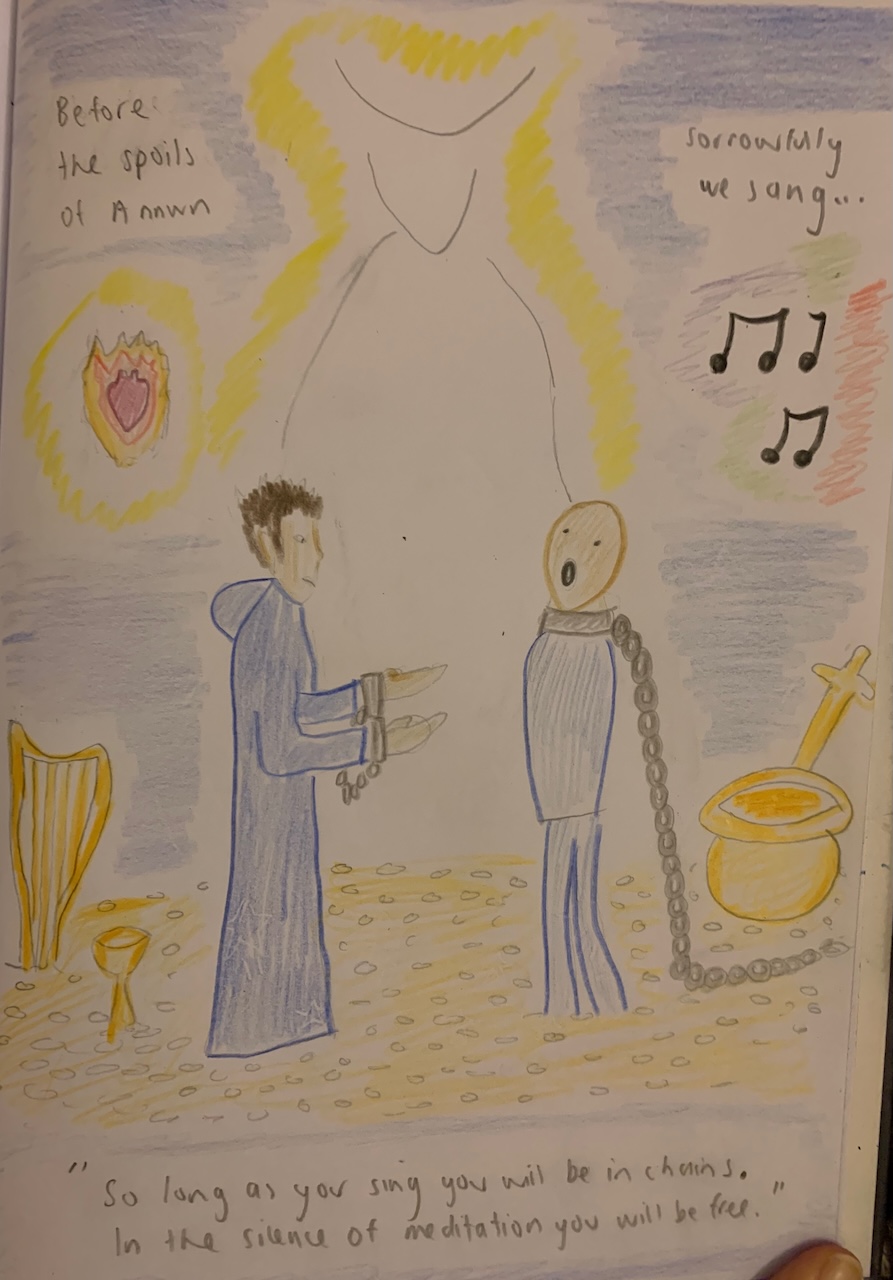
In the Monastery of Annwn meditation group we have recently been exploring the medieval Welsh poem ‘The Spoils of Annwn’ from an Annuvian perspective rather than from the views of the ‘victors’ Arthur and Taliesin.

Last week, in the guided visualisation meditation, we journeyed to the first fortress, Caer Siddi ‘the Fairy Fort’, on our magical monastic boat and gained personal visions based on lines from the poem:

Maintained was Gwair’s prison in Caer Siddi
throughout Pwyll and Pryderi’s story.
No-one went there before he did –
into the heavy grey chain guarding the loyal lad.
And before the spoils / herds of Annwn he was singing sadly,
and until Doom shall our poetic prayer continue.

I found myself standing before Gwyn wearing chains with Gwair in a scene resembling the Devil card from the Rider Waite Tarot. Whilst Gwair was imprisoned in a heavy grey chain I was wearing only toy-like silver handcuffs and felt they were close to breaking and to my being released.

Gwyn said:

‘As long as you sing you will be in chains.
In the silence of meditation you will be free.’

Gwyn’s words reminded me of the shift in my path from being a bard in the mead hall to becoming a Nun of Annwn. To moving away from performing poetry to a more monastic and shamanic path.

Another way of looking at it was that the singing is the voice of the incessant thoughts in my head and that only when I’m silent in meditation will their song and the chains be gone.

Breathe

We need to remember that our very breathing is to drink our mother’s milk – the air – made for us by countless microbial brothers and sisters in the sea and soil, and by the plant beings with whom we share the great land surfaces of our mother’s lustrous sphere.’
Stephan Harding

Inspire. Expire.
Anadlu i mewn. Anadlu i allan.
Breathe in. Breathe out.

Respiration (from spirare ‘breath’ and re ‘again’) is participation.

Inspire. Expire.
Anadlu i mewn. Anadlu i allan.
Breathe in. Breathe out.

Lungs. Two. Right and left. Each enclosed in a pleural sack in the thoracic cavity of the chest. Primary bronchus, secondary bronchi, tertiary bronchi, terminal bronchiole. In the alveoli, ‘little cavities’, across the blood-air barrier, gas exchange takes place.

Breathe in: oxygen 21%, carbon dioxide 0.04%. Breathe out: oxygen 16%, carbon dioxide 4.4%. 6 carbon glucose, oxidised, forms carbon dioxide. Product: ATP (adenosine triphosphate) ‘the molecular unit of currency of intracellular energy transfer’. The spark of all life.

Inspire. Expire.
Anadlu i mewn. Anadlu i allan.
Breathe in. Breathe out.

Respiration (from spirare ‘breath’ and re ‘again’) is participation.

Inspire. Expire.
Anadlu i mewn. Anadlu i allan.
Breathe in. Breathe out.

Birds have lungs plus cervical, clavicular, abdominal, and thoracic air sacs. Hollow-boned they are light as balloons, breathing in, breathing out. Then there are the lungless. Through tiny holes in the abdomen called spiracles leading to the trachea, insects fill their air sacs. Earthworms and amphibians breathe in and out through moist skins. Fish breathe water in through gulpy mouth breathe it out through gapey gills.

Plants breathe through their leaves. By daylight they photosynthesise. Stomata breathe carbon dioxide. It mixes with water. The green lions of chlorophyll work their magic by sunlight. Oxygen is released. From glucose the magical hum and buzz of ATP. At night they respire glucose and oxygen back to carbon dioxide and water. 10 times more oxygen produced than used.

Underground fungi breathe the air of the soil through thread-like hyphae that mass as mycelia. They respire aerobically (with oxygen) or anaerobically (without oxygen), changing glucose to ATP (it’s all about ATP!), ethanol, carbon dioxide, and water. This old, old, metabolic pathway dates back to the days before oxygen ruled our breath and is utilised by microbes. The hidden ones of the deep, single-celled, or living colonies, breathe through their single cell walls in ancient ways – acetogenesis, methanogenesis – to gain the blessed ATP.

Inspire. Expire.
Anadlu i mewn. Anadlu i allan.
Breathe in. Breathe out.

Respiration (from spirare ‘breath’ and re ‘again’) is participation.

Inspire. Expire.
Anadlu i mewn. Anadlu i allan.
Breathe in. Breathe out.

And what is this creature that does not breathe (in or out) with no metabolism or need for ATP? This simple strand of genes in a designer jacket called a capsid? Does this thing, neither dead nor living, have a spirit? Like all living things was it breathed into life by the gods?

Or is this death-bringer undead? This assaulter of lungs? Lung-cell-killer and causer of coughs – dead lung cells coughed up as sputum, mucus, the yellow remains of what was ours?

By what dark programme does it turn the body against itself – alveoli ‘little cavities’ where the exchange of carbon dioxide and oxygen takes place filling with water – no space to make ATP? No lungs – no breath. The pump of ventilators, breathing in, breathing out, our new iron lungs…

Did it crawl from the cauldron of inspiration like the speechless dead or is it something entirely other?

Inspire. Expire.
Anadlu i mewn. Anadlu i allan.
Breathe in. Breathe out.

Respiration (from spirare ‘breath’ and re ‘again’) is participation.

Inspire. Expire.
Anadlu i mewn. Anadlu i allan.
Breathe in. Breathe out.

To whom do we pray? To the gods and goddesses of breath and to the spirits of inspiration? To Ceridwen, Gwyn ap Nudd, Morgana and her sisters, who gave us breath, and take it away?

“Breath always leads to me,” says Gwyn. I find this reassuring and disconcerting from a death-god. From the one who releases the spirits of Annwn from the cauldron and holds them back.

So we breathe together with the lunged and lungless creatures with skin, fur, feathers, shells, scales, leaves, hyphae, the single-celled, the uncelled who ride our breath, until we return to the gods. To the winds that carry the voices of all ancestors over our 4.543 billion year old earth.

Inspire. Expire.
Anadlu i mewn. Anadlu i allan.
Breathe in. Breathe out.

Respiration (from spirare ‘breath’ and re ‘again’) is participation.

Inspire. Expire.
Anadlu i mewn. Anadlu i allan.
Breathe in. Breathe out.

*I adapted this meditation from an earlier version ‘The Ways We Breathe‘ previously published on Gods & Radicals following guidance from my deities to focus on my breath and being struck by the realisation that a distinguishing feature of coronavirus and other viruses is that they do not breathe.