The Calming of Meadowsweet

On an un-named patch of land half a mile from my home that I know as the Meadows, meadowsweet grows along the banks of the ditches and in damp areas.

Its fluffy white flowers, with their almond essence-like scent, are unmistakable. Look a bit closer and you will see they are tiny (5 – 10mm in diameter) and grouped together in cymes with the stamens providing the fuzzy look. Its leaves, too, are striking. They are deep-veined, serrated, and arranged alternately in up to five pairs, ending in a three lobed leaflet. In some places, the flowers have gone over and seeds are forming – tight-clustered achenes.

The common name, ‘meadowsweet’, (1) derives from the Anglo-Saxon, meodu-swete ‘mead-sweetener’ referring to its use to sweeten mead. Other names include bridewort, meadwort, meadow-wort and queen of the meadow. 

There’s certainly a feminine energy about this plant. In Irish mythology, Aine, a goddess associated with the summer, love and fertility, gave meadowsweet its sweet scent. In the Welsh myths, the flower maiden, Blodeuwedd, is conjured by Gwydion from the flowers of oak, meadowsweet and broom as a bride for Lleu. Thus, we can see why it might be known as bridewort. 

Its scent and presence have a calming quality. In Irish and Scottish Gaelic, it is known as Crios Cu Chulainn ‘Cu Chulainn’s belt’. In the Irish myths, Cu Chulainn, ‘Chulainn’s Hound’, was a fearsome warrior renowned for his riastrad, ‘battle fury’. When he entered his ‘warp spasm’, he shook like a tree, his limbs changed places in his body, one of his eyes sucked in and the other fell out, and his lungs and liver ‘flapped in his mouth’. Thus, he wrecked devastation on his enemies with his living spear, the Gae Bolga.

According to oral Gaelic folklore (I haven’t managed to find a textual reference), the only thing that could calm Cu Chulainn after a battle was being bathed in a cauldron that was filled with meadowsweet by the maidens of Ulster. Afterwards, they tied a belt of meadowsweet around his waist, or he carried a sprig in his hand, its calming capacities preventing further furies. 

Although his stories are only now known in Irish and Scottish mythology, Cu Chulainn, whose early name was Setanta, might have had associations with my home county, Lancashire, where the Iron Age tribe were called the Setantii. The name has been translated as ‘the Reaping People’ (2) from the Celtic set mutated to met ‘cut, harvest’ and Andrew Breeze has argued they were not so much the harvesters of crops but the reapers of heads. This is evidenced by the large numbers of ‘bog heads’ deposited in Setantii territory.

Back in the days of war and head-hunting, it’s possible to imagine many a warrior in his, or her, battle fury being calmed by meadowsweet. Men and women who were angered walking the damp meadows and being calmed by its scent, picking a piece, weaving it into a belt, carrying it home to strew in a calming bath or on the floor of a hut, or brewing it to make a relaxing cup of tea.

There is evidence, too, that it was placed in the tombs of the dead during the Bronze Age, such as at Forteviot in Scotland and Fan Foel in Wales. Perhaps to calm the spirits, help them on their way, as it provided second sight. Inhaling the scent was said to help you to be able to see the fairies.

Meadowsweet has traditionally been used to soothe the stomach, relieve headaches and joint pain, and to calm fevers. Its calming qualities have a basis in its chemical constitution. Meadowsweet contains salicylates, such as salicin, salicylaldehyde, and methyl salicylate. These are converted into salicylic acid, a natural painkiller, in the body. In 1897, Felix Hoffman created a gentler, acetylated medication from meadowsweet and this is now known as Aspirin. The name is derived from its earlier botanical genus, Spiraea. It also contains antioxidants such as quercetin, rutin, and spiraeoside which calm inflammation and tannins that protect the digestive tract. 

Thus, when I’m feeling angry, or when I’m feeling anxious, I take a walk along the mown pathways through the Meadows and breathe in the scent of meadowsweet. I think of the ancestors who have done so before me, of Setanta and the Setantii, their forebears, those who came after. I think of the flower brides, the fairies, the Fairy King and Queen, their leadership of the dead. I think of sweetness, I think of life, I think of death. If only I could know the calm of Setanta and wear his belt around my waist.

(1) Its scientific name, Filipendula ulmaria, comes firstly from the Latin filipendula. Filum means ‘thread’ and pendulus ‘hanging’. These terms described the tubers that hang from the root. Secondly from the Latin ulmaria, ‘elm-like’ as its leaves resemble elm leaves. It was earlier known as Spirea ulmaria on the basis of its spiralling leaves and this was changed when woody shrubs were separated from soft-stemmed plants (which it is).

SOURCES

Breeze, A. ‘Three Celtic Toponyms: Setantii, Blencathra, and Pen-Y-Ghent, Northern History XLII: 1, (University of Leeds, 2006)
Buzzard, ‘The Legend of Cu Chullain’s Belt’, Buzzardbushcraft, http://www.buzzardbushcraft.co.uk/2012/04/cu-chulainns-belt.html
Ciaran Carson (transl.), The Tain, (Penguin, 2008)
Carden-Porrett, J. ‘Meadowsweet’, National Institute of Medical Herbalists, https://nimh.org.uk/herbal-resources/herb-of-the-month-8/
Howell, J. ‘Beautiful Botanicals: Meadowsweet was used to calm a Gaelic hero’s berserk battle rage’, John O’Groat Journal, https://www.johnogroat-journal.co.uk/news/beautiful-botanicals-meadowsweet-was-used-to-calm-a-gaelic-291935/
‘Meadowsweet’, The Woodland Trust’, https://www.woodlandtrust.org.uk/trees-woods-and-wildlife/plants/wild-flowers/meadowsweet/
‘Meadowsweet’, The Hazel Tree’, https://thehazeltree.co.uk/2019/08/16/meadowsweet/
‘Meadowsweet-Herb’, Health Line, https://www.healthline.com/nutrition/meadowsweet-herb

Alder – Tree of the Water-Dwellers

River-watcher, what have you 
and your predecessors seen
of the water-dwellers?

Was it from you
the tribe was sprung?

A couple of weeks ago, when I was walking beside the river Ribble, my eyes were drawn to this splendid river-watcher, an alder tree covered with brown-golden catkins and still bearing the dark brown cones from last year. Its trunk was splotchy with a white crustose lichen and bore several mosses.

This got me researching the natural history of alder, its role in myth and folklore, and pondering how it was perceived by the early inhabitants of this land, the Setantii tribe, ‘the Dwellers in the Water Country’, and their successors.

Alder was one of the first trees to re-populate Britain after the Ice Age. A pioneer species, it is able to grow in barren and soggy ground due to its partnership with a bacterium called Frankia alni, which absorbs nitrogen from the air and exchanges it with the tree for sugars produced by photosynthesis. Alder then fixes nitrogen into the soil and enhances the fertility, meaning other trees and plants can follow. The nitrogen-fixing nodules of Frankia alni are visible on the roots.

The wood of alder would have been viewed as particularly sacred across Britain and Ireland, wet and boggy countries, as it does not rot in water. Since prehistoric times, it has been used for the building of crannógs (lake dwellings), in fish sluices, and for building trackways across bogs. 

Near the river-watcher, in the location of Riversway Dockland, a brushwood platform, suggesting the presence of a Bronze Age lake dwelling was found. That the twigs and branches hadn’t rotted away suggests they may have been alder.

Alder was also used to make bowls, domestic vessels such as the Pallasboy vessel, and wooden idols. One of the most famous is the ‘Red Man of Kilbeg’ from Ballykean bog in Ireland. It has been suggested that alder was used to craft this idol because red droplets that resemble blood ooze from the wood when it is cut, associating with the human bleeding and with death. In this context it also interesting that, in early Irish lore, the first human was believed to have been born from alder, a story that might be linked with its flesh-like qualities. The Scottish Ballachullish Goddess was also made from alder. 

Alder was used to make shields. In medieval Welsh mythology, Bran the Blessed, a gigantic son of the sea-god Llyr, carried an alder shield. Bran and his army were compared to trees when they crossed the sea from Britain to Ireland. Bran, like an alder tree, allowed his body to be used as a bridge by his warriors across the river Shannon. His sister, Branwen, had a son named Gwern (which means alder in Welsh) who was cast into a fire. Alder thus seems to be bound up with the mythos of the Children of Llyr. 

Lancashire’s Dwellers in the Water Country were likely, too, to have made their shields from alder and to have traversed the waters between Britain and Ireland. Place-name evidence from my local area such as ‘Alderfield’ and ‘Carr Wood’ (relating to alder carr) suggests that this species has long been held in particular favour and has been abundant. 

I did wonder whether the sluices for the canals and for Riversway Dockland were made of alder but the former is Baltic Pine and the latter is Greenheart. 

Alder is of value not only to human but other-than-human water dwellers. Where it grows beside water, its roots provide shelter for fish and nesting sites for otters. When its leaves fall, it provides food for river flies and aquatic beetles, who are feasted upon, in turn by fish such as brown trout and salmon. 

Its catkins provide nectar for bees and its seeds for finches, such as the charms of goldfinches who can frequently be seen beside the Ribble. It is the food plant of insects, such as the alder leaf beetle, which I have seen on alders on peatland nature reserves. I found a red beetle on the river-watcher’s trunk and suspect it is a leaf beetle from the Chrysomelidae family.

Alder is also the food plant of the larvae of several moths, including alder kitten, pebble hooktip, the autumnal, and the blue bordered carpet moth.

Alder trunks are frequently covered in white splotches which might be mistaken for the colour of the bark but are, in fact, crustose lichens. On the river-watcher, I found a white spotted lichen called Lecidella elaeochroma. Also a patch of Parmelia sulcata. On nearby trees was Trentepholia aurea, a green alga that appears orange and is a photosynthetic partner with Graftis scripta, another lichen that is also often found on alder trees. I identified these with the help of a friend who is studying lichens.

All these factors, together, suggest that alder has long been a special tree to Lancashire’s water dwellers and thus it remains in the hearts of many. 

In the Way of the Buzzard Mystery School it is associated with foundations and with being a spiritual warrior. This fits with it providing a platform for lake dwellings and with Bran’s shield and I will be drawing upon its support and protective qualities as I prepare to take my shamanic offerings further into the world.

SOURCES

Alder, The Wildlife Trusts, https://www.wildlifetrusts.org/wildlife-explorer/trees-and-shrubs/alder
Alder, Woodland Trust, https://www.woodlandtrust.org.uk/trees-woods-and-wildlife/british-trees/a-z-of-british-trees/alder/
Alder, Trees for Life, https://treesforlife.org.uk/into-the-forest/trees-plants-animals/trees/alder/alder-mythology-and-folklore/
Alder, Tree Explorers, https://www.ucc.ie/en/tree-explorers/trees/a-z/alnusglutinosa/
‘The Company of Alders’, Salish Magazine, https://salishmagazine.org/in-the-company-of-alders/
The Way of the Buzzard Mystery School, https://thebuzzardtribe.com/

Black Poplars at the Source

Beside the source of the brook in Greencroft Valley stand two black poplars. There aren’t any known British myths about black poplars but, in Greek myth, they are associated with Hades (the Underworld) and death. 

In Homer’s Odyssey, poplars, described in different translations as ‘tall’ and ‘dusky’, so likely black, with willow, form Persephone’s Grove. Springs, throughout world myth, are seen as entrances to the Underworld.

In another story from ancient Greece, Phaethon, son of the sun God, Helios, drives his father’s chariot too close to the sun. His blazing end brings deep grief to his sisters, who are transformed into black poplar trees. The amber sap is said to be their tears. Thus its associations with death and sorrow. 

In more recent folklore the red male catkins are referred to as ‘Devil’s Fingers.’

This leads me to believe that there might have once been parallel British myths about black poplar, connecting it with springs at the entrance to Annwn and with the groves of Annwn’s Queen. Perhaps there was once a story in which the red male catkins were the bloody fingers of Annwn’s King?

I will admit that I’m not sure if these trees are true black poplars (Populus nigra) or hybrids because black poplars are rare. Plus, I’m not referring to the true source of Fish House Brook but to the outflow pipe that the culverted brook emerges from. The original source would have lain further south, somewhere on Penwortham Moss, which has been drained and replaced by housing. The brook is culverted under the gardens on the other side of my street, Bank Parade, also giving its name to Burnside Way. I feel this relates to my founding of the Sanctuary of Vindos / Gwyn ap Nudd, a King of Annwn, very near to the ‘black poplars’ at the ‘source’.

In a shamanic journey I visited the poplars for advice on descending to the ancestors in preparation for some ancestral healing work. I was shown the left tree represented my mother line and the right my father line. I slid down the roots of the left into a cavern where a group of spirits were drinking from cups from the same source. I was told that on the new and full moons I must consecrate a cup of water and make an offering:

“To the Gods,
spirits and ancestors –
we all drink from the same source.”

I felt this related to keeping the source clean – something I have been trying to do as a volunteer in Greencroft Valley with the Friends group I set up (now part of Guardians of Nature).

By Your Anger and Your Arrow – On Invoking Rudra and Gwyn

In a recent article I mentioned my discovery that yoga and tantra originate from Shaivism, ‘the Path of evoking Shiva’, ‘a system of mysticism rooted in indigenous shamanism’ which existed before the beginning of the Vedic period (1).

This got me really excited as it provided evidence that yoga has shamanic origins and that Shiva, ‘Lord of Yoga,’ was the God of this pre-vedic system. As a Brythonic polytheist and shamanic guide I associate my patron God, Gwyn ap Nudd, a King of Annwn (the Otherworld) with shamanic practices and have come to know Him as a ‘Master of Meditation’.

These similarities led me to looking for the earliest textual references to Shiva. I found out that He was earlier known by the name Rudra – ‘Roarer’ or ‘Howler’. By this name He shares many similarities with Gwyn as a God of hunting, wind and storms, and healing. Rudra is the leader of the Maruts or Rudras – storm Deities who are His sons. Gwyn and His ‘family’ are associated with ‘the province of the wind’ (2). Gwyn is a leader of the Wild Hunt, which is a similar phenomenon.

The oldest hymns to Rudra appear in the Rig Veda (1500BCE). In her introduction Wendy Doniger describes Him as follows: ‘Rudra is a liminal figure… invoked with Vedic hymns but not invited to partake in the regular Vedic sacrifice; as the embodiment of wildness and unpredictable danger, he is addressed more with the hope of keeping him at bay than with the wish to bring him near… Though only three entire hymns in the Rig Veda are addressed to Rudra, the rich ambivalence of his character is the basis of an important line of Indian theology that culminates in the Hindu god Śiva. Rudra is fierce and destructive like a terrible beast, like a wild storm; the sage begs him to turn his malevolence elsewhere. Yet Rudra is not merely demonic, for he is the healer and cooler as well as the bringer of disease and destructive fever’ (3).

I found this description striking and it reminded me very much of Gwyn, who shares an outsider status as a wild God who is revered and feared. Gwyn and the spirits of Annwn, like the Irish andedion ‘ungods’, also exist outside the ‘pantheons’ of culture Gods – the Children of Don  and the Tuatha De Dannan (4). This is suggestive of their origins in an earlier wilder shamanic culture.

Gwyn shares with Rudra a ‘rich ambivalence’. As the leader of the spirits of Annwn He contains their aryal ‘fury’ and demonic nature yet, at the same time, He is the Deity who holds it back to prevent the destruction of the world (5). These spirits share many similarities with the Maruts, or Rudras, the sons of Rudra. Rudra is also said to have power over the Asuras, ‘demons’.

Like Rudra, Gwyn is viewed as being able to bring disease and destruction and, contrastingly, is seen as a healer. In the fourteenth century He was invoked to heal the effects of the Evil Eye as recorded in The Speculum Christiani: ‘Some stupid people also stupidly go to the door holding fire and iron in the hands when someone has inflicted illness, and call to the King of the Benevolent Ones and his Queen, who are evil spirits, saying, “Gwyn ap Nudd who are in the forests for the love of your mate allow us to return home” (6).

It is very interesting to see Gwyn referred to as the King of the Benevolent Ones. This, like the term Tylwyth Teg, ‘Fair Family,’ is a euphemism for His spirits similar to how the Greek furies are referred to as the Eumenides, ‘Kindly Ones’. Likewise, Rudra is implored for His ‘kindness’. Gwyn’s name, which means ‘white, blessed, holy,’ might be seen as a similar appellation.

In ‘Rudra, Father of the Maruts’, Rudra is called upon to send ‘kindess’ and ‘healing medicine’, to drive away ‘hatred’, ‘anguish’ and ‘disease’ and to ward off ‘attacks and injury’. He is petitioned as ‘the best healer’ and as a protector who takes the form of a ‘tawny and amazing bull’ carrying ‘arrows and bow’ (7). In this apparel He bears striking similarities with Gwyn, who appears as a warrior-huntsman and ‘bull of battle’ in The Black Book of Carmarthen (8).

In ‘Have Mercy on us Rudra’ He is again petitioned to show ‘kindness’, to offer ‘protection, shelter, refuge’ and to hold back His destructive power. ‘Do not kill our father or our mother, nor harm the bodies dear to us.’ ‘Keep far away from us your cow-killing and man-killing power, O ruler of heroes’ (9). Here, like Gwyn, whose horse tramples armies like felled reeds to the ground (10) He brings death. ‘Ruler of heroes’ resembles Gwyn’s epithet ‘Lord of Hosts.’

Intriguingly we find the lines: ‘We call down for help the dreaded Rudra… the sage who flies.’ (11) This might refer to Rudra’s mastery of shamanic soul-flight. 

In the Yajur Veda we find a hymn to Rudra called ‘Shri Rudram’ which is divided into two parts. In the Namakam, Rudra is invoked by a number of names to stay His bow and arrow and destructive tendencies and to bring happiness and peace. ‘Oh! Rudra Deva! My salutations to your anger and your arrows. My salutations to your bow and to your pair of hands. Oh! Destroyer! By that arrow of yours, that bow of yours and that quiver of yours which have become the most peaceful make us happy’ (12).

Here Rudra and the Rudras are intimately associated with forests and trees. We find lines where They share similarities with the spirits of Annwn or fairies who, in The Life of St Collen, wear garments of red and blue and offer a delicious banquet (13). ‘Those Rudras who exist in trees as their overlords, yellow-hued, like tender grass, crimson and blue-necked… lords of ghosts and spirits… those Rudras who are protectors of the pathways, the givers of food’ (14).

The Chamakan is a series of petitions to Rudra for health and good fortune. ‘Let the life forces and vital airs of Prana, Apana and Vyana function properly in me.’ ‘Let me have well functioning sense organs with clear eye sight and clear hearing.’ ‘May I be granted happiness in this world and the other world’ (15).

These early hymns show how Rudra was invoked in the vedic times and hint at His function in an earlier wilder shamanic culture. At their heart lies Rudra’s ambivalent nature – His fierceness and His kindness – qualities He shares with Gwyn. Thus, they offer clues to how Gwyn (by His earlier name Vindos) might have been praised and called upon by the Brythonic people around 1500BCE and might serve as inspiration for new hymns from modern devotees.

REFERENCES

  1. Swami Nischalananda, Insight into Reality, (Kindle Edition, 2019), p387
  2. Dafydd ap Gwilym, Poems, (Gomer Press, 1982), p131
  3. Wendy Doniger (transl), The Rig Veda (Penguin Classics, Kindle Edition), p219 – p222
  4. Similar wild outsider Gods are found in other Indo-European cultures such as Dionysus to the Olympian Gods in the Greek tradition and the Vanir to the Aesir in the Norse tradition.
  5. ‘Gwyn ap Nudd… God has put the spirit of the demons of Annwfn in Him, lest the world be destroyed.’Sioned Davies, The Mabinogion, (Oxford University Press, 2007),p199
  6. Angelika H. Rudiger, ‘Gwyn ap Nudd: Transfigurations of a character on the way from medieval literature to Neo-pagan beliefs’, Gramayre: The Journal of the Sussex Centre for Folklore, Winter 2012, Issue 2 
  7. Wendy Doniger (transl), The Rig Veda (Penguin Classics, Kindle Edition), p222 – 223
  8. https://awenydd.weebly.com/the-conversation-between-gwyn-ap-nudd-and-gwyddno-garanhir.html
  9. Wendy Doniger (transl), The Rig Veda (Penguin Classics, Kindle Edition), p224 – 225
  10. https://awenydd.weebly.com/the-conversation-between-gwyn-ap-nudd-and-gwyddno-garanhir.html
  11. Wendy Doniger (transl), The Rig Veda (Penguin Classics, Kindle Edition), p224 – 225
  12. https://www.sathyasai.org/sites/default/files/pages/eternal-companion/vol-4/issue-3/rudram-namakam-chamakam.pdf p1-2
  13. https://www.maryjones.us/ctexts/collen.html
  14. Ibid. p23

The Universe Unrolls from His Heart – Thoughts on Kashmir Shaivism and Annuvian Monasticism

‘He becomes intent to roll out the entire splendour of the Universe that is contained in His heart…’
~ Swami Maheshwarananda

When I first started practicing yoga in 2022 in the hope it would help with my hip and knee problems I had no idea that I would fall in love not only with the asana ‘postures’ but with pranayama ‘breathwork’ and dhayana ‘meditation’. I never guessed that I would find such astonishing parallels between the Hindu God Shiva, ‘Lord of Yoga’, and my patron God, Gwyn ap Nudd, who presented Himself to me as our Brythonic ‘Master of Meditation’. Both, I realised, come from a shared Indo-European origin.

I found similarities exist between Shiva and Gwyn on a symbolic level. Both are associated with bulls and serpents and with intuitive insight and visionary experience. Shiva’s often seen as a destroyer and Gwyn has destructive potency as a leader of the Wild Hunt and the God who holds back the fury of the ‘devils’ of Annwn in order to prevent their destruction of the world.

There’s a story about Shiva riding down the mountain to His wedding feast on a huge bull ‘covered in snakes and ash’ ‘with ghosts and demons’ ‘some had their mouths in their stomachs, some had only one foot and some had three’. Yet when He and His company ‘crossed the wedding portals’ and entered the presence of His bride, Shakti, they were transfigured into ‘a handsome young man’ and ‘divine beings’ (1). This spoke immediately to me of the paradoxical nature of Gwyn and the spirits of Annwn who are referred to both as furious ‘devils’ and as beautiful and beneficent fair folk.

Whilst studying yogic meditation in more depth with the Mandala Yoga Ashram I discovered an incredible text called the Vigyana Bhairava Tantra from the Kasmir Shaivite tradition.The ashram founder, Swami Nischalanda, refers to it as his Bible and many of the practices within the ashram derive from it. Over recent months I have taken a short course (2) and read Swamiji’s exposition of it in Insight Into Reality from which I gleaned many insights.

Bhairava ‘Fearsome’ or ‘Awe-Inspiring’ is another name for Shiva which evokes qualities of Gwyn, whilst vigyana means ‘insight’ and tantra ‘techniques’. The text is also known as Shiva Vigyana Upanishad ‘The Secret Teachings of Shiva’. Within, Bhairava addresses His consort, Bhairavi as His Beloved and student, teaching Her in 112 dharanas ‘concentrations / lessons’ how to gain insights into the fundamental nature of reality. As I’ve been listening to and practicing the dharanas I have felt that Gwyn is speaking through it to me as His student and beloved as a nun of Annwn.

In The Edge of Infinity Swami Nischalananda provides an account of the history of Kashmir Shaivism. He says: ‘In the past, tantra was widely known as Shaivism, ‘the Path of Evoking Shiva’, a system of mysticism rooted in indigenous shamanism. It existed  throughout India well before 1500 CE, the start of the vedic period’ (3). Tantra, as an oral tradition, predates the Vedic texts, with its first scriptures emerging in the first millenium CE. Kashmir Shaivism originated in 850 CE with one of the main texts being the Shiva Sutras which were gifted to Vasugupta by Shiva in a dream. The Vigyana Bhairava Tantra is central and was written down around 7 – 800CE.

I was incredibly excited to find out that a number of texts, such as Pratyabhijna Hridayam ‘The Heart of Recognition’ and The Triadic Heart of Shiva, refer to the universe unfolding from Shiva’s heart and to His residence in the heart. 

‘When He becomes intent to roll out the entire splendour of the Universe that is contained in His heart… he is designated as Sakti.’ (4)

‘The Heart, says Abhinavagupta, is the very Self of Siva, of Bhairava, and of the Devi, the Goddess who is inseparable from Siva. Indeed, the Heart is the site of their union (yamala), of their embrace (samghata). This abode is pure consciousness (caitanya) as well as unlimited bliss (ananda)… The Heart, says Abhinavagupta, is the sacred fire-pit of Bhairava. The Heart is the Ultimate (anuttara) which is both utterly transcendent to (visvottirna) and yet totally immanent in (visvamaya) all created things. It is the ultimate essence (sãra). Thus, the Heart embodies the paradoxical nature of Siva and is therefore a place of astonishment (camatkara), sheer wonder (vismaya), and ineffable mystery. The Heart is the fullness and unboundedness of Siva (purnata), the plenum of being that overflows continuously into manifestation. At the same time, it is also an inconceivable emptiness (sunyatisunya). The Heart is the unbounded and universal Self (purnahantä).’ (5)

‘He, truly, indeed, is the Self (atman) within the heart, very subtle, kindled like fire, assuming all forms. This whole world is his food. On Him creatures here are woven. He is the Self, which is free from evil, ageless, deathless, sorrowless, free from uncertainty, free from fetters, whose conception is real, whose desire is real. He is the Supreme Lord. He is the ruler of beings. He is the protector of beings. This Soul, assuredly, indeed, is Isana, Sambhu, Bhava, Rudra.’ (6) (The names at the end are all epithets of Shiva).

Reading these words was meaningful for me because Gwyn revealed to me that His heart is the Heart of Annwn ‘Very Deep’ (the Brythonic Otherworld). During my practice of playing the heartbeat of Annwn on my drum for an hour every week I have experienced visions of the universe and its people being born from Annwn like red blood pouring from His heart and returning at death like blue blood. When we entered a sacred marriage He came to dwell within my heart as ‘the Heart of my Heart’. I was told that my heart is also the Heart of Annwn and the universe unrolls from my heart (which fits with the practices emphasising the importance of the heart-space in yoga).

As I read more about Kashmir Shaivism I found further similarities with the cosmology I have been gifted in visions from Gwyn. In Kashmir Shaivism the fundamental ground of reality is Brahman or Parama ‘Ultimate’ Shiva. In mythology it is represented as the serpent-king Nagaraja ‘the infinite… who spreads out the universe with thousands of hooded heads, set with blazing, effulgent jewels’ (7). Before I had read these lines I was shown that the ground of reality is Anrhuna, the Mother of Annwn, the Dragon Mother, who has nine dragon heads with jewels in their foreheads and an infinite number of coils. 

In a vision I was shown how Anrhuna was slaughtered and Gwyn and His sister, Creiddylad, were torn from Her womb. Through eating His mother’s heart Gwyn inherited the Heart of Annwn and became King of Annwn (8). Creiddylad brought life to the world as the energy behind creation – the ‘green fuse’ of vegetative life and by breathing life into living creatures. 

This bears a resemblance with Kashmir Shaivism wherein Brahman divides into Shiva (Consciousness) and Shakti (energy and matter). There are parallels between the Heart of Annwn being the source of the universe from which all living beings are born and to which they return and the Heart of Shiva being the source of all energy and matter manifesting as Shakti.

Intriguingly, the first three dharanas in the Vigyana Bhairava Tantra focus on the origin and end points of the breath. When I practice these exercises I find myself contemplating how Creiddylad gave breath to life and Gwyn takes it away.

Finding these similarities between Kashmir Shaivism and the Annuvian monasticism I am developing for Gwyn has been revealing and exciting. I’m sure there is much more to be discovered as I continue with my research and practices.

REFERENCES

(1) Swami Nischalananda, Insight into Reality, (Kindle Edition, 2019), p393
(2) https://www.mandalayogaashram.com/self-study-course-vigyana-bhairava-tantra
(3) Swami Nischalananda, Insight into Reality, (Kindle Edition, 2019), p387
(4) Jaideva Singh, Pratyabhijna Hridayam, (Sundar Lal Jain, 1963), p30
(5) Paul Eduardo Muller-Ortega, The Triadic Heart of Siva, (State University of New York Press), p71
(6) Ibid. p82
(7) Richard Freeman, The Mirror of Yoga: Awakening the Intelligence of Body and Mind, (Kindle Edition, 2019) p19
(8) This story has a basis in medieval Welsh mythology. In Culhwch and Olwen, Gwyn kills a king called Nwython then feeds his heart to his son. I believe this might evidence an earlier ‘Cult of the Heart’ that preceded the ‘Cult of the Head’ wherein the soul was seen to dwell in the heart and the wisdom of one’s ancestors could be passed on by eating their hearts.

The Frozen Men of Caer Rigor

‘I’m splendid of fame: songs are heard
in the four quarters of the fort, island of the strong door.
Fresh water and jet are mixed together;
sparkling wine is their drink, set in front of their battalion.
Three full loads of Prydwen we went by sea:
save seven, none came back from Caer Rigor.’
~ The Spoils of Annwn

It’s the middle of summer. We set sail for Caer Rigor beyond the ninth wave and further on to where all waves freeze beneath the turning of the frosty gulls. 

There is no fortress in Thisworld or the Otherworld colder than Caer Rigor. It wears its icicles like the Winter King’s crown upside down when he was cast down. There are frozen birds upon the turrets with songs frozen on their tongues.

The gate of the fortress is frosted shut like the cold lips of the gatekeeper.

Down from a tower swoops a messenger on wide white wings like an albatross. He pours water over jet mixing them together. Whoosh! A rush of flames, like from a flamethrower, burning in a multitude of colours, like a flambeau.

Ice drips from the gate and hinges open like the gatekeeper’s jaw. The giant stares and unclenches his fist but halts not our passage as we enter the frozen corridors of Caer Rigor and are taken to stand before the Strong Door.

“The door to this hall has not been opened for 1500 years,” the messenger speaks solemnly, “the men inside have known not death, nor decay, nor old age.”

He holds the jet-flame to the door and the icy seal around it melts. Inside is a battalion of frozen men, not the seven survivors, no, these are dead men. Young, pitifully young hopefuls who accompanied Arthur on his fateful voyage.

There is wine, sparkling wine, in their cups, they wear the faces of happy drunks. Yet, as the door opens, as the ice begins to thaw, they set down their glasses and the pain of memory appears in their eyes with the onset of sobriety as fire and ice, jet and water mix, fiercely coloured and hallucinatory.

“Where are we?” “Thisworld or the Otherworld?” “Are we alive or are we dead?” “Are we burning or are we freezing?” “Is this reward or punishment?”

“All I remember is the flash of Llenlleog’s sword as it was thrust into the cauldron.”

“Blinding!” “The explosion.” “It blinded us.” “Yet we can see.” 

“I remember the cauldron, tiny, in Lleog’s hand.” 

“Nonsense – that was just an illusion – the cauldron cannot be stolen.”

“Arthur cut off His head! The head of the Head of Annwn.” 

“And it sung to us for nights in this feasting hall.” 

“The Head of Annwn sung of cutting off Arthur’s head and how it was deaf and dumb.”

“What will become of us now?” “How can we return to the cauldron if it is gone?”

“I told you it was all an illusion,” speaks the youngest of the men. 

“You’re no longer trapped in that old myth,” the messenger tells them. 

“That old myth is done,” I am inspired to speak up, “we come as new monastic devotees of the Head of Annwn to set you free from Arthur’s rule. When this castle has thawed to the cauldron you will return to be reborn.”

They raise their cups and embrace – fire and ice, jet and water mix fierce and hallucinatory as from the turrets the birds fly free and burst into song.

~

This piece is based on my experiences during our Monastery of Annwn Brythonic texts meditation group last night. Caer Rigor has been translated as ‘the Petrification Fort’ from the Latin rigor from ‘stiffness’ and also contains connotations of ‘cold’ from frigor. The citation above is from Marged Haycock but replaces her translation of ynys pybrydor as ‘stout defence of the island’ with the more popular translation ‘island of the strong door’. This allows it to be related to the Second Branch of The Mabinogion wherein the seven survivors of the battle between the Britons and the Irish feast and drink blissfully on the Island of Gwales with the head of Bran the Blessed until one of the men, Heilyn, opens the door, and all their losses and ills return.

The Breath of Nine Maidens and the Kindling of the Cauldrons

‘My first utterance was spoken concerning the cauldron
kindled by the breath of nine maidens.
The cauldron of the Head of Annwn, what is its disposition
(with its) a dark trim, and pearls?
It does not boil the food of a coward, it has not been destined to do so.’
~ ‘The Spoils of Annwn’

In ‘The Spoils of Annwn’, a medieval Welsh poem from The Book of Taliesin, we find mysterious lines about the breath of nine maidens kindling the cauldron of the Head of Annwn. The cauldron, the source of awen, ‘poetic inspiration’, is a central symbol within Celtic mythology. 

In ‘The Story of Taliesin’ the cauldron belongs to Ceridwen. In this tale Ceridwen is referred to as a witch but it’s my intuition She is a Goddess whose crochan – cauldron / womb is a sacred vessel of rebirth (1). In Her cauldron she brews a potion from 365 herbs (one picked on each day of the year) to provide her ugly son, Afagddu ‘Utter Darkness’ with the ‘Prophetic Spirit’. She assigns a blind man called Morda to bring kindling for the cauldron and to stir the cauldron she summons a boy called Gwion. After a year and a day Gwion shoves Afagddu out of the way and steals the awen. After a shapeshifting chase he is swallowed by Ceridwen (he as a grain and She as a black hen) then reborn from her womb as Taliesin.

In ‘The Spoils of Annwn’ the model is slightly different. The cauldron of Ceridwen, the magical vessel associated with inspiration and rebirth, is in the custodianship of the Head of Annwn – the ruler of the Brythonic Otherworld. Here there is no need for kindling or a person to stir the cauldron as the breath of the nine maidens is enough to set the processes within it into motion. The ‘food’ ‘not for a coward’ that it brews no doubt refers to the awen. Taliesin accompanies Arthur and his men not only to steal the awen, but the cauldron itself, bringing it back through ‘Hell’s Gate’ to the world.

This shows that when a potential awenydd, ‘person inspired’, proves their courage to the Head of Annwn, the breath of the nine maidens or awenau, ‘muses’ (2), kindles the cauldron, then the awen is received as a gift from the Gods.

This feels like an older and deeper model for the origins of awen. The significance of the breath of the nine maidens can be further elucidated by looking at the etymology. The medieval Welsh term used for breath is anadyl and this derives from the proto-Celtic anatla which shares a resemblance with anaman the proto-Celtic word for ‘soul’. The Indo-European *uel is closely related giving us the root form of awel ‘breeze’ and awen ‘inspiration’. There seems to be something fundamental this myth is telling us about how, in Annwn, on the soul-level, the breath of the nine maidens kindles the cauldron and sets in motion the processes within the cauldron that create the awen.

It’s my personal intuition that the cauldron / womb of Ceridwen, who I know as Old Mother Universe, is a macrocosm of the universe. That it lies in Annwn ‘Very Deep’ shows the Otherworld is a deeper reality underlying the universe. 

On a microcosmic level each awenydd might too be seen as a cauldron which is kindled by the breath of the nine maidens producing awen for poetic works. The breath itself might be seen as a gift from the awenau. 

Microcosm within microcosm a number of Celtic Pagans have come to relate the three cauldrons in the seventh century Irish text ‘The Cauldron of Poesy’ to the three main energy centres or chakras in our belly, heart and head (3). Interestingly the Irish term coire ‘cauldron’ or ‘whirlpool’ might be seen to relate to the spiralling manifestation of the universe and the turning of the chakras.

In yogic meditation the breath is used to awaken the chakras. I was once dubious about the existence of ‘Celtic Chakras’ but I am now coming to perceive the resonsances between these shared Indo-European traditions. I wonder whether anatla ‘breath’ is the Celtic equivalent of the yogic prana ‘breath’ or ‘life force’ which Celtic Pagans have long been searching for (4). 

(1)These insights derive from Kristoffer Hughes’ From the Cauldron Born.
(2)This term is borrowed from Greg Hill who uses it in his poem ‘The Muses’ in his poetry collection The Birds of Rhiannon – ‘O Muses / O Awenau / You whose breath kindled the cauldron of awen in Ceridwen’s keeping.’
(3) For example see Erynn Rowan Laurie’s ‘The Cauldron of Poesy’ – https://www.obsidianmagazine.com/Pages/cauldronpoesy.html
(4) Some druids have in the past mistakenly identified prana with nwyfre ‘sky, firmament’ which Mhara Starling explains is erroneous on her Youtube channel – https://www.youtube.com/channel/UCkc4iRymvz4t619FEk5dFfA/videos Interestingly the proto-Celtic anatla ‘breath’and anaman ‘soul’ share similarities with the Sanksrit atman which is sometimes translated as ‘soul’ but refers to the Self or witness-consciousness beyond phenomena and ananda which refers to bliss at escaping the cycle of mortality or uniting with a God.

On Singing in Chains

In the Monastery of Annwn meditation group we have recently been exploring the medieval Welsh poem ‘The Spoils of Annwn’ from an Annuvian perspective rather than from the views of the ‘victors’ Arthur and Taliesin.

Last week, in the guided visualisation meditation, we journeyed to the first fortress, Caer Siddi ‘the Fairy Fort’, on our magical monastic boat and gained personal visions based on lines from the poem:

Maintained was Gwair’s prison in Caer Siddi
throughout Pwyll and Pryderi’s story.
No-one went there before he did –
into the heavy grey chain guarding the loyal lad.
And before the spoils / herds of Annwn he was singing sadly,
and until Doom shall our poetic prayer continue.

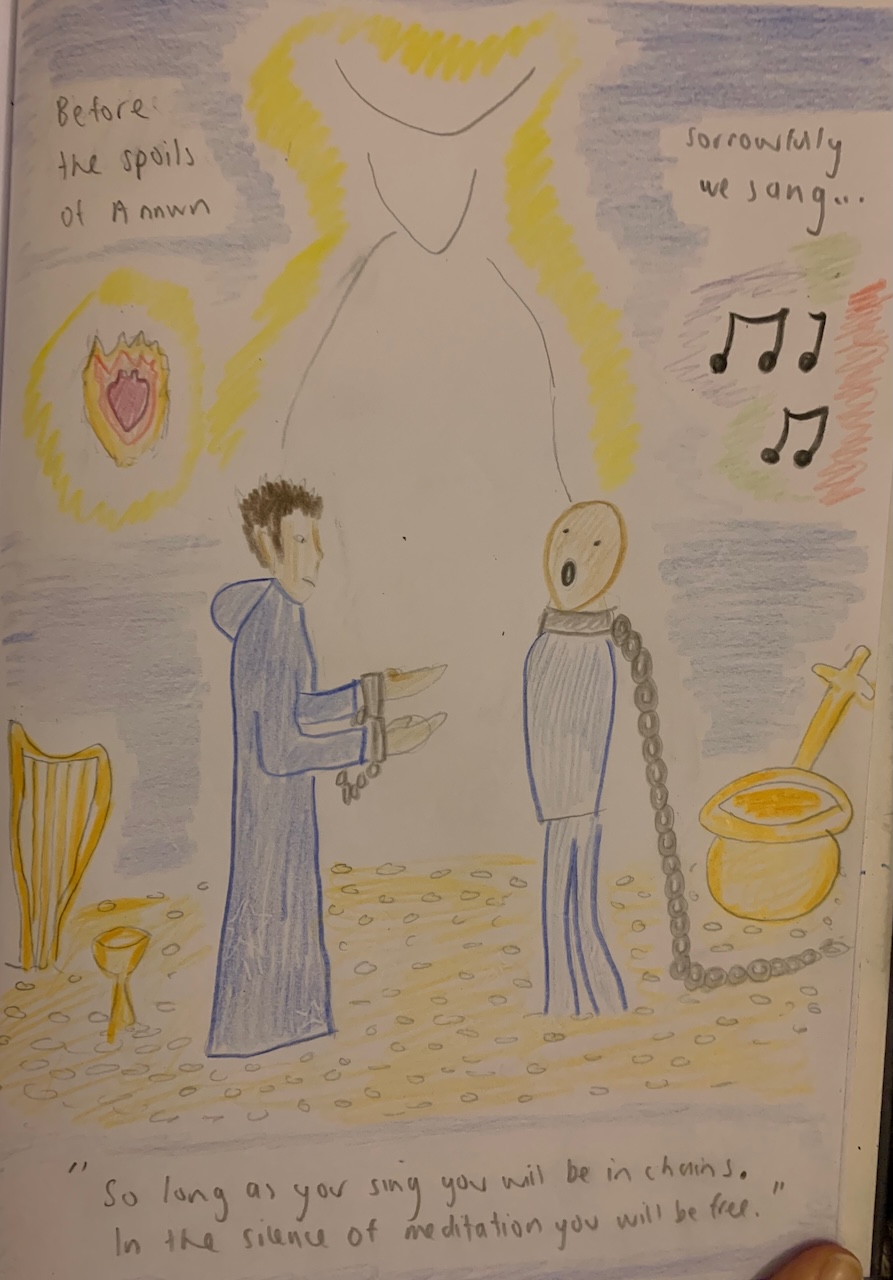
I found myself standing before Gwyn wearing chains with Gwair in a scene resembling the Devil card from the Rider Waite Tarot. Whilst Gwair was imprisoned in a heavy grey chain I was wearing only toy-like silver handcuffs and felt they were close to breaking and to my being released.

Gwyn said:

‘As long as you sing you will be in chains.
In the silence of meditation you will be free.’

Gwyn’s words reminded me of the shift in my path from being a bard in the mead hall to becoming a Nun of Annwn. To moving away from performing poetry to a more monastic and shamanic path.

Another way of looking at it was that the singing is the voice of the incessant thoughts in my head and that only when I’m silent in meditation will their song and the chains be gone.

Nodens Father of Sea Horses

Recently, in one-to-one sessions with another monastic devotee of Annwn, we have been exploring her intuitions about Gwyn ap Nudd’s associations with the sea. Gwyn’s father, Nodens / Nudd, is equated with Neptune at Chesterholm in an inscription which reads Deo No / Neptu. This suggests, like Neptune, He is associated with freshwater and the sea, seahorses, and with horses more widely (Neptune was worshipped as Neptunus Equestris – God of horse racing).

Little is known about the myths of Neptune but there are many about His Greek counterpart, Poseidon Hippios ‘of the horse’, the Father of Horses. When Demeter fled Poseidon’s lust in the form of a mare He took the form of a stallion and mated with Her and She bore a colt called Arion ‘Very Swift’. In another tale He mated with Medusa and She gave birth to Pegasus.

These stories remind me of my personal gnosis about Nodens mating with Anrhuna, the Dragon Mother of Annwn, to bear Gwyn and Creiddylad and other children who might have included horses and seahorses. Intriguingly Rhiannon, who like Creiddylad is a Queen of Annwn, is a Horse Goddess. I often wonder if Creiddylad and Rhiannon are titles for the same Goddess who takes horse form. If so this would suggest that Nodens is the Father of Horses and likely Sea Horses here in Britain. That He might be the father of Gwyn’s sea-going steed, Du y Moroedd, ‘the Black of the Seas’.

It also make me wonder if Nodens and Anrhuna might be the parents of white winged horses like pegasus from whom my closest spirit animal, a white winged mare, is descended. March allelog, ‘flying horses’, are known in Wales.

The devotional art above was born from these musings and is based on the mural crown depicting Nodens on a chariot pulled by four seahorses from Lydney and a triumph of Neptune in a chariot drawn by two seahorses from Sousse Archaeological Museum.

The Old Three Bears

In a recent journey circle at the Way of the Buzzard Mystery School we journeyed to Bear to ask for advice on overwintering. I was expecting to receive my usual guidance on slowing down and making time for rest. What happened was surprising. 

When I got to the cave Bear was in a torpor. I pulled back his skin, like velcro, and found to my shock that he was mechanical inside. I searched inside his insides, which were like circuit boards and pulled out a box of cornflakes! I then found myself in a cottage with the three bears shouting at them: “You should be eating porridge not cheap cornflakes!” This made me realise they were not real bears. In the basement of the cottage I found three bear pawprints leading into a woodland. There I found the three bears inside each other like Russian Dolls playing a drum. I was told I must play ‘the Bear Drumbeat.’ As they drummed images came from the drum and were made manifest. I was told, this way, I must ‘repopulate the forest.’ 

This got me wondering if the Goldilocks and the Three Bears story has roots in an older myth about the Old Three Bears from the time between when the Romans imported oats to Britain to feed their horses and potentially to make porridge and bears became extinct 1,500 years ago. Could the Three Bears within each other be a triple form of the Celtic Bear God or Goddess, Artaios or Artio? 

Their advice is suggestive of how images of the Otherworld are evoked by a shamanic drumbeat and of the power of durmming and imagination to create more ecologically viable futures to which extinct animals like Bear might return.