Review – Dwelling on the Threshold: Reflections of a Spirit-Worker and Devotional Polytheist by Sara Kate Istra Winter

This book was published in 2012. When I first read it in 2015 I was delighted to find a kindred spirit who shared my deep devotion to the Gods and practices as a spiritworker, albeit in the Hellenic rather than the Brythonic tradition.

It is a collection of essays covering diverse topics from relationships with Deities, land spirits and personal spirits to practices such as oracular trance and possession and the use of entheogens. As the author states, it ‘isn’t geared towards beginners’ but is a record of ‘thoughts and experiences’ that serve to ‘inspire and stimulate’ ‘anyone on a devotional and / or spirit-work path’.

In the introduction Winter notes the term ‘spirit-worker’ is recent and is ‘not well defined. But it generally indicates a polytheist and / or animist who serves the gods and spirits directly in some capacity, and with a level of intensity and devotion above the average worshipper… They might serve a community, but unlike a a shaman they don’t necessarily have to. A spirit-worker traverses the road between humans and gods, between this world and the otherworlds, and they do this because they must, because they are called to, and because it is quite literally their work in life.’

She says, ‘devotional polytheist’ ‘was coined partly as a counterpoint to strict reconstructionism’. The differences lies in placing ‘a high level of importance on personal and direct experience of the holy powers’ and the devotional practices of ‘prayer, ritual, offerings etc’ whilst remaining respectful of the historical sources rather than attempting to reconstruct past traditions.

The rest of the essays form an exploration of these ‘twin paths’. A piece that particularly still resonates is ‘Mysticism as Vocation in Modern Paganism’. Here Winter rails against the view not only of secular society but ‘the majority of pagans’ that ‘spiritual vocation’ ‘is a luxury to be fitted around daily life’. Why cannot ‘home, family and career’ ‘be fitted around spiritual vocation?’ With no state support for Pagan religious vocations here in the UK those of us who share such a calling are left with a constant struggle to balance the need for financial security with fulfilling our calling from the Gods and spirits.

Those who follow Winter / Dver’s blog ‘A Forest Door’ will know she writes beautifully about her relationship with lands spirits. Here, too, she describes her practice, traversing her ritual landscape, carrying a ‘beeswax taper’ ‘like a ritual torch’, following crow feathers, making offerings of ‘mandrake root’, ‘an old and crackled coyote’s tooth’, ‘fly agaric’, for a local land spirit.

In ‘Evolving Patron Relationships’ and ‘Two Decades with Dionysos’ Winter talks about how He crept into her life ‘in bits and pieces’ with poetry, red wine, the Doors and how she became a Hellenic Polytheist and served her God ‘in the community at large’ before seeming to withdraw in order to lead her elsewhere – into ‘entanglement’ with the spirits. She prompts the reader to ‘recognise the possibility that a patron relationship might end’ or one might find it ‘evolves in a new unexpected directions’ ‘to where you needed to be all along’. I cannot imagine my relationship with Gwyn ap Nudd ending but do appreciate the warning of that potential and for unexpected change.

‘The Gods Are Real and Trance Isn’t Just Visualisation’ is important in stating that argument in relation to the writings of Diana Paxon and others who fail to point out the difference between ‘visualising a pre-set series of events’ and ‘actually meeting the gods and spirits in a foreign land’.

Of immense value are the pieces documenting Winter’s reconstruction of her oracular practice for Apollon based on the traditions at Delphi. Winter visited Delphi in 2003 and performed ritual and ceremony and a night long vigil. She was later inspired to take up the practices of the Pythiai after seeing similarities between her landscape of Cascadia and that of Delphi. This inspired a pilgrimage to the source of her local headwaters and to setting up her own adyton andtaking to the tripod on the seventh day of the month. In ‘On the Tripod’ she describes emptying herself to receive Appollon’s words.

‘Lord Apollon,
enter into this place
made only for Your entry
and no other’s.

I have emptied out my skull,
and await your voice to fill it.’

Eight years on I have found this book to be packed with wise words and inspiration and to be incredibly relatable as someone still walking the ‘twin paths’ of devotional polytheism and spirit-work as a polytheistic monastic. I would recommend it as a core resource for anyone wanting to learn more about these paths or delve more deeply into the issues that confront modern practitioners and the struggles and joys of building sacred relationships.

Review – Mycogenous: Dionysos in the Fungal Realm by Dver

Dionysos is a dangerous God and this is a dangerous book. 

Herein Dver reveals a ‘new’ face of Dionysos which she explains isn’t entirely new but is significant in its appearance at this time. Many polytheists will be familiar with Dionysos as a God of pandemonium, wild revelry and wine, but less as the yeast that transmutes the wine and the silence and stillness ‘at the heart of the Dionysian storm’, as mushrooms, as mycocelium, as mold. Here He is revealed as ‘mycogenous: arising from or inhabiting fungi.’

Dver’s revelations began when she ‘noticed a blue-green mold’ on half-evaporated wine she left too long in a silver kylix on Dionysos’ shrine. In an epiphany she realised He was not only in the wine but the mold and fermentation. This book is the result of five years of cultivating mychorrhizal insights.

‘The Way of Mycogenous Dionysos’ is described as ‘a path of mysticism – or mycomysticism’, ‘at times contemplative, at times shamanic… ultimately transformative.’ 

‘The heart of the tradition’ is presented in ‘The Book of Hyphae’ which contains gnosis and practice and is supplemented with exegesis at the end. 

These words, ancient Greek names for Dionysos, lines from the Dionysian tradition and new epiphanies, are not just to be read, but to be meditated on, ingested, for the Dionysian devotee performed and practiced to work the processes that will transform them into mystes and mycomystic. 

Although I am a Brythonic polytheist with little experiential knowledge of the Greek tradition I am familiar with Dionysos in mythology and as a presence. As I read this book for the first time I found certain words and practices jumping out at me and recognising a number of mychorrhizal connections. 

I found it to be of deep interest that, like myself, Dver has been inspired to draw upon practices from yoga with it being notable that the Greek, Brythonic and Hindu religions all share Indo-European roots. 

One that stood out was a breathwork based on the words βίος ‘bios’ ‘life’, θᾰ́νᾰτος ‘thanatos’ ‘death’, βίος ‘bios’ ‘life’ combining them with the three colours black – exhalation, white – ‘the liminal space between breaths’, and red – ‘the inhalation’. Later Dver explains these colours are central to the Orphic strain of the Dionysian religion and combined create a colour called orphinnos. I have been guided towards similar breathwork and black, white and red are the colours of Annwn, ‘Very Deep’, the Brythonic Otherworld.

Another practice is singing seven epithets of Dionysos activating the seven chakras / energy centres. In ascending order from root to crown, Khtonios (of the earth), Auxites (growth), Purigenes (born of fire), Omadios (eater of raw flesh), Iakkhos (the ritual cry), Kruphios (ineffable), Lusios (loosener). 

The words that leapt from the page most were ‘Bakkhios Himself has freed me.’ A shiver ran up my spine when I learnt ‘This line is adapted from one of the Orphic gold tablets which contained instructions for the soul of a dead person navigating the underworld’ and is ‘a totenpass’ ‘passport for the dead.’ 

Dver says, ’It is a prayer for liberation, a hope, a plea. It is an affirmation of devotion and dedication. And if you sing it long long enough it becomes an ordeal, a sacrifice’ and ‘could comprise one’s entire devotional practice to Dionysos.’

Another practice is practicing death, lying in shavasana ‘corpse pose’, surrendering oneself to the fungal processes of decay.

Dver has found a likeness between Shiva and Dionysos and I have found likenesses between Shiva and my patron God, Gwyn ap Nudd. All are Gods of ecstasy with associations with death and dissolution and renewal.

Not long after I read this book, having received it as a birthday present, over the November full moon I was plummetted into a process of dissolution myself. Then release from old things holding me down. As I read it again that phrase leaps out, echoes in my mind, ‘Dionysos has liberated me.’ I believe these words, the fungal touch of this God, had a role.

On a final note I would like to mention the three wonderful colour plates. ‘Mycogenous’ and ‘Lichenized’ are devotional art and ‘Remediation’ is a mask worn when lying in corpse pose and all are made from organic materials.

The book arrived beautifully wrapped and it is clear every stage in its creation has been carried out with devotion. 

I would recommend it to Dionysian devotees and to polytheists with an interest in building a devotional practice based on mystical revelations. But be warned, like fungal spores, these words, this God is dangerous. Do not expect to open it, turn its pages, without releasing a little Dionysos into your world.

Review – The Way of the Gods by Edward Butler

In The Way of the Gods philosopher and polytheist Edward P. Butler provides an introduction to polytheisms around the world. This book originated as a course he delivered for the Center for Global Polytheist and Indigenous Traditions at INDICA*.

It contains fifteen chapters covering India, the Mideast, Hellenic and Roman Polytheism, Northern Europe, Ancient Egypt, African Traditional Religions, South America, Mesoamerica, the African Diaspora, North America, Oceania and New Zealand, Australia, Southeast Asia, Japan and Korea and China. 

It is unique within academia as, from the start, Butler states his standpoint as a polytheist who believes the Gods of all the world’s traditions are real**. Thus for him these religions are not ‘solely a matter for historical study’ but embody ‘eternal relationships to the Gods whom they address.’ 

Throughout the book Butler makes clear that the terms ‘polytheism’ and ‘Gods’ are not used to ‘determine the self-understanding’ of non-Western cultures. Consistently he provides the indigenous terms for the religions and deities of each culture. He notes his use of ‘Gods’ is to ensure their divinities are not seen as lesser than the Christian God or reduced to pantheistic concepts. He also notes the Western mistake in the labelling of cultures as animistic in a way that sets up a false opposition between animism and polytheism, leading to the supposition that cultures that have spirits have no Gods.

In each chapter Butler provides a history of the polytheistic traditions of the cultures of his chosen geographical areas. It is noted that whilst some have continuity (such as ‘India, ‘home of the largest polytheistic tradition in the world… Hinduism’ and Australia ‘the longest continuous tradition on Earth) many others (such as Greek and Roman and Egyptian) are sundered. Butler does not flinch from speaking of the oppression most polytheistic traditions have suffered, and some still suffer, under the hegemony of Christianity. 

The chapters begin with core readings and many are on creation myths such as Enuma Elish, Theogony, Gylfaginning, Kumalipo and the Popol Vuh. Butler provides studies of these cosmogonies showing how several originate with ‘water’ as ‘a much broader cosmic phenomenon’ and ‘result in the emergence of a hierarchical or layered reality’. ‘Every cosmogonic myth is a doctrine concerning Being’. He notes the similarities and differences between the African cosmogonies where the Creator withdraws into the sky opening up a space for further action and the threat of the falling sky in South America due to the decline of spiritwork which maintains the supports. 

Throughout Butler emphasises that myth does not relate to some distant past but is ‘always now’. Western scholarship has tended to favour diachronic interpretations and linear narratives to those that are synchronic. Rituals, such as the recitation of Enuma Elish ‘on the fourth day of the Babylonian New Year’, allow for participation in this eternal now with the Gods.

Different approaches to ritual and spiritwork are presented. One of these is the Yoruba tradition of Vodou from the African Diaspora. Herein there is a single pantheon of Orishas (from ori ‘head’ and sa ‘selection or choice’). Divination reveals the patron deity as ‘the owner of the head’. One of the practices is the mounting or possession of the devotee by one’s God.

This book provides a fascinating introduction to polytheisms around the world. It is meticulately researched and respectful to each of the cultures and their Gods. As a philosophy post-graduate I particularly enjoyed Butler’s analyses of the cosmogonies in the creation myths and discussions about the rich philosophical traditions these polytheisms have given birth to.

I would recommend The Way of the Gods to all polytheists who want to learn more about our world-wide polytheisms and to anyone interested in the subject. I found having prior knowledge of basic philosophical concepts helpful but it is accessible to all with a dictionary to hand.

It also a beautiful act of devotion in itself from a practicing polytheist who states his ‘life work is the study of polytheism and polytheistic traditions’.

*https://indica.in/
** This contrasts with the majority of academics who keep their personal spiritual and religious beliefs separate from their academic work.

Review – Taliesin Origins by Dr. Gwilym Morris-Baird

Dr. Gwilym Morus-Baird is a native Welsh speaker and scholar. He runs the excellent Celtic Source website where he shares scholarly research and personal insights into the Celtic myths through videos and free and paid online courses. Taliesin Origins originated from an online course. 

As would be expected this book provides a superb introduction to the myth of Taliesin well grounded in the social and political history of Wales. It not only introduces material that might already be known to students of the bardic tradition such as Ystoria Taliesin (‘The Tale of Taliesin’) and the poetry from Llyfr Taliesin (The Book of Taliesin) but sets it in a context with and expounds on its themes through other bardic works that are less familiar. The author’s translations of these, as well as the Taliesin content, are valuable resources in themselves. 

Morus-Baird, who is not only a scholar, but a musician, presents the material in a way that is not only academically accurate but lively and vivid and enthused with experiential insights based on his practices as a living bard.

One of my favourite parts was where he traces the travels of the historical Taliesin north from Cynan’s court at Pengwern (Shrewsbury) to Urien’s court in Rheged*. Here we find an evocation of the revelry in the hall and the lord with ‘long, flowing white hair and beard’ ‘his body’ ‘covered with many battle scars’.

There is a good deal of speculation founded on research and personal insights. Morus-Baird presents a strong argument for the story of Gwion stealing awen from Ceridwen’s cauldron then being eaten by her and reborn as Taliesin originating from interactions between the visionary tradition of the witches and the Welsh bards. This tale is shown to play out in the prehistoric ritual landscapes around the Dyfi and Conwy estuaries where it is set. It is argued that the alternative telling of the creation of Taliesin by Gwydion from vegetation as ‘a weapon of bardic destruction’ along with the trees in Kat Godeu (‘The Battle of the Trees’) originates from a different bardic lineage.

This book also contains much philosophical depth. The concept of awen is explored from its Proto-Celtic origin in *awek ‘inspiration or insight’ through its complex of meanings in Irish and in Welsh which include awel ‘breath.

The imagination is beautifully likened to the Mare Goddess Rhiannon as ‘an insubstantial beast, a grey mare of little but breath. We may ride her to ends of the Earth, but she vanishes the minute we look at her too closely.’ Awen as is seen to ‘live’ in Annwfn and is drawn upon by the bards.

Morus-Baird states that the popular understanding of Annwfn as the otherworld isn’t the ‘most accurate’ and translates it as ‘inner world’ or ‘inner depth’, describing it as ‘a world-within-the-world, a depth that is everywhere’. Drawing on the First Branch of The Mabinogion along with the poetry of Cynddelw and Taliesin (who speaks of his seat in Caer Siddi ‘the fairy-mound Fortress’) he categorieses Annwfn as a timeless, pristine place of high ideals and dismisses the Christianised hellish view in Culhwch ac Olwen.

At the end of the section on Annfwn he summarises his argument: 

‘The main difference between Annwfn and our realm appears to be a temporal one. Whereas our plane of existence is characterised by ageing and death, ‘sickness and old age’ do not affect those in Caer Siddi. It appears to be the place of eternal renewal, where pristine life continues without the effects of time and its changes. By contrast, to partake of the mortal realm is to be swept up in the turbulent currents of transformation, to be spun in the cycles of birth and death and to know the suffering of experience.’**

Annwfn is described not as a land of dead, in the sense of a final destination for souls, but it is one where spirits such as those of Taliesin and Myrddin can reside. These ‘bardic masters’ can be channelled in live performances.

Taliesin Origins is an engaging read on an intellectual and spiritual level. I have been studying the bardic tradition for over ten years and it gave me additional food for thought and led me to question a number of assumptions. I would recommend it as the go-to source for anyone interested in the Taliesin myth whether from an academic or religious perspective or both. 

*There’s a mention of Taliesin crossing the Ribble at Preston near to my home. It hadn’t crossed my mind he would have passed so close on his travels.
**This isn’t an argument I wholly agree with. Although there are lots of examples of Annwfn being a timeless, pristine place we also have descriptions of terrible battles there which include violence and death. The prime example being in Preiddeu Annwfn from which only seven men return. Gwyn ap Nudd speaks of this conflict – ‘At Caer Fanddwy I saw a host / Shields shattered, spears broken, / Violence inflicted by the honoured and fair’. If this is to be conflated with the raid set in Ireland the Head of Annwfn himself is killed. One might claim these are so terrible because they are interruptions to the pristine state and I believe this is partly the case. Yet the presence of Annwfian monsters in Kad Godeu along with the gormes ‘oppression’caused by a dragon in Lludd a Llefelys that blights Britain and its people are suggestive of a darker side to Annwfn. It’s my personal belief that like the ‘otherworlds’ of most Indo-European cultures it has both pristine and beautiful and monstrous and terrifiying aspects (for example the Hindu and Buddhist ‘heavens’ and ‘hells’, the Norse Valhalla and Hel, the Greek Elysian Fields and Tartarus). In my personal experience of travelling Annwfn in spirit the transformative processes, including life and death, mirror our own.

Review – Polytheistic Monasticism edited by Janet Munin

This is the third time I have read this book. The first was when I was asked to write an endorsement for it prior to publication around 2019. The second was on publication in 2021. This third time round I am re-reading it to refamiliarise myself with the foundations of the movement and for inspiration.

In her introduction editor Janet Munin defines polytheism as ‘the worship of more than one Deity or Holy Power’ and polytheistic monastics as ‘those who take solemn vows to live centred on their relationship with one or more Holy Power.’ For me this definition describing centring one’s life on one or more Deity under vows captures perfectly the core of polytheistic monasticism.

Common features of monastic life are listed as living by a Rule, taking vows and structuring time. Living a devotional life necessitates the renunciation of distractions such as ‘wealth acquisition, social life, media consumption’.

Nine essays from polytheistic monastics* follow. The first two cover the topic of callings. Aine Llewellyn’s short piece was very relatable as they speak about being called to throughly orientate their life around their Gods but finding no existing structures and not feeling monastic enough before returning ‘eyes clearer,’ ‘mind tempered,’ ‘heart opened’. Kimberley Kirner tells of being called by the spirits but not to the priesthood and notes the differences between these vocations – being inward and outward looking, one serving the spirits first and community second and the other vice versa. 

Julie Bond, an early pioneer, describes how she began developing a druidic monastic practice in the 1990s before taking formal vows with the Order of the Sacred Nemeton in 2012. She speaks of developing a system of daily observance based around set times of day and their correspondences, keeping seasonal festivals, a breviary, and adopting a habit.

John Michael Greer shares the story of the conception of the Gnostic Celtic Church Monastery centring on the Rule of Awen and the Hermitage of the Heart. Patricia Christmas is interviewed about being the resident votary at Harvest Home Hermitage and her spiritual and physical work on its 0.8 acre plot.

Danica Swanson speaks of her development of the Blackstone Sanctuary as a place of worship for a number of Norse Goddesses and for a variety of monastic practices including incubation retreats. The rule is ‘Follow the Ways of Non-Contrivance’. Swanson’s principle of ‘sacred endarkment’ – ‘holding respectful space for beings and places of holy darkness’ resonated deeply with me as a nun of Annwn. Her words about an initiation involving a mystical encounter with ‘the Void, the Abyss’ and the need for spaces where we can engage with such states deliberately felt very important and wise.

Rebecca Korvo focuses on reclaiming ‘the custody of the eye’ as a method for ‘pushing out the unholy and toxic’ and turning our attention to the Gods.

Syren Nagakyrie describes polytheistic monasticism as a ‘revolutionary vision’. She speaks of it as a form of resistance to ‘the exploitation of time and labour’, ‘disenchantment’, ‘oppression and devaluation of all beings’ and ‘extraction from the earth’ by ‘making every day sacred’.

Within these pages polytheistic monasticism is covered from a number of angles. As I said in my endorsement it is ‘a defining and much-needed book’. Three reads through I would still highly recommend it as the go-to publication for all people interested in the topic and to practicing pagan and polytheistic monastics who are seeking inspiration from like minds.

As the movement develops with more monastics being called and with online communities such as the Cloister** this book will continue to guide the way.

*With the exception of John Michael Greer.
**https://cloister.bone.blue

Review – Bardskull by Martin Shaw

What’s in a bard’s skull? A topography of lands and dreams and stories and mythic figures from Martin Shaw’s local Devonian story-hunting ground and across Britain to as far away as Crete, Africa, Scandinavia, Siberia. Courted, incanted, summoned, they come to inspire, converse with and possess the bard.

The book takes the form of three ritual journeys in the Devonian landscape wherein Shaw offers up physical gifts and storytelling to court the land into opening, conversing, to spilling forth the visions he and the world need to hear.

It differs from his previous publications in its recording of raw thoughts and experiences rather than more refined reflections on mythic material. Sometimes this leads to brilliance and at others borders on self indulgent rant. There are a few pokes at ‘pagans’ and ‘eco-hippies’ some might find offensive.

The first journey leads along the river Durius and tales include ‘Vita Merlini’ and ‘Rhiannon of the Horses.’ Merlin comes swimming up his local watercourses ‘good rivers all’ but full of ‘effluent’ he ‘drank sloughed off the fields’ and puked up ‘outside Taunton services’ protesting about being reduced to an ‘archetype’. Shaw agrees he is clearly ‘not fucking Gandalf.’ 

At the end is a particularly striking scene during which Shaw is called to crawl into the ‘pitch-black belly’ of a ‘butchered horse’ by Childe the Hunter (a character from Dartmoor’s legends who got lost hunting through the snow and slew his horse and climbed inside it to keep warm but no avail). 

This drives Shaw into his next journey – a one hundred and one night vigil in a ‘nest’ ‘in a thirty foot circle, perimeter articulated by flour and whisky’ in a Dartmoor grove with a ‘little hazel bush’ in the middle where he sits and calls.

What he seeks are stories not for a ‘horse time’ but for a ‘wolf time’. This leads to his possession by old man Vainamoinen, a dialogue with his great-great uncle Hamer Broadbent, a Christian missionary in Russia, and his ‘big dream’, his ‘great, lumbering fuck of a dream’ of Wolferland – Doggerland in the shape of a wolf (some of this is recorded in his previous book of that name). 

This section ends with an Old Testament style vision and nine words that will ever be imprinted on his mind that lead to his conversion to Christianity. 

Throughout Shaw is haunted by a rider on a ridge but he does his best not to look. ‘I don’t have time for this… Horseman pass by.’ He appears again talking backwards and is warded off – Shaw isn’t one for courting dark things.

The final journey leads up to Big Rock and singings of the songlines of Devon and Shaw’s final taking of every story he has ever told for a walk and offering them up with myrhh, henna blossoms, a vineyard, his ‘plait, a foot of hair cut away’ as a grand finale resulting in a final vision. And what does he see? 

*SPOILER ALERT* ‘A great gathering of humans and animals… all the originals of this place… And suddenly, there he is. The rider. My teacher. The one who has stalked me this whole time. And finally he speaks. And finally I understand. What was dark sound has become new wine.’ 

This passage gave me goose bumps. It reminded me shiveringly of my first meeting with my patron God, Gwyn ap Nudd, an otherworldly huntsman. Shaw never reveals who this rider, his teacher is, but he is led not to devotion to a pre-Christian deity but to ‘crawling into God’.* *SPOILER END*

This book is highly recommended to all who are not only lovers of myths and stories but wish to enter into them and be initiated by the figures within on a deeper level. It speaks of the trials and tribulations and triumphs of courting old tales, of holding vigils, of honouring the land, of awakening its songlines.

To me it forms the grand finale of a series of books charting Shaw’s life and work as an animistic mythteller before his conversion to Orthodox Christianity.

*Shaw’s conversion to Orthodox Christianity, like his friend, Paul Kingsnorth’s, came as a big shock to me. Whilst I totally understand their being claimed by Jesus their choosing to convert to a black and white religion with binary theology that has oppressed countless peoples and their traditions and stories and deities is beyond my comprehension.

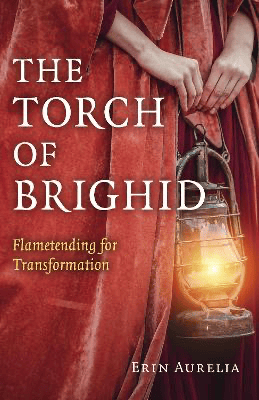
Review: The Torch of Brighid by Erin Aurelia

The Torch of Brighid is a book by Erin Aurelia who has tended the sacred flame of the Celtic Goddess Brighid for over twenty years. The book provides historical information about Brighid based on existing sources and introduces a transformational flametending practice that is rooted in tradition and inspired by mythic connections and by Brighid herself. The author makes it clear at the beginning that she is not reconstructing a past Pagan practice.

Working with traditional material Erin has produced a series of meditations forming a transformational journey based upon Brighid’s roles as smith, healer and poet (and dreamer*), the ogam, the three cauldrons and the celebration of Imbolc. 

She begins by providing Brighid’s historical background followed by guidance for setting up an altar to Brighid and beginning a flame tending practice through making a Brighid-flame candle ‘to light and tend Brighid’s fire’. 

As further preparatory work there are meditations in the form of visits to the Inner Temple, the Well of Wisdom and opening to Brighid’s energy through the Mantle of Brighid. These felt like a firm foundation for a flametending practice.

Erin bases the twenty day flametending journey on the ogam and the life cycle of a tree (relating to St Brighid’s sanctuary Cill Dara ‘The Church of the Oak). The first five days focus on growth, the next five on fruiting, the next five on ripening, the last five on seeding. Meditations are given for each of the days guiding the devotee through the transformational processes.

The ritual year is based around the four Celtic festivals Imbolc, Beltane, Lughnasadh and Samhain which are identified with four ogam characters and mapped onto the Celtic cross with the fifth in the middle.

A new rite Erin introduces that particularly resonated with me was holding an ‘advent’ for Brighid’s return to the land at Imbolc based upon Her four faces.

Although I am not a Brighid devotee or a flametender myself so haven’t been called to participate in the practices outlined in the book I can see that they would provide an excellent grounding for both newcomers and practicing Polytheists to meet Brighid and begin flametending as a devotional practice. 

I admired the way Erin has reimagined this series of rites from traditional material. I would recommend this book to anyone interested in Brighid and flametending and to all Polytheists seeking inspiration on how to create new rituals from existing sources with the guidance of their Gods and Goddesses.

The Torch of Brighid is available from Moon Books HERE.

*This is based on gnosis surrounding Brighid as the serpent who sleeps in winter and comes out of the mound in Scottish folklore.

Review: The Ghosts of the Forest by William A. Young

In The Ghosts of the Forest – The Lost Mythology of the North, Edinburgh-based writer William A. Young traces the folklore and legends of southern Scotland and the Borders and the figures within them back into the Brythonic past of Yr Hen Ogledd ‘The Old North’* and prehistoric Britain. 

William follows a number of ghosts in literature and on foot, across the landscapes where the stories are set, to trace how they have arisen from the land – from a ‘Dreaming North’. He begins with Walter Scott and notes that his own collecting of the tales echoes Scott’s ‘raids’. 

His first journey is to Eildon Hill, the Eildon Tree, and the Rhymer’s Stone. Here he finds connections between the legends of Cannabie Dick and Thomas the Rhymer and conjectures that the Fairy Queen might be linked to the Roman Diana, goddess of hunting and the wilds, to whom stood an altar less than 1km away. 

He then journeys with the ghost of Myrthin* Wyllt the ‘surest guide’ to the lost world of the North’. This ‘wild Merlin of the Tweed’ and ‘madman’ is contrasted with ‘the Arthurian Merlin’ and ‘Archdruid’. 

The quest to find Myrthin forms the heart of the journey. William begins with a visit to Myrthin’s grave in Drumelzier then follows William Skene and Nicolas Tolstoy in travelling to Arthuret, Liddel Strength and Caer Gwentholye where the tragic battle of Arfderyth took place and Myrthin went mad. 

Like Tolstoy he makes links between the black mountain in Fergus and Myrthin’s Peak. These leads and the story of Owain take him not to Hart Fell but to the Bewcastle Fells and the complex of Glen Dhu (Black), Marven’s (Myrthin’s) Peak and Cleugh and Capelstone Fell.

William draws connections between the ‘Dark Man’ in Owain and the churl in Fergus. He identifies these figures with the Brythonic deity Cocidius who was worshipped at a shrine at Bewcastle known as Fanocodi. The spirit of the grove with whom Myrthin associates is tentatively identified with Nemetona, who is known as Diana Nemorensis under Intepretatio Romana. Owain’s links with the Brythonic deities Mabon and Modron and his father, Urien’s, with Nevyd, are also explicated. Here we find a potential ‘pantheon’ underlying these tales and this sacred landscape. 

Cocidius is then further traced to legends featuring the ‘Brown Man of the Moors’ whose sacred home might have been the house-sized Kielder stone appearing in the legend of the ‘Colt of Kielder’. William then has a potent encounter with Cocidius ‘the Red God’ at his shrine at Yardstone where he comes ‘face to face’ with the God in a remarkable carving. 

These journeys takes us into the heart of the Forest of Celython where Myrthin fled in his madness. William notes that here he finds not only plantation woodlands but, more encouragingly, areas of restoration such as Kielderhead Wildwood and areas owned by the Borders Forest Trust.

Suggestions based on William’s findings are finally made for further archaeolgical research.

This 606 page book is a labour of love crafted from poring over old texts and following them across the land, walking, camping, holding vigil in wild places, showing how by offering his ‘sweat’ and ‘time’ William has come closer to the old Gods. It gives voice to a quest and is the culmination of many years of dedication. I would recommend it to all who have an interest in the folklore and legends of Britain and how they might be traced to their prehistoric origins.

You can buy Ghosts of the Lost Forest HERE.

*William substitutes ‘th’ for the Welsh ‘dd’ in his spellings. 

Review – The Path of the Sacred Hermit by Avallach Emrys

The Path of the Sacred Hermit: Exploring Monasticism in Modern Pagan Spirituality is the first book by Avallach Emrys. Avallach is a novice monk with the Gnostic Celtic Church of the Ancient Order of Druids of America and  the Order of the Sacred Nemeton. He is also a monk with the Monastery of Annwn and has played a much appreciated role in setting up our forum.

This is the third book I know of that has been published over the past few years on the topic of Pagan and Polytheistic Monasticism (1) as the movement, originating in the early 2000s (2), continues to grow and define itself.

In his introduction Avallach makes it clear this is not a scholarly book but one created ‘as a novice… for other novices’. It is a ‘book for beginners’.

He defines Pagan Monasticism as: ‘A way of life that returns us to a focus on the simple things: our connection to the natural world, our connection with the Divine, and our connection to each other. It is a life of service, devotion, and contemplation.’

Speaking of what Pagan Monastics do in terms of monastic spiritual practices he lists prayer, meditation, ritual, ceremony (including celebrating Holy Days), making offerings, shrine tending, divination, and keeping daily offices/a monastic horarium. He notes that ‘Pagans also engage in study and learning’, service to the community and environment, and self-care and self-improvement such as regular exercise and healthy eating. 

It is of interest, that in contrast to monastic traditions in other religions and the definition of Polytheistic Monasticism put forward by Janet Munin (3), that Afallach does not mention renunciation or any strict rules controlling behaviour.

Avallach goes on to say that Pagan monastic practice is based on four components – ‘discernment, discipline, devotion and contemplation’. I thought this explicated a strong and firm foundation and has led me to contemplate how these four components manifest in my own spiritual path.

A brief history of monasticism is provided. Also coverered are key elements of monasticism one would expect to find in a beginner’s book such as monastic vocation (and suitable vocations for paid work), commitments and vows, life as a monastic and the challenges of creating physical Pagan monasteries.

In the Appendix are writing exercises and prayers by the author written for commitments and Holy Days and for honouring individual deities such as Brighid and Cernunnos. Some of these include Latin translations. As I can’t read Latin I can’t vouch for their accuracy but I found this impressive as a devotional act in itself. 

I felt this book covered the basics of Pagan Monasticism very well and provided some sound components to help a beginner to start practicing. Much of it resonated with me as Brythonic Polytheist, such as the section of devotion. ‘Devotion means giving your heart and mind to the deity or deities you worship and committing yourself to their service. It means making them the focus of your life and seeking to live in accordance with their will.’ 

Another thing I liked was the repeated emphasis on doing ‘what works for you.’ The following passage, I felt, was of utmost importance for a beginner – ‘don’t feel like you must do everything that traditional Monastics do in order to be considered a “real” monastic. Instead focus on small commitments that work for you.’ Not feeling monastic enough is an obstacle that has hampered my own spiritual progress and taken joy from my path.

This book is not without its flaws. The language is quite repetitive and the author explains that in the introduction, stating that he chose that style to convey a ‘concise and easily-readable message’.

Whilst in some places the approach to deity resonates in others I found it a little problematic. Avallach says, ‘One way that pagans connect with the divine through devotional prayer is by honouring deities associated with different aspects of life such as love, fertility, or protection. For example, a pagan seeking to improve their love life might choose to honour Aphrodite, the Greek goddess of love’ or when ‘trying to conceive’ honour Freya ‘for fertility’. Whilst understanding the need to keep things simple I thought it might be worth adding a cautionary note that one needs to build a relationship with deities before asking for ‘blessings and guidance’ and it’s not always the obvious deities who choose to relate to us and answer our prayers.

I was also a little unsure about the author’s claims about the existence of historical ‘monastic magick’. He notes it has been found in ancient Egypt in the ceremonies of ‘temple priests and priestesses’ and in ancient Greece in the context of the mystery cults but I’m not sure how many of these practitioners identified as monks or nuns. However, this isn’t my area of expertise, and as there are no footnotes, I couldn’t check the sources.

Overall I feel this book makes a valuable contribution to the Pagan and Polytheistic Monastic movement and succeeds in fulfilling the aim outlined in the introduction of providing a guide for novices written by a novice monk.

The Path of the Sacred Hermit is available through Barnes & Noble HERE.

  1. The first is A New Monastic Way: Modern Polytheistic Celtic Monasticism by Oisin Dolye (2017) and the second is Polytheistic Monasticism: Voices from the Pagan Cloisters edited by Janet Munin (2022).
  2. With Matreum of Cybele which has been running for 20 years https://www.gallae.com/
  3. ‘Monastics are those who take solemn vows to live centred on their relationship with one or more Holy Power. Anything which impedes or compromises that relationship is left behind or minimized as much as possible. They are renunciates, offering up wealth, social status, a conventional career, and family life on the altar of devotion.’ Polytheistic Monasticism: Voices from the Pagan Cloisters edited by Janet Munin (2022), p.2

Review: Gods-Speaking by Judith O’Grady

Gods-Speaking is by Judith O’Grady, an elderly druid and biologist who had a career in veterinary medicine and lived on a tiny urban farm in Ottawa, Canada. She sadly passed away in December 2020.

Judith, like myself, was one of the long-standing writers for Gods & Radicals and I felt a kinship with her as somebody who honoured the old gods and had a deep relationship with the land and its spirits, upheld not only in ritual but in action such as going out and litter picking and planting trees. It is with regret I write this review after her passing. I hope, somehow, my words may still reach her.

In the first section of this readable little book Judith outlines what it means to be a ‘God-Speaker’. She relates this word, which she coined herself, to the better-known terms ‘visionary’, ‘seer’, and ‘mystic’ and says this is about ‘the belief in the Gods that I believe that are speaking to me, the belief that They can and do speak to me, and the belief that our communication has some purpose’.

Judith describes the ‘process of God-Speaking’ as ‘two-way communication’ and also refers to it as ‘Gods-Bothered’ as ‘the Gods don’t enter communication with us to pat us on the back or congratulate us on a job well done, but instead to give us difficult tasks and teach us unpleasant truths.’

She speaks of how most societies ‘have a place for the person who troubles hirself to speak with the Gods and whom They trouble in return’ and notes most Gods-Bothered people are segregated in some way, for example, in ‘the detached dwelling of the shaman’, ‘the hut of the hermit’ and ‘the monastery’. This draws to attention the lack of a place for the God-Speaker outside traditional religions.

She outlines some of the problems faced by the Gods-Bothered, one of the most common, for those who see visions and hear voices, being walking the fine line between being a seer and being crazy. This is distinguished by the ability to use discernment and free choice in accepting advice from the gods for the better of themselves and their communities rather than engaging in destructive behaviour.

One of the helpful analogies she uses is the ‘crazy train’ – it is always possible to ‘get off at “ask a question junction” or “find a guide halt” and refuse to descend to “the platform of destructive thinking”’.

Judith outlines how her conception of how God-Speaking relates to biology. ‘Imaging technology’ shows that when a person is having a mystical experience ‘a tiny part of the brain’ ‘lights up’. She calls this the ‘God-Speaker’ and suggests there is an evolutionary purpose to speaking with the Gods.

As an awenydd, an ‘inspired one’ or ‘seer’ in the Brythonic tradition, I found this section insightful and relatable and imagine anyone who speaks with or has been spoken to by the gods would also relate.

In the second section Judith speaks of her personal experiences with the gods and spirits of the land. As someone with an important relationship with my local river goddess and her ‘daughters’ (my local streams), I empathised strongly with Judith’s account of getting to know the spirit of her creek, Pinecrest Creek, which is piped from near her home, under a bus transitway and shopping centre, into a Parkway, then ‘comes out into a pool to flow for a brief free stretch before flowing into the Ottawa river.’

Judith provides an account of how her Druid Grove came to honour the Spirit of the Creek by collecting water and using it as an offering in ritual and by litter picking. Her vision of this spirit, who they came to know as Sionnach Du ‘Black Fox’ stood out to me as vivid and very real.

‘Ze steps out from the shadows, taking the form of an urbanized wild creature, a fox, to personify to me. But it was a humanoid-shaped being, apart from the fox face, and dressed in dark colours, black, and heavily cloaked as befitting a land spirit largely confined to sewer pipes and storm drains. Androgynous…’

Judith speaks of how the spirits of the grove, Black Fox Watershed, Singing Memory Frog, the ghost of large Snapping Turtle and the dragons, were slowly and organically gathered. I related to this way of discovering gods and spirits within the land rather than calling them from outside.

Throughout the book Judith, who is clearly not only wise but well-read in philosophy, outlines her conception of the gods. She says that rather than being ‘friends’, ‘allies’, or ‘partners’ to ‘work with’ they are ‘timeless, wise, philosophical, powerful and motivated by a greater understanding and comprehension than I have access to.’ The come from ‘Gods-Land’ and speak ‘God-ish’ not English or any other language (it is a function of our human minds that translates their language into our own).

Most profoundly: ‘I do not think that my belief or the lack of belief of others affects the beings of place or the Gods; I believe that They are present whether believed in or not. They see us regardless of what we see when we look towards Them. Their world lies behind ours like a bright shadow of reality: the shadow does not reflect what we have built (or destroyed), but what might be.’

These are the words of a true God-Speaker, a seer, a wise woman in the modern Druidic tradition.

This book is essential reading for all who are new to God-Speaking, for in Judith you will find an older, wiser guide whose voice is filled with love of the land and the gods, rich in counsel and humour. It will also resonate with those who have been speaking with the gods for a long while. I would recommend it, too, to those who are curious about whether they can speak with the Gods (yes, you can – I believe, with Judith, this is a capacity we all have and can develop with practice) and to those who don’t want to try it, but would like to find out more from an experienced practitioner.

Gods-Speaking is available through Gods & Radicals Press HERE.