The last few months have driven home how important our relationship with water is. We’re all troubled by concerns about there being not enough or too much and the impact of this on human and other-than-human persons.
Water has long been held sacred throughout spiritual traditions. From animistic, polytheistic and shamanic perspectives, water and all our watercourses (‘natural’ and man-made) are inspirited. Through practices including shamanic journeying we can connect with and build relationships with water spirits.
Have you ever wanted to make a connection with the spirit of your local brook or the river God or Goddess of your watershed? With the spirit of a pond, a lake, a canal, with the spirits of your drains and the sewers? Have you got questions and concerns you want to take to them?
If so, I am currently offering shamanic guidance sessions which will focus on journeying to water spirits at a discount rate of £20 an hour (reduced from £30).
A couple of weeks ago, I shared a post about ‘Spirits of the Water Sources’. Today, I’m going to be looking at the other side of our relationship with water spirits – those who have been assigned to carrying away our waste.
In this article, I will cover the history of latrines and sewers in Britain and discuss how people related to, or failed to relate to, the spirits of these facilities. I will then share a little about the sewers of my locality and their spirits.
Prehistoric Latrines
It’s difficult to know what the earliest hunter-gatherer people did with their excrement. Because they were highly mobile and of small numbers, it’s possible to imagine that, when they set up camp, they chose a suitable place on the land and everything disintegrated and returned to nature.
There is potential evidence for latrines from the Neolithic settlement at Skara Brae. Each dwelling contains a small cell with running water beneath that might have been used as a toilet (although its exact use is debated).
This is the first instance I know of in which water is used to carry waste away from a settlement. My guess is that, in these times, for an animistic culture, certain areas of land and certain water courses were seen as less sacred than others. These lesser places and waters were delegated as latrines.
It’s possible there were rites for setting up a latrine in which the spirits of the land or waters were invoked, asked for permission, and thanked. Also, perhaps, for when the latrine was used as well.
Romano-British Latrines and Sewers
When the Romans conquered Britain and built their fortresses, these included latrines. Back in Rome, they had their own complex drainage and sewer system, the Cloaca Maxima. This was associated with a goddess named Cloacina, ‘the Purifier’, to whom offerings of coins were made in the drains.
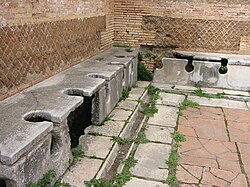
The latrines at Roman forts in Britain consisted of long, open rooms with wooden or stone benches with keyhole-shaped openings. At Housesteads, there were twenty seats and at Vindolanda, where the oldest wooden toilet seat can still be viewed, sixteen. Using the toilet was a social occasion.The waste was flushed away with rainwater from a cistern or with hot water from the baths. It then ran into sewers and into the nearest watercourse.
Roman toilets, from Ostia, Rome, as no British images available.
There is no evidence that Cloacina was venerated in Britain. However, coins and other objects such as gaming counters and beads have been found in the drains of Roman fortresses such as Eboracum and Vindolanda. Some of these are likely to be accidental losses but some might have been offerings to local purification deities who presided over the sewers and the drains.
Medieval Privies
When Christianity replaced animistic beliefs, there was a shift in perception away from our bodies, bodily functions and waste products being part of the course of nature and the spirits who dealt with them being purifiers worthy of respect. Instead, they became viewed as sinful and corrupt.
In the Bible, in Kings 10:27, when the Temple of Baal is destroyed, it is turned into a latrine and this act of desecration is seen to rob it of its sanctity. Going to the toilet became shameful and was done in private, in privies.
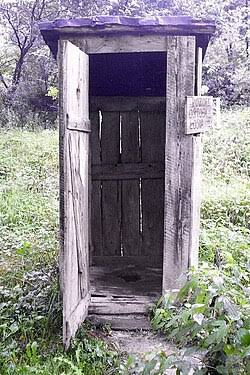
Outhouse
During the medieval period, privies were the most common form of latrine. These were outhouses built on the land of farms or in the backyards of houses. In towns and villages, a number of people shared a privy. It was a basic building with a hole in the floor and a cesspit beneath to collect waste. This was collected by night soil men, who took it to spread on the fields.
In medieval castles, there were garderobes, toilets built into the castle walls, from which the waste dropped down a chute into the moat or a cesspit. People also used chamber pots during the night, which they emptied into cesspits or water courses or added to the manure on their middens.
Only the monasteries had sewers. The toilet block, known as a reredorter (from rere ‘rear’ and dorter ‘dormitory’) was behind the sleeping quarters and was built over a flowing stream or a sewer channel, which led to a nearby river.
Waste was a dirty thing to removed from sight and mind by the men of the night. The purificatory spirits were no longer invoked. Yet, still, they served. As did those were called to dig out the cesspits and fertilise the fields.
Industrial Stink and the Sewage System
As the towns grew, in the industrial period, as an increasing number of people moved to dwell them in them in order to work in the mills and factories, human waste became a major problem. More people came to share limited latrines and the cesspits spilled and contaminated the water sources.
People emptied their chamber pots into the rivers or drains on the streets. Roads and water courses ran black with filth. It reeked. Diseases, such as cholera and typhoid, ran rife. Life expectancy was as low as nineteen.
The growing popularity, amongst the rich, of the flushing toilet didn’t help. The earliest flush toilet was designed for Queen Elizabeth by her godson, John Harrington, in 1596. In 1775 Alexander Cumming produced the widely recognised design with the U-bend to keep solids and their odour in their place.
In 1948 the Public Health Act was instituted to tackle sanitation issues. It was decreed that every house should have a water closet. Unfortunately, the use of flush toilets led to the water courses being overwhelmed more quickly.
The first sewers were constructed in Liverpool, between 1848 and 1862, in accordance with a programme created by James Newlands. Following the 1858 ‘Big Stink’ of London, Joseph Bazelgette constructed a sewer system with six main interceptors, incorporating stretches of London’s already culverted or ‘lost’ rivers to take the waste to the Thames estuary. Manchester and Preston developed sewers around this time.
Building of London sewage system in the 1860s
The development of Preston’s sewers was carried out by Preston Corporation Waterworks in tandem with the installation of piped drinking water. Water sources culverted underground such as the River Syke and the Moor Brook were used to carry surface run-off, industrial waste and sewage into the river Ribble. This was compounded by waste from other mill towns just as dirty, such as Blackburn and Darwen, coming down the river Darwen, and from Wigan coming down the river Lostock.
The pollution and the works would have had a major impact on the water sources and their spirits, whose presence was unacknowledged and unappeased.
Wastewater Treatment Works
The waste was removed from the towns only to pollute the rivers. Thus, it was soon realised that it needed to be treated before it was discharged.
The earliest wastewater treatment works was set up in 1864, at Beckton, in London. This used settling tanks to remove solids before discharging the liquids. In 1887, chemical methods to separate liquid and sludge were developed.
In 1894, Davyhulme Sewage Works opened outside Manchester. This pioneered the Active Sludge Process, invented by Edward Ardern and William Lockett, in 1914. In the first stage, bacteria and protozoa, powered by oxygen, break down pollutants. In the second stage, clarification, the biological flocs settle and are pumped back into the process whereas clear liquid remains. This is repeated until all the flocs have been processed and the water is clear. This technique is still used worldwide to this day.
At a modern wastewater treatment plant there are typically four stages. The first is screening to remove items like nappies, sanitary towels and cotton wool. The next, primary treatment, or sedimentation, is where the sludge settles to the bottom in large tanks and oils and grease are skimmed from the top. Secondary treatment is biological breakdown via the Active Sludge Process. Tertiary treatment involves filtering out any last remaining particles and disinfection by UV light or chemicals like chlorine to kill harmful bacteria. The effluent is then tested and released back into the watercourses. The solids are made into ‘cake’ for fertiliser or used to generate electricity.
In 1893, a sewage farm was developed at Freckleton to take the sewage from Preston and Fulwood and the waste was spread on the fields. The site was later replaced by the Preston Wastewater Treatment Works at Clifton Marsh. This currently receives the waste from Preston, my home town of Penwortham, and the surrounding area. The Walton-le-Dale Wastewater Treatment Works was established in 1891 and still caters for that area.
Preston Wastewater Treatment Works
When my house was built, in the 1940s, it would have been constructed with sewers leading, via Penwortham Pumping Station at Crookings Lane, to the Preston Waste Water Treatment Works.
What kind of purificatory spirits govern the processes of sedimentation, biological breakdown, filtering and disinfection is a question unasked and unanswered.
Storm Spills and the Preston Interceptor Tunnel
The development of better wastewater treatment has led to our rivers being cleaner. We’re still not there yet. In 2010, Preston’s 19th century sewage system was still emitting storm spills into the Ribble at times of heavy rain.
This resulted in £114m project delivered by KMI+ for United Utilities to build a 3.5km interceptor tunnel capable of carrying and storing 40 million litres of water. This tunnel is famously wide enough to drive a car down. New storm tanks were also built to hold the water at Preston Waste Water Treatment works.
What new spirits abide in these tunnels and holding systems?
Journeying with the Spirits of the Sewers
The history of the sewers is intrinsically bound up with our rivers. The goddess of the river Ribble is called Belisama, ‘Most Shining One’. I see her tributaries as her daughters. Many of these rivers and brooks, such as the river Syke and the Moor Brook have been culverted to form drains and sewers.
Additional tunnels have been built, subverting, changing the older courses. Do the same spirits flow in these channels or have new ones become? Is there a purificatory deity who presides over the drains and sewers of this watershed?
I took these questions when I journeyed to the spirits of my local sewage system. I didn’t get that much an answer. Journeying down our toilet, with my guides, we came out into a sewer where the sewage was flowing slowly. Every now and then its reluctant flow was punctuated by the splash of another flush, another push. The spirit was equally sluggish and uncommunicative.
Contrastingly, we met a male brown rat and then ran into a female and her young in a nest of toilet paper. A larger rat-headed more humanoid spirit appeared and said, “As your population grows, as our sewers grow, we grow too.”
When I asked if there was a purifier present, the rat spirit just laughed and told me, “There is no purifier, no purity, nothing is pure in these sewers.”
We traversed the tunnels and arrived at the water treatment works. There, I gained a sense of the liveliness of the bacteria going about their work and the steady rhythms of the machines – the scrapers ceaselessly rotating, gathering the sludge that settles at the edges, pushing it to the centre for removal. I intuited the mechanical agency of the spirit but received no messages.
However, at the end, the message from Belisama and her daughters was loud and clear. “Your waste does not belong to the waters but to the land.”
The recent heat waves, here in the UK and across Europe, and the drought in southern England, have got me thinking about how deeply I appreciate our water sources and the continuing miracle of having water on tap.
Here, in the Penwortham and Preston area, we’ve had piped water for around two centuries. And it has come at the great cost of our natural water sources being drained, ruptured, subverted, closed off, drying up.
The Wells and Springs of Penwortham and Preston
There were once numerous wells and springs in Penwortham and Preston. On Castle Hill, Penwortham, St Mary’s Well and St Anne’s Well. In Preston, Lady Well, Spa Well (on Spring Row, near Spar Bath where springs were abundant), Main Sprit Weind Well, Ashton Quays Well, and the Dolphin Fountain.
Their abundance has its basis in our underlying geology. Deep beneath is a primary aquifer composed of Permian and Triassic sandstone which is nationally recognised as a high-quality drinking water source. Above, flanking the river Ribble and its tributaries, are secondary aquifers formed from bedrock blanketed by river alluvium and glacial meltwater sand and gravel. These provide pockets of groundwater and interact with river base flows. Contrastingly, the surrounding soil is clay, and acts as an aquitard.
The spring and well waters of Penwortham and Preston flowed from secondary aquifers. St Mary’s Well, which was renowned for its clear pure water as a holy well with healing qualities, ran dry after the aquifer was shattered when the river Ribble was moved 500m south, close to Castle Hill, during the building of the Riversway Docklands. The wells of Preston were drained, covered, and built over after piped water was introduced.
In my locality, on the 1840 OS map, there are three wells close to Fish House Brook in the area now known as Greencroft Valley. By the time of the 1890 OS map, they have disappeared. It was common for local farms and houses, such as Malt Kiln Farm and Hurst Grange, to have their own wells.
1840s OS mapCovered well at Hurst Grange Park now part of the path
As far as I know, the source of Fish House Brook was never used for drinking water. This is likely because it was dark and peaty, flowing off Penwortham Moss somewhere near the present-day southern end of Bank Parade.
The continuing presence of groundwater close to the surface was recently revealed around 10 years ago during the demolition of the Maltings and building of the new houses on Maltings Way and Birch Tree Drive. They broke the secondary aquifer, which continues to leak to this day, down the woodland bank in Greencroft Valley and into Fish House Brook. This has led to the water-logging of the soil and the death of many trees, mostly birch.
Greencroft Valley leak crossing the path into Fish House BrookDead trees due to water logging
Preston Corporation Waterworks
The industrialisation of Preston and some of Penwortham began in the 18th century with Preston’s first cotton mill being opened in 1777. As the town grew, more water than local wells could provide was needed. In 1815, an Act of Parliament led to the formation of the Preston Improvement Commissioners to tackle civil infrastructure and organise a reliable public water supply. Water was first piped from Alston Springs. In 1835, Grimsargh Reservoir and Upper Dilworth reservoir were built to provide further supplies. The waterworks consisted of aqueducts, pumping stations and a network of pipes.
Present-day Valley Road pumping station providing water to Penwortham
In 1844, due to concerns about the cleanliness of the water, Preston Corporation took over the waterworks. Around this time, the local wells were closed. Following the cholera outbreak in London, in 1854, St Mary’s Well was capped. The local supply was soon replaced with piped water.
Further reservoirs were built around Longridge – Alston 3 (1842), Spade Mill 1 (1862), Alston 2 (1899), Alston 3 (1931), Spade Mill 2 (1936). In 1932, Stocks Reservoir, in Bowland, was built to supply regional districts including Blackburn and the Fylde coast and began also to feed Preston.
Stocks Reservoir (Wikipedia Commons)
In 1959, Preston Corporation Waterworks was subsumed into Preston and District Water Board. It was then amalgamated into North West Water in 1974. In 1995, North West Water merged with NORWEB to become United Utilities.
The Alston and Spade Mill reservoirs fell out of use until 2020. Due to increasing demand, the 9.7km Alston and Spade Mill pipeline was built to reconnect the four reservoirs into the network of pipes supplying the region, providing 38,000 million of litres a day – enough for 90,000 homes.
Spirits of the Water Sources
From the times the first hominids walked the land until the last couple of centuries, water sources such as springs, wells, streams and rivers, have been viewed as sacred. They were seen as inspirited as evidenced by the names of deities, such as Belisama ‘Most Shining One’, goddess of the river Ribble, and folkloric legends of spirits of the wells and well maidens who tended them. These may have given rise to the common name ‘Lady Well’. Many of the well spirits were replaced with Christian saints with similar qualities.
During the industrial period, this sense of sanctity was lost. Water was commodified. People were severed from their connection with local water sources. We became used to having water on tap. Paid for. Paying the companies who had engineered its delivery rather than offering to its true source.
Sadly, most of the old sources are covered over, dried up. Fish House Brook, my closest water source, now emerges from its culvert through a concrete pipe. Still, it is still possible to visit, to pray, to sing, to commune, to make offerings.
Present-day source of Fish House Brook
When I consulted the Spirit of Fish House Brook on the matter she said:
‘You have broken our ability to self-regulate, to filter. You like straight lines. We like to meander. Your pipelines are like catheters – lead to blockage and disease.’
Spirits of the Taps and Pipelines
We have three sets of taps in our house and one tap outside. All have their own personalities. Our kitchen tap drips. The bath taps are cranky. They grunt and groan. A bath or shower is never quite the right temperature. The taps of our new sink are far more congenial and friendly. The outdoor tap, to which the hose pipe is attached, is prone to surge and spit and leak.
My journeys to the pipes have been characterised by a feeling of the frustration of waters used to flowing, never stopping, by their own will and volition, getting contrarily pumped along, on demand, or forced to wait.
There’s a sense of irritation at our clumsiness, at our ineptitude. An “Is it any wonder we burst your pipes?” “Is it any wonder you get infections like the cryptosporidium at the Franklaw Water Treatment Plant at Garstang?”
When I wonder who the ‘we’ are, my logical mind reminds me of the reservoirs and underground sources, but the waters spirits tell me they are “one”. I might call them “the spirits of the north west waters,” if I wish.
The pipes, like the taps, have their spirits too, their personalities. Bound up with them are their makers, their users, the places their materials come from. We have old lead pipes, hopefully, now, with another mineral deposit to be safe.
When I have a drink, a bath or a shower, something I have been doing automatically and without much thought since I was very young, I now do my best to give a word of thanks to the spirits of the waters, the taps, the pipes. To our artificial water sources and the still-living waters that flow within.
My article, ‘The Dream Temple of Nodens,’ has been published in the latest issue of Sacred Hoop. It provides an exploration of the history and archaeology of the temple to Nodens at Lydney and the evidence for a tradition of dream incubation centring on Nodens as an ancient British God of healing dreams. This issue of this long-standing shamanic magazine also contains articles on dreaming the land, working with ancestors, plant medicines and much more.
I currently have the privilege of tending a garden. My relationship with our garden is quite unique for I have lived here, in the same house with my parents, since I was four years old, with only a couple of brief periods of living away. I’m forty-four now. So I’ve been here almost forty years.
I’ve played in the garden, ignored the garden, done bits and bobs, but only since the health of my parents has deteriorated and Covid struck, have I taken gardening and building a relationship with the garden spirits seriously. I’ve had successes and failures and learnt quite a few things along the way.
Here, I will provide an account of the processes I’ve been through and provide some guidance for others on working with spirits of the garden.
What is a Garden?
For anybody setting out to get to know the spirits of their garden, it’s helpful to know what a garden is. According to the Oxford English Dictionary, it is ‘an enclosed piece of ground used to grow flowers, fruit, or vegetables.’
Thus, a garden is born by the act of enclosing pre-existing land. Often, a garden belongs to a house and is one amongst many in a row on a street. Sometimes, gardens are created as stand-alone green spaces, such as allotments, community gardens, botanical gardens and garden areas in parks.
The History of the Land
Because a garden is an enclosed piece of ground on pre-existing land, it is helpful to get to know what the land was used for prior to its enclosure. You can do this by looking at old Ordnance Survey maps and at your local tithe map (1).
The OS maps for 1910 and 1890 show that there was an orchard on this land. The deeds to our house record it as cherry orchard. In Lancashire, both sweet cherry (Prunus avium) and sour cherry (Prunus cerasus) were grown. In next door’s garden there is a sweet cherry tree – perhaps a descendant. Sweet cherry seedlings are always trying to grow in our garden.
The 1840 OS map and the local tithe map, from 1839, show beforehand it was meadow. It was known as Golden Bank Croft. The land belonged to Malt Kiln Cottage and Farm and was owned by Richard Palmer, who leased it to William Mayor and his son, Robert Mayor, who is listed as owning the field. The large, irregular field patterns suggest that they date back to the medieval period.
The ‘Bank’ refers to the bank of Fish House Brook, which is culverted beneath the gardens of the houses across the road, Bank Parade. It then flows through Greencroft Valley and north to enter the river Ribble at Fish House Bridge. The source of Fish House Brook lies 100m to the south of my house.
I thus see the presiding land spirits to be the Spirit of Fish House Brook and the Spirit of Greencroft Valley, for they are the powers who have resided here long before we spoke those names and created meadows, houses and gardens.
It is likely that Golden Bank Croft was farmed as hay meadow. The way this worked was that fields were grazed as pasture over the winter, then in spring the cattle were shut out and the grasses were let grow and cut in the summer.
Typical species of a lowland hay meadow in Lancashire include grasses such as: sweet vernal grass (Anthoxanthum oderatum), meadow foxtail (Alopecurus pratensis), crested dog’s tail (Cynosurus cristatus), red fescue (Festuca rubra) and Yorkshire fog (Holcus lanatus) and wildflowers such as: ox-eye daisy (Leucanthemum vulgare), bird’s-foot trefoil (Lotus corniculatus), common knapweed (Centaurea nigra), yellow rattle (Rhinanthus minor), great burnet (Sanguisorba officinalis), meadow vetchling (Lathrus pratensis), and meadow buttercup (Ranunculus acris). Remnants of some of the more pervasive of these species are found in our lawn and on local parks and green spaces.
I perceive the guardian spirit of my home and garden to be the former guardian of Golden Bank Meadow and the surrounding land on this side of the brook.
It is likely that, before it was enclosed as meadow, this area would have been mixed deciduous woodland, dominated by oak, with some patches of carr wood. This is suggested by the old oak trees that are remnants of former hedgerows in Greencroft Valley and by place-names such as Broad Oak, Oak Avenue, Oaklands Drive, the Oaks, Alderfield, the Carrs and Carr Wood.
The History of the Garden
The history of a house and garden is usually passed on from its previous owners. This is how we learnt our house was built during the 1940s. If you don’t have this information, you can check the Ordnance Survey maps.
I believe our garden, when we moved in, in 1985, was close to the original design. It had a lot of conifers, shrubs and ornamental plants. All the conifers have been removed due to poor condition and my dad dug most of the plants up.
A few things have survived. A pair of apple trees. Camellia, lilac and eschalonia that have grown to tree-like proportions. Fuchsia and astilbe. Cloves in a pair of pots. Of my dad’s blunders only the raspberry patch remains.
When I was a child, I was far more interested in my toy horses and make-believe equine worlds than I was in the garden. I dug up the lawn to make water jumps and banks for my Playmobile cross country and show jumping competitions and ran round leaping courses made of garden canes myself.
I loved wild nature, which led me to conservation volunteering aged thirty. I didn’t care much for gardens or gardening until I developed a passion for growing native wildflowers. This expanded to include cultivated plants and fruit and vegetables when I began volunteering at Let’s Grow Preston.
Still, I ignored our garden, as I didn’t see it as ‘mine’. This changed when Covid struck and all my volunteer work parties got cancelled. By that time, it was in a state of neglect due to the deteriorating health of my parents.
Building a Relationship with a Garden
My relationship with our garden started off thorny. Quite literally. The cultivated blackberry bushes at the top of our garden had taken over the path. I battled them back. I battled the ‘weeds’. I was angry with the garden for growing so wild and I was angry with my parents for their neglect. The spirits named me ‘Mrs Angry Gardener’. We didn’t start out very well.
Yet, as time went on, with the help of Creiddylad (2) I learnt to listen better to the garden and its needs and to the intelligence of the plants. When my comfrey plant spread from its pot down the side by the compost bin, I allowed it to grow there to provide food for pollinators and to add to the compost. I let honesty grow toward the back of the garden. When the blackberries died, I created a fern garden on advice from Creiddylad and Gwyn (3), populating it with ferns and hart’s tongue growing elsewhere as ‘weeds’.
I replaced the flower beds with a wildflower patch, growing ox-eye daisy, ragged robin, red campion, common knapweed and foxgloves from seed. I added betony and common agrimony from an ecology colleague and blue geraniums from Let’s Grow Preston and Newgate Nursery (bees love them).
When the red campion became dominant in the wildflower patch and threatened to take over the garden, I began picking the seedlings to grow to plant in Greencroft Valley and translocating the larger plants there.
As time has gone on, I have come to know the spirit of the garden better, if something comes up in ‘the wrong place’, to ask its purpose, where else it could go. I have become more one with the movement and succession of plants.
Prayers and Offerings
My personal approach to prayers and offerings is one of practicality and simplicity. I speak morning prayers of praise and evening prayers of thanks. I treat watering and feeding the garden as an offering, doing it prayerfully. When I place items on the compost heap at the bottom of the garden, I feel it is an offering of sorts for the fay who abide in the ferns and the lilac.
I used to make offerings of mead to Gwyn and the garden spirits beneath one of the apple trees. When the hellebores wilted, I found out that alcohol damages trees and plants. It causes dehydration, strips protective layers and kills beneficial soil bacteria. Herbal tea now forms a more suitable alternative. I also, occasionally, offer fruit. This gives nutrients back to the ground. However, I don’t do this often, due to sightings of a brown rat.
Our spirits appreciate arrangements of stones, such as my mum’s ‘god stones’ (4), as shown by the mosses and lungwort who have grown around them.
Others might prefer more elaborate ceremonies and rituals. Always check in with the spirits first make sure that what you want aligns with what they want.
Shamanic Journeys and Dreams
It is also possible to journey to the spirits of the garden. On my journeys, I have not come across a single ‘spirit of the garden’ who has presented in an anthropomorphic or phytomorphic form. Yet, I have heard a ‘voice’ that seems to speak with the deeper being of the wider area.
I have been shown that I’m a mere instrument in the greater design of the land. A mid-wife and foster-mother to the plants, a nurturer, a waterer. That my existence and doings here are transient against the ancientness of this place and of its inhabitants, some who outdate humans by millions of years.
I have been shown that willowherb (Epilobium) will never stop spreading and horse tail (Equisetum) will maintain its vast subterranean system beneath the earth for millennia. My existence here is more ephemeral than the so-called ephemeral plants who will continue in their seed whereas, with me, my line ends.
As I have built a deeper relationship with the garden, it has appeared more often in my dreams. I have dreamt the Leylandii are back again. I have dreamt strange bees and wasps. I have dreamt a pond in the middle of the back lawn that my parents will never allow but might be created by a future owner.
Presence and Listening
Of all things, I have found that the main need of our garden has been that I pay attention and listen. That, instead of being in my head, listening to my internal chatter, I am embodied and present amongst the trees, plants and creatures.
In this state, I am more at one with the garden, more attentive to its needs. I notice things better. For example, how the types of bees on the oregano – honey bee (Apis mellifera) and white-tailed bumblebee (Bombus lucorum) – differ from the types of bee on the common knapweed – red-tailed bumblebee (Bombus lapidarius), common carder bee (Bombus pascuorum) and hairy-footed flower bee (Anthothora plumipes). I notice a hornet mimic hoverfly (Volucella zonaria) for the first time and wonder what its appearance means.
Taking the time and effort to be present and listen, whether whilst gardening or sitting or standing still, for me forms the foundation of good relationship. It also opens the door to deeper mysteries and more intimate disclosures from the spirits. Thus, Blake’s ‘Heaven in a wildflower’ can be found in any garden.
*If you enjoy my writing please consider supporting me on Patreon HERE.*
Footnotes
(1) Tithe maps were created following the Tithe Commutation Act of 1836 to replace the ancient system of paying tithes in goods with monetary taxes. (2) An ancient British and Welsh goddess of sovereignty and fertility who I perceive to be connected with flowers. (3) Gwyn ap Nudd, ‘White son of Mist’, earlier known as Vindos, is the King of Annwn / Faerie and Creiddylad is his queen. (4) The stones, in order, from the top left, represent Creiddylad, Nodens, Anrhuna, Vindos / Gwyn, Maponos / Mabon and Gwythyr.
I’m very pleased to announce that the first The Sanctuary of Vindos Shamanic Circle will take place online on Wednesday 2nd September 7 – 8.30pm UK time.
This month, we will be getting to know each other and finding out what participants want to gain from the circle. We will then undertake a shamanic journey to a spirit teacher to ask for advice on what to focus on learning over the coming months, as the schools and universities return and the nights draw in, making the evenings more conducive for study.
The cost is £10 to be paid on booking. Contact: thesanctuaryofvindos@gmail.com
Everybody is welcome. If you know somebody who would like to come along please share this link.
Winds of Spirit is an inspired and inspirational book by Renee Baribeau. It provides a framework for working shamanically with the winds in order to navigate better through our lives and be of service to the spirits and others.
As far as I know, this book is unique, as it is the first to focus solely on working with the winds and to provide a modern wind-based divinatory system. This is based on a combination of historical and cultural research and phenomenological evidence based on personal and group experiences.
Baribeau speaks candidly about her spiritual awakening from drug and alcohol addiction and how this led to her training in shamanism in the Native American, Chilean, Mexican and Peruvian traditions. Whilst working as a shamanic healer, she received the name ‘the practical shaman’ on the basis of her talent for helping people to find the tools to improve their everyday lives.
It’s no surprise, then, that this book is very practical and accessible. The idea at its centre is ‘using the body as a compass for navigating through life.’ This is simple, intuitive, but something we too often neglect in our digital world. Thus, embodied presence in the here-and-now, provides the ground.
Baribeau echoes the wisdom of worldwide religious traditions, emphasising the importance of establishing a prayer and meditation practice and also practicing surrender, acceptance, devotion and mindfulness. Only when we have this grounding can we begin to work with the ungrounding forces of the winds.
Baribeau’s system is based around the cardinal winds of the four directions, which she associates with the cycles of life (‘birth, expansion, death and decay’) and to which she assigns the following resonances: East – mind, south – emotions, west – body, north – spirituality and community.
She goes on to describe both inner and outer winds and their different types. I particularly related to the section where she speaks of how tailwinds can drive you forward, headwinds can blow against you or be used for uplift, and crosswinds can blow you off course or bring detours that result in gifts. I found myself nodding along as I recognised these types of wind in my life.
Baribeau shares a variety of practices for working with the winds, such as wind baths, wind knots and the weather vane process. She also talks about taking a wind walk as a way of finding clarity and insight. Finally, she lists 29 winds from world-wide cultures and their meaning when they arrive in the four quadrants and the blessings they can bring when called in.
I live in Lancashire, in an area usually dominated by a strong, damp, west wind that blows in from the sea and up the Ribble estuary and is one I often find myself fighting against when I’m cycling in a westward direction. Less often, we experience a drier and airier wind from the east, a warmer wind from the south, or a bitterly cold wind from the north or from the north-west.
This book has inspired me to listen to them better, to think of my body as a compass, to tune in to what they’re saying and how they relate to my inner winds.
Overall, it is well-researched and contains an excellent blend of ancient and modern wisdom. It is profoundly accessible in its grounding in our shared experience, in the breath we share, in our inner winds, in the outer winds that blow across our lands and appear with different names in different cultures. I would recommend it to those on a shamanic or nature-based path and to all who seek understanding and communion with the winds in their lives and localities.
In ancient and modern polytheistic and shamanic cultures, houses are viewed as inspirited and as being occupied by one or more house spirits. My recent efforts to build a better relationship with my house and house spirits has led me to researching how people in Britain and, in particular, in my local area and more widely across Lancashire, have related to theirs.
Living Lightly
The earliest people of Britain were hunter-gatherers. They were highly mobile. Those who dwelled in Lancashire spent their summers in temporary camps in various locations on the West Pennines and moved to larger and more static base camps in the western lowlands over the winter.
I live in Penwortham in a lowland area close to the river Ribble. A couple of miles upriver was a camp at Walton-le-Dale where blades were made. The closest upland camps are on Withnell, Wheelton, Anglezarke, Rivington and Smithills Moors.
These people lived so lightly on the land not a trace of their dwellings has been found. They slept in tents made from animal hides that they carried with them, supported by stakes made from dwarf birch and willow. The animal hides were viewed as imbued with the spirit of the animal who was killed and the stakes with the spirits of the trees who had been felled. Prayers and offerings were likely made to these spirits before and after their deaths.
The First Houses
During the Paleolithic and Mesolithic periods, settlements were rare but did exist. The most famous example is Star Carr in Yorkshire. Here, the earliest house in Britain was found, dating to around 8,500 BCE. It consisted of a ring of 18 wooden posts enclosing a circular floor 3.5 meters in diameter. It was likely thatched with reeds from the nearby lake. Three later houses were found along with timber platforms from which offerings were made to the lake.
Reconstruction of Howick House in Northumberland, Wikipedia Commons
Another example is Howick House in Northumberland dating to 7500BCE. At Lunt Meadows in Merseyside, three houses dating to 6000BCE were found. Close by was an intricate arrangement of stones consisting of two granite boulders, stained red, with sparkling mica pieces, with struck blue flints and a smaller pebble. These likely served a ritual function. Also, a tree had been set alight on the site and a white flint blade deposited underneath it.
It has been theorised that, whilst most of the population remained mobile, some people might have lived permanently at these camps and made them ‘home’. Here, perhaps, we found the earliest house spirits.
It is likely that offerings were made to placate the land spirits before building a house and to keep them happy whilst people were in residence. It’s possible that some of the land spirits who were recipients came to be house spirits.
During the Neolithic period, in southern Britain, people began settling in farmsteads and taking to small-scale agriculture but this was less common in the north. The earliest domestic settlement in my vicinity is Irby, on the Wirral, from the Middle Bronze Age. It’s a circular structure with post-sockets in which pottery and clay artefacts were found – likely offerings to the land spirits. Within was an oven, pottery and bronze work. Cereals were farmed.
Such farmsteads, and other roundhouses, were simple structures with a hearth in the middle and beds around the outside. People worked and slept in them and no doubt told stories around the fire through the winter months. These houses would have been alive with the spirit of the family, their work, their tales. The fire would likely have been honoured along with the house spirits.
Here, in Penwortham, there was a Bronze Age lake dwelling on Penwortham Marsh consisting of a brushwood platform and piles measuring 17m by 7m. This may have been occupied during the winter and by people travelling the Ribble in dug-out canoes (two of which were found in the nearby area).
Hill Forts and Foundation Burials
In the Late Bronze Age and in the Iron Age people began building hill forts. These ranged in size. Some were a single fortified building with defensive palisades, banks and ditches, whereas others contained whole villages with roundhouses, granaries and storage pits, and shrines.
It’s possible that an earlier small prehistoric fort (or burial mound) lay beneath the Anglo-Saxon fort that gave its name to Castle Hill in Penwortham. Along the Ribble, there were possible promontory forts on Frenchwood Knoll and along the banks at Fishwick Allotments, Red Scar Wood and Boilton Wood.
Hill forts across Britain are often associated with foundation burials. For example, there was an adult burial beneath Maiden Hill in Dorset and at South Cadbury in Somerset there were numerous burials in ritual pits. These may have been made to placate the land spirits and / or to incorporate ancestors into the house. These spirits likely became house spirits.
Maiden Castle, Wikipedia Commons
The tradition of foundation burials of humans and animals is long standing. Two human skeletons were buried beneath a house on Orkney during the Neolithic period and a sea eagle was also buried as a foundation deposit. At Cladh Hallan, in South Ouist, on the Outer Hebrides, two mummified skeletons were deposited beneath a Bronze Age roundhouse. These were composed of different persons showing a complex merging of ancestors and house.
Hill forts were seen to have their own spirit and to be inspirited by past owners. In medieval Welsh literature, we find references to Caer Gwenddolau (‘the Fort of Gwenddolau’) and Staffell Cynddylan (‘The Hall of Cynddylan’) about whose fall exists a lament describing it as ‘forlorn,’ ‘desolate’, ‘dark’.
Roman House Spirits
Unfortunately, the Britons didn’t write anything down, so we don’t know much about their specific beliefs about house spirits or their names. However, we do know about the traditions brought by the Romans.
It’s worth noting here that Roman building traditions differed to the British. When they came here, they built houses with multiple rooms, including kitchens, dining rooms, baths and individual bedrooms.
Examples here in Lancashire include the fort at Kirkham and the Roman town at Ribchester known as Bremetennacum, ‘the Fortress by the Roaring Ford’, due to its proximity to the River Ribble. There was also a Roman industrial site at Walton-le-Dale, continuing the earlier blade industry.
The Romans honoured a variety of house spirits. The Lares domesticus were house spirits and might formerly have been spirits of the land. The Lares familiaris were spirits of the family – family ancestors. The penates were spirits of the pantries and kitchen and often had altars in the cupboards and were seen to look after the food and were gifted with food offerings at mealtimes. The male head of the household had a genius who helped him to govern the home and the female a guiding spirit called a Juno. Each family also had their own patron God or Goddess and worshipped the local deities.
Roman Lararium (a shrine to the Lares), Wikipedia Commons
Whereas we see examples of Romans taking over British shrines and equating British and Roman deities via interpretatio Romana (for example, Belisama, Goddess of the Ribble, was equated with Minerva at Ribchester), we do not find any examples of British and Roman house spirits being equated. This is likely because household shrines were small and made of organic materials and did not leave any traces in the archaeological records.
It’s likely that the Britons also honoured both spirits of the house and family and possibly had guiding spirits for their male and female lineages.
‘Unclean Spirits’
With the coming of Christianity and its establishment as the mainstream religion in Britain following the conversion of Constantine in 312CE and the Augustinian Mission in 597CE, interaction with spirits became frowned upon. Pre-Christian sacred sites were replaced with Christian ones. People were told to pray not to the deities of the land but to the Christian God. ‘Unclean spirits’ were routinely banished by the Christian priesthood.
Still, amongst rural people, the older traditions lived on. These were recorded in later folklore. In his Journey Through Wales, in 1188, Gerald of Wales records the existence of disruptive house spirits in Pembroke. He refers to them as ‘unclean spirits’ who ‘have been in close communication with human beings. They are not visible, but their presence is felt all the same… They have been in the habit of manifesting them-selves, throwing refuse all over the place, more keen perhaps to be a nuisance than to do any real harm.’
In William Not’s house, ‘They were a cause of annoyance to both host and guests alike, ripping up their clothes of linen, and their woollen ones, too, and even cutting holes in them. No matter what precautions were taken, there seemed to be no way of protecting these garments, not even if the doors were kept bolted and barred.’
In Stephen Wiet’s house, the spirit argued with humans. ‘When they protested, and this they would often do in sport, he would upbraid them in public for every nasty little act which they had committed from the day of their birth onwards, things which they did not like to hear discussed.’
Gerald notes that Christian priests failed to banish these spirits with holy water.
Bwbachan
In British Goblins (1880), Wirt Sikes records several stories of the Welsh Bwbachan, ‘house fairies’. He provides the following description: ‘The Bwbach, or Boobach, is the good-natured goblin which does good turns for the tidy Welsh maid who wins its favour by a certain course of behaviour recommended by long tradition. The maid having swept the kitchen, makes a good fire the last thing at night, and having put the churn, filled with cream, on the whitened hearth, with a basin of fresh cream for the Bwbach on the hob, goes to bed to await the event. In the morning she finds (if she is in luck) that the Bwbach has emptied the basin of cream, and plied the churn-dasher so well that the maid has but to give a thump or two to bring the butter in a great lump. Like the Ellyll which it so much resembles, the Bwbach does not approve of dissenters and their ways, and especially strong is its aversion to total abstainers.’
He records a number of tales of how these spirits have come to help on farms. In Glamorganshire, Rowli Pugh was down on his luck. An ellyll ‘elf or fairy’ offered to help on the condition that he bid his ‘good wife leave the candle burning when she goes to bed, and say no more about it.’ Every night, ‘his wife set the candle out, swept the hearth, and went to bed; and every night the fairies would come and do her baking and brewing, her washing and mending, sometimes even furnishing their own tools and materials.’ ‘Everything prospered’. Then, ‘one night… she took a peep at the fair family… through a crack in the door. There they were, a jolly company of ellyllon, working away like mad, and laughing and dancing as madly as they worked. Catti was so amused that in spite of herself she fell to laughing too; and at sound of her voice the ellyllon scattered like mist before the wind, leaving the room empty. They never came back any more; but the farmer was now prosperous, and his bad luck never returned to plague him.’
In a story that shares resemblances with others from across Britain, at Hendrefawr farm, in Merionethshire, a farmer is tormented by a Bwbach who he wishes would ‘flit’. To get rid of the troublesome spirit, he feigns leaving the farm, putting his household goods on a cart and leaving for England. When he reaches a ford called Rhyd-y-Fen, a neighbour asks if he is leaving for good. From the churn on the cart comes a shrill cry, ‘Yes, yes, we are flitting from Hendrefawr to Eingl-dud, where we’ve got a new home.’ The farmer, realising his plan has failed, takes the Bwbach back to their home.
This shows that once a house spirit has formed an attachment with a certain family, they will often follow the family, rather than remaining with the new owners.
Brownies
Brownie, by Alice Woodward, Wikipedia Commons
In Scotland and some areas of northern England and the midlands, house spirits are referred to as brownies. In his Fairy Mythology, (1828), Thomas Keightley describes a ‘Brownie’ as ‘a personage of small stature, wrinkled visage, covered with short curly brown hair, and wearing a brown mantle and hood. His residence is the hollow of the old tree, a ruined castle, or the abode of man, He is attached to particular families, with whom he has been known to reside, even for centuries, threshing the corn, cleaning the house… He is, to a certain degree, disinterested; like many great personages, he is shocked at anything approaching to the name of a bribe or douceur, yet, like them, allows his scruples to be overcome if the thing be done in a genteel, delicate, and secret way. Thus, offer Brownie a piece of bread, a cup of drink, or a new coat and hood, and he flouted at it, and perhaps, in his huff, quitted the place for ever; but leave a nice bowl of cream, and some fresh honeycomb, in a snug private corner, and they soon disappeared, though Brownie, it was to be supposed, never knew anything of them.’
Here, we find some overlap with other British house spirits with the helping with household chores and enjoyment of offerings of dairy products. We also find the additional rule against giving other forms of payment, particularly clothing.
In other tales, Brownies given clothing take offence and depart. ‘A new mantle and a new hood; / Poor Brownie! ye ‘ll ne’er do mair gude!’ ‘Gie Brownie coat, gie Brownie sark, / Ye ‘se get nae mair o’ Brownie’s wark!’ A Brownie given bread and milk left taking ‘the luck’ of the house with him.
House Boggarts
Here, in Lancashire, house spirits often appear as troublesome boggarts. These spirits traditionally dwell in boggart holes and come to take up residence in farms and cause trouble, possibly because they have taken a disliking to the draining of their land by the ditches that drain the fields.
In The Lancashire Dictionary, Alan Crosby defines a boggart as a ‘ghost, sprite, evil spirit or feeorin.’ He says, ‘There was scarcely an old house or a lonely valley which did not have its terrifying tales of creatures which roamed, shrieked and caused havoc – though most do not appear to have been especially malevolent, and some were just a nuisance.’
A farmhouse in Boggart’s Hole Clough in Blackley was haunted by a creature with ‘a small shrill voice’ ‘like a baby’s penny trumpet’ who played tricks on the residents and their children. Having decided to leave, as they made their departure they heard the shrill voice say ‘Ay, ay neighbour, we’re flitting you see.” Realising wherever they went the boggart would follow, they turned back.
The boggart of Barcroft Hall in Burnley was reputedly ‘a helpful little fellow’ until given a pair of clogs. After this he caused trouble, breaking pots and pans, making animals sick and lame, preventing the cows from milking and putting the farmer’s prize bull on the roof. Fed up of his tricks the farmer decided to leave. Crossing a small bridge he heard a voice call from beneath, “Stop while I’ve tied my clogs, and I’ll go with you!” The farmer resigned to go back.’
Here we find again the themes of ‘flitting’ and the rule against giving clothes.
Approaching House Spirits
The archaeological and literary evidence for house spirits suggests they originated as land spirits and became incorporated into the house and then became attached to certain families, who they would often follow. They exercise a certain amount of freedom, choosing who they serve, setting conditions, and causing trouble or departing if they are not met. Some are satisfied by any offering of food or drink whilst others demand dairy. Giving them money or clothes appears to be a universal no-no.
Assessing whether your house has a house spirit and whether it is happy might be evidenced by the feel and condition of the house. Is the house clean and airy? Do you feel like you’re helped with the chores? Does anything get on its own? Or are things always breaking or being misplaced? Is everything always a mess? Do you find you’re plagued by mould and damp?
For those who feel comfortable it is a good idea to try to commune with the house spirit. This can be done in meditation or light trance. A candle can be lit and an offering of food or drink (dairy products if it feels right) can be made.
Be polite and respectful. Don’t immediately ask for help or favours. Check in with the spirit about who they are, how long they’ve been there, what they need. Depending on your own and the spirit’s ways of speaking and listening, you might see and hear the spirit directly with your inner sense or might receive feelings, an inner knowing, or some physical sign like a creak or blast of wind. Be aware that such spirits have likely not been talked to for a long time and might be feeling hurt and resentful about their neglect.
Afterwards, if drawn to, you might set aside a space for the spirit with a representation, a candle, or a place for offerings, as you both see fit.
The spirit can then be consulted on questions relating to the house such as cleaning, decorating and renovation and even asked for advice on family affairs.
When considering moving house you might ask if the spirit wants to stay or leave. And… if you don’t… you might find that it comes flitting with you!
“The sanctuary is a place not a product,” says Vindos.
That’s easy for Him to say when He’s the King of Annwn. From the heights of His golden throne. When He’s got all the treasures of Annwn arrayed around Him. Heaps of golden coins. Plates. Cups. A horn of ever-flowing mead. A cauldron that feeds a kingdom of fair folk and all the dead who ever walked there.
He who has no fear of hunger. He who has no fear of thirst. He whose four-cornered fortress belongs to Him, is part of Him, requires no mortgage nor rent.
And it’s not as if I live in poverty. By the generosity of my parents, I have a roof over my head, enough to eat, a lovely garden where I grow wildflowers.
But I won’t be able to live here forever. The day will come when I must stand on my own two feet. When I must earn my living. My shamanic work is paying far better than my writing ever did but still is not enough to live off.
I take a business course. I learn some useful things. I get pulled back towards the drive to endless productivity, endless growth, attempt to go back on social media and laughably end up faced with multiple dead ends. I’m banned from Facebook and Instagram. I refuse to go on X. I try Linkedin. It’s corporate, soulless, the Land of the Vampires. Drained, I make my escape.
“The sanctuary is a place not a product,” says Vindos. He tells me to embody sanctuary and this is not possible when I’m selling my soul. “Start at home. Heal yourself, heal your relationships, only then will others come for healing.”
Start at home. Do the moneyless work. Heal my own wounds. My relationship with this place, with my family, with my ancestors. A lifetime’s work.
“Do your soulwork,” he says. “It will pay, if not in this life, in the next or the next.”
“And as for the sanctuary?”
“Between you and I and those who come it will take shape.”
Let your soul rest gently as a butterfly on my chest
One of my practices during the heat and noise of summer is journeying to the Otherworld, where Vindos / Gwyn sleeps as Winter King, and finding rest with Him in His tomb in the Castle of Cold Stone.