Alder – Tree of the Water-Dwellers

River-watcher, what have you 
and your predecessors seen
of the water-dwellers?

Was it from you
the tribe was sprung?
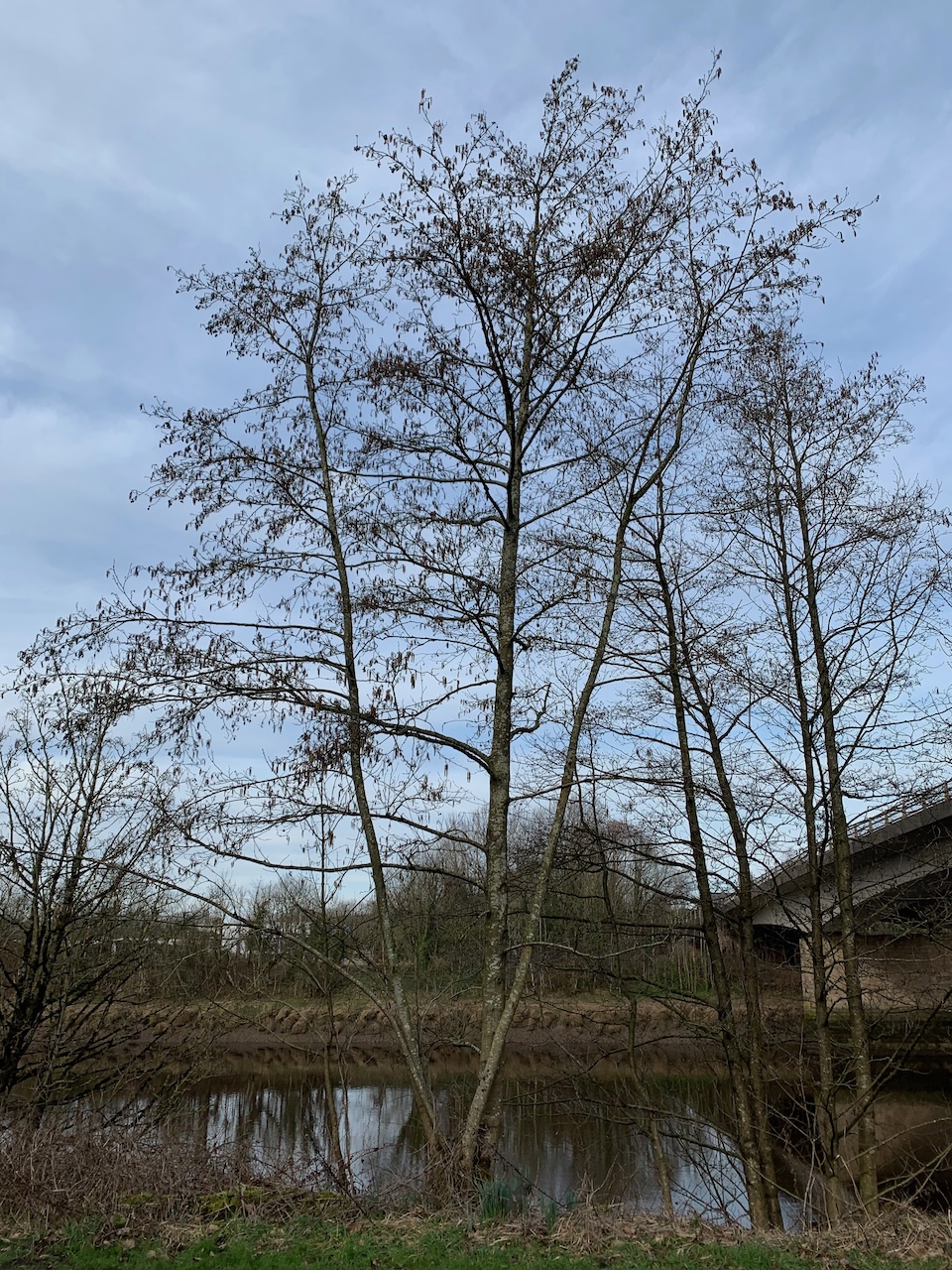
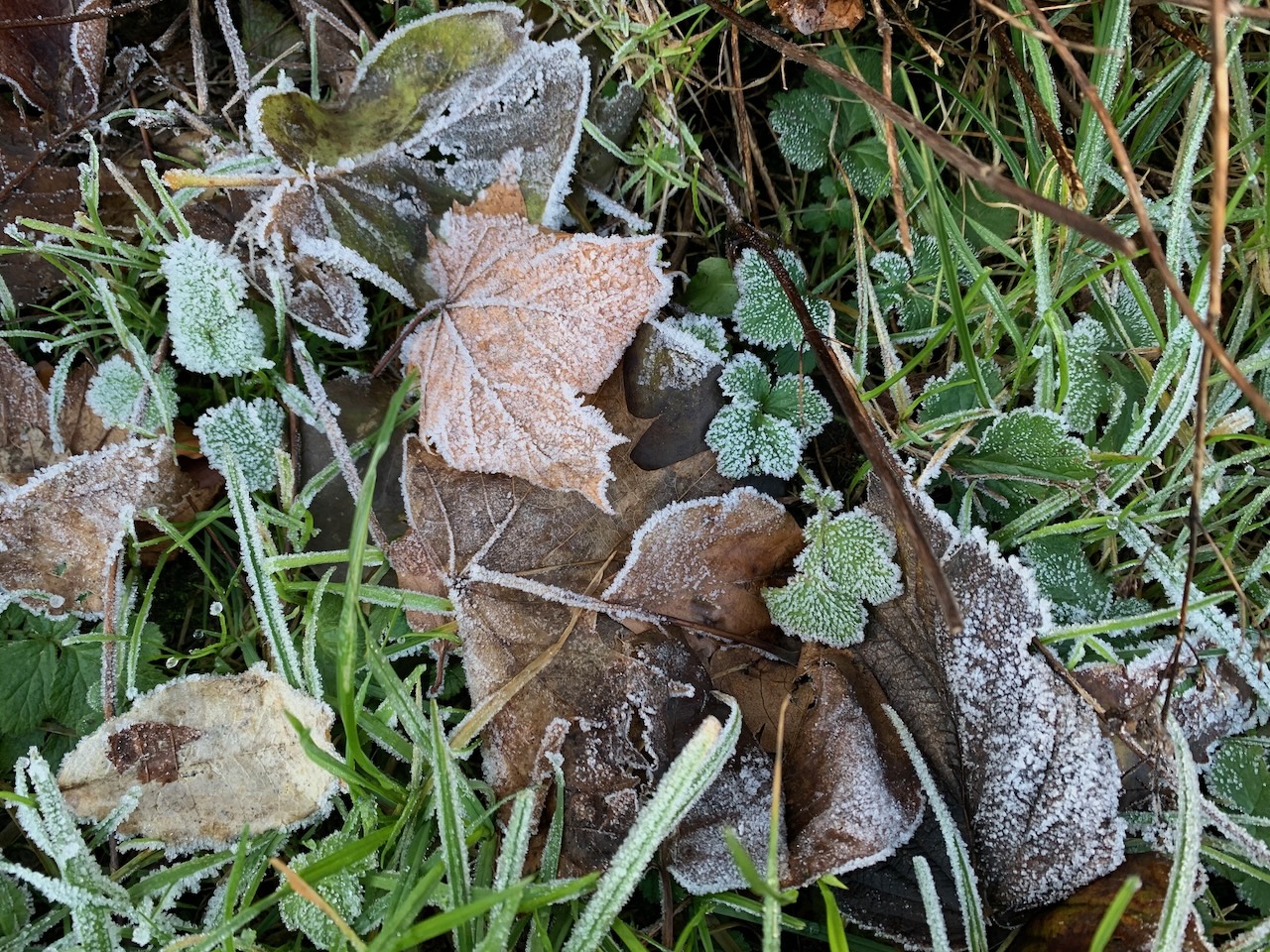
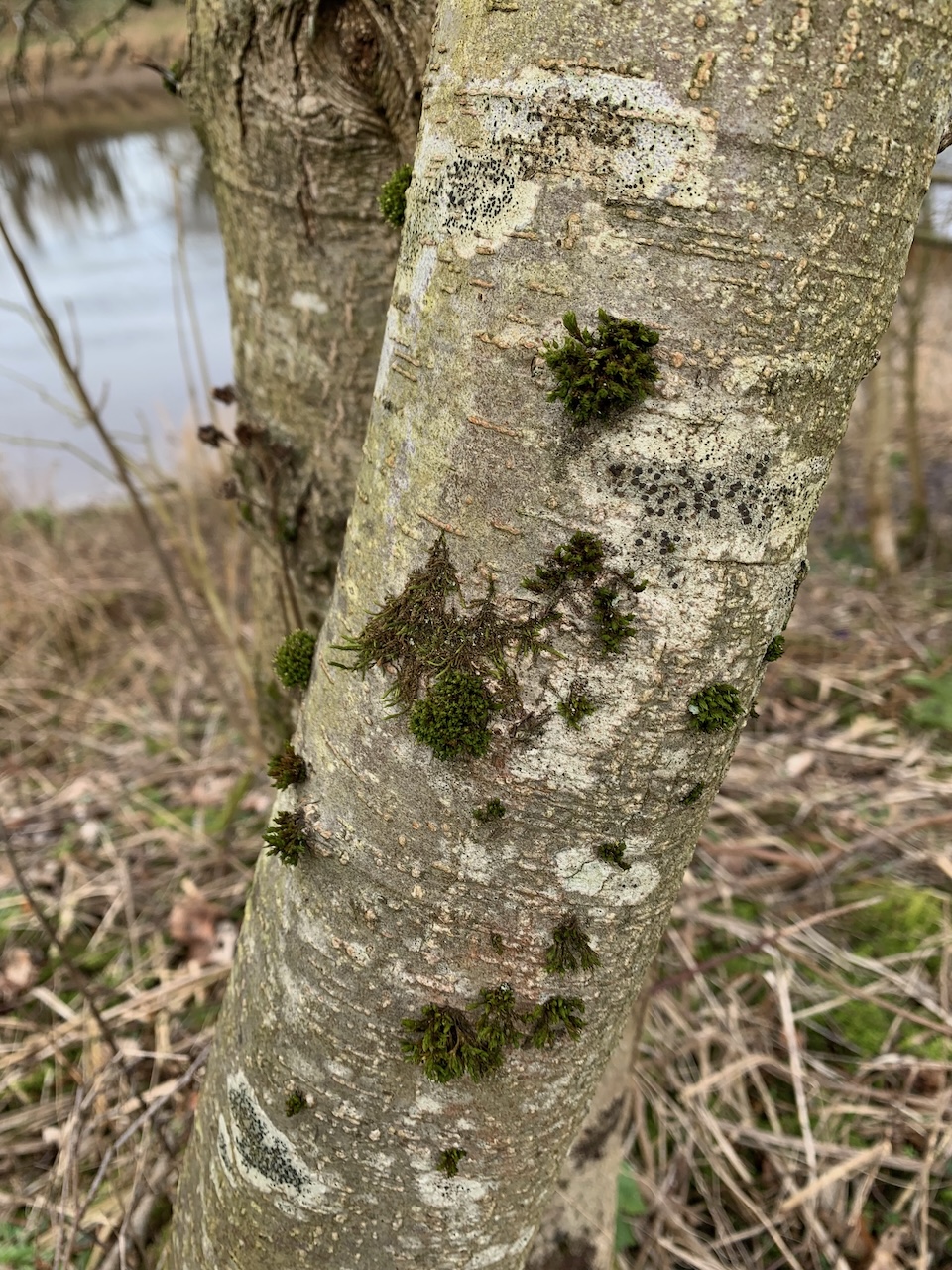
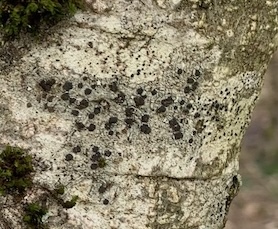
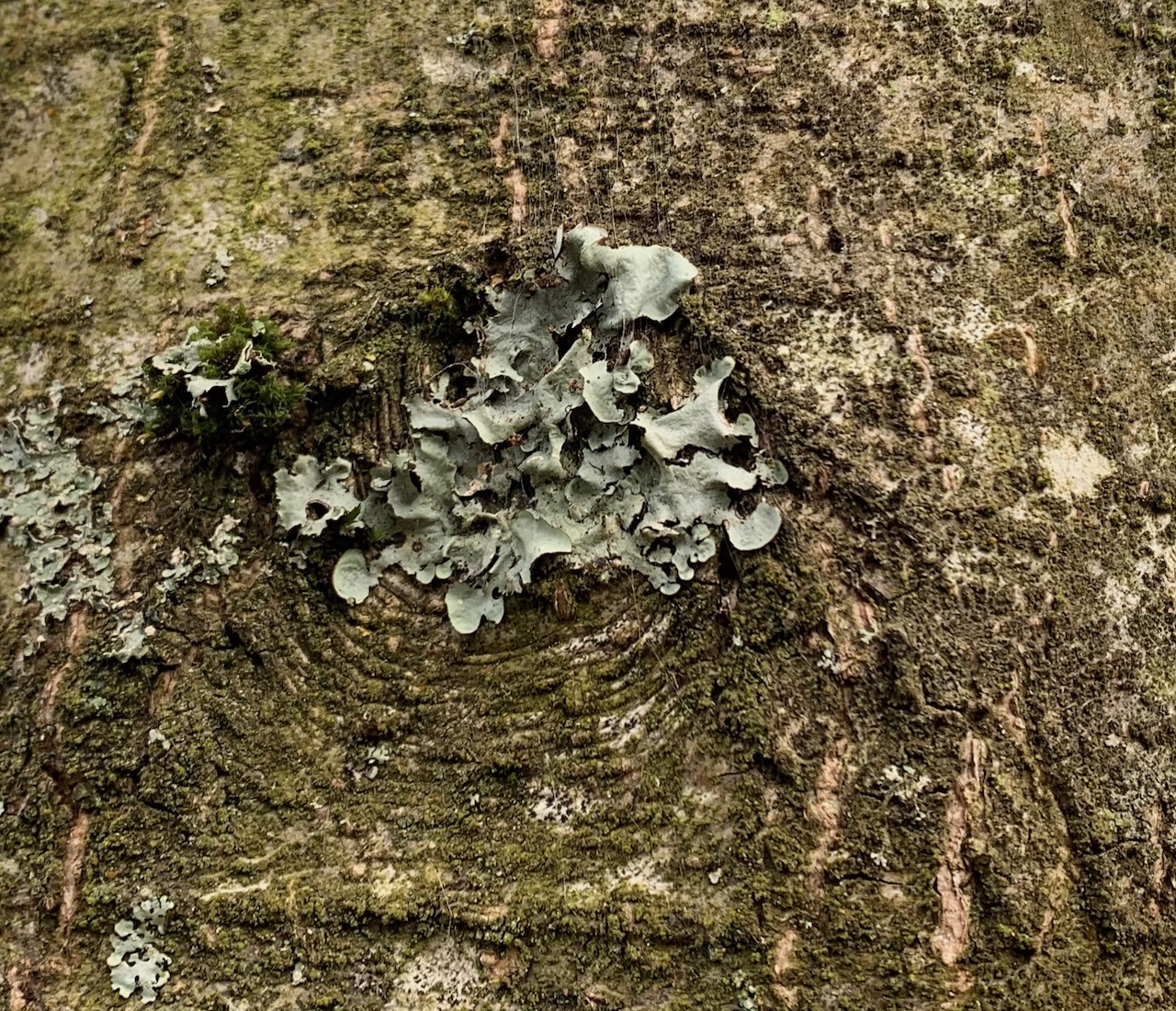
A couple of weeks ago, when I was walking beside the river Ribble, my eyes were drawn to this splendid river-watcher, an alder tree covered with brown-golden catkins and still bearing the dark brown cones from last year. Its trunk was splotchy with a white crustose lichen and bore several mosses.
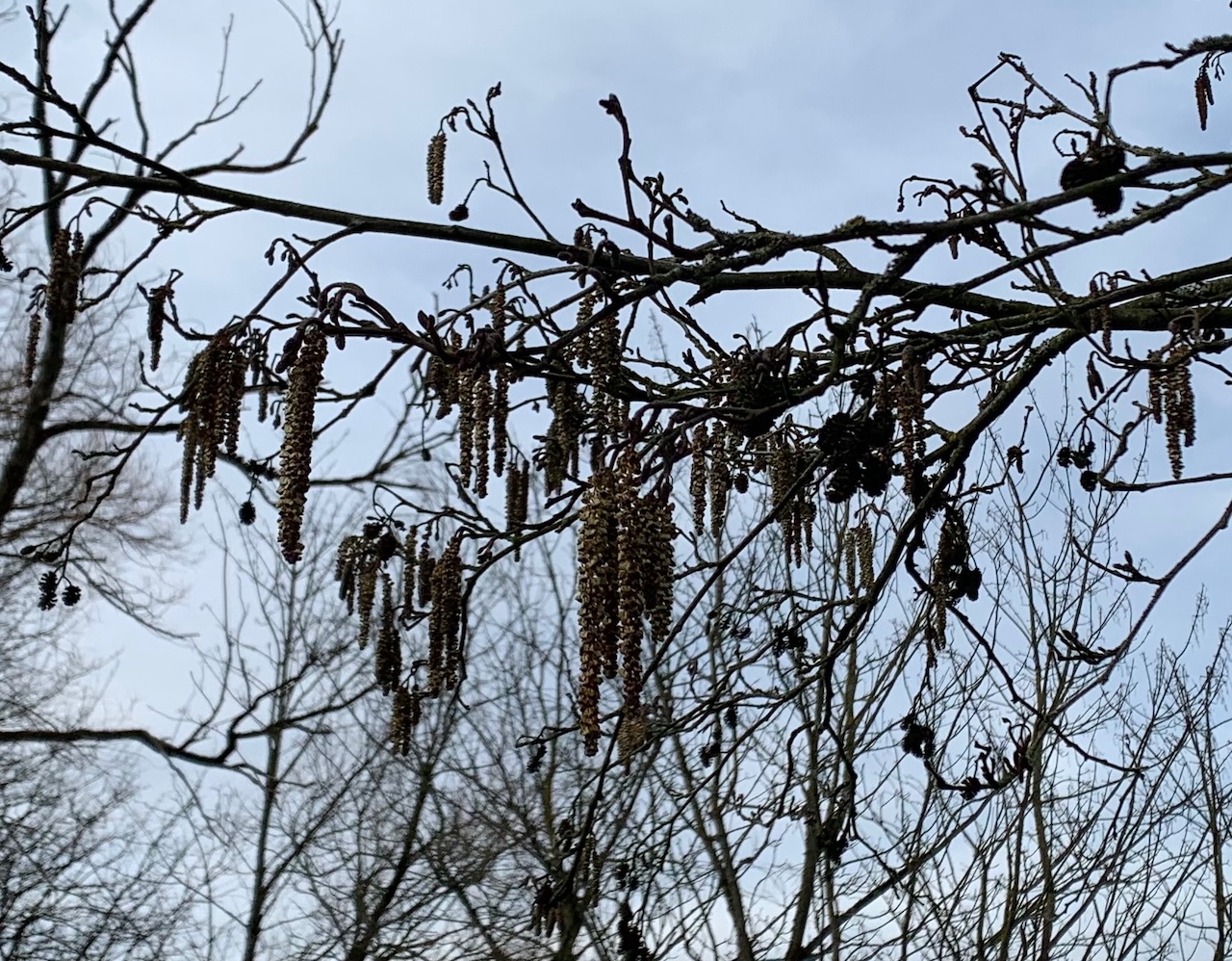
This got me researching the natural history of alder, its role in myth and folklore, and pondering how it was perceived by the early inhabitants of this land, the Setantii tribe, ‘the Dwellers in the Water Country’, and their successors.

Alder was one of the first trees to re-populate Britain after the Ice Age. A pioneer species, it is able to grow in barren and soggy ground due to its partnership with a bacterium called Frankia alni, which absorbs nitrogen from the air and exchanges it with the tree for sugars produced by photosynthesis. Alder then fixes nitrogen into the soil and enhances the fertility, meaning other trees and plants can follow. The nitrogen-fixing nodules of Frankia alni are visible on the roots.

The wood of alder would have been viewed as particularly sacred across Britain and Ireland, wet and boggy countries, as it does not rot in water. Since prehistoric times, it has been used for the building of crannógs (lake dwellings), in fish sluices, and for building trackways across bogs. 

Near the river-watcher, in the location of Riversway Dockland, a brushwood platform, suggesting the presence of a Bronze Age lake dwelling was found. That the twigs and branches hadn’t rotted away suggests they may have been alder.

Alder was also used to make bowls, domestic vessels such as the Pallasboy vessel, and wooden idols. One of the most famous is the ‘Red Man of Kilbeg’ from Ballykean bog in Ireland. It has been suggested that alder was used to craft this idol because red droplets that resemble blood ooze from the wood when it is cut, associating with the human bleeding and with death. In this context it also interesting that, in early Irish lore, the first human was believed to have been born from alder, a story that might be linked with its flesh-like qualities. The Scottish Ballachullish Goddess was also made from alder. 

Alder was used to make shields. In medieval Welsh mythology, Bran the Blessed, a gigantic son of the sea-god Llyr, carried an alder shield. Bran and his army were compared to trees when they crossed the sea from Britain to Ireland. Bran, like an alder tree, allowed his body to be used as a bridge by his warriors across the river Shannon. His sister, Branwen, had a son named Gwern (which means alder in Welsh) who was cast into a fire. Alder thus seems to be bound up with the mythos of the Children of Llyr. 

Lancashire’s Dwellers in the Water Country were likely, too, to have made their shields from alder and to have traversed the waters between Britain and Ireland. Place-name evidence from my local area such as ‘Alderfield’ and ‘Carr Wood’ (relating to alder carr) suggests that this species has long been held in particular favour and has been abundant. 

I did wonder whether the sluices for the canals and for Riversway Dockland were made of alder but the former is Baltic Pine and the latter is Greenheart. 

Alder is of value not only to human but other-than-human water dwellers. Where it grows beside water, its roots provide shelter for fish and nesting sites for otters. When its leaves fall, it provides food for river flies and aquatic beetles, who are feasted upon, in turn by fish such as brown trout and salmon. 

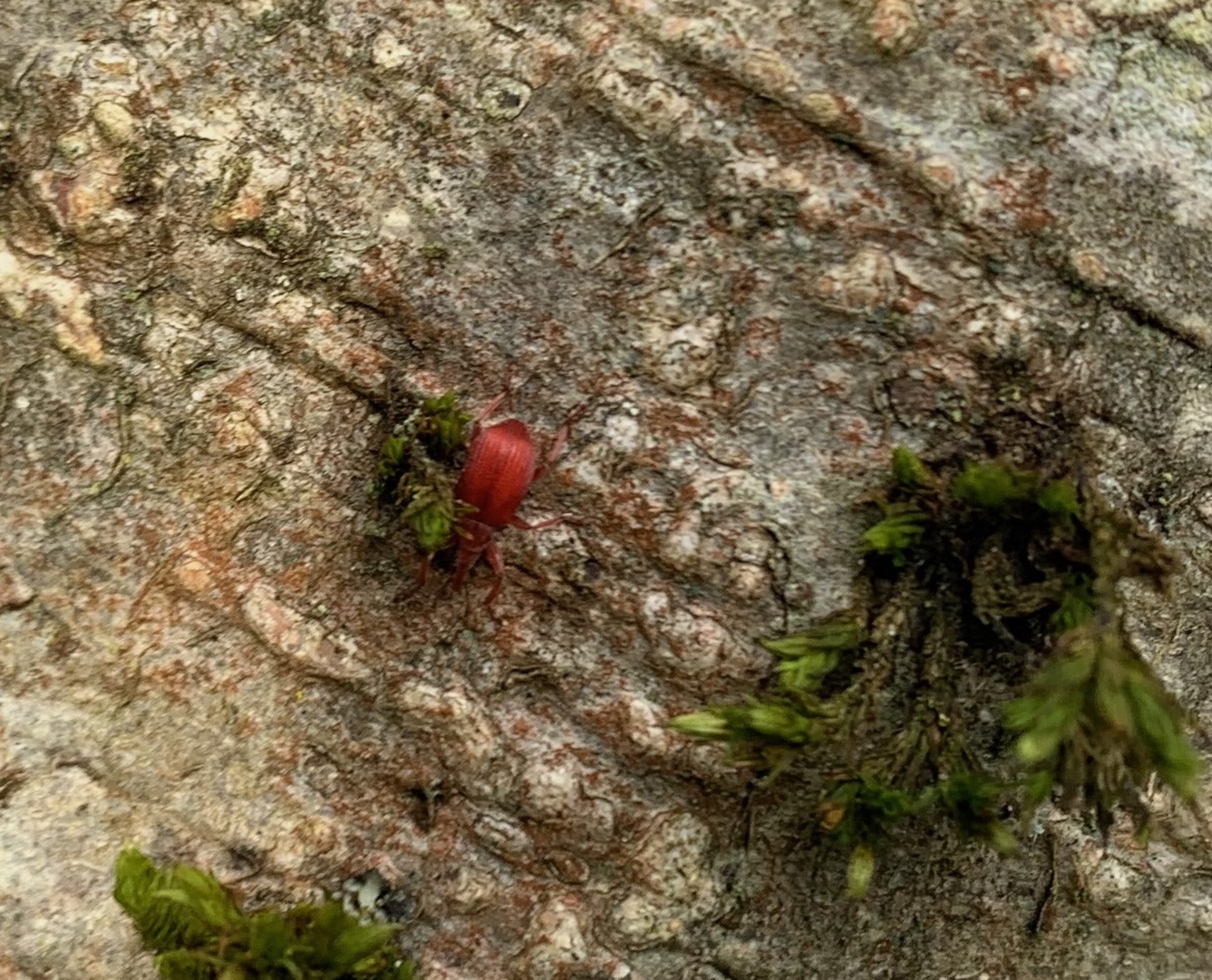
Its catkins provide nectar for bees and its seeds for finches, such as the charms of goldfinches who can frequently be seen beside the Ribble. It is the food plant of insects, such as the alder leaf beetle, which I have seen on alders on peatland nature reserves. I found a red beetle on the river-watcher’s trunk and suspect it is a leaf beetle from the Chrysomelidae family.
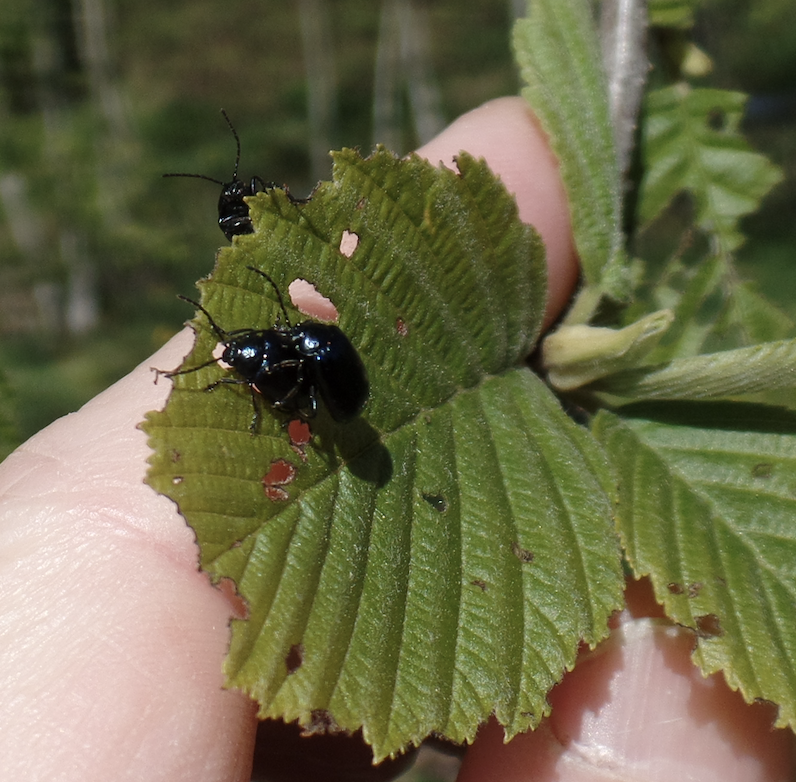
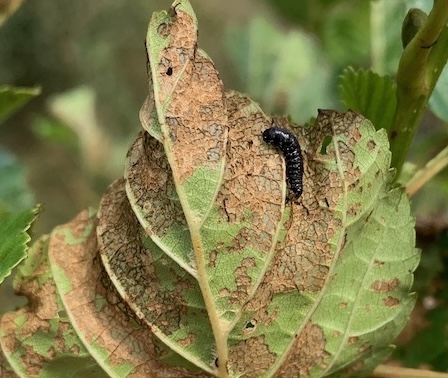
Alder is also the food plant of the larvae of several moths, including alder kitten, pebble hooktip, the autumnal, and the blue bordered carpet moth.

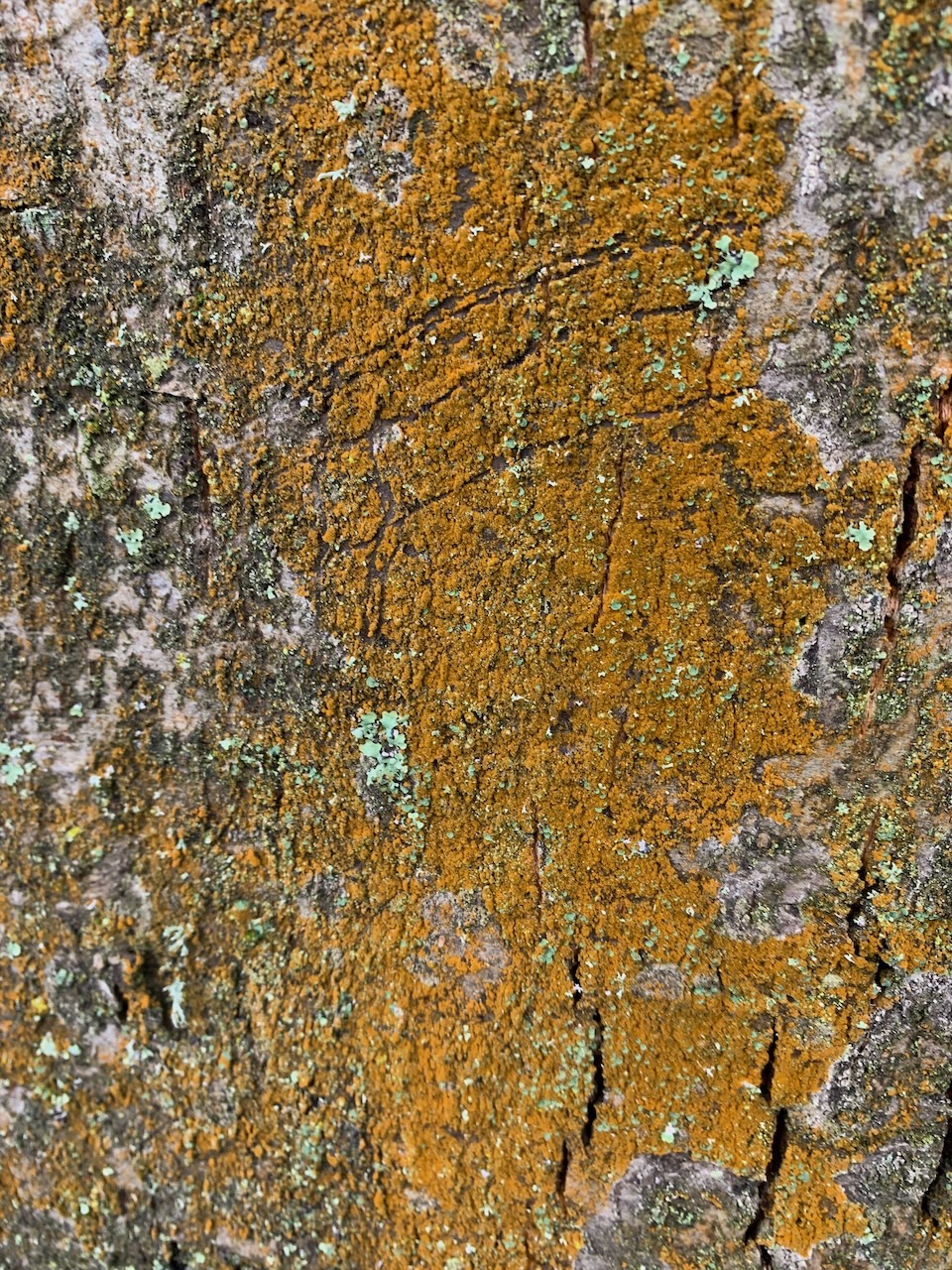
Alder trunks are frequently covered in white splotches which might be mistaken for the colour of the bark but are, in fact, crustose lichens. On the river-watcher, I found a white spotted lichen called Lecidella elaeochroma. Also a patch of Parmelia sulcata. On nearby trees was Trentepholia aurea, a green alga that appears orange and is a photosynthetic partner with Graftis scripta, another lichen that is also often found on alder trees. I identified these with the help of a friend who is studying lichens.
All these factors, together, suggest that alder has long been a special tree to Lancashire’s water dwellers and thus it remains in the hearts of many. 

In the Way of the Buzzard Mystery School it is associated with foundations and with being a spiritual warrior. This fits with it providing a platform for lake dwellings and with Bran’s shield and I will be drawing upon its support and protective qualities as I prepare to take my shamanic offerings further into the world.

SOURCES

Alder, The Wildlife Trusts, https://www.wildlifetrusts.org/wildlife-explorer/trees-and-shrubs/alder
Alder, Woodland Trust, https://www.woodlandtrust.org.uk/trees-woods-and-wildlife/british-trees/a-z-of-british-trees/alder/
Alder, Trees for Life, https://treesforlife.org.uk/into-the-forest/trees-plants-animals/trees/alder/alder-mythology-and-folklore/
Alder, Tree Explorers, https://www.ucc.ie/en/tree-explorers/trees/a-z/alnusglutinosa/
‘The Company of Alders’, Salish Magazine, https://salishmagazine.org/in-the-company-of-alders/
The Way of the Buzzard Mystery School, https://thebuzzardtribe.com/
The Frozen Men of Caer Rigor

‘I’m splendid of fame: songs are heard
in the four quarters of the fort, island of the strong door.
Fresh water and jet are mixed together;
sparkling wine is their drink, set in front of their battalion.
Three full loads of Prydwen we went by sea:
save seven, none came back from Caer Rigor.’
~ The Spoils of Annwn

It’s the middle of summer. We set sail for Caer Rigor beyond the ninth wave and further on to where all waves freeze beneath the turning of the frosty gulls. 

There is no fortress in Thisworld or the Otherworld colder than Caer Rigor. It wears its icicles like the Winter King’s crown upside down when he was cast down. There are frozen birds upon the turrets with songs frozen on their tongues.

The gate of the fortress is frosted shut like the cold lips of the gatekeeper.

Down from a tower swoops a messenger on wide white wings like an albatross. He pours water over jet mixing them together. Whoosh! A rush of flames, like from a flamethrower, burning in a multitude of colours, like a flambeau.

Ice drips from the gate and hinges open like the gatekeeper’s jaw. The giant stares and unclenches his fist but halts not our passage as we enter the frozen corridors of Caer Rigor and are taken to stand before the Strong Door.

“The door to this hall has not been opened for 1500 years,” the messenger speaks solemnly, “the men inside have known not death, nor decay, nor old age.”

He holds the jet-flame to the door and the icy seal around it melts. Inside is a battalion of frozen men, not the seven survivors, no, these are dead men. Young, pitifully young hopefuls who accompanied Arthur on his fateful voyage.

There is wine, sparkling wine, in their cups, they wear the faces of happy drunks. Yet, as the door opens, as the ice begins to thaw, they set down their glasses and the pain of memory appears in their eyes with the onset of sobriety as fire and ice, jet and water mix, fiercely coloured and hallucinatory.

“Where are we?” “Thisworld or the Otherworld?” “Are we alive or are we dead?” “Are we burning or are we freezing?” “Is this reward or punishment?”

“All I remember is the flash of Llenlleog’s sword as it was thrust into the cauldron.”

“Blinding!” “The explosion.” “It blinded us.” “Yet we can see.” 

“I remember the cauldron, tiny, in Lleog’s hand.” 

“Nonsense – that was just an illusion – the cauldron cannot be stolen.”

“Arthur cut off His head! The head of the Head of Annwn.” 

“And it sung to us for nights in this feasting hall.” 

“The Head of Annwn sung of cutting off Arthur’s head and how it was deaf and dumb.”

“What will become of us now?” “How can we return to the cauldron if it is gone?”

“I told you it was all an illusion,” speaks the youngest of the men. 

“You’re no longer trapped in that old myth,” the messenger tells them. 

“That old myth is done,” I am inspired to speak up, “we come as new monastic devotees of the Head of Annwn to set you free from Arthur’s rule. When this castle has thawed to the cauldron you will return to be reborn.”

They raise their cups and embrace – fire and ice, jet and water mix fierce and hallucinatory as from the turrets the birds fly free and burst into song.

~

This piece is based on my experiences during our Monastery of Annwn Brythonic texts meditation group last night. Caer Rigor has been translated as ‘the Petrification Fort’ from the Latin rigor from ‘stiffness’ and also contains connotations of ‘cold’ from frigor. The citation above is from Marged Haycock but replaces her translation of ynys pybrydor as ‘stout defence of the island’ with the more popular translation ‘island of the strong door’. This allows it to be related to the Second Branch of The Mabinogion wherein the seven survivors of the battle between the Britons and the Irish feast and drink blissfully on the Island of Gwales with the head of Bran the Blessed until one of the men, Heilyn, opens the door, and all their losses and ills return.

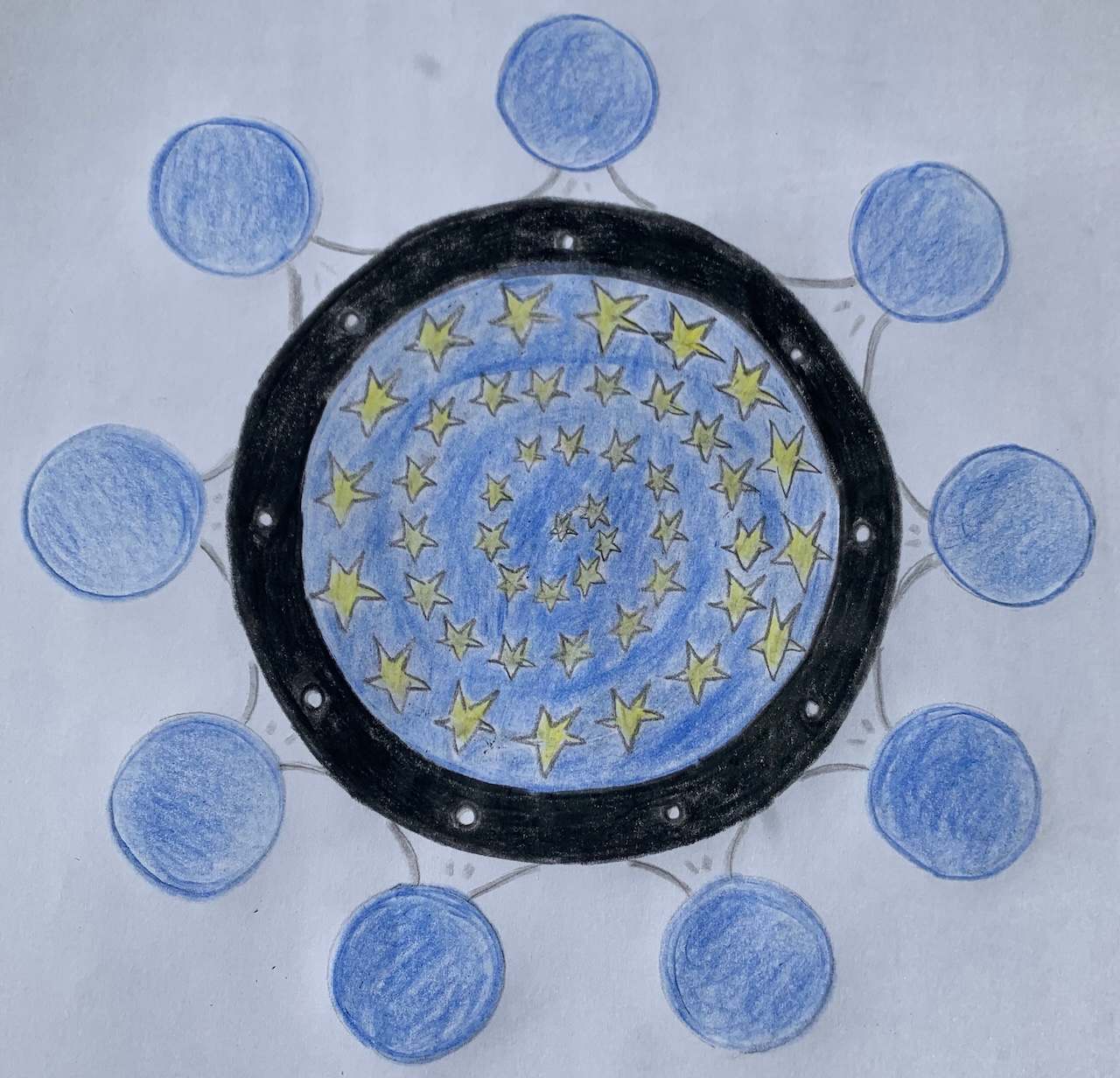
The Breath of Nine Maidens and the Kindling of the Cauldrons

‘My first utterance was spoken concerning the cauldron
kindled by the breath of nine maidens.
The cauldron of the Head of Annwn, what is its disposition
(with its) a dark trim, and pearls?
It does not boil the food of a coward, it has not been destined to do so.’
~ ‘The Spoils of Annwn’

In ‘The Spoils of Annwn’, a medieval Welsh poem from The Book of Taliesin, we find mysterious lines about the breath of nine maidens kindling the cauldron of the Head of Annwn. The cauldron, the source of awen, ‘poetic inspiration’, is a central symbol within Celtic mythology. 

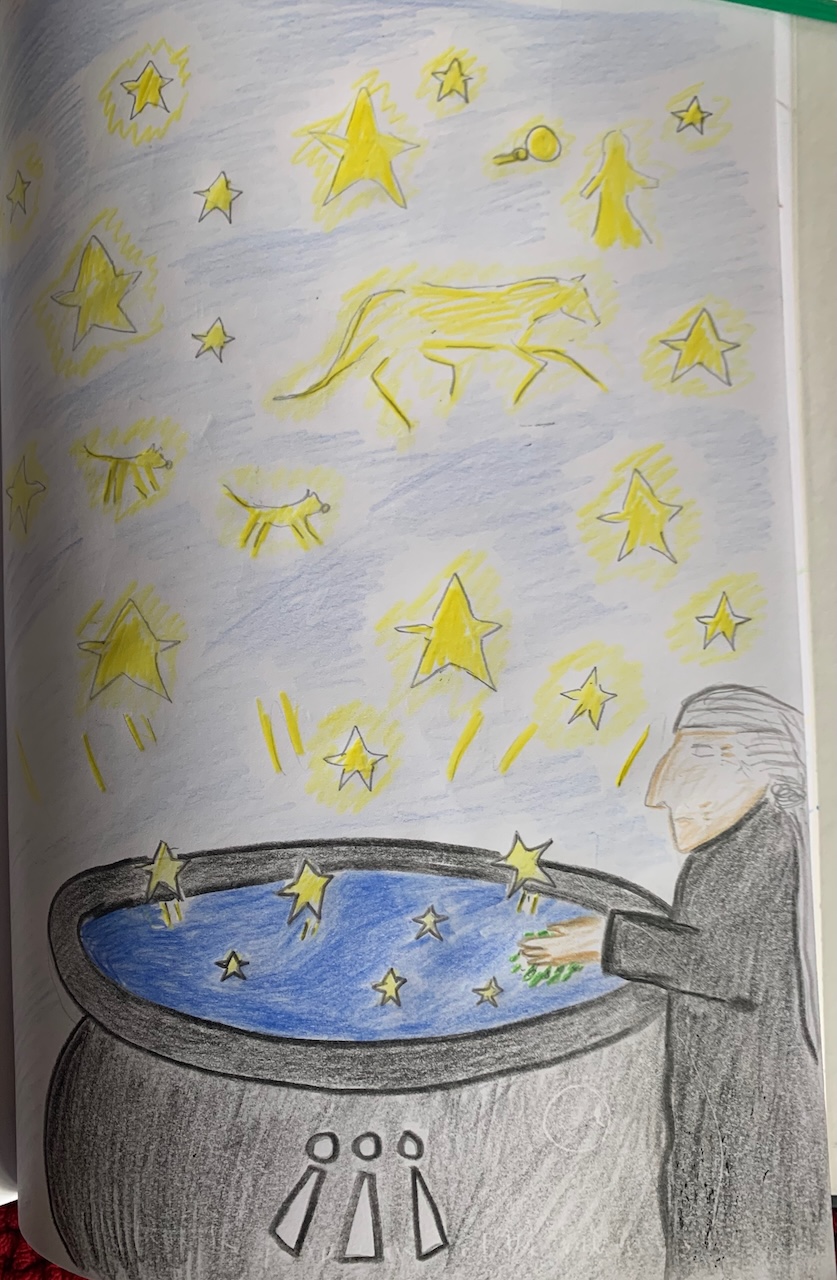
In ‘The Story of Taliesin’ the cauldron belongs to Ceridwen. In this tale Ceridwen is referred to as a witch but it’s my intuition She is a Goddess whose crochan – cauldron / womb is a sacred vessel of rebirth (1). In Her cauldron she brews a potion from 365 herbs (one picked on each day of the year) to provide her ugly son, Afagddu ‘Utter Darkness’ with the ‘Prophetic Spirit’. She assigns a blind man called Morda to bring kindling for the cauldron and to stir the cauldron she summons a boy called Gwion. After a year and a day Gwion shoves Afagddu out of the way and steals the awen. After a shapeshifting chase he is swallowed by Ceridwen (he as a grain and She as a black hen) then reborn from her womb as Taliesin.

In ‘The Spoils of Annwn’ the model is slightly different. The cauldron of Ceridwen, the magical vessel associated with inspiration and rebirth, is in the custodianship of the Head of Annwn – the ruler of the Brythonic Otherworld. Here there is no need for kindling or a person to stir the cauldron as the breath of the nine maidens is enough to set the processes within it into motion. The ‘food’ ‘not for a coward’ that it brews no doubt refers to the awen. Taliesin accompanies Arthur and his men not only to steal the awen, but the cauldron itself, bringing it back through ‘Hell’s Gate’ to the world.

This shows that when a potential awenydd, ‘person inspired’, proves their courage to the Head of Annwn, the breath of the nine maidens or awenau, ‘muses’ (2), kindles the cauldron, then the awen is received as a gift from the Gods.

This feels like an older and deeper model for the origins of awen. The significance of the breath of the nine maidens can be further elucidated by looking at the etymology. The medieval Welsh term used for breath is anadyl and this derives from the proto-Celtic anatla which shares a resemblance with anaman the proto-Celtic word for ‘soul’. The Indo-European *uel is closely related giving us the root form of awel ‘breeze’ and awen ‘inspiration’. There seems to be something fundamental this myth is telling us about how, in Annwn, on the soul-level, the breath of the nine maidens kindles the cauldron and sets in motion the processes within the cauldron that create the awen.

It’s my personal intuition that the cauldron / womb of Ceridwen, who I know as Old Mother Universe, is a macrocosm of the universe. That it lies in Annwn ‘Very Deep’ shows the Otherworld is a deeper reality underlying the universe. 

On a microcosmic level each awenydd might too be seen as a cauldron which is kindled by the breath of the nine maidens producing awen for poetic works. The breath itself might be seen as a gift from the awenau. 

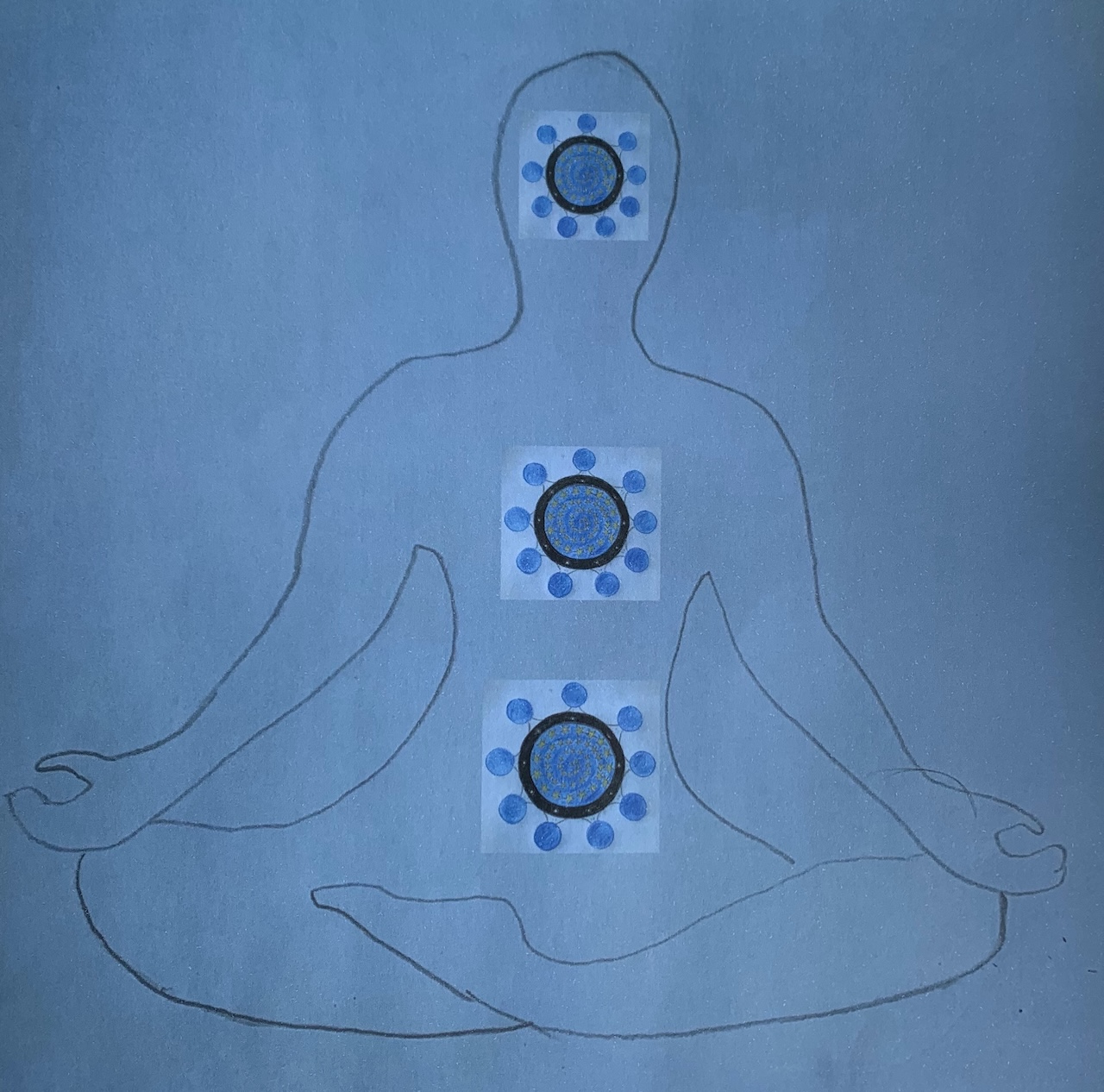
Microcosm within microcosm a number of Celtic Pagans have come to relate the three cauldrons in the seventh century Irish text ‘The Cauldron of Poesy’ to the three main energy centres or chakras in our belly, heart and head (3). Interestingly the Irish term coire ‘cauldron’ or ‘whirlpool’ might be seen to relate to the spiralling manifestation of the universe and the turning of the chakras.

In yogic meditation the breath is used to awaken the chakras. I was once dubious about the existence of ‘Celtic Chakras’ but I am now coming to perceive the resonsances between these shared Indo-European traditions. I wonder whether anatla ‘breath’ is the Celtic equivalent of the yogic prana ‘breath’ or ‘life force’ which Celtic Pagans have long been searching for (4). 

(1)These insights derive from Kristoffer Hughes’ From the Cauldron Born.
(2)This term is borrowed from Greg Hill who uses it in his poem ‘The Muses’ in his poetry collection The Birds of Rhiannon – ‘O Muses / O Awenau / You whose breath kindled the cauldron of awen in Ceridwen’s keeping.’
(3) For example see Erynn Rowan Laurie’s ‘The Cauldron of Poesy’ – https://www.obsidianmagazine.com/Pages/cauldronpoesy.html
(4) Some druids have in the past mistakenly identified prana with nwyfre ‘sky, firmament’ which Mhara Starling explains is erroneous on her Youtube channel – https://www.youtube.com/channel/UCkc4iRymvz4t619FEk5dFfA/videos Interestingly the proto-Celtic anatla ‘breath’and anaman ‘soul’ share similarities with the Sanksrit atman which is sometimes translated as ‘soul’ but refers to the Self or witness-consciousness beyond phenomena and ananda which refers to bliss at escaping the cycle of mortality or uniting with a God.

On Singing in Chains

In the Monastery of Annwn meditation group we have recently been exploring the medieval Welsh poem ‘The Spoils of Annwn’ from an Annuvian perspective rather than from the views of the ‘victors’ Arthur and Taliesin.

Last week, in the guided visualisation meditation, we journeyed to the first fortress, Caer Siddi ‘the Fairy Fort’, on our magical monastic boat and gained personal visions based on lines from the poem:

Maintained was Gwair’s prison in Caer Siddi
throughout Pwyll and Pryderi’s story.
No-one went there before he did –
into the heavy grey chain guarding the loyal lad.
And before the spoils / herds of Annwn he was singing sadly,
and until Doom shall our poetic prayer continue.

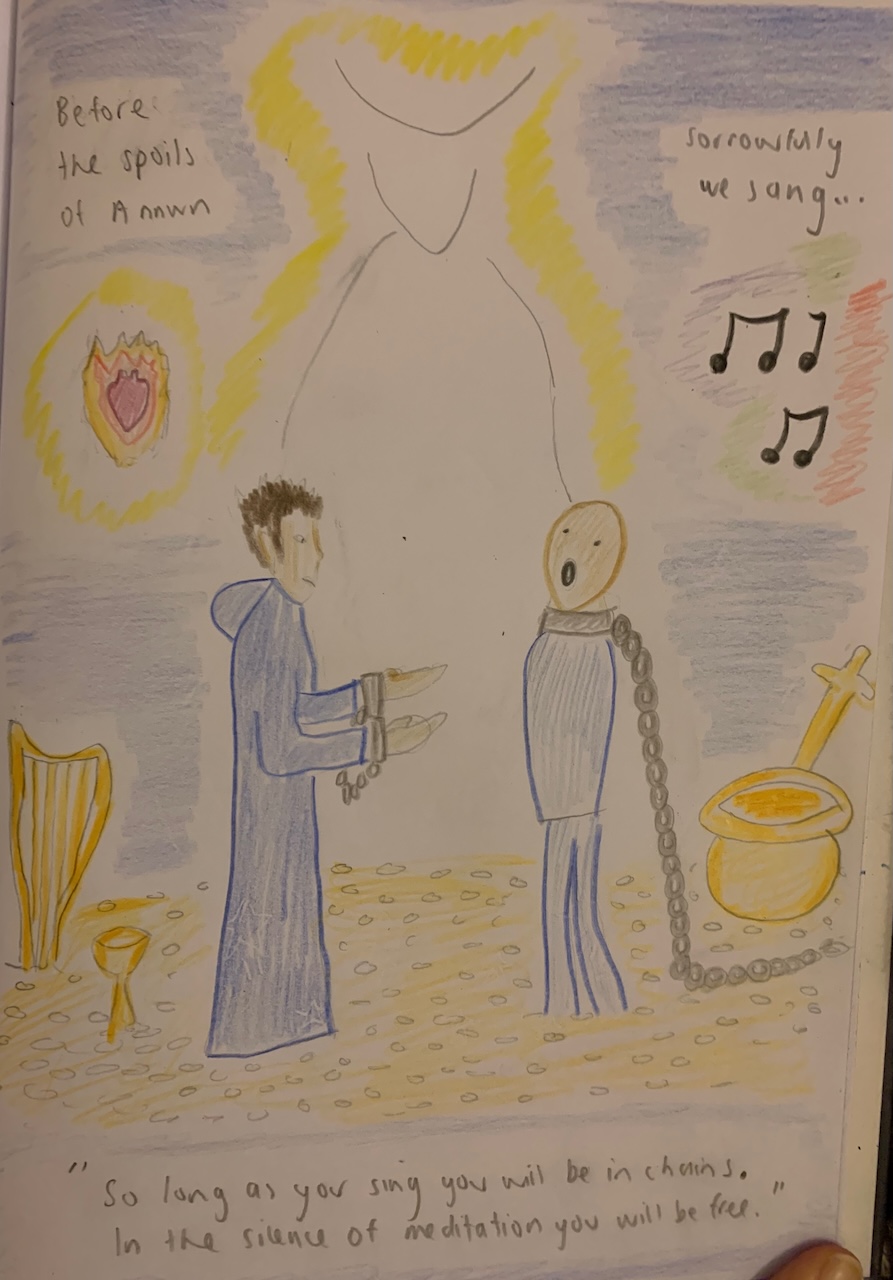
I found myself standing before Gwyn wearing chains with Gwair in a scene resembling the Devil card from the Rider Waite Tarot. Whilst Gwair was imprisoned in a heavy grey chain I was wearing only toy-like silver handcuffs and felt they were close to breaking and to my being released.

Gwyn said:

‘As long as you sing you will be in chains.
In the silence of meditation you will be free.’

Gwyn’s words reminded me of the shift in my path from being a bard in the mead hall to becoming a Nun of Annwn. To moving away from performing poetry to a more monastic and shamanic path.

Another way of looking at it was that the singing is the voice of the incessant thoughts in my head and that only when I’m silent in meditation will their song and the chains be gone.

Nodens Father of Sea Horses

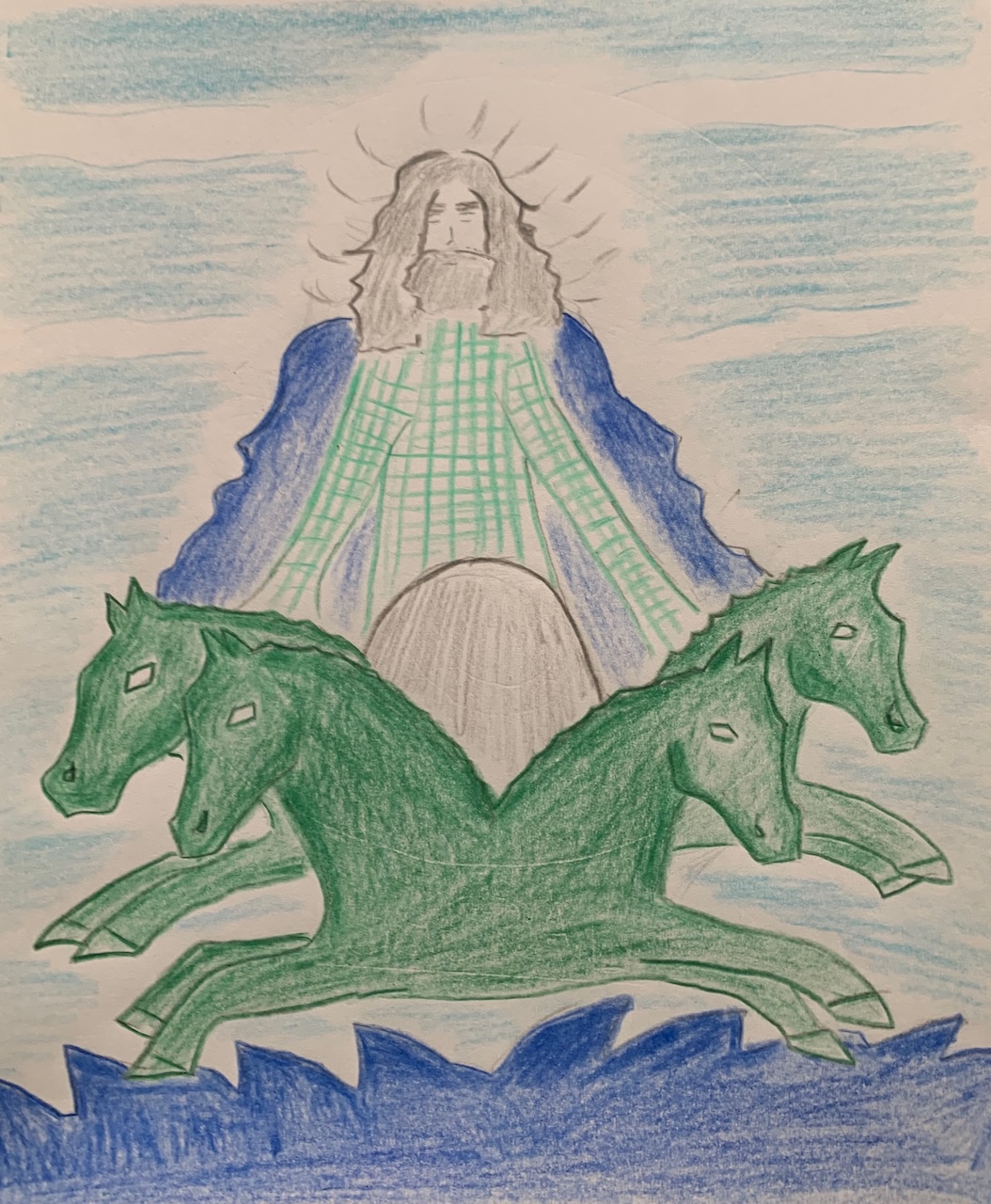
Recently, in one-to-one sessions with another monastic devotee of Annwn, we have been exploring her intuitions about Gwyn ap Nudd’s associations with the sea. Gwyn’s father, Nodens / Nudd, is equated with Neptune at Chesterholm in an inscription which reads Deo No / Neptu. This suggests, like Neptune, He is associated with freshwater and the sea, seahorses, and with horses more widely (Neptune was worshipped as Neptunus Equestris – God of horse racing).

Little is known about the myths of Neptune but there are many about His Greek counterpart, Poseidon Hippios ‘of the horse’, the Father of Horses. When Demeter fled Poseidon’s lust in the form of a mare He took the form of a stallion and mated with Her and She bore a colt called Arion ‘Very Swift’. In another tale He mated with Medusa and She gave birth to Pegasus.

These stories remind me of my personal gnosis about Nodens mating with Anrhuna, the Dragon Mother of Annwn, to bear Gwyn and Creiddylad and other children who might have included horses and seahorses. Intriguingly Rhiannon, who like Creiddylad is a Queen of Annwn, is a Horse Goddess. I often wonder if Creiddylad and Rhiannon are titles for the same Goddess who takes horse form. If so this would suggest that Nodens is the Father of Horses and likely Sea Horses here in Britain. That He might be the father of Gwyn’s sea-going steed, Du y Moroedd, ‘the Black of the Seas’.

It also make me wonder if Nodens and Anrhuna might be the parents of white winged horses like pegasus from whom my closest spirit animal, a white winged mare, is descended. March allelog, ‘flying horses’, are known in Wales.

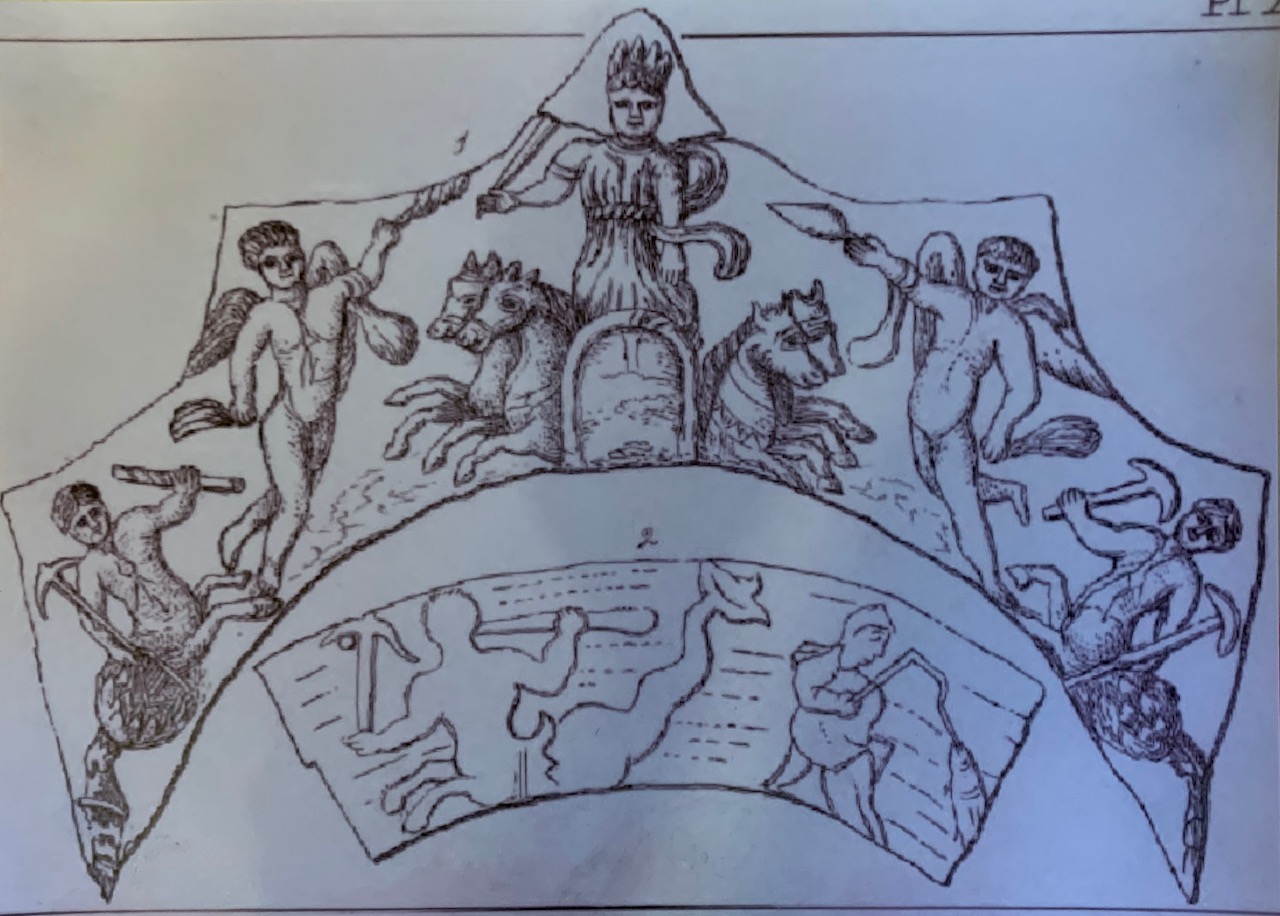
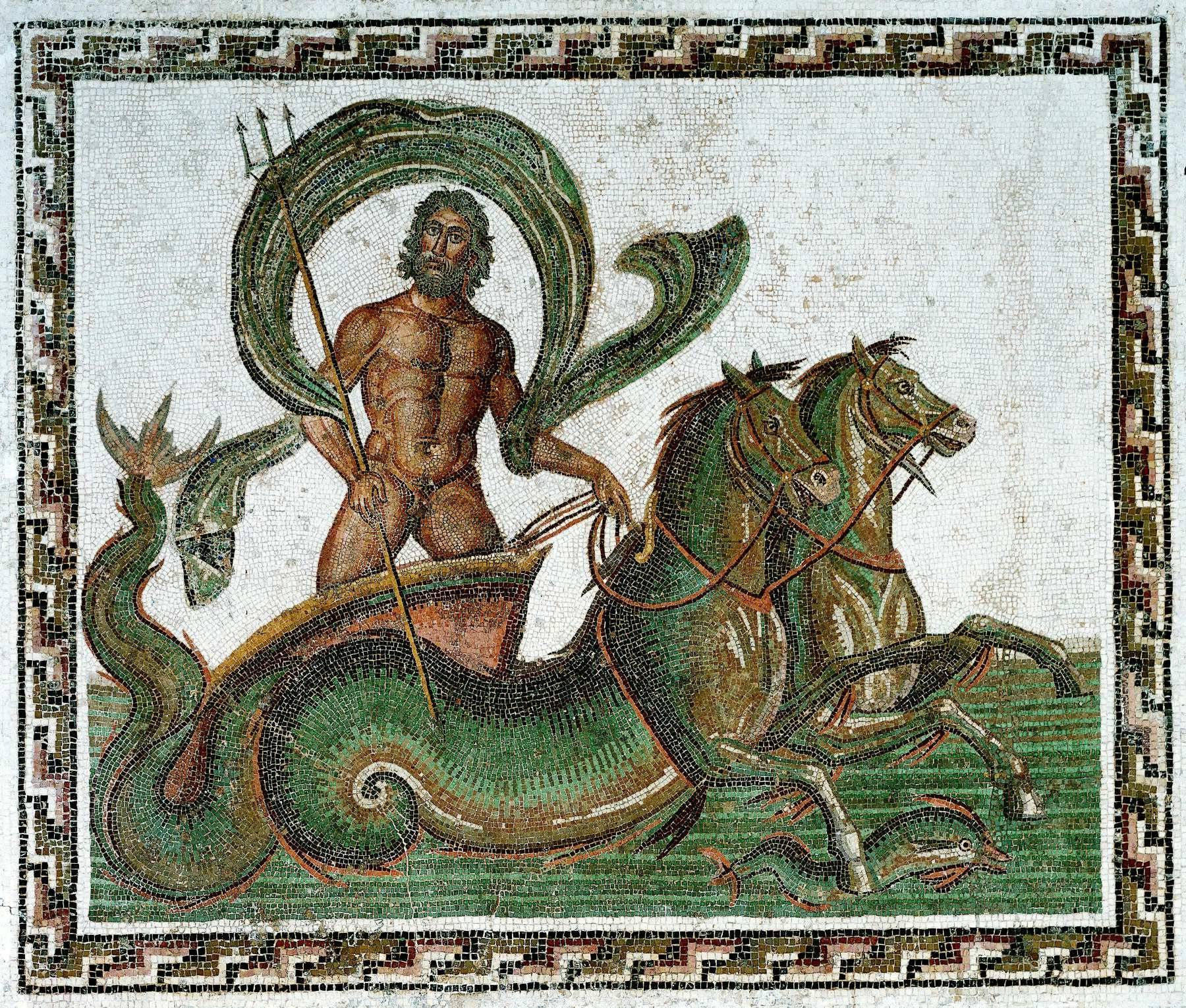
The devotional art above was born from these musings and is based on the mural crown depicting Nodens on a chariot pulled by four seahorses from Lydney and a triumph of Neptune in a chariot drawn by two seahorses from Sousse Archaeological Museum.

Why I failed to write a Brythonic creation myth

In my attempted novel, In the Deep, I tried to imagine a story for the origins of Vindos / Gwyn, His kingdom in Annwn, and for the creation of the world. This was based on a combination of my readings of Brythonic and other Celtic and Indo-European and world myths and my personal gnosis. 

I worked for a year and a half on a story that had meaning for me and I felt Gwyn wanted me to write as the awen kept on flowing. Yet it didn’t speak to many humans and, in retrospect, although coherent, contained a lot of flaws.

Looking back, I feel it was a process I needed to go through. I genuinely believe I saw faces of Gwyn, such as the Boy in the Serpent Skins, that were meaningful for me and needed to journey with Him and write those tales.

Yet there were elements of the story I could never quite make work. My personal gnosis led me to perceive parallels between Tiamat in the Enuma Elish and a ‘found’ Goddess I know as Anrhuna who takes the form of a nine-headed dragon and is Gwyn’s mother and the Mother of Annwn.

In the Deep was written as an inversion of Enuma Elish ‘When on High’ reimagining what might have been a wider Indo-European origin myth centring on the slaying of a dragon from the side of the Deep rather than the victors.

It opens with a battle between the Dragons of the Deep (Annwn) and the Children of Don wherein Lugus / Lleu slays Anrhuna, the Dragon Mother. By cutting off Her nine heads He releases the dragon children of the nine elements*. He then cuts open Her womb and tears out Kraideti / Creiddylad (the Girl who will Bring Life) and Vindos / Gwyn (the Boy who will Bring Death). Lugus takes Kraideti to the stars and flings Vindos into the Abyss. Uidianos / Gwydion steals the magical jewels from Anrhuna’s foreheads and with them commands the dragon children to create the world. 

Although I’ve been able to picture the dragon slaying scene quite vividly I’ve never quite managed to see or write the creation of the world. I’ve ‘seen’ Uidianos and a circle of enchanters with their wands conjuring with the elements to form a world but can’t seem to connect it with the dragons.

The role of Gwydion as demiurge I derived from His creation of Taliesin in ‘The Battle of the Trees’ from ‘nine forms of consistency’ – ‘fruit’, ‘fruits’, ‘God’s fruit in the beginning’, ‘primroses’, ‘flowers’, ‘the blossoms of trees and shrubs’, ‘earth’ / ‘sod’, ‘nettle blossoms’, and ‘the ninth wave’s water’. 

In ‘The Song of the Great World’ Taliesin is created by God from ‘seven consistencies’ – ‘fire and earth, / and water and air, / and mist and flowers, / and the fruitful wind’. Like the the microcosmic Adam** his creation may be seen to mirror the creation of the world by God in this poem. It seems possible Gwydion was earlier seen as creating Taliesin and the world.

In ‘A British Myth of Origins’ John Carey suggests the Fourth Branch of The Mabinogion might contain an origin myth with Math’s kingdom whilst He has His feet in the lap of a virgin, Goewin, representing a timeless paradisal state. Gwydion’s scheming with Gilfaethwy to bring about her rape represent a fall. Gwydion and Gilfaethwy’s transformation by Math into a deer and a pig and a wolf, and their bearing of offspring, may explain the origin of animals.

Carey also suggests the story of Taliesin shapeshifting into various animals after stealing the awen from the cauldron of Ceridwen and the animal transformations of figures such as Mongan in the Irish myths function ‘as a device to connect the present with its origins, whether the beginnings of history or the transtemporal eternity of the Otherworld.’

It’s my personal intuition that Ceridwen may be a creator Goddess. That Her crochan ‘cauldron’ or ‘womb’ could be the vessel from which the universe was born. This is another strand that I attempted to weave into my book. 

If we look back beyond medieval Welsh mythology to the Roman sources we find no evidence whatsoever of a creation myth. Instead Strabo reports that the Gallic peoples (who according to Caesar derived their beliefs from the Britons) believe ‘men’s souls and the universe are imperishable’. Several authors speak of the belief that the soul is immortal. According to Caesar it ‘does not die but crosses over after death from one place to another’ showing existence in an ‘otherworld’ (potentially Annwn). Diodorus Siclus claims the Gauls ‘subscribe to the doctrine of Pythagoras that the human spirit is immortal and will enter a new body after a fixed number of years’. The key doctrine of Pythagoras is metempychosis and we find this throughout the Taliesin material wherein he speaks of his transformations. 

It seems possible we don’t have a Brythonic creation myth as the universe was viewed as ‘imperishable’ and the eternal soul as shifting through different shapes, potentially crossing from this world to Annwn and back again.

One of the things that has stood out to me whilst returning to the Taliesin material is that rather than telling of creation as given he instead poses riddles.  ‘How is the sun put into position? / Where does the roofing of the Earth come from?’ ‘Where do the day and the night come from?’ He mocks Christian scribes for not knowing ‘how the darkness and light divide, / (nor) the wind’s course’.

Taliesin seems to be claiming to know yet he leaves the answers a mystery. Could it be that our Brythonic ancestors treated these issues as mysteries rather than having clear cut myths and stories and explanations? 

If so could my failure to create a myth that works be based on the fact there have never been any direct answers and these things should be left mysterious?

If so it seems this book idea has played itself out for what it is but can go no further. I fulfilled my promise to Gwyn to write Him an origin story (something He didn’t ask for but that I did as an act of devotion to Him). It just didn’t turn out to be a novel sellable to humans. Which is ok. 

Where to go from here I’m not sure. I still want to write, I still need to write, in service to my Gods and to give voice to the awen from Annwn and within. To provide content for my patrons who continue to support me. But it might be that now I’ve become a nun of Annwn, Sister Patience, what I write will change.

It seems possible I will be taking a more meditative approach with a focus on mystery, which feels fitting for a nun dedicated to a God of the Deep.

*Stone, earth, water, ice, mist, wind, air, fire, magma.
**In her notes to ‘The Battle of the Trees’ Marged Haycock adds some references to medieval Christian texts where Adam is said to be created from ‘eight consistencies’ – ‘land, sea, earth, clouds of the firmament, wind, stones, the Holy Spirit and the light of the world’ or ‘earth (flesh), fire (red, hot blood), wind (breath), cloud (instability of mind), grace (understanding and thought) blossoms (variety of his eyes), dew (sweat), salt (tears).’

The King of Distractions

He came into my life around 2012 when I started this blog and joined the strange world of the blogosphere. His presence was invisible at first and it took me a few years to perceive his influence. I started this blog to share inspiration and find and connect with like-minded people and I succeeded in those aims. Only I found that during that process ‘something’ had gained power over me. I was not only reading what inspired me and felt important but trying to keep up with every last thing on the blogosphere, on social media, not wanting to miss out or get left behind.

In 2015 when I was doing my best to fit the mould of being a politically-engaged Pagan there were days when I did nothing but scroll the internet for information to make the right replies on blogs and Facebook and Twitter feeds. 

Around that time there were some really nasty arguments between right and left-wing polytheists that led to the breakdown of the polytheist movement. It was a horrible thing to see and this, on top of being burnt out from having forced myself into activism, led me to stop blogging and abandon social media.

I went to Wales. I had some experiences with Gods and giants. I came back. 

Since then I have been more mindful of my internet use and how it uses me. After a couple of brief flirtations I have abandoned Facebook and Twitter. I follow only blogs that inspire me. I steer clear of arguments. I limit my engagements to old-fashioned forums at the Monastery of Annwn and The Cloister.

Yet still I’m distracted which I find to be a terrible irony for a nun of Annwn, one who is devoted to the Gods of the Deep, is writing a book called ‘in the Deep.’ When I need a break or when I get stuck I’m tempted to check my emails or look at a blog, then one thing leads to another and I’ve lost half an hour. 

The problem of attention theft, of stolen focus, and the resulting atrophy of our deep work muscles is something we have been working with at the Way of the Buzzard Mystery School* and has been picked up on by fellow Polytheist Monastic Danica Swanson.**

Since then reclaiming my attention and retraining my deep work muscles has been a large part of my personal spiritual development as a nun of Annwn. But it hasn’t been easy. I’ve had a lot of resistance to keeping my focus on one thing at a time, whether it is meditation, writing, gardening, running or a gym work out. I’ve had a lot of minor things go wrong recently from personal and family health issues to a stolen bike and a troublesome member at the monastery. I’ve used them as excuses for letting distractions have their way.

In spite of my best efforts I have been struggling to focus on one thing at a time to the point I have felt that ‘something’ is actively stealing my attention.

Returning to look at the Way of the Buzzard journey circle in January 2022 ‘Reclaim your Attention’ last night I noticed the intention was to journey on ‘what is getting in the way of your attention?’ I intended to do so this morning but instead woke up with the answer – ‘the King of Distractions.’

Having dreamt a couple of days ago about our house being burgled and linking this to the man of enormous stature with a huge hamper who stole food and drink from Lludd in Lludd ac Llefelys I realised I had found the culprit. 

I then had the gnosis that the King of Distractions has been here, not only in my house, but in my very room since I started blogging. He has been sitting beside me, stealing my attention and focus away from the things that really matter, putting them into his huge hamper, filling it full, as my mind grows weak. 

(‘And nothing amazed Lludd more than that so much could fit into that hamper!’)

He’s been following me about taking my mind from nature on a walk, bike ride, or run, from what I’m doing with my body at the gym. He’s been next to me when I sleep, waking me up with distractions, robbing me of my dreams. 

It thus seems meaningful that Lludd/Nudd/Nodens, God of Dreams, defeats this man and that his identity has been revealed to me by sleeping and dreaming.

In Lludd ac Llefelys the man achieves his theft by sending everyone to sleep. As the King of Distractions he makes himself invisible by putting us into a sleep-like trance in which we are barely aware of what we’re doing as we flick onto our emails or onto the internet and begin scrolling from this to that.

On Nos Galan Mai Lludd manages to defeat the man by immersing himself in a tub of cold water every time sleep comes upon him. He then confronts him in a violent battle in which sparks fly from their weapons, throws him to the ground, and demands that all his losses are restored and the man becomes his vassal. 

Whilst immersing myself in a tub of cold water every time I’m distracted isn’t very practical it could serve as a good visualisation aid against the King of Distractions. As could visualising beating him off, sparks flying, forcing him to give back what is in his hamper and putting him in his place. 

An additional tactic is to put up some defences. Thus I’ve drawn up a schedule in which I’ve restricted my internet usage to checking emails once a day in the late afternoon when my other work is complete and limiting catching up on blogs and reading articles online to Saturdays.

I’m hoping this will help me reclaim my focus and strengthen my deep work muscles so I can make better progress with ‘In the Deep’ and my spiritual practices.

*Nicola at the Way of the Buzzard blogs about stolen focus in her post ‘Attention’ HERE.
****Danica Swanson proposes ‘Creative Incubation’ as a remedy for stolen focus and the atrophy of deep work muscles HERE.

Introducing the Boy in the Serpent Skins

Who would go
with the boy in the serpent skins
draped over one shoulder fastened with a bone pin

to the world of dead dragons at the bottom of the Otherworld?

Who would go with him clambering over the corpses where his hands
and feet are always bloody because the aftermath of the battle is endless?

Who would follow him down the trails of the scales of dead serpents
to where they have sloughed off their skins, one, then another?

Who would face what lies beneath, the glistening organs,
the hearts, the lungs, the livers hung up in caves,
the bowels woven into a pattern on a loom,
the heart strings strung on a harp?

Who would walk amongst those who took the pickings?

Who would run ragged through the caves of a hundred claws?

Who would refuse to admit defeat to the jaws that hang on the walls?

Who would take off all their masks and skins and expose not only raw flesh
and organs but what lies underneath
and hope it is a soul?

~

Vindos/Gwyn ap Nudd first appeared to me as the Boy in the Serpent Skins during some journeywork I was doing to find out more about his boyhood as part of the process of writing my novel-in-progress In the Deep.

The book begins in Annwn, ‘the Deep’, prior to the creation of the world. After his Dragon Mother is slain by the Children of the Stars and he is flung into and escapes the Abyss, the boy finds himself alone except for the corpses and ghosts of dead dragons and the devouring serpents who lie beneath. 

Over the past six months I have been journeying with him to find out more about this phase in his life and how it has been shaped by the challenges of the serpents and his descent and initiation into their savage and visceral culture. This has provided the raw material for a good part of the story of In the Deep.

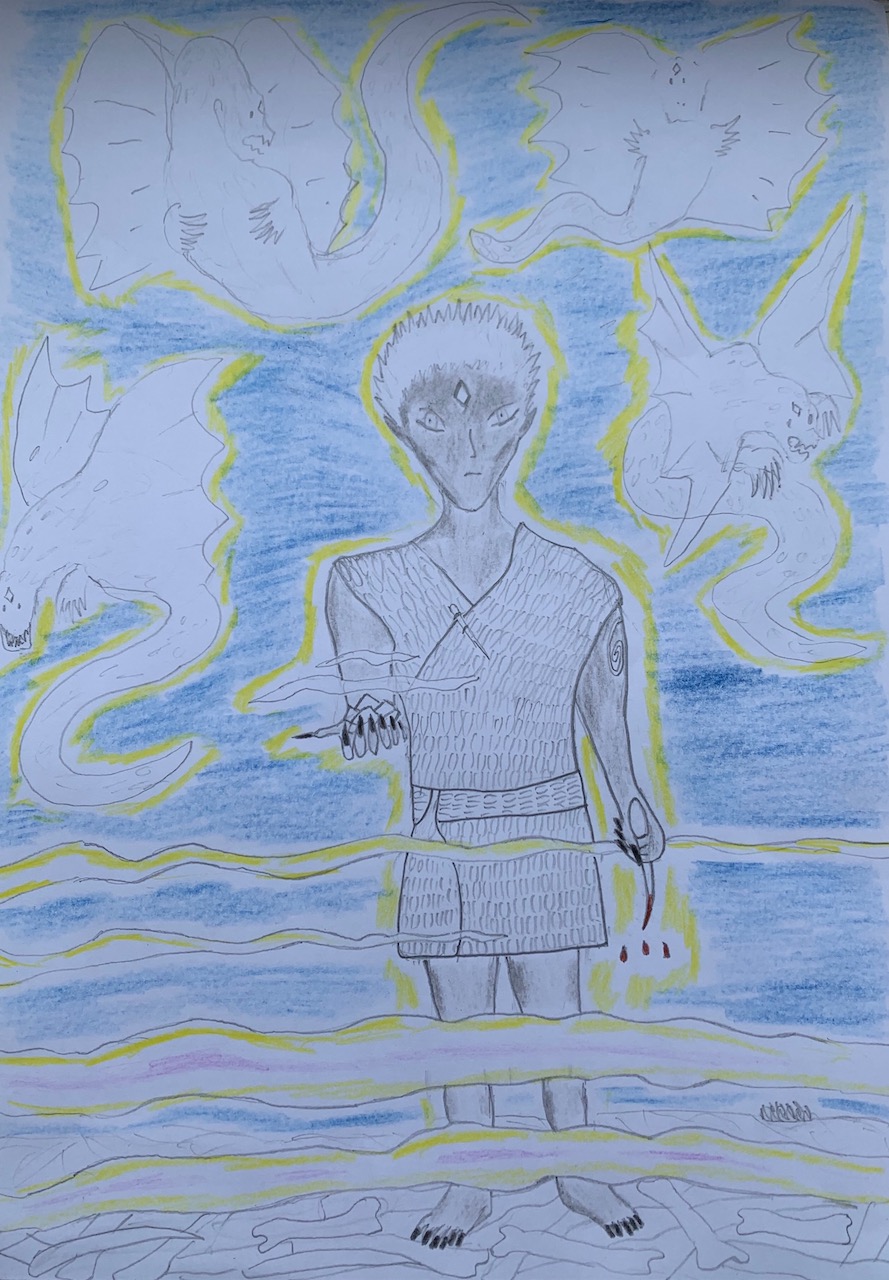
In the image beneath he is pictured as he appears to me with grey skin, white hair and a white jewel in his forehead*, wearing white serpent skins fastened with a bone pin. He has seven fingers and toes with claws.** He carries a handful of white dragon jewels in his right hand and in the left a serpent’s tooth. Above him are the four winged ghost serpents with whom he forms a bond and come to serve him as his messengers – Tero, Goro, Fero and Kilya.

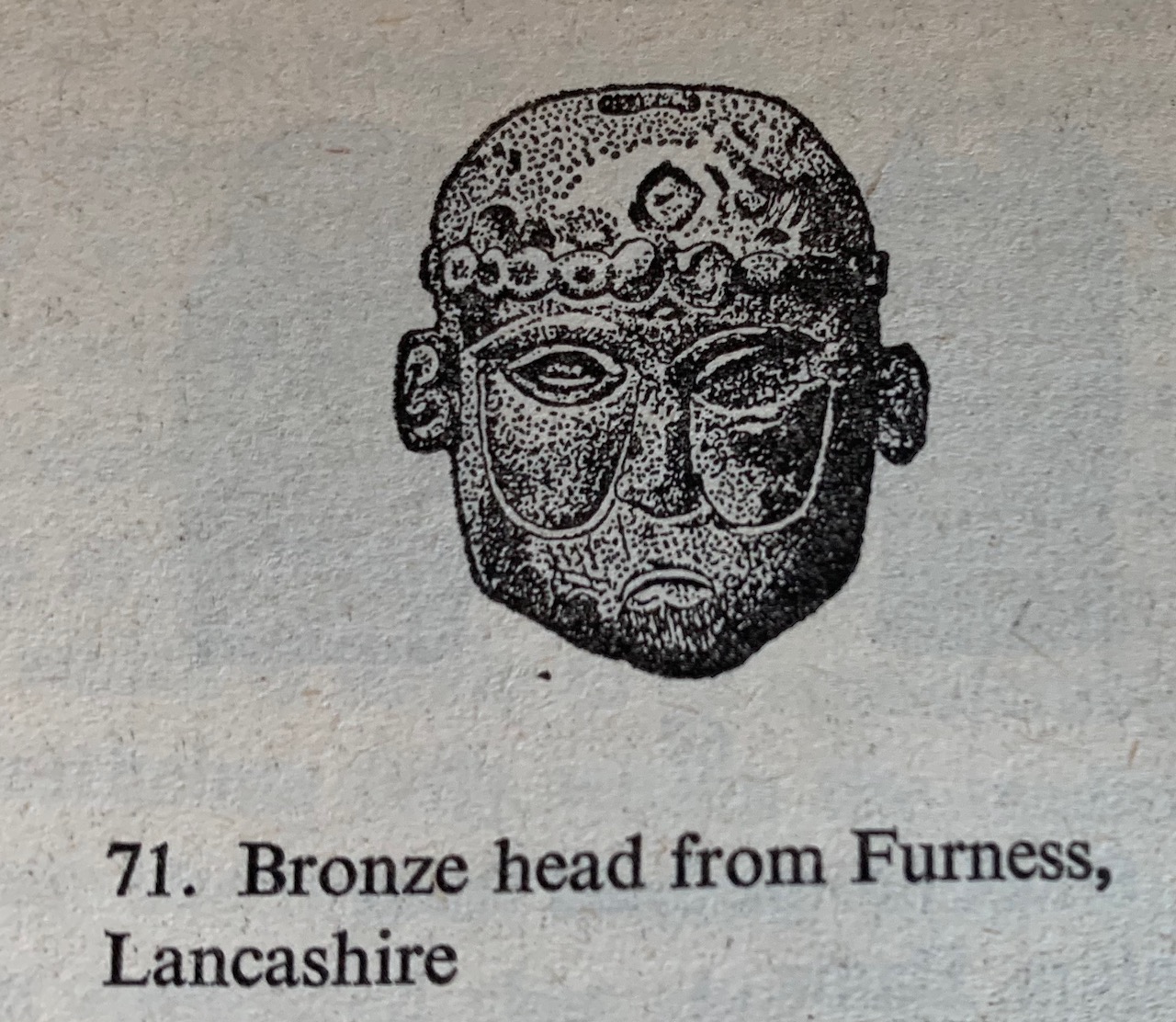
*I had thought this was an appearance unique to me until by coincidence I was re-reading Pagan Celtic Britain by Anne Ross and came across an image of a bronze head with a jewel in its forehead from Furness, Lancashire, not far from me!

**This is not unknown in Celtic mythology. In The Tain Cu Chullain is described thus – ‘Each foot had seven toes and each hand seven fingers, the nails with the grip of a hawk’s claw or a gryphon’s clench.’ Cu Chullain’s former name was Setanta and he might have been known in northern Britain as Setantios, a possible deity of the Setantii tribe here in Lancashire. 

You can support my work in return for exclusive excerpts from In the Deep HERE.

Afagddu’s Declamation

Until death it shall be obscure –
Afagddu’s declamation
The Hostile Confederacy

I am bedraggled tonight, unwelcome,
the one taught to hang his head
in his mother’s court:

Utter Darkness, the Dark Son,
the Ugly One she wishes
utterly forgotten.

I carry no shield, spear, or sword.
The brushing of damp fur
on my thighs

unnerves the courtly women.
My hair hangs like ivies over
the face of a bridge,

disappears like rain into a dark adit.
They compare me to Sanddef
the angelic.

Wings tarred to my back, I am
the sea-bird abandoned
in the oil-slick.

I drag myself in with my shadow,
carping words in metres
they can’t name.

The slow swooshing of my feet
reminds them of wetsuits.
From my feathers

sadness drips like tears of oily rain.
When I shake myself off
like a wet dog

they flinch away from the globules.
Looking into my green eye
they are beholden.

With my reptilian beak I speak
of swallowing sorrow
like stones,

plummeting down to the deep
in search of lands
unpoisoned

by my mother’s toxic cauldron.
From the darkest places
I won my awen.

I cleared the blowholes of whales,
untangled sea turtles
from gillnets.

On islands of bottles, pill packets,
polystyrene, prosthetic limbs,
I laid out the dead.

I learnt to divine from the plastics
in the entrails of copepods,
euphausiids,

mussels, mackerel, jellyfish,
sea gulls who rattled
in flight.

From bottle caps and cotton bud sticks,
pieces of red, green, blue, yellow
Lego bricks,

an alphabet of magnetic letters
stuck to a sunken fridge
I read the future.

Of course they were upside down,
back to front, in another
language.

I was forced to turn myself inside out
like a rabbit unskinning
to decipher it.

I’m still not sure whose future
I brought back in
my pockets.

I empty them out and letters writhe
like sea worms spelling
an inky fate

to the chant of plastic-eating bacteria:
Ideonella sakaiensi I gathered
from the deep.

The courtiers draw back their chairs,
weapons aglinting,
curse me.

I am but the messenger – the angelus.
Nevertheless they take aim.
A terrible poetry

of microbeads spills from my belly
as I fly up like a fury
to declaim…

Cormorant_(Phalacrocorax_carbo)_(17)