Spirits of the Woodland

Introduction

For thousands of years, humans have lived in or alongside woodlands. Throughout most of our history we have been dependent on them for food, materials to make dwellings, trackways, vehicles and weapons, and for medicines. 

Woodlands, one of most diverse terrestrial habitats, are teeming with life. Thus, they have long been seen as alive, inspirited and filled with spirits.

In this article, I will provide a history of the woodlands of Britain and our relationship with them and the spirits known from myth and folklore. I will then suggest some ways of building relationships with these beings.

A History of Britain’s Woodlands

Trees have been around for millions of years. The first trees evolved from plants 400 million years ago with the first modern tree, with solid wood, leaves and roots, being Archaeopteris, growing over 30 metres tall.

The first broad-leaved trees developed 140 millions years ago and hominids appeared to start living amongst them 2.5 million years ago. 

The woodlands we know today are descendants of the trees that re-colonised Britain at the end of the last Ice Age. Oliver Rackham describes these early woodlands, ‘before the coming of civilisation’, as ‘wildwood’. (1)

He tells of how the ‘earliest wildwoods’ were ‘formed by birch, aspen and sallow’. These were followed by pine and hazel. ‘Pine was followed by oak and alder; next by lime and elm; then by holly, ash, beech, hornbeam and maple.’

The ‘climax’ of the wildwood was the Atlantic Period 7300 – 4500 BCE. Rackham names five woodland provinces based upon their type. The Pine Province of the Eastern Scottish Highlands; the Birch Province of the Western Scottish Highlands; the Oak-Hazel Province, which covered much of Southern Scotland and Northern England, Wales, Devon and Cornwall; Hazel and Elm in South West Wales and Lime throughout most of Southern England.

Dyffryn Maentwrog, Wales, Atlantic rainforest, which is perhaps the closest we have to wildwood in Britain.

During Palaeolithic and Mesolithic times, hunter-gatherers were felling trees to make dwellings and weapons and vessels such as bowls for eating. Due to their low numbers and mobile lifestyle their influence was minimal.

In the Neolithic period and through the Bronze Age and Iron Age, people had a much bigger impact, as they began living in more permanent dwellings and clearing the woods in order to grow crops. They also started to manage the woodland. Trees, such as hazel, were coppiced for wooden rods and larger trees, such as oak, were felled to build roundhouses, wooden trackways, wooden canoes, and wood henges. This led to the destruction of the wildwood.

Rackham notes that, by the Roman period, the woodlands were much reduced, with the landscape already having taken ‘something like its medieval form’ ‘with cities, towns, villages and farmsteads’.

The woodlands may have increased a little following the departure of the Romans and the plague years and through the so-called ‘Dark Ages’ – the period during which the Anglo-Saxons colonised most of Britain.

In the Middle Ages, it is recorded in the Domesday Book (1086), that around 15 per cent of the land was woodland. As the population expanded, more woods were destroyed and replaced with cultivated land, commons, parks and forests. At this time, the term ‘forest’ referred to an area more like wood pasture, owned by a lord, and set aside for hunting, not to dense woodland.

Throughout this time, and into the post-medieval period and the eighteenth and nineteenth centuries, woodlands were managed for fuel and building materials. Felling accelerated rapidly to fuel the First and Second World Wars. 

The Forestry Commission was founded in 1919, but it was only after the Second World War, at a time it was demanded that all land be productive, that vast swathes of woodland were cut down to make way for plantations along with farmland and housing. Native trees were replaced with conifers. Rackham calls this period, between 1950 and 1975, ‘the locust years’. 

Since the impact on biodiversity of the destruction of our woodlands and their importance for carbon cycling has been recognised, the focus has shifted to recovery, with organisations such as the Woodland Trust, the Wildlife Trust, Trees for Life and many more working to restore our woods.

Spirits of the Woodlands

The hunter-gatherer peoples of Britain lived in interdependence with the woods. It’s likely, that like other indigenous cultures, they saw the trees as inspirited and made prayers and offerings before felling a tree or taking a branch. 

Such traditions would have continued into the Neolithic and are evidenced in Bronze and Iron Age Lancashire, where offerings of metalwork were made in the roots and hollows of bog oaks. The Winmarleigh Horde was found inside a large oak box fastened with oaken pins. This suggests that oak, the dominant tree in Northern England, was particularly venerated here.

Bog Oak, Little Woolden Moss, Greater Manchester

The term ‘Druid’, from the Proto-Indo-European deru ‘oak’ and weid ‘to see or know’, means ‘oak-seer’ or ‘oak knower’. The Romans reported that the Druids met and made their sacrifices in sacred groves. These were known as nemetons (from the Proto-Celtic *nemeto ‘sanctuary’ or ‘sacred space’). They may have been dedicated to Nemetona, whose name is recorded in Bath.

In ancient Ireland, people met at bile (from Proto-Celtic belyos ‘tree’) trees. The Dindshenchas (Lore of Places) lists five legendary bileanna – Eo Mugna: an oak in County Kildare, Eo Rossa: a yew in County Carlow, Bile Tortan: an ash in County Meath, Craebh Dáithí: an ash in Connacht and Craebh Uisnig: an ash in County Westmeath. In Britain we don’t have any comparable records of antiquity, but in the medieval period and continuing to today, people have met at ‘trysting’ tree such as the Major Oak in Nottinghamshire, the Trysting Pine in Norfolk and the Todwick Trysting Tree in Yorkshire.

Major Oak, 1890, Wikipedia Commons

The interconnectedness of people and trees pervades our myths. In Irish lore, the first human was born from an alder tree. Similarly, in the Norse myths, the first two humans, Ask and Embla, were created by the Gods from two pieces of driftwood – respectively from an ash tree and an elm tree. It is probable we had a myth about people being created from trees in Britain too.

The medieval Irish Ogham alphabet is formed from the names of trees. There are 20 letters, beginning beith ‘birch’, luis ‘rowan’, fearn ‘alder’, sail ‘willow’, nion ‘ash’. Inscriptions are typically found on stones. There are around 350 in Ireland and 80 in Britain, with 35 concentrated in south-west and mid-Wales and others in Aberdeen and Angus in Scotland and Devon and Cornwall in England. Each letter might be seen to represent the spirit of each tree. (2)

The medieval Welsh poem, Cad Godeu, ‘The Battle of the Trees’, possibly contains an ancient British myth about the creation of trees by the magician, Gwydion. The root of the name, Gwydion, is complex. It may come from gwybod to ‘know’ which becomes gwyddon ‘knowledgeable one’ or from gwydd ‘wood’ or ‘tree’ (which gives its name to the board game gwyddbwyll ‘wood sense’). 

In this poem, Gwydion, the knowledgeable wood-wizard, creates ‘majestic trees’ from ‘language and materials of the earth’. These trees take the forms of marching and battling warriors, great tree-people, ready for warfare. 

‘Alder at the head of the line

struck first;
Willow and Rowan
were slow joining the army.
Spiky Blackthorn
eager for slaughter…’

Not only trees, such as Medlar, Cherry, Birch, Pine, Ash, Elm, Hazel, Beech, Pear and Oak partake, but shrubs and plants such as Dogwood, Broom, Privet, Honeysuckle, Raspberry, Rose, Ivy, Golden Rod and Clover. (3)

In the Second Branch of The Mabinogi, Bran is described as a mountain and his army as ‘a forest on the sea’, again invoking a march of living tree-people.

It’s clear that the people of Britain saw trees as inspirited, as mighty spirits with agency, well into the medieval period in spite of Christian bans on worshipping trees or making offerings or practicing rituals near trees.

In Britain, we do not have a collective name for tree spirits such as the Greek dryads. However, it doesn’t mean such a concept didn’t once exist. Nor do we have do so many names for the individuals spirits of each tree (for example, meliades – ash, daphnaia – laurel, epimiledes – apple). A few are known to us today, such as the Oak Man, the Apple Tree Man and the Elder Mother.

It is possible that the Green Man carvings found in churches represent the genius loci, ‘spirit of place’, of nearby woodlands, although it is also argued that they represent the regenerative powers of nature in general.

Green Man carving, Ludlow parish church, Shropshire, Wikipedia Commons

The notion that trees are alive and communicate was once derided by science but has now, ironically, been proven by scientists. They have shown that trees speak through phytochemicals and electrical impulses both through the air and through the ‘wood-wide web’, which is formed through their invisible relationships beneath the ground with mycorrhizal fungi.

Building Relationships with Woodland Spirits

Sadly, in Britain, there are not many woodlands where the complex web of relationships between trees, mycorrhizal fungi, and a plethora of other interdependent species such as lichens, epiphytic ferns, bees, beetles, butterflies, moths and birds and larger mammals exists unspoilt by humans.

In a few places, ancient woodlands, land that has had continuous cover since 1600 CE, remain. But they are rare. Local examples include Church Wood, here in Penwortham, and Boilton Wood, at Brockholes Nature Reserve. 

It’s arguable that these would be the places where the oldest, most complex and most powerful genius loci and other woodland spirits might be found.

Unfortunately, Church Wood isn’t a happy place. In the 19th century, the aquifer beneath Castle Hill, where St Mary’s Church stands on the summit, was shattered during the building of Riversway Docklands and the holy wells dried up. The wood is restricted to the east side of Castle Hill by Penwortham By-Pass running beside it. Trees are falling due to the vibrations, along with gravestones which stand in the graveyard of the church. This place is connected with the Legend of Penwortham Fairy Funeral. A dark little tale. The spirits are unhappy and unfriendly. I once wanted to befriend them and do ritual there but they made it clear that was not wanted. They tolerate me walking down Fairy Lane and leaving offerings at the Leaning Yew, where I met Vindos, but I generally pass through quite quickly.

The Leaning Yew, Fairy Lane, Church Wood, Penwortham, increasingly leaning due to subsidence…

There are woodlands in Greencroft Valley, on the banks of Fish House Brook, just round the corner from my house. These woods were planted in the 1970s, following the building of the Greencroft and Alderfield estates. Beforehand, this land was farmland, but it would earlier have been oak woodland with some alder carr, as evidenced by former hedgerows where old oaks still stand and local place-names such as Broad Oak and Alderfield.

When I first came to Paganism and Druidry and began wanting to build a relationship with Greencroft Valley and its spirits, I started out by litter picking. I removed over 20 bags of litter from the woods. Following this, I caught my first glimpse of a pair of spirits, two ‘Sycamore Ladies’.

Since then, I have deepened my relationship over the years. Because it is such a public place, I have never done formal ritual there. However, I do my best to listen to and commune with the spirits of the woods whilst I am litter picking. I have left simple offerings, such as bird seed or hazel nuts. I have also written poetry and prayers for the beings of the wood I have befriended.

My firmest relationship is with the Trysting Oak in the centre of the valley. Whenever I pass, I greet him as an old friend. The Friends of Greencroft Valley used to meet beneath his branches and I occasionally meet others there. He is my Axis Mundi, for shamanic journeying, where all worlds meet. Other allies include the Spirit of Fish House Brook, Lady Ivy, Old Mother Elder, the Tangled Hawthorns and a faun-like being who has appeared on a couple of occasions and summoned me to be Gwyn’s apprentice.

I have yet to meet an overarching Spirit of the Woods. This might be because the woods are quite new, still finding their roots, their name, their identity.

For anyone new to working with woodland spirits I would advise connecting to the woods that are nearest to you. Spending time there walking, listening, sitting if it is not too public. Picking up litter. Learning the local history. Making offerings of prayers and poetry and biodegradable items where appropriate. Doing ritual if this is what the spirits want. Never assume that rites and offerings are wanted or that the land needs healing and it’s your job. This may be the case, but be sure to check in with the spirits first.

It is also possible to undertake a shamanic journey to the Spirit of the Woods and to the spirits of the individual trees in the woodlands. If you have the privilege of living near a quiet woodland, this can be undertaken in the wood itself. If not, you can journey from home, from your usual departure point.

My present challenge is bringing a shamanic perspective to upcoming conservation work in the woodlands in Greencroft Valley – listening to what the woods want rather than imposing a management plan from on top. 

FOOTNOTES

(1) Rackham notes that there are two different theories of the wildwood. The first, the best known and most traditional, is ‘close-set trees… from coast to coast and far into the mountains. A proverbial squirrel could have leapt from Land’s End to Ullapool without setting paw to the ground’. Rackham calls this the ‘Tansley’ model, as it was put forward by Sir Arthur Tansley in The British Islands and their Vegetation in 1939. The second, more recent theory, is that at least some of landscape more resembled wood pasture, ‘with substantial tracts of grassland as well as woods, maintained by browsing multitudes of deer and wild oxen’. He calls this the ‘Vera model, after Francis Vera in Grazing Ecology and Forest History in 2000.’
(2) Meanings were not solely related to trees. For example, uath meant not only ‘whitethorn’ but ‘horror’ and ‘fear’.
(3) The poet, Robert Graves, believed that ‘the Battle of the Trees’ encoded knowledge of the Ogham. In The White Goddess (1948), he created a ‘Celtic Tree alphabet’ from 13 of the Ogham letters and linked each to a month in the lunar cycle. This has been taken up by many modern Pagan groups and slightly annoyingly leads to many of our other trees and shrubs being over-looked.


SOURCES

Barrowclough, D., Prehistoric Lancashire, (History Press, 2008)
Davies, S. (transl.), The Mabinogion, (Oxford University Press, 2007)
Haycock, M. (transl), Legendary Poems from the Book of Taliesin, (CMCS, 2007)
Rackham, O., Woodlands, (William Collins, 2015)
Rackham, O., Trees and Woodland in the British Landscape, (W & N, 2020)
Simard, S., Finding the Mother Tree, (Penguin, 2021)
Wohlleben, P., The Hidden Life of Trees, (William Collins, 2017)

Black Poplars at the Source

Beside the source of the brook in Greencroft Valley stand two black poplars. There aren’t any known British myths about black poplars but, in Greek myth, they are associated with Hades (the Underworld) and death. 
In Homer’s Odyssey, poplars, described in different translations as ‘tall’ and ‘dusky’, so likely black, with willow, form Persephone’s Grove. Springs, throughout world myth, are seen as entrances to the Underworld.

In another story from ancient Greece, Phaethon, son of the sun God, Helios, drives his father’s chariot too close to the sun. His blazing end brings deep grief to his sisters, who are transformed into black poplar trees. The amber sap is said to be their tears. Thus its associations with death and sorrow. 

In more recent folklore the red male catkins are referred to as ‘Devil’s Fingers.’

This leads me to believe that there might have once been parallel British myths about black poplar, connecting it with springs at the entrance to Annwn and with the groves of Annwn’s Queen. Perhaps there was once a story in which the red male catkins were the bloody fingers of Annwn’s King?

I will admit that I’m not sure if these trees are true black poplars (Populus nigra) or hybrids because black poplars are rare. Plus, I’m not referring to the true source of Fish House Brook but to the outflow pipe that the culverted brook emerges from. The original source would have lain further south, somewhere on Penwortham Moss, which has been drained and replaced by housing. The brook is culverted under the gardens on the other side of my street, Bank Parade, also giving its name to Burnside Way. I feel this relates to my founding of the Sanctuary of Vindos / Gwyn ap Nudd, a King of Annwn, very near to the ‘black poplars’ at the ‘source’.

In a shamanic journey I visited the poplars for advice on descending to the ancestors in preparation for some ancestral healing work. I was shown the left tree represented my mother line and the right my father line. I slid down the roots of the left into a cavern where a group of spirits were drinking from cups from the same source. I was told that on the new and full moons I must consecrate a cup of water and make an offering:

“To the Gods,
spirits and ancestors –
we all drink from the same source.”

I felt this related to keeping the source clean – something I have been trying to do as a volunteer in Greencroft Valley with the Friends group I set up (now part of Guardians of Nature).

A Mossy Holiday

A two week holiday has given me the chance to start exploring and recording the mosses and liverworts in my local area. Equipped with a x 10 hand lens and the FSC Field Guides to common species in woodlands and gardens, backed up by the British Bryological Society’s Mosses and Liverworts of Britain and Ireland a Field Guide, I have made some interesting discoveries and managed to identify more bryophytes than hoped.

I started with my garden and firstly discovered that the moss which is everywhere is Rough-stalked feather-moss (Brachythecium rutabulum) in various stages of growth. It came as no little surprise that Springy turf-moss (Rhytiadelphus squarrosus) is in my lawn. I was excited to find the unmistakable Big-shaggy-moss (Rhytiadelphus triquestrus) on a stony area. The fourth moss, growing in a damp area beneath the shed (which is not on the FSC Field Guides, but I have identified from the key in the BBS Field Guide by its capsules) is Clustered feather-moss (Rhynchostegium confertum).

In Greencroft Valley the most abundant species of moss is Common feather-moss (Kindbergia praelonga). My guess is the acrocarpous moss covering two Elders and seen on the trunks of other trees may be Common smoothcap (Atricham undulatum).

Beside the brook I spotted Common pocket-moss (Fissidens taxifolius) alongside some fascinating plants I cannot name.

I then decided to go to Castle Hill as some of the woodland on its banks is ancient. By the steps up the hill from Well Field, past where St Mary’s Well once was, I found more Common pocket-moss, and Cypress-leaved plait-moss (Hypnum cuppreseforme) on a fallen branch.

On the wall on Church Avenue and on the old stone cross halfway down was the evocatively named Grey-cushioned grimmia (Grimmia pulvinata). It is named after a German scientist called Johann Friedrich Carl Grimm yet, to me, the name ‘grimmia’ is particularly evocative of this unmistakable mossy creature. By this point I had started getting to grips with taking photos through my hand lens.

On a stone on the side of Church Avenue was this unidentified acrocarpous moss.

In Church Wood the most abundant moss was Common feather-moss (here with capsules present).

Another unidentified moss was found on the pathway on the fallen branch of a tree.

Although I didn’t identify as many different mosses as I had hoped to in Church Wood it was a treat to find Great scented liverwort (Conocephalum conicum) on a damp bank.

So far I have been delighted to discover so many mosses within walking distance of my home in a couple of days. I am planning to continue to explore and record the bryophytes of my local area and on the Manchester Mosslands in the New Year.

Green Equinox

This equinox
seems greener than before –
warmth, steam remind me of the Atlantic rainforests in Wales
where it rains six days out of seven glaw, glaw, glaw,
whilst protests sweep the planet like clouds
but do not quell the Amazon fires.

I win my green belt in a martial art
learning to harness light like photosynthesis,
undoing my roots, learning to twist, kick, turn, leap,
kicking back against body dysmorphia.

The leaves, all green-brown, are not yet
in their autumn splendour bursting into colour
like lollipops like coloured belts I don’t yet know the meaning of.

Leaves of ash fall, touch my shoulder, give me strength.

Heaven and Light, Joyfulness, Fire and Sun, these
are the names of the first three poomsae but the fourth
is Thunder and the morning after I win that belt

I’m awoken by a mighty roar and flash of lightning
illuminating my room, the altars of my gods, a broken mirror,
my laptop and the jam jar in which I keep my pens
painted black with yellow and red stars,

the rubber the only dumb thing like the doubts
that hold me back yet the eraser of my past.

The skies are broken glass and the stream a darkness
running from eternity as a voice from a martial arts film asks:
“What do you see in front of your fist?” “My destiny.”

This slideshow requires JavaScript.

*‘Glaw, glaw, glaw’ is Welsh for ‘rain, rain, rain’.
**The martial art I am learning is Taekwondo and my instructor is Eddie Ellison.
***The lines from the martial arts film are from Streetfighter II: The Animated Movie (1994).
****All photos are my own except ‘Lightning Ground Storm‘ by Brandon Morgan on Unsplash.

Prayer: A Little Window

Following Anna Applegate’s comment on the lack of discourse on prayer in the Pagan communities I’ve decided to share a little window into my prayer life. I’ve never done this before because, rather than saying set prayers, I simply speak to the gods and spirits from the heart. These are examples of heartfelt words rather than literary masterpieces. I’d be interested to hear from others about their daily prayers.

Altars April 2018 II

Morning

I.
Spirit of this house
Spirits of Greencroft Valley
Spirits of this land on which I stand
I give thanks to you.

Lady of the Marsh
Lady of the sacred hill of Penwortham
Lady of the wells now lost
I give thanks to you.

Belisama, Goddess of the Ribble, flowing
from Gavel Gap through Settle, Clitheroe, Ribchester
bringing your gift of sacred waters
I give thanks to you.

Nodens and the Weather Shapers
cloud-makers, wind-bringers
mist, fog, and rain-bearers
I give thanks to you.

Gwyn ap Nudd
first amongst my gods my forever patron
who leads the dead and living to Annwn
I give thanks to you.

II.

Gwyn ap Nudd,
Lord of Annwn,
Guide of Souls,
Light of the Mist,

God who dwells
in the Otherworld yet
close as my heartbeat
close as my breath*

grant me guidance
from Annwn’s dark heart

and inspiration
from Annwn’s deep depths.

As I walk each step
in service to you.

(Followed by a recital of the Annuvian Awen and a meditation, journey, or divination).

Evening

Gwyn ap Nudd
Gatherer of Souls
Walker Between Worlds

God who guides the dead
God who walks the brink of madness
God who contains the fury
of the spirits of Annwn

I come to you in awe and reverence
I come to you in love and service.

Let us share our journeys…

(Followed by communion with Gwyn)

Bedtime

Nodens Lord of Dreams
God of that deep and absurd world
that I vow to remember the next morning
before it slips from my mind with
the waters of forgetting

I give thanks for the joy of sleeping
I give thanks for the joy of dreaming

and these were last night’s dreams…

Nodens Lord of Dreams
guide me in this night of deep dreaming.

*Phrase borrowed from Greg Hill.

Apples

For Epona

The blood moon:
an apple in a goddess’ eye
drops and I think of the windfall
crisp autumn mornings when we released
the horses slipping from their halters
twisting away in leaps and bucks
with piquant glint-eyed excitement
to the trees where they’d drop their heads
whuffle up the crispy moons of green and red.

Some days before we turned them out
we whispered to them “apples”
and they knew exactly what we meant…

The blood moon has passed.
The horses are staying out late this year.
Yet the sun has gone down on my stable-yard:
baling freshly-cut hay, stacking barns
with hard-shouldered labour,
stuffing stretching nets
for hungry mouths.

As I cut the meadow and gather orchard fruits
I reminisce about the rural life that didn’t last.

When the horses are tied behind bar and bolt
tugging at hay with meadow-sweet muzzles
I will feed them apple-moons
from my open palm.

*This poem was written after watching September’s lunar eclipse from Greencroft Valley, where we planted apple trees two years ago, and is based on my experience of working with horses. I read it for Epona at a ritual in Glasgow led by Potia at the beginning of October.

Of Ducklings, Ganesh and Woodland Fires

Thursday the 9th of July was a strange and crazy day. My disastrous morning began with buying blu-tac to put up signs for a conference at work: signs I realised on arrival I hadn’t printed off. It went downhill from there. After managing to print the signs double-sided and procrastinating whether to leave at the agreed time of 9.45am after doing such a botched job, I fled to the Lancashire Archives.

On arrival I realised I had spent the £5 I put in my purse for a photography pass on blu-tac. Apologising and rushing to the cash machine, my head was in such a spin I entered the wrong pin code thrice and had to go to my bank to get a new one and ask for the money in person.

That done, I had a reasonable amount of success in photographing the 1811 Enclosure Act for Fulwood Forest and accompanying map and acquiring Ronald Cunliffe Shaw’s massive tome The Royal Forest of Lancaster from the basement of the Harris Library. With the huge book under my arm, feeling slightly nervous about dropping or damaging it, I headed home.

The Forest of Lancashire by Ronald Cunliffe Shawe

The Forest of Lancashire by Ronald Cunliffe Shawe

Walking down Riverside beside the Ribble, crossing a street, I caught the silvery glint of a pair of glasses. Stopping to pick them up and wondering what to do with them, I heard a shout from behind. It was a postman, who told me the glasses were his and he had lost them because he had been trying to catch a duckling and put it back over the river wall.

Assuming said duckling had been caught and put back I walked on, only moments later, to see her; striped tawny and brown running panickedly with a flap of short wings dangerously close to the roadside. With no idea how I was going to catch her or where to put the book I began following her with the aim, at least, of making sure she wasn’t run over.

Riverside

Riverside

As the duckling pursuit approached Penwortham Bridge a couple on a tandem bike stopped to help. The woman took my book and her partner and I managed to herd the duckling into a front yard. Four bins stood on the right. When she ran behind we manoeuvred them to form a make-shift duck pen.

When we finally thought we had caught her she slipped through the cyclists’ hands yet he managed to catch her in the next garden whilst I was left explaining to the owner of the house why we had used his bins to make a duck-pen.

The cyclist handed me the duckling and the pair departed. Realising quickly that holding the frightened creature was a job that necessitated constant attention and two hands, and with no sign of the duckling’s mother in sight, I asked the local resident if he would hold her whilst I phoned for advice.

13th C statue of Ganesh, courtesy of Wikipedia

13th C statue of Ganesh, courtesy of Wikipedia

He kindly obliged, inviting me into the porch of his vibrantly decorated house where I borrowed his telephone to ring the RSPCA whilst standing in front of a statue of Ganesh. I first met Ganesh when I performed Puja to him at a Druid and Hindu gathering last year. Beforehand I had been stressed as I’d been told at the last minute I had to drastically cut down a talk I’d spent some time preparing and rehearsing. After the Puja, I felt calm and my contribution went well.

Whilst navigating the phone system of the RSPCA was an absolute nightmare, Ganesh provided a sense of reassurance. Eventually I got put through to a human operator by pressing the line for ‘tangled and trapped animals’. She told me to remain beside the river and look out for the mother for a couple of hours and if I didn’t see her to call them back.

Realising I couldn’t hold the duckling and use my phone I called my friend, Nick, who was luckily in town and said he would meet me. Leaving my book at the Broadgate resident’s house, I walked up river and noticed a small family of ducks. However, the mother showed no sign of having lost one of her flock.

When I met Nick he told me he had phoned his friend, Lee, an animal rescue volunteer. She arrived within minutes in her van with a bird carrier. When I mentioned the family Lee said as it wasn’t certain the duckling belonged to them it was safer for her to take her home. Farewells were made to the duckling who ran swiftly into the carrier then, clearly exhausted, settled down.

After a catch-up with Nick, Lee departed. Reassured the duckling was safe, I picked up the book and thanked the gentleman. Thinking back, I couldn’t help pondering how if I hadn’t been delayed at the archives I would have been home a couple of hours ago reading my book and wouldn’t have seen and rescued the duckling at all.

However this strange chain of events had not reached its end. Close to home I found my local valley filled with smoke. Although I assumed it must be from someone’s bonfire I checked the woodland and was glad I did as someone had built and abandoned a large fire which, with the wind, looked perilously close to the withered cow parsley and other dry vegetation.

I rushed home, dropped off the book and picked up two buckets and a jug to fill them from Fish House Brook. After ten trips the fire was out. I was left exhausted and shaken by the realisation if it hadn’t been for my delay at the archives and the duckling pursuit I might have got home before the fire was lit and it might have caused considerable damage to the valley.

GCV Fire

Doused fire, Greencroft Valley

Looking back I can make no clear sense of the events. Yet what stands out is the slow inexorable pull of nature away from the white noise of forms and formalities. From the confines of the university to the archives and enclosed and mapped landscape of 1811 to the living webbed running feet of the duckling to the manual labour of filling buckets from my local stream, with a hiss, fizz and sizzle, dousing the fire in the valley I love.

A clearish lesson is I’m much better at rescuing ducklings and fire-fighting than administration and I feel more myself and grounded in these tasks and the land. And what of Ganesh? Hindu god of removing obstacles, peace and new beginnings? I hope his appearance signals a time when I can clear away my failures, renew my connection with my land and my gods and move on, even if means sacrificing some of the ambitions that led me to the position I’m currently trapped in.

Fish House Brook

Fish House BrookFish House Brook is a stream in Penwortham, which runs from behind my street, Bank Parade, through Greencroft Valley to the river Ribble. Since I started litter picking in the valley three years ago I have been clearing the brook, walking it regularly and researching its history. This article traces its course from source to mouth and provides snap shots of the ways people have related to it over the last few centuries.

~

The source of Fish House Brook and its earliest stretch have been culverted underground. Its course is indicated by the street names Bank Parade and an adjacent cul-de-sac called Burnside Way. It runs underneath the gardens on the eastern side of Bank Parade.

Bank Parade and Burnside Way, courtesy of Mario Maps

Bank Parade and Burnside Way, courtesy of Mario Maps

A few months ago Gordon at number 14 kindly invited me into his garden to see the site of its steep banking, which is now occupied by a pond.

FHB tributary's old valley BP no. 14 - CopyHe also lifted the grille to let me take a peek at the swiftly flowing underground stream.

FHB culverted tributary - CopyThe brook now emerges from a concrete pipeline behind Malt Kiln Cottage.

Fish House Brook, sourceThe following maps show Fish House Brook running from behind Malt Kiln Cottage into Greencroft Valley in the 1840’s and today.

Malt Kiln Farm and Greencroft Valley

Malt Kilm Cottage and Greencroft Valley 1840’s, courtesy of Mario Maps

Malt Kiln Farm and Greencroft Valley

Malt Kiln Cottage and Greencroft Valley now, courtesy of Mario Maps

Malt Kiln Cottage

Malt Kiln Cottage

Malt Kiln Cottage originally housed a water mill used to mill grain for beer. A picture of the pool behind the mill leat can be found on the Tithe Map (1838). Elizabeth Basquill provides a detailed account of how the malsters in residence used water from the stream and adjacent well to soak barley in a malster’s trough before it was dried and delivered by horse and cart round the corner to the Black Bull pub (2).

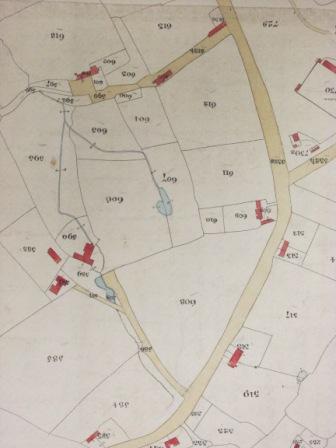
Malt Kiln Cottage, Tithe Map, 1838

Malt Kiln Cottage, Tithe Map, 1838

During this period Fish House Brook must have been much larger and more powerful to turn a water wheel. Its diminishment shows the effect of building 300 houses and their accompanying pipelines for clean water, drainage and sewage during the Central New Towns Project in the 1980’s.

Greencroft Valley

Greencroft Valley

Greencroft Valley is the largest surviving green space between the new estates. The old field lines remain intact, indicated by rows of trees. The wooded areas provide living space and nesting places for hedgehogs, squirrels and birds including magpies, wrens, a variety of tits, nut hatches and a woodpecker.

Greencroft Valley

Greencroft Valley playing field

The brook has had its share of pollution problems, mainly from grey water out of faulty washing machines. Since reporting this, it has been less frequent. Frog spawn and frogs have been seen, and a few smaller insects. However, there is no sign of any fish. This is disappointing as the 1840’s map shows a fish pond, which according to the Tithe Map was in Fish Pan Field, suggesting local people used to pan in the brook for fish.

Fish Pan Field

Fish Pond and Greencroft Valley 1840, courtesy of Mario Maps

Fish Pan Field

Greencroft Valley now, courtesy of Mario Maps

The brook is culverted from Greencroft Valley beneath Hill Road South.

Fish House Brook, Culvert under Hill Rd SouthIt emerges close to Rosefold house and cottages.

Rose Fold Cottages

Rose Fold Cottages

According to Elizabeth Basquill the cottages and yard were part of a tannery. During the late 19th century Fish House Brook was used to wash hides. ‘The hides were soaked in slaked lime first, then washed, and the hair and flesh scraped off.’ This process would have caused considerable pollution to the stream. Two adjacent fish ponds, which Elizabeth believes may have existed from the medieval period were ‘later used as tan pits for washing the skins’ (3).

Rosefold

Rose Fold 1840, Courtesy of Mario Maps

Rosefold

Rose Fold now, courtesy of Mario Maps

The first stretch of the brook, heading northeast, cannot be followed behind the houses. Where it makes a rightangle and heads northwest, a footpath runs alongside it. This follows the line of a much older route that led from Middleforth Green to St Mary’s Well (4).

Fish House BrookIt then bends right and passes through Campbell’s Park Homes following its old course round the back of the mobile houses.

Fish House Brook, Campbell's Park Homes

Fish House Brook, Campbell’s Park Homes

Campbells Park Homes, Meadows

Fish House Brook 1840, courtesy of Mario Maps

Campbell's Park Homes, Meadows

Fish House Brook, the Meadows and Campbells Park Homes now, courtesy of Mario Maps

The residential park nestles within the triangle of Penwortham Junction. The train lines pictured closed in 1965 and are now covered by beech, birch, sycamore, bramble and an array of wildflowers, forming important wildlife corridors.

Campbell's Park Homes

Campbell’s Park Homes

Another tributary enters Fish House Brook, running from the back of Far Field across the meadows. The pathway to St Mary’s Well crosses it, and there is a newer footbridge further south. At this time of year the meadows are thriving with mayflowers, buttercups, plantain, wild carrot, orange tipped and cabbage white butterflies and an abundance of bees.

The Meadows

The Meadows

The brook runs through Penwortham Allotments (unfortunately out of bounds) then is finally culverted beneath Leyland Road under Fish House Bridge.

Fish House Bridge

Fish House Bridge

Fish House Bridge

Fish House Brook culverted under Fish House Bridge

The 1840’s map shows a lodge beside Fish House Bridge. Alan Crosby says the bridge took its name from a timber building which ‘served as the quarters of the manorial river bailiff.’ This dwelling was adjacent to the fish garths, which were mainly used for catching salmon between December and August. It was the bailiff’s task to make sure the fishermen from different townships abided by the rules of the fisheries (5).

Fish House Bridge

Fish House Bridge 1840’s, courtesy of Mario Maps

Fish House Bridge

Fish House Bridge now, courtesy of Mario Maps

It is clear Fish House Brook derives its name from the Fish House, and as far as I know, no trace of an earlier name remains.

~

Each of these locations holds a story and discloses a relationship between the brook and the people who have depended on it. Since water started being piped in the 19th century, we’ve had no need to fetch it from wells or streams for drinking or bathing. Due to modern farming and production methods few of us rely on local waterways for fish, mill our own grain or tan our own skins.

This has a distancing effect. Due to continuing building work, I cannot imagine a time when the water from Fish House Brook will be safe to drink. It is uncertain whether fish will return, although some small fish were sighted by mum in nearby Penwortham Brook.

Small fish photographed by my mum in Penwortham Brook. Can you identify them?

Small fish photographed by my mum in Penwortham Brook. Can you identify them?

Whilst it’s impossible to turn back the clocks, I think there is time to get to know and understand our watercourses, and the lives and motivations of the people who have worked with and changed them. This article is an early marker stone on the journey through this process for me.

(1) Courtesy of Mario Maps
(2) Elizabeth Basquill, More Hidden Histories of Penwortham Houses (2011), p6-11, 42-44
(3) Ibid, p34-36
(4) St Mary’s Well was famous for being the cleanest source of water in the area and was attributed healing properties. Local people used to walk a mile to access their favoured water source, and it was also a site of pilgrimage.
(5) Alan Crosby, Penwortham in the Past, (1988), p48

Hey Ivy

Hey ivy,
Hey-ey-ey-ey ivy
Life force of this valley
Immortal green

Hey ivy,
Hey-ey-ey-ey ivy
Arriving from mystery
In a chorus of leaves

Hey ivy,
Hey-ey-ey-ey ivy
She gives us shelter
Beneath her palisades

Hey ivy,
Hey-ey-ey-ey ivy
She feeds us berries
When trees are bleak

Hey ivy,
Hey-ey-ey-ey ivy
We sing her praise songs
With ardent beaks

Hey Ivy