will you depart to the land of the dead to sleep in your cold castle in Annwn?
~
The seasons must turn.
My battle must commence and my death-blow must be struck.
Yet when I die you will see my ghost and when I sleep I will sleepwalk.
Many will see the wolf of my soul.
Through these days of plague I will guide the dead.
This poem is addressed to my patron god, Gwyn ap Nudd, on Calan Mai. Today Gwyn (Winter’s King) battles against Gwythyr (Summer’s King) for Creiddylad, a goddess of spring and flowers, and is destined to lose and return to sleep in the Castle of Cold Stone, in Annwn.
‘Porth-Annwfyn. Some numinous, arcane agnomen, but which to my dream cognition was livid as moonshine and did plainly signify: Gate of Elysium.’ David Jones
Porth Annwn ‘Door of the Otherworld’. Porth so easily rolling into ‘portal’. The type of door that not only forms both a barrier and an entranceway between here-and-there but transports elsewhere.
Doors are usually boundaries between rooms in a building or its inside and outside and gates serve a similar function in walls, fences, and hedges. Doors and gates that are portals transport between worlds.
Most famously, in the Brythonic tradition, in the poem ‘The Spoils of Annwn’ we find the lines ‘A rac drws porth Vffern, llugyrn lloscit’ ‘And in front of Hell’s gate lamps were burned.’ This suggests there is a gateway through which Arthur and his warriors travelled from Thisworld to the Otherworld and that lamps were burned in the course of a vigil until he and only seven of his men returned. Annwn, ‘the Deep’, was equated with Uffern ‘Inferno’ or ‘Hell’ by Christians in medieval Wales.
Although there a number of places known as ‘Hell’s Gate’ across the world I’ve never found one in Britain. Although, at liminal times, in liminal places, I have been transported to the Otherworld. I have no control over such events.
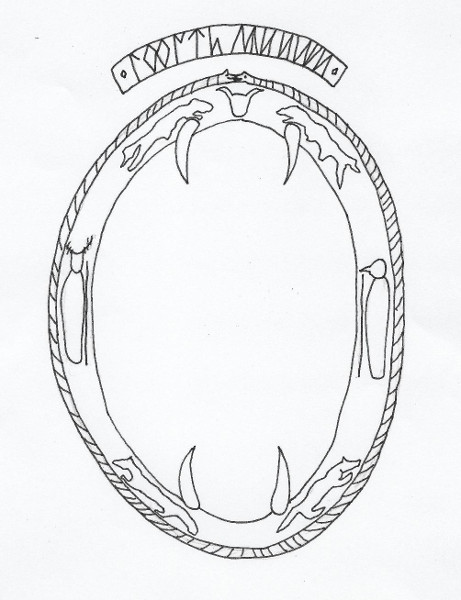
Finally, I was guided by the Witches of Pennant Gofid, who I believe were similarly devoted to Gwyn ap Nudd, my Lord of Annwn, to create my own doorway. They guided my hand in drawing it and decorating it with the head of Gwyn as bull-of-battle, shapeshifting horses and hounds, and two new guides – a bird man and antlered woman. The teeth symbolise it being the maw of Dormach, Gwyn’s Death Hound. the Jaws of Death.
When I step out of the door it is always into a misty hinterland. Occasionally I’m standing on solid ground, but often it’s marsh, and more often I’m on my winged horse treading mist with my hounds beside me. It’s said of Gwyn and Dormach that they travel ar wybir ‘on the clouds that haunt the mountaintops’ and that wybir or nuden ‘condensed floating white cloud’ ‘serves as a garment for Gwyn’.
And so we travel ar wybir, like Gwyn, until the mist clears, or someone appears to guide us out. Setting off right or left, or North, East, South, or West never works as the directions don’t function the same in Annwn (if they exist at all). I often end up in the same places, but never by the same routes. In contrast to other followers of shamanistic paths I haven’t managed to form a stable map of Annwn.
I’ve been told by numerous teachers one should always return by the same route. Some days I manage this, but other days the routes undo themselves as if Annwn is innately resistant to memory. I search instead for the mist, wait for it to come, like my god, to sweep me up, place me back at the portal.
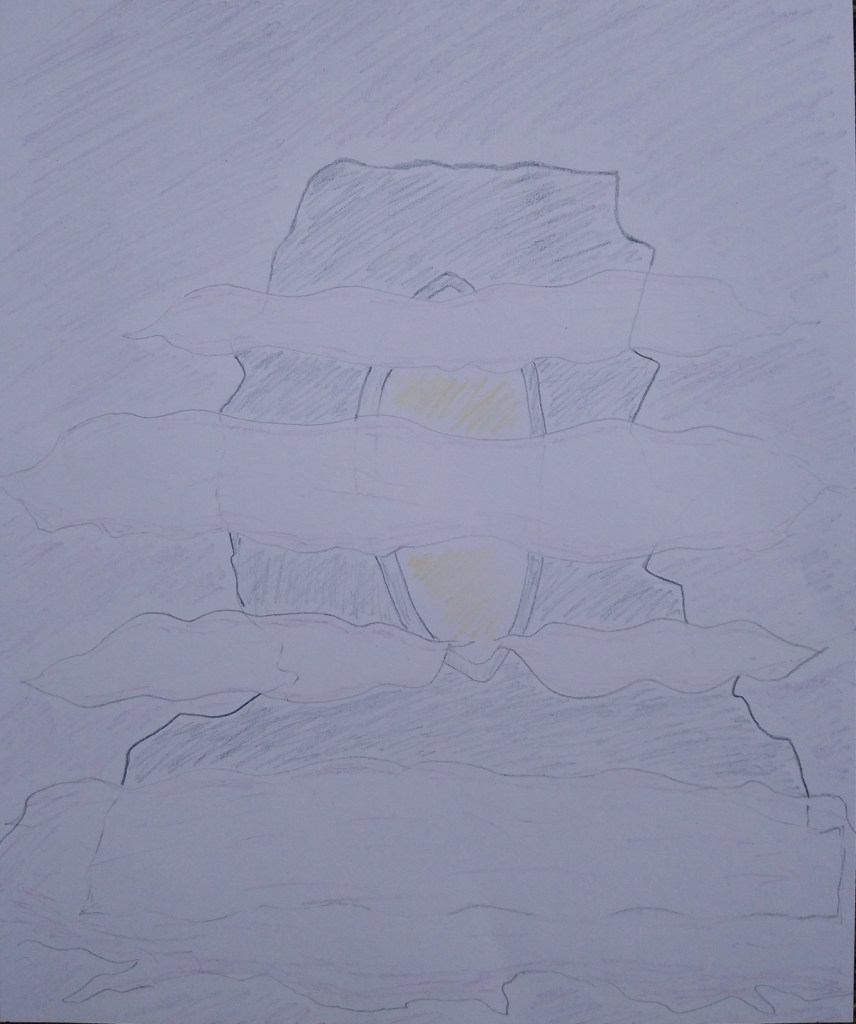
The door is always shrouded by mist and I have only just realised, after two years of constant use, that I have never seen the other side of the door. That I drew only my entryway, on my side, in my room, in Thisworld. That the origin and location of the exit, on Gwyn’s side, in the Otherworld, is a mystery.
All I know is that as I approach through the mist I have a feeling of increasing solidity. There is ground beneath my feet and the door is set within a wall. This creates the impression the door may once have been part of a fortress, shattered, fragmented, still able to float in the mist like Gwyn’s castle.
Could it be a cast-off door from the Fort of Pen Annwn rendered disposable by Arthur’s despoiling? A relic of Hell’s Gate? Or something older, or newer, but nonetheless no less mysterious? No burning of lanterns will shift the mist and again I must trust a gift of Gwyn’s that is incomprehensible.
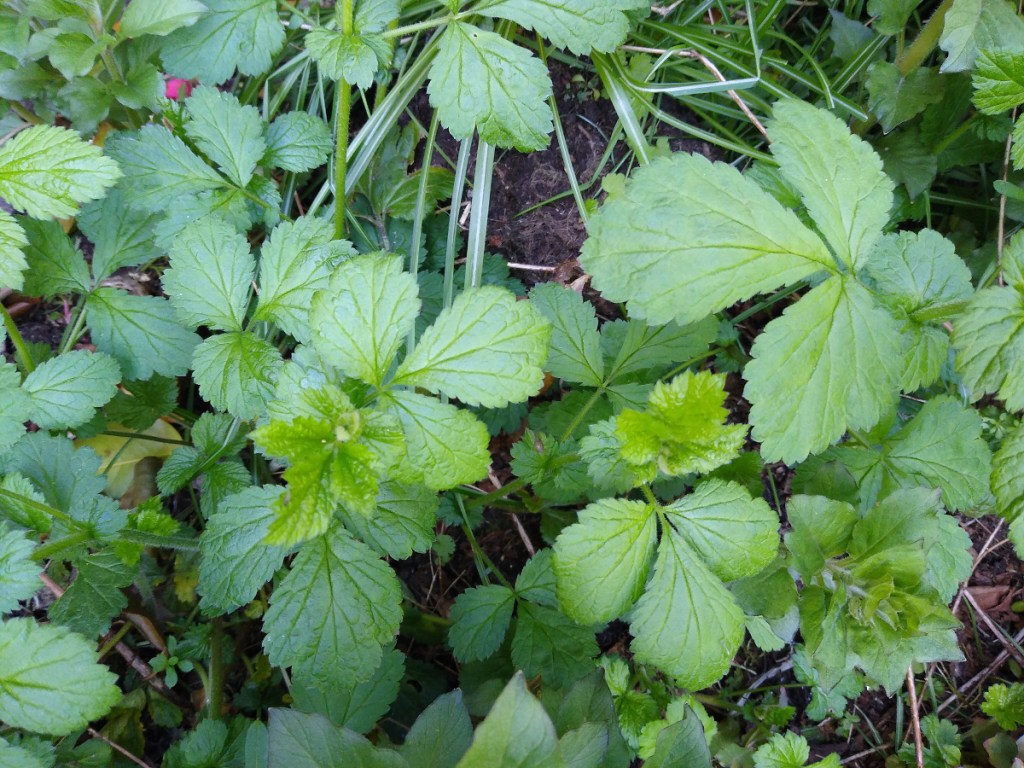
All around me in my local landscape, in my parents’ garden, a persistent three-leafed plant. Wood avens (Geum urbanum), otherwise known as colewort, Herb Bennet, and St Benedict’s Herb. My mum wants me to get rid of this common ‘weed’ but, like with the cleavers and the nettles, I give it a small patch as it provides nectar for the bees and is the food plant of the grizzled skipper caterpillar.
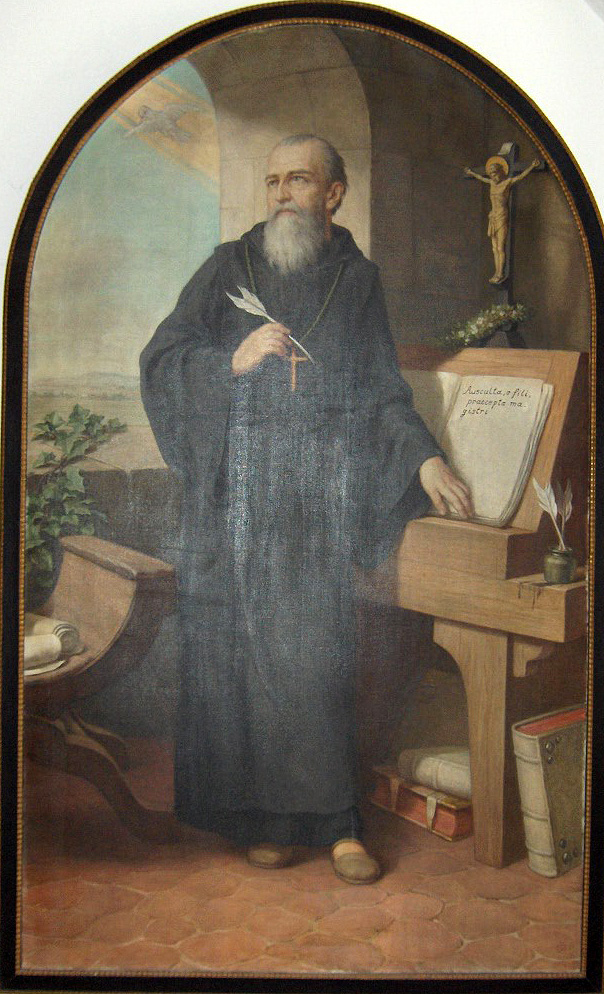
I do not know how wood avens came to be associated with Saint Benedict. Only that it was considered to drive off evil spirits and was used to treat the poisonous bites of snakes and rabid dogs. It has been suggested its three leaves and five flowers are reminiscent of the trinity and the wounds of Christ. Whatever the case, it seems like a good plant to have around in a time of pandemic. Its leaves make a tasty addition to salads and it’s possible I’d try using its roots to flavour soup.
Interestingly, with the emergence of Saint Benedict’s Herb into my life, my awareness of the influence of the Order of Saint Benedict in my locality and what feels like either past life or ancestral memory has been growing stronger.
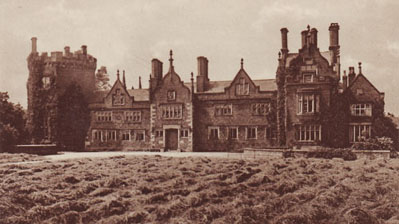
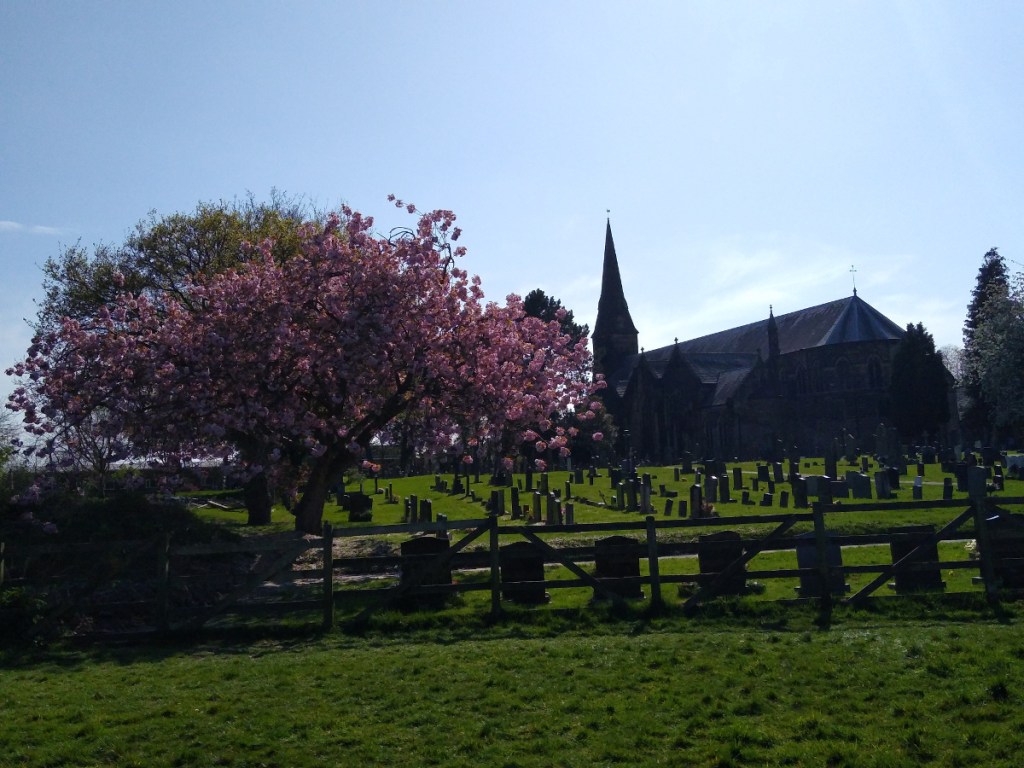
I’ve long been fascinated by the Benedictine Priory which was located next to St Mary’s Church on Castle Hill in my home town of Penwortham. It was founded in the 1140s as an obedience of Evesham Abbey, dissolved in 1539, rebuilt as a mansion, then demolished in the 1940s to make way for housing.
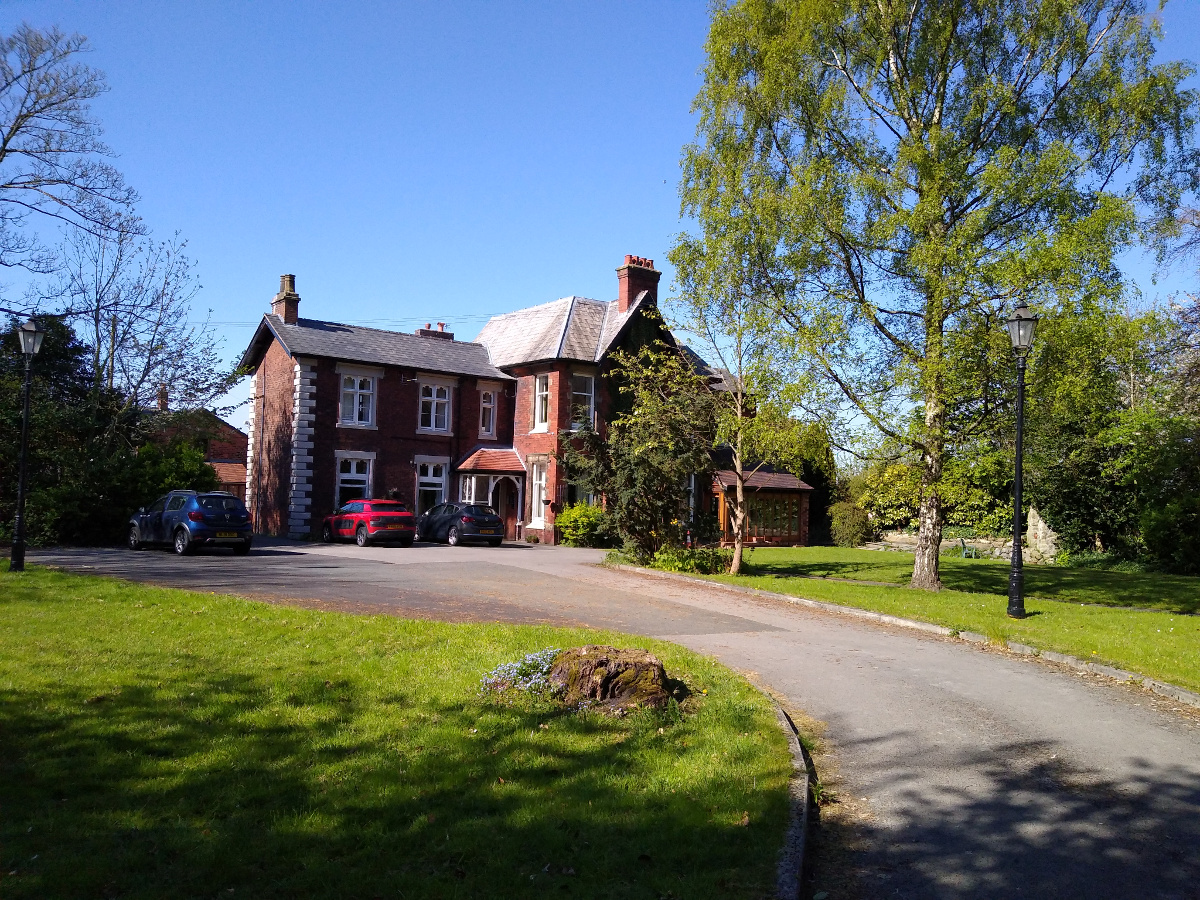
On my daily walks I’ve been repeatedly drawn to St Mary’s Church and the Benedictine Monastery in Bamber Bridge. The latter was founded by the Order at Ampleforth Abbey in 1780 and closed in 2016.
I’ve felt the Benedictines, with their motto of ora et labora ‘pray and work’, and their slow prayerful way of life organised around eight offices of prayer a day: Matins (midnight), Lauds (dawn), Prime (early morning), Terce (mid-morning), Sext (midday), None (mid-afternoon), Vespers (evening), Compline (bedtime), has something important to say to a world in lockdown due to coronavirus.
This feeling was confirmed when I learnt that the Benedictine nuns of the Abbey of Notre-Dame de Fidélité de Jouques in France had released six days of their Gregorian chants of the offices in Latin for free via Neumz for Holy Week to help people in isolation. Their singing and the sound of the bells and organ is beautiful and calming and the perfect antidote to the stresses of this turbulent time.
The re-emergence of Saint Benedict has brought back to the forefront my own monastic leanings. A couple of years back I really wanted to be a nun but could not reconcile the demands of living by a rule with my own unruliness or the renunciation of worldly pursuits with sharing awen as an awenydd. I also felt uneasy adopting a lifestyle originating from the Christian religion, which played a major role in extinguishing British pre-Christian beliefs and demonising my god, Gwyn, and his spirits.
Yet my craving for a life of prayer and work has not gone away but has grown stronger. Since the beginning of the year, when I stopped drinking alcohol and thus having drunken evenings and lie-ins and going to the pub, my life has been structured around prayer/meditation/journeywork, writing and study, physical work in the house and outdoors, and exercise including a martial art.
Since the lockdown the biggest changes have been the cancellation of my volunteer work parties with the Lancashire Wildlife Trust, my Taekwondo classes, my monthly drumming circle with the Way of the Buzzard, and the Damson Poets event, and not being able to see friends. I’ve dealt with this by replacing my practical conservation work with gardening, practicing my Taekwondo moves and patterns alone in the garden, participating in the Way of the Buzzard online drumming circles, and keeping in touch with friends and the other members of Damson Poets by email and text message.
Slowly I’ve been developing a semi-monastic routine based on my natural rhythms and my duties to Gwyn and the gods and spirits of Peneverdant rather than the rule of a Christian saint. It is helping me stay focused through these days of isolation and to build a deeper relationship with my land and my gods.
5.30am – Dawn prayer and breakfast 6.00am – Morning prayers and practice 7.00am – Writing, study, blog 10.00am – Housework/shopping/cooking/gardening 11.30am – Dinner 12 noon – Noon prayer and study 1.00pm – Housework/gardening 2.00pm – Exercise (walk, run, or cycle, Taekwondo) 4.30pm Afternoon prayer and bath 5.00pm – Tea 5.30pm – Emails and news 6.00pm – Housework and water plants 6.30pm – Evening prayer and meditation in garden 7.00pm – Study 9.30pm – Night and bedtime prayers 10.00pm – Bed
A nun in a small room. A big woman, robed in grey, not only her bulk but her presence fills the space. Every ounce of her being, of her focus, of her concentration, is directed to the page on which she slowly, painstakingly, inscribes flowing letters and illuminates the words with beautiful artworks.
How I envy her slow pace of life. The space she has, inner and outer, for this steady work. For her fulfilment in this golden now of creation and lack of cravings for whatever lies beyond those stony walls.
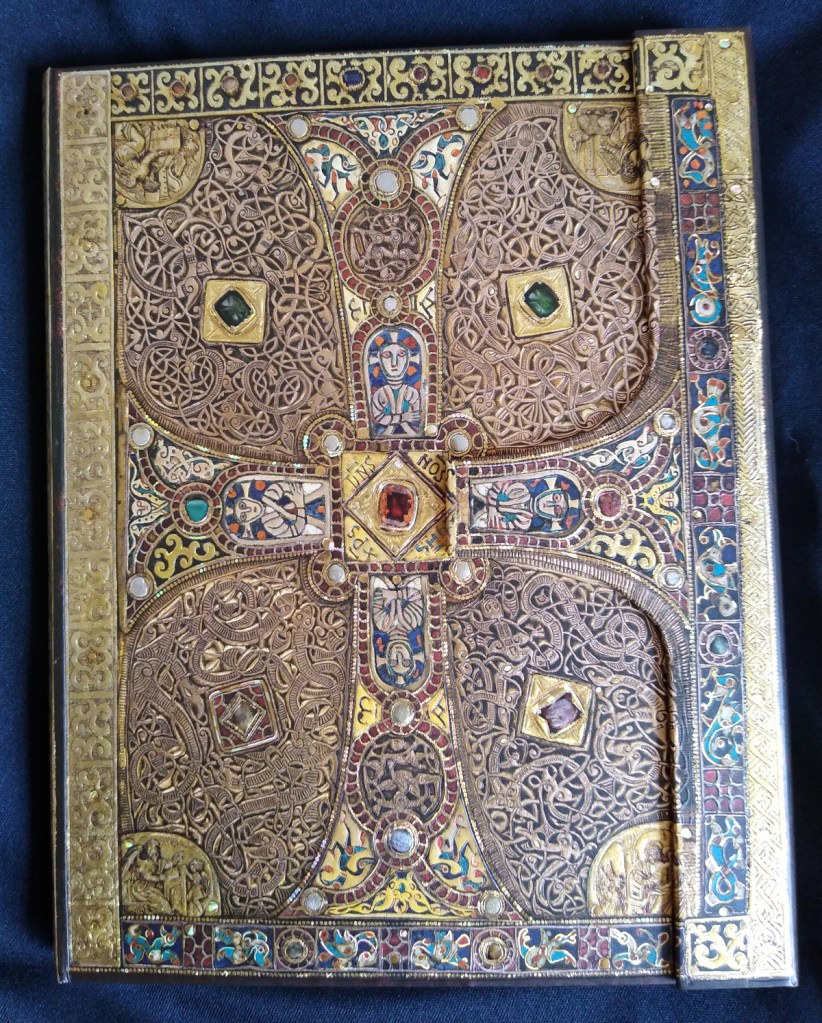
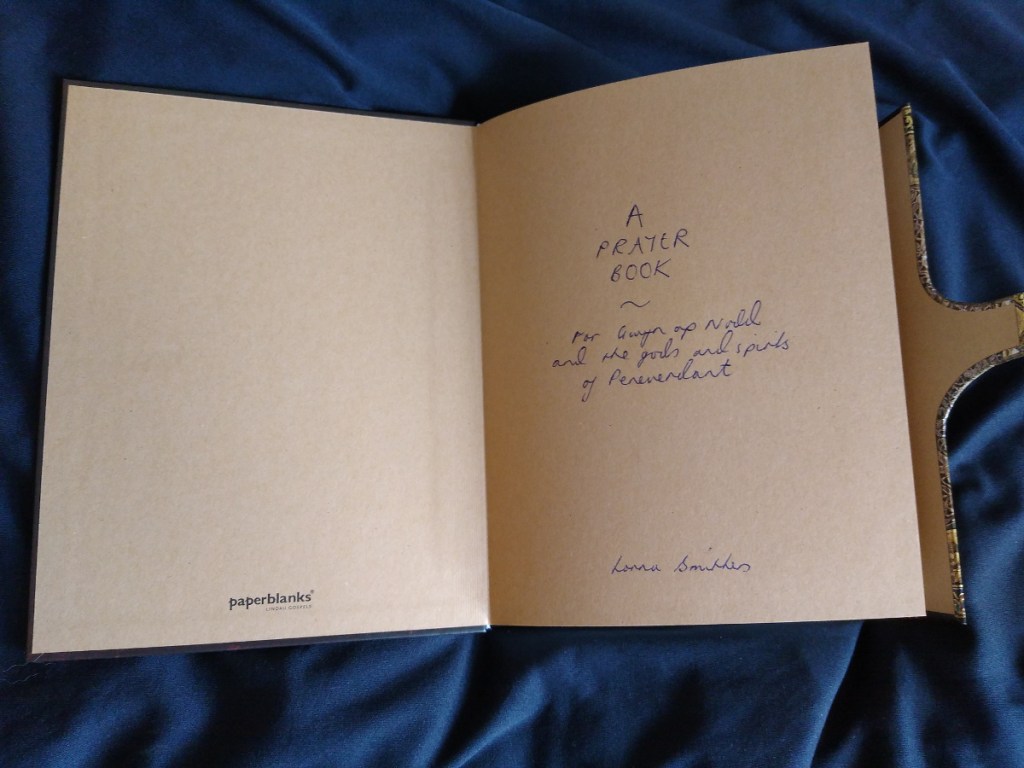
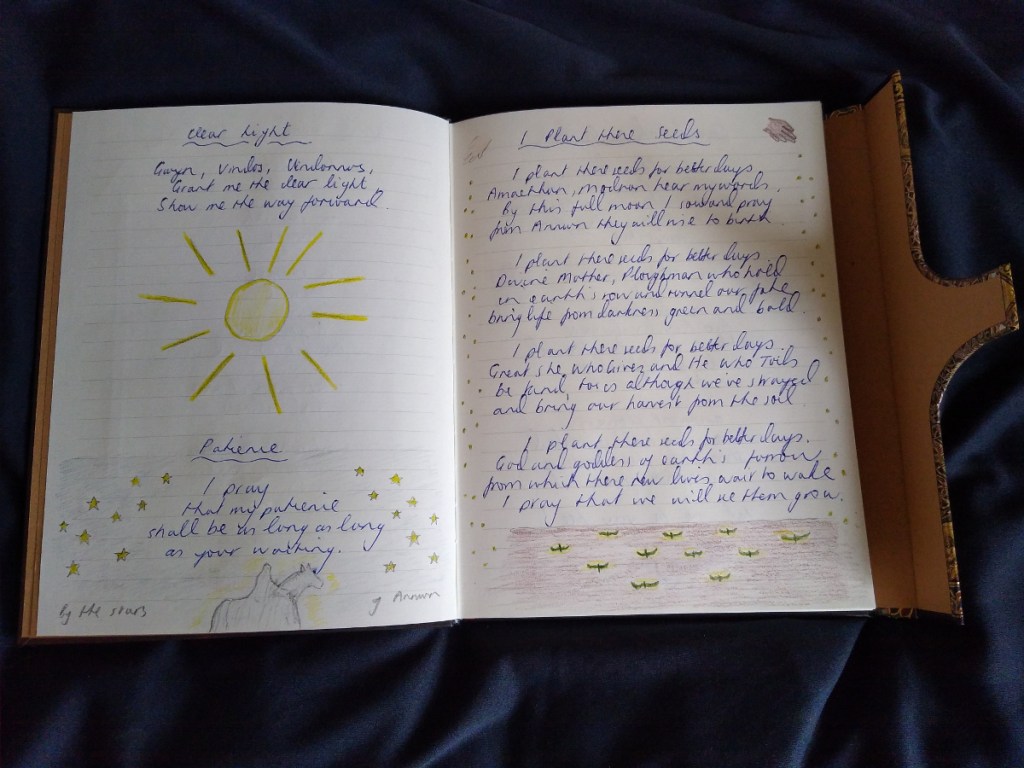
She first appeared to me a few weeks ago and I took this as a signal the time had arrived to start writing in a notebook with a cover based on the Lindau Gospels, which a friend bought for me several years back. I’d never dared write in it for fear of spoiling it as the artwork is so beautiful.
The Lindau Gospels are so named because they were once housed in the Abbey of Lindau in Germany. The lower cover, on which my notebook is based, was produced in 8th century Austria, but its style is that of insular British art. It is predominantly Christian. Around the central topaz are the monograms ‘IHS, XPS, DNS, NOS’ ‘Jesus Christ Our Lord’ and Jesus appears on each of the arms of the cross in a cruciform halo. The four evangelists appear in the plaques in the corners. Yet the spaces between the cross and within the cross are filled with swirling, shapeshifting figures, which morph from serpent to bird to fish to dog and back again, and recall pre-Christian traditions.
Illuminated manuscripts, based on Christian scripture, were produced across Western Europe from 500 to 1600 CE. The phrase derives from the use of gold or silver to illuminate the words and pictures. Many were ‘Books of Hours’ containing devotional prayers said at set times of the day.
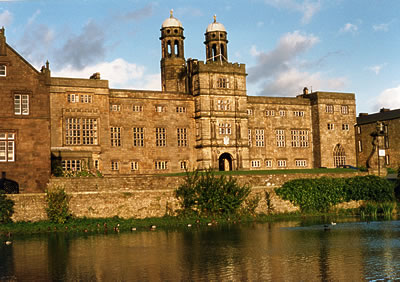
I’ve been drawn to such books before. Several years back I visited Stonyhurst College, which was founded by the Jesuits in 1593, with Preston Poets’ Society. Whilst the other poets were geeking out over Shakespeare’s First Folio I was far more fascinated by the prayer books of Mary Queen of Scots and Elizabeth of York one of which, if I recall rightly, was illuminated by lapis lazuli.
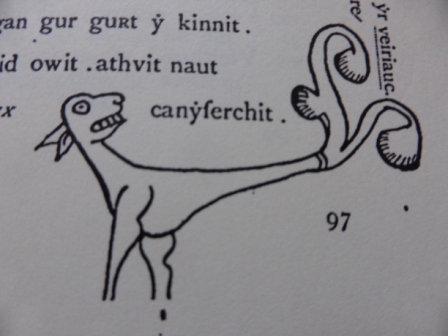
And, of course, many of the medieval Welsh manuscripts which contain the myths of my gods were illustrated by their scribes, including The Black Book of Carmarthen where we find ‘The Conversation of Gwyn ap Nudd and Gwyddno Garanhir’ with a cheeky portrait of Gwyn’s dog, Dormach.
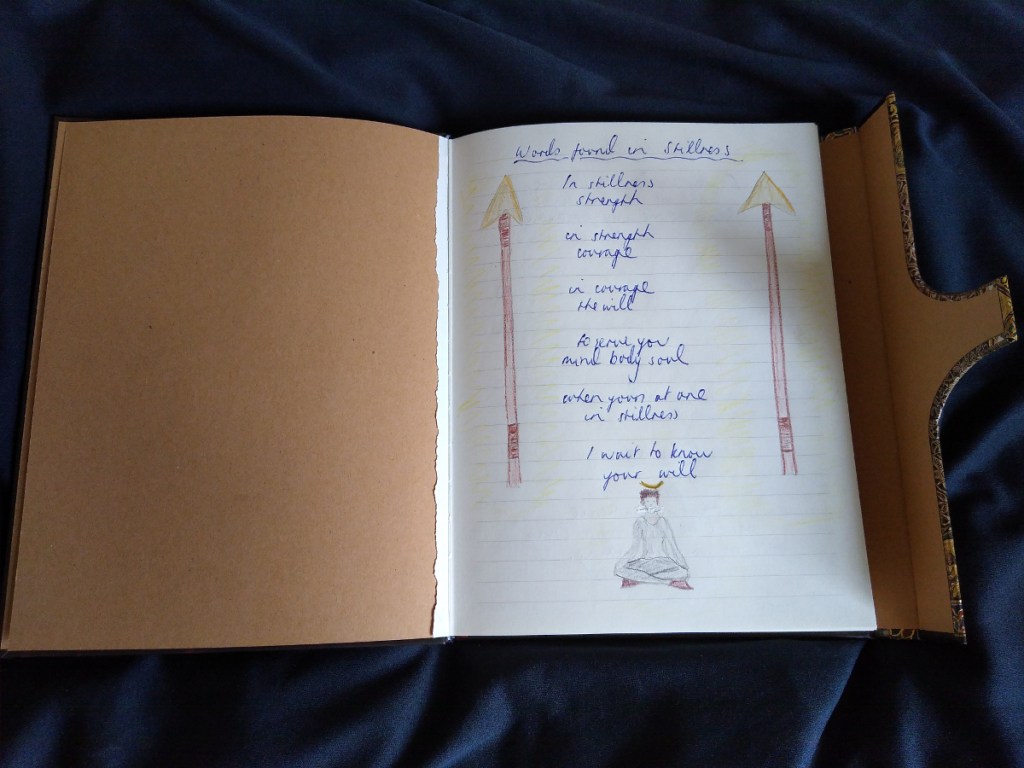
The childlike nature of the drawings in the old Welsh texts and the way the seething mass of pre-Christian imagery unsettles the golden veneer of the Lindau Gospels gave me the confidence and the feeling of rightness to open the notebook, to begin writing. To dedicate it to ‘Gwyn ap Nudd and the gods and spirits of Peneverdant’ and to begin penning within my first prayers and illustrations.
I am now using it as a space in which my re-emerging monastic leanings can combine with my relationship with the Annuvian gods. Where my prayers and pictures are not illuminated by gold but by the golden light of the Otherworld.
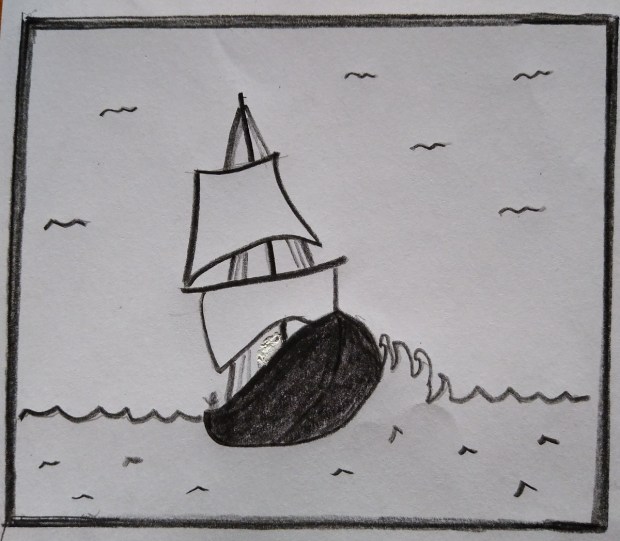
The ship is tall, leaning. Its only crew are the gulls, who tie the knots in the sails; old, old, sailor souls. On its prow stands Barinthus, the helmsman, dark-cloaked, stern, implacable.
No-one sees if his lips move beneath the shadows of his hood as he reads out the roll call: the names of Londeners, Devonians, Bristolians, Scousers, Mancunians, Lancastrians, Glaswegians, Brummies, whose accents mix in the huge make-shift camp that has grown up in the marshy hinterland between the worlds.
They’re mostly old. Veteran souls move between them, boiling tea on stoves that burn on no gas. They drink from metal cups, pull blankets around them, attempt to recall to one another their stories.
Some of them are funny – drunken exploits – other people’s knickers and roundabouts. Some are tragic – motorcycle crashes, the loss of daughters and sons, spouses who lost their memory yet lived on.
“How did we get here?” few recall that journey or what brought them.
White hounds with red markings on their ears, noses, the tips of their tails, patrol the edges of the camp. If anyone tries to leave they are there. A grin and friendly growl is always enough. The pups like to play amongst the child souls, tongues lolling, letting their bellies be rubbed. When their master calls them, not liking them to get attached, they leave whining with their tails between their legs.
“Where are we going?” few recall that journey they have made so many times before.
“The biggest shipload since the last war,” my god’s voice from where he stands invisible so as not to frighten the souls.
Their leaving seems to take forever, one by one getting up from their camp stools, boarding across a wobbly plank and taking their places in the cabins, more cabins-worth of souls than there are cabins on board?
“The number of cabins, the space of the hold, the expanses of the deck, are limitless, infinitesimal,” Gwyn informs me. Speaking ominously “no matter how many passengers the ship is never full.”
I watch with Gwyn as the camp fires go out and the ship sinks deeper and deeper into the waters.
As a gull flies down and with a practiced twist of her yellow red-spotted beak unties the mooring rope I clasp my hands, bow my head in mourning, say farewell to 980 Britons who I never knew.
As I leave, dropping a tea bag in a pot for the next souls, I see them already beginning to arrive. Some are escorted by their ancestors, others by the hounds, others by white birds. A little boy is carrying a white red-spotted hamster wrapped up in his school blazer.
approaches with a little bit of Chernobyl in its deadly stride.
A big black bell is ringing inside it.
Its face is a man’s.
There is nothing behind it.
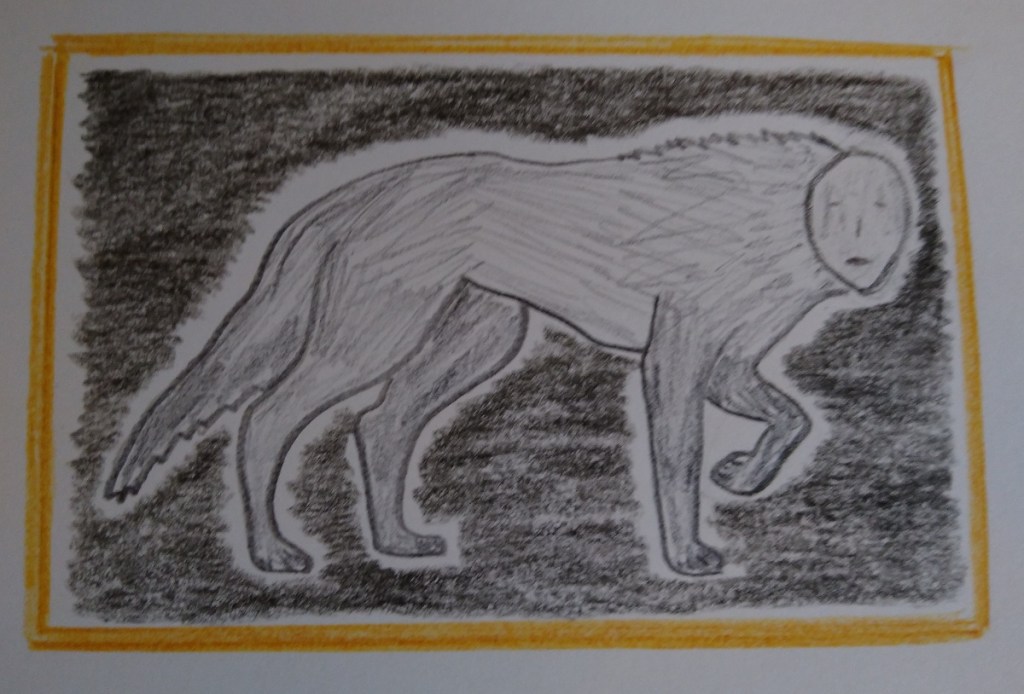
I wrote this poem following a dream of which I remember little but the vivid image of a lean menacing wolf with a man’s face and the knowing because I’d seen it, been its presence, I was going to die.
I’ve had a handful of dreams in which I’ve had this gnosis. In one I was a captured soldier awaiting execution and Gwyn prepared me for death by telling me I must go into the hazel, and the beetle, and something I can’t recall. In another I was a clawed creature clinging to a lift descending to the abyss. And in another I was and was not a dark magician, who in a magical battle against mechanical forces, was cut into a thousand pieces by whirling blades and resurrected as a vampiric woman.
Through these dreams I know I have lived many lives, died many deaths, in Thisworld and in Annwn, and perhaps in worlds beyond. That a part of me, which I call my soul, carries these memories.
When I was talking to my dad about his funeral plans I was surprised to hear that he, like me a philosophy graduate, had never thought about whether he had a soul or what would happen when he died. He might have theorised about it but had never really contemplated what would happen to him.
Such questions have been on my mind as long as I can remember. Like my dad I theorised about them, attempting to find answers through philosophy, until I met Gwyn and he taught me to journey to Annwn. Until he and his father, the dream-god Nudd/Nodens, helped me to sleep and listen to my dreams.
For the first time since the Second World War people in Britain are suddenly facing death, due to the threat of the coronavirus. This is a complete unknown for people of my mum and dad’s generation, for mine, and the next generation, who might have included my children, if I’d had them.
I understand that one of the reasons Gwyn appeared in my life and taught me to journey was to help me prepare for death. I know a small handful of others who have had similar experiences with him and different gods, and of those who have gained their own understanding without experience of deity.
In contrast to the advice I’ve seen in various places to focus only on the positives, I believe at this time, when so many of us have so much extra time, there is no better time to contemplate the lean wolf.
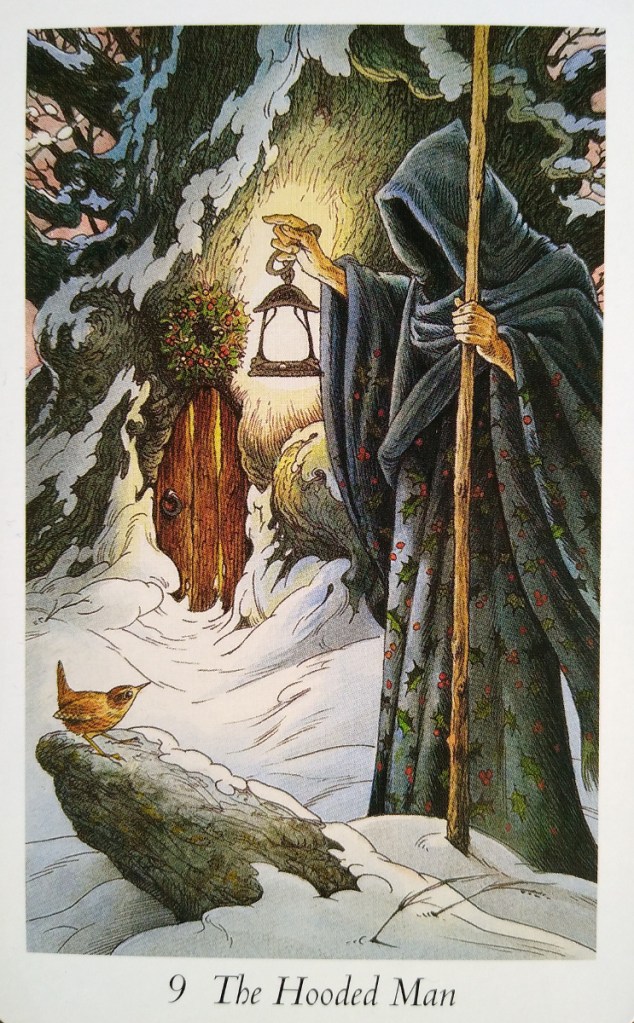
He started appearing in my tarot readings at the beginning of the year: the Hooded Man. In my reading for 2020 on New Year’s Eve in the place of ‘home’, then again and again, strangely, mysteriously, as we shifted from a stormy winter to a glorious spring and I was spending more time with people outdoors.
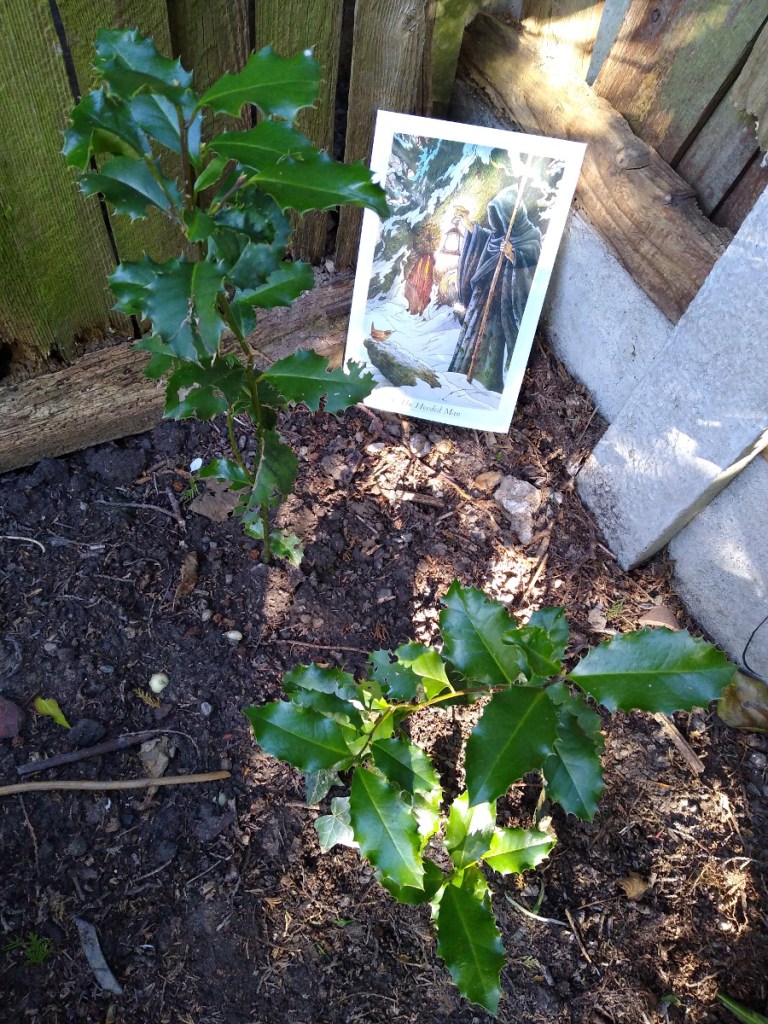
In the Wildwood Tarot the Hooded Man occupies the traditional position of the Hermit. His ‘Position on the Wheel’ is ‘the mid-winter solstice’. Dressed in a black cloak adorned with holly he stands amidst the snow with a wren at his side, a staff in one hand, a shining lantern in the other. He points towards a doorway in a great tree with a wreath upon it, offering solace from winter’s harshness.
The main meaning of this card is ‘this is the time of solitude and contemplation’. Why was I getting this card when I was busying myself with work parties five days a week and preparing for an internship at Brockholes, which involved outdoor work and engaging with large groups of volunteers?
The answer came as the arrival of coronavirus, as the lockdown, the perfect reason to respond to his call. But what did I do for the first three weeks? Spend my time watching what everyone else was doing, beating myself up for not being busy, for not having a proper job, resisting the call of the Hooded Man.
And yes, I felt it, and he spoke to me clearly. On one occasion this was through the new module on ‘Holly’ in the Tree Spirit Medicine course on the Way of the Buzzard Mystery School. The course leaders, Jason and Nicola associate holly with ‘sanctuary, resilience, and protection’. These were qualities I felt I needed to draw upon and immediately I associated them with the Hooded Man. I journeyed to holly to ask ‘how to slow down and participate in the Hooded Man’s sanctuary.
Holly said:
The berries of life are not always yours.
So what is yours?
How will you grow your berries?
What can you offer?
How will you shape your sanctuary?
I took this to mean that I couldn’t just barge into the Hooded Man’s sanctuary and assume his berries (the hard-won fruits of many years of solitude and contemplation) are mine for the taking. That I must take the time and effort to shape my own sanctuary, grow my own berries, share them with others.
What was particularly significant about this journey is that the day afterwards, after I had cut back and cleared the blackberry bushes which were taking over the bottom of my parents’ garden, I found a little holly sprig. Immediately I knew this was ‘the Hooded Man’s corner’: a place I could find sanctuary.
But still I resisted for fear that retreating would make me less of an awenydd to my community and gods. When I first set out on the awenydd path it was with the purpose of serving Gwyn and the spirits of the land through sharing poems and research on mythology and my personal journey.
Somewhere along the line, when I was involved with Dun Brython, when Greg Hill and I founded ‘Awen ac Awenydd’ I felt these responsibilities were nudging me toward community leadership. However, Dun Brython never grew due to a lack of interest in Brythonic Polytheism. Whilst the Awen ac Awenydd Facebook group generated some interesting discussions, the participants didn’t mesh enough to develop a shared practice, and the plans for a physical meet-up failed completely.
I reached the conclusion that Facebook is not a suitable platform for building meaningful relationships and left. ‘You’re not a follower but you’re not a leader,’ the words of my wise friend, who read my tarot, haunted me. What am I then? What is the role of an awenydd who neither leads nor follows?
“You must focus on your gift,” the voice of my god from within.
Reflecting on the nature of this gift I realised that it is the awen and the meaning of ‘gift’ is manifold. The awen is not only my gift, my talent, my role in the world, my destiny, but is given by the gods and something I have a responsibility to give back to others. This being gifted with and my giving of awen is of value in itself. I don’t need to be a leader or a spokesperson for my path.
This revelation came as a huge relief and has given me clarity about where I’ve made mistakes in the past. After watching a podcast with Martin Shaw on ‘Pandemic and Mythic Meanings of this Cultural Movement’ in which he posed the question ‘would this not be a good time to re-establish a relationship with our souls?’ I realised over the past few months I have neglected my soul’s journey.
When I journeyed to the Hooded Man for advice on how to focus on this he said I need to ‘clear space outer and inner’ and ‘cultivate a longing for the mysteries’ in the place of my anxieties.
What was of interest, and slightly disturbed me, was that he told me has had burning ambitions, been riddled by doubts, that he has made made mistakes, that his aura of calm is the result of centuries of inner work. That sometimes it is just a facade that covers over the conflicts he feels within.
For some reason I thought he had always been the Hooded Man at perfect peace in his self-mastery. Yet a story, or many stories, lie beneath the the hood of this man who has many faces.
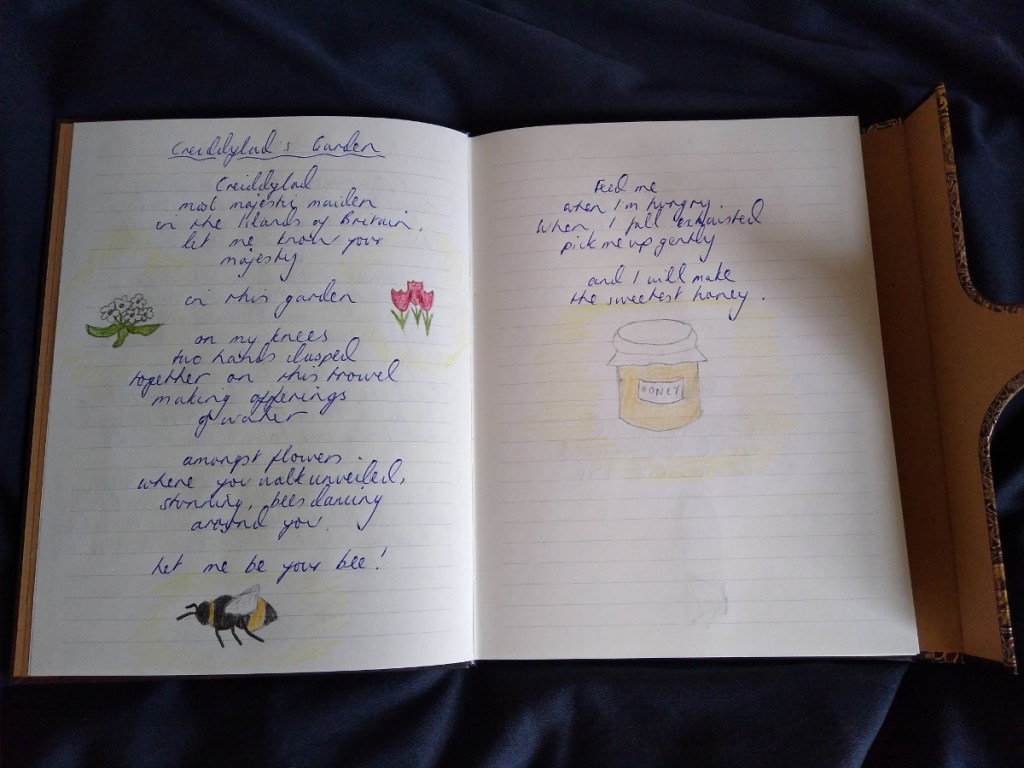
Creiddylad most majestic maiden in the Islands of Britain, let me know your majesty
in this garden
on my knees two hands clasped together on this trowel making offerings of water
amongst flowers where you walk unveiled, stunning, bees dancing around you.
Let me be your bee!
Feed me when I’m hungry. When I fall exhausted pick me up gently
and I will make the sweetest honey.
“Stay here in this garden,” my patron god, Gwyn ap Nudd, advised me a week before the lockdown. A couple of days before my conservation internship was cancelled and, like many, I was rendered jobless.
We’ve been on lockdown in the UK for over a fortnight now and how I’ve to-and-froed, some days accepting this advice and, on others, after reading the news, wishing I was doing something more important, more heroic, than shopping and cleaning for my parents, tending the garden, doing my best to find the focus to pray, meditate, spend time in devotion to my gods, and to write for my supporters.
My main battle has been against feelings of guilt and uselessness caused by my awareness of the utter contrast between my easy life, touched by the bliss of the spring sun, and the hell that the nurses and doctors are going through on the front line, risking their lives fighting for the lives of others. The risks taken by the funeral services. The chaos and stress faced by supermarket staff. Our dependence on the long hours and monotonous work of fruit and veg pickers usually imported from abroad.
I’ve thought of applying for, have actually applied for, some of these jobs (which may have necessitated moving out of my parent’s house so I do not put them at risk), but nothing has come of it.
“Stay here in this garden.” I accept the gods have their reasons when the Blasted Oak, spelling disaster, appears in a tarot reading on what will happen if I take a veg picking job.
And deep within I know if I took any of the above jobs I’d likely get physically or mentally ill. That there is something fundamentally wrong with this industrialised and militarised system that keeps comparing the ‘fight’ against this virus with the Second World War and tries to inspire a wartime ethos.
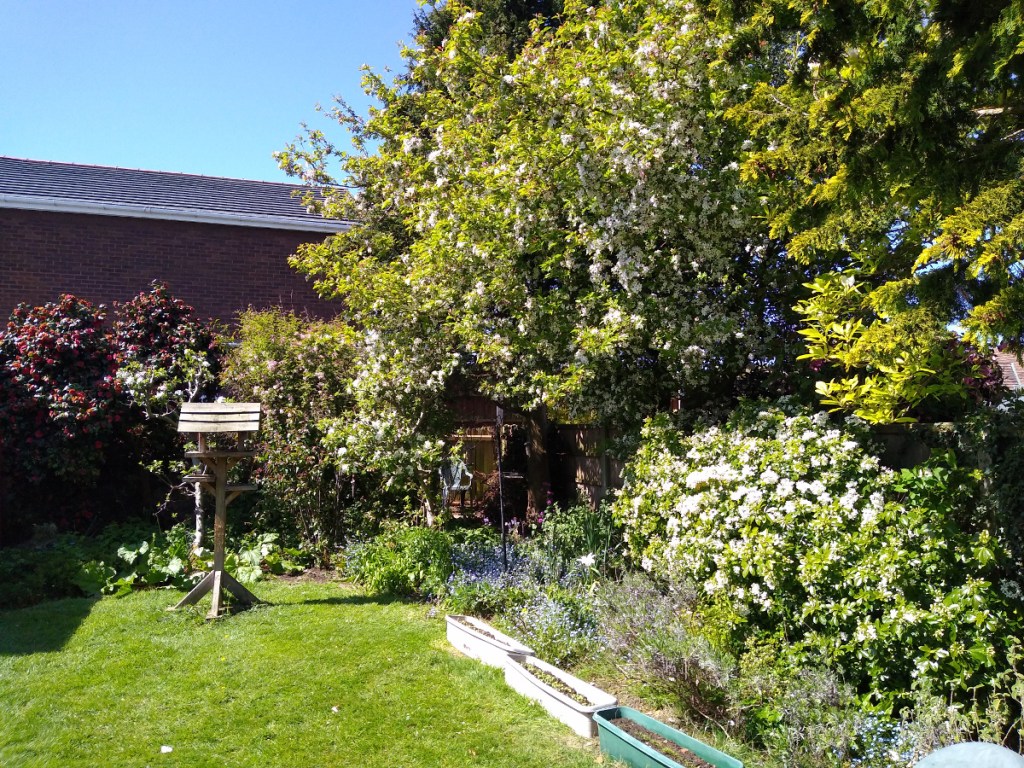
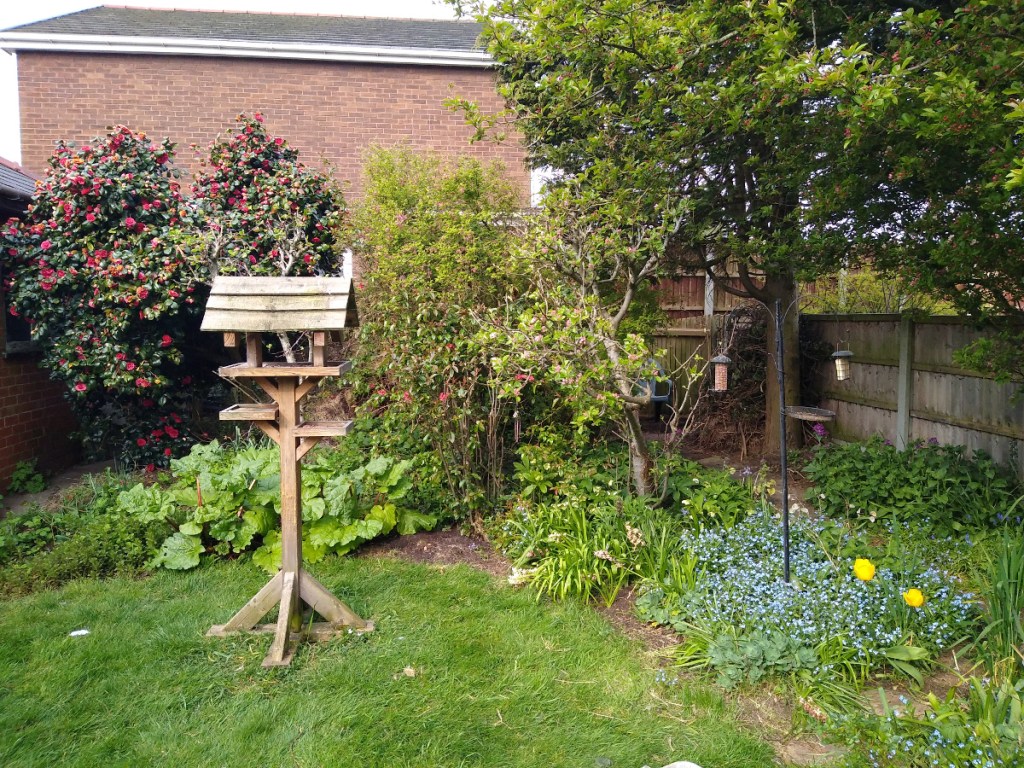
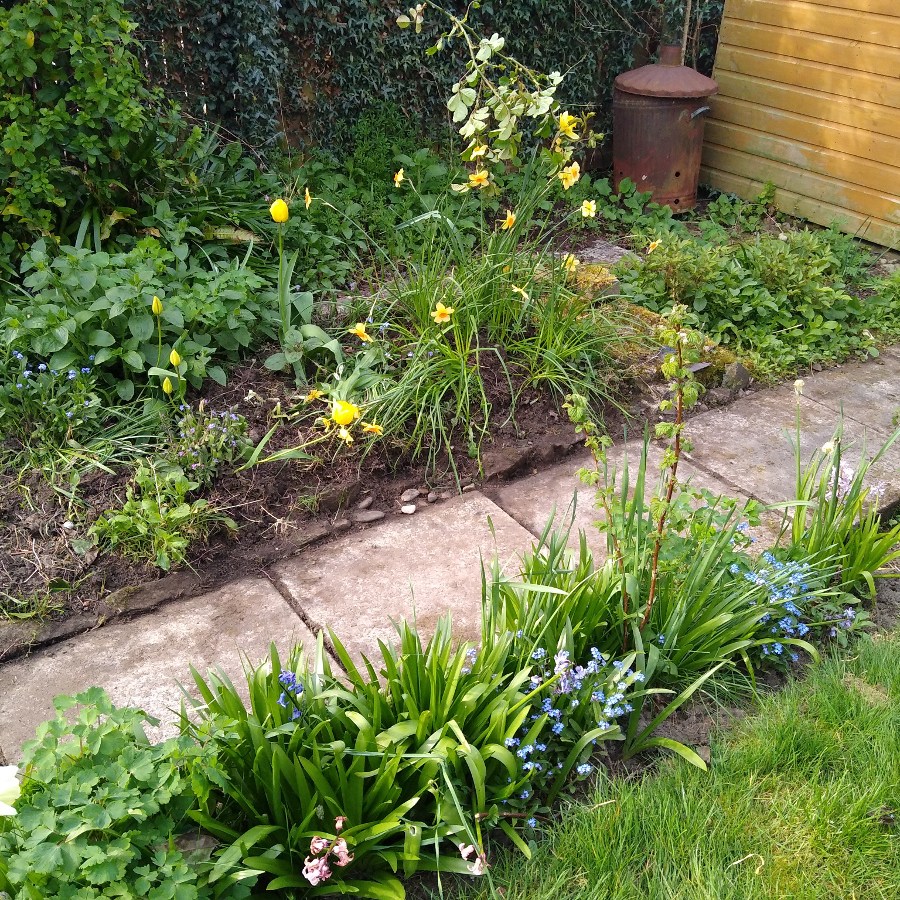
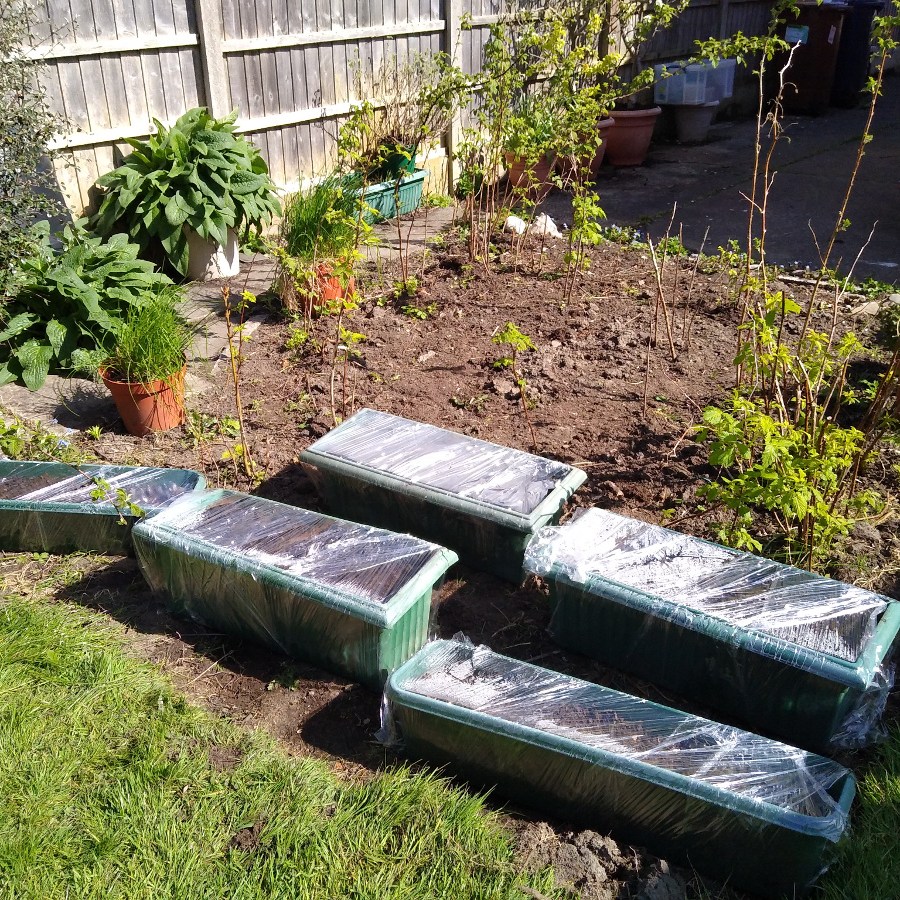
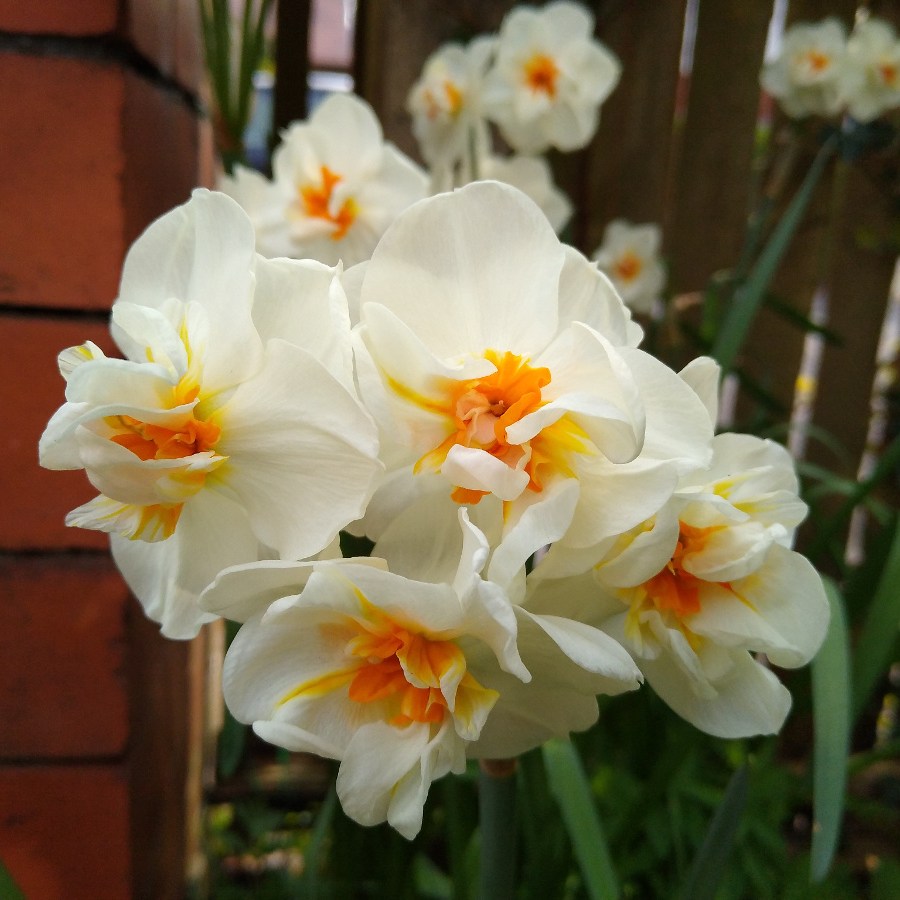
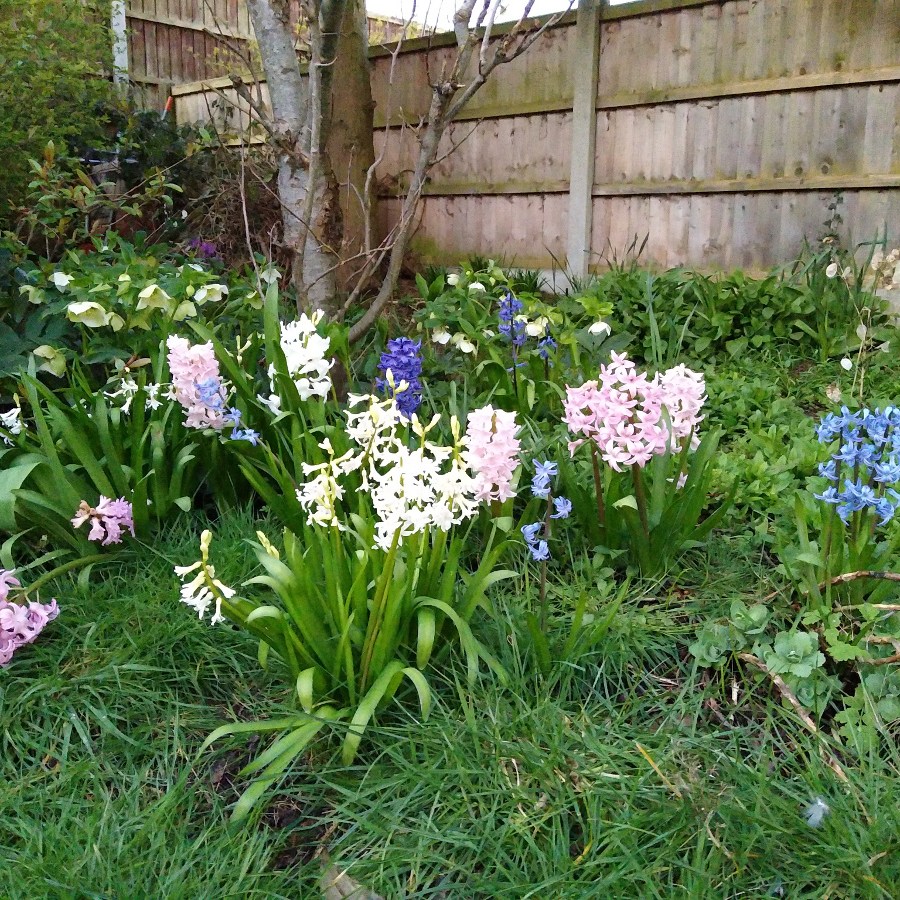
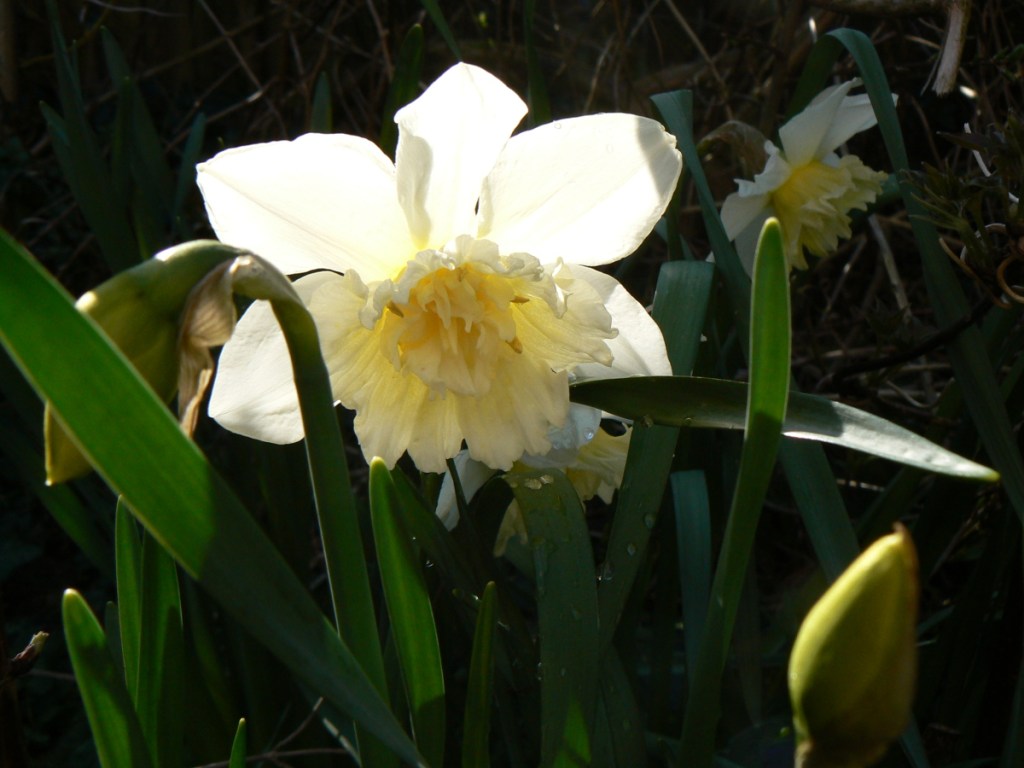
And so I tend my parents’ garden, cutting back years of overgrowth, clearing the paths, weeding amongst the many beautiful flowers that already grow here – hyacinths, daffodils, bluebells, honesty. And the shrubs and trees – apple, pear, rose, quince, camelia. Watering the raspberry canes. Sowing herb and lettuce seeds in troughs and veg seeds – carrot, turnip, onion, cauliflower, broccoli – in the soil.
And somewhere along the way it enters my mind this is ‘Creiddylad’s Garden’. And once the thought has entered it will not leave. I come to see the face of Creiddylad, ‘the most majestic maiden in the islands of Britain’, one of our Brythonic goddesses of flowers and spring, in each flower.
Creiddylad is a sovereignty deity who walks between worlds and lovers. This ‘majestic maiden’ is truly a majesty, a Queen, the lifeforce of nature who inspires great awe in her worshippers and the male deities, Gwyn and Gwythyr, Kings of Winter and Summer, who fight for her every Calan Mai.
Through the Winter she dwells with Gwyn, in the Otherworld, as Annwn’s Queen. In the Summer, with Gwythyr, she is May Queen, a great sovereign in Thisworld, revealing herself slowly flower by flower.
In Creiddylad’s contrary nature I find a better understanding of my own pulls between darkness and light, Thisworld and Otherworld. There is a part of me that wants to walk with Gwyn, a warrior and psychopomp, facing death, disease and sorrow. And at the same time an awareness he and other humans do this so the rest of us can appreciate the flowers and the sunlight and the lives that are our gifts.
It sometimes seems easier, more worthy, to embrace pain than pleasure. Why? I do not know. Only that in Annwn the sadness of the dead is transformed into great beauty and joy, and it this is that Creiddylad brings with her when walks from the Otherworld, into the light, and embraces Gwythyr.
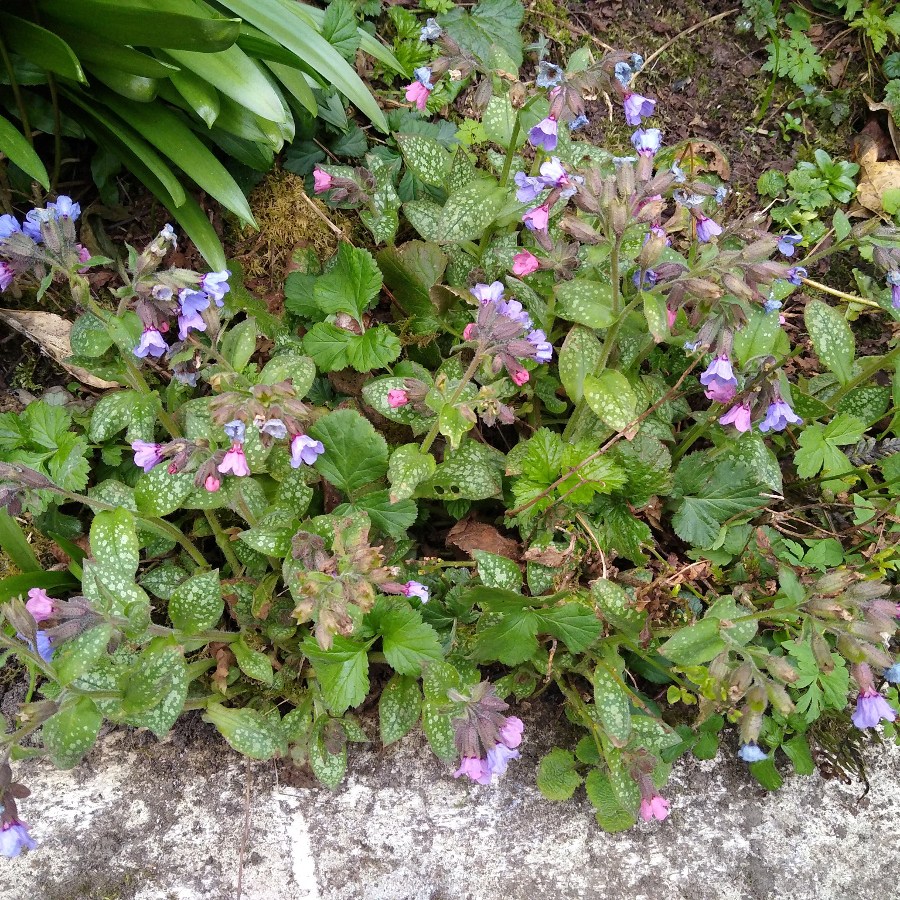
Many of the flowers in my garden speak of similar myths through the correlates of other cultures. The narcissus, or the daffodil, was the plant Persephone was picking before Hades took her to… Hades. The hyacinth was born from the blood of Hyacinth, the lover of Apollo, killed by his rival Zephyrus, and its beautiful petals are inscribed with ‘AI AI’ ‘Alas’. Lungwort’s petals turn from pink to blue as the flowers are pollinated, edging toward death, like flesh, or deoxygenated blood.
Nature and myth, death and life, Thisworld and Otherworld, are deeply intertwined in Creiddylad’s garden. A place where I work slowly, contemplating the mysteries, where I meet flowers, goddess, gods. It seems they don’t want me to be a hero but instead a small suburban bee offering a taste of Creiddylad’s honey.
It’s the last day of March. It has been a week since the lockdown to contain coronavirus began in the UK. I wake at 4am, as has become my habit, and lie awake with my mind running through all the things I need to do and all the worries that it is useless to worry about and then I beat myself up for worrying about them. By 5.30am I’ve had enough and decide to get up and do something useful.
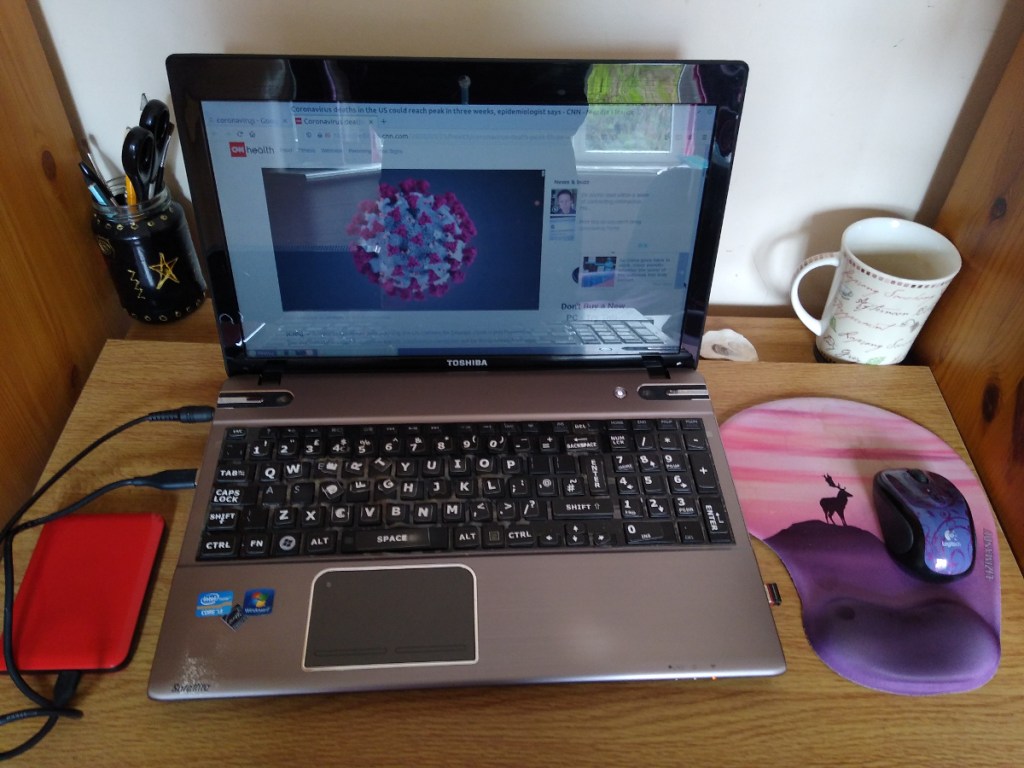
Breakfast, my morning prayers to my gods and the spirits of place, my daily too often failed attempt to sit and breathe and listen. Then I fire up my laptop, open Firefox, and click on the link to gmail. ‘This webpage is unavailable’. Agh. How the hell am I going to send my patron newsletters? Now my conservation internship has been cancelled until who knows when I have no route into paid work and my Patreon account is my only source of income. My heart’s racing and I can’t breathe as I check the modem (green lights on) and my network connection (fine) then turn the machine on and off.
Thankfully it starts working. I can breathe again. And now I’m looking back at my reaction. What the fuck? How, in the space of a few days, have I gone from being happy in a role that involves making positive changes out in nature alongside likeminded people – building a hibernaculum for newts, planting wildflowers, installing an outdoor classroom – to being completely dependent on something as ineffable and fallible as the internet not only for money but for a place in society?
~
Over the past few days I have been reflecting on how much of my identity and reason for being have become bound up with this blog, which provides a platform for my voice as an awenydd in service to Gwyn and the gods and spirits of my landscape and my online communities, as well as for book sales.
Its small successes have partly been down to my use of social media platforms such as Facebook and Twitter. Over the past few years the former, in particular, has had a massively detrimental effect on my mental health. For me it’s the virtual equivalent of walking into a large, noisy crowd in a magical castle that has no walls but the multiplicity of glass screens that grant us access and contain us.
Attempting to find friends and acquaintances at some illusory fairy feast where the food looks its tastiest but cannot be touched and interacting only with their reflections in their best party gear. Like the speechless dead their mouths do not move and their facial expressions do not change one bit.
Yet words appear on the page and conversations take place, stuttering, dragging on for days, as people blink in and out of existence, moving between the worlds, like ghosts. Being able to flit in and out of the crowd, of groups, creates a perennial nosiness. It takes up an incredible amount of headspace trying to keep up, to find the right answers, to argue against points of disagreement, to read responses in the absence of real faces. When I get offline a part of me remains in the glass castle, a shadow of myself arguing with shades of my own imagining, exhausted, distracted, lost.
I recognise this. But it’s only when coronavirus hits and so many people are forced online for work and to communicate due to the social distancing rules I realise just how powerful the internet has become. To the point we can neither earn a living nor live without it. The web has made it possible for us to work and meet without travelling (which is also greener) and set up groups for mutual support. I admit these are very good things yet something within me is screaming a warning about the surrender of our power to the invisible rulers of the halls of the internet on their glass thrones.
I make the decision to leave Facebook. It’s hard. I know the costs. I will lose contact with people, I will miss events, I will be giving up opportunities for publicity. Less people will see my blog posts and buy my books. These are the teeth, like a monster of Annwn, it has sunk into me. These are the tendrils of dependency that the beast beneath the glass castle has coiled around me, extending from my virtual being to my well being in Thisworld. It hurts when I pull them off, although there is no blood.
I return to Peneverdant, to the green hill in this virtual space between Thisworld and Annwn. I look back at the times I’ve been lost in the ether of pointless arguments and at the good it’s done. Through it I’ve helped real people connect with real lands and real gods and put real books in their hands. But at the cost of the loss of a piece myself, the surrender of part of my identity, to the glass castle.
Looking forward, to the promised ‘when this is all over’, I realise, if I survive, I no longer want to be ruled by the web. I want to walk again amongst the people of Thisworld and Annwn. To put down firmer roots in my land and my community – I determine that I will carry on volunteering for the Wildlife Trust whether it leads to paid work or not and put my name on the waiting list for an allotment. I will continue my service of blogging here but I will not let it rule or define me.
I whistle to that lost piece of my soul and pray to my god, Gwyn ap Nudd, to guide it back to his glass castle in Annwn where our souls are reunited and the dance of the dead reconciles illusion and truth.
~
Only once this process is complete do I feel ready to face the scary now this piece self-indulgently avoids. The escalating infections, the escalating deaths, of course relayed in figures and graphs by the internet. The rising numbers worldwide, across the UK, here in Lancashire. I see people are infected in Liverpool, Salford, Bolton, Wigan, Chorley, Blackpool, dying in the Royal Lancaster Infirmary.
That soon it will be here in South Ribble and Preston. That people will be fighting for their lives and dying in the Royal Preston Hospital, where the day centre has been allocated to coronavirus patients. I fear for my elderly parents, friends who are old or have health problems, know I’m not immune.
I’m asked to provide a pagan perspective on faith requirements in relation to excess deaths as a result of COVID-19 for the Lancashire Resilience Forum (Lancashire County Council’s emergency planning service). A small useful thing I can do. I revive my Microsoft laptop to attend a Skype meeting.
Right now there is no avoiding using the halls of the internet’s glass castle to bring about physical changes. All over the world fellowships are founded with people we may or may not see on the otherside. I walk these spaces more mindfully, my eyes on the goal, not allowing myself to get lost. I pray that one day some of us will meet on the green hills of Thisworld and, if not, on the hills of Annwn.

 The Sanctuary of Vindos