On Becoming Gwyn’s Awenydd

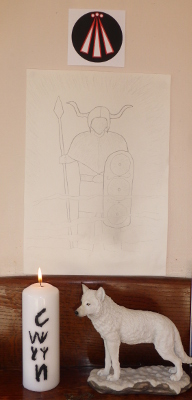
Gwyn Altar

In Pum Llyfr Cerddwriaeth (1570) Simwnt Fychan lists three main stages of poet-hood; disgybl ysbâs heb radd, ‘unqualified apprentice’, disgybl disgyblaidd ‘qualified apprentice’, and pencerdd ‘master poet’.

In January 2013 I took vows to Gwyn ap Nudd, a Brythonic god of the dead and ruler of Annwn, embarking on an apprenticeship to him that would lead me to becoming a disgybl disgyblaidd and his awenydd.

Undertaking an apprenticeship to a god is little known or spoken about in the Western world. In English schools the myths of ancient Britain contained in medieval Welsh literature are not taught. The names of the gods and spirits associated with our localities are not told. Nobody speaks of Annwn, the Brythonic Otherworld, as a place of initiation. An apprenticeship is a route to a secular career rather than to a vocation, a word stemming from vocātiō, a call or summons by the divine.

Because of this I did not recognise the first intimations of my calling. I did not understand the impulse that led me to read, walk, dance, drink myself to the heights of ecstatic visions, to the depths of abyssal despair. Lacking the framework of religion or knowledge of shamanistic experience I did not know whether my visions or the beings I saw were real or symptoms of madness.

Not knowing that it was possible to communicate with them (speaking back would mean I was surely mad!), to walk the Otherworld with will and intention, I could neither embrace or shrug off my calling. I stumbled through life like a drunken teenager, failing in my ambitions to become a philosophy lecturer, a riding instructor, or a fantasy writer because none fulfilled this inexplicable urge.

It was only after learning about the revival of animism and polytheism in the West that I realised my experiences were real and meaningful. That it was possible to communicate with gods and spirits. When Gwyn showed up when I was thirty years old I finally put a face to that calling and understood that my visions were of his realm, Annwn/Faerie, and his people, the spirits of Annwn/fairies.

My life suddenly made sense. Following a haunting vision of a satyr-like spirit in my local woodland in the depths of winter who spoke the words ‘a sadness is coming this land – you must become Gwyn’s apprentice’ I knew for sure what was already in my heart and the depths of my soul; that I must devote myself to Gwyn.

So I made three vows to Gwyn at the White Spring beneath Glastonbury Tor: to honour him daily, to stand in my truth, and to walk between the worlds with reverence. I chose this place not only because it is Gwyn’s best known sacred site, but because of powerful experiences at Glastonbury Festival I believe were associated with this enigmatic god and his bright spirits.

Soon afterwards the name of the vocation I was working towards as an apprentice was revealed. I was to become Gwyn’s awenydd – a spirit worker and inspired poet who travels between the worlds questing the awen, the divine breath of inspiration, from the land and the depths of Annwn.

During my apprenticeship to Gwyn I have learnt and done far more than I ever did at university. Gwyn has taught me how to journey back into the land’s deep memories to retrieve stories from distant times, those of ancestors who have left little or no trace, or have been erased by the victors.

Gwyn has taken me deeper into Annwn, where history fades into myth, to reveal the extent of the atrocities committed against his people by Christian warriors such as Arthur and his warband and by ‘saints’ and the effect on our psyche of our violent separation from our ancient deities and the Otherworld. To me he gave the task of revealing and thus beginning the process of healing these wounds.

Gwyn finally called upon me to recover his forgotten mythos from the mists of time, from the pens of Christian scribes bent on portraying him and his spirits as demons; to give voice to the inspired ones who have served him, whose souls he has gathered, since the last of the ice departed from this land.

I have recorded my personal journey since its beginning along with my research and creative writing on my blog and now have nearly a thousand followers and several patrons who support my work. I have shared my poems and stories in individual and group performances in my local area. At Pagan events in the North West of England and beyond I have spoken on the lore of the land and the Brythonic gods.

With the launch of Gatherer of Souls, my devotional book for Gwyn and Annuvian counter-narrative to Arthurian mythology, my apprenticeship is complete. I am now a disgybl disgyblaidd and his awenydd. Whether I will ever reach, or want to reach, the Taliesinic heights of pencerdd is doubtful.

I am currently happy knowing that I am one of the first of a new generation of awenyddion to complete something ancient and profound, with knowing the joy of being devoted to this terrible beautiful god whose mists shroud the mysteries of the Otherworld; that the well of learning is infinite.

I am planning to take new lifelong vows to Gwyn as his awenydd here in Penwortham, where he first appeared to me in person and where most of my work for him takes place, on this January’s full moon.

Discovering Anrhuna

Anrhuna… it’s taken me many years to find out her name… nearly as many years as the many names I’ve known her by: Lady Ivy, Lady Green, Lady of Peneverdant (‘The Green Hill on the Water’), Lady of the Marsh, Mother of the Marsh, Mary of the Marsh, Marian, Mother of Annwn.

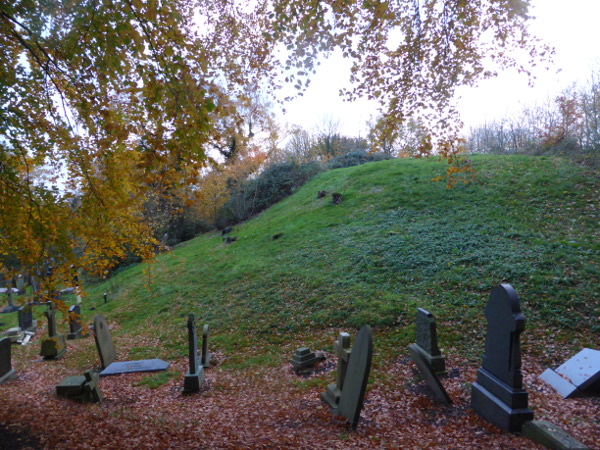
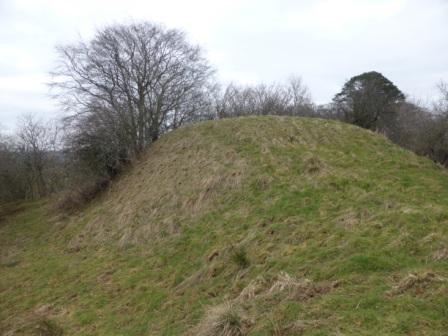
At my local sacred site, Castle Hill in Penwortham (Peneverdant in the Domesday Book), the church on the summit is dedicated to St Mary the Virgin, as was the well at the hill’s foot. I have known for a long time a goddess replaced by Mary lies beneath. I’ve felt her presence in the water dripping from the ivy, in ferns, hart’s tongue, enchanter’s nightshade, all the plants that love the damp.

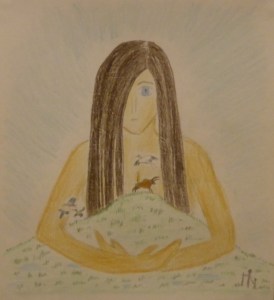
Lady on the Mound - Copy

She’s gifted me with visions of how the land appeared to the ancient Britons who worshipped her. The Bronze Age Lake Village, the way across the marsh to the sacred hill marked out by stakes, the moonlit processions spiralling around the hill to light a beacon fire, the burial mound beneath the castle mound, the grove of trees circling the area where the church now stands, beloved of the druids.

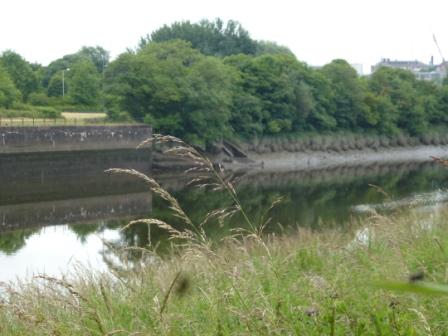
Where the river Ribble (known then as Belisama, ‘Most Shining One’) runs culverted and shifted from her course and on the other side stand the flats and out of town stores around the redundant docks I have listened to widgeon whistling and curlew calling across the marsh. I have seen tall, handsome cranes grazing beside the river and taller, mightier aurochs drinking deep, raising horned heads.

River Ribble, water level

Stranger still, two people from the US have contacted me to share visions of this place. A while back Heather Awen spoke of witnessing women making offerings from a wooden platform, praying for ‘a baby to fill their womb’, and seeing a woman ‘wrapped in burlap… tied with ropes’ lowered into the marsh. More recently Bryan Hewitt reported being drawn to do healing work in the area and seeing people in wooden boats traversing the river. Afterwards I had my first vision of the goddess as a person – a woman in a wooden boat getting bigger and bigger until she filled the skies, then trying to take the hill and docklands, severed by the moved river, in her arms to make her marshland one again.

Mother of the Marsh I

Bryan spoke to me of his relationship with a goddess he knows as the Mother of Annwn. When I met her on a journey she presented me with watery marshland imagery. A number of threads came together and I realised my local marsh goddess is this goddess of the waters of life flowing from Annwn.

Another thread that helped to complete this mysterious tapestry of place and deity is Bryan’s knowledge that the Mother of Annwn is the mother of Gwyn ap Nudd, my patron god, who I met in the damp woodland on the east bank of Castle Hill, where our local fairy funeral legend is set.

It is well known from his patronymic that Gwyn’s father is Nudd/Nodens, but the identity of his mother has fallen into obscurity. In The Descent of the Saints Gwyn is listed as the son of Tywanwedd, a little-known sixth century saint, who is also the father of Gwallog and Caradog, yet this has never rung true. Neither has the ungrounded claim of Robert Graves that Gwyn’s mother is Arianrhod.

The only real clue I have found is Ann Ross’s mention that at Nodens’ temple at Lydney there was found a stone statuette of a mother goddess, thirty inches in height, ‘her left leg crossed over her right’, ‘a corncupia in the crook of her left arm’, her head unfortunately missing. Pins were offered to her by women seeking aid with childbirth. It seems likely she is Nodens’ consort and Gwyn’s mother.

There is also evidence for the worship of Nodens here in Lancashire. Two statuettes dedicated to him were found on Cockersand Moss very close the remains of Cockersand Abbey. This was dedicated to Mary of the Marsh – my marshland goddess Christianised. I realised it was likely she and Nodens were worshipped together both there and here on Castle Hill with their son, Gwyn.

The final thread was finding out the goddess’s name. When guesswork failed I asked her directly and she set me searching for it through the reeds as if for a bird’s egg scaring up whistling ducks, digging down into the peat through layers of history to the age of dug-out canoes and bronze spears, hearing it whispered in my ear as if on the breath of a bog body – “Anrhuna” (tentatively ‘Very Great’).

The tapestry of land and deity at Castle Hill – Anrhuna, Nodens, Gwyn, alongside Belisama, is complete.

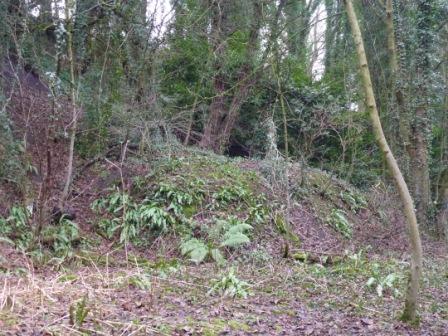
Castle Hill Mound Autumn 2018

Maelgwn and the Death Hound

I. The Princely Hound

Maelgwn, ‘Princely Hound’, was the king of Gwynedd during the 6th century. His seat of rule was Deganwy on the Creuddyn Peninsula and his fortress overlooked the estuary of the river Conwy.
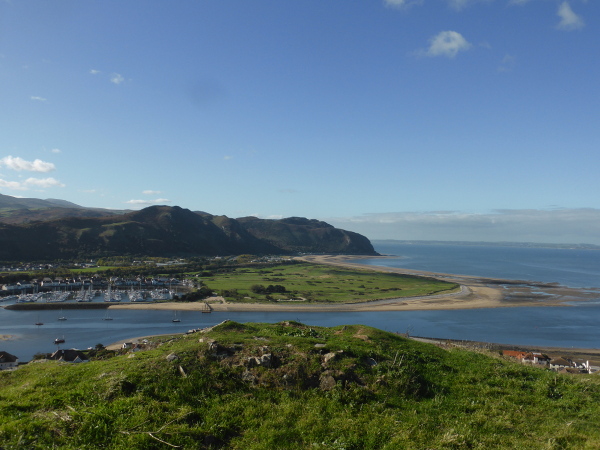
Deganwy Castle Site big hill summit II Conwy and Beach Med

Maelgwn was a descendant of ‘the Men of the North’ from Manaw Gododdin, the area around Clackmannshire, which included Din Eidyn (Edinburgh). The old Welsh form of Gododdin, Guotodin, derives from the Iron Age tribal name, Votadini. No satisfactory translation has been made.

The Votadini came under Roman rule between 132 and 162 and remained allies with the Romans when they withdrew to Hadrian’s Wall, being awarded with the riches of the Roman lifestyle whilst maintaining independence. The names of Maelgwn’s ancestors, Tegid, Padarn, and Edern, were derived from the Latin names Tacitus, Paternus, and Aeternus, reflecting the pro-Roman sympathies of their lineage.

It seems likely this people worshipped a variety of local, tribal, and pan-Brythonic deities, along with those imported by the Romans. The name ‘Manaw Gododdin’ suggests they venerated Manawydan. A reference to Castle Rock as ‘Lleu’s Rock’ in the poem Y Gododdin shows Lugus/Lleu may also have been an important patron whilst the mention of Cynfelyn ‘Dog Heads’ slaughtered by Arthur at Din Eidyn could refer to a shapeshifting cult dedicated to a wolf/dog god such as Cunomaglos, Nodens/Nudd, or his son Vindos/Gwyn ap Nudd. Two statues of horned gods have been found in the area along with altars to Apollo, Sol, and Mithras at the Roman fortress at Inveresk.

It is impossible to pinpoint when the rulers of the Gododdin converted to Christianity. The religion began filtering into Britain and the 1st and 2nd centuries. The Roman Emperor, Constantine I, converted in 312 and began issuing penalties for pagan sacrifice in 324. Constantius followed in his footsteps by ordering the closure of temples ‘in all places and cities’ in 354 and Theodosius made Christianity the official state religion of the Roman Empire in 380. The burning of a temple to Jupiter Dolichenus at Vindolanda on Hadrian’s Wall in 370 suggests the pro-Roman rulers of Manaw Gododdin would have followed their Roman allies in converting during the 4th century.

It is likely that Maelgwyn’s great-great grandfather, Cunedda, ‘Good Hound’, who lived during the mid-fourth century, was Christian. Triad 81 names ‘Three Saintly Lineages of the Island of Britain’ and these include ‘the Lineage of Cunedda Wledig’. Intriguingly his name, however, contains traces of a totemic relationships with dogs and perhaps a patron relationship with a canine god.

In his History of the Britons (828) Nennius recorded that Cunedda went to Anglesey and drove out the Gaelic tribes:

‘62. The great king, Mailcun, reigned among the Britons, i.e. in the district of Guenedota, because his great-great-grandfather, Cunedda, with his twelve sons, had come before from the left-hand part, i.e. from the country which is called Manau Gustodin, one hundred and forty-six years before Mailcun reigned, and expelled the Scots with much slaughter from those countries, and they never returned again to inhabit them.’

Cadwallon, Maelgwyn’s father, completed the driving out of the Gaelic people and secured the kingdom of Gwynedd. Originally its name was Venedotia. Ven may be linked with Vindos, ‘White’, and Gwynedd seems to contain Gwyn’s name and his father’s (Nudd was also spelt ‘Nedd’, ‘Nidd’, ‘Nith’, ‘Neath’) although whether it was named after these old pagan hound-gods we’ll never know.

Maelgwn’s name refers both to his princely descent and ancient associations with dogs and dog-gods. Although he attempted to maintain the veneer of a civilised Christian ruler he could not shut out the deities of his land and lineage or his wilder impulses completely. He failed to keep the hounds and monsters of Annwn, within and without, at bay, and ultimately his soul was gathered by Gwyn.

II. The Dragon of the Island

Maelgwn was referred to as ‘high king’, which suggests he maintained a hegemony over other kingdoms. He collected tributes from Gwynllwg and led attacks on Dyfed and on the southern Britons.

Christian, like his ancestors, in some sources he was depicted as a generous supporter of Christianity, financing the foundation of Bangor for St Daniel and helping St Asaph build his church at Llanelwy. However, in many of the saints’ lives he was represented as a ‘great tormentor of the saints’, such as Brynach, Cadog, Curig, Cybi, and Mechyll. His grants of land and monetary donations resulted from his being discomfited by a miracle and making offerings as a sign of his forgiveness.

In a section in The Ruin of Britain (6th century) Gildas presented a damning portrait of Maelgwn and five other princes. He likened them to the beast in the Book of Revelation 13.2: ‘And the beast which I saw was like unto a leopard, and his feet were as the feet of a bear, and his mouth as the mouth of a lion: and the dragon gave him his power, and his seat, and great authority.’ Maelgwn was identified with the dragon who gave the beast power and was referred to as ‘the Dragon of the Island.’

‘And thou, the island dragon, who hast driven many of the tyrants mentioned previously, as well from life as from kingdom, thou last in my writing, first in wickedness, exceeding many in power and at the same time in malice, more liberal in giving, more excessive in sin, strong in arms, but stronger in what destroys thy soul – thou Maclocunus, why dost thou obtusely wallow in such an old black pool of crimes, as if sodden with the wine that is pressed from the vine of Sodom?’

He spoke of how Maelgwn committed to Christianity but was drawn instead to sin by the ‘crafty wolf’ and reverted to his ‘fearful vomit like a sick dog’. Rather than attending to the praises of God, his court was a ‘rascally crew yelling forth, like Bacchanalian revellers, full of lies and foaming phlegm’.

Gildas accused Maelgwn of killing his ‘uncle the king with sword, spear, and fire’ to gain power. He told of how, when Maelgwn decided to become a monk, this made his first marriage illicit. After his reversion he killed his wife, then his brother’s son, and took his young wife ‘in desecrated wedlock’.

Whether Gildas’ accusations were true remains uncertain. We do know Maelgwn had a first wife called Sanan with whom he had two children: Alser, and Doeg, and a second who was the mother of Einion and Eurgain. He also had an illegitimate son called Rhun with Gwallen, daughter of Afallach.
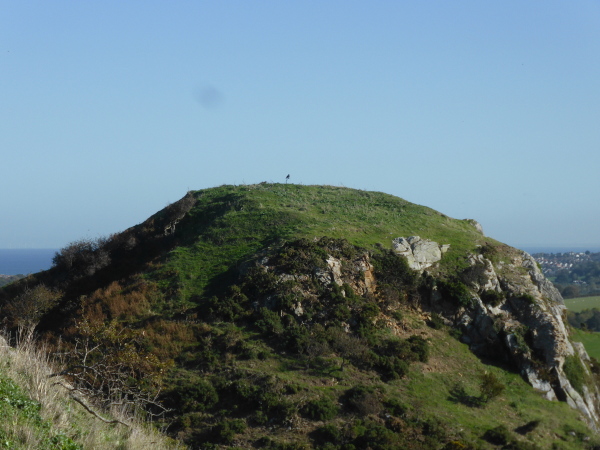
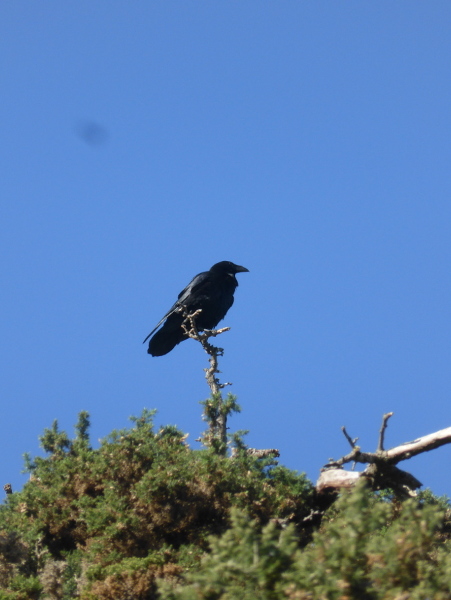
Deganwy Castle Site little hill with raven med

Deganwy Castle Site little hill raven close up Med

A raven watches from the opposite hill – do his or her ancestors know the truth?

III. The Silencing of the Bards

Maelgwn’s lacivious lifestyle was echoed in ‘The Story of Taliesin’ (16th century). Here we find a depiction of a bardic competition, a long-standing form of entertainment Maelgwn was most fond of.

Maelgwn was served by a circle of twenty-four sycophantic bards whose chief was Heinin Vardd. They showered him with praises saying no king was as great in ‘form, and beauty, and meekness, and strength’ and all the powers of the soul. They are described as ‘learned men, not only expert in the service of kings and princes, but studious and well versed in the lineage, and arms, and exploits of princes and kings, and in discussions concerning foreign kingdoms, and the ancient things of this kingdom, and chiefly in the annals of the first nobles; and also were prepared always with their answers in various languages, Latin, French, Welsh, and English… great chroniclers, and recorders, and skilful in framing verses, and ready in making englyns in every one of those languages.’

This echoes the structure of the bardic professions in the medieval court. Most important was the Pencerdd, ‘Chief of Song’, who held a special chair. Then there were twenty-four officers holding the position Bardd Teulu, ‘Poet of the Household’. It took nine years to train to be a qualified court poet.

It seems Maelgwn enjoyed hosting competitions, sometimes cruel, amongst his bards and fermenting trouble between them. In an instance recorded in a poem by Iorweth Beli he challenged them to swim from Arfon to Castell Caer Seion across the Conwy. ‘When they came to land the harpers were not worth a halfpenny’ because their strings had broken ‘while the poets sang as well as before’.

Elphin went to Maelgwn’s court at Deganwy to claim he had a better bard than the wise and skilful bards of Maelgwn and was consequently locked in a golden fetter. Taliesin then went to win him back.
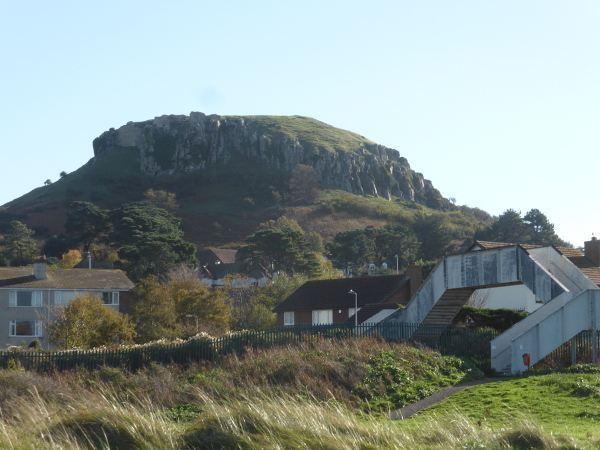
Deganwy Castle Site big hill from beach Med

In his opening poem Taliesin not only promised to silence Maelgwn’s bards, but to curse the king and his offspring:

And to the gate I will come;
The hall I will enter,
And my song I will sing;
My speech I will pronounce
To silence royal bards,
In presence of their chief…
I Taliesin, chief of bards,
With a sapient Druid’s words,
Will set kind Elphin free
From haughty tyrant’s bonds…
Let neither grace nor health
Be to Maelgwn Gwynedd,
For this force and this wrong;
And be extremes of ills
And an avenged end
To Rhun and all his race:
Short be his course of life,
Be all his lands laid waste;
And long exile be assigned
To Maelgwn Gwynedd!

Taliesin silenced the bards by sitting in a corner and playing ‘blerwm, blewrm’ with his finger on his lips. When each went to perform for the king this was the only thing they could do. Maelgwn derided them for their drunkenness and ordered a squire to hit Heinin on the head with a broom! This seemed to do the trick as Heinin was then able to tell Maelgwn that Taliesin had caused their indignity.

IV. A Most Strange Creature

Taliesin introduced himself as Elphin’s Chief Bard, told of his origins from ‘the summer stars’ and boasted of a long line of exploits and interactions with pagan and Christian figures – a common bardic practice.

Then, on a more sinister level, he began to invoke Annuvian monsters:

There is a noxious creature,
From the rampart of Satanas,
Which has overcome all
Between the deep and the shallow;
Equally wide are his jaws
As the mountains of the Alps;
Him death will not subdue,
Nor hand or blades;
There is the load of nine hundred wagons
In the hair of his two paws;
There is in his head an eye
Green as the limpid sheet of icicle;
Three springs arise
In the nape of his neck;
Sea-roughs thereon
Swim through it;
There was the dissolution of the oxen
Of Deivrdonwy the water-gifted.

This monster shares similarities with those Taliesin ‘pierced’ in ‘The Battle of the Trees: a great scaled beast, a black forked toad, and speckled crested snake, all of whom were eaters of human souls.

He then spoke a disturbing prophesy against Maelgwn:

A most strange creature will come from the sea marsh of Rhianedd*
As a punishment of iniquity on Maelgwn Gwynedd;
His hair, his teeth, and his eyes being as gold,
And this will bring destruction upon Maelgwn Gwynedd.

After Taliesin summoned the wind, a ‘strong creature’ ‘Without flesh, without bone, / Without vein, without blood, / Without head, without feet’ into Maelgwn’s hall, the terrified king released Elphin.
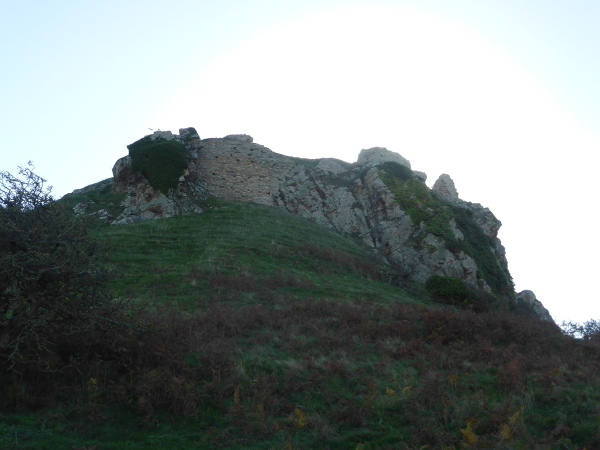
Deganwy Castle Site big hill with wall Med

Only the walls of an older castle remain…
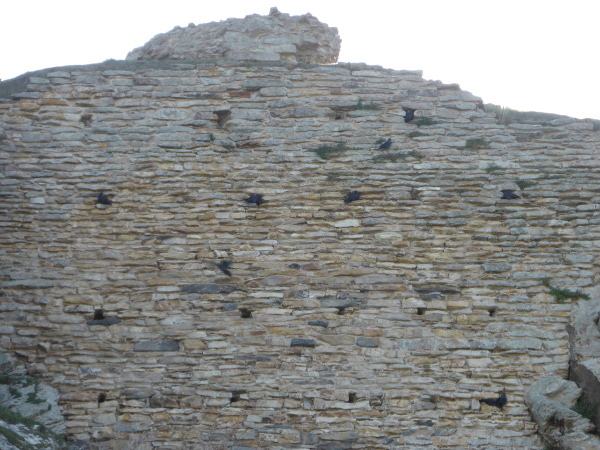
Deganwy Castle Site big hill wall with jackdaws Med

… and they are haunted by jackdaw bards.

V. The Long Sleep of Maelgwn

The ‘strange creature’ with golden eyes, hair, and teeth, who Taliesin prophesied would destroy Maelgwn, turned out to be Y Fat Velen ‘The Yellow Plague’ – a great pestilence which struck in 547.

In an attempt to avoid the plague he retreated to the church in Llan Rhos and shut all the windows and doors.
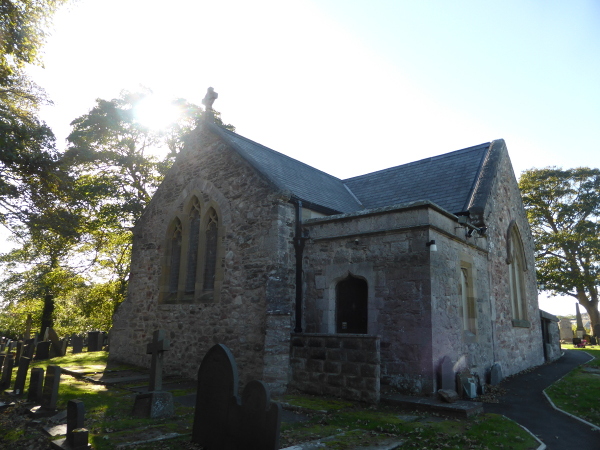
Llan Rhos Church III North East Med

However, when he looked out through a hole, he saw Y Vat Velen, that terrifying gold-yellow beast, and fell into a long, long sleep.
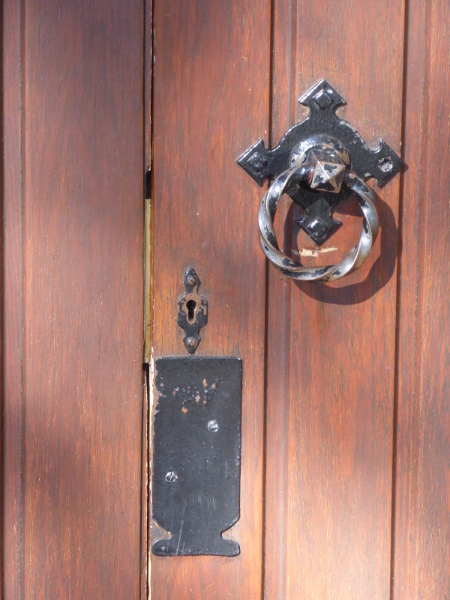
Llan Rhos Church Key Hole Med.JPG

His attendants waited for days. When they realised his silence had been too long for sleep they found him dead. Thus a saying originated: ‘Hir hun Faelgwn yn eglwys Ros’, ‘the long sleep of Maelgwn in the Church of Rhos,’ a sleep so long he never awoke.

Although Maelgwn shut himself away in a church he did not escape Y Vat Velen or Gwyn and the hounds of Annwn arriving to take his soul. Lines in ‘The Conversation of Gwyn ap Nudd and Gwyddno Garanhir’ suggest that Dormach, Gwyn’s best hound, was present at Maelgwn’s death:

My hound is sleek and fair,
The best of hounds;
Dormach he is, who was with Maelgwn.

In this poem Gwyn recites the names of four Men of the North whose souls he gathered from the battlefield: Gwenddolau ap Ceidio, Brân ap Ywerydd, Meurig ap Careian, and Gwallog ap Llenog. Gwyddno was of northern origins and on the brink of death. Like these other Men of the North, the Princely Hound did not go to Heaven, but returned with the death hound to join his ancestors in Annwn.
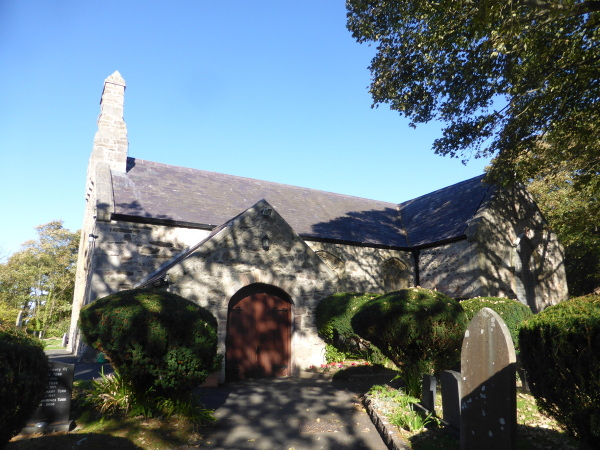
Llan Rhos Church I South Door Med

According to some sources Maelgwn is buried in Llan Rhos Church near the south door and to others on Ynys Seiriol, ‘Puffin Island’.

*Morfa Rhianedd, ‘the Sea-strand of the Maidens’ is between Great and Little Orme’s Head near Llandudno.


SOURCES

A.O.H. Jarman (transl.), Aneirin – Gododdin, (Gomer Press, 1998)
Charlotte Guest, The Story of Taliesin, Sacred Texts, (1877)
Edward Dawson, ‘Tribal Names: Linguistic Analysis and the Origin of Gwynedd
Eberhard Sauer, Fraser Hunter, John Gooder, Martin Henig, ‘Mithras in Scotland: A Mithraeum at Inveresk’, Britannia, Vol. 46,
Gildas, The Ruin of Britain, Tertullian.org, (1899)
Greg Hill (transl.), ‘The Conversation Between Gwyn ap Nudd and Gwyddno Garanhir, Awen ac Awenydd‘, (2015)
Greg Hill, ‘Lleu Llaw Gyfes… is that Lugus?’, Dun Brython, (2016)
Mererid Hopwood, Singing in Chains, (Gomer Press, 2004)
Nennius, History of the Britons, Gutenburg.org, (2006)
Peter Bartrum, A Welsh Classical Dictionary: People in History and Legend up to about A.D. 1000, (National Library of Wales, 1993)
Rachel Bromwich (ed), The Triads of the Island of Britain, (University of Wales Press, 2014)
Book of Revelation 13.2, King James Bible, Bible Gateway
Gwyn’s Hunt

Within modern Paganism Gwyn ap Nudd is generally understood to be a leader of ‘the Wild Hunt’. Before Jacob Grimm developed the term Wilde Jagd ‘Wild Hunt’ and applied it to various otherworldly hunts across Europe in his Deutsch Mythologie (1835), they were known by individual names, often referring to their leaders, such as ‘Woden’s Hunt’, ‘Household of Harlequin’, and ‘Herla’s Assembly’. This essay will focus on the Brythonic tradition of ‘Gwyn’s Hunt’.

The earliest literary reference to Gwyn as a hunter comes from Culhwch and Olwen (1090) where it is stated, ‘Twrch Trwyth will not be hunted until Gwyn son of Nudd is found.’ This suggests Gwyn was the leader of the hunt for Twrch Trwyth, ‘King of Boars’, prior to Arthur. According to the text, which was penned by Christian scribes, Twrch Trwyth was a king changed into a swine by God ‘for his sins’. This overlay conceals a pagan tradition wherein the ‘boar’ was a human shapeshifter. Gwyn’s hunt was for a man: a shapeshifting human soul.

The following lines, ‘God has put the fury of the devils of Annwn in him, lest the world be destroyed. He will not be spared from there’ form another Christian overlay obscuring Gwyn’s role as a protector and ruler of Annwn containing furious spirits including the fay and the dead within his realm and person. The comb, razor, and shears Twrch Trwyth mysteriously carries between his ears may have been grave goods, suggesting he is a restless soul Gwyn hunts down into the ocean (symbolic of Annwn ‘the Deep’) on a cyclical basis to lay to rest.

In later folklore Gwyn is depicted hunting for souls with the Cwn Annwn, ‘Hounds of the Otherworld’, who are also known as Cwn Wybyr, ‘Hounds of the Sky’, and Cwn Cyrff, ‘Corpse Dogs’. These include Dormach, Gwyn’s fair red-nosed hunting dog. To hear or see the Cwn Annwn is a portent of death. This belief may be rooted in earlier traditions where wolves and dogs along with carrion birds (Gwyn is also associated with ravens who ‘croak over blood’) devoured the corpses of the dead before Gwyn gathered their souls.

A fascinating legend surrounds the minstrel Ned Pugh or Iolo ap Huw who disappeared into the cave of Tag y Clegyr playing ‘Ffarwel Ned Pugh’, ‘Ned Pugh’s Farewell’:

‘To leave my dear girl, my country, and friends,
and roam o’er the ocean, where toil never ends;
to mount the high yards, when the whistle shall sound,
Amidst the wild winds as they bluster around!’

Exchanging ‘his fiddle for a bugle’ the minstrel became Gwyn’s huntsman-in-chief and can be found ‘cheering Cwn Annwn over Cader Idris’ every Nos Galan Gaeaf.

SAMSUNG CAMERA PICTURES

There are numerous instances where Gwyn (by this name or as a spectral or demon huntsman or fairy king), sometimes with his hunt and sometimes alone, also carries off the souls of the living. On Nos Galan Gaeaf, Gwyn wins back his beloved, Creiddylad, from Gwythyr and takes her to Annwn. Creiddylad’s descent with Gwyn to the underworld explains the coming of winter. Later folktales featuring abductions may have some basis in this old seasonal myth.

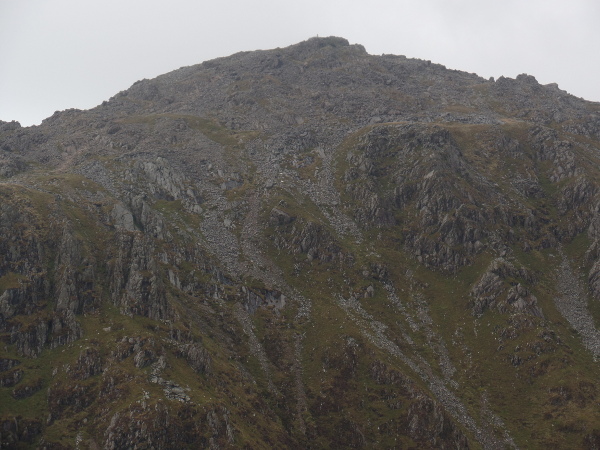
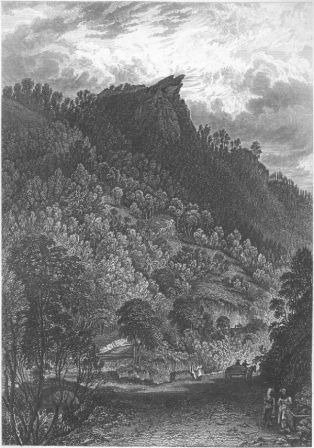
Here, on the borders of Lancashire and Yorkshire, there is a story featuring Sybil, the Lady of Bearnshaw Tower, who spends an unseemly amount of time on the hills and moors chasing wild swans whose hound-like calls remind her of ‘wild hunters and the spectral horseman’. She is swept from the dizzy heights of Eagle Crag overlooking Cliviger Gorge by a ‘demon’:

‘Immediately she felt as though she were sweeping through the trackless air… she thought the whole world lay at her feet, and the kingdoms of the earth moved on like a mighty pageant. Then did the vision change. Objects began to waver and grow dim, as if passing through a mist; and she found herself again upon that lonely crag, and her conductor at her side.’

Gwyn ap Nudd, ‘White son of Mist’, goes ‘between sky and air’ and moves ar wybir ‘through the clouds’. I believe Gwyn is ‘the spectral horseman’ and Sybil’s demonic ‘conductor’.

Sybil’s ability to shapeshift may have been learnt from Gwyn: a god of transformation. In deer-form she is hunted down by a human huntsman called William Towneley and forced to marry him. Her failed attempt to escape in cat-form leads to her death and burial at Eagle’s Crag where she was captured; her ghost and William’s can be seen there every Nos Galan Gaeaf.

eagle-crag-drawn-by-g-pickering-and-engraved-by-edward-finden-copy

The Cliviger area is also haunted by Gabriel Ratchets, corpse hounds who may be an Anglicised variant of the Cwn Annwn. In his poem, ‘Gabriel Ratchets’, which is based on Sybil’s story, Philip Hamerton opens: ‘Wild huntsmen? ‘Twas a flight of swans / But how invisibly they flew.’

Gwyn and his hunt are associated with soul flight and ecstasis. Ecstatic experiences with otherworldly beings were frowned upon by the Christian church and twisted into stories of abduction by a demon huntsman or fairy king who was confronted by knights and heroes who won those ‘poor souls’ back (whether they wanted to return or not…).

When I accepted Gwyn’s challenge to ride with him to the Otherworld and offered my soul into his care he showed me parts of Lancashire where people lived in lake villages and walked on wooden trackways then glaciers creeping across the landscape with blizzard winds.

This has led me to believe Gwyn was worshiped as a god of hunting and the transitions of the souls of the dead and living between worlds by this land’s earliest inhabitants after the Ice Age. Yuri Leitch identifies Gwyn with the constellation of Orion and Dormach with Canis Major (Sirius, the dog star, is Dormach’s nose). Gwyn is our ancient British Hunter in the Skies who rises from Annwn on Nos Galan Gaeaf and presides over the dark months of winter.

Nos Galan Gaeaf is an ysbrydnos ‘spirit night’ when Gwyn’s Hunt rides and the borders between thisworld and Annwn, life and death, and the laws that govern time and space break down. It is a time of migrating swans and geese and transitions of souls. It is a time of deep magic.

I’ll end with a passage from Sian Hayton’s ‘The Story of Kigva’ because, for me, it evokes so beautifully the experience of flying with Gwyn:

‘She felt a hand on her arm… steady, comforting her in her despair. The strongest one of all was there, as he had been in the forest and he promised, silently, that he would stay with her for the rest of her vigil. With tears she thanked him and felt herself gathered up in his arms. Together, from then on, they wandered the universe. He showed her things which only he knew. With him she touched the cold, hard moon and walked on the black rind of the sky. She found the stars felt like the taste of blaeberries and the north wind was truly a great river whose source was the mountains of the sun. He gave her jewelled collars and crowns and broke open an oak-tree so that she could feast on the honey. There was no one equal to him.’

*This article was first published on Dun Brython HERE.

SOURCES

Jacob Grimm, Deutsch Mythologie, https://archive.org/details/deutschemytholo07grimgoog
J. Gwengobryn Evans, The Black Book of Carmarthen, (Lightning Source,1901)
John Rhys, Celtic Folklore: Welsh and Manx (Oxford, 1901)
John Roby, Traditions of Lancashire I, (1872) http://www.gutenberg.org/files/15271/15271-h/15271-h.htm
Philip Hamerton, The Isle of Loch Awe and Other Poems of My Youth, (Forgotten Books, 2017)
Sian Hayton, ‘The Story of Kigva’, Within the Hollow Hills, (Lindisfarne Books, 1995)
Sioned Davies (transl.), The Mabinogion, (Oxford University Press, 2007)
T. Gwynn Jones, Welsh Folklore and Folk-Custom, (Redwood Burn, 1979)

Gwyn’s Feast

Gwyn ap Nudd is a god of the dead and ruler of Annwn. As the Brythonic leader of ‘the Wild Hunt’ he gathers the souls of the deceased back to his realm to be united in an otherworldly feast. This repast of the dead can, at certain times of the year, be participated in by the living.

Unfortunately this is a tradition that Christians went to great lengths to bring to an end. This article will introduce the evidence for Gwyn’s Feast, how it was abolished, and how it can be reclaimed by modern polytheists.

*

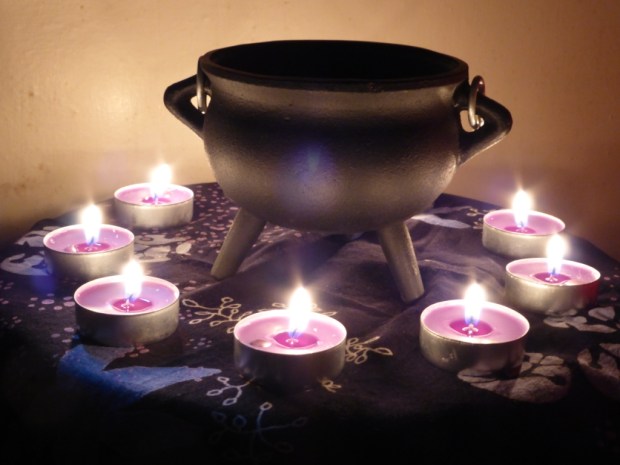
In ‘The Spoils of Annwn’, as Pen Annwn, ‘Head of the Underworld’, Gwyn presides over a feast in Caer Vedwit, ‘The Mead-Feast Fort’. At its centre is the cauldron of Pen Annwn, with its ‘dark trim, and pearls’, which ‘does not boil a coward’s food’: a vessel symbolic of rebirth.

Cauldron

Arthur raids seven Annuvian fortresses, confronting six thousand speechless dead men, inflicting violence on ‘the honoured and fair’ and stealing the Brindled Ox, kidnapping a bard called Gweir, and stealing the cauldron of Pen Annwn before slamming ‘Hell’s Gate’ shut.

I believe Arthur’s raid on Annwn replaced an earlier tradition of the soul’s return to the underworld and journey through seven fortresses (which are faces of the same fort) to Gwyn’s Feast and the Cauldron of Rebirth. Arthur’s defeat of Gwyn and his people and theft of his cauldron represent the triumph of Christianity over the pagan mysteries of death and rebirth.

This story is paralleled in Culhwch and Olwen, where Arthur raids Gwyn’s fortress to rescue Gwyn’s rival, Gwythyr, and his army (who include Graid who might be equated with Gweir), and steals a number of otherworldly treasures including the Brindled Ox and a magical cauldron.

Arthur also usurps Gwyn’s hunt for Twrch Trwyth, ‘King of Boars’, ‘a king and for his sins God changed him into a swine’. This thinly disguises that Arthur takes leadership of Gwyn’s hunt for a human soul in boar-form – ‘the Wild Hunt’ – reducing it to just a boar hunt and again obscuring pagan traditions.

*

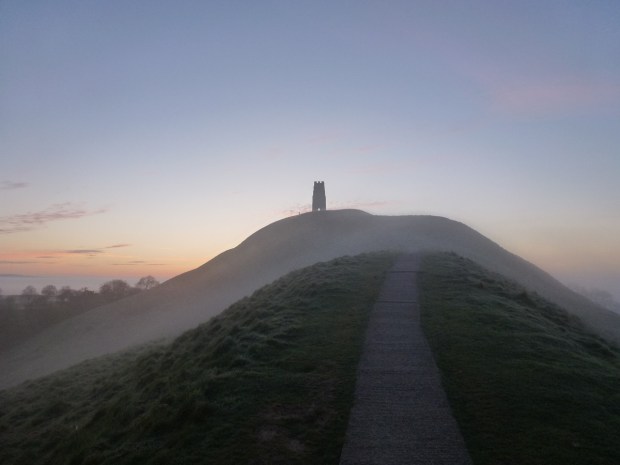
Glastonbury Tor Calan Mai 2013

Gwyn is intimately associated with Glastonbury Tor. Excavations have revealed the existence of a building with several hearths dating to the 5th – 7th century. Two north-south aligned graves (not Christian) nearby along with an empty stone cairn and helmeted bronze head with ‘a narrow face’ and ‘slit mouth’ in the ‘long’ Celtic style suggest it may have been a pagan temple.

Bones of cattle, sheep, and pigs, from joints of meat, and Mediterranean amphorae (large jugs for holding wine) suggest feasting took place at this temple on the Tor; a liminal place where Thisworld and Annwn and the living and the dead meet in revels presided over by Gwyn.

Several pernicious accounts in saints’ lives record Christian attempts to abolish this tradition. In The Charter of St Patrick, Patrick and his brother Wellias climb the Tor and find ‘an ancient oratory’. There they fast for three months ‘dominating the devils and wild beasts’ and are rewarded with a vision of Jesus telling them to claim the place in his name and invoke St Michael.

In The Life of St Collen, Collen, Abbot of Glastonbury, derides Gwyn and his host as ‘devils’. When Gwyn invites him to the summit of the Tor to feast in ‘the fairest castle he had ever beheld’, Collen refuses to ‘eat the leaves of trees’, says the red of Gwyn’s people’s clothing signifies ‘burning’ and the blue ‘coldness’, then supposedly banishes them with holy water.

Gwyn appears as Melwas (1) in The Life of Gildas, where he violates Arthur’s wife, Gwenhwyfar, and carries her off to the Tor, which is well fortified by ‘thickets of reed, river, and marsh’. Gildas sides with Arthur and wins Gwenhwyfar back. The tradition of ‘Arthur’s Hunting Path’ from Cadbury to Glastonbury and his burial further illustrate his replacement of Gwyn.

*

The tradition of invoking St Michael on Glastonbury Tor continued. In the 11th century a wooden church dedicated to him was built on the summit. In 1243 Henry III granted permission for an annual fair to be held there for six days around the Feast of St Michael, September 29th.

It is likely St Michael’s Feast replaced a feast day for Gwyn. The 29th of September was the final day of bringing in the harvest. In Cornwall, September is known as Gwynngala, ‘White or Blessed Fields’, a name which contains suggestions that Gwyn, a death-god, is associated with reaping and celebrations for him were held when the fields were cleared at the month’s end.

This date has also become attached to St Michael’s defeat of Satan in a war of Heaven and banishment of him to Hell. It seems this Biblical story was recalled to reinforce St Michael’s defeat of Gwyn on his feast day. According to a folkloric tale the Devil first fell to earth and landed in a blackberry bush and spat or urinated on the blackberries, explaining why they go rotten.

Gwyn was identified with ‘that ancient serpent called the Devil’. This is not surprising as Gwyn’s father, Nodens/Nudd/Lludd is associated with two dragons and Gwyn’s dog, Dormach, ‘Death’s Door’, has two serpent’s tails. It may be suggested Gwyn took serpent-form (2).

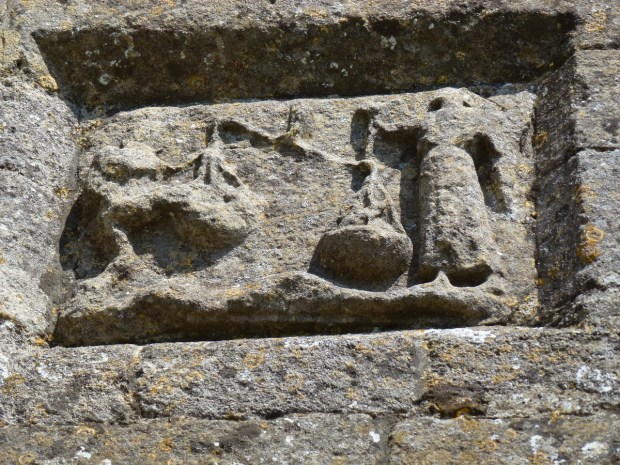
On the tower of the 14th century stone church on Glastonbury Tor (the wooden one was unsurprisingly destroyed in an earthquake in 1275!) is an image of St Michael with a set of scales weighted toward him, rather than his opponent, the Devil-as-serpent. St Michael’s taking souls to heaven and weighing them forms an antithesis to Gwyn gathering souls to Annwn where all are united at his feast without moral judgement.

St Michael, Scales, Dragon, Glatonbury Tor 2013

*

I’ve been celebrating Gwyn’s Feast on the 29th of September since 2013 as a way of reaffirming his presence in the place of Arthur and St Michael, who has taken over many other sites sacred to Gwyn and the spirits of Annwn/the fairies, including some in Lancashire (3).

When I asked Gwyn if I could celebrate a feast for him on this date, he agreed. Since then I’ve been joined annually by a friend, and Dun Brython members such as Greg Hill and Lee Davies have held their own celebrations. This year I know of several other devotees of Gwyn, who I’m in contact with online, who will be celebrating Gwyn’s Feast.

A meal I have developed and found Gwyn is happy with (4) is pork with apple sauce, a glass of mead, and offerings of meat for his hounds and apples for his horses. I open the feast by calling to Gwyn and his spirits and acknowledging the connection with all who have feasted with him in the past and those who are feasting with him on September the 29th today. Then we eat.

After the meal I read prayers, poems, and stories, which have been written for Gwyn or remind me of him by myself and others. This is followed by some form of communion with Gwyn such as divination, journeywork, or quiet contemplation. Rather than saying farewell I end by welcoming Gwyn and his spirits back into the landscape as we enter the dark half of the year.

This year I will be holding a feast for Gwyn then afterwards the readings will take place at the launch of Gatherer of Souls at the Black Horse in Preston. The publication of this book, which is dedicated to Gwyn and recovers his mythos, is the culmination of six years of devotion.

*

(1) The identification of Gwyn and Melwas is also backed up by Welsh tradition. In ‘The Dialogue of Melwas and Gwenhwyfar’ Melwas introduces himself: ‘Black is my steed and brave beneath me / No water will make him fear / And no man will make him swerve.’ This is clearly Gwyn’s mount, the legendary water-horse Du y Moroedd, ‘the Black of the Seas’. Other lines suggesting Melwas is Gwyn, referring to his otherworld nature, include, ‘It is I that will ride and will stand, / And walk heavily on the brink of the ebb’, and ‘I would hold against a hundred of myself’.

(2) Robert Graves refers to Gwyn as ‘the Serpent Son’ in The White Goddess. This name is of his own coining based on personal inspiration and does not have any historical basis, yet is fitting.

(3) John Rhys notes Michael ‘was regarded as par excellence the defender of Christians against the sprites and demons with which the Celtic imagination peopled the shades of night, the gloom of the forest, and even the straggling mist on the tops of hills. Perhaps it would not be rash to suppose that most of the old foundations associated with his name occupy sites of sinister reputation, inherited from the time when paganism prevailed in the land, sites which were considered to be dangerous and to form the haunts of evil spirits.’ Here in Lancashire there is a church dedicated to St Michael in Whitewell, which is named for its white well, which many be connected with Gwyn. It is close to Fairy Holes and Fair Oak. In Beetham St Michael’s is the destination of a coffin path/fairy path which is famous for its Fairy Steps.

(4) One small word of advice on something he was very unhappy with… avoid eggs at all cost. In 2014 we decided to add boiled eggs to the arranged meal of ham without asking him. Three times we boiled them for the right amount of time and they were completely uncooked!

An earlier version of this article was published on the Dun Brython blog HERE.

SOURCES

Alex Langstone, ‘The Berwyn Mountains of Poetic Adventure’, Mirror of Isis
Anon, ‘The Charter of St Patrick’, Britannia History
Anon, ‘The Dialogue of Melwas and Gwenhywfar’, Mary Jones Celtic Literature Collective
Ben Johnson, ‘Michaelmas’, Historic UK
Caradoc of Llancarfan, The Life of Gildas, http://www.maryjones.us/ctexts/gildas06.html
Charlotte Guest (transl), ‘St Collen and Gwyn ap Nudd’, Mary Jones Celtic Literature Collective
John Rhys, Studies in the Arthurian Legend, (Adamant Media Corporation, 2001)
Marged Haycock, Legendary Poems from the Book of Taliesin, (CMCS, 2007)
Mary Beth Albright, ‘Michaelmas: The Day the Devil Spit on Your Blackberries’, National Geographic
Nicolas R. Mann, The Isle of Avalon, (Green Magic, 2008)
Sioned Davies (transl.), The Mabinogion, (Oxford University Press, 2007)
Yuri Leitch, Gwyn: Ancient God of Glastonbury and key to the Glastonbury Zodiac, (The Temple Publications, 2007)

The Ghost of Myrddin Wyllt

Mountain ghosts come to me
here in Aber Caraf
A Fugitive Poem of Myrddin in his Grave

He haunts me. He who speaks from his grave at Aber Caraf with other wyllon mynydd, ‘mountain ghosts’ – Myrddin Wyllt.

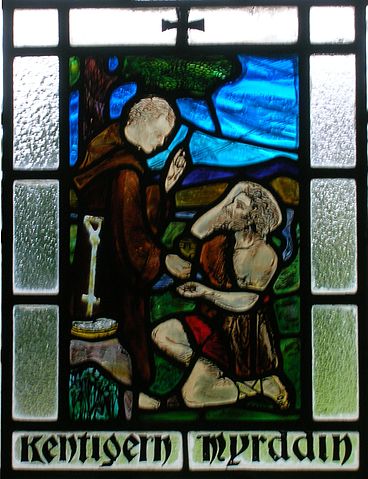
He entered my life when he broke from a scene we both despise. In Stobo Kirk, in a stained glass window, he kneels before Kentigern, begging for the sacrament, as The Life of St Kentigern claims.

368px-Merlin_and_St_Kentigern,_Stobo_Kirk

“This isn’t true!” the gnosis struck me like shattering glass as Myrddin leapt free in an explosion of splinters; ethereal blue, red, green. The bishop fell in pieces with his chalice and crozier. The light swept in. Not just sunlight but that otherlight, the unendurable brightness that Myrddin gazed upon after the Battle of Arfderydd, which made him gwyllt, ‘wild’, ‘mad’. The light of truth. The ‘White/Clear Light’ of Vindonnus, Vindos, Gwyn ap Nudd, Lord of Annwn.

It illuminated Myrddin in all his naked glory, leafy-haired, bony-limbed, spry and supple as a sapling even in his old age. It glinted in the scintillae of his pupils, declaring him wildman, madman, prophet, awenydd: one who speaks the Awen from the tangled heart of the forest, from the wind-swept mountains where ghosts scream, from the deep wells of Annwn.

The stories of this wild Myrddin have been smothered beneath the fusty robes of Merlin. The popular wizard, who is frequently depicted as an advisor to King Arthur in film and television, was created by Geoffrey of Monmouth in The History of the Kings of Britain (1136) and The Life of Merlin (1150) from the lives of two very different men.

Merlin Ambrosius was based on the Romano-British war leader Ambrosius Aurelianus. He acted as advisor to Vortigern and helped Uther Pendragon to father Arthur by magically disguising him as Gorlois, the husband of Igraine, so he could sleep with her.

Merlin Caledonensis was based on Myrddin Wyllt: a northern British warrior who became gwyllt after the Battle of Arfderydd in 573 and retreated to Celyddon (the Caledonian forest) where he learnt the arts of poetry and prophesy and used them to warn against future wars. The two Merlins became conflated.

In Robert de Boron’s Merlin (1190-1200), Merlin became Uther Pendragon’s advisor and responsible for Arthur’s fosterage, his pulling the sword from the stone, and building the Round Table. The ‘Mage Merlin’ appears as Arthur’s advisor and as a guide to the grail quest in Thomas Malory’s Le Morte D’Arthur (1485). His later depictions draw upon these associations.

The conflation of the two Merlins and the downplaying of Myrddin Wyllt’s stories is deeply problematic. Firstly Myrddin lived after Arthur making their association impossible. Secondly Myrddin would never have supported the warmongering of Arthur and his ‘knights’.

Yet he has been subsumed within the Arthurian tradition and its vile strain of Christian militarism, which brought about the slaying of the dragons, giants, and witches of ancient Britain, then the Anglo-Saxons, then ‘the infidels’ who fell in the Crusades, leading to our War on Terror.

He rages against his identification with Merlin: a political advisor to the warlords of Britain who supports going to war over chemical weapons that don’t exist and approves arms sales to countries using our weapons in attacks that breach international humanitarian law.

He calls to me, a fellow awenydd, to shatter the illusion of his complicity in Arthurian imperialism with the otherlight of Annwn from our god, Gwyn ap Nudd. Here I share his story.

Myrddin grew up amongst the warband of Gwenddolau, the last Pagan warlord of the Old North. He was fierce in those days, blood thirsty, callous, with a love of gold and strong mead. Warring in nothing but the golden torque gifted him by Gwenddolau, his battle-madness was legendary. He piled up corpses for Gwenddolau’s two sea-eagles to strip their flesh.

View from Liddel Strength

Caer Gwenddolau (present-day Liddel Strength)

A great change came over Myrddin after the Battle of Arfderydd. This was fought between the armies of Gwenddolau and Rhydderch, who was married to Gwenddydd, Myrddin’s twin sister. Rhydderch had allied with a number of Gwenddolau’s kinsmen.

Gwenddolau was slaughtered. Aggrieved by the death of his lord Myrddin was consumed by such a battle rage that he killed his niece and nephew, the son and daughter of Gwenddydd and Rhydderch, who were fighting on Rhydderch’s side.

After the battle Myrddin was near-blinded by an unendurable brightness illuminating the carnage. By it he recognised the pale faces of his sister’s offspring who he had hacked apart. Martial battalions filled the sky. To his horror he realised they were the victims he had slaughtered gathered in the form of a cold and angry god staring at him with countless dead eyes.

One of those spirits swept down and tore Myrddin out of himself. With a howl of terror and pain that became a whimper and squeak he leapt and fluttered up like a bird-puppet on a string. He was tossed on the winds of Annwn, on a merlin’s wings, to the forest of Celyddon where he shivered in the branches of an apple tree.

That image of Gwyn ap Nudd containing all the dead who he had killed was indelibly impressed on his mind like an irremovable afterimage from staring foolishly at the sun.

Myrddin does not remember the days when he flitted from tree to tree, a lost soul, birdlike, unable to feel or think or see. He remembers some of his slow return to himself, to chill recumbent flesh, relearning the contours of his body and its need to eat and drink, sights, sounds.

Blog 6. Coille Coire Chuilc

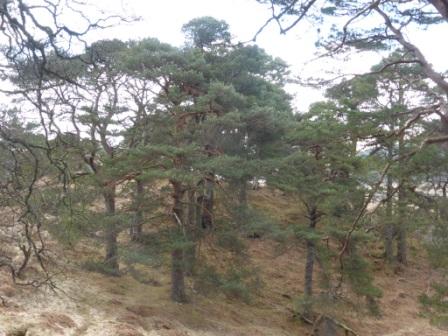
A last remnant of Celyddon at Coille Coire Chuilc

The birds of the forest guided him to tasty berries, the squirrels to hazelnuts, and a happy little piglet to roots and grubs and the most exquisite truffles. When the bleak northern winter brought snow to his hips and icicles to his hair a white-haired wolf taught him the secrets of endurance.

Words came last. Stuttering, stammering, then in a sudden stream. With them the wells of the past opened. Every memory flooded back to him and he poured them out to his apple tree and little pig in a poetry that was only stemmed when each wound had bled, was cauterised, could heal.

Most terrible were his outpourings of guilt and desire for death; his attempts to drown and leaps from trees. Gwyn ap Nudd would not take him. Instead he showed him black holes in the fabric of reality from which the otherlight of Annwn streamed in illuminating future battles.

Myrddin knew then that he must give his suffering a purpose by using his prophetic abilities to warn against those devastating wars. Knowing the influence of Kentigern he took himself to the stone above Molendinar Burn, where the bishop spoke his sermons, to share his prophecies.

Kentigern did not listen. Preoccupied with teaching the word of the one true God he had little time for the words of a wildman naked as a new born rabbit and rambunctious as a rutting stag. Yet the truth of Myrddin’s words pierced some of Kentigern’s followers like antlers. The otherlight in his pine-green eyes terrified and enticed them and some began to believe him.

When Myrddin came to Kentigern to prophesy his death the bishop did not think he could die thrice: by being stoned, pierced by a stake, and drowning. He thought the impossibility of this prediction coming true would put an end to his peoples’ belief in the madman’s prophecies.

Myrddin died as predicted. Kentigern constructed the story of him begging for the sacrament to prove his power over him and his uncanny prophecies, which he claimed were no match for the word of God.

Afterward Myrddin haunted Kentigern with the furore of a soul unable to live out its entelechy because more powerful forces have got in its way.

The poetry of a lonely voice was not enough to stop the rise of Christian militarism seeded by Arthur which dominates Britain to this day. Yet Myrddin opened in many people the portals through which the otherlight comes in, illuminating the horrors Merlin’s illusions cannot conceal.

Myrddin walks amongst us opening doors and haunting us with the countless eyes of the dead until we cannot bear to be complicit with the world of Arthur and the wizard Merlin anymore.

Breaking every window, every text, every screen, he tears us out of ourselves and takes us back to the forest.

The ghost of Myrddin Wyllt sets us free.

*First published in Pagan Dawn, 204, August 2017

SOURCES

Geoffrey of Monmouth, The History of the Kings of Britain, (Penguin Classic, 1973)
Geoffrey of Monmouth, The Life of Merlin, (Forgotten Books, 2008)
Meirion Pennar (transl.), The Black Book of Carmarthen, (Llanerch Enterprises, 1989)
Neil Thomas, ‘The Celtic Wild Man Tradition and Geoffrey of Monmouth’s Vita Merlini: Madness or Contemptus Mundi?’, Arthuriana, Vol. 10, No. 1 (Spring 2000)
Nikolai Tolstoy, The Quest for Merlin, (Sceptre, 1985)
Robert de Boron, Merlin and the Grail: Joseph of Arimathea, Merlin, Perceval (DS Brewer, 2008)
Thomas Malory, Le Morte D’Arthur, (Cassel, 2003)
Tim Clarkson, Scotland’s Merlin, (Berlinn, 2016)
William F. Skene, The Four Ancient Books of Wales, (Forgotten Books 2007)

Caledfwlch

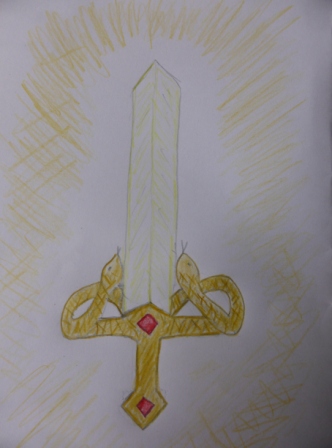
He got up with Arthur’s sword in his hand and the image of two golden serpents on the sword. When the sword was drawn from the sheath, it was like seeing two flames of fire from the serpents’ jaws. And it was not easy for anyone to look at that, because it was so terrifying.’
Rhonabwy’s Dream

On the edge of Celyddon two serpents
danced, ziz-zag bodies tumbling, twining, jaws
bared, jets of fire
hissing from their sword-
like tongues as they rose and fell in terrifying
splendour beneath the golden

sun competing for the favour of a golden-
eyed female. Arthur followed the serpents’
tracks to behold the terrifying
sight. His jaw
dropped as their sword-
like bodies intertwined in deadly combat; fiery

and tempestuous as the fires
of Hell. From the burning undergrowth a golden
lizard scurried to avoid their sword-
play – a flash in a serpents’
eye before jaws
closed over him and a terrifying

darkness. Remembering the terrifying
battle between gods of ice and fire;
Flame-Lipped and Wolf-Jaws,
white and golden-
haired interlocking like serpents
wielding flaming and ice-rimmed swords,

Arthur decided he wanted a sword:
sharp-edged, cloud-lit, to tame those terrifying
rivals. He grasped the serpents,
hissing and spitting fire
in his golden
gauntleted hands beneath their jaws,

took them to the forge of anvil-jawed
Gofannon. “I want a sword
of purest gold,
beaten into the most terrifying
form; living, breathing two flames of fire,
harnessing the strength of these struggling serpents.”

Gofannon plunged the serpents, flickering-eyed, wide-jawed,
into his fire, skins sloughing, blackening, goldening,
intertwining as one terrifying sword.

Caledfwlch

*This is one of the poems that didn’t make it into Gatherer of Souls, but relates to the theme of Gwyn’s opposition to Arthur. The form I have used is the sestina.


Gwythyr and the Lame Ant

In Culhwch and Olwen there is an episode which opens with a curious scene. Gwythyr ap Greidol, ‘Victor son of Scorcher’, ‘was travelling over a mountain’ and heard ‘weeping and woeful wailing… terrible to hear.’ The source was a burning anthill. ‘He rushed forward, and as he came there he unsheathed his sword and cut off the anthill at ground level and so saved them from the fire.’

anna-popovic-187219-unsplash_med

What to make of this strange opening? Why, on earth, was the anthill on fire? Was Gwythyr having a burning bush moment akin to that of Moses on Mount Sinai? The fire shared a similar revelatory and numinous quality. However, the anthill, unlike the bush, definitely appeared to be burning up.

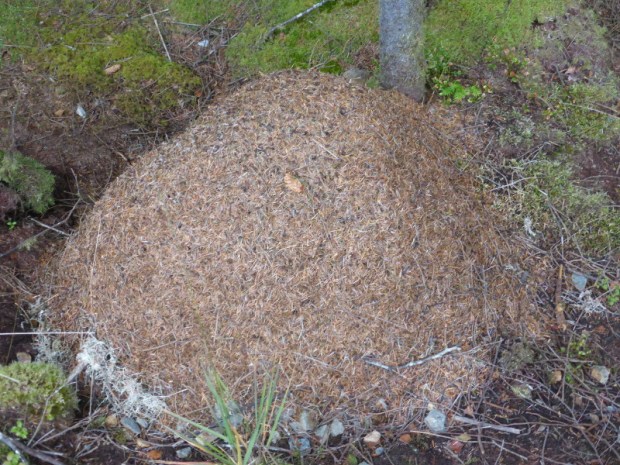
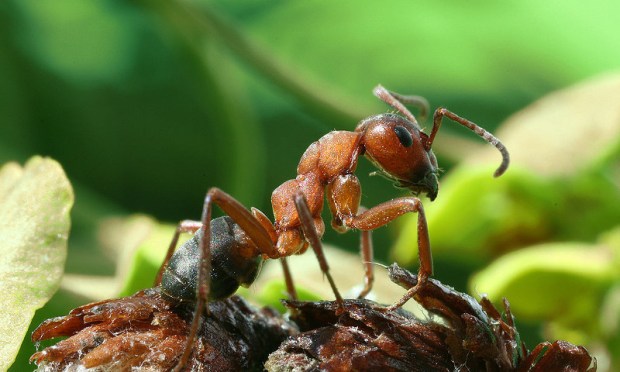
Did Gwythyr’s scorching feet cause the fire? His patronym suggests that, like his father, he is a god of fire and war. If so, his rescue of the ants shows a softer and more compassionate side to his nature. Or did the anthill catch fire on its own? It’s well known that wood ants orientate their complex homes (which have tunnels, storerooms, bedrooms, nurseries and even a graveyard) south toward the sun as if using solar panels in order to harness the energy for heat. Did it just get too hot?

Wood Ant Nest Coed y Brenin

Whatever the case, Gwythyr, rescued the ants. The symbolism of this act reveals Gwythyr’s connections with fire, the sun, the South, summer, and the building, heating, and saving of civilisation. These underlie the rest of the episode and his role in the narrative of Culhwch and Olwen.

Following their rescue the ants said to Gwythyr, ‘Take with you God’s blessing and ours, and that which no man can recover, we will come and recover it for you.’ ‘After that’ they ‘brought the nine hestors of flax seed that Ysbaddaden Bencawr had demanded of Culhwch, in full measure, with none missing except for a single flax seed, but the lame ant brought that before nightfall.’

1024px-A_Formica_rufa_sideview

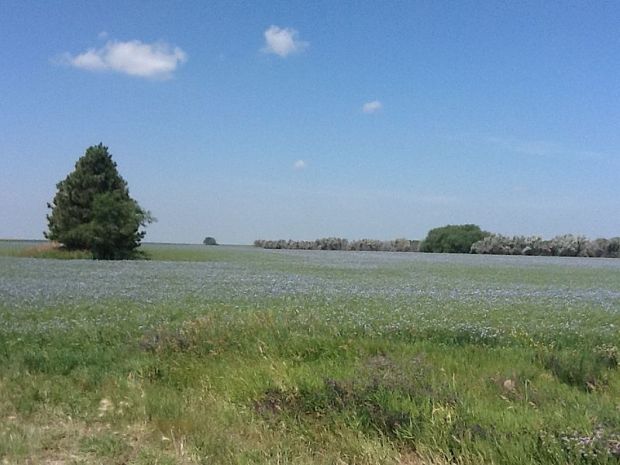
The retrieval of the flax seed was one of the forty amoethau, ‘impossible tasks’, that the giant, Ysbaddaden Bencawr, set Culhwch to win his daughter, Olwen. The flax seed was sown in ‘tilled red soil’ the day Ysbaddaden first met Olwen’s mother yet had never flowered. Culhwch was told he must resow it in a newly ploughed field to make a veil for Olwen in preparation for their wedding day.

Culhwch and Olwen is rooted in the folk motifs of ‘The Giant’s Daughter’ and ‘Six Go Through the World’. However, in this retelling, Culhwch did not fulfil the tasks with six helpers. Instead, his uncle, Arthur, completed them with aid from six warriors and a retinue of outlandish figures with strange abilities (such as Sgilti Sgafndroed who ‘would travel along the tops of trees’, Osla Gyllellfawr whose dagger could bridge a torrent, and Clust son of Clustfieniad ‘if he were buried seven fathoms in the earth he could hear an ant fifty miles away stirring from its bed in the morning’) and pre-Christian gods including Gwythyr, Amaethon the plough-god, and Gofannon the smith-god.

On the surface this narrative is about the overthrow of the primitive and oppressive reign of Ysbaddaden to bring fertility to the land as symbolised by Culhwch and Olwen’s marriage. The story of Gwythyr and the Lame Ant shows how, through an act of kindness, Gwythyr enlisted the aid of helping insects to perform a task no human could accomplish – crawling into the airy interstices of the soil to retrieve the flax seed. It’s possible to imagine that in longer versions there was far more suspense surrounding whether the flax seed was gained by the giant’s deadline and veritable relief when the lame ant finally appeared, limping valiantly, to add the final flax seed to the measure. The sowing and flowering of the seed demonstrates the fertilisation of a barren landscape.

800px-Flax_field

This gentle and benign episode is at odds with the violence pervading the rest of Culhwch and Olwen. Giants were mutilated and beheaded. Orddu the witch was cut in half and her blood drained and bottled. Ysgithrwyn was slaughtered for his tusk, Twrch Trwyth’s seven piglets were killed, and the Twrch only just escaped. Culhwch’s quest to win Olwen was twisted by the narrator to demonstrate Arthur’s civilising of the wild and banishment and all-out slaughter and destruction of the Other.

This conflict is embodied in Arthur’s allegiance with Gwythyr against his rival, Gwyn ap Nudd. In other texts we find out that Greidol was one of Arthur’s forty-two counsellors and that Gwythyr was the father of one of Arthur’s three wives (who are all named Gwenhwyfar!). Gwyn is a ruler of Annwn contrastingly associated with wildness, winter, the North, destructive Annuvian spirits, and death.

In Culhwch and Olwen, Arthur went North to intercede in the battle between Gwyn and Gwythyr for Creiddylad, a fertility goddess. He rescued Gwythyr and his men from Gwyn’s imprisonment, then bound the rivals in combat every May Day and said neither could take the maiden until Judgement Day. This seems to be a Christianised reworking of a seasonal myth in which Gwythyr, Summer, won Creiddylad on Calan Mai and this was surrounded by fertility rites, then she returned to Annwn with Gwyn, Winter, on Nos Galan Gaeaf, and Gwythyr and the powers of summer were imprisoned.

Once Arthur had defeated Gwyn – the Head of Annwn – and the body of Annwn had fallen, he usurped Gwyn’s leadership of the hunt for Twrch Trwyth and slaughtered Ysbaddaden. When his nephew, Culhwch, married Olwen, his civilising hegemony over the wild and the Otherworld was complete.

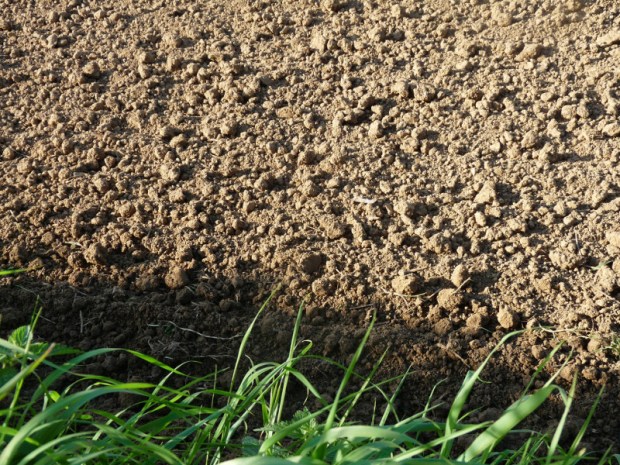
Yet it will not last forever. Otherworld gods don’t stay dead for long and dead giants, witches, and monstrous boars, having joined the furious and vengeful spirits of Annwn, will not remain shut out. Arthur is still dependent on the aid of the gods. And the gods of civilisation are dependent on the Other. Gwythyr depends on the help of the ants to traverse the chthonic regions beneath the red soil to rescue the seeds from the underworld, from the clutches of the spirits of Annwn. And one of those ants is lame. This mission is dangerous and touch-and-go. As more and more of our soil blows away, becomes barren and red, it seems less and less likely the Lame Ant will make the deadline.

soil_free_stock_photo_med

Strange Stars

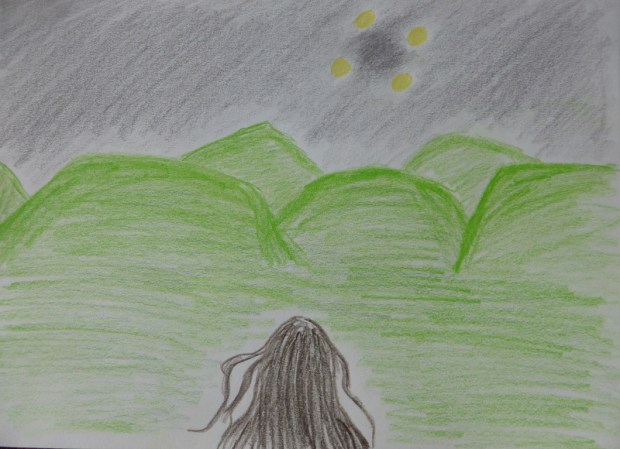
I’m in the midst of a dream, a very normal dream. I’m on the bus to Leyland. Realising I don’t want to go to Leyland at all, knowing I need to be somewhere else, I head for the doors and ask to get off.

Suddenly I’m whisked away by Gwyn (who has a habit of doing this on occasions when he wants to show me something) to a scene of tall, green, mountainous hills. I know they’re in northern Britain, but can’t place them. They’re not quite the Howgills, or in Bowland, or the Lakes, or the Yorkshire Dales.

Above is an ominous grey sky. The wind is gathering at my back. Overhead I see four stars converging on a fifth star. It disappears, obliterated, without a trace, without a sound. I intuit the strange stars are four war planes shooting down a fifth and know with certitude this is happening NOW.

When I awake I question the reality of the dream. Was a war plane really shot down over our northern hills last night? Or were the strange stars something else? And, in the dream world, when is NOW?

Strange Stars

Heart

I carry my heart in my hands
and lay it upon your altar.

“It is so heavy, so sad, so lonely.”

Your spirits bear witness
in the blinking eyes of trees,
shivery breezes rustling leaves,
the distant bones of wind chimes.
Some amongst them are hungry.
They are held back only by
your invisible command.

A part of me wishes it would break.

“What do you want me to do with it?”
You speak wearily from your sleep.

“Bury it and someone will dig it up.

Take it to the end of the universe
and it will return in a space shuttle.

Give it away and it will still be yours.

If I feed it to my hounds or devour it
myself your pain will live on in us.”

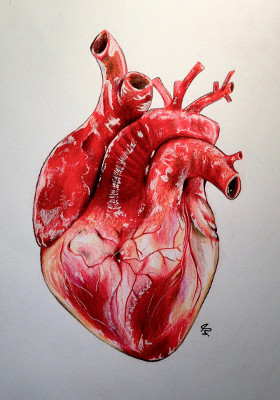
It stares back at me – obdurate aorta,
perfect superior vena cava, pulmonary
arteries and veins, atria and ventricles
pumping out their irrepressible beat.

“Take it away,” you speak abruptly.

As I gather it up and depart tearfully,
“it is strong,” you say more kindly,
“see it as a gift and not as a burden.”

A dozen invisible hands press it back
into my chest and seal the vision shut.

heart-drawing-real-61-by-lunacanan-getdrawings