Uffern ar y Ddaear

Uffern ar y Ddaear – Hell on Earth

I’m surrounded by the smell of dead grass
dreaming of a machine that creates water from nothing.
Someone’s got the radio on too loud and always a baby is wailing.

I lift my nose and smell the smoke on the wind and my throat
is already whining for my master dead on the moors
like cottongrass, heather, butterfly, grasshopper,

where the battle that began on the first of May is still going on
between a fire ignited by one who belongs to the inferno
and the fire fighters with hoses, beaters, leaf blowers.

If only they could bring the rains and autumn winds,
summon them into a summer already too hot and too long,
where reservoirs empty and carbon reservoirs bake, burn, reignite.

I hear they’re trying to save the mast, 1000 feet high, which I saw
lit red like a warning sign beneath the full moon transmitting not only
radio, television for the BBC, ITV, C4, signals for mobile phones,

but some kind of howl we’ve somehow got used to between silences.
What if it goes down like the plane that crashed on the 27th of February
in 1958 when the snow was so cold no-one could rescue the 35 dead

who still roam the hill cursing the faulty radio signals and the drones
flying overhead in the way of the helicopter pouring its cauldron
of water from the reservoirs over the baking baking peat?

When the endless chatter ceases will everyone hear the howl
pouring the dead down Winter Hill like radio waves
from the spring where the Douglas starts

and the mourning song for Winter’s King
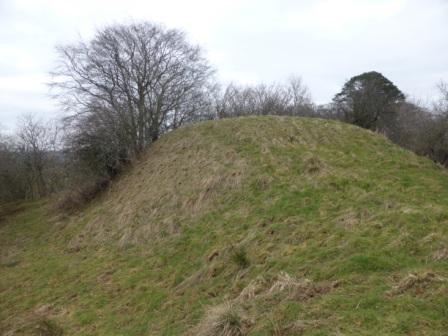
dead like a bog body amongst the burial mounds
beneath the burning feet of his rival who is ever victorious?

When we try to shut Hell’s gate with torches on each side
and inside red as a death hound’s oesophagus will we realise
the throat will never close and the howl wrenched from it is us?

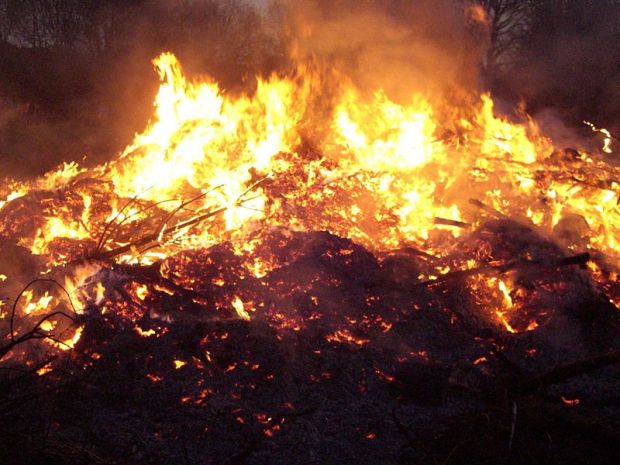
800px-Campfire_flames

*This poem is based on the Winter Hill fire and the mythic battle between Gwyn ap Nudd (Winter) and Gwythyr ap Greidol (Summer).

Scorched

The UK is in the throes of a heat wave. Here in Lancashire temperatures have reached a scorching 30 degrees for four consecutive days. It’s been uncharacteristically warm and dry for two months. Preston, dubbed the ‘wettest city in England’, has barely seen an inch of rain since the beginning of May. Our lawn is scorched, our raspberries are shrivelled, the rivers and streams are running low.

In northern British mythology the first of May is the day that Gwythyr ap Greidol ‘Victor son of Scorcher’ beats Gwyn ap Nudd ‘White son of Mist’ in a ritual battle to win the hand of Creiddylad, a fertility goddess whose name may stem from creir/crair ‘treasure… object of admiration or love.’

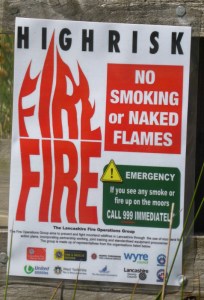
Scorched Fire Sign

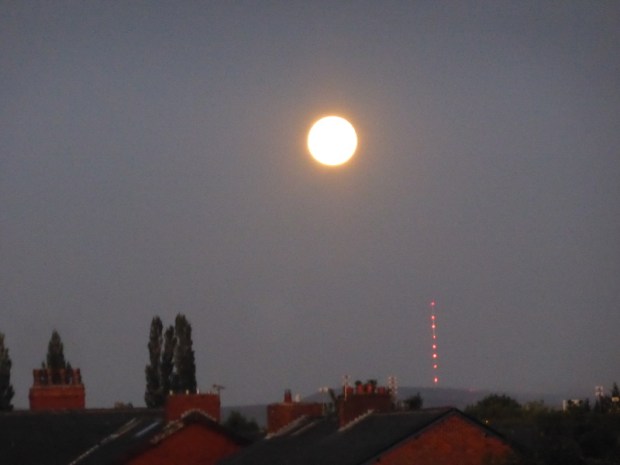
Gwythyr ap Greidol’s name suggests he is a god of victory in combat, the scorching fire of war and the heat of passion. His is the spark that gives life to the land but also initiates the wildfire. Over the last week wildfires have raged across Saddleworth Moor, Rivington Moor, and Winter Hill. The latter seems symbolic of Gwythyr, Summer’s King, beating Gwyn, Winter’s King, on his home ground. Of course I haven’t been up to Winter Hill whilst it is ablaze (last night it reignited in multiple locations), but I noticed the portent of the full moon over the mast, lit up red like a warning sign.

Scorched Winter Hill Warning

People have been evacuated from their houses and schools closed. Less has been said about the numerous birds, small mammals and insects who have lost their lives or been driven from their homes.

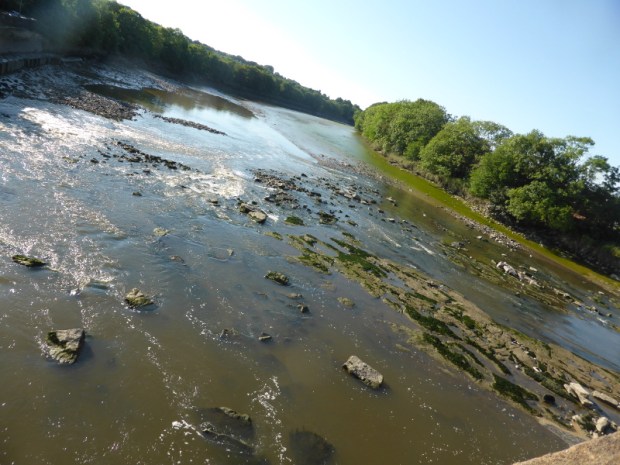
Just as concerning is the Ribble running the lowest I have ever seen, banks of silt and sandstone bedrock exposed, tributaries becoming drier and drier, pond water getting lower and lower. Water shortages have already hit in the South East and Staffordshire. In the North West United Utilities are recommending that we cut down on water use. On next week’s forecast there is not a drop of rain in sight.

Scorched Ribble

May 2018 was the hottest on record in the UK and June looks set to be a record breaker too. What is causing this uncharacteristic heat, empowering Gwythyr, the Victor, to increasingly destructive victories?

***

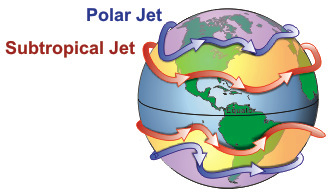
Research suggests this long period of hot weather results from the effects of man-driven global warming on the North Atlantic Polar Front Jet Stream. The Jet Stream is a ‘ribbon’ of winds blowing east to west at up to 200 miles an hour 9 to 16 kilometres above the earth’s surface over the mid-latitudes. It arises due to the contrast between warm tropical air and cold polar air. The differences in the pressure of warm and cold air produce a ‘pressure gradient force’. These winds would blow from high to low pressure, from south to north, if it wasn’t for the Coriolis effect.

jet_streams_wpclipart

The higher the contrast in temperature the stronger the Jet Stream. It is strongest in winter due to the cooling of the poles and weakest in summer due to their warming. Low pressure systems causing wet windy weather occur to the north of the Jet Stream and high pressure systems causing warm settled weather to the south. During the winter, when it’s strong, the Jet Stream lies south of the UK and gives us rain and wind. If it remains to the south we tend to have wet summers too. If the Jet Stream weakens in the summer and shifts north of the UK we are more likely to have hot still weather.

According to Dr. Jennifer Francis and Stephen Vavrus the warming of the Arctic is lessening the temperature gradient between the equator and the North Pole and causing the jet to slow and become ‘wavier’. James Mason explains that when ‘the eastwards progression of these upper waves becomes sluggish or stalls’ this ‘leads to prolonged weather-conditions of one type or another’ like this heat wave, which is dangerous not so much due to its temperature but the length of time without rain leading to wildfires and water shortages and potentially to drought and crop failure.

***

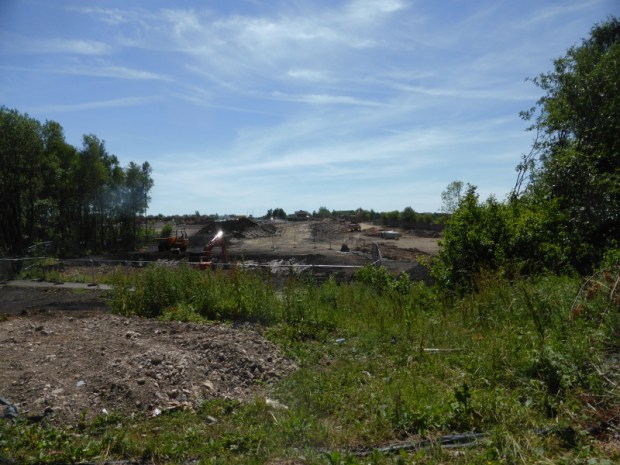
The root of global warming is humanity’s reckless drive for economic growth at the cost of the environment. Our government are aware of the increasing dangers of drought in the summer and flooding in the winter and are taking steps to deal with the effects but not the cause. Instead they are pushing ahead with plans to create more houses, more roads, more jobs; pumping out more greenhouses gases, removing more green space, causing more warming. Here in South Ribble alone 9000 houses are being built along with new and expanded roads and business parks. Preston, South Ribble, and Chorley are being merged into one urban conglomerate with parks as our only green spots.

Lostock Hall Gasworks Development

Dissenting voices are not listened to by the victors. From their positions of wealth and comfort they refuse to see, acknowledge, care about the effects their victory is having on the land and its creatures.

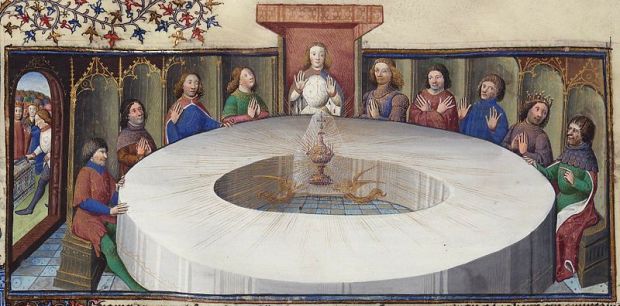
In British mythology Gwythyr and his father sided with Arthur against Gwyn and his spirits, the ancient animals, the monsters, the giants, the witches, and were victorious. In modern Britain the Arthurian court of war-mongering treasure-hoarding politicians and business leaders reign supreme.

800px-Holy-grail-round-table-bnf-ms-120-f524v-14th-detail

What to do in a world where history is determined and written by the victors, when, as Gwyn knows before going into battle every May Day, as Walter Benjamin says, ‘this enemy has not ceased to be victorious’?

Perhaps we must look beyond battle, beyond victory, which can only makes us the next victors, for other ways to our bit for the scorched land, the drying rivers, the dying creatures, the cast-out gods.

SOURCES

Ed Walker, ‘Winter Hill fire reignites and is in multiple locations’, Blog Preston,
John Mason, ‘A Rough Guide to the Jet Stream’, Skeptical Science,
Francis Perraudin, Helen Pidd and Kevin Rawlinson, ‘A hundred soldiers sent in to tackle fire on Saddleworth Moor’, The Guardian
Walter Benjamin, ‘On the Concept of History’, Marxists.Org
BBC Weather, Penwortham, BBC website
Climate change the jet stream’, Climate Central
Preston’s named wettest place in England’, Lancashire Evening Post,
UK weather: Water shortage warnings and hosepipe bans as heatwave intensifies’, The Indepedent
What is the jet stream?’, Met Office

Between Texto and Gloss

I. The Glosa

As an awenydd and polytheist writing and sharing poetry is an essential part of my path. Of all the poetic forms I have experimented with, including English, Welsh, Irish, French, and Italian metres, I have found the Spanish glosa the most conducive to religious practice.

The glosa was invented by the Spanish court poets during the Golden Age. It takes the form of four lines of text (texto) from an existing poet and four ten line stanzas of commentary (gloss) written by the glosser with the final line taken consecutively from the quatrain. The conventional rhyme scheme is ABBAACCDDC.

This versatile form was popular in Parisian literary salons during the reign of Louis XVI, in Germany in the Romantic period, and in Latin America throughout the struggles for independence. It was introduced into the English language comparatively recently by the Canadian poet P. K. Page in 1994.

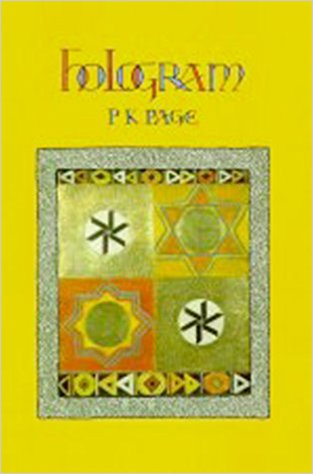
Hologram by P.K.Page

In Hologram, Page used a series of glossae to pay homage to other poets. Her use of a rhyme scheme where the sixth and ninth lines rhyme with the borrowed tenth, and italicisation of the text and its repetitions, has set the form for poetry in English.

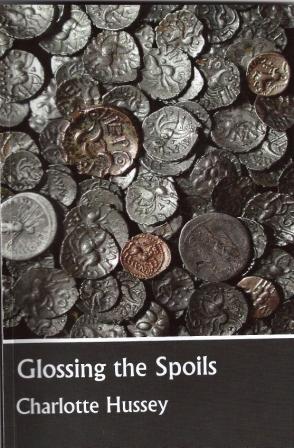
Page’s work prepared the ground for Charlotte Hussey, another Canadian poet, who teaches Old Irish and Arthurian literature and studied Celtic Shamanism with Tom Cowan. Her collection of glossae, Glossing the Spoils (2012), glosses the ‘earliest Western European texts’ to ‘mend a break in tradition and time’, thereby reweaving the ancient myths into modernity.

Glossing the Spoils by Charlotte Hussey

In these glossae Hussey opens a visionary space between texto and gloss where it is possible for conversations with mythic personages and experiences of the transformative qualities of ‘the spoils’ to take place. In ‘Lake of the Cauldron’ she glosses lines from ‘Branwen Daughter of Llyr’. After watching a ‘huge man with yellow-red hair’ emerging ‘from the lake with the cauldron on his back’ the narrator is pushed ‘into the boil’ by a woman with ‘dreadlocks’, ‘long breasts’, and ‘a sweaty belly’ who ‘hacks / shoulder blades, buttocks apart, / scrapes off chunks of flesh / bones sinking then surging to the rim’. The ‘great monstrous man’ from the text watches her dismemberment ‘with an evil thieving look about him’.

Many of the poems reveal the subliminal influence of these near-forgotten myths on our time. ‘Trolls’ is based on lines spoken by the Loathly Lady in Parzival. It ends with ‘The knight, lifting his fluted, iron / visor with its narrow sights’ to ‘stare out’ for ‘a crusading convoy / to join, another holocaust to start, / or a melancholic witch to burn’. Glossing Perlesvaus, Hussey draws parallels between the animistic qualities of the ghastly black shield of the knight’s aggressor with its ‘dragon’s head throwing out / fire and flame with a terrible force’ and the atom bomb – a weapon of destruction she notes cannot be contained or exorcised (1).

I read Glossing the Spoils for the first time in 2012. Discovering the glosa and Hussey’s use of it as a gateway to visionary experience has had a profound effect on my spiritual path and my approach to the medieval Welsh texts that are central to my tradition as an awenydd.

II. The Bull of Conflict

I wrote my first glosa in September that year after an initiatory encounter with Gwyn ap Nudd, a god of the dead and ruler of Annwn, the Brythonic Otherworld. Desiring to honour and thank him for pulling me back from the brink of an abyss and to learn more about him, I decided to gloss four lines from ‘The Dialogue of Gwyn ap Nudd and Gwyddno Garanhir’ (2).

This poem, from The Black Book of Carmarthen (1350) documents a conversation that takes place in the misty hinterland between the worlds following Gwyddno’s death. Gwyn appears as a ‘bull of conflict’ – a divine warrior and psychopomp – to guide Gwyddno back to Annwn. Set during the fall of northern Britain to the Anglo-Saxons it contains some of the most powerful and poignant lines in Western European literature, ending with Gwyn’s lament:

I was there when the warriors of Britain were slain
From the east to the north;
I live on; they are in the grave.

I was there when the warriors of Britain were slain
From the east to the south;
I live on; they are dead.

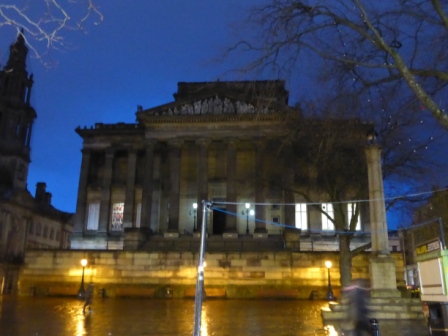
Choosing four lines I started by meditating on the first and was taken back to walking the streets of Preston that afternoon in the aftermath of the Preston Guild Festival (4) and the pervading melancholy. Drifting amongst shadow-people I found myself in the Harris Museum surrounded by the spoils of war and face-to-face with Gwyn stepping from the poem.

The Harris

The Harris Museum

In this familiar yet unfamiliar space, between texto and gloss, between poet and god a conversation took place that would change my life. Gwyn’s imperative of ‘enchanting the shadowlands’ gave me a purpose, became the title of my first book, and has guided my path ever since.

The Bull of Conflict

I come from battle and conflict
With a shield in my hand;
Broken is the helmet
By the pushing of spears.
‘The Dialogue of Gwyddno Garanhir and Gwyn ap Nudd’

On an empty day automata drift,
Wending suit shapes through the mist.
Touchless I fade like a symbol unhitched.
The spoils of war quake in the museum.
Piercing the grey wearing horns of a bull
A white warrior blackened and bloodied
Disguises his limp in an infinite gloom,
On his spear leans, softly says:
“My comrades are slain and yet I live,
I come from battle and conflict.”

His dire avowal brings howling winds,
Chill clutch at my shoulders their lament dins
Of hero light fading from mortal skin.
In glass cabinets swords clash savage,
Raging figures thrash on ragged pages
Chanting the desolate past of ravaged war bands.
With war-torn wisdom, sombrely he whispers:
“These gathered memories to you I give.
Gone are the days I crossed this land
With a shield in my hand.”

His barrage of sadness barks in my mind
Like hapless hounds on a winter’s night.
Fierce their madness, dark their plight,
For the perishing souls they collect,
The past’s great spirit protect.
Like thundering wind obligation overwhelms me.
The blade of futility threatens to unfasten me.
“How do I cherish and defend these memories
When like the kingdoms of Rheged and Elmet
Broken is the helmet?”

I ask the Bull of Conflict.
His tears run bright with the passing of time,
Chariots wheeling in multihued light,
Victims reflected in star lit skies.
He says: “this shadow land needs enchantment
To banish the blight of despair.
Nurture the memories with magic
And they’ll sing a blessed new year.
Do not be pressed into fear
By the pushing of spears.”

This was a once-in-a-lifetime experience which led me to devote myself to Gwyn as my patron god. Nothing quite like it has happened since and I have written many glosa, good and bad.

III. The Spoils

Hussey’s title, Glossing the Spoils, works on many levels. By ‘the spoils’ it refers to the spoils of war, the spoils of the distant past gathered in museums, and the spoils of our literary heritage. It also subtly alludes to ‘The Spoils of Annwn’, from The Book of Taliesin (14th C). Taliesin, the narrator, accompanies Arthur and his men on a raid on Annwn to plunder its treasures, including the cauldron of Pen Annwn, ‘Head of the Otherworld’ (Gwyn). There a catastrophic battle takes place, which Gwyn later describes to Gwyddno:

And to my sorrow
I saw battle at Caer Fanddwy.

At Caer Fanddwy I saw a host
Shields shattered, spears broken,
Violence inflicted by the honoured and fair.

Arthur assaults ‘the honoured and fair’: the fair folk ruled by Gwyn, who are forced to retaliate. In a moment suggestive of both pillage and rape Lleog thrusts his ‘flashing sword’ into the cauldron and it is ‘left behind in Lleminog’s hand’. Arthur escapes from Annwn with the spoils, slamming ‘Hell’s Gate’ shut. Only seven of three ship-loads of his men survive the conflict.

Analogously most of the spoils in our museums have been plundered violently from other lands. The literary heritage of Western Europe is largely based on a history of the victors, mythic and real, crusading, conquering, colonising. As Walter Benjamin says: ‘There is no document of civilization which is not at the same time a document of barbarism.’

These thoughts were on my mind when I embarked on a quest to explore the contemporary relevance of the Thirteen Treasures of the Island of Britain (3). They include the cauldron (which is kept by Dyrnwch the Giant), the Hamper of Gwyddno Garanhir, vessels for eating and drinking, weapons, items of clothing, and vehicles for transport. It is likely most of them were won or stolen from Annwn by the northern British warlords who own them.

Like the spoils evoked by Hussey the treasures are animate, inspirited, alive, expressing their agency through magical qualities. The cauldron will only brew meat for the brave. Brân’s horn provides any drink one wishes. Morgan’s chariot takes a traveller wherever they wish quickly. Rhydderch’s sword bursts into flames in the hand of any man who is well-born.

The Gwyddbwyll Gwenddolau, ‘Chessboard of Gwenddolau’ (4), is made of gold and has silver gwerin, ‘men’, who play by themselves. The men represent Gwenddolau’s army and his enemy and serve a divinatory function – the outcome of the game predicts the result of real battles.

Writing a glosa based on four lines about the chessboard took me on a visionary journey to Gwenddolau’s seat of rule in Arfderydd (modern day Arthuret in Scotland) and gave me a glimpse of its magic outliving Gwenddolau to predict the outcomes of upcoming wars.

View from Liddel Strength

Caer Gwenddolau

The Chessboard of Gwenddolau

The Chessboard of Gwenddolau…
if the pieces are set,
they play by themselves.
The board is gold and the men silver
(5).
The Thirteen Treasures of the Island of Britain

I leave my world behind at Carwinley Burn
to follow the feral steps of a girl,
red-haired, torqued, coloured-trousered,
a wild thing with fox’s teeth at her neck
down a fox-hole to the grave
of Gwenddolau.
Beside his bull-horned corpse
stands a table and upon it a golden board.
Round its edges silver dead men lie.
The Chessboard of Gwenddolau

has lain here as long as my father,”
she says. “It predicts the outcome of battles.
It played before Arfderydd, Catraeth,
when Britain’s air force clashed
with the Luftwaffe,
on the eve of the invasion of Iraq. As yet
it has never mispredicted an event.
At times of peace it sleeps.
At times of threat
if the pieces are set

they play out every move in the coming conflict.”
As she speaks the eyes of a warrior
jerk open and his spasmodic
hand grips his spear.
A warhorse rises from a tangle of stirrups and mane.
A bishop shakes off his robes and delves
for fireballs and mist in his pockets.
Caers rebuild their ramparts.
Returning to health
they play by themselves

speechless as automata resuming their positions.
Warriors move forward two squares
spearing on the diagonal.
Warhorses leap
over the mounting carnage,
on a fiery blast fall into splinters.
A king drags his queen into a caer.
As the bishops prepare the final spell
I am shaken by a premonitory shiver.
The board is gold and the men silver.

For me this glosa reveals the sad fact that since the war-torn period when Gwenddolau lived and now there has barely been a time when the warriors of Britain have not been at war. The uncanny battles fought between the gwerin, beneath the earth, in Annwn, represent our militant history.

As modern glossers we are faced with a past of ravaging, wounding, spoiling: a world spoilt by Arthurian warlords. How, between texto and gloss, can we enchant its shadows, heal its wounds?

Footnotes

(1) In ‘Glossing Faery
(2) At this point I was working with William Skene’s 1868 translation. I recommend the 2015 translation by Greg Hill. The title and glossed lines are from Skene, but the other two are from Hill.
(3) The Thirteen Treasures of the Island of Britain appear in several medieval Welsh manuscripts. The earliest is the autograph of Gwilym Tew in Peniarth Manuscript 51 (1460).
(4) Gwyddbwyll means ‘wood-sense’. Its translation as ‘Chessboard’ isn’t entirely correct because chess originated in the Arab world and was imported to Britain by the Normans in the 11th century.
(5) Here I took the poetic liberty of changing the form and tense of the original quote.

Sources

Charlotte Hussey, Glossing the Spoils, (Awen Publications, 2012)
Charlotte Hussey, ‘Glossing Faery’, Awen ac Awenydd
Greg Hill, ‘The Conversation Between Gwyn ap Nudd and Gwyddno Garanhir’, Awen ac Awenydd,
Keith Ellis, ‘The Glosa: A Genre to be Noticed for its Constructive Values’, Comparative Literature and World Literature, Vol 1. No. 2 (2016)
Marged Haycock, Legendary Poems from the Book of Taliesin, (CMCS, 2007)
P. K. Page, Hologram, (Brick Books, 1995)
Walter Benjamin, ‘On the Concept of History‘, Marxists.org
William Skene, ‘The Dialogue of Gwyn ap Nudd and Gwyddno Garanhir’, The Four Books of Ancient Wales, (Forgotten Books, 2007)

How to Pray

After Rilke’s First Duino Elegy

In Annwn below the earth…
There is one who knows
what sadness
is better than joy
The Hostile Confederacy

Who, if I cried out, would hear me
in the depths of Annwn? Its spirits
have wings yet are not Rilke’s angels.
I am all alone in my dark sobbing.
My hands are clasped. How to pray
when told prayer has little worth?
How to fling out this heartfelt cry
on the unclipped wings of a bird,
throughout Prydain make it heard
and in Annwn below the earth?

Voices, voices, whisper in my ears.
I, unsaintly, do not know how to hear.
How to listen as saints have heard
to voices of spirits derided as devils,
denied, defied on summits of hills,
chthonic shrines now unhallowed?
How to respond to spirits of Annwn
cast out with their unangelic terror?
Deep below, so very deep below
there is one who knows.

Oh what does he know?
Speak, please, not of sorrow,
the hardness of being dead and those
who move between the dead and living,
who died violently and could not rest,
wandered lost to their madness
until he called them home.
Speak instead of the glow
of his mead hall, the gladness
of his poetry, not what sadness

lies within his soul of many souls.
It’s said he contains the fury of the devils
of Annwn within him – an eternal current
sweeping through all the ages,
both worlds. Swept along
only knowing him when we die,
we have lost so much and are so lost.
How to pray to him in his immensity?
Fling out my cry knowing his reply
will be better than joy?seagull-flying-3-public-domain-photos

The Knell of Dark Matter

Hairy_Dark_Matter_Wikipedia_Commons

“Dark matter” – a whisper from a guide from another world.

I google it and find out that on the 7th of May the US Department of Energy approved $19 million for the Super Cryogenic Dark Matter Search at the SNOLAB facility in Ontario, which will be led by SLAC.

Scientists posit the existence of dark matter because the movements of galaxies cannot be explained in terms of visible matter alone. Measurements suggest 80 per cent of the universe is dark matter. Unfortunately dark matter has not yet been detected because it doesn’t emit light or energy.

According to a popular theory it is made up of weakly interacting particles (WIMPs) that ‘pass through regular matter like ghosts, but every so often may collide with an atom of regular matter, causing a reaction scientists can note’. Detecting this reaction is the aim of the SuperCDMS SNOLAB experiment.

SNOLAB’s laboratory, located 6,800 feet underground in an abandoned nickel mine, is the deepest in North America. This ensures it is shielded from unwanted background signals from cosmic radiation.

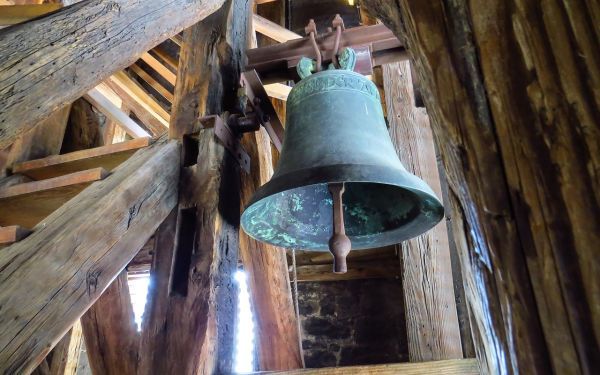
The apparatus will consist of four detector towers containing lattices of silicon and germanium crystals, which will vibrate if struck by a WIMP. To measure these tiny vibrations, these ‘atomic jiggles’, ‘the crystals need to be cooled to less than minus 459.6 degrees Fahrenheit – a fraction of a degree above absolute zero temperature.’ Absolute zero is the coldest matter can be. ‘Near this state any movement on the atomic level should be detectable.’ Therefore the towers will be placed in a cryogenic container called a SNOBOX. Hopefully a WIMP will ring one of the crystal detectors ‘like an atomic bell’ and leave its mysterious ‘fingerprint’. The experiment will begin in the 2020s.

My initial reaction was “how very Annuvian!” Way before science most ancient peoples have been aware of a invisible otherworld of ghost-like matter, a vast otherness that holds and shapes the visible. Within Brythonic tradition it is known as Annwn, ‘the Deep’, and later became Faerie. Frequently located underground, across water, in the starry heavens, it is a realm of ghosts, fay, chthonic gods usually visible and audible only to the eyes and ears of the soul, although the vibrations of their presence can sometimes be detected in the liminal and deep places of Thisworld.

So this quest is to capture a particle of Annwn, a particle of Faerie. No surprises it must take place so deep underground in conditions of ultracold. This brings to mind the sleep of Pen Annwn, Winter’s King, Gwyn ap Nudd, from Calan Mai (1st or 8th May) throughout the summer. His place of rest is Caer Ochren, the castle of cold stone. It is colder than ice. Near absolute zero. At this temperature the restless spirits of Annwn who threaten to destroy Thisworld are also more restful. Could one be caught in frozen slowness, ring that bell, a knelling from Faerie, give the scientists proof?

Following these contemplations I checked out the astrology. Several years ago, Brian Taylor, who sadly passed in February this year, made me aware of the influence of Pluto over events concerning the underworld and atomic science. In 1985, in the aftermath of Chernobyl, he began an astrological essay tracing ‘the exteriorisation of Pluto in the history of the nuclear era’ which he completed in 1995.

Brian also mapped the synchronicities surrounding the photographing of Pluto on the 14th of July 2015. These included the culmination of the deal between the West and Iran over the Iranian nuclear programme which, perhaps not so coincidentally, Trump recently withdrew the US from this week.

In ‘Shock and Awe: The Astrology of May 2018’ Anna Applegate says ‘on Monday, May 7, in the wee hours of the morning (3:52 CDT), Mercury in Aries forms a square to Underworld Lord Pluto in Capricorn.’ This was the day of the press release for the SuperCDMS SNOLAB experiment.

Anna continues, ‘The Taurus Sun will also make a trine to transformative Pluto; it occurs on Friday, May 11 at 6:10 p.m.’ ‘After Mercury enters the sign of Taurus on the Sunday 13th, the square to Pluto will transform into a more “benevolent” trine, as Taurus and Capricorn are sister signs.’

Although I have little knowledge of astrology I have long been aware of the influence of Pluto in my life. I’m a Scorpio, which is ruled by Pluto. According to Brian, who read my birth chart, I ‘have Pluto rising’, ‘angular Pluto is a powerful placement’ and ‘the moon’s nodes exactly square Pluto’. Sun and Mercury are also in Scorpio. Brian also charted transits to my natal Pluto for the day I met Gwyn.

For me, Gwyn is the Brythonic equivalent of Pluto, ruler of winter and the underworld, and the primary guiding force in my life. The synchronicities between the transits of Pluto, the inaugration of the SuperCDMS SNOLAB experiment deep underground with its cryogenic SNOBOX, and the sleep of Gwyn and his spirits in the castle of cold stone feel important. Is this a portent? A warning about something that will happen if the bell is rung and the knell of dark matter begins to echo from Annwn?

full_Church_Bell_(Pixabay_Public_Domain)

SOURCES

Anna Applegate, ‘Shock and Awe: The Astrology of May 2018’, Amor et Mortem, 1st May 2015
Brian Taylor, ‘Photographing the Underworld? A Note on NASA’s Pluto Fly-By’, Animist Jottings, 18th July 2015
Dana Dovey, ‘What is dark matter? Scientists may be on cusp of detecting of finally detecting elusive material’, Newsweek, 10th May 2015
Jay Bennett, ‘The Search for Dark Matter Continues, More Than a Mile Underground’, Popular Mechanics, 9th May 2015
Manuel Gnida, ‘Construction Begins on One of the World’s Most Sensitive Dark Matter Experiments’, SLAC National Accelerator Laboratory, 7th May 2015

Burial

A Poem for Calan Mai

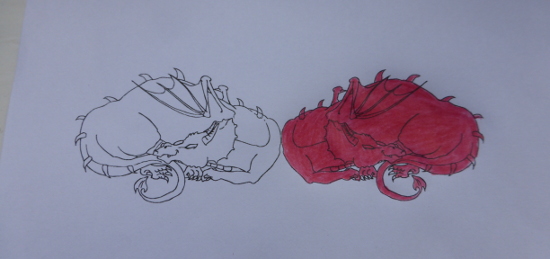
Two gods fight. Two dragons circle the sky.
A scream is in my mouth – soon my god will be gone.

He dies so the bluebells, mayflowers, hawthorn blossoms thrive,
baby birds pecking from eggs stumbling pink into the dawn.

There will be a victory tonight and there will be a wedding.
There will be a death tonight and there will be a burial.

Whilst lovers dance the maypole and tryst in the woods
I will walk alone without a bouquet and in silence

down forgotten paths to the castle of cold stone
where winter is entombed while summer rules

to pay my regards in tears of dew and mourning songs
amongst the kindly fay, the winged horses, the howling hounds.

While others laugh at the wedding I will weep at the funeral.
I will bury two dragons in the stone chest of my heart.

I will bury two dragons

Prayer: A Little Window

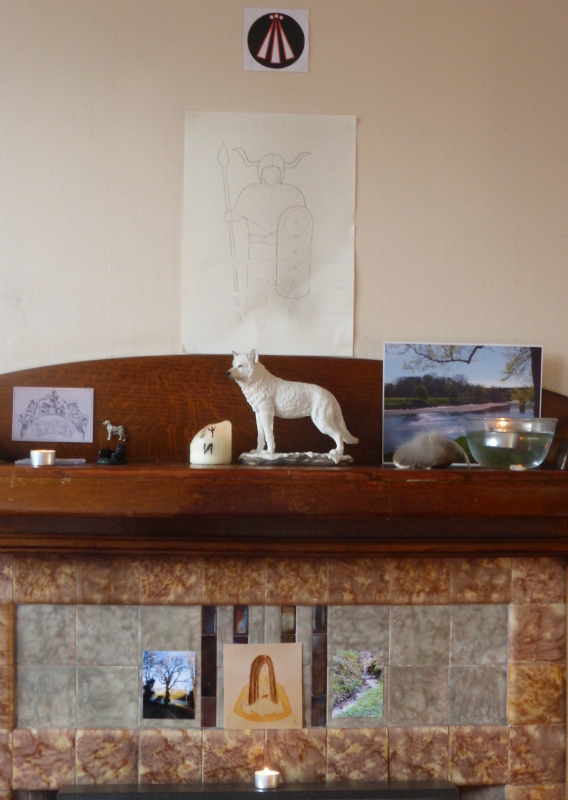
Following Anna Applegate’s comment on the lack of discourse on prayer in the Pagan communities I’ve decided to share a little window into my prayer life. I’ve never done this before because, rather than saying set prayers, I simply speak to the gods and spirits from the heart. These are examples of heartfelt words rather than literary masterpieces. I’d be interested to hear from others about their daily prayers.

Altars April 2018 II

Morning

I.
Spirit of this house
Spirits of Greencroft Valley
Spirits of this land on which I stand
I give thanks to you.

Lady of the Marsh
Lady of the sacred hill of Penwortham
Lady of the wells now lost
I give thanks to you.

Belisama, Goddess of the Ribble, flowing
from Gavel Gap through Settle, Clitheroe, Ribchester
bringing your gift of sacred waters
I give thanks to you.

Nodens and the Weather Shapers
cloud-makers, wind-bringers
mist, fog, and rain-bearers
I give thanks to you.

Gwyn ap Nudd
first amongst my gods my forever patron
who leads the dead and living to Annwn
I give thanks to you.

II.

Gwyn ap Nudd,
Lord of Annwn,
Guide of Souls,
Light of the Mist,

God who dwells
in the Otherworld yet
close as my heartbeat
close as my breath*

grant me guidance
from Annwn’s dark heart

and inspiration
from Annwn’s deep depths.

As I walk each step
in service to you.

(Followed by a recital of the Annuvian Awen and a meditation, journey, or divination).

Evening

Gwyn ap Nudd
Gatherer of Souls
Walker Between Worlds

God who guides the dead
God who walks the brink of madness
God who contains the fury
of the spirits of Annwn

I come to you in awe and reverence
I come to you in love and service.

Let us share our journeys…

(Followed by communion with Gwyn)

Bedtime

Nodens Lord of Dreams
God of that deep and absurd world
that I vow to remember the next morning
before it slips from my mind with
the waters of forgetting

I give thanks for the joy of sleeping
I give thanks for the joy of dreaming

and these were last night’s dreams…

Nodens Lord of Dreams
guide me in this night of deep dreaming.

*Phrase borrowed from Greg Hill.

Afagddu, Prophet of Darkness

I. The Dark Son

Afagddu, ‘Utter Darkness’, is a minor figure in Welsh mythology whose significance has not been recognised because he was pushed out of the way by Gwion Bach, who became the celebrated bard, Taliesin.

Afagddu’s mother is Ceridwen. She and God are called on interchangeably as the ultimate source of awen, divine inspiration, by the medieval bards. This suggests she is the greatest of the Brythonic deities, the Great Goddess closest to a creator God, Old Mother Universe, the creatrix and destructrix from which all life is born and to whom it returns at the moment of death.

If this is the case, then surely her son, Afagddu, should hold a greater position within Brythonic tradition? Why is his story shoved aside like a dirty secret? Why is his name not better known?

I believe this is partly due to his hideous apparel. In Elis Gruffudd’s recording of ‘The Story of Taliesin’ we are told his ‘looks, shape and carriage were extraordinarily odious’. Firstly they named him Morfran, ‘Great Crow’ or ‘Sea Raven’ but ended up calling him Afagddu ‘Utter Darkness’ ‘on account of his gloomy appearance’. John Jones’ redaction describes him as ‘the most ill-favoured man in the world’ and compares him to his sister, Creirwy, ‘Living Treasure’, ‘the fairest maiden in the world’.

Afagddu’s ancestry goes some way to explaining his looks. Ceridwen’s name can be translated as ‘crooked wife’ (from cwrr, ‘crooked’, and fen, ‘wife’) and ‘fair and loved’ (from cerid, ‘love’ and wen, ‘fair’). Perhaps because she is both crooked and fair she gave birth to crooked and fair children. Afagddu’s father is Tegid Foel, ‘the Bald’, whose patrimony is Llyn Tegid. Tegid’s baldness, along with his rulership of a lake rather than a human kingdom, suggest he is a monstrous water deity.

Unfortunately for Afagddu he was born ‘in the days when Arthur started to rule’ – a period when Christianity was the religion of warrior elites who built their status through the repression of the gods, monsters, ancestral animals, and witches of the ancient British pagan traditions. Ceridwen was allegedly keen for Afagddu to ‘win acceptance amongst the nobility.’ It’s my suspicion this was the addition of a Christian interculator who was either ignorant of Ceridwen’s identity as a goddess or purposefully erased it. At some point she was reduced to a ‘magician’ and Tegid to a ‘nobleman’.

II. The Spirit of Prophecy

In Gruffudd’s recording, after realising that Afagddu will not be recognised for his looks, Ceridwen decided instead to ‘make him full of the spirit of prophecy and a great prognosticator of the world to come.’ The link between his ‘ugliness’ and being chosen for a prophetic vocation may date back to traditions of pagan Britain wherein differences were celebrated and revered rather than despised.

After ‘labouring long in her arts’ Ceridwen discovered a way of achieving prophetic knowledge by choosing certain herbs on certain hours and days and brewing them in a cauldron for a year and a day. Resultingly ‘three drops containing all the virtues of the multitude of herbs would spring forth; on whatever man they fell… he would be extraordinarily learned and full of the spirit of prophecy.’

Interestingly, in John Jones’ version, Ceridwen learnt to ‘boil a cauldron of awen’ from the book of the Fferyllt, ‘Alchemists’, and books of astrology. We find a steady shift from a pagan standpoint where Ceridwen was the omniscient mother of the stars and planets and herbs and well aware of their motions and qualities, to her working hard at her art, to her learning it from the books of human mages.

In both variants Ceridwen made the fatal mistake of recruiting a young man called Gwion Bach to stir the cauldron. In Gruffudd’s, after a year and a day had passed, she stationed Afagddu beside the vessel to receive the drops on the allotted hour then… fell asleep!!! When the trio sprang forth, Gwion shoved Afagddu out of the way and received their blessings. In Jones’s, ‘three drops of liquid accidentally leapt from the cauldron onto the thumb of Gwion Bach; lest he be burnt, he thrust the digit into his mouth.’ In the former Gwion was an active thief and in the latter an innocent bystander.
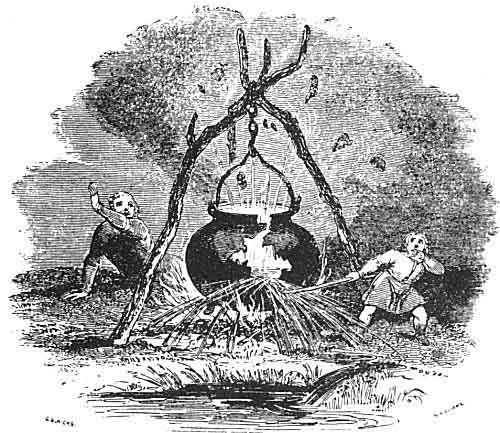
From 'The Story of Taliesin' on Sacred Texts

In both retellings the cauldron shattered and the remains of the brew spilled out and poisoned the land. Ceridwen was, understandably, furious. After finding out what happened from Afagddu she chased Gwion through a variety of shapes (he fled as hare, she pursued as a greyhound, he leapt into a river as a salmon and she dived as an otter, he took flight as a bird and she followed as a hawk) before he became a grain of wheat and she became a black hen and swallowed him whole.

For Afagddu her reaction was too late. Pushed aside by Gwion, who was reborn all-knowing and shiny-browed to take centre stage as Taliesin, erased from the story, he fell into utter darkness. We never find out how he felt or reacted to the theft of the awen. Imagining our own emotions we can assume he was disappointed, angry, jealous, bitter, consumed by wrath. Bereft of the spirit of prophecy, abandoned by his mother in a poisoned land, disparaged by the nobility, Afagddu chose another path.

III. The Man With Stag’s Hairs

From other texts we learn ‘Morfran son of Tegid’ became a fearsome warrior. In The Triads of the Island of Britain, Triad 24, he is listed with Gilbert son of Cadgyffro and Gwgawn Red-Sword as one of ‘Three Slaughter-Blocks of the Island of Britain’. Someone who is an ysgymyd aeruaeu, ‘slaughter block’ or ‘chopping block of battles’ ‘holds his ground firmly… in spite of the enemy’s blows’.

Morfran son of Tegid appears in the court list in Culhwch and Olwen:‘no-one wounded him at the battle of Camlan because of his ugliness. Everyone thought he was an attendant demon; he had hair on him like a stag.’ He is compared, this time, with ‘Sanddef Pryd Angel angel-face – no-one wounded him at the battle of Camlan because of his beauty. Everyone supposed he was an attendant angel.’

Morfran is still clearly despised. The reference to him having ‘stag’s hair’ connects him with other warriors who became wyllt ‘mad’ or ‘wild’ in battle and took the forms of wild animals. In The Gododdin combatants are described as ‘bull of an army’, ‘wolf in fury’, ‘terrible bear’ and ‘celebrated stag’.

He shares a kinship with the shapeshifters who Arthur captured and forced to join his hunt for Twrch Trwyth ‘King of Boars’. These include Rhymi who took ‘the form of a she-wolf’ and gwyllon such as Cynedyr Wyllt who was ‘nine times wilder than the wildest beast’. Whether Afagddu fought on Arthur’s side freely or was coerced remains uncertain. Whatever the case his description suggests he became wyllt and battled in a stag-like guise.

The comparison of Morfran to an ‘attendant demon’ is evocative of the ‘devils of Annwn’ led by Gwyn ap Nudd, a pagan god, who gathers the souls of the dead from the battlefield. Gwyn’s epithet is ‘Bull of Battle’ and he has ‘horns on his head’. His host, members of his ‘Wild Hunt’, are part animal.

The evocation of attendant demons and angels gathering souls from the battlefield presents us with a vivid depiction of the conflict between paganism and Christianity. Morfran is placed on the side of Gwyn.

IV. The Bird of Wrath

We find further evidence of Morfran/Afagddu’s connections with battlefield demons in ‘The Death Song of Uther Pendragon’ in The Book of Taliesin. Uncannily the celebrated bard channels Uther’s voice:

I broke a hundred forts.
I slew a hundred stewards.
I bestowed a hundred mantles.
I cut off a hundred heads.

Later lines refer to Afagddu:

The unskillful
May he be possessed by the ravens and eagle and bird of wrath.
Avagddu came to him with his equal,
When the bands of four men feed between two plains.

These lines are obtuse and require unpacking. Firstly we find a reference to an unskillful warrior who Taliesin-as-Uther calls for to be ‘possessed by the ravens and eagle and bird of wrath’. This seems, again, to be evoking the tradition of shapeshifting wherein warriors were possessed by a bird or animal.

The ‘bird of wrath’ is Morfran/Afagddu; he appears in the next line and Morfran means ‘Great Crow’ or ‘Sea Raven’, a name for a cormorant. His approach with his ‘equal’ refers to his bird-form.

The final line is the most difficult to comprehend. Its reference to bands of four men feeding is suggestive of bird-like or animal-like behaviour. In the context of the poem I believe it refers to men-in-bird-form feeding on the corpses of the dead on a battlefield ‘between two plains’.

References to corpse-eating birds are prevalent throughout medieval Welsh literature. Gwenddolau owns two birds: ‘two corpses of the Cymry they ate for dinner, and two for their supper’. The Eagle of Pengwern is ‘greedy for the flesh of Cynddylan’. Gwyn’s ravens ‘croak over gore’. In Rhonabwy’s Dream, Owain’s warband, who are described as ravens, not only kill Arthur’s army but carry off their heads, eyes, ears, and arms. The Papil Stone depicts two bird-headed men bearing a human head between their long beaks, which make them look more like cormorants than carrion birds.

The image of men-as-birds feeding on the dead is a horrific one and perhaps portrays fearful superstitions about warriors who become wyllt. These may not be entirely ungrounded. Bones bearing human teeth marks from Gough’s cave show some of the early Britons practiced cannibalism. In Culhwch and Olwen, Gwyn forced Cyledyr to eat his father’s heart, making him wyllt.

The evidence suggests Afagddu not only partook in the slaughter at numerous battles but may also have joined the birds who feasted on the corpses of the dead. His name became a self-fulfilling prophecy. Driven over the edge by losing the awen he lost himself in war and surrendered to utter darkness.

V. A Night of Unordinary Darkness

Afagddu’s name is derived from y faggdu, ‘a night of unordinary darkness’. What happened to him after he was seen at Camlan amongst the battlefield demons remains unknown. If, as I have surmised, he killed other men and ate their flesh, we can guess he descended traumatised into a long dark night.

That most famous of the gwyllon, Myrddin Wyllt, slew his sister’s son and daughter whilst battle-mad. After the Battle of Arfderydd he witnessed Gwyn and his host arriving to gather the souls of the dead. One of Gwyn’s spirits tore him out of himself and assigned him to the forest of Celyddon where he recovered from trauma, guilt, and grief and learnt the arts of poetry and prophecy.

Is it possible Afagddu also made a recovery and became a poet and prophet? Lines from ‘The Hostile Confederacy’, from The Book of Taliesin, suggest he did:

Until death it shall be obscure –
Afagddu’s declamation:
skilfully he brought forth
speech in metre.

Here we find references to the obscurity of his prophetic speech and to his mastery of poetic metre. Afagddu has become a poet-prophet. How he won his awen and became filled with the spirit of prophecy remains obscure as his declamation. I have only my own experiences and intuitions to go on.

Three years ago, during a conversation with Gwyn, I was transported into ‘The Story of Taliesin’. I found myself in Afagddu’s shoes, watching as the cauldron shattered and the contents spilled out, poisoning the streams and rivers, killing Gwyddno Garanhir’s horses and other animals and birds. I walked with Afagddu as he attempted to comfort the dying. Since then I have been inspired to write about him visiting other areas polluted by man-made disasters, helping those affected, cleaning up the land.

Whereas Myrddin found healing in the forest of Celyddon, Afagddu found it in the darkest of places. Perhaps undoing the damage caused by his mother’s cauldron is his way of making reparations, not only for the toxic effects of her attempt to brew the awen for him, but for his own atrocities.

Afagddu’s awen arises from nights of darkness and poisoning and death in which he sees his own nature reflected. They have their own poetry, which seems ugly to an Arthurian eye, but less so from an Annuvian perspective that embraces what our society derides as hideous as poetic and prophetic.

Afagddu’s story is not without happiness. He owns a horse, ‘Silver-White, Proud and Fair’, one of ‘Three Beloved Horses of the Island of Britain’. Her fairness speaks of faerie/Annuvian qualities. I believe she was a gift from Annwn, from Gwyn, in return for his help with the dead and dying lands. She represents his awen, galloping silver-white, proud and fair, from the longest and darkest of nights.

SOURCES

A.O.H. Jarman (transl.), Aneirin – Gododdin, (Gomer Press, 1998)
Charlotte Guest, The Mabinogion, (1877)
Kristoffer Hughes, From the Cauldron Born, (Llewellyn, 2013)
Marged Haycock, Legendary Poems from the Book of Taliesin, (CMCS, 2007)
Patrick Ford, Mabinogi and Other Welsh Tales, (University of California Press, 2008)
Rachel Bromwich (ed), The Triads of the Island of Britain, (University of Wales Press, 2014)
William F. Skene (transl), The Four Ancient Books of Wales, (Forgotten Books 2007)
Methanogens and the End of the World

I. In the Deepest of Places…

They’re possibly the oldest living beings on earth. They possess the power to create and destroy life-giving climates. They thrive in the deepest of places and most extreme conditions – submarine springs, volcanic vents, hot desert sands, glacial ice – as well as in marshlands, rice paddies, landfills, sewage plants, and in the guts of termites, ruminants, and humans. Discovering their existence forced scientists to restructure the phylogenetic tree and rethink the origins of life.

Their name is only just beginning to make it into our mainstream vocabulary. They are methanogens.

Methanogens are methane generating microorganisms who can only survive in anaerobic environments. Because of their microscopic size and inability to survive in air containing oxygen they weren’t identified until the 20th century. Yet suspicions about their existence had been inferred.

Gas collecting in the marshes near Angera JPEG

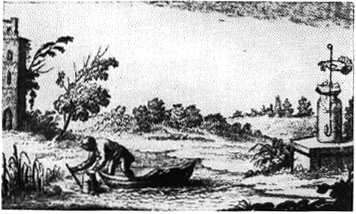
In 1776 Alessandro Volta discovered the flammability of marsh gas on Lake Maggiore. Poking the reedy bottom of the marsh with his cane he collected the bubbles in a gas container then set fire to it, producing ‘a beautiful blue flame’. Natural scientists called this ‘swamp air’ ‘carbonated hydrogen’ and in 1865 ‘methan’ was proposed. ‘Methane’ was accepted in 1892.

Pierre Jacques Antoine Béchamp was the first to suspect methane was formed by a microbiological process as the result of a fermentation experiment in 1868. It was not until 1936 that the first methanogen, Methanobacillus omelianskii, was isolated with Delft canal sediment by Horace Albert Barker. This marked ‘the beginning of the modern era for the study of methanogenesis.’

Scientists went on to find out methanogenesis, a form of anaerobic respiration which uses carbon rather than oxygen as an electron acceptor, takes place in three ways: carbon dioxide reduction (hydrogenotrophic methanogenesis), cleavage of acetates (acetoclatic methanogenesis), and the breakdown of methylated compounds (methylotrophic methanogenesis).

II. Ancient Things

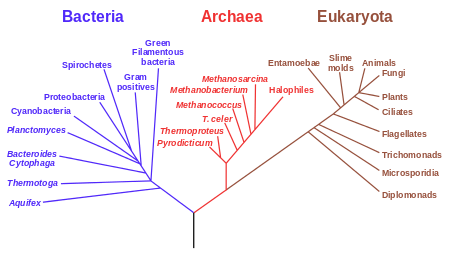
In 1997, during an experiment with RNA, Carl Woese discovered that methanogens are phylogenetically different from bacteria and eukaryota (this branch includes fungi, plants, and animals) establishing a third domain on the phylogenetic tree.

450px-Phylogenetic_tree.svg

This new group of microorganisms was named archaea, ‘ancient things’. Because their ‘methanogenic metabolism is ideally suited to the kind of atmosphere thought to have existed on the primitive earth: one that was rich in carbon dioxide and included some hydrogen but virtually no oxygen’, Woese asserted they could be the earliest living beings on our planet.

According to James F. Fasting their generation of methane, a greenhouse gas, from carbon dioxide and hydrogen, kept the young earth warm between 3.5 and 2.5 billion years ago when the sun burnt only 80 per cent as brightly as today. They played a significant role in the chain of events that led to the development of other life forms.

Methanogens were driven underground by the great oxygenation event 2.3 billion years ago – a time that corresponds with the first Global Ice Age. The world-changing effects of methanogenesis were felt again 252 million years ago when a bacteria transferred two genes to methanosarcina. This allowed them to feed on carbon on the sea floor, releasing immense amounts of methane into the atmosphere, raising the temperatures and acidifying oceans, leading to the Permian-Triassic Extinction Event, which killed 96% of species on the earth.

III. A Dangerous Game

The greenhouse gases responsible for global warming in our current era are carbon dioxide (82%), methane (10%), nitrous oxide (5%), and fluorinated gases (3%). Although methane only accounts for 10% ‘it is 25 times more powerful than carbon dioxide in global warming potential’.

74% of methane emissions in our atmosphere are produced by methanogens. The main sources are wetlands (22%), coal and oil mining and natural gas (19%), enteric fermentation (16%), rice cultivation (12%), biomass burning (8%), landfills (6%), and sewage treatment (6%). Our ability to understand and work with methanogens will play a crucial role in our future. A great deal of research has been carried out into the pros and cons of methanogenesis.

A study by Susannah G. Tringe et al. focuses on ‘a pilot-scale restored wetland in the Sacramento-San Joaquin Delta of California.’ Tringe notes that wetlands are effective carbon sinks, but methane production can outweigh the benefits in terms of emissions of greenhouse gases. By mapping the relationships between microbial communities and gas measurements her group aims to ‘reduce methane flux to the atmosphere and enhance belowground carbon storage.’

Several studies have been carried out on methanogenesis in coal mines. It has been discovered that the majority of emissions from mines are biogenic as opposed to thermogenic and take place by acetoclastic methanogensis from hard coal and mine timber. Ways of using the methane for energy are being explored. Methanogenesis also occurs in shale and experiments in biostimulation to improve productivity in combination with fracking are in progress.

Studies on landfills, a new source of organic (and inorganic) matter for these ingenuous microorganisms, show that methanogenesis, which follows hydrolysis, acidification, and acetogenesis, is an essential process in the breakdown of ‘municipal solid waste’. In landfills, as well as in wetlands, coal, and shale, acetoclastic methanogens work with acetate-producing bacteria in a syntrophic relationship. This also occurs in the breakdown of sewage. Again, ways of using the methane for energy and thus reducing emissions are being explored.

A common theme that cropped up in all these studies is that the complex interrelationships between methanogens and other bacteria and the role of methanogenesis in the global cycles are not fully understood. Nothing is said about the intelligence and agency of these secretive near-invisible beings who have played a key role in the shaping of our climate for billions of years.

Methanosarcina, Wikipedia

Science, measuring, quantifying, postulating, manipulating, rarely listens to or respects its subjects. The Permian-Triassic extinction, which took place as the consequence of a small genetic change, highlights the potential dangers of attempting to manipulate these complex microorganisms. Without understanding, without relationship, we are playing a dangerous game.

IV. Listening to the Deep

For me as an awenydd working with Brythonic cosmology, methanogens, chthonic beings who inhabit the deepest of places and feed on organic matter composed of dead organisms, seem associated with Annwn, ‘the Deep’, the Otherworld, where the dead and dead worlds reside. Death-eaters par excellence, their activities release the gaseous spirits of the dead into the air.

These processes are essential on both physical and spiritual levels and are part of the earth’s innate balance. When this is disturbed, as now, by mankind’s raiding of Annwn for fossil fuels and release of its spirits, extinction events swiftly follow to correct the disequilibrium.

This knowledge from the depths of time is embodied in Brythonic mythology wherein Gwyn ap Nudd is said to contain the spirits of Annwn in order to prevent their destruction of the world.

Whereas we once mined with due reverence for the rules of the gods of the deep (Nodens/Nudd,‘Lord of the Mines’ was venerated at an iron ore mine at Lydney), who keep its spirits in check, their forgetting has led to all-out ravaging with disastrous consequences.

Over two thousands miners in Lancashire alone have lost their lives, many as a result of explosions caused by methane, which is also a threat at landfill sites. Flammable methane haunts the taps of people whose water has been contaminated by fracking. Global warming, caused by greenhouse gases, is claiming the lives of at least ten thousand species a year.

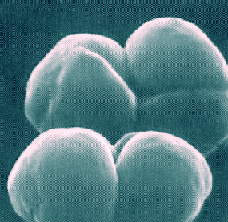
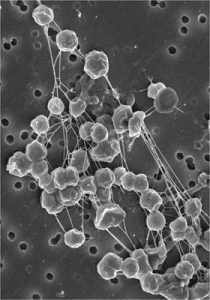
As the death toll rises I believe it is no coincidence that methanogens have begun to reveal themselves to us (as opposed to us thinking we are so clever finding them); coccoid, baccilic, in enigmatic strings and webs, under the UV illumination of fluorescence microscopes. These 3.5 billion year old microorganisms who dwell deep in our guts are clearly communicating.

Methanogen Microwiki

Will we learn their language? Will we listen? If we do will they lead us to redemption or destruction?

Gwyn ap Nudd,
you who have travelled time
to know the secrets of archaea:
their containment and release,

you who exist in the no-time
of Annwn between life and death
please teach us to listen
with reverence again

before you and your spirits
decide our end.

SOURCES

Carl Woese, ‘Archaebacteria: The Third Domain of Life Missed by Biologists for Decades’, Scientific American, (2012, originally published 1981)
Colin Schultz, ‘How a Single Act of Evolution Nearly Wiped Out All Life on Earth’, Smithsonian
Daniela Buckroithner, ‘Microbiology of Landfill Sites’, University of Natural Resources and Life Sciences, Masters Thesis, (2015)
Fabrizio Colozimio et al.,‘Biogenic methane in shale gas and coal bed methane: A review of current knowledge and gaps’, International Journal of Coal Geology, Vol. 165, (2016)
James F. Kasting, ‘When Methane Made Climate,’ Scientific American, (2015)
Ralph S. Wolfe, ‘A Historical Overview of Methanogenesis’, Methanogenesis: Physiology, Biochemistry & Genetics, (Chapman and Hall, 1993)
Sabrina Beckman et al, ‘Acetogens and Acetoclastic Methanosarcinales Govern Methane Formation in Abandoned Coal Mines’, Applied and Environmental Biology, (2011)
Shaomei He et al., ‘Patterns in Wetland Microbial Community Composition and Functional Gene Repertoire Associated with Methane Emissions’, American Society for Microbiology, (2015)

The Defwy – A Brythonic River of the Dead

In the sixth verse of ‘The Spoils of Annwn’ Taliesin berates ‘pathetic men’ (monks) for their lack of knowledge of the answers to riddles which in his day must have been well known. He says they do not know ‘who made the one who didn’t go to the meadows of Defwy’.

The meadows of Defwy are clearly in Annwn. Marged Haycock notes it has been suggested Defwy is a river-name from def-/dyf- ‘black’ ‘as in Dyfi’ and may be ‘a river between this world and the next’. Taliesin also sings of this river in a list of fine things in ‘The Spoils of Taliesin’: ‘Fine it is on the banks of the Dyfwy / when the waters flow’.

Rivers dividing Thisworld and the Otherworld, the realms of the living and the dead, are found in many world cultures. In Greek mythology the Styx ‘Hatred’ divides Thisworld and Hades, the dead must cross the Acheron ‘Woe’ to reach their destination, and surrender their memories to the Lethe ‘forgetfulness’ to be reborn. There are another two rivers: Cocytus ‘Lamentation’ and Phlegyton ‘fire’. All originate from Oceanus ‘Ocean’. Each is a deity. Each flows through both worlds: the Styx is a stream in Arcadia, the Acheron and Cocytus flow through Thesprotia, the Lethe through Boetia, and the Phlegethon near to Avernus.

In Norse mythology eleven rivers called Elvigar ‘Ice Waves’ arise from Hvergelmir ‘Boiling Bubbling Spring’ in Niflheim ‘Mist-World’. Amongst them is Gjǫll, which flows past Hel’s Gate and separates the living from the dead. There are forty-two rivers in total. Some flow into the ‘fields of the gods’. Others ‘go among men’ before falling into Hel. Midgard, Thisworld, is encircled by an impassable ocean where Jörmungandr, the world-serpent, lives.

Unfortunately in Brythonic tradition we possess far less lore about the cartography of Annwn. Whether it was simply lost or actively erased by Christian scribes is impossible to know. Much of what we have is obscured by Taliesin’s riddling. In ‘The Hostile Confederacy’ he speaks of:

‘the connected river which flows (around the world)
I know its might,
I know how it ebbs,
I know how it flows,
I know how it courses,
I know how it retreats.
I know how many creatures
are under the sea’

It seems the Britons shared with the Greeks and the Norse a concept of a river/ocean encircling the world. To me this speaks of an intuitive knowledge of the oceanic currents of our ‘global conveyor belt’ which flow through the world’s oceans maintaining its ecosystems.

Another riddle suggests we once possessed knowledge of many rivers thisworldly and otherworldy:

‘how many winds, how many waters,
how many waters, how many winds,
how many coursing rivers,
how many rivers they are’

It’s my intuition that, like the Greek and Norse rivers, the rivers of Annwn flow through Thisworld and the Otherworld too. In ‘The Conversation of Gwyn ap Nudd and Gwyddno Garanhir’, Gwyn, a ruler of Annwn and gatherer of souls, says he is:

‘Hurrying to battles in Tawe and Nedd.

Not the Tawe here in this land
But the one far away in a distant land
Where the tide ebbs fiercely on the shore.’

The Tawe is a river in Thisworld that flows through ‘a distant land’ – Annwn – too. It seems likely the Defwy, which might be identified with the Dyfi, appears in both worlds.

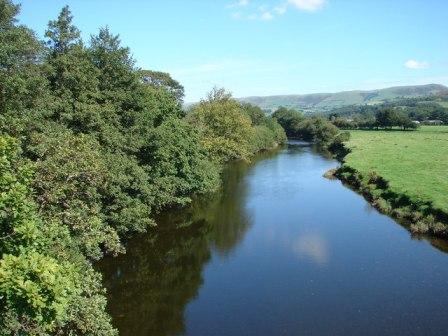
Afon_Dyfi_-_geograph.org.uk_-_242012

Afon Dyfi – the Defwy here in this land?

It is notable that Gwyn speaks to Gwyddno of his ‘sorrow’ at seeing ‘battle at Caer Vandwy’, ‘Shields shattered, spears broken / Violence inflicted by the honoured and fair’. Caer Vandwy ‘The Fortress of God’s Peak’ is mentioned in the same verse as ‘the meadows of Defwy’ with the legendary Ych Brych ‘Brindled Ox’.

Gwyn is speaking of a devastating battle between his people ‘the honoured and fair’ (the dead) and Arthur and his men who Taliesin accompanied on their raid on Annwn to plunder its spoils, which included the Brindled Ox and cauldron of Pen Annwn ‘Head of the Otherworld’ (Gwyn).

Even the impervious Taliesin describes this part of the raid of a ‘sad journey’ and says ‘save seven none returned from Caer Vandwy’. Arthur set out with ‘three loads full of Prydwen’ (his ship).

It seems Gwyn is sorrowful because the dead, who should be free of sorrow, were forced to fight and die again and he had again to gather their souls – a task he performs at battles in both worlds.

On a journey to the Defwy with Gwyn I saw people approaching the river, some to kneel and pray, some to cry, some to pour into it great jugs of tears. He told me that the Defwy is the place where the dead discard their sorrowful memories so they can move on to the lands of joy.

He also said the living can come here to do the same, but discarding one’s sorrows is a dangerous process, a form of death, and that they can never be regained because they flow away into the ocean to be reborn in new shapes walking abroad in forms unrecognisable to us.

In ‘The Hostile Confederacy’ Taliesin says in Annwn ‘There is one that knows / what sadness is / better than joy’. I believe this is Gwyn, who knows too well the sorrow of the dead who leave their memories at the Defwy in order to travel onward into his joyful realm.

Taliesin is, of course, ‘the one who didn’t go to the meadows of Defwy’, the one who continues to evade death, who claims to know all, remember all, yet in spite of this feels little sorrow, little guilt, for the catastrophes that he has witnessed and played a role in.

Knowing neither sorrow nor death will this mysterious glib-tongued entity, who was created by the magician-gods from fruit, blossoms and flowers, earth and water, ever truly know life or joy?