In Van Gogh’s Starry Night

I can picture you
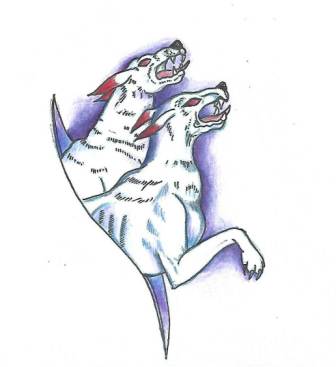
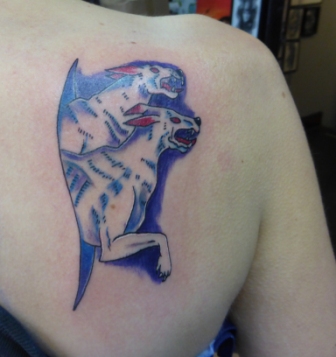
with many-headed horses
many-headed hounds

amongst stars unswung
swinging cypress

hear your laughter
in the Mistral ‘the idiot wind’.

But you are not in
Saint-Rémy-de-Provence.

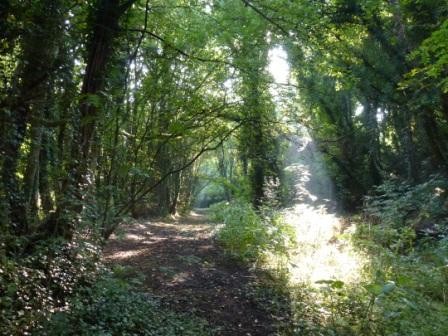
You are here on Castle Hill
swaying beech trees
where St Walburge’s
cannot outspire the Pennines.

Why the stars so bright and loud?
The processions of mist walking on the summits?
The long lapping tongue of a death-hound?

You are silent
but from a small room
in a distant asylum Van Gogh speaks:

“we take death to reach a star”.

1280px-Van_Gogh_-_Starry_Night_-_Google_Art_Project


Mist and Darkness and the Road to Joy – The Completion of Gatherer of Souls

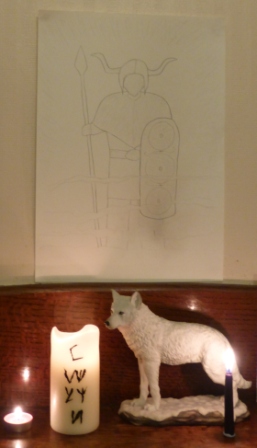
P1240462 - Copy - Copy - Copy

Over the past three years I have been working on a book for Gwyn ap Nudd, my patron god, to whom I devoted myself five years ago in January at the White Spring in Glastonbury.

At first I wasn’t sure what it was going to be about. It began simply as ‘Gwyn’s Book’. Because I am based in Lancashire and so many other writers have explored his connections with Glastonbury and Wales I decided to focus on his stories originating from the Old North, which are found in The Black Book of Carmarthen and Culhwch and Olwen.

After some time he made it clear that he did not want me to write an academic book (I therefore published my research on my website HERE) or  simply repeat the old tales penned by Christian scribes. Instead he wanted me to peel back the golden patina, expose the atrocities committed against him and the people of Annwn by Arthur, and journey back to the roots of his mythos in pre-Christian times when he was venerated as a god of the dead and gatherer of souls.

I met with other Inspired Ones who served him and whose souls he gathered such as the ancient ancestors of Orddu, ‘Very Black’, the Last Witch of Pennant Gofid; the northern British prophets Myrddin and his sister Gwenddydd; witches who flew with him between sky and air; wild women, madmen, poets, broken dreamers whose dreams have never been recorded.

I was prompted to explore how the closing of the doors of Annwn led to the sense of disconnection and soul loss that forms the void at the heart of the Anthropocene and to see the wonder in Gwyn’s reappearance on the brink of time as the Anglo-American Empire, which has its roots in Arthur uniting Britain under ‘One King, One God, One Law’, begins to fall.

My devotional journey has had its ups and downs. Sometimes it has felt like an endless ‘wow’ as I’ve discovered faces of Gwyn as yet unrecorded and hidden facets of his nature. At others, when I’ve been stuck in the Arthurian stories, unable to see beneath or get a break through, or I’ve written Gwyn’s voice wrong, I’ve felt frustrated, awkward, unworthy, and utterly inept. Yet I never once thought about giving up as I knew it was something I had to do.

Because there are no groups in the North West of England who venerate the Brythonic gods and goddesses or work experientially with our native myths my journey has been a lonely one. At low points I have contemplated joining the Anglesey Druid Order and even becoming a nun (when I hit thirty-five I realised it was my last chance!) although within I have known that my path in life is to walk with Gwyn even when all he can offer is “mist, darkness, and uncertainty”.

I’ve seen writing this book through to the end because serving him as an awenydd, although sometimes tough – Gwyn is the god who contains the fury of the spirits of Annwn and he is that fury just as he is the god who gathers the dead with love and compassion – is a source of deep and profound joy. Walking with him, whether through the starlit skies, or industrial smog, or blood-strewn battlefields, or the healing woodlands of Celyddon has always felt utterly right.

Gatherer of Souls is a book of new visions of the forgotten mythos of Gwyn ap Nudd  recorded in poems and stories to be published on Gwyn’s Feast, September the 29th, this year.

Over the past week I have read it out loud to Gwyn and it feels fitting that he has approved it as we approach the eclipse of the super blue wolf moon.

The One Who Didn’t Go To The Meadows of Defwy

In the fifth verse of ‘The Spoils of Annwn’ Taliesin berates ‘pathetic men’ (monks) who do not know ‘who made the one who didn’t go to the Meadows of Defwy’. I have been perplexed for several months by these lines, which pose the questions: Where and what are these mysterious meadows? Who didn’t go? What is the significance of not going? Who is his/her maker?

The Meadows of Defwy

Both my research and spirit-journeys suggest the Meadows of Defwy are in Annwn, ‘the Deep’, the Brythonic Otherworld. ‘The Spoils of Annwn’ depicts Arthur’s raid on seven otherworldly fortresses and his plundering of its treasures. Arthur’s adversaries are Pen Annwn, ‘the Head of the Otherworld’, and his people.

In the fifth verse, the Meadows of Defwy are connected with the Brindled Ox and Caer Vandwy, ‘the Fortress of God’s Peak’. In ‘The Conversation of Gwyn ap Nudd and Gwyddno Garanhir’, Gwyn (Pen Annwn) speaks of his ‘sorrow’ at witnessing ‘a battle at Caer Vandwy’ where ‘the honoured and fair’ fought Arthur’s raiding party and lost. This resulted in the theft of the Brindled Ox.

The first time I journeyed to the Meadows of Defwy I walked straight into the aftermath of the Arthur’s battle and recorded what I saw in the following verse:

A plain of blood where men once stood.
The lights have gone out in Caer Vandwy.
The clashing sea rolls over shield and spear.
The living dead. The dead dead again.

The Brindled Ox had been stolen, leaving only the deep trails of his struggling hooves as he was hauled aboard Prydwen, Arthur’s ship. His herd were frightened witnesses who had watched from a distance.

The association of the Brindled Ox with the Meadows of Defwy suggests it is a place where the animals of Annwn graze. This is backed up by the folktale Childe Roland, in which Roland found herds of horses, cows, sheep, goats, swine, and a flock of hens in Fairyland/Annwn. Roland beheaded each of their herders before assaulting the Fairy King’s castle.

wild-flowers-1363733002BId

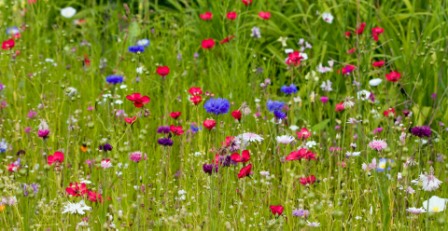
In more recent journeys I have found myself galloping through the Meadows of Defwy as a horse with the horse-herds. The meadows have appeared as a paradisal place of endless grassy plains alive with meadowflowers, bees, butterflies, grasshoppers, crickets.

It shares a kinship with ‘the Plains of Annwn’, which are written about by modern polytheist Nick Ford:

Broad and wide the plains of Annwn,
Sweet and thick, the grass thereon;
Fragrant with a million flowers,
Where graze the herds of Riganton.

Mild the breeze breathes on the pastures,
Blows the grasses that way, this;
As the horse-herds, like the wind, race
Further than the mind can guess.

The Meadows of Defwy are connected with the mare goddess Rigantona/Rhiannon and seem to bear some resemblance to the Elysian Fields of Greek mythology where the souls of the dead go to lead a blessed and happy afterlife.

Marged Haycock suggests Defwy is a river-name deriving from def-/dyf ‘black’ and may have been viewed as a river of the dead. A river Dyfwy is referred to in ‘The Spoils of Taliesin’: ‘Fine it is on the banks of Dyfwy / when the waters flow’. The Elysian Fields are located by the river of Oceanus, which separates this world from the underworld.

This ties together to suggest the Meadows of Defwy are a liminal place where the dead reside happily alongside the animals of Annwn (unless assaulted by thisworldly raiders!).

The One Who Didn’t Go

 It is my belief the phrase ‘the one who didn’t go the Meadows of Defwy’ does not literally mean someone who has not visited the meadows, but refers figuratively to someone who has escaped death.

Who could that be?

After pondering this question for a long while I received an answer from Greg Hill’s new translation of ‘The Conversation Between Taliesin and Ugnach’. When I first read this poem, which opens: ‘Horseman who rides to the fortress, / With white hounds and great horns’ I had a strong feeling the horseman was Gwyn, but was confused by his revelation of his name as Ugnach.

My confusion was laid to rest by Greg’s explanation that the suffix -ach signifies a supernatural character. It’s therefore likely to be another title of Gwyn/Pen Annwn. Greg added in a discussion that when Ugnach identifies himself he uses the word ‘heno’, a variant on ‘name’, but that ‘heno’ also means ‘tonight’. He might be saying ‘he is Ugnach just for tonight’.

The identification of Ugnach with Gwyn/Pen Annwn makes perfect sense in the context of the poem. Ugnach repeatedly extends his invitation to Taliesin to visit his fortress, promising ‘shining mead’, ‘wine flowing freely’, ‘fine gold for your spear-rest’ and a ‘bed’. Taliesin refuses to be lured by his ‘speech honeyed and fair’ and repeatedly states he does not know Ugnach. Whilst acknowledging Ugnach’s feast he insists he cannot stay.

Taliesin is refusing to stay with Ugnach in the lands of the dead; to accept death; to go to the Meadows of Defwy.

Taliesin is the One Who Didn’t Go To The Meadows of Defwy. Characteristically he is riddling about himself!

Who then is his maker?

Taliesin describes his making in ‘the Battle of the Trees’:

It was not from a mother and a father
that I was made,
and my creation was created for me
from nine forms of consistency:
from fruit, from fruits,
from God’s fruit in the beginning;
from primroses and flowers,
from the blossom of trees and shrubs,
from earth, from the sod
was I made,
from nettle blossom,
from the ninth wave’s water.
Math created me
before I was completed.
Gwydion fashioned me –
great enchantment wrought by a magic staff.

It seems this story refers to his making prior to his incarnation as Gwion Bach and rebirth from the womb of Ceridwen as Taliesin. He believes himself to have been created by the magician gods ‘before the world (was made)’ ‘when the extent of the world was (still) small’.

Thus he places himself above the processes of death and rebirth symbolised by the cauldron of Ceridwen which stands at the centre of the feast of Pen Annwn. Refusing to go to the fortress of Ugnach, Taliesin goes instead to ‘the fortress of Lleu and Gwydion’. Caer Gwydion is located in the Milky Way. There he hopes to reside in eternal life with his makers.

Taliesin escapes the fortress from which he helped steal the cauldron, the meadows where he fought ‘the honoured and fair’, the god of many names he refuses to know, but for how long?…

SOURCES

 Greg Hill, ‘The Conversation Between Gwyn ap Nudd and Gwyddno Garanhir’, The Way of the Awenydd
Greg Hill, ‘The Conversation Between Taliesin and Ugnach’, The Way of the Awenydd
Marged Haycock, Legendary Poems from the Book of Taliesin, (CMCS, 2007)
Nick Ford, ‘The Plains of Annwn’, Association of Polytheist Traditions

The Crazy Owl of Gwyn ap Nudd

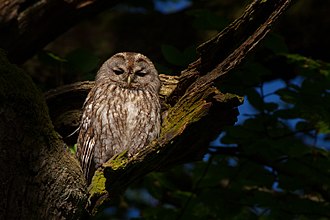
330px-Waldkauz-Strix_aluco

In ‘Y Dylluan’ (‘The Owl’) (1350), the medieval Welsh poet Dafydd ap Gwilym refers to the ‘Crazy Owl’ ‘of Gwyn ap Nudd’:

Piercingly she shrieked: I recognise her form,
she is the bird of Gwyn ap Nudd.
Crazy Owl that sings to robbers,
misfortune on her tongue and on her tune.

She will not be silent whilst he chants his prayer by starlight. He cannot sleep because of ‘the voice and screeching of the Owl, / her frequent outcry and her laugh, / and poetry’s travesty from her tongue.’ His description of her is far from flattering and becomes increasingly sinister:

Dirty she is, with two raucous cries,
big-headed, with a hateful shout,
broad-browed, and berry-bellied,
old wide-eyed catcher of mice,
busy, vile, and colourless,
shrivelled her voice, her colour that of tin…
and her face, like that of a gentle human being,
and her form, she-fiend of birds.

Speaking of her ‘wretched song’ he says ‘“Hw-ddy-hw” – a lively gasp – / with energy, by Anna’s grandson, / she incites the hounds of night.’ By the “hw-ddy-hw” we know Dafydd is referring to the tawny owl who is also known as the screech owl.

‘Anna’s grandson’ refers to Gwyn. In The Mabinogion, Gwyn’s father, Nudd/Lludd is the son of Beli Mawr who, in the Harleian Genealogies, is partnered with Anna. This may be mapped onto an older cosmography where Bel and Don are the ‘parents’ of Gwyn’s father, Nudd.

The ‘hounds of night’ are the Cwn Annwn, ‘Hounds of the Otherworld’, with whom Gwyn hunts the souls of the dead. This poem suggests the screech of Crazy Owl precedes Gwyn’s Hunt and that she flies at its head, terrifying, fiend-like with her human-like face.

In the final verse, Dafydd determines not only to scare the owl away with his song, but to ‘put… a bonfire in each ivied tree’, presumably with the intention of eliminating owls!

***

Gwyn is not the only god of hunting and the dead who appears with an owl. Charles Hardwick notes that the Hunter Hackelberg, who he identifies with Woden, the Germanic leader of ‘the Wild Hunt’, is accompanied by an owl named Tutursel:

‘Mounted on his white or dappled grey steed, the wild huntsman may always be recognised by his broad-brimmed hat, and his wide mantle, from which he is named Hakelbarend or Hakelberg, an old name signifying mantle-wearer. The hooting owl, Tutursel, flies before him.’

In the story of ‘The Hunter Hackelberg and the Tut-Osel’, the owl was a nun called Ursula who tormented her sisterhood and interrupted services with her ‘discordant voice’. Therefore they called her Tutursel. After her death, ‘from eleven o’clock at night she thrust her head through a hole in the tower and tooted miserably; and every morning at about four o’clock she joined unasked in the matin song.’

When the nuns realised the voice was Tutursel’s they refused to enter the nunnery until she was banished. Tutursel eventually met Hackelberg and found she delighted in his wood-cry “Hu Hu!” as much he delighted in her “U! Hu!” and she has flown with him since.

We do not know the story behind how Crazy Owl came to fly with Gwyn. Yet the reference to her ‘face, like that of a gentle human being’ may suggest she is of human origin or is a shapeshifter capable of taking human form.

***

In ‘The Fourth Branch’ of The Mabinogion, Blodeuwedd, a flower maiden, is transformed into an owl by Gwydion as a punishment for helping her lover, Gronw, to kill her husband, Lleu. This story may be based on an older seasonal myth where Blodeuwedd chose freely to be flowers whilst with Lleu in summer and an owl whilst with Gronw (a hunter god) in winter.

This story is paralleled by Creiddylad spending the summer with Gwythyr and winter with Gwyn. This led me to wonder whether Creiddylad takes owl-form on Gwyn’s Hunt. My meditations spoke otherwise – Crazy Owl is a separate person to Creiddylad with her own story*.

I’d like to end with this poem by Thomas Vantor, written in 1619, which describes the owl as a bright lady singing the dirge of the dying and puts me in mind of the Crazy Owl of Gwyn ap Nudd:

Sweet Suffolk owl, so trimly dight,
With feathers like a lady bright,
Thou sittest alone, singing at night
Te whit, te whoo, te whit, te whoo,
Thy note that forth so freely rolls
With shrill command the mouse controls,
And sings a dirge for dying souls,
Te whit, te whoo, te whit, te whoo.

*Crazy Owl’s story will appear in my next book Gatherer of Souls.

SOURCES

Dafydd ap Gwilym, Poems, (Gomer Press, 1982)
Charles Hardwick, Traditions, Superstitions, Folklore, (Forgotten Books, 2012)
Kristine Weinstein, The Owl in Art, Myth, and Legend, (Book Sales, 1991)
Marianne Taylor, Owls, (Bloomsbury, 2012)
Sioned Davies (transl.), The Mabinogion, (Oxford University Press, 2007)
The Hunter Hackelnberg and the Tut-Osel

The Last Wolves

Every district has its last wolf.’
Lays of the Deer Forest

I watch across the troubled waters
of the Bay whilst you gather up
the Last Wolf of Lancashire
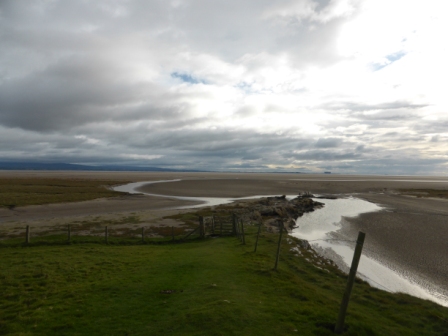
from Humphrey Head.

Some say he was driven
over Kirkhead and Holker
and plunged across the Leven,
sheltered on Coniston Old Man,
swam Windermere to Gummershaw,
Witherslack, Eggerslack, Grange,
met his end in Sir Edgar’s cave
by John Harrington’s lance,

others he fled the Bowland forest
where your ghost-wolves still howl
and was stuck by a thousand pikes
where tides meet the headland.

With thumb and forefinger
you squeeze his wounds closed,
pass your hand across glazed eyes
like the shadow of a lantern.

You shake out his pelt. His soul slips free
to join the wolf-dance in your death-light:

the dance of all the Last Wolves you gathered up…

From Gleann Chon-fhiadh, the Wolves’ Glen,
you gathered up the Last Wolf of Chisolm:
pulled the dirk from her breast, the spear
from her flank, the steel gauntlet,
lamhainn chruaidh from
the trap of her jaws,
laid her amongst
her slaughtered cubs
and sang out their yelping souls.

From between Fi-Giuthas and Pall-a-chrocain,
pinewood known for deer and township in the crooked river,
you gathered up the Last Wolf of Chisolm:
carried back his heavy black head
severed for fear he’d live again,
sewed up his severed throat,
wounds where he’d been
buckled and dirkit,
sang his black shape hurtling back
through pines, upriver, startling deer.

From a cave of bones in Helmsdale
you gathered up the Last Wolf of Sutherland:
closed her stab-wounds,
straightened out her tail from when she was suspended
by a God-like hand, wolf-shadow snapping
ineffectually over her dead cubs,
their ruddy-armed killer.
Her tail straight,
you sang her family whole into the Otherworld.

You gathered up the Last Wolf
of Inverness: pieced together his skull
shattered by an old woman’s frying pan,
sang him back to where he will no longer
prowl into houses or lick
a human hand.

You gathered up all the Last Wolves from
the Wolf’s Rivers, Burns, Crags, Glens, Dens,
Hills, even from Wormhills. You gathered
up the Last Wolf of the Weald

as you gathered up the Last Elk, Aurochs, Bear, Lynx, Boar…

I watch the Last Wolves join your wolf-dance.
White wolves, grey wolves, black wolves,
she-wolves and cubs vivid as stars
whilst bioluminescent fishes
leap across the Bay.

Humphrey Head III

Annuvian Awen

Annuvian Awen

Allan o dywyllwch caf fy ngeni
Allan o waed caf fy ngeni
Allan o ysbryd caf fy ngeni

Yn canu o Annwn

Tri phelydryn golau
Tri phelydryn llais
Tri phelydryn wirionedd

I oleuo â rhyfeddod
Ac yn torri’r galon wytnaf

Yn canu o Annwn

~

Out of darkness I am born
Out of blood I am born
Out of spirit I am born

Singing from Annwn

Three rays of light
Three rays of voice
Three rays of truth

To illuminate with wonder
And break the hardest heart

Singing from Annwn

~

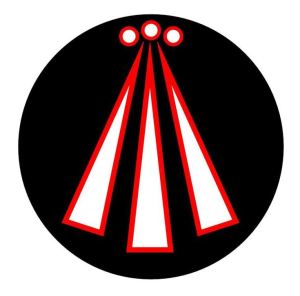
About a month ago I awoke with the symbol above in my mind with the name ‘Annuvian Awen’. Awen derives from the Indo-European *-uel ‘to blow’ and has the same root as the Welsh awel ‘breeze’. It is the primordial breath that binds all things, as Kristoffer Hughes says, ‘the voice of the universe speaking to itself’.

The Awen symbol was popularised by Iolo Morganwg in the 1860s. He claimed it was derived from a Welsh alphabet recorded by Nennius in the ninth century and that its meaning was ‘I am that I am’. It has been used by Neo-Druids since.

In medieval Welsh poetry ‘the ogyrven of threefold inspiration’ originate from the cauldron of Ceridwen. Crochan means both ‘cauldron’ and ‘womb’. It is the place from which all beings of the universe are born and to where they return at death.

The cauldron of Ceridwen lies in Annwn, ‘Very Deep’, the ancient British Otherworld. It is guarded by the Head of Annwn: a god with many names who I know as Gwyn ap Nudd. Gwyn guides the souls of the dead and of living initiates to the cauldron.

The black background of the Annuvian Awen represents the origin of Awen from the darkness of Ceridwen’s cauldron in the depths of Annwn. The red stands for the blood of the dead (human and non-human) whose sacrifices have made it possible the living can have Awen. The white is spirit: the breath, the voice of truth, the misty otherlight of the ogyrven ‘spirits’ contained in the person of Gwyn ‘White’ who is also known as the giant Ogyrven.

When I had created the design I received the gnosis I must write a poem to accompany it in English and Welsh. My Welsh is very basic. Having written the English version with an eye to how it looked and sounded in Welsh, translating as I went, I contacted fellow awenydd and Welsh-speaker Greg Hill for help with the translation.

Greg corrected my grammatical errors and helped me with choices of individual words. Interestingly this led to changing the tense of the English poem from past to present which was a big improvement. This fortuitous exchange of Awen between awenyddion gave birth to the poem in its present form. We decided to use it with the symbol on the front page of ‘Awen ac Awenydd’: a website providing a repository of information on the awenydd path.

For me the Annuvian Awen forms an expression of the path of the awenydd that acknowledges the importance of depth in our increasingly superficial world; the need to recover the inspiration that lies in the deeps of Annwn and in the deep places of our souls to combat the soullessness that allows the destructive systems that are wrecking Thisworld to thrive.

The ways to Annwn are dark, misty, uncertain, steeped in blood, for the most part forgotten. Yet there are gods and guides who offer to walk with us and share our quest. So we go with them through the darkness, across the river of blood, to return with the otherlight to illuminate the beauty of Thisworld because not only our lives but the lives of our souls depend on it.

SOURCES

Angela Grant, ‘A Short History of the Awen’, The Druid Network
Greg Hill, ‘Awen’, Awen ac Awenydd
Greg Hill, ‘Taliesin, the Bardic Tradition and the Awen’, The Way of the Awenydd
Greg Hill, ‘The Girl in Ogyrven’s Hall’
Kristoffer Hughes, Natural Druidry, (Thoth Publications, 2007)
Kristoffer Hughes, From the Cauldron Born, (Llewellyn, 2013)
Marged Haycock, Legendary Poems from the Book of Taliesin, (CMCS, 2007)
Awen’, Wikipedia

A Glimpse of Pure Sunshine

The final prose poem in Melissa Lee-Houghton’s challenging confessional collection, Sunshine, is called ‘Hope’. Hope is scarce. The subject is a dream akin to a horror movie where the narrator is kidnapped and her companions are beheaded one by one, ‘blood gushing like red schnapps.’ When she is the only one left alive for a moment she thinks she’s won. Yet the time arrives for her to hang her head over the metal sink for the man in the white surgeon’s mask with the scalpel. ‘Hope’ ends with the following lines: ‘Although my psychiatric worker said it’s more than unusual, I died in that dream, and I went somewhere. Part of me remains there, happily, in the glamorous glare of lost hope and a sadness spun of pure sunshine.’

This poem struck a chord because two years ago I had a horrific dream ending with the suggestion of an afterlife. I was a soldier fighting in a jungle and had been captured to be executed. As I faced the firing squad, I knew I was going to die. I called to Gwyn ap Nudd, my patron god, for help. Filled with superhuman strength, I broke away in the form of a heavily muscled pig-like warrior. However, I was tracked down and recaptured. When I consulted Gwyn from my cell, he told me he couldn’t save me again. I must send my soul into the hazel, the beetle and… a third thing I can’t remember when it came to my execution. The next minute I was walking amongst hazel trees with a friend, speaking with complete calm about how to get my soul into a tree and turning over the leaves to find a beetle. I was utterly convinced about the survival of my soul, the calmest and surest I’ve ever felt. That reassuring feeling, like a glimpse of pure sunshine, remains with me to this day.

Fairy Lane

Gwyn’s Hunt

For Nos Galan Gaeaf: An article on soul hunting and soul flight in the Brythonic tradition of Gwyn’s Hunt on this night of deep magic as the borders between thisworld and Annwn, life and death, and the laws that govern time and space break down.

Lorna Smithers's avatarDun Brython

Within Neo-Paganism Gwyn ap Nudd is generally understood to be a leader of ‘the Wild Hunt’. Before Jacob Grimm developed ‘the Wild Hunt’ as a concept applied to various otherworldly hunts across Europe in his Deutsch Mythologie (1835), they were known by individual names often referring to their leaders such as ‘Woden’s Hunt’, ‘Household of Harlequin’, and ‘Herla’s Assembly’. This essay will focus on the Brythonic tradition of ‘Gwyn’s Hunt’.

The earliest literary reference to Gwyn as a hunter comes from Culhwch and Olwen (1090) where it is stated, ‘Twrch Trwyth will not be hunted until Gwyn son of Nudd is found.’ This suggests Gwyn was the leader of the hunt for Twrch Trwyth, ‘King of Boars’, prior to Arthur. According to the text, which was penned by Christian scribes, Twrch Trwyth was a king changed into a swine by God ‘for his sins’. This overlay conceals a pagan tradition…

View original post 1,062 more words

Grey Geese and Oracles

Between September and November grey geese arrive in my locality. I’ve seen a local flock of greylag geese on the stretch of the river Ribble near Howick Cross at this time two years running. Greylags are the ancestors of domestic geese and residents in the UK all year round; migratory birds are only found in Scotland. This flock also contains Canada and domestic geese.
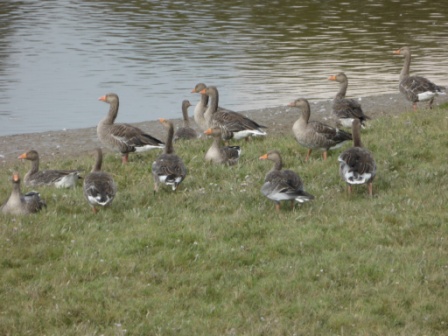
Greylag Geese, Ribble

Greylag geese, river Ribble

More dramatically pink-footed geese begin arriving from Iceland and Greenland. They can be heard flying overhead to WWT Martin Mere. This year the first group touched down on September the 9th and there are currently 15000 roosting on the reserve.
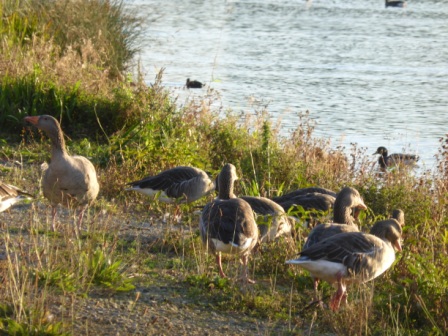
Pink-footed Geese, Martin Mere

Pink-footed geese, Martin Mere

Watching their return to the last fragment of Martin Mere at sunset is awe-inspiring. One can only imagine the noise and patterns of the skeins before the Lancashire’s Lost Lake, once 15 miles long, was drained.
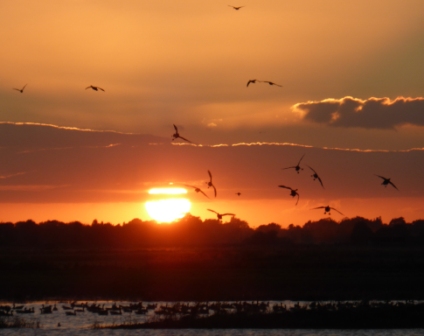
Pink-footed Geese, Martin Mere

Pink-footed geese return at sunset, Martin Mere

 ***

In the folklore of northern England, the cries of migrating geese are linked to Gabriel Ratchets. ‘Gabriel’ may derive from the name of the Angel of Death, the ‘gabble’ of geese, or the medieval word gabbe, ‘corpse’. ‘Ratchet’ originates from the Old English ‘ræcc’ meaning a ‘a dog that hunts by scent’.

The earliest record of Gabriel Ratchets is from 1664. Whilst living at Coley Hall in the Calder Valley, Reverend Oliver Heywood wrote in his Memoranda:

‘There is also a strange noise in the air heard of many in these parts this winter, called Gabriel-Ratches by this country-people, the noise is as if a great number of whelps were barking and howling, and ‘tis observed that if any see them the persons that see them die shortly after, they are never heard but before a great death or dearth… Though I never heard them.’

In his Notes on the Folklore of the Northern Counties of England and the Borders (1879), William Henderson suggests the ‘belief in a pack of spectral hounds’ originates from ‘the strange un-earthly cries, so like the yelping of dogs, uttered by wild fowl on their passage southwards.’

Lancashire folklorist James Bowker notes, in his Goblin Tales of Lancashire (1879), ‘Mr Yarrell, the distinguished naturalist, reduces the cries of the Gabriel Hounds, into the whistling of the Bean Goose… as the flocks are flying southward in the night, migrating from Scandinavia.’
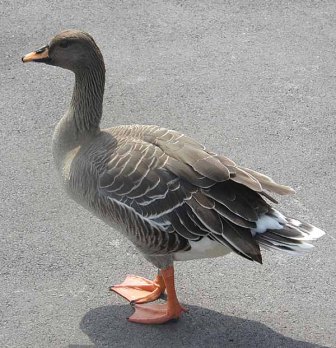
Bean Goose, WWT Slimbridge, Wikipedia Commons

Bean Goose, WWT Slimbridge, Wikipedia Commons

This appears to be a mistake: bean geese migrate from Scandinavia to Norfolk and southern Scotland. Here in Lancashire it seems more likely that pink-footed geese, with their ‘high-pitched honking calls, being particularly vocal in flight, with large skeins being almost deafening’ would have been associated with Gabriel Ratchets. The pink-footed goose is closely related to the Bean Goose and was once considered a subspecies. Perhaps Mr Yarrell conflated the two.

Gabriel Ratchets are often associated with a spectral huntsmen. This may originate from pagan beliefs about ‘the Wild Hunt’ which takes place at the time of year geese migrate. In Norse and Germanic tradition it is usually led by Odin or Woden, to whom a goose was sacrificed on the Autumn Equinox. The Germanic goddess, Berchta, has a goose-foot and also leads a hunt with a goose flying in front of her. Dancers in her processions, the Berchten, wear bird-masks.

In Brythonic tradition a leader of ‘the Wild Hunt’ is Gwyn ap Nudd. His hounds are known as Cwn Annwn ‘Hounds of the Otherworld’, Cwn Wybyr ‘Hounds of the Sky’, or Cwn Cyrff, ‘Corpse Hounds’. Like the Gabriel Ratchets they are seen as death portents because they hunt the souls of the dead. Gwyn is a ruler of Annwn who oversees the passage of souls between the worlds, which is mirrored by the migrations of geese.

***

Goose is traditionally eaten on Martinmas, November the 11th, which is dedicated to St Martin of Tours. This festival ‘originated in France, then spread to the Low Countries, the British Isles, Germany, Scandinavia, and Eastern Europe’. Martin attempted to hide in a goose pen to avoid being ordained as a bishop, but was given away by the cackling of geese. (I can’t help noticing connections between Martin, Martin Mere and geese…)
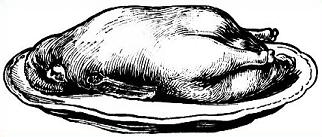
Roast goose, all things clipart

After the feast, divination was performed by the breast-bone. In 1455, Dr Hartlieb wrote, ‘When the goose has been eaten on St Martin’s Day or Night, the oldest and most sagacious keeps the breast-bone and allowing it to dry until the morning examines it all around, in front, behind and in the middle. Thereby they divine whether the winter will be severe or mild, dry or wet.’ In Hampshire ‘the nature of the coming winter’ was divined from a breast-bone and, in Yorkshire, weather was predicted from the colour of goose-flesh.

The British Apollo (1708) poses the question why the ‘breast of a fowl’ is ‘called the Merry Thought’ and provides the answer, ‘The original of that name was doubtless from the pleasant fancies that commonly arise from the breaking of that bone, and ‘twas then first certainly so called, when these merry notions were first started.’ Every Commercialmas someone in my family breaks the ‘wish-bone’ of our turkey and makes a wish.

These traditions are rooted in a wide-spread belief that the goose was an oracular bird. It has been argued this derives from the Etruscans who ‘believed geese had supernatural visionary powers as oracle birds with these prophetic powers residing within its bones’ and was brought to Britain by the Romans.

***

Our understanding of the oracles of geese has diminished; drained away with their wetland homes. We can no longer tell, from the cacophany of voices barking overhead, who carries news and who carries a death portent. Goose is rarely eaten in Britain, with the tradition of rearing flocks of domestic geese for food, particularly for during the festive season, being replaced by turkey farming. Divination has been reduced to a facile act of wish-fulfilment in a world increasingly disconnected from the language of the divine.

Yet, whilst there are geese, there is hope that their language can be re-learnt by re-attuning to their flight paths, their life ways, listening to their gabble, divining how this relates to teachings from our gods. Perhaps, as pumps are shut down and wetlands are re-flooded, our abilities to divine will return with the geese.
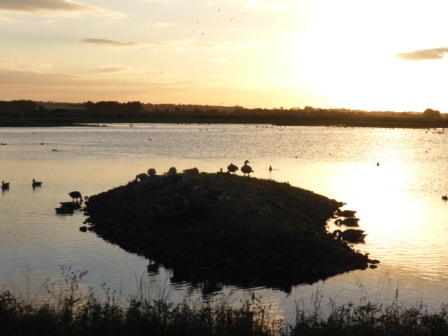
Martin Mere at Sunset

Martin Mere at sunset

***

SOURCES

 Edward A. Armstrong, The Folklore of Birds, (Dover, 1958)
James Bowker, Goblin Tales of Lancashire, (Classic Reprint, 2015)
William Henderson, Notes on the Folklore of the Northern Counties of England and the Borders (Create Space, 2014)
‘Origin of the Wishbone Tradition’, Republic of You Blog
‘The Gabble Ratchets’, Ghosts and Legends of the Lower Calder Valley
Pink-Footed Goose, RSPB
WWT Martin Mere