Lamentation for Catraeth

‘By fighting they made women widows,
Many a mother with her tear on her eyelid’
Y Gododdin

After Catraeth battle flags sway in the wind.
Storm darks our hair. Our tears are rain.
We press cheeks against cold skin,
load biers with sons and husbands
who will never drink in the mead-hall again,
lift weapons, smile across a furrowed field,
mend the plough, yoke oxen, share a meal,
touch ought but blood-stained soil,
chilled fingers reticent to let go.

Storm sky breaks. Our love pours out.
Ravens descend on soft wings to take them.
How we wish they would take our burning eyes,
flesh we rend with nails unkempt
from the year they left for Din Eiddyn,
drunk their reward before it was earned

at dawn with sharpened spears
at daybreak with clashing spears
at noon with bloody spears
at dusk with broken spears
at night with fallen spears,
shattered shields, smashed armour, severed heads.

Seven days of wading through blood.
Of each three hundred only one lives.
Their steel was dark-blue. Now it is red.
Because of mead and battle-madness
our husbands and sons are dead.

We rend our veils. The veil is rent.
We long to tear out our hearts
and offer them instead
to the Gatherer of Souls approaching
with the ravens and hounds of death,
whose face is black as our lament,
whose hair is the death-wind,
whose touch is sorrow,
whose heart is the portal to the otherworld.

Our men rise up to meet him.
The march of the dead is his heart-beat.
The dead of centuries march through him.
The great night is his saddle.
The dead men ride his horse.

Forefathers and foremothers hold out their hands.
We do not want to let go but they slip
through our fingers like water
like tears
from sooty eyelids
into the eyes of others
into the eyes of their kin
to gather in the eyes of the Gatherer of Souls.

They are stars in our eyes now.
They are stars in the eyes of the hounds of death,
marching from drunken Catraeth:
the battle that knows no end.

Din Eidyn and Drunken Catraeth

A few weeks ago I visited Edinburgh. This was partly due to my interest in its history as part of the Old North. During this period it was known as Din Eidyn ‘fort of Eidyn’ (Eidyn’s identity and whether this name refers to a person and/or place remain a mystery).

There is evidence of settlements on Castle Rock and Arthur’s Seat from the Bronze and Iron Ages. The earliest fort was known as ‘The Castle of the Maidens’. It may have been established on a pre-Christian site sacred to ‘the nine maidens’ amongst whom was Morgen: a divinity connected with water, shapeshifting, healing and the weather.

During the Iron Age the local tribe were known as the Votadini. It has been argued this name originates from the early Celtic *wo-tādo, which means ‘foundation’ or ‘support’ and that this was the name of an ancestral figure. During the Romano-British period, the Votadini became known as the Gododdin and their kingdom was Manaw Gododdin.

Like many of the northern British peoples, the Gododdin had complex relationships with Wales. Sometime between 380 and 440, Cunedda, a man from Manaw Gododdin, helped defend north Wales from the Irish and played a prominent role in founding the kingdom of Gwynedd, which his offspring ruled.

After the death of Cunedda’s descendant, Maelgwn Gwynedd in 547, Elidyr Mwynfawr, who was married to Maelgwn’s daughter, Eurgain, travelled from Benllech in the North via the sea* to Benllech on Anglesey to contest the claim of Maelgwn’s illegitimate son, Rhun, to the throne of Gwynedd. Elidyr was killed at Arfon.

Afterward, Clydno Eiddyn, who may have ruled Din Eidyn, formed part of a warband alongside other northern rulers; Nudd Hael, Mordaf Hael and Rhydderch Hael. Seeking vengeance for Elidyr’s death, they travelled to Wales, set fire to Arfon and were driven back all the way to the river Gwerydd (the Forth).

Clydno was also the keeper of one of ‘The Thirteen Treasures of the Island of Britain’ ‘which were in the North’: ‘The Halter of Clydno Eiddyn, which was fixed to a staple at the foot of his bed: whatever horse he might wish for, he would find in the halter.’

p1170878

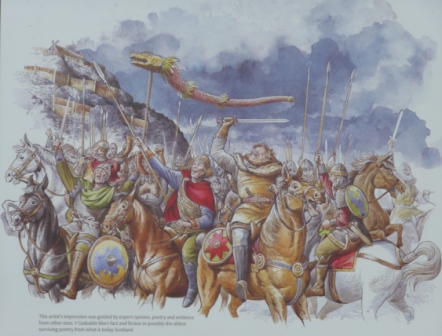
The Gododdin are immortalised in the poem The Gododdin, which has been dated to the 7th century. This takes the form of a series of verses eulogising and elegising the northern Britons who perished in the battle of Catraeth** in 600AD fighting against the Bernician Angles. Prior to the battle, the warriors feasted and drank for a year in the hall of Mynyddog Mwynfawr, ruler of Din Eidyn. The joy of the mead-feast is repeatedly contrasted with the bloodshed of the battle from which ‘of three hundred, save one man, none returned.’

‘Warriors went to Catraeth with the dawn,
Their ardours shortened their lives,
They drank mead, yellow, sweet, ensnaring,
For a year many a minstrel was joyful.
Blood-stained were their swords, may their spears not be cleansed;
White were the shields and square-pointed the spearheads
Before the retinue of Mynyddog Mwynfawr.’

Cynon, a son of Clydno Eidyn was amongst the casualties and is the subject of several verses.

‘…generous-hearted Cynon, lord of graces…
Whomever he struck would not be struck again.
Sharp-pointed were his spears,
With shattered shields he tore through armies,
His horses swift racing forward.’

‘He slew the enemy with the sharpest blade,
Like rushes they fell before his hand.
Son of Clydno of enduring fame’

The imagery of The Gododdin is strikingly similar to that of The Conversation of Gwyn ap Nudd and Gwyddno Garanhir. In The Conversation, Gwyddno addresses Gwyn as a ‘bull of battle’ and says ‘armies fall before the hooves of your horse / As swiftly as cut reeds to the ground’. Gwyn speaks of ‘shields shattered, spears broken’ and states his presence at the deaths of a number of northern warriors ‘where ravens croaked on gore’.

In The Gododdin, two warriors are referred to as ‘bull(s) of battle’, one as ‘bull of an army’ and another as ‘heroic bull’. Men are hewn down ‘like rushes’, there are countless references to ‘shattered’ and ‘splintered’ spears and shields and the dead become ‘food’ for ‘ravens’. This suggests both poems originated from the same milieu. It seems possible Gwyn gathered the souls of the dead after the battle of Catraeth as he did after the battle of Arfderydd in 573.

p1170962

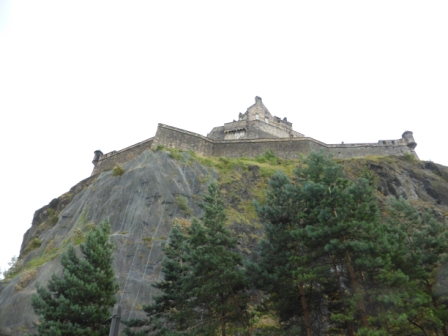
When I visited Edinburgh Castle, I was struck by the height and impenetrability of the cliff face (Castle Rock was originally a volcano which was later flattened by a glacier) and could see why it has been a defensive location for so long.

Unsurprisingly, after so many centuries, there were few traces of the Gododdin. The castle was built in stone in the 12th century and the current banqueting hall during the 15th. The hall has a prominent hearth fire and is decorated with spears, swords and armoury. It’s possible to imagine Mynyddog Mwynfawr’s hall would have been equipped in a similar manner.

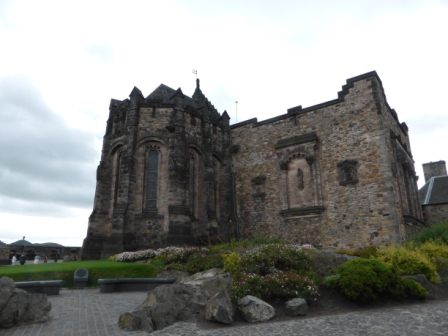
Since Catraeth, Edinburgh’s people have seen countless bloody battles, including the Wars of Independence from 1296 and 1341, the ‘Lang’ siege which lasted from 1571-1573 and the Jacobite Risings from 1688-1746. The castle was later used as a military prison. It is still a barracks and is now home to the Scottish National War Memorial: an extensive ‘shrine to the fallen of two world wars and campaigns since 1945’.

p1170885

As a metaphor for tragic and ill-conceived warfare, ‘drunken Catraeth’ may be seen to repeat itself throughout history. A. O. H. Jarman notes ‘a veteran of the action of Mametz Wood during the battle of the Somme in 1916 ‘recalled an observer saying what a magnificent sight it was seeing the Welsh battalions moving along in a line without wavering until they fell’… His observation could have translated a couplet of Y Gododdin.

In ‘Elegy for the Welsh Dead in the Falkland Islands, 1982’, Tony Conran draws analogies between Catraeth and the Falklands War:

‘Men went to Catraeth. The luxury liner
For three weeks feasted them…
With the dawn men went. Those forty-three,
Gentlemen all, from the streets and byways of Wales,
Dragons of Aberdare, Denbigh and Neath –
Fragment of Empire, whore’s honour, held them.
Forty-three at Catraeth died for our dregs.’

Beneath Din Eidyn I read my poem, ‘Lamentation for Catraeth’, which is also based on lines from The Gododdin: ‘By fighting they made women widows, / Many a mother with her tear on her eyelid’. Written in the voices of mourning women, it laments ‘drunken Catraeth / the battle that knows no end’.

***

*This is recorded in the triad of the Horse Burdens where Elidyr and seven-and-a-half men (one holding onto the crupper!) are carried by the legendary water-horse, Du y Moroedd.
**The location of Catraeth is hotly contested. Traditionally it has been identified as Catterick, yet so far no evidence for a full-scale battle has been found. Tim Clarkson notes the identification of Catraeth with Catterick is based on a ‘sounds like’ etymology’ and suggests the conflict was more likely to have taken place on the fringes of Lothian.

SOURCES

John Matthews (ed), The Book of Celtic Verse, (Watkins Publishing, 2007)
Heron (transl), Gwyn ap Nudd and Gwyddno Garanhir, HERE
Kenneth Hurlstone Jackson (transl), The Gododdin, (Edinburgh University Press, 1969)
Peter Bartrum, A Welsh Classical Dictionary: People in History and Legend up to about A.D. 1000, (National Library of Wales, 1993)
Rachel Bromwich (ed), The Triads of the Island of Britain, (University of Wales Press, 2014)
Stuart McHardy, The Quest for the Nine Maidens, (Luath Press, 2002)
Tim Clarkson, The Men of the North: The Britons of Southern Scotland, (John Donald, 2010)
Votadini, ‘The History Files’, HERE

When they had eaten the King

they put down their knives and forks,
wiped grease from their chins with napkins,
dared not look one another in the eye.

They bought the pork from market:
a joint with stuffing and apple sauce,
cooked it in the oven on gas mark 9.

When they started the rite it got weird.
The candles cast strange shadows across
limbs of a giant boar and ancient apples.

The living room became the great hall
of an otherworldly huntsman; fierce, fair
and tall. Surrounded by his motley host

to pipes and fiddles, the strum of violins,
they tucked in to the most delicious meal.
On a stake in the corner was a boar’s head.

Before its sharp gaze and curved tusks
a bard recited the story of Twrch Trwyth:
a human King transformed into a boar

doomed to be hunted then eaten by day,
by night made whole. Their hands trembled
like dropped pins but they dared not put

down their knives and forks or stop chewing
before the imposing eyes of the huntsman
until he had eaten his fill and thrown

the leftovers to his dog. They dared not
look one another in the eye as they cleansed
their fingers and left the table with a nod

of thanks to the leader of the hunt.
She dared not tell them for nights afterward
she dreamt of being reborn from a sow

as a porcine King growing up amongst
little piglets into a mighty warrior;
strong muscled, strong tusked,

running bristled through the forest
to meet the huntsman’s spear;
being slaughtered, spitted, roasted,

a head on a stick in the corner of the hall
watching as they ate the King by day
then at night he was made whole.

p1170734-copy

I wrote this poem last year after my experience of holding a celebration for Gwyn’s Feast (on September the 29th) which was based around Gwyn’s leadership of the hunt for Twrch Trwyth, ‘King of Boars’. A pork roast was cooked and a plate offered to Gwyn, along with meat for his dog, Dormach, and apples for his horses. The poem forms a slant take on my experiences.

Gwilym Morus-Baird has written an excellent series on ‘The Hunting of Twrch Trwyth’ beginning HERE.

Riddles and Howling Monks

In ‘The Spoils of Annwn, after Taliesin has finished narrating Arthur’s raid, he continues to mock the monks (earlier referred to as ‘pathetic men’) because they do not know the answers to certain riddles.

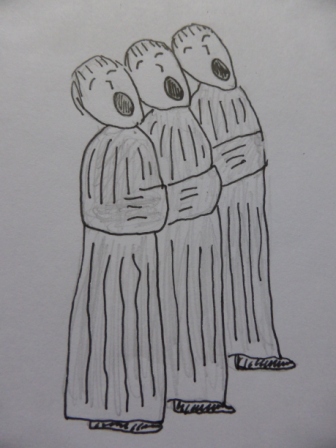
The opening ‘Myneich dychnut val cunin cor / o gyfranc udyd ae gwidanhor’ has been translated ‘Monks congregate like a pack of dogs / because of the clash between masters who know’ and ‘Monks howl like a choir of dogs / from an encounter with lords who know’.

Dychnut may derive from cnut ‘pack of hounds, wolves’ or *dychnudo, an archaism meaning ‘howl’. Cun means ‘pack of dogs’ or ‘lord’. The primary meaning of cor is ‘choir’, but it is also used to refer to groups such as ‘a host of angels’ or ‘a company of bards’. Côr bytheiaid and côr hela  both mean ‘kennel or pack of hounds’. Udyd may be the plural of ud ‘lord’ or relate to udaw ‘howl’.

In these ambiguous, carefully chosen words, dogs/wolves, choirs, lords and howling are cleverly and intricately linked. These intricate connections are unfortunately not conveyed by the English language.

Within Welsh tradition numerous divine ‘lords’ are associated with hounds: Cunomaglus ‘Hound Lord’; Cunobelinus ‘Hound of Belinus’; Nudd who Taliesin refers to as ‘the superior wolf lord’ and his son, Gwyn ap Nudd, who owns a hound called Dormach ‘Death’s Door’ and hunts with the Cwn Annwn. Another is Arawn who, like Gwyn, is a ruler of Annwn and associated with white, red-eared Annuvian hounds. It seems possible Taliesin is comparing the howling monks with their howling hounds.

Cyfranc means ‘clash, contention’ or ‘tale, story’. This brings to mind Taliesin’s clash with the bards of Maelgwn in The Story of Taliesin. Taliesin enters this contest to rescue his master, Elphin, son of Gwyddno Garanhir, from Maelgwn’s imprisonment.

Gwidanhor ‘one who knows’ (from gwybod ‘know’) shares a likeness with Gwyddno Garanhir ‘knowing one’. In The Conversation of Gwyn ap Nudd and Gwyddno Garanhir, Gwyddno converses with Gwyn and meets his hound, Dormach. Gwyn reminds Gwyddno that Dormach ‘was with Maelgwn’. These complex mythic intersections would have been in a medieval Welsh audience’s mind.

Taliesin claims the lords/masters  know, ‘Whether the wind (follows) a single path, whether the sea is all one water, / whether fire – an unstoppable force is all one spark’. In The Story of Taliesin, Taliesin wins the contest with a series of poems including an extended riddle about the wind. He is claiming knowledge of the elements Maelgwn’s bards do not possess.

Taliesin counts himself amongst the ‘knowing ones’ initiated into the mysteries of the universe alongside lords/masters such as Gwyddno and Gwyn. The howling of the monks parodies their otherworldly company.

The next verse continues in a similar vein:

‘Monks congregate like wolves
because of the clash between masters who know.
They (the monks) don’t know how the darkness and light divide,
(nor) the wind’s course, its onrush,
what place it devastates, what land it strikes,
how many saints are in the void, and how many altars.’

The reference to the monks’ lack of knowledge of where darkness and light divide echoes preceding verses where Taliesin mocks them for not knowing the divisions of time nor when Pen Annwn ‘Head of Annwn’ was conceived or born. These questions are intrinsically linked as Pen Annwn is associated with the transitions between night and day, the seasons and the mysteries of death and rebirth.

The line referring to saints and altars being ‘in the void’ is intriguing. This may relate back to the transitional period between paganism and Christianity when the links between Annwn and the dead were severed and Annwn was re-construed as a hellish (hot, cold or empty) place.

In the final lines Taliesin says, ‘I praise the Lord, the great Ruler: / may I not endure sadness: Christ will reward me.’ The ending is undeniably Christian yet in Pendefic mawr, ‘great Ruler’ we find traces of a most un-Christian lord: Pen Annwn.

 So the end of the poem has been reached. Arthur and his men have raided Annwn and slammed its gate shut. As Taliesin returns to his chair in Caer Siddi we’re left contemplating a trail of destruction amongst the howling monks whose choir echoes the howling of the hounds of the Lord(s) of Annwn.

 ***

The monks howl.
We howl with them.
There is no turning back
to when Annwn was unspoilt
before the flashing sword
the stolen cauldron
and trail of death.

No turning back
only howling onwards
into the next chapter
the next myth…

P1170785 - Copy

*The translations of Preiddu Annwn ‘The Spoils of Annwn’ I have used are Marged Haycock’s from Legendary Poems of Taliesin and Sarah Higley’s HERE. With thanks to Heron for notes on cor from The University of Wales Dictionary.

Vindolanda: The Land of White Springs

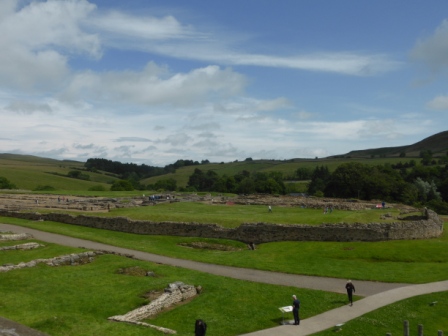
29 miles east along Hadrian’s Wall from Carlisle lies the ruins of the Roman village of Vindolanda. I was drawn there because the name Vindolanda, usually translated ‘White Fields’ or ‘White Lands’, derives from *Windo ‘fair, white, blessed’ and this is the root of Gwyn ap Nudd’s name. Gwyn may have been known as Vindos in Iron Age Britian. There are no known dedications to Vindos but it seems possible he was venerated at Vindolanda and Vindogladia.

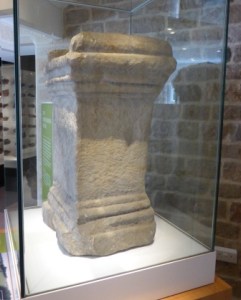
Evidence for the place-name Vindolanda comes from the Vindolanda Altar, which was found at the edge of the settlement. It reads, ‘Pro domu divina et Numinibus Augustorum Volcano sacrum vicani Vindolandesses curam agente…V S L…’ ‘For the Divine House and the Deities of the Emperors, the villagers of Vindolanda (set up) this sacred offering to Volcanus, willingly and deservedly fulfilling their vow, under the charge of…’

P1170197 - Copy

Here we find the name Vindolandesses ‘villagers of Vindolanda’. The altar was set up for Volcanus, Roman god of volcanoes and blacksmithing. As there isn’t any evidence of volcanic activity in the area, I assume the villagers chose Volcanus because iron smelting and forging took place at Vindolanda.

Surprisingly there is no information on display about what was there before the Roman invasion. When I asked a member of staff, she said it was farmland and told me the name Vindolanda derives from the land being coloured white by natural springs running from above the village and Barcombe Hill.

Near the wells and water tanks above the ruins is a notice which mentions ‘many springs and good steams’ and states ‘the most powerful source lay near here’. The stone aqueduct which carried the water into the village is still visible, but its source appears to have run dry.

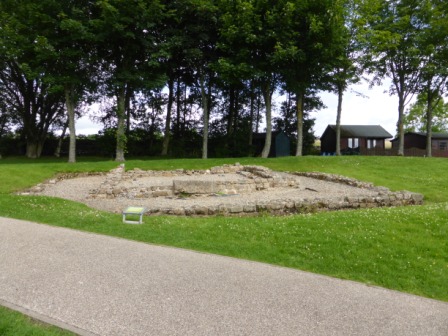
Adjacent to the wells and tanks stands the remains of a Romano-Celtic temple ‘used by soldiers to celebrate both local and Roman gods’. No individual deities are named. Gwyn is associated with the White Spring beneath Glastonbury Tor and I’ve experienced his presence at Whitewell here in Lancashire.

P1170043

It’s my intuition he could have been worshipped as Vindos in this temple beside the source of the white springs. My excitement at potentially discovering one of Vindos/Gwyn’s most ancient sacred sites was tempered with sadness that the springs had run dry.

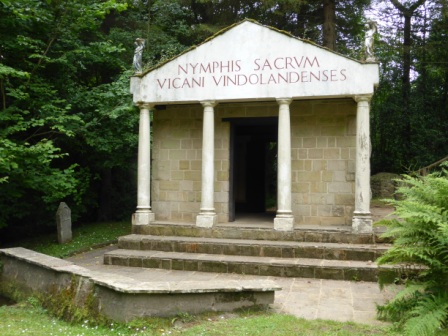
Below the village near to Chainley Burn is a reconstructed shrine with the painted inscription, ‘NYMPHIS SACRUM VICANI VINDOLANDENSES’ ‘The villagers of Vindolanda (dedicated this temple) sacred to the Nymphs’. This is based on an ornate temple still standing in the 18th century. There is plenty of evidence Vindolanda was a place of water worship.

P1170179

*

 Nine forts have existed at Vindolanda, built between 85AD and 370AD. Archaeological evidence suggests it was occupied long into the Dark Ages. It has been the home of soldiers from many different cultures; the 9th cohort of Batavians (Netherlands), the 1st cohort of Tungrians (Belgium), the 4th cohort of Gauls (France), the 2nd cohort of Nervians (Belgium) and Vardullian Cavalry (Spain). These men were removed from their homelands and stationed across the Empire. Defeated Britons were sent to fight for Rome in other countries.

P1170110

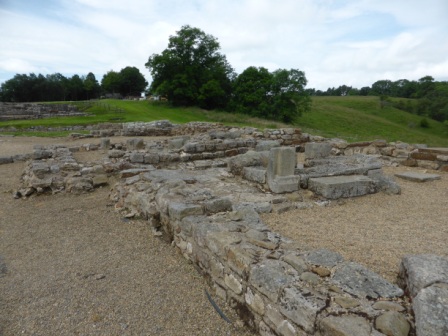
Rows of houses, storehouses, a tavern and mausoleums lie outside the walls of the fort which, when they were built in 211AD, were two storeys high with impressive guard towers (much of the stone has since been stolen). Inside are more houses and stores, bathhouses, workshops, horrea ‘granaries’, the principia ‘headquarters’ (where regimental officers and clerks maintained records) and the praetorium ‘house of the commanding officer’.

One of the buildings was a temple to Jupiter Dolichenus, an ancient weather god from the south-east of modern Turkey, who is depicted holding bolts of lightning whilst standing on a goat. His temple was destroyed then set on fire in 370AD when paganism was replaced with Christianity and a Christian church built within the fort. This is significant as it provides an exact date for the conversion of the people of Vindolanda to Christianity. It seems likely other Roman-ruled populaces on Hadrian’s Wall were converted around the same time.

P1170143

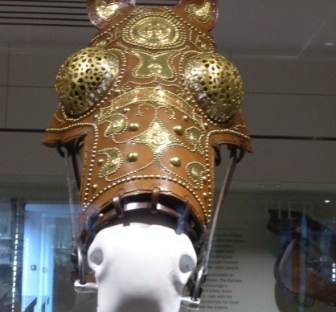
Within the museum are a large variety of finds perfectly preserved by the peaty soil. 6,000 shoes (but only one pair!) of all shapes and sizes were found in the ditches surrounding the fort, along with armour, weaponry, tents, a drawstring bag, cavalry standard and equipment for horses.

I was particularly impressed by the chamfron; a horse’s ceremonial face-mask made from leather with bronze fittings and protection for the eyes. Gwyn speaks of Carngrwn as a ‘white horse gold-adorned’. I could imagine Carngrwn wearing similar headgear. Could his depiction in The Black Book of Carmarthen have originated from the Land of White Springs and its tradition of elaborately decorated saddlery?

*

Most famous of all are the Vindolanda tablets. These inscriptions on wood date back to 121AD and provide some fascinating insights into the lives and viewpoints of the soldiers of Vindolanda.

‘…the Britons are unprotected by armour. There are very many cavalry. The cavalry do not use swords, nor do the wretched Britons (Brittonculi) mount in order to throw their javelins.’

‘…order (accommodation) to be given to…, but also a lodging where horses are well (looked after). Farewell, brother dearest to me’

‘Tomorrow nice and early in the morning come to Vindolanda, so that (you can join the counting of the census)’

Pieces of writing not on display are summarised on the surrounding walls:

Tranquilius ‘Who supplied some undergarments to the Cerialis household’

Claudius Super ‘A centurion, apologising to Cerialis for failing to attend Sulpicia Lepidina’s birthday celebrations’

Flavius Genialis ‘A predecessor prefect to Cerialis, who appears to have had a nervous breakdown at some point’

Lucius ‘A cavalry troop commander (decurion), receives a letter from a friend reporting on a gift of 50 oysters from a place called Cordonovi

Virrilus ‘A veterinary surgeon (veterinarius), who is reminded by Chrauttius that he hasn’t yet sent the castrating shears that he promised’

There is a small collection of statues and altars of gods and goddesses. These include statues of Priapus, Maponus and statuettes of Venus and Dea Nutrices and altars to the Veteres and an unknown god which frustratingly simply reads ‘Deo’.

They represent only a small portion of the dedications found at Vindolanda. I hoped to find an altar to Mogons ‘great one’ inscribed ‘Mogonti et Genio Loci’, as Vindos may have been viewed as the genius of the place. However, it was not on display.

That’s only a small complaint. The people who work at Vindolanda have done a superb job in their excavations of the Roman forts and preservation of the objects and remains of the people who lived there. No inscriptions to Vindos have been found, but their work is ongoing and no-one knows what might be recovered next…

*

Vindos god of the Land of White Springs
where the springs flow no longer
yet memories flow from
Annwn’s wells

soldiers from a thousand distant lands
have whispered your name

water holds their peaty memories

I do not wield a stylus on birch
nor chisel on altar

to engrave your greatness here forever

I let my words fall on the wind
spiralling downward
to join
the well-springs

Dogs of Carlisle

I went to Carlisle looking for proof of the claim it was the capital of Rheged and thus the seat of Urien Rheged where Taliesin sang his praises. I was also curious about whether I’d find any traces of Gwyn ap Nudd in the context of my research into his forgotten connections with the Old North.

I didn’t find what I expected and I found many things I didn’t expect. Such is the way of the world when you venerate a god of strange dogs…

*

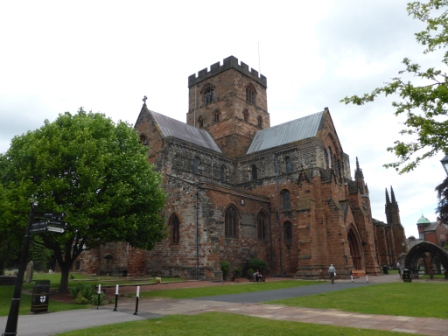
Carlisle Cathedral
P1160463 - Copy

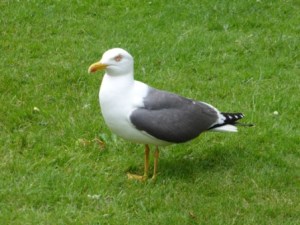
When I got to the entrance of the grounds of Carlisle cathedral I was stopped dead in my tracks by a stunning black-backed gull with a blush of red on his yellow beak, red star-studded rims around yellow eyes and black tail feathers spotted white. It wasn’t just his colouring. I felt like I recognised him.
P1160512 - Copy

However, there was a man eating a burger on the bench beside me. It wasn’t a time for talking to gulls. I looked around the ruins of the chapter house, the fratry, the friar’s tower, and St Cuthbert’s church then approached the doors of the cathedral.

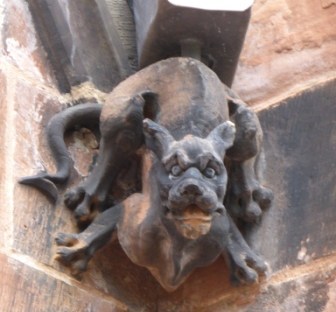
On either side were sculptures of dogs. One was thickset, heavy-jowled, mouth open as if to speak an order or breathe out a blast of wind. The other was smaller, crouched, leaner, ready to pounce with an intriguing serpent-like fork at the end of her tail. Guard dogs. They let me pass.

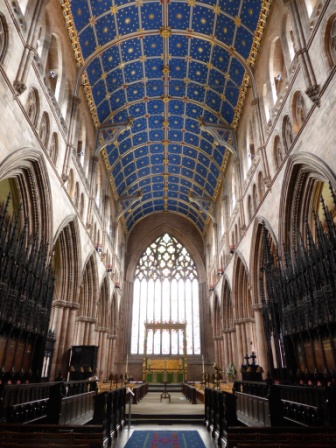
Inside were chapels to St Wilfrid and St Michael, statues of bishops sleeping like corpses on their tombs. In the treasury a beautiful Roman glass bowl, stones engraved with early Christian art, collections of chalices, platens, jewellery. I was most impressed by the high star-studded ceiling and the ornate artwork on the misericords.
P1160473 - Copy

Misericord means ‘mercy seat’. The monks stood for their seven daily sets of prayers hence their seats folded down. However for the elderly and infirm a small shelf was created for support. This is the origin of some wonderful art: wyverns, man-headed lions, a siren with a mirror, a woman beating a man, St Margaret of Antioch being swallowed by a dragon and eaten by a boar*. In a world where neither prayer nor craftsmanship are valued, the time and effort put into carvings to support the backsides of praying monks seem undreamable.

There was no mention anywhere of Urien Rheged or Taliesin. When I got out, the gull was waiting at the entrance. I sat on the wall and shared some crumbs from my sandwich. An old woman approached, remarked on the proximity of my ‘friend’ and told me there had not been black-backed gulls in the area until a pair nested on one of the roofs. Everyone was terrified the little grey chicks would tumble out. Yet they’re alive and well and it looks like they’re staying.

*

Carlisle Castle
P1160535 - Copy

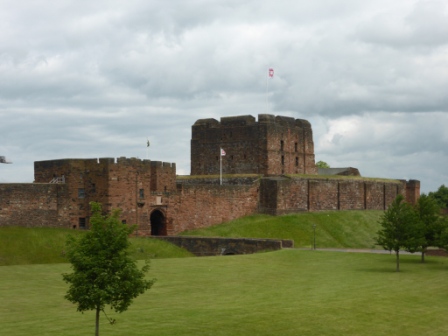
Like the Cathedral, Carlisle Castle was built (in stone) in the early 12th century but was founded on an earlier site. This was known in the Romano-British period as Luguvalium ‘Strong in Lugus’ and as the capital of Civitas Carvetiorum: the territory of the Carvetii tribe (‘the deer people’). A Roman fort which housed 1000 men was built there in 73AD then another called Petriana facing it on the north bank of the Eden.

Due to its powerful defensive position near the confluence of the rivers Eden and Caldew and to Hadrian’s Wall plus its earlier status as a tribal centre (which may have become one of Nennius’ 26 cities: Cair Ligualid) scholars have conjectured it may have been the capital of Rheged.
P1160588 - Copy

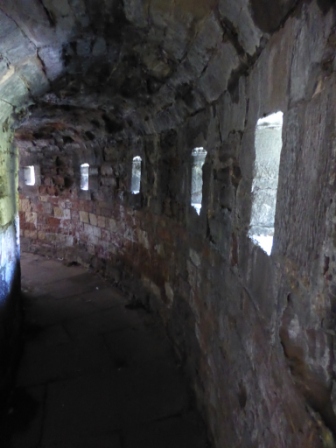
I walked the walls, descended into the half-moon crescent, found the well, and the tower where Mary Queen of Scots had been kept. Descending into the basement of the keep, once a storehouse and dungeon, I read how the thirsty prisoners had been forced to lick the stones for moisture.

In that inner cell I spotted grooves in the stone, a wet glint. Water? I touched it and my finger came away damp. Like a tongue. I felt the crush of bodies, the walls closing in, said a quick prayer for those who had been imprisoned, and rushed back to the light.
P1160579 - Copy

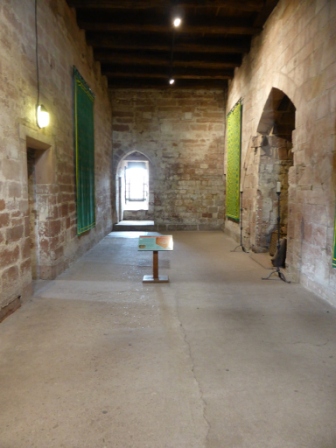
On the first floor the Great Hall with its expansive fireplace was the kind of place you could imagine a poet performing for a King. However, once again neither Urien nor Taliesin were mentioned. Up another flight of stairs a pair of walls decorated by bored 14th C guards with drawings from coats of arms and oral tales. Engraved on the door: a huntsman and his dogs.

*

The Eden and Caldew
P1160604 - Copy

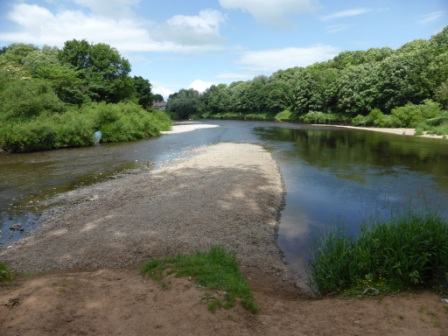
I walked from the castle down to the river Eden, noting the path that runs along the line of Hadrian’s Wall. The Eden would have felt peaceful if it wasn’t for policemen searching for something in snorkels which set me slightly on edge. At the spot where the Eden and Caldew meet I touched the water and saw a shoal of tiny newly hatched fish.

Up the Caldew jackdaws flocked between the trees. As I walked back through the woods I felt like I was surrounded by them every way I turned: a fairytale moment, a jackdaw on every branch, in every ear. I don’t see jackdaws in Penwortham and was enchanted by their roguish presence. At the end of the wood I found a freshly fallen feather.

*

Curse and Counter
P1160622

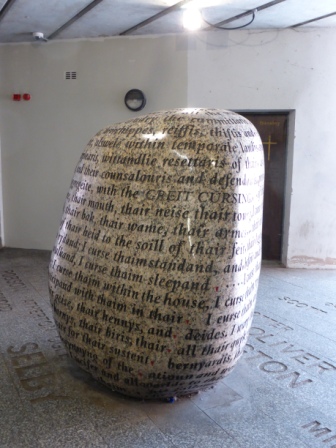
Walking through the subway between the castle and city centre I came across the infamous Cursing Stone. Designed by Gordon Young and made by Andy Altman it was set in place in 2001. It is inscribed with the Curse of Carlisle, which was used against the Border Reivers by the Archbishop of Glasgow in 1525. The curse is 1069 words long. It begins:

“I curse their head and all the hairs of their head; I curse their face, their brain (innermost thoughts), their mouth, their nose, their tongue, their teeth, their forehead, their shoulders, their breast, their heart, their stomach, their back, their womb, their arms, their leggs, their hands, their feet and every part of their body, from the top of their head to the soles of their feet, before and behind, within and without.”

The Cursing Stone has caused controversy because since its instalment Carlisle has suffered from a spate of bad luck including foot-and-mouth disease, floods, rising crime and unemployment and the relegation from the league of Carlise United football team.
P1160623

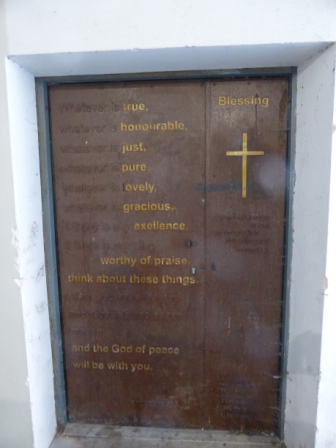
Christians have campaigned to have it removed. I noticed behind the stone was a door engraved with a Christian prayer and a cross saying ‘blessing’: an attempt to redress the negativity of the curse? Ensuingly someone less high-minded had written beside ‘honourable’ ‘just’ ‘pure’ in permanent marker, ‘Ha ha your God is dead.’

*

Tullie House Museum

You could spend days in the Tullie House Museum learning about the history of Carlisle (from a hand-axe dating to 10,000BC to the modern-day) and looking at the art-work. I had only a couple of hours left so had to keep my focus on finding something relating to Urien and Taliesin.

The bottom floor was entirely dedicated to Roman Britain and included statues and altars to the Roman deities and interactive spaces where you could enter a tent or try on jewellery. I noticed a brooch featuring a hunting dog then upstairs a dog statuette from the Romano-British period. Both put me in mind of the votive hounds offered to Gwyn’s father, Nudd/Nodens.

To my surprise I found numerous sculptures of Celtic deities: a Celtic wheel-god (Taranis?), three sets of Genii Cucullati, three sculptures of the Mother Goddesses and a dedication, a Celtic horned god, the eye-catching ram-horned head from Netherby with his deep, sunken eyes and fathomless expression. There were also altars to Hueteris, Belatucadrus, and Mars Cocidius.

I’d seen many sketched in Anne Ross’s Pagan Celtic Britain and wasn’t prepared to see them all together at once. It was overwhelming and rather peculiar seeing them packed into four cabinets; some headless, limbless, or defaced. I managed to get my act together and speak their names, those I knew, those I didn’t. Images of deities sculptured 2,000 years ago, revered, now viewed in a entirely different context.
P1160686 - Copy - Copy

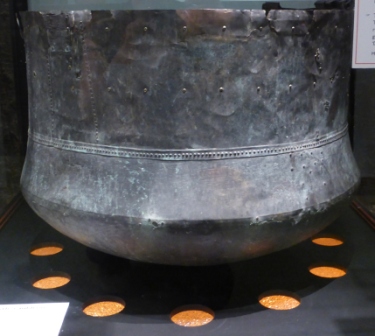
The most surprising find was a cauldron. I’ve been researching the stories of the broken cauldron in British mythology for the past two years yet this was the first time I’d seen a cauldron in real life. The Bewcastle Cauldron was found during peat cutting at Black Moss, was missing its handles and coincidentally had been repaired five times by patching. Most astonishingly it was surrounded by orange lights; in ritual, I place candles around my cauldron in the same manner! Once again there was no sign of Urien or Taliesin.

*

A Wild Dog Chase

If I’d seen a goose I might have been able to say I’d been on a wild goose chase. However, I found myself led along my journey by a variety of strange dogs, birds (but no geese), and other bizarre creatures to the cabinet of the gods and the ‘grail’ itself: the handle-less patchwork cauldron.

A strange day out and in the non-logic of it this ‘wild dog chase’ I sense the presence of my Annuvian deity…

*I found out the correct identities of the carvings on the misericords from an obscure pamphlet called Cry Pure, Cry Pagan by Thirlie Grundy which a friend coincidentally happened to own.

Caer Vandwy and the Theft of the Brindled Ox

A plain of blood where men once stood.
The lights have gone out in Caer Vandwy.
The clashing sea rolls over shield and spear.
The living dead. The dead dead again.

***

The sixth fortress in ‘The Spoils of Annwn’ is Caer Vandwy. This has been translated as ‘Fortress of God’s Peak’ and ‘Fort of the High God’. Marged Haycock uses ‘Mand(d)wy Fort’ but does not explain her re-rendering. It could relate to Manawydan (‘Manawyd’ in ‘Arthur and the Porter’). The connection of a sea-god with an island location seems credible.

In the verse relating to Caer Vandwy, Taliesin again berates ‘pathetic men’ (monks) for their lack of insight into certain mysteries he is knowledgeable about:

‘I don’t deserve to be stuck with pathetic men trailing their shields,
who don’t know who’s created on what day,
when at mid-day God was born,
(nor) who made the one who didn’t go to the Meadows of Defwy.’

The second line suggests the existence of a Bardic riddle enumerating mythic and/or historic figures born on certain days. In line three, Haycock reconstitutes Dwy ‘God’ from Cwy. Caitlin and John Matthews prefer Cyw ‘chick’ whereas Sarah Higley sticks with Cwy as a personal name.

Haycock’s choice fits with the translations of Caer Vandwy as a fortress belonging to (a) God. This may not be the Christian God. In the next verse Taliesin refers to the ‘pathetic men’ as ‘(those) who don’t know on what day the Lord is created’. Lord is translated from Pen ‘Head’. Perhaps this god is Pen Annwn ‘The Head of Annwn’.

Next we come across an unnamed person ‘who didn’t go to the Meadows of Defwy’. Haycock suggests Defwy is a river-name meaning ‘black’ (from def-/dyf) and poses the question ‘Was this imagined as a river between this world and the next?’

The Matthews link the Meadows of Defwy to Gweir ap Gweirioed ‘Hay son of Grassiness’ (the divine prisoner in verse one) and say ‘we may be looking at Doleu Defwy as an otherworldly meadow’.

This brings to mind the Gwerddonau Llion (translated as ‘green meadows of the sea’ and ‘green islands of the floods’). In a triad* referring to ‘three losses by disappearance of the Isle of Britain’ Gavran is said to have gone to sea in search of the Gwerddonau Llion.

Philip Runngaldier connects the Gwerddonau Llion with the sunken land of Cantre’r Gwaelod ‘The Bottom Hundred’ and says they are inhabited by ‘Gwyllion’: ‘the shades of (Llyn) Llion’ ‘the dead’. Perhaps the one who didn’t go to these mysterious meadows escaped death.

***

Taliesin continues to deride the monks:

‘those who know nothing of the Brindled Ox, with his stout collar,
(and) seven score links in its chain.’

Grazing on the Meadows of Defwy we come across an animal of great fame: Ych Brych ‘The Brindled Ox’. He appears in The Triads as one of ‘Three Principal Oxen of the Island of Britain’:

‘Yellow Spring (‘The One of the yellow of spring’)
and Chestnut, of Gwylwylyd (or ‘a meek and gentle ox),
and the Brindled Ox.’

His capture is amongst the ‘impossible tasks’ Arthur and his men must fulfil on Culhwch’s behalf in Culhwch and Olwen. For food to be grown for Culhwch and Olwen’s wedding feast, a field must be ploughed by the divine ploughman, Amaethon.

The plough must be pulled by a team of six oxen: ‘the two oxen of Gwylwlydd Winau, yoked together’, ‘Melyn Gwanwyn and the Ych Brych yoked together’ and ‘two horned oxen… Nyniaw and Peibiaw.’

Two oxen from the triad: Yellow Spring and the Brindled Ox are placed together and Gwylwylyd appears as the owner of two oxen, presumably Chestnut and an unnamed ox. Intriguingly Nyniaw and Peibiaw are the sons of the king of Archenfield ‘whom God transformed into oxen for their sins.’

John Rhŷs records a folkloric story where Nyniaw and Peibiaw are brother kings. One moonlit night, Nyniaw boasts his field is ‘the whole firmament’. Peibiaw says his sheep and cattle are grazing in his fields: ‘the great host of stars, each of golden brightness, with the moon to shepherd them.’ Nyniaw is furious and a terrible battle ensues which leads to their transformation into oxen by God.

This may be a Christianised explanation of their shapeshifting capacities. In The Tain, the two bulls Finnbennach and Donn Cuailnge are ‘pig-keepers’ ‘practiced in the pagan arts’ who can ‘form themselves into any shape’. Tricked into falling out, they battle against each other as birds of prey, whale and seabeast, stags, warriors, phantoms, and as dragons before becoming maggots, being swallowed by cows and reborn as bulls. It seems likely the Brindled Ox was originally a shapeshifter with the capacity to take human and other forms.

***

In the last lines of the verse Taliesin says:

‘And when we went with Arthur, sad journey,
save seven none came back from Caer Vandwy*’.

The final line is repeated as a refrain at the end of each verse. Of three full loads of Prydwen who went to Annwn, only seven survivors return. Some catastrophe has taken place. Lines spoken by Gwyn ap Nudd in The Conversation of Gwyn ap Nudd and Gwyddno Garanhir suggest this was a battle at Caer Vandwy:

‘to my sorrow
I saw battle at Caer Vandwy**.

At Caer Vandwy I saw a host
Shields shattered, spears broken,
Violence inflicted by the honoured and fair.’

It is my growing intuition the names of individual fortresses are in fact different names for the same fort. In the previous verse Taliesin said six thousand men and an incommunicative watchman were standing on Caer Wydyr’s glass walls. Gwyn is referring to the catastrophic battle against the people of Annwn by which Arthur and his men broke into the fort. After breaking in, they took Gweir, stole the Head of Annwn’s cauldron, and captured the Brindled Ox before slamming ‘Hell’s gate’ shut.

A couple of months ago Brian Taylor drew my attention to a passage in James Hillman’s The Dream and the Underworld which illustrates the parallels between Arthur’s raid on the Head of Annwn’s fortress and Hercules’ assault on the House of Hades: ‘drawing his sword, wounding Hades in the shoulder, slaughtering cattle, wrestling the herdsman, choking and chaining Cerberos… the Herculean ego does not know how to behave in the underworld’.

As I continue my own journey through ‘The Spoils of Annwn’ where others see a quest for inspiration, I see violence, desecration, the utmost disrespect for the people of Annwn: a trail of atrocities committed by a power-hungry warlord and ambitious bard.

Far from being a model for seekers of Annwn’s mysteries it advocates the selfish pursuit of objects of desire through deceit and brute force. Our stories of journeys to the underworld are reflected in the upperworld and we have still not outgrown this Arthurian/Herculean mindset.

New ways of approaching Annwn based on respectful relationships with its people are required. Perhaps in time these will yield the stories needed to replace Arthur’s hegemony. But first repairs must be made…

*This is referred to in The Cambro Briton but I can’t find a source. It isn’t in The Triads of the Islands of Britain.
**Rather than using Haycock’s unexplained re-rendering of Gaer Vandwy I have stuck with the name in the Welsh text.
***Heron translates kaer wantvy as Caer Fanddwy. I’ve stuck to Caer Vandwy for consistency.

SOURCES

Caitlin and John Matthews, King Arthur’s Raid on the Underworld, (Gothic Image, 2008)
Heron (transl), ‘Gwyn ap Nudd and Gwyddno Garanhir’
James Hillman, The Dream and the Underworld, (CN, 1979)
Marged Haycock (transl.), Legendary Poems from the Book of Taliesin, (CMCS, 2007)
Philip Runggaldier, Llyn Llion Theory, (Matador, 2016)
Rachel Bromwich (ed), The Triads of the Island of Britain, (University of Wales Press, 2014)
Sarah Higley (transl.), ‘Preiddu Annwn’, (Camelot, 2007)
Sioned Davies (transl.), The Mabinogion, (Oxford University Press, 2007)
Thomas Kinsella (transl), The Tain, (OUP, 1979)
Wirt Sikes, British Goblins, (Lightning Source, 1880)

Crane-Dance in the Labyrinth?

Over the past few months I’ve been involved with several of the work parties building a labyrinth for ‘fun, exploration and meditation’ at Brockholes Nature Reserve. It was designed by John Lamb (an archaeologist and Lancashire Wildlife Trust’s Senior Conservation Officer) and opened on April the 23rd 2016.

During the period the labyrinth was being built, I was researching links between Gwyn ap Nudd as a ‘bull of battle’ and Gwyddno Garanhir (‘the Knowing One with Long/Crane Legs’) and Tarvos Trigaranus (‘The Bull with Three Cranes’).

Coincidentally I came across a ritual crane-dance in Greece called geranos initiated by Theseus after defeating the minotaur in the  labyrinth in Crete. Its blows and crane-like turns imitated the battle and the labyrinth’s winding course and the leader of the dance was known as geranoulkos. This got me wondering whether the name Gwyddno Garanhir may have been a title deriving from a similar role.

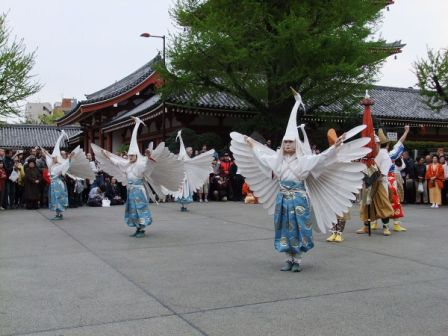
Crane-dances are found in many parts of the world. One of the most famous is the Japanese Shirasagi-no-mai ‘White Heron (‘Crane’) Dance’ which is one thousand years old and ‘was originally performed to drive out the plague and to purify the spirits on their passage to the next world.’ Cranes are also associated with the otherworld in Celtic mythology.

Shirasagi no mai (White heron dance) of Sensō-ji, Wikipedia Commons

Shirasagi-no-mai, Wikipedia Commons

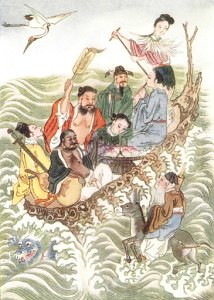
Cranes are depicted accompanying the Eight Immortals in Chinese mythology. They inhabit five islands in the Bohai Sea which include Mount Penglai. This is known as Horai by the Japanese. In both cultures it is a paradisal place with endless amounts of food and drink where nobody grows old. This is intriguing because Gwyddno is a sage-like figure.

Eight_Immortals_Crossing_the_Sea_-_Project_Gutenberg_eText_15250

Eight Immortals Crossing the Sea, Wikipedia Commons

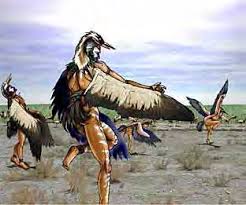
One of the earliest finds relating to a crane-dance is an 8,500 year old crane wing found on top of a cattle horn core in Çatalhöyük in ancient Anatolia. The crane bones were pierced by holes of a suitable size for string which suggests they were tied to the arms of a crane-dancer. Two black cranes are depicted on a painting on one of the walls facing a bull  on the opposite wall. A dance scene depicting a sacred marriage and mother and child may prove the dance focused on fertility and birth.

Dance of the Cranes John-Gordon Swogger

Dance of the Cranes by John-Gordon Swogger http://www.savingcranes.org

Crane-dances have many meanings across cultures. One theme that stands out is passage: from the trials of the labyrinth, from one world to the next on birth or death. Gwyn and Gwyddno’s conversation takes place upon Gwyddno’s passing from thisworld to Annwn, possibly in crane-form.

At Brockholes the closest likenesses to a bull (or minotaur!) with cranes are the long-horned cattle and numerous herons who can be seen on the river Ribble and lakes.

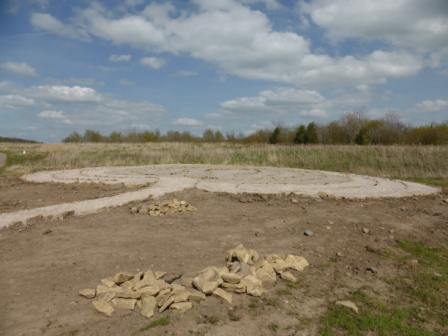
When I walked the labyrinth for the first time my intention was getting a feel for its path within the nature reserve between the car park and stone circle as skylarks loudened the summer sky and oystercatchers pipped overhead.

P1150689

I found myself pondering whether a geranoulkos would have used such a setting for a crane-dance and what the steps would have looked like at various rites. But I didn’t dance. I’ll leave that to those more agile with longer legs…

SOURCES

Edward A. Armstrong, The Folklore of Birds, (Dover, 1970)
Nerissa Russell & Kevin J. McGowan, ‘Dance of the Cranes: Crane Symbolism at Çatalhöyük and beyond’, (2003) HERE
‘Hypocherma’ (Geranos), Wikipedia HERE
‘White heron (“crane”) dance: Shirasagi-no-mai and heron symbolism’, Japanese Mythology and Folklore HERE

Gwyn’s Death and Departure

You say you come from many battles and many deaths.
I try not to hold on or shed tears on the edge
of summer.

You’ve been doing this for many years.
I’m the fearful one.

After death you staunch your wounds,
draw your blood back
into itself

before your hounds come forever guides into the mists
with your horse who carries the dead.

You’ve never been more yourself.

You remind me of the November
we touched the moon and tell me not to mourn.

You are long-lived and my summers are limited:
hours to be savoured as a bee
drinks nectar from
a gold cup.

I cast off my grief
for my gown is not yet a shroud.

On the motorway bridge
where the railings sing like hummingbirds in the gale

I am alive yet your hunt is never far off.

Maelawr Gawr and Gwerthmwl Wledig: Pen Dinas in Retrospect

P1120829

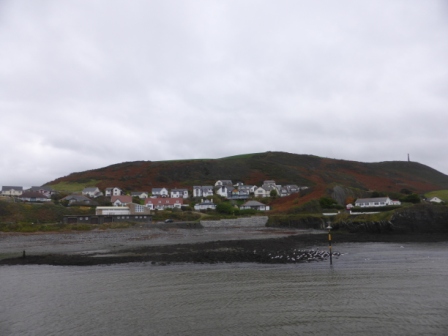
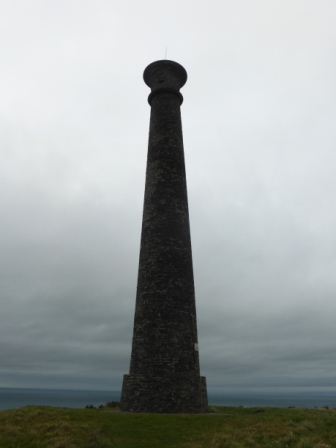
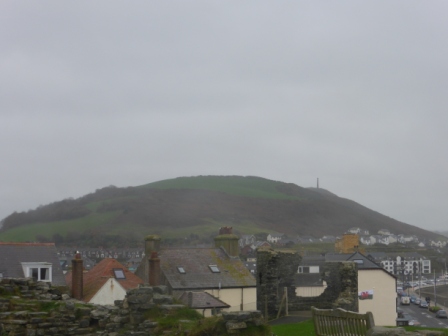
When I went to visit Heron in Borth last year I stayed in Aberystwyth. On my last day I had the chance to climb Pen Dinas (‘Head of the Citadel’). This is the name of the northern summit of the hill overlooking Aberstwyth which lies between the rivers Ystwyth and Rheidol.

When I made my visit, I went with limited knowledge. I’d read on Wikipedia that there was a Bronze Age burial mound on the southern summit. It was the site of two consecutive Iron Age hill-forts, one of which had been raided. The Romans did not occupy the hill, but a 4thC hoard of coins suggested they used it as a shrine.

I also read that Pen Dinas was associated with Maelawr Gawr (‘the giant’) who had three sons called Cornippyn, Crygyn and Babwa. Like in so many British stories he was presented as an adversary. In this case it isn’t clear what he’d done wrong. The crux of the story is that he was captured in Cyfeiliog and sentenced to death.

Maelawr asked his enemies a final request: to blow on his horn three times. The horn was so loud and forceful that on the first blow his hair and beard fell out, on the second his finger and toenails fell off and on the third the horn blasted apart and crumbled into pieces.

Cornippyn heard the horn whilst he was out hunting with horse and hound. He set off to rescue his father so fast he tore the head off his hound. He spurred his horse on in one leap over the Ystwyth and was slain in his attack on Maelor’s captors. Crygyn and Bwba were murdered in their fortresses in Llanilar and Llanbadarn Fawr the same night.

P1120748

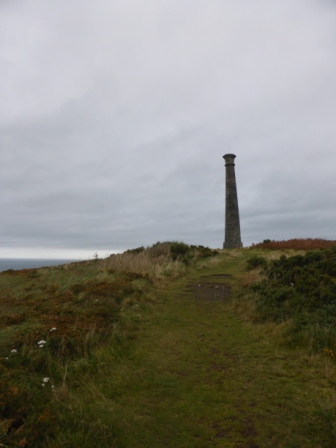
I was drawn up the hill by the magnetism of the Wellington Monument on the northern summit. It felt like a strong place: like the aura of giant wasn’t quite gone nor the feeling of relative safety offered by occupying a high hill.

P1120741

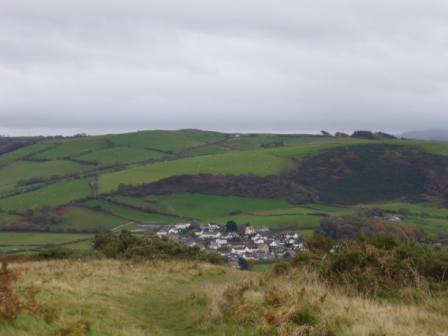
Looking toward Penparcau I didn’t spot or hear a headless hound but I did see a pair of ravens.

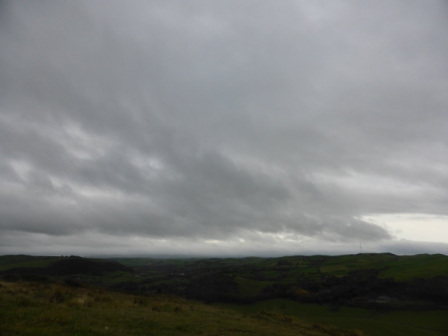
Clouds marched in on a growing wind. I found myself feeling distant from the harbour beneath, Aberystwyth and the cliff railway, not so much in place but time.

P1120743

I felt Gwyn’s presence and that of others cloaked in cloud and knew he had been there to gather the dead.

That was unexpected and it wasn’t until several months later I found a possible explanation. In The Triads of the Island of Britain I found the fragments of a story set during the Dark Ages.

One of ‘Three Horses who carried the Three Horse Burdens’ is ‘Dappled the horse of the sons of Gwerthmwl Wledig, who carried Gweir and Gleis and Archenad up the hill of Maelawr in Ceredigion to avenge their father.’

‘The hill of Maelawr’ has been identified as Pen Dinas by Owen Jones. In Cymru, he says ‘in the land of Aber Teifi there was in former times before Brutus came to this island, the giant Maylor, and the place where he lives is still called Castell Maylor, built upon a high hill or ridge which is called Y Dinas, beside the river Ystwyth, within the freehold of the town of Aberystwyth.’

It appears that Gwerthmwl led an attack on Maelawr and was defeated hence his three sons rode up Pen Dinas to avenge him. Pen Dinas was the site of two Dark Age battles as well as a raid in the Iron Age. There is no record of whether Gwerthmwl’s sons succeeded.

Further research turned up that Gwerthmwl was an important (albeit now forgotten) figure in British mythology who originated from northern Britain. In Rhonabwy’s Dream he appears as one of forty-two of Arthur’s counsellors.

In the ‘Three Tribal Thrones’ he is listed as ‘Chief Elder’ in ‘Pen Rhionydd in the North’ alongside ‘Arthur as Chief of Princes’ and ‘Cyndeyrn Garthwys’ (St Kentigern) as ‘Chief of Bishops’.

Pen Rhionydd has been identified with Ptolemy’s Rerigonium ‘very royal place’ and may have been located on the Rhinns. One possible location is Port Patrick, which used to be called Portree (from port righ ‘King’s Port’). Another is Penrith. Wherever Pen Rhionydd was, Gwerthmwl’s three sons travelled a long way to avenge their father’s death.

Gwerthmwl also appears in The Triads as one of ‘Three Bull-Spectres’. Epithets such as Bull Chieftain, Bull Protector and Bull of Battle were commonly assigned to Dark Age warriors to illustrate their strength and battle-prowess.

Gwerthmwl’s status as a Bull-Spectre suggests he was as a bull-epitheted warrior who remained as a ghost. Another interpretation is he became wyllt ‘wild’ or ‘mad’ as a result of his battle with Maelawr (the welsh for Bull Spectre is tharw ellyll).

It is notable that Gwyn, who is addressed as a Bull of Battle by Gwyddno Garanhir, has strong associations with warriors with bull-epithets and gwyllon.

The resting place of Gwerthmwl is listed in ‘The Stanzas of the Graves’:

‘The grave of a chieftain from the North
is in the open land of Gwynasedd,
where the Lliw flows into the Llychwr;
at Celli Friafael is the grave of Gyrthmwl.’

Gwerthmwl’s grave is where the Lliw runs into the Llwchwr near Casllwchwr in Gower. He was buried a long way south of Pen Dinas and a long, long way from Pen Rhionydd in the North.

In the story of Maelawr and Gwerthmwl I come across another example of the destructive conflicts between the people of Wales and the North which Gwyn attended as a psychopomp.

What makes this particular story interesting is that Maelawr is most famously remembered as a giant. This raises the question of whether he was always known as a giant or was a human chieftain who literally grew in status after defending his hill from Gwerthmwl.

Could the story of Maelawr’s capture and death be founded on the vengeance of the sons of Gwerthmwl?

The answer lies buried as the giant’s bones, his fallen beard, fingernails, toenails, the broken pieces of his horn which still blasts clouds over the pillar that marks the location of his citadel.

P1120742

P1120866

SOURCES

Mike McCarthy, ‘Rheged: An Early Historic Kingdom near the Solway’ in Proc Soc Antiq Scot, 132 (2002),
Peter Bartrum, A Welsh Classical Dictionary: People in History and Legend up to about A.D. 1000, (National Library of Wales, 1993)
Rachel Bromwich (ed), The Triads of the Island of Britain, (University of Wales Press, 2014)
Sioned Davies (transl.), The Mabinogion, (Oxford University Press, 2007)
Wikipedia ‘Pen Dinas’ https://en.wikipedia.org/wiki/Pen_Dinas