Over the past year I have been practicing meditations in the yogic tradition that develop awareness such as antar mouna ‘inner silence’ and ‘spaciousness.’ This has led from the development of my personal practice of being present for my patron, God, Gwyn, to be being aware that I am present.
Whilst reflecting on this He gave me three guidelines for awareness –
Be present and aware in both Thisworld and Annwn.
Be aware of Me without and within (I am everywhere).
Spend time in solitude and silence so we can meet in awareness.
Having an awareness practice is very helpful for me as an autistic person who struggles with sensory and emotional overload and tends to disassociate and get lost in thoughts. It helps me stay present and grounded in Thisworld and focused when journeying in the Otherworld.
Being aware of Gwyn in each moment makes awareness a devotional act. Any moment, no matter what’s happening, can be transfigured by the knowledge that He is with me, inspiring me and guiding me.
The hardest guideline to follow is withdrawing from the busyness of everyday life and quieting my mind enough to find inner silence and meet with Gwyn awareness to awareness but when this happens it works deep magic.
“Meet Me in the place between thoughts,” is a guiding thread running through these guidelines that has helped me, as a nun of Annwn and Bride of Gwyn, to rendezvous with my Beloved in any place and time.
Whilst watching the Carmelcast Podcast on Youtube for its discussions on prayer I noticed the hosts introducing themselves as Brother John Mary of Jesus Crucified and Brother Pier Georgio of Christ the King. This alerted me to the fact many monastics not only take a monastic name but add a dedication to an aspect of their Deity or religion. Other examples include Saint Elizabeth of the Trinity and Sister Mary of the Divine Heart.
Thus I meditated on what aspect of Gwyn or my tradition I’d dedicate myself to. I considered firstly our Monastery of Annwn Nine Faces of Gwyn – Gwyn the Warrior, Gwyn the Hunter, Gwyn the Lover, Gwyn the Dreamer, Gwyn the Inspirer, Gwyn the Reaper, Gwyn the Gatherer, Gwyn the Unknown.
Ten years back I might have chosen Gwyn the Inspirer. As a trainee shamanic practitioner practicing soul retrieval I wondered if Gwyn the Gatherer (of souls) might be apt but it didn’t feel right. I felt drawn to Gwyn the Unknown but that didn’t feel quite right either.
I then contemplated aspects of our tradition such as the Awen. Not as important in my life as it was once was. I gave up and went upstairs to the bathroom and on my way saw what should have been obvious considering that central to our monastery is the Rule of the Heart – the Heart of Annwn. I saw and felt it beating in the depths of the Otherworld and within my own heart.
“Will you dedicate yourself to the mysteries of my Sacred Heart?” Gwyn asked.
Returning to meditation I agreed and for the first time Gwyn took me into His heart.
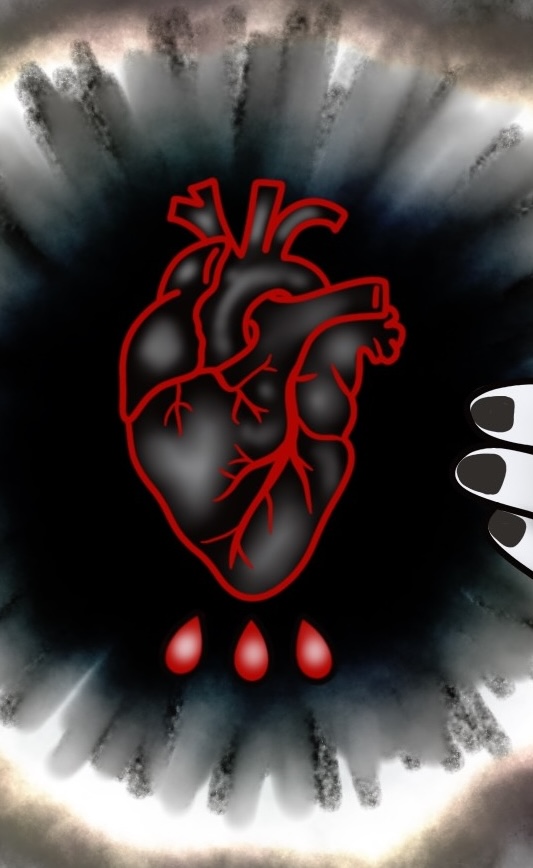
There is a black butterfly in Your heart. I cannot decipher the meaning on a bright spring morning when the May flowers blossom and all the hawthorns are in bloom.
There is a black butterfly in Your heart. I cannot decipher the meaning at midday when the sun burns bright and Maponos strums a song on His harp with chords of sunlight brighter than the fires of Bel.
There is a black butterfly in Your heart. I cannot decipher the meaning at sunset as the blackbirds sing the sun down and burning happy dancers dance and talk and do the things that people do.
There is a black butterfly in Your heart. I cannot decipher the meaning until midnight comes and I follow the funeral procession of the sun into darkness. Until I walk with the dead sun into the depths of the Otherworld.
~
“Dead sun, dead sun, what are we doing here, what are we doing here in this darkness, darker than the dark side of the moon, darker than the dark side of the sun?
“Dead sun, dead sun, what are we doing here, what are we doing here in this silence, more silent than the silence when the King of Annwn died and Maponos ceased to play His harp?
“Dead sun, dead sun, what are we doing here, what are we doing here in this stillness stiller than the places between the dance-steps of His faery dancers, the hoofbeats of the horses of His hunt, the spaces between the beats of His heart?”
“Come deeper, come deeper,” says the dead sun, “beneath the world’s chatter and words and images that paint butterfly colours, come deeper, come deeper.”
~
The dead sun takes me to Your tomb in the Castle of Cold Stone. Reminds me of how Your castle fell from the skies of Annwn, circling four-cornered, from the songs of the mead-feast, from the revelry, from the boiling of the cauldron, from the passing of the mead-cup,
down, down, down,
into the Abyss,
into the place between the end and the beginning of life and death, the end and beginning of words and of worlds…
~
You’re dead – there are no words to express my sorrow. You’re alive, only sleeping, there are no words to express my hope.
You’re dressed in black as if ready to attend Your own funeral. Your hair is white and silver as the light of the moon and the hairs in the manes and tails of the horses of Your hunt.
And Your heart, Your heart is red as the reddest of the roses of Your queen who forever betrays You on May the first.
For You I plant five red roses in Annwn and a single rose above.
~
For you I sit here in the darkness, the silence, the stillness. I listen to Your breath and the beating of Your heart.
At first it is felt, not heard, not seen.
Then I hear it, then I see it – the dark flutter of the butterfly in Your heart.
“What is this? What is this?” My heart flutters in concern. “Why has a black butterfly come to abide in the heart of the King of Annwn, the heart of the Otherworld?”
“Worry not.” Even death does not faze You. You do not speak like a corpse but like the most living of the living and the brightest light in Annwn’s darkness. “You are the black butterfly who flaps her wings in my heart.”
~
“Did You hear that?” I ask the dead sun.
The dead sun has already fled – it is morning.
“Did You hear that?” I ask Maponos.
He has already gone to play His harp.
We’re alone now, my King and I, butterfly and heart, in the darkness, in the silence, in the solitude, for a moment before the world’s call forces us to part.
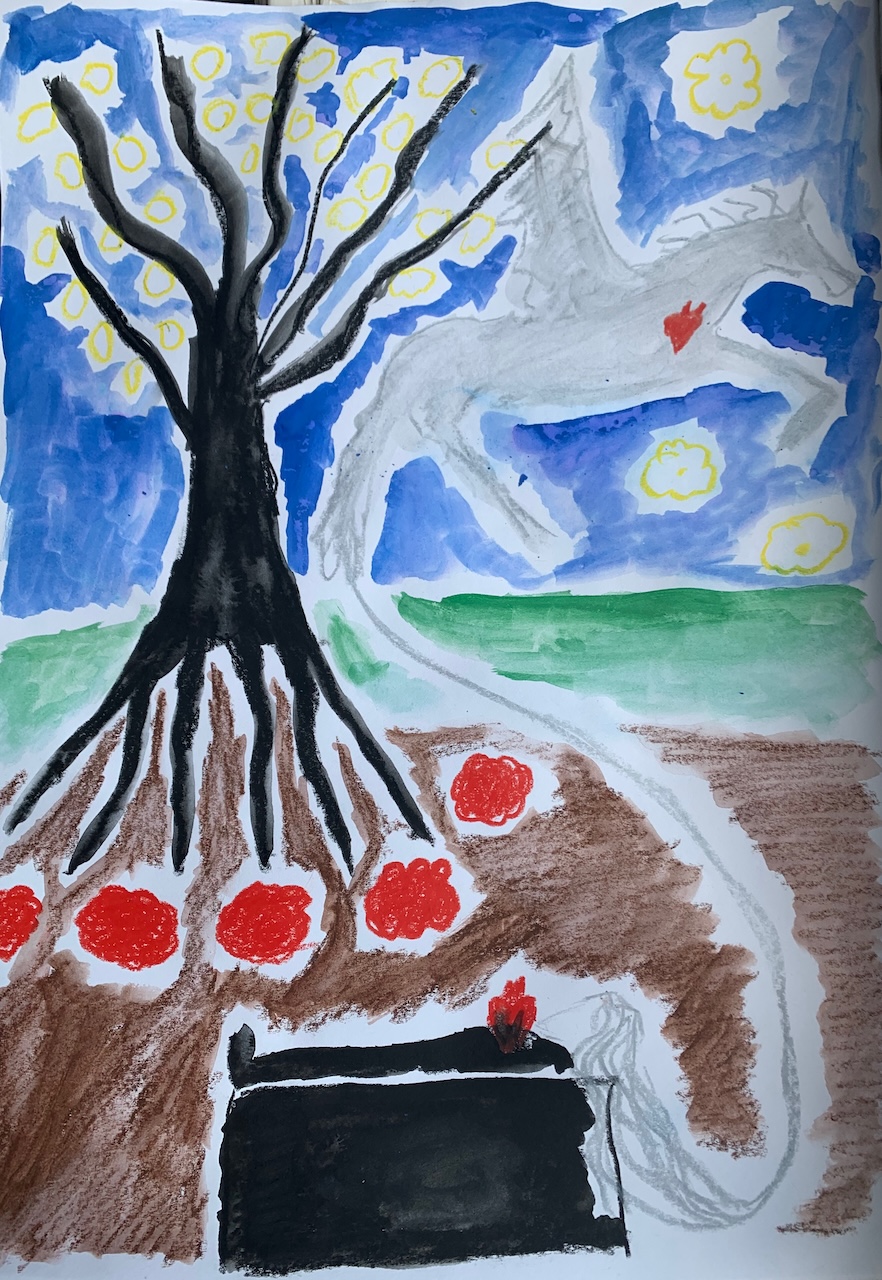
I created this painting at a Beltane focused seasonal creative workshop with Two Birds Therapy and wrote the poem afterwards. It’s based on the dichotomy I always feel at this time of year between the beauty and energy of nature and the sadness of Gwyn’s death and my need to be alone with Him whilst others are celebrating. The black butterfly was the result of a mistake wherein I tried to make Gwyn’s heart redder but instead smudged black into it. For me this gave the piece its meaning.
I’ve recently been re-reading St Teresa of Avila for inspiration on forming a framework for my own practices and experiences of prayer. Teresa’s techniques are complicated and vary as her ideas change over time as evidenced in The Way of the Perfection and The Interior Castle.
During this time I had a dream in which the Mother Superior of an abbey was giving a talk on prayer and told the audience not to mistake the scaffolding for the thing itself. I thought her words were wise but at present feel like I need a little scaffolding as I attempt to build a palace for prayer fit for Gwyn – Annwn’s King. Below, inspired by Teresa, is my scaffolding for prayer.
Formal Prayer
Formal prayers are those that are addressed to the Gods and are often written down and spoken regularly – daily, monthly or at seasonal celebrations. For example prayers of praise (“Gwyn ap Nudd, Lord of Annwn, I adore Your starlit crown”), prayers of thanksgiving (“I thank You, White Son of Mist, for guiding me on the misty ways”) and prayers of celebration (“Hunter in the Skies tonight we honour You as You ride out with Your hunt.” Prayers of petition and intercession might also be included here. “Bull of Battle, with Your horned helmet, strong shield and piercing spear, lend me Your strength”. “Gatherer of Souls please gather the soul of… to Your realm.”
Conversational Prayer
Conversational prayer is less formal and gives the Gods more space to respond. As St Teresa says it is like conversing with a friend. Checking in, asking what They need from us and for Their advice and guidance, listening to Their opinions on how we have served Them throughout the day. “Good morning.” “I’m feeling… how are you?” “How might I serve you best?” “I’ve got this problem.” “Good evening.” “My day’s been… how was yours?” “I messed up, I’m sorry, what do you think and how can I make repairs?”
Conversations with the Gods might take place like those between human persons, like between two friends, with a Deity appearing in human-like form and speaking directly through the inner senses. The Gods might also respond in more nuanced ways, providing us with a feeling or a knowing, they might show us a vision or a sign in nature or gift us with a dream.
The Prayer of Vision
The prayer of vision involves the active visualisation of a Deity. We can visualise our Gods before us, at our altars, or we can use visualisation meditation to visit Them at Their sacred places in Thisworld or the Otherworld. In this type of prayer we often find at the beginning we feel like we’re ‘making it up’ and we are to some degree yet the very act of imagining is sacred and the beginning of the co-creation of a vision that often shifts and takes on a life of its own as we enter deeper communion with our Gods. Spontaneous visions can also occur both in and outside of prayer time.
The Prayer of Silence
Whilst the prayer of vision involves the active use of the imagination and the inner senses the prayer of silence occurs when the faculties are stilled. Here, it is common to experience a deep sense of calm, of quiet, of abiding with a God. As it lacks sensory content it is notoriously difficult to put into words. I experience it as the otherside of Gwyn’s paradoxical nature – the calm within the storm, the hunter waiting patiently before He rides out hunting for souls, His sleep as the Sleeper in Deep Annwn throughout the summer months.
The Prayer of Union
In the prayer of union we not only abide with a God but are united. This is the sacred marriage or hieros gamos wherein we become one with our Gods. This is not only difficult to put into words but on account of its intimate nature is a mystery that is shared between devotee and God alone.
The Prayer of Presence
I’ve come to this type of prayer last but it might as easily have been first or come anywhere in between because it’s the type of prayer that takes place inside and outside set prayer times and can be practiced any time day and night. That is being present, in the moment, for the Gods and those who we are in relationship with in our every daily lives in both the seen and unseen worlds.
In most religions we find the aspiration towards ‘unceasing prayer’. Every act, if we have but the will and focus, can become an act of prayer – waking, eating, drinking, working, gardening, cleaning, sleeping. It might be argued that the purpose of the types of prayer above is to provide us with the connection and communion with the Gods that enables to lead deeper and richer lives in Thisworld and to be of better service to the land and to others.
A place of quiet beyond the row, the heartbeat of Annwn is Your only sound, the occasional song rising like heartbreak from the Deep.
To keep me safe Your invisible roses twine around.
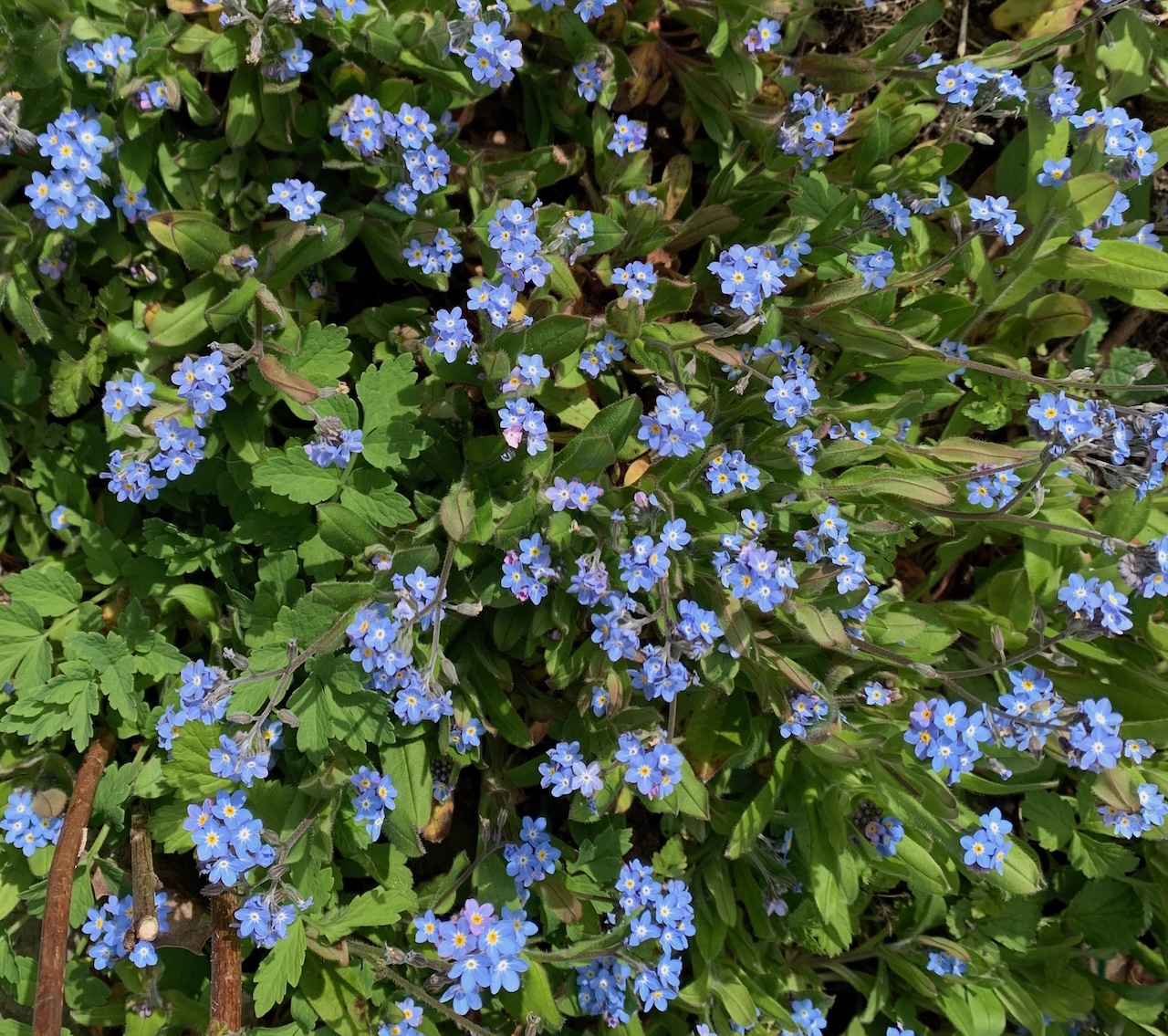
Your forget-me-nots remind me of the King of Annwn in the summer.
Into You I am gathered by the Gatherer of Souls. In You, with my Beloved, I am at home.
In You I can heal and I can heal others too. Into You I gather the lost pieces of our souls.
In You I am complete in every single moment. In You I can breathe every single breath. In You my heartbeat is at one with the heartbeat of Annwn – the heart of my Lord.
I pray to the Gatherer of Souls, You who waits patiently, You who works ceaselessly, gathering the souls of the dead, being there for those who are on the brink.
May I be a good guide of souls. May I share and lessen your burden by guiding others on their paths in this world and through Your doors and into Annwn.
May I be a good guide of souls for the living and for the dead.
May I serve You patiently and ceaselessly on my days of joy and my days of sorrow on this sacred day and on every day until my end.
‘They strive to lead their lives in the world but not of the world’ ~ Carmelite Sisters of the Most Sacred Heart Los Angeles
When I took my monastic vows as a nun of Annwn in October 2022 I was leading a very solitary life centring on devotion to my Gods and on my writing. My only connections with the outside world were online – with fellow members of the Monastery of Annwn and with the Pagan and Polytheist blogosphere.
Things changed after I realised my book, The King of Annwn, wasn’t destined to be professionally published and I received the gnosis I must give my ambition to be a professional writer up for good.
In spring 2024 in a shamanic journey I was shown I must ‘re-root the monastery’. It took me a while to work out what that meant. I took it literally and tried returning to horticultural volunteering but ran into physical limitations with knee problems and Raynaud’s.
I also began training as a shamanic practitioner and have now realised that is where my true calling lies. Over the past six months I have been providing shamanic guidance and running shamanic circles in my local community and have recently begun to offer shamanic healings.
In some ways that I’m able to go out and work shamanically with individuals and groups of people has come as a surprise as I’m autistic and an introvert and usually find social interaction draining. In other ways it hasn’t because from the very first time I did a shamanic journey I felt a sense of potency and calling and a deep connection with the spirit world that I wanted to share.
Fifteen years since that first shamanic journey, following completing my apprenticeship to my patron God, Gwyn, a ruler of Annwn, the Brythonic Otherworld), I have finally proved ready to guide and heal others.
This has opened the possibility of leading a more outward-facing life than I guessed when I first took my vows. Of serving not only the Gods but other people.
For this I’ve looked for inspiration to other groups of monastics and have found my deepest sense of kinship with the Lay Carmelites. This an order of the Discalced Carmelites who were founded by St Teresa of Avila in 1562.
Their charism is contemplative prayer, community, and ministry. Their rule of life is characterised by six obligations: meditation, morning and evening prayer, mass, Mary, meetings, mission. (1)
These come very close to what included in the Monastery of Annwn nine vows: keeping morning and evening prayers to the Gods and Goddesses of Annwn, deepening our relationships with Them through prayer, meditation and trance, checking in and praying with other members, and building the monastery. (2)
I particularly like what the Carmelite Sisters of the Most Sacred Heart Los Angeles have to say about secular Carmelites being those who are called to ‘devotion to prayer’, ’an intimacy with Jesus Who dwells within the soul’, a ‘heart-to-heart encounter with God’ and cultivating a ‘friendship’, ‘a conversing’, a ‘listening to Him which becomes the normal way of life.’ (3)
This fits with my striving to make all my daily activities offerings to Gwyn with my shamanic work fitting so well with Him being a God of the Otherworld.
They also refer to Lay Carmelites being ‘In the world but not of the world.’ (4) That also fits with my life being centred around my Gods first and foremost rather than on money, career or social life, with my service to other people being one of the ways I serve my Gods.
I’m now two-and-half years into living by vows and am now contemplating the possibility that when I take my lifelong vows in autumn 2026 they might be as a lay nun as opposed to a nun who is leading a near-hermitic life.
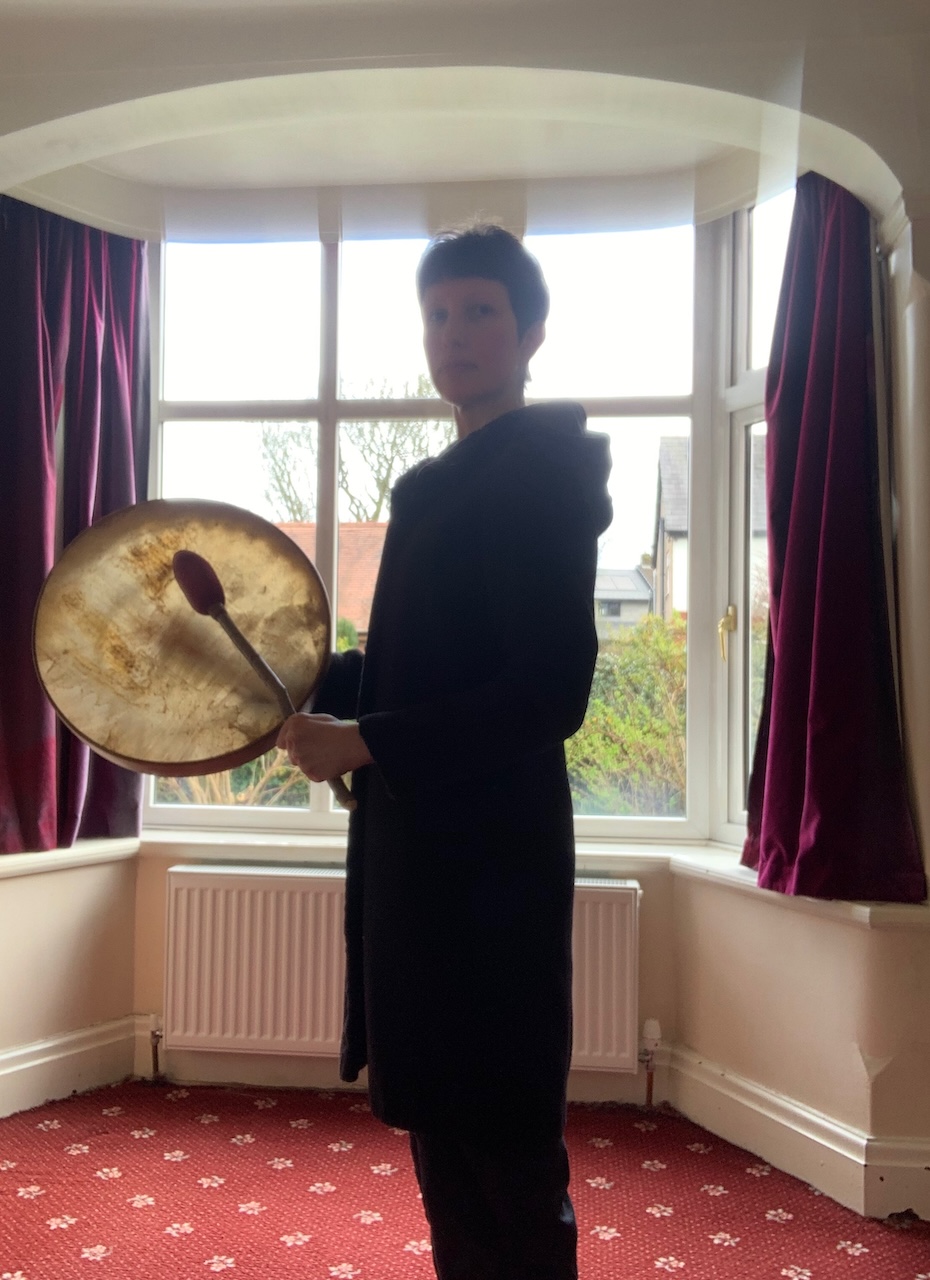
“You’re a nun with a drum,” Gwyn told me when I asked if I could bring monasticism and shamanism together. His joking words now summarise my path.
In the Monastery of Annwn meditation group we have recently been exploring the medieval Welsh poem ‘The Spoils of Annwn’ from an Annuvian perspective rather than from the views of the ‘victors’ Arthur and Taliesin.
Last week, in the guided visualisation meditation, we journeyed to the first fortress, Caer Siddi ‘the Fairy Fort’, on our magical monastic boat and gained personal visions based on lines from the poem:
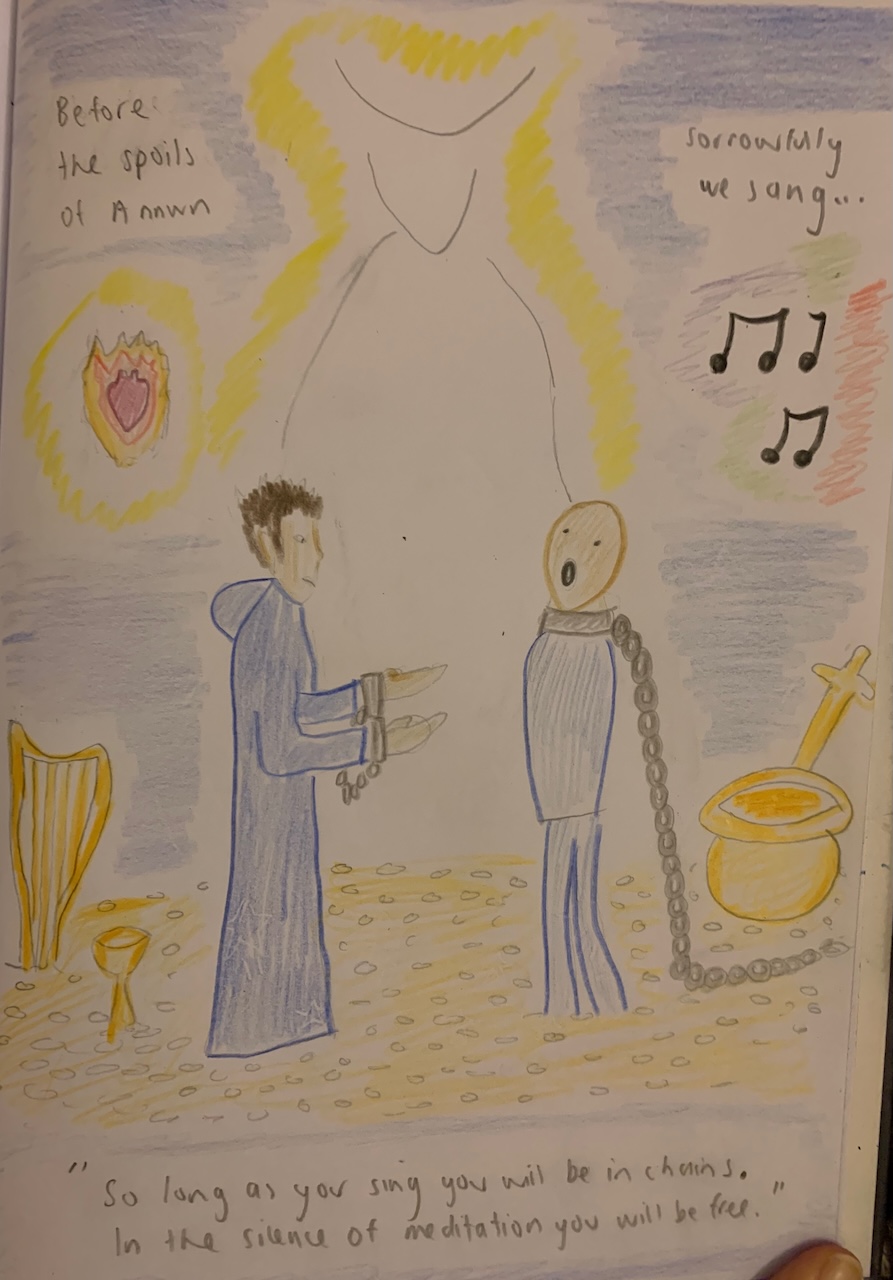
Maintained was Gwair’s prison in Caer Siddi throughout Pwyll and Pryderi’s story. No-one went there before he did – into the heavy grey chain guarding the loyal lad. And before the spoils / herds of Annwn he was singing sadly, and until Doom shall our poetic prayer continue.
I found myself standing before Gwyn wearing chains with Gwair in a scene resembling the Devil card from the Rider Waite Tarot. Whilst Gwair was imprisoned in a heavy grey chain I was wearing only toy-like silver handcuffs and felt they were close to breaking and to my being released.
Gwyn said:
‘As long as you sing you will be in chains. In the silence of meditation you will be free.’
Gwyn’s words reminded me of the shift in my path from being a bard in the mead hall to becoming a Nun of Annwn. To moving away from performing poetry to a more monastic and shamanic path.
Another way of looking at it was that the singing is the voice of the incessant thoughts in my head and that only when I’m silent in meditation will their song and the chains be gone.
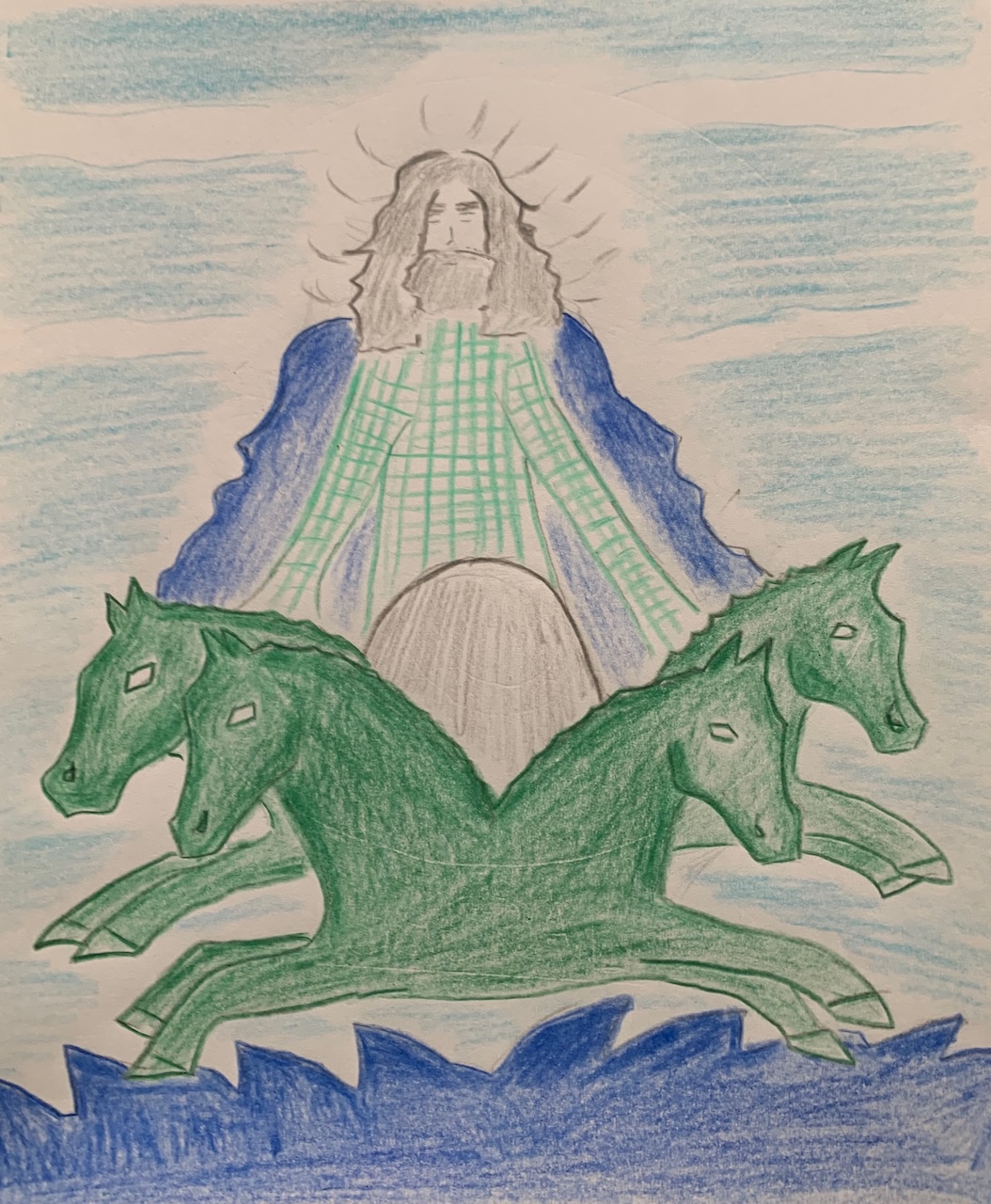
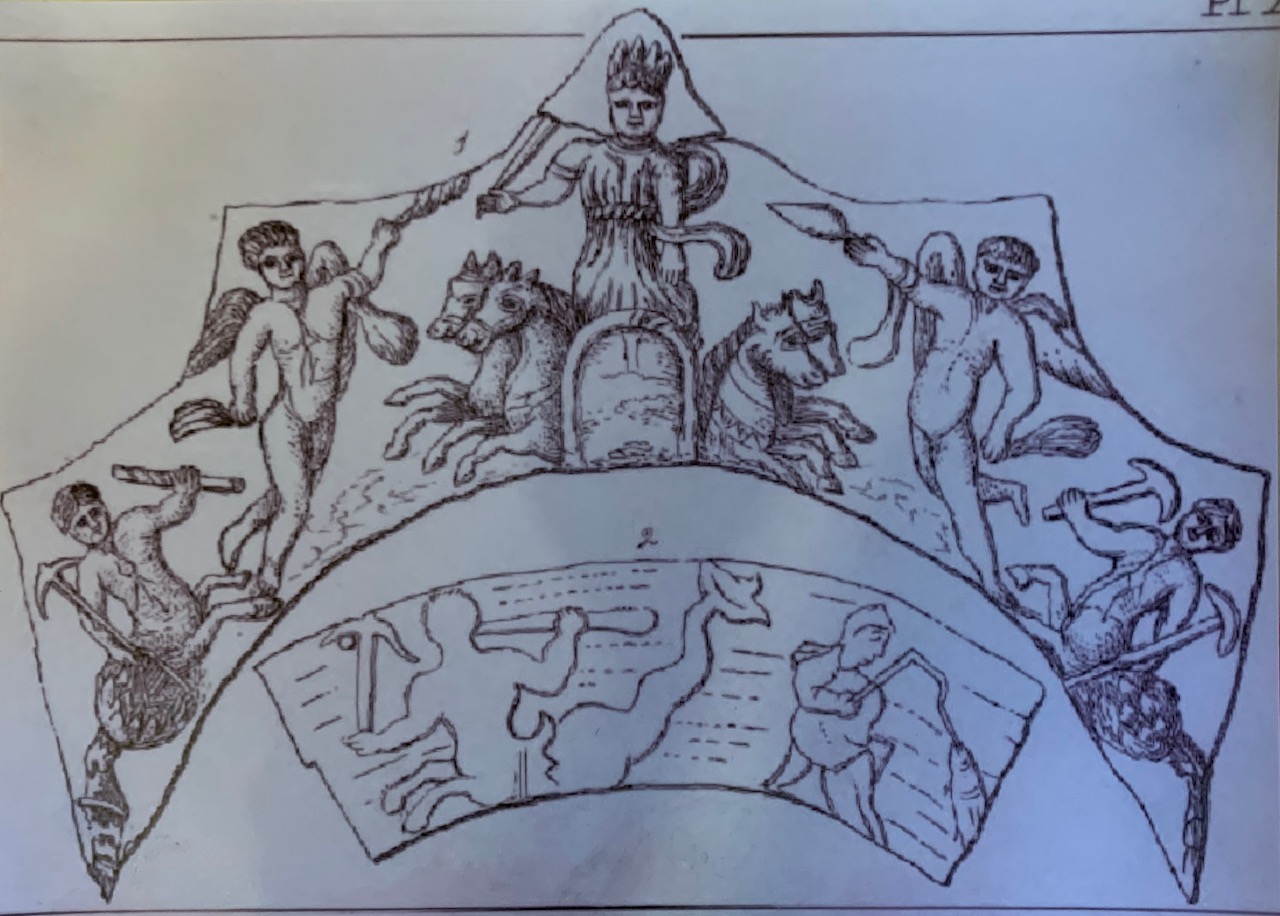
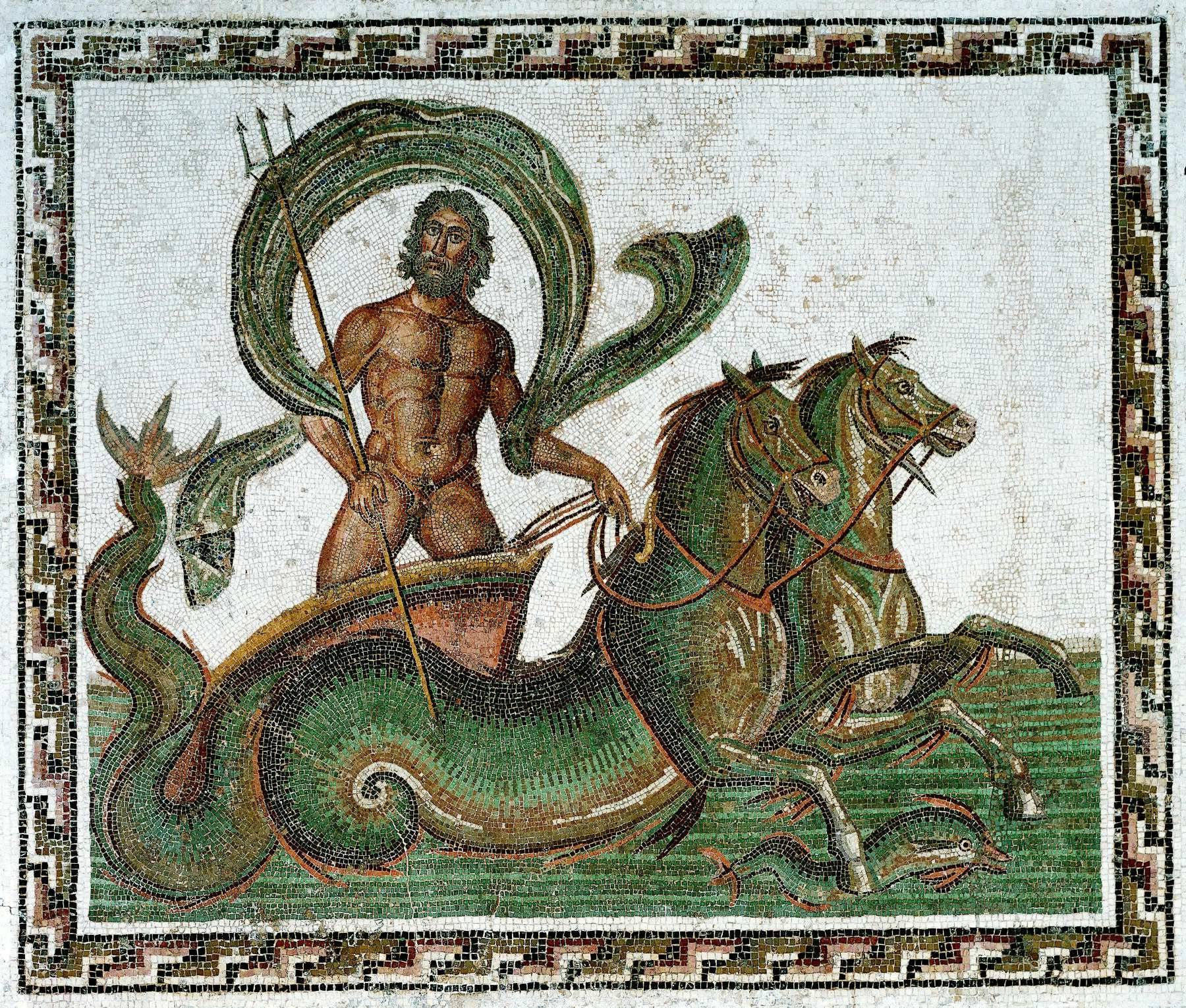
Recently, in one-to-one sessions with another monastic devotee of Annwn, we have been exploring her intuitions about Gwyn ap Nudd’s associations with the sea. Gwyn’s father, Nodens / Nudd, is equated with Neptune at Chesterholm in an inscription which reads Deo No / Neptu. This suggests, like Neptune, He is associated with freshwater and the sea, seahorses, and with horses more widely (Neptune was worshipped as Neptunus Equestris – God of horse racing).
Little is known about the myths of Neptune but there are many about His Greek counterpart, Poseidon Hippios ‘of the horse’, the Father of Horses. When Demeter fled Poseidon’s lust in the form of a mare He took the form of a stallion and mated with Her and She bore a colt called Arion ‘Very Swift’. In another tale He mated with Medusa and She gave birth to Pegasus.
These stories remind me of my personal gnosis about Nodens mating with Anrhuna, the Dragon Mother of Annwn, to bear Gwyn and Creiddylad and other children who might have included horses and seahorses. Intriguingly Rhiannon, who like Creiddylad is a Queen of Annwn, is a Horse Goddess. I often wonder if Creiddylad and Rhiannon are titles for the same Goddess who takes horse form. If so this would suggest that Nodens is the Father of Horses and likely Sea Horses here in Britain. That He might be the father of Gwyn’s sea-going steed, Du y Moroedd, ‘the Black of the Seas’.
It also make me wonder if Nodens and Anrhuna might be the parents of white winged horses like pegasus from whom my closest spirit animal, a white winged mare, is descended. March allelog, ‘flying horses’, are known in Wales.
The devotional art above was born from these musings and is based on the mural crown depicting Nodens on a chariot pulled by four seahorses from Lydney and a triumph of Neptune in a chariot drawn by two seahorses from Sousse Archaeological Museum.
If I had a thousand words to describe the King of Annwn’s cheekbones
I would say they were like icebergs, like the hulls of the ships that crash into them and sink, like the angles of the limbs of the dead men who float to the surface, like the way He lays out the dead in the icy caverns where the ice dragon roams with a single icy jewel hidden deep within his forehead.
I would say they are like the way He says the letter ‘A’, the capital, with the triangular tip, as if it is not the beginning but the end of the alphabet.
I would say they are like the broken glass of shattered coffins in my good dreams and not the bad.
I would say they are the antithesis of polar bears and the peak of antinomy. I would say that I have seen many a skier slide down them to death.
I would say they are like runways and the paths of aircraft and the flightpaths of starships, the souls trampling across them to the otherworld.
I would say they are like the travels of swans and geese.
I would say they are like the strobe lights that shine down from the helicopters that fly over my house at night, sometimes hunting for the criminals as He is always hunting for the dead.
I would say they are like the spotlight in which I stood, dancing, seeking to win His favour.
I would say they are like His anger, like His fury, like His lament, that they were bent with a hammer in a forge that was neither hot nor cold nor even burning.
I would say they are his secret.
I would say everybody knows but keeps quiet.
I would say they are like the divine madness that unfolds itself within His followers in their shapeshifting, folding, unfolding, spreading wings.
I would say they are bone-light but heavy in my hands.
I would say they are like the precipice I walked on so narrowly between life and death, so very thin and dangerous on both sides a fall into the abyss.
I would say they were the answer to my prayer after a long dark night of soul searching, the first slants of the appearance of a face in the darkness, the first strokes of a name written on my soul.
I would say they were the remedy to the poison within me, the pharmakon, the paradox.
I would say they were the pride that summoned me from shame.
I would say they were the answer to my cry for help.
I would say they will help old men and feeble infants regain their dignity again.
I would say they will once more be serpents and dragons with wings bent at cheek-bone-like angles.
I would say I have spoken only half the words and will speak the other half to him alone in death.
 The Sanctuary of Vindos