Brigantia Stone

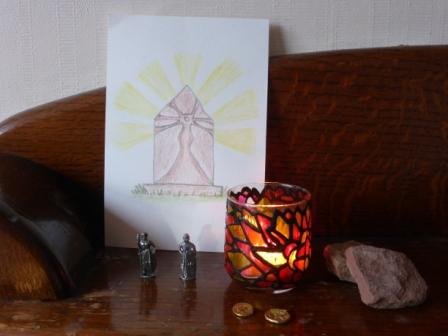
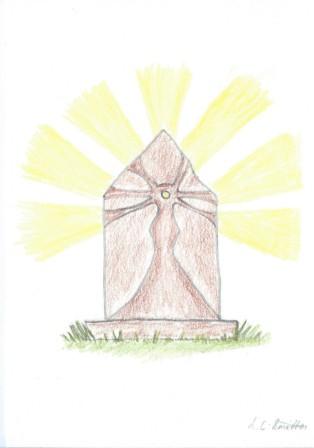
Brigantia Stone Earlier in January I dreamt the Oak and Feather Grove were holding a celebration on the West Pennine Moors around a sandstone monument carved with a goddess figure rooted in the earth drawing up its energy to combine with shining rays of sunshine. I knew this was a ‘Brigantia Stone.’

Today is the Gaelic festival of Imbolc, which is connected to the goddess Brighid or Bride. In Scottish mythology she is imprisoned in a mountain by the Cailleach throughout winter and escapes her prison in spring, bringing new growth and regeneration. In Wales she is known as Ffraid and this festival is Gwyl Ffraid.

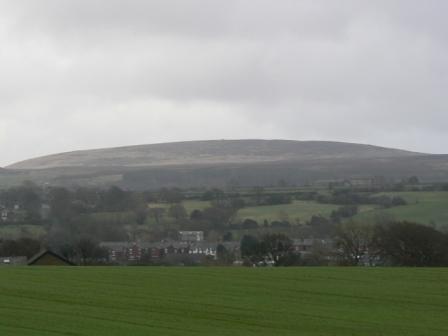
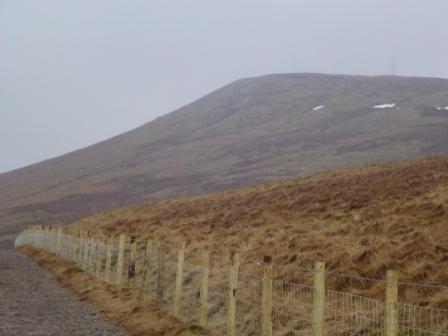
Here in Northern England she is known as Brigantia. Her name is Brythonic and means ‘High One.’ She was the warrior goddess of the Brigantes tribe, whose tribal confederation dominated the North until the Roman Invasions. I associate Brigantia with high places, locally with the West Pennine Moors and in particular Great Hill.

Great Hill from Brindle

Great Hill viewed from Brindle

In contrast to Brighid, whose stories and roles as a poet, smith and healer are well documented, we know comparatively less about Brigantia. Seven inscriptions exist to her across Northern England and Southern Scotland. She is equated with Victory, and on a statue with Minerva in warrior form, holding a spear and a globe of Victory and wearing a Gorgon’s head.

In my experience, Brigantia is a goddess of the wild harshness of the high hills. A warrior for certain and a goddess of the all-consuming fire of the Awen, the hammer beat of creation and a forger of souls. She’s the first goddess I met. Because she’s a poet and we share a fiery irascible temperament I thought she would become my patroness.

I was wrong and the reason behind this was a difficult one to learn. I worked very closely with Brigantia for two years whilst completing a fantasy novel. It was about a fire magician who, in order to bring down capitalism, made a pact with fire elementals which resulted in his near destruction of the world and death in the flames by which he made his pact. With my anti-hero a part of me burnt and was consumed.

After completing the novel I realised it was too dark and incomprehensible to publish. I’d wasted two years, wasn’t cut out to be a fantasy writer and and I’d lost my trust in Brigantia.

The death of my novel left a void. And into it stepped my true god. Perhaps this was Brigantia’s plan. I needed to learn the dangers of working with the untrammelled Awen; fire in the head, pure imagining, without relation to this world or the realities of the Otherworld, to which Gwyn ap Nudd opened the gates.

Afterward I resented her. Because I’d sold my car and could no longer drive to the Pennines we also became physically distanced. In spite of this, looking down on my valley from the surrounding hills, in the fire of the Awen, she has continued to be a presence in my life. I still honour her as the warrior goddess of the North. But we rarely speak in person.

My dream of the Brigantia Stone came as a surprise, even though Brigantia is in many ways a patroness of the Oak and Feather grove. I experienced the calling to redraw the stone for our Imbolc celebration (which I’d sketched in my diary) in colour, as a Bardic contribution to the grove and for Brigantia as an offering on her festival day. It came out perfectly first time, so well I decided to make copies for each member of the grove.

Lynda has suggested we take a grove walk to find the stone on the West Pennine Moors. Whether it ‘really’ exists on the moors, or in their dreamscape, I’m not certain. However, I do know it is the time to acknowledge and accept Brigantia’s role and place in my life.

Brigantia Altar

The Star-Strewn Pathway

‘Thence rolled down upon him the storm-clouds from the home of the tempest;
thence streamed up the winter sky the flaming banners of the Northern lights;
thence rose through the illimitable darkness on high
the star-strewn pathway of the fairy king.’
-Wirt Sikes

I write this post as a newcomer to the path of the Awenydd, having walked it in earnest little longer than a year and a day. The terms Awen and Awenydd have been familiar since coming to Druidry. In the Awen I found a name for the all-consuming force of inspiration that has burnt forever in my veins with the fire of stars in the iciest reaches of a dark universe. Its furious purpose was revealed by a god after many years of searching.

Restless years. Wilder years. Seeking Blake’s infinite. Throwing my soul into the furthermost abysses of Western European philosophy where reason bites its own tail, curls up and dies and the only way to survive the white hot sun of truth is to burn with and express its creativity.

Trying to find a framework to decipher visions of our native spirit world without knowing if my experiences were ‘real’. Searching Christian mysticism, Graeco-Roman, Saxon and Norse mythologies and finding only analogies. Discovering Britain has its own mythology in The Mabinogion, The Triads of the Island of Britain, The Four Ancient Books of Wales and regional folk and faerie lore.

Finally, Gwyn ap Nudd, my Fairy King finding me and teaching me to walk the Star-Strewn Pathway.

***

The Star-Strewn Pathway begins in one’s local area with the recognition the whole landscape is inspirited. Awen sings from the earth-sun at this world’s core through its molten mantle, sandstone bedrock, layers of clay and harrowed loam. Wonder can be found in backyards of composting earthworms and hatching spiders.

Pathways lead to suburban edgelands. Narrow valleys of trees impossible to build on, brooks shrunken by drainage systems tripping down wooden platforms. Algae-covered stagnant ponds beloved of ducks. Decaying mills pink with Herb Robert housing volleys of pigeons circling above.

These places are inspirited and there are spirits: huge boggarts who once stretched gurgling through mosslands grey and whiskery; undines clasping their last waters; newly planted woodlands arising into forms of consciousness with inherent knowledge of tree, bird and mycelia of mushrooms to the tread of deer.

Inevitably pathways lead abroad. It is necessary to trace local brooks to the river’s crashing heart, find its trickling source and greet rolling tides with the sea at its shining estuary. To meet its Great Goddess who washes her hair by moonlight and stretches watery arms throughout the watershed.

To travel ancient woodlands of oak men, snow-topped mountains of icy blasting and cities of tower blocks, steeples and malls which guard a heritage locked in catacombs and glassy vaults. Every facet of woe and joy, awe and strife, adds to the alchemy of our own sun.

***

In rain or mist, at twilight to the touch of thunder, it is possible to step from known to unknown pathways. Wandering lost in a storm-cloud of emotion I have often found myself on unfamiliar tracks with strange figures, no longer myself. Sometimes it is those dusky shadows who beckon me, footsteps leading into the wildwood’s tangled heart.

In the wildwood all the fay lights are lit by stars. They dance and glimmer, throwing bright shapes and longer shadows across paths which intertwine like roots. These paths have their own lives, untwining and uprooting to walk their own way through the wood. Where the fay strew their lanterns on the ground one might find the Star-Strewn pathway.

There is a long tradition of caves and holes leading to the underworld. Their entryways are utter darkness. Timeless. Illimitable as despair. They lead into a womb of tunnels, the edge of an abyss, to where that age-old creatrix Old Mother Universe gives birth to stars. From thence the Star-Strewn Pathway unfurls through underground heavens.

When the moon is full she lays out her bridge of vibrant stars in the river. The ripples become stepping stones. From the river-moon the Star-Strewn Pathway leads through the catastrophic beauty of falling stars to the star-decked parapets of the Fairy King’s hall.

At his banquet stars burn and freeze. The order of things is undone. In the crux of fairy arts, the Fairy King’s Star Cauldron, the wonder of the universe is reflected and re-made anew.

***

There are other ways to reach Gwyn’s Hall. As many ways as there are souls. Some fly with coveys of hounds or wild geese. Others do not need to fly at all.

This is not the path for everyone. There are many gods, stars and cauldrons.

Any soul flight requires a return to and grounding in the body of this world; dragging backward through hedgerows, screaming and echoing from slanting rock-faces to kiss the earth with bloodied and muddy lips.

Apostasies need voicing in cafes and bars, chain-stores and museums. Launching into the internet’s mirror-void where the dust-mote of a spark of Awen can be multiplied into a million blazing simulacra fading as quickly into black holes.

Following the Star-Strewn Pathway does not lead to catasterism ‘placing amongst the stars,’ but living a full life upon this earth, returning to and from the halls of our deities, knowing only our bones and star-songs will survive for future generations. Until, with our land and gods, we are swallowed by the sun. Perhaps in this manner we will receive our final catasterism.

***

*This article was written for and first published with an introduction by Heron on ‘The Path of the Awenydd‘. This blog aims to explicate and explore this lesser known path. It is also an excellent and growing resource on Bardic, Brythonic and Faerie Lore. Do check it out. Many thanks to Heron for supporting my work.

The Star Cauldron

‘Is it not the cauldron of the chief of Annwn? What is its intention?
A ridge about its edge and pearls.
It will not boil the food of a coward, that has not been sworn…’
The Spoils of Annwn

Returning not on time
but at the perfect time
to the place I made my vow,
your cauldron of pouring water
is still flowing and today
it contains the stars.

As always I have a question,
tearing through the veil
torn a million times,
calling through the names
and faces of indefinite thoughts,
impelled by a shape and form unsung:

the suggestion of a bardic book
prompted by a voyage
to the moon in the river
where I stood amongst your stars
and in the river-rain of their fire
learnt the Awen only follows absolute necessity.

You say “do what is necessary.
Write the book that needs to be written.
The stars in my cauldron, write it in their fire.”

Ribble Stars

Fairy Lights and The Strangeness, Fishergate

Last night I dreamt I was watching a television programme in my living room. Somehow I entered it and became an active participant. With a group of friends I was preparing to stage a protest. For it to succeed, a special light on a tree needed to be changed. I ran with a blonde, sporty woman (who I did not know) across a car park to the tree, which stood on the end of a busy city street I identified as Fishergate in Preston.

The lights were off. The one we had to change looked more like a silver Christmas decoration and stood out as markedly special and ‘other.’ As the woman started taking it down, chatting easily, she paused. Her expression froze into uncanny wistfulness and her gaze grew distant. Speaking in a voice from far away, she told me “it belonged to Gwyn ap Nudd.”

I knew at this point (somehow being outside the programme and within it) the words and memory that possessed her were not her own. Like in a film there was powerful, beautiful music. A strange wind blew, stripping away the façade of the city streets. I had a profound sense of another landscape stirring and awaking at the sound of Gwyn’s name. Once the strangeness had blown over, the woman began chatting normally as if nothing had happened and traffic started driving past again.

Throughout the preparations there were rumours about the massing of an army of otherworldly beings. As someone in the programme with an audience member’s knowledge I knew they were the fay / Gwyn’s hunt and could sense them gathering in clouds and forests somewhere behind. I had the feeling they might disrupt the clash between the two sides in the protest. As audience, I was aware this was the part I was looking forward to.

This awareness brought me back to my living room to see the credits rolling down the screen…

***

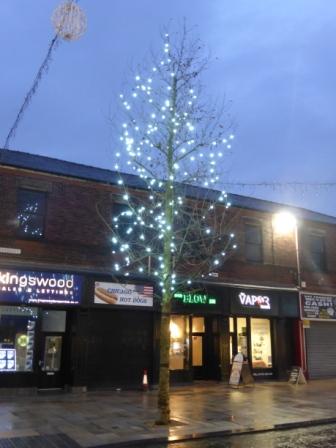
The dream inspired me to walk into Preston at dusk tonight. Several months ago, Fishergate (the high street) was pedestrianised. The road was narrowed to make way for wider pavements and as a final touch, trees. Delighted when I saw first saw them, I walked the street, greeting them in turn and welcoming them to the city.

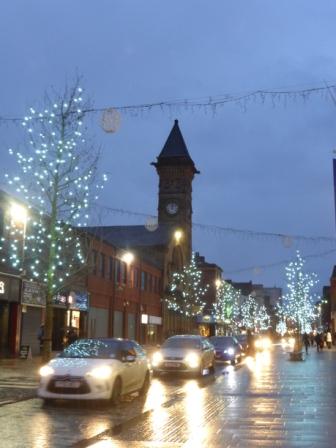
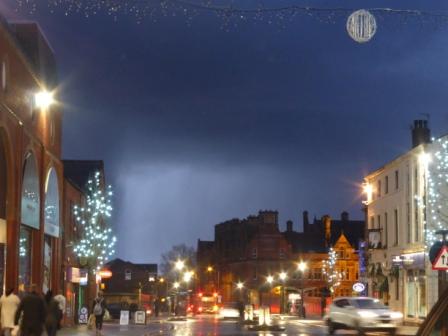
Since the Christmas lights went off, the trees have been lit by fairy lights. Following rain and hail, the pavements gleamed. Reflected in windscreens the lights shone like cold stars, miniscule glances leaping from fragments of hail.

Fishergate, PrestonIdentifying the tree from my dream, I noticed all the lights were working.

Tree, FishergateI stood with the tree for a short while. Crossing the road and looking back, I saw huge dark ominous clouds gathering over the County Hall, which is where the anti-fracking protests will take place on the 28th and 29th of January.

Fishergate, County HallThe music of hail came down. An immense strangeness like none I had known before came over the city. I felt as if I stood in another Preston where the landscape was more than it was by the strange life of those lights against winter’s silver-grey sky. Everything seemed more profound and enthused with meaning, although I couldn’t divine what the exact meaning was.

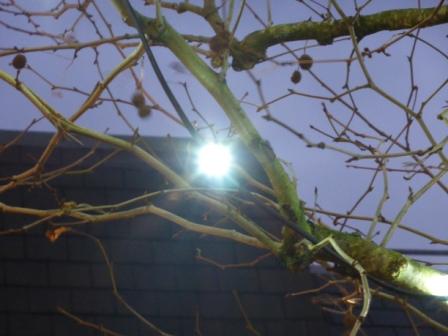
Fairy LightWhat happened to the silvery light, which belonged to Gwyn ap Nudd and led me to the strangeness remains uncertain.

Gwyn ap Nudd and the Spirits of Annwn: Remembering the Underworld Gods

I recently came across an article through the Caer Feddwyd Forum (1) called ‘The Underworld Gods’ by medieval scholar, Will Parker. It brought to my awareness the existence of an inscription in Chamalieres in central France, which took the form of a prayer or invocation addressed to an entity or group of entities known in Ancient Gaul as the andedion, ‘the Under-world God(s)’ or ‘Infernal One(s)’ (2).

Parker links the andedion to the Irish andee ‘non-gods’ and suggests a similar group of deities would have been worshipped in Iron Age Britain. Through etymological links between the ‘elements Clt. dio(n) (Ir. dé) ‘god(s)’ and ‘the suffix ande-/an-‘ he connects them to Annwn ‘not world’, Britain’s indigenous otherworld or underworld. Parker goes on to identify the andedion and andee with the spirits of Annwn and their ruler, Gwyn ap Nudd.

This is of interest to me because Gwyn is my patron god. Parker’s insights make it possible to trace a trajectory from Iron Age beliefs concerning underworld gods, through Gwyn’s appearances in medieval literature and later folklore to those who worship him today.

Gwyn ap Nudd ‘White Son of Mist’ is a Brythonic deity. His veneration dates back, at least, to the Iron Age, where he appears as Vindonnus ‘White or Clear Light,’ in a trio of Gallo-Brythonic inscriptions in Essarois. Here he is equated with Apollo, another hunter deity (3). It is likely he was worshipped across Britain as Vindos ‘White’ (4). It has also been conjectured that Gwyn and his hunting dog, Dormarth ‘Death’s Door’ occupied the astrological positions of Orion and Sirius to the ancient Britons.
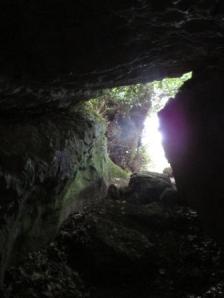
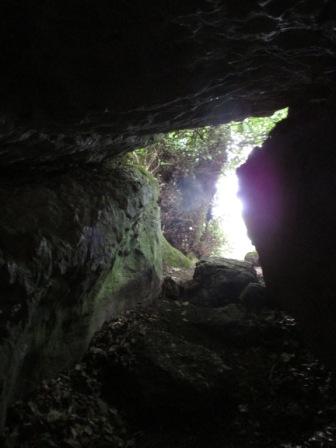
Cave, SilverdaleParker suggests Late Bronze Age ‘ritual shafts’ and ‘offering pits’ containing depositions including human and animal bones, grain, pottery and metalwork express a ‘quid-pro-quo’ relationship between the ancient Britons and the underworld gods. If he is correct, it is possible that Vindos / Gwyn, Dormarth and other kindred spirits were involved in these rites.

Gwyn’s first literary appearances are in medieval Welsh texts; ‘How Culhwch Won Olwen’ (11th C) in The Mabinogion and ‘The Dialogue of Gwyddno Garanhir and Gwyn ap Nudd’ (13th C) in The Four Ancient Books of Wales. These texts have roots in an older, oral tradition and contain fragments of tales from across Britain that predate Christianity. A significant number of these, including two featuring Gwyn, are from ‘The Old North’ (5). This is important to me because I connect with Gwyn in Lancashire.

Parker argues that superstitions about the underworld gods carry over into The Mabinogion. This is evidenced in the disappearance of livestock, children and crops. Pwyll’s encounter with Arawn, a King of Annwn, is the catalyst for the unfolding drama of the first four Mabinogi. Parker says these stories show the spirits of Annwn could not ‘be simply dismissed or ignored. Instead, a complex narrative had to be constructed in which, through a series of symbolic ritual manoeuvres, their power was drawn out, confronted and finally neutralised.’ The attempts of medieval scholars to disempower these deities can be seen at work in the development of Gwyn’s mythology.

In ‘The Dialogue of Gwyddno Garanhir and Gwyn ap Nudd,’ (6) Gwyn is presented as a divine warrior returning from battle to the Tawe near the vale of Neath. Gwyddno, ruler of Cantre’r Gwaelod, speaks of and addresses him with reverence and respect. ‘Bull of conflict was he, active in dispersing an arrayed army, / The ruler of hosts, indisposed to anger, / Blameless and pure was his conduct in protecting life.’ Other epithets Gwyddno uses include ‘hope of armies’ and ‘hero of hosts.’ ‘Host’ may refer to the spirits of Annwn.

Gwyn introduces himself as ‘Gwyn, the son of Nud, / The lover of Creurdilad, the daughter of Lud.’ He names his horse as ‘the torment of battle’ and refers to Dormarth as ‘truly the best of dogs,’ ‘handsome,’ ‘round bodied’ and ‘ruddy nosed.’ References to his possession of a ‘polished ring’ and ‘golden saddle’ are also suggestive of his status.

The title ‘Bull of Conflict’ refers to Gwyn’s role as a psychopomp. At the end of the poem he describes his travels across Britain gathering the souls of fallen soldiers. He appears to be berating this task. ‘I have been where the soldiers of Prydain were slain, / From the East to the North; / I am alive, they in their graves! / I have been where the soldiers of Prydain were slain / From the East to the South / I am alive, they in death!’

This poem contains important clues about Gwyn’s identity as a divine warrior and huntsman, whose role was to gather the souls of the dead and take them to Annwn.

In ‘How Culhwch Won Olwen’ in The Mabinogion, Gwyn is depicted as a huntsman and advisor to King Arthur. His place in Arthur’s court list and apparent subjection to both Arthur and God may be read as attempts by medieval scholars’ to explain and downgrade his position.

That ‘Twrch Trwyth will not be hunted until Gwyn son of Nudd is found’ (7) hints at his role as leader of the hunt, and knowledge of otherworldly beings. The Twrch was a king reputedly turned into a swine by God. When Gwyn does not reveal his location it is possible he is defending his own.

The advice of Gwyn and Gwythyr ap Greidol ‘Victor Son of Scorcher’ is also needed by Arthur to find Pennant Gofid in the ‘uplands of hell,’ which Evans and Bromwich say is ‘clearly situated in North Britain’ (8). When they reach this location, Gwyn and Gwythyr advise Arthur in his defeat of the ‘The Hag of Pennant Gofid,’ another otherworldly entity. The parcity of their advice, which leads to several failed attempts by Arthur’s men before the Christian King is forced to step in to slay her, may also suggest that Gwyn and Gwythyr are acting as tricksters.

A pair of lines fundamental to understanding Gwyn’s mythos, and which continue to intrigue and perplex me, are the following; ‘God has put the spirit of the demons of Annwfn in him, lest the world be destroyed. He will not be spared from there’ (9).

Taken literally, this seems to mean that at some point during the period of Christianisation God put the spirit of the demons of Annwn ‘in’ Gwyn’s person to prevent the world’s destruction. Or it may mean that he granted Gwyn rulership of them for this purpose. However, it is probable that the agency of God was brought in as a cover to excuse the prevalent belief in the existence of these spirits and their ruler.

Even if we assume God’s agency is a cover for existing beliefs, the notion that Gwyn somehow contains ‘the spirit of the demons of Annwn’ is a fascinating one. In a conversation via e-mail, Heron (10) told me the word ‘spirit,’ in Welsh, is ‘aryal,’ which can mean ‘ferocity,’ ‘essence’ or ‘nature’. He referred me to Evans and Bromwich, who say ‘Gwyn’s partaking of the ‘nature of the devils of Annwfn’ indicates a recognition on the part of the redactor of the tale that Gwyn ap Nudd belonged to a sinister and forbidden mythology’ (11). Within this mythology he may already be seen to embody the nature of these entities, or to hold power over them.

That the destruction of the world is at stake suggests Gwyn’s role was extremely significant. If it is assumed this notion has older roots, some of the offerings of the ancient Britons may be explained as attempts to placate these spirits and their ruler due to their destructive capacity. It is also possible Gwyn was invoked as the only being who could hold them in check.

Fears and superstitions surrounding Gwyn and the spirits of Annwn may lie behind the story of his abduction of Creiddylad. After Creiddylad, who is both Gwyn’s lover and sister, elopes with Gwythyr, Gwyn seizes her back. It might be assumed he takes her to Annwn, and that this suggests an underlying fear of being abducted by Gwyn and his forces.

Gwythyr amasses his armies and attacks Gwyn. Gwyn triumphs and captures a number of Gwythyr’s allies, who are mainly rulers of the Old North. During their captivity Gwyn slaughters Nwython, cuts out his heart and feeds it to his son, Cyledr, who goes mad. This could be read as a clear example of Gwyn’s ferocity and hints at existing superstitions about what goes on in Annwn.

Evans and Bromwich say the concentration of the names of people Gwyn kidnaps suggest ‘that north Britain was the ultimate place of origin for the Creiddylad episode, and that this incident was one of the surviving fragments of tradition emanating from there’ (12). It is therefore likely it originates in earlier beliefs held about Gwyn and his host by the Northern Britons.

Arthur eventually comes North to Gwythyr’s aid and frees his noblemen. Afterward he makes peace between Gwyn and Gwythyr by placing a dihenydd ‘fate’ on them. This dictates that they must fight for Creiddylad’s hand every Calan Mai ‘May Day’. An added condition, which seems particularly unfair, is that Creiddylad must remain in her father’s house, and no matter who wins neither can take her until Judgement Day. It is likely Arthur’s agency was brought in to explain an earlier myth, which was already prevalent in the Old North.

Whilst, on one level, this myth may be about fears of abduction to the underworld, it is more frequently interpreted as a seasonal drama comparable with Hades’ capture of Persephone. In this reading, Creiddylad is a maiden goddess who embodies the powers of spring and fertility. Creiddylad’s abduction by Gwyn may explain the failure of these powers at Calan Gaeaf, the first day of winter. Gwythyr and Arthur’s rescue of her at Calan Mai, the first day of summer, may explain their resurgence.
Winter Hill

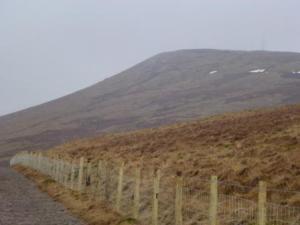
Winter Hill

Gwyn is also seen as the Winter King. It is possible his white, shining qualities relate to snow and cold, associations which could date back to the Ice Age. Elen Sentier links Gwyn with the reindeer goddess Elen of the Ways (13) and the Boreal forest. He may also be connected with the North wind. The 14th C Welsh poet Dafydd ap Gwilim refers to ‘Tylwyth Gwyn, talaith y gwynt’ ‘the family of Gwyn, the province of the wind’ (14). The pervasiveness of a myth featuring Gwyn in Northern Britain could have a basis in its harsh winters.

In a later text, The Life of St Collen (14th C), Gwyn is referred to as ‘the King of Annwn and the Fairies’ and is supposedly banished by the saint from Glastonbury Tor (15). The transition from belief in Gwyn as a King of Annwn to King of the ‘Tylwyth Teg’ or ‘Fair Folk’ is a significant one. The original natures of Gwyn and the spirits of Annwn are covered over by their reduction to diminutive form. However, hints at their mythos can still be found in the majority of folktales.

Gwyn retains his status as leader of the Wild Hunt in the folklore of Wales and Somerset. There he is seen to appear on horse back with a pack of white, red-eared hounds, riding out on Nos Calan Gaeaf and through the winter months, chasing down the souls of the dead. To hear his hounds is an omen of death. The other riders are seen often seen as captive souls and may represent the spirits of Annwn.

In the North West of England, however, the hunt is assigned either to the Norse god Odin, or to Christian angels. In Cumbria it is Michael, and in Lancashire and Yorkshire Gabriel is said to lead a pack of black, red-eyed dogs, the Gabriel Ratchetts.

Coincidentally, Preston born writer Francis Thompson is famous for a poem called ‘The Hound of Heaven.’ Anybody who has felt like Gwyn’s hounds are on their tail might find these lines hauntingly familiar; ‘I fled Him, down the nights and down the days; / I fled Him, down the arches of the years; / I fled Him, down the labyrinthine ways / Of my own mind; and in the mist of tears / I hid from him, and under running laughter.’ (16)

More recently, Gwyn’s significance as an ancient god has been attested by contemporary scholars such as Geoffrey Ashe, in King Arthur’s Avalon (2007) and Nicholas R. Mann in The Isle of Avalon (1996) and Glastonbury Tor (2012). He is also the subject of a full length book called Gwyn: Ancient God of Glastonbury and Key to the Glastonbury Zodiac (2007) by Yuri Leitch.

This increase in interest suggests we are approaching a time when Gwyn and the spirits of Annwn are taken seriously as Brythonic deities again. However, the main focus of these books is Gwyn’s role at Glastonbury, with only a small mention of his place in Wales and other areas of Britain. Disappointingly there is no mention of Gwyn’s activities in the North. In this respect I have only my own experiences and conjectures to go on.
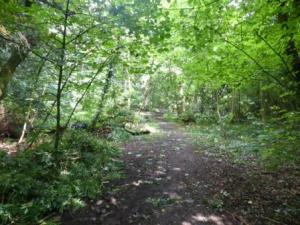
Fairy Lane

Fairy Lane

I first met Gwyn on Fairy Lane in my hometown of Penwortham, where he challenged me to journey with him to Annwn. Since then I have worked with him as a guide to the otherside of my local landscape and its hidden myths. His interest in my locality surprised me at first. However, it seems less surprising when looked at in the context of his role as an ancient underworld god of Britain, particularly in relation to the history and folklore surrounding this site.

Penwortham has been inhabited since 4000BC. The Riversway Dockfinds, a collection of animal bones, 30 human skulls, two dug out canoes and the remains of a timber structure suggest the existence of a lake village on Penwortham Marsh. Nearby is Castle Hill, a point of military and religious importance. There is a church dedicated to St Mary on the summit of Castle Hill, which means it was likely to have been a pre-Christian sacred site.

That the church is dedicated to St Mary and she was also the patron saint of a healing well at the foot of Castle Hill suggest the presence of an earlier female deity with healing powers, who has been Christianised as Mary. Three human skulls found in the wall of the church (17), which may have served an apotraic function suggest superstitious beliefs in chthonic spirits were also once popular but not openly acknowledged.

The survival of the legend of Penwortham Fairy Funeral attests to these superstitions. In the earliest version in Bowker’s Goblin Tales of Lancashire (1878), it is set on Church Avenue on Castle Hill. Two men walking home to Longton encounter a procession of fairies carrying a coffin. Robin, one of the men, looks into the coffin and sees his own miniature corpse. Frightened by the sight, they follow the fairies into St Mary’s graveyard. Robin attempts to prevent the burial by reaching out to grab the leader of the fairies. The procession vanishes and Robin, driven mad, topples to his death from a haystack a couple of months later (18). In later versions, this story takes place on Fairy Lane, which runs through Penwortham Wood at the foot of Castle Hill.

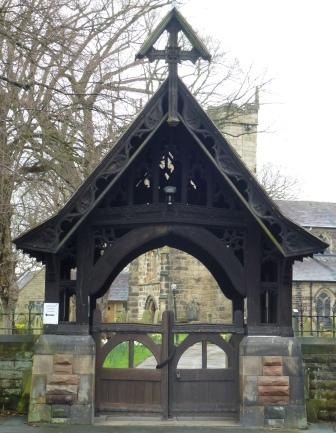
This legend may be interpreted to hint at older beliefs in underworld gods. Church ways are often identified with spirit paths. It is possible that prior to Christianity people believed chthonic spirits to have been actively involved in bearing the deceased to the underworld. The ringing of bells to drive them away and superstitions surrounding lych gates are testaments to fear of such entities. The movement of the legend to Fairy Lane may be seen as an attempt to sever their connection with the church. It is also possible it represents a shift in the energy of the area.

Gwyn ap Nudd and the spirits of Annwn (more frequently referred to as fairies today) are frightening beings. However, they play an essential role in maintaining the relationships between the worlds, the seasons, and the living and the dead. Like death itself and the cold dark of winter they will never go away. Their roles and identities, covered over or ignored for many centuries, can be recovered and understood.

Like Pwyll’s meeting with Arawn, my relationship with Gwyn has changed my life. He guides me to visions in Annwn and the physical world I would not be able to access without him. He teaches me to walk the spirit paths and inspires me to learn the song lines of this land’s ancestral heritage.

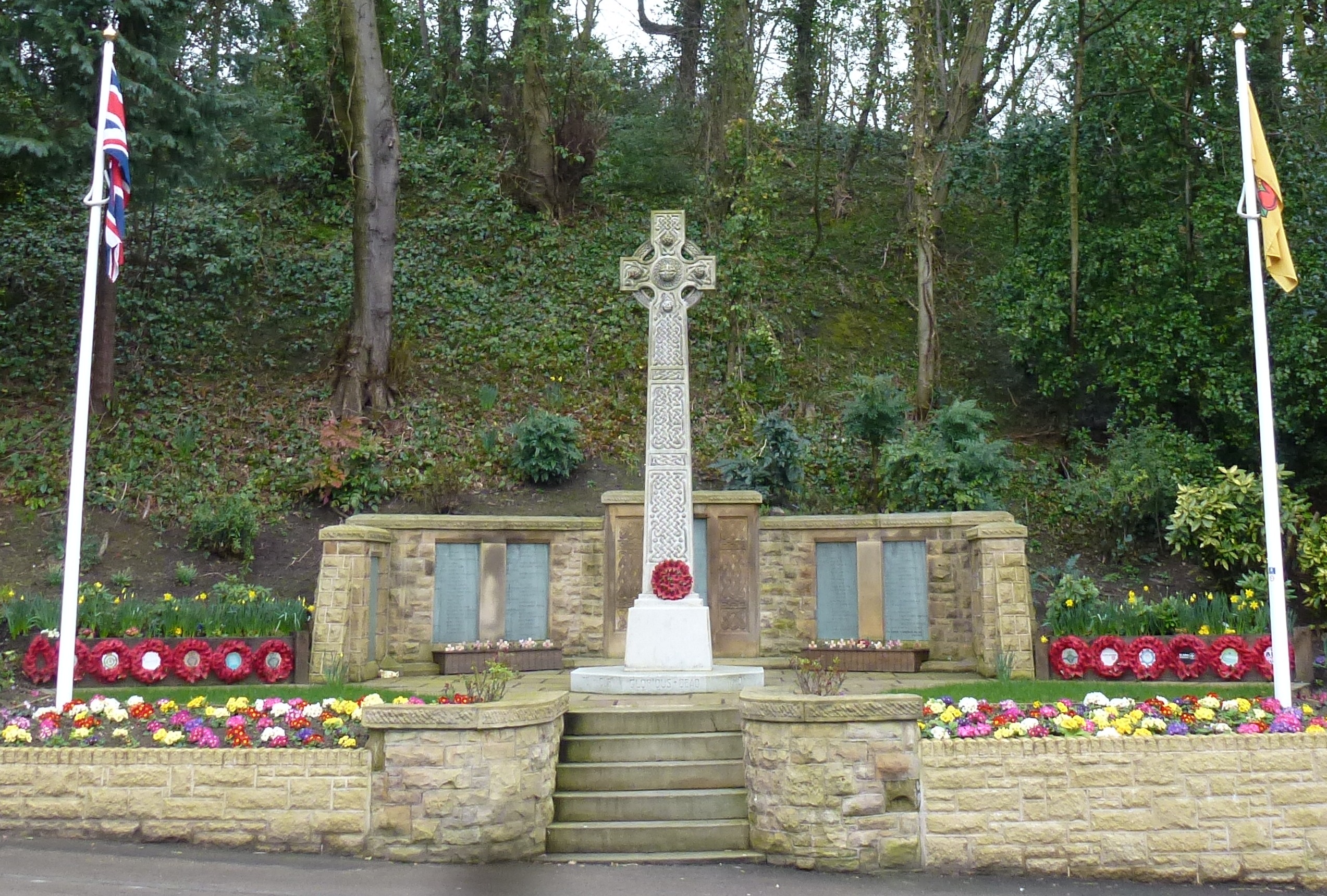
As late summer arrives, harvesters take to the fields and leaves begin to fall I sense the spirits of Annwn stirring, the first hint of the breath of winter on the wind. Monday is the date of the commemoration of the beginning of the First World War. When I help lay candles in front of Preston cenotaph for each of the 1956 soldiers who lost their lives I will remember that care of the souls of the battle dead was once believed to be Gwyn’s role.

(1) http://www.caerfeddwyd.co.uk/
(2) http://www.mabinogi.net/sections/Appendix/The_Underworld_Gods.pdf
(3) James MacKilliop, Dictionary of Celtic Mythology, (1998), p375
(4) Robin Herne, Old Gods, New Druids, (2009), p48
(5) A collection of Kingdoms in the North of England and Southern Scotland from 500AD and 800AD.
(6) Transl. William F. Skene, ‘The Dialogue of Gwyddno Garanhir and Gwyn ap Nudd,’ The Four Ancient Books of Wales, (2007), p210-211
(7) Transl. Sioned Davies, ‘How Culhwch Won Olwen,’ The Mabinogion, (2007), p199
(8) Ed. Rachel Bromwich and Simon Evans, Culhwch and Olwen, (1992), p169
(9) Transl. Sioned Davies, ‘How Culhwch Won Olwen,’ The Mabinogion, (2007), p199
(10) https://www.blogger.com/profile/02055792516386371373
(11) Ed. Rachel Bromwich and Simon Evans, Culhwch and Olwen, (1992), p133
(12) Ibid. p150
(13) Elen Sentier, Elen of the Ways, (2013), p26-28
(14) Dafydd ap Gwilim, Poems, (1982), p132 – 133
(15) http://www.maryjones.us/ctexts/collen.html
(16) Francis Thompson, The Hound of Heaven and Other Poems, (2000), p11
(17) Rev C. Nelson, St Mary’s Church, Penwortham, Lancashire, Archaeological Watching Brief and Explanation, (2011), p48
(18) http://www.gutenberg.org/files/39712/39712-h/39712-h.htm#THE_FAIRY_FUNERAL

Many thanks to Heron and Lee at Caer Feddwyd for bringing Will Parker’s article to my attention.
Choosing a Path

Fairy LaneThe metaphor of choosing a path appears frequently within Paganism but can be applied to the journey of life, which in many religious traditions is seen as the journey of the soul.

I’ve walked many paths; riding instructor and groom, philosophy student, fantasy writer. Over the past three years I have been writing and performing poetry and exploring Druidry. The binding core is that in each I’ve been seeking magic and I’ve pursued all these paths with religious commitment.

Looking back, it appears I have walked one path with many names. This week I have come to question the suitability of the name ‘Druid.’

I have never felt any commonality with, or desire to join any of the systematic orders of Druidry where one can complete courses and achieve grades in exchange for coins. It’s my firm belief that the living landscape, the gods and ancestors are the greatest teachers. Their guidance, trust and respect are not bought but earned, and thus utterly priceless.

However, one place I have felt at home is The Druid Network. Hearing a talk by its chair, Phil Ryder formed a huge turning point in my life that led me to recognise and honour the divine in my local landscape. The Druid Network is the only organisation I know of that promotes Druidry as a religion. There are no set courses or hierarchies. Each member is encouraged to find and explore their relationship with whatever they hold sacred in their own way, and the social forum provides a safe area for discussing issues and experiences. However, there are guiding principles (1).

I’m in agreement with most of these principles, except that the native religion of the British Isles must nominally be called Druidry. I imagine Heathens, Witches, Shamans and many other Pagan groups would make similar claims.

This winter’s solstice I was gifted a name for my path- Awenydd. For Kristoffer Hughes becoming Awenydd forms the core of Druidry. For Elen Sentier it is a form of native British Shamanism. My path currently seems to sit somewhere in an unknown hinterland between two names I am equally uncomfortable with, ‘Druid’ and ‘Shaman.’

For me ‘Awenydd’ works a similar magic to that which others describe in relation to ‘Druid’ and ‘Shaman’. It opens the doors of perception and initiates connection with the Awen, divine inspiration. It is as Awenydd I truly serve my land, gods and communities.

I can see a future for myself as Awenydd; continuing to learn the stories and songs of my local landscape and its spirits; journeying more deeply the immensities of the otherworlds with Gwyn and learning his mysteries; bringing my insights back to my communities and thus learning to weave a magic between the worlds.

Contrastingly, I perceive ‘Druid’ as closing doors, leading to pointless arguments, in-fighting, and attempting to define myself against systems and practices with which I share little commonality.

If the journey of life is the journey of the soul, I want to choose a path that fills my soul with awe and wonder. I want to live a life true to my heart, in devotion to the land and gods who call to me. I want to sing their songs. I want to share their inspiration. I want to die knowing I have done everything I can to respond to their call.

I don’t want to remain a prisoner in the maze of arguments and contradictions which, for me, constitutes contemporary Druidry, and which will only lead me into greater negativity.

It is on this basis I give up the name of Druid and choose Awenydd.

And the consequences?

The biggest consequence is that the path of Awenydd is not classed as a religion. If I am no longer a Druid I no longer belong to a religion.

To anyone on the outside this might look like a massive change. However on the inside this does not change my relationship with my land and deities, nor with family and friends.

It has, and I think will continue to have some impact on my Pagan, Druid and other religious communities. I’ve already talked my decision through with some of the members of TDN who, for the most part, are happy for me to remain a part of the organisation on the basis of shared principles, and I’m hoping to discuss it with my grove at the solstice.

My local Pagan Society is inclusive of open-minded people of any faith or none, so no problems there. As for Preston Faith Forum and the further questions, if I’m not a Druid, then am I Pagan? And can I be an Interfaith Representative if I don’t belong to a faith? That’s another kettle of fish entirely and not one I’m ready to address right now!

I want to live a life that fills my soul with awe and wonder

I choose a path that fills my soul with awe and wonder, in devotion to the magic this land, its deities and spirits, my patron Gwyn ap Nudd and the ancestors. This path is Awenydd. Let their songs be sung!

(1) http://druidnetwork.org/files/about/constitutionrevnov2009.pdf

Personal Religion?

Glastonbury Tor Beltane 2013 102 - CopyA couple of days ago I read write-ups of the OBOD (Order of Bards, Ovates and Druids) 50th anniversary gathering on Glastonbury Tor, on the blogs of Joanna van der Hoeven and Robin Herne.

http://downtheforestpath.wordpress.com/2014/06/09/celebrating-50-years-of-obod/

http://roundtheherne.blogspot.co.uk/2014/06/the-people-of-peace.html

It sounds like they had a grand time. Although one of the things Robin acutely pointed out was the irony that although the main topic was peace, the powers of place, including Gwyn ap Nudd and the Tylwyth Teg (the People of Peace) were not addressed or involved.

Why should that bother me? OBOD aren’t all pagans or polytheists. Hundreds of different religious groups use the Tor for various ceremonies- that’s part of its power and draw, and the eclecticism and chaos that constitutes the spirit of Glastonbury.

It was not until this morning I perceived my vexation was the symptom of an approaching realisation; I awoke with an image of the OBODies on the Tor in my mind combined with an overwhelming gnosis clear as the dawn; THIS ISN’T MY RELIGION.

I know the OBOD doesn’t pretend to be a religious organisation… however my discomfort about the lack of commonality I feel with Druids outside The Druid Network has been growing for a while. I’m beginning to feel the distinctions between my path and those of some other Druids are so huge that there is no meaningful common ground at all.

Plus… I recall Nimue Brown mentioning to be a Druid you must walk your path with conscious intent as a Druid. Looking back, I have done this as a Bard, and now do so as Awenydd. I believed these paths fitted under the umbrella term Druid but now I’m not so sure.

And I’m not so sure I did the right thing in claiming the name Druid for my religion pretty soon after joining TDN, on the ground I was a member of the network and a grove. It was much later I was gifted with the name Awenydd by Gwyn ap Nudd and the spirits of my local landscape.

So I’m beginning to wonder now whether my path as Awenydd, which is based in these relationships and expressing them through poetry, is not the religion of Druidry but a personal spirituality I live religiously?

I also wonder, because my practice focuses more on ‘anthropomorphised’ deities and spirits than most Druids whether I’m more of a polytheist? In answering that I find myself drawn back to the issue of commonality… I once wondered whether I was a Brythonic polytheist but decided I wasn’t as I don’t know enough about all the deities and their lore in depth, haven’t made enough effort to learn Welsh, and don’t follow a joint ritual structure.

So I wonder now…

Can polytheism be religious without commonality?

Must religion have a name?

Is personal religion a contradiction in terms? And is it possible to live a personal religion?

View from Glastonbury Tor Beltane 2013 120

Gwyn Portrait, April’s End

The huntsman has ridden all night, following the brilliance of the spirit roads- the shining tracks that criss-cross the island of Britain. Instead of returning home he remains here for dawn, listening to the idiosyncrasies of each bird’s song, watching dew form on blades of grass, on petals of hawthorn blossoms and may flowers.

He is and is not the mist, riding through damp meadows over hills, mountains and moors on a pale horse accompanied by a hound of the same complexion. He is and is not each sun-lit cloud he travels with, the touch and whisper of the wind.

He cannot stay here long, for this world we see as the land of the living is not his. He must return home to Annwn, the Otherworld, to prepare for a battle that cannot be won. To fight for a maiden he shouldn’t have loved, shouldn’t still love… in bluebells and forget-me-nots, emerging greens and white and yellow flowers he sees her colours.

For a moment he is possessed by memories of their passion, and the crimes it drove him to. A glimpse of his blacked face in a reed strewn pool shows no amount of war paint can mask his guilt, which he must live with for as long as there are people to sing his songs.

He searches for a sign. What is Judgement Day? When is it? Although he knows the language of the trees and plants, the tracks of every wild creature and the flight of birds, these questions are beyond his power to divine. When the worlds end, will Creiddylad and I be together again?

May Flower, Penwortham

Corpse Road

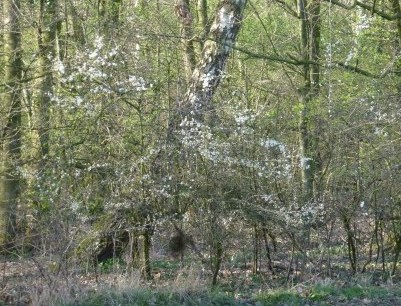
Birch and Blackthorn, Hurst Grange Park, PenworthamWho’ll walk the corpse road back to me?
– ‘Revenants’ Andrew O’Riordan

Where spring brings hope to downy birch
And blossoms of stars to blackthorn trees
When the hunt is still as the final frosts
Who will walk the corpse road back to me?

Where spring brings hope to drunks of the woods
With the pale potential of anemone
When my court dance in dew where a man lay cold
Who will walk the corpse road back to me?

Where spring brings hope to primrose hills
But none to vagrants on city streets
When wills clash like I do with impudent rivals
Who will walk the corpse road back to me?

Where spring brings hope to prison gardens
For a watchful moment the condemned walk free
When to solitary confinement comes Annwn’s darkness
Who will walk the corpse road back to me?

Where spring brings hope to those who can see it
Yet Victorian cells of asylums scream
When dreams of my kind are derided as madness
Who will walk the corpse road back to me?

Where spring brings no hope and death is release
And no fusion of flowers can quench the pain
When souls are lost as my absent queen
Will you walk the corpse road back to me?

Lych Gate, St Mary's Church, Penwortham* Poem written in the voice of Gwyn ap Nudd, a British King of the dead and the fairies

Gatherer of Souls

I have been where the soldiers of Prydain were slain…
I am alive, they in their graves!
– Words spoken by Gwyn ap Nudd in The Black Book of Carmarthen XXXIII

Spring is here, daffodils
amongst the headstones,
flowers on the cenotaph
grieving summers of war-

shells shattering spirit paths,
ditches filled with corpses,
a perverse test of love
for brave young fools

and you being liminal,
battle rage and compassion
on the blood soaked fields
where banshees wail

gathering the fallen
from amongst explosions,
returning to Prydain
wracked and torn.

Spring is here, yet in
Annwn’s long autumn you know
the weight of the battle dead,
the sorrow behind the veil.

War memorial in Penwortham