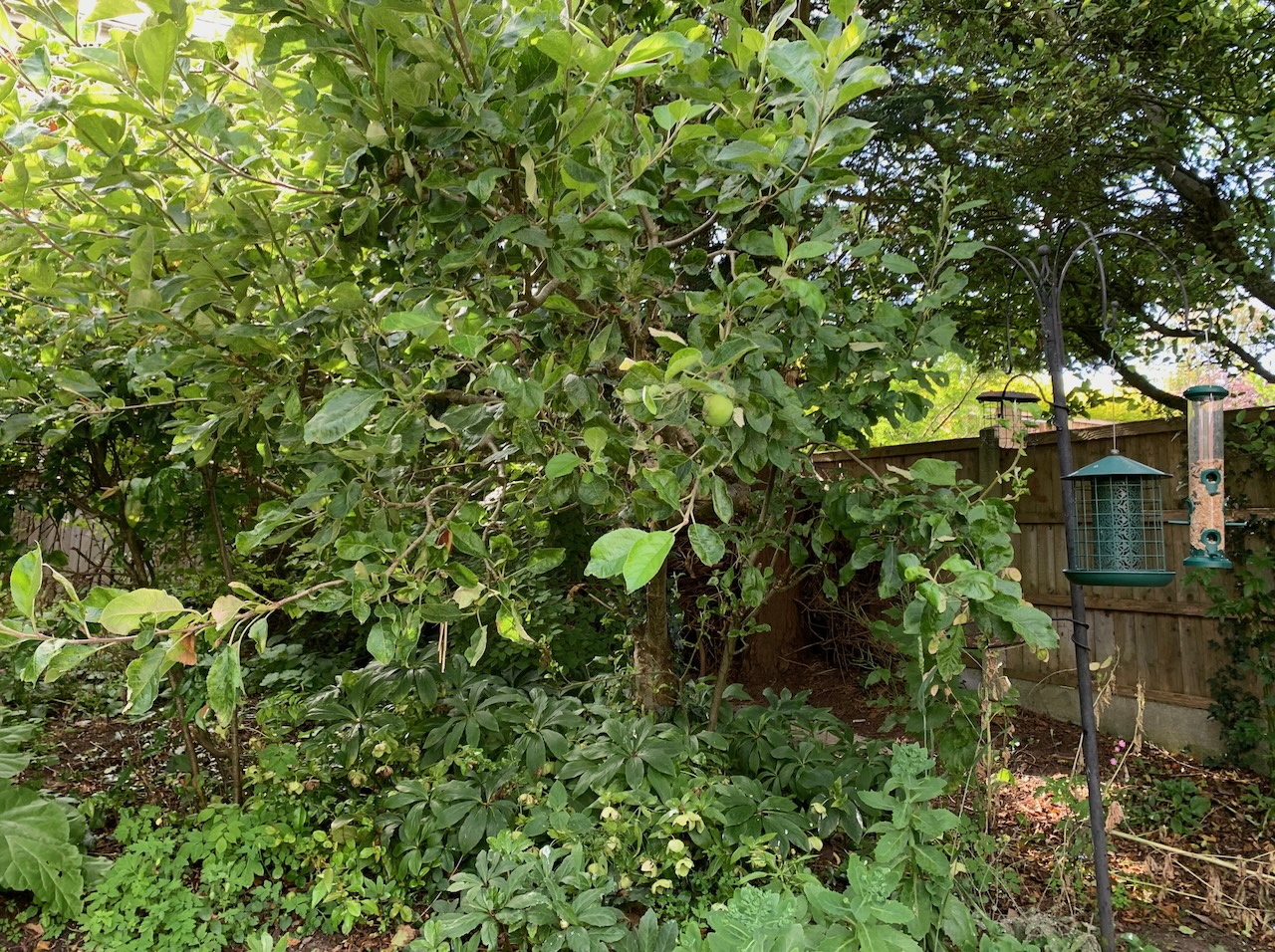
I. Apple tree, sweet apple tree, who grows in my suburban garden, know I am no Myrddin and no prophet.
I fought not in the Battle of Arfderydd. I was not a golden-torqued warrior.
I wandered not in the Forest of Celyddon.
But I have wandered for thirty years with madness and madmen in the wildernesses of suburbia not knowing what is real and what is not.
I have known my pigs and my stolen berries and my maidens of the suburban drains, my Chwyfleian beneath her trap.
II. Apple tree, sweet apple tree, who grows close to my garden fence, know I am no Myrddin and no prophet.
I knew not Gwenddolau and his two eagles who feast on the flesh of the Britons every day but I have been devoured by death-eaters.
I did not get involved with the games of Gwenddolau and Rhydderch on the gwyddbwyll board, men gold and silver,
but I predicted the outcome and did not speak up about Caerlaverock.
I ask that my Lord of Hosts have mercy on me.
III. Apple tree, sweet apple tree, near where the birds come to feed, where the sparrows pick, the starlings peck, where the long-tailed tits come to twirl their tails, know I am no Myrddin and no prophet
yet I was torn out of myself
not after the Battle of Arfderydd but when I was but a child, a fledgling by the bullies who called me a pig, knowing not Myrddin’s sweet little one, when I was only half-pig half-bird.
I knew not what kind of bird.
Not a hawk certainly not a merlin.
Perhaps a blackbird or the big black bird perching on my chimney-top blotting out the sun.
IV. Apple tree, sweet apple tree, with your blossoms white and pink, foxglove pink, the colours of the fair folk, know I am no Myrddin and no prophet,
yet I was invited to walk not in Celyddon but in Avalon with my Lord of Hosts.
Oh happy happy days beneath your boughs with the long-tailed tits twirling, picking at the worms
as the snake returned to the garden and the Dragon King spread His wings and they were filled with the apples of the sun.
This poem is inspired by ‘The Apple Trees’ from The Black Book of Carmarthen wherein Myrddin Wyllt speaks his woes to an apple tree after the tragic Battle of Arfderydd. I believe ‘the Lord of Hosts’ referred to in this poem is Gwyn ap Nudd, who is also referred to as ‘the Lord of Hosts’ in ‘The Conversation of Gwyn ap Nudd and Gwyddno Garanhir’. Gwyn, ‘White’, has paradoxically appeared to me in the guise of a black dragon. It’s a poem about knowing in spite of my defects and limitations I am loved.
I have an announcement to make. A happy announcement. One that may come to you partly as a surprise and partly not at all (as it did to me).
Gwyn and I got married! – A sacred marriage between a God and a nun of Annwn.
The moment Gwyn and I met and He revealed His name and His face I fell in love with Him and knew that I’d known Him from time’s beginning.
It’s taken a long time for me understand the nature of that love, which has taken many forms – of the love between patron and devotee, of teacher and apprentice, of inspirer and inspired one, of truth and one who receives truths.
For many years that we might be beloveds – married as bride and groom, husband and wife – was completely unthinkable to me as someone who is asexual and aromantic and found the language of love soppy and sentimental.
Another reason is that although Gwyn saved my life and my sanity and has been there for me through the toughest of times it’s taken me a while to become open to the possibility that He cares about me let alone loves me.
This changed when I had my first soul retrieval with my spiritual mentor, shamanic practitioner and wild therapist Jayne Johnson, in March. Jayne knew Gwyn is my patron God but didn’t know the meaning of Gwyn ap Nudd, ‘White son of Mist’ or His earlier name Vindos / Vindonnus ‘White / Clear Light’ or about His associations with Gwynfyd, ‘Paradise’.
Before we began Gwyn told me He would oversee the soul retrieval and I told Jayne. The landscapes she journeyed were covered with mist and she came across an area of thick mist and an incredibly bright light and felt confused – like she was in the upperworld although she was in the lowerworld. The mist revealed an ancestor who led her to my lost soul part – the young girl who had fled the trauma of school to the stables. Gwyn appeared to carry her back and Jayne blew her into my heart. The experience was incredibly moving and I was astonished to learn Gwyn cared.
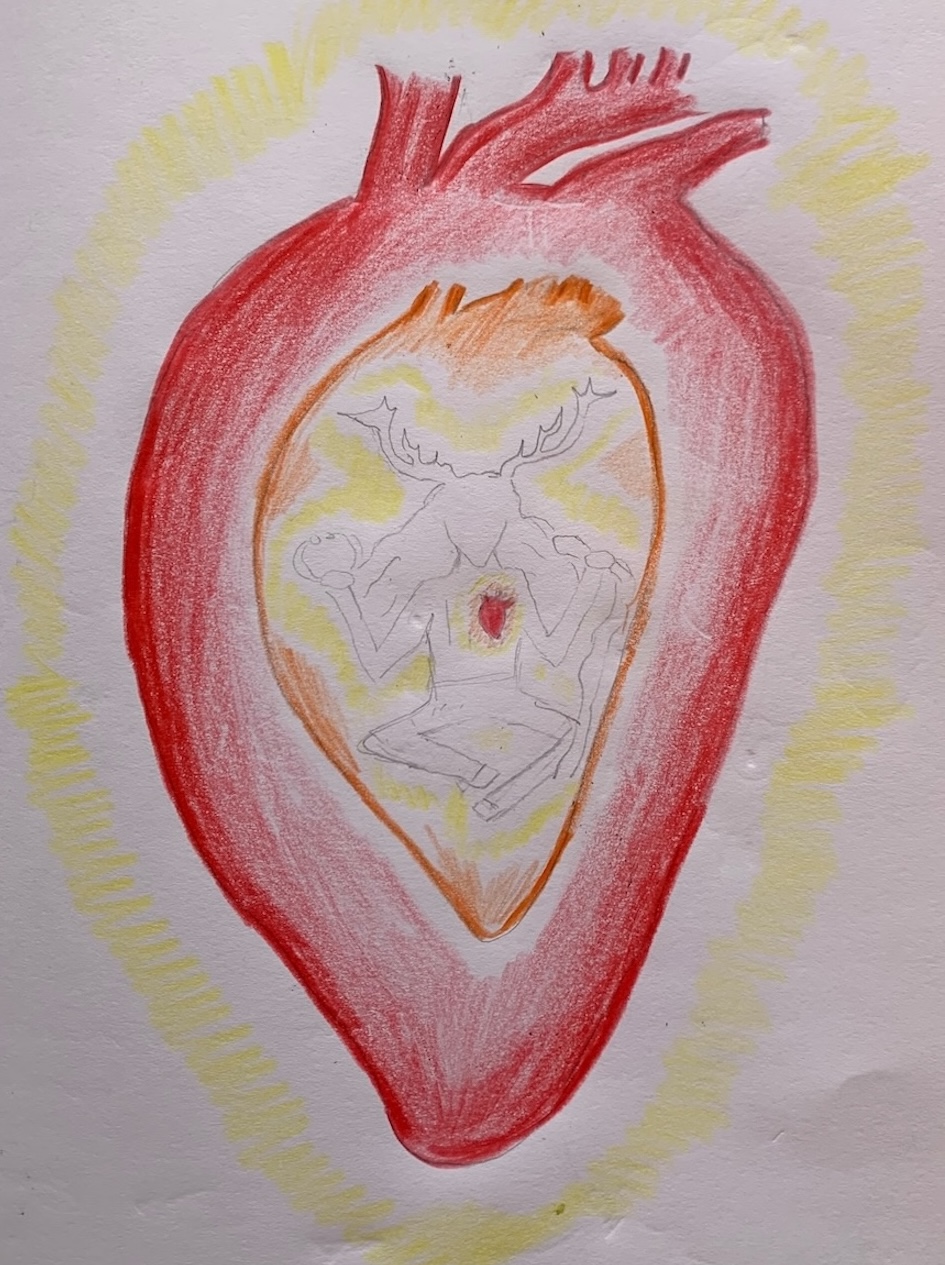
This tied in with my experiences of the Heart of Annwn as Gwyn’s Sacred Heart. Of my playing a heartbeat on my drum every night to unite my heart with His and with my offering my heart to Gwyn several years ago and its travails in fire and ice before Him returning it to me on His feast day last year.
More recently attending a shamanic workshop in London led me to discovering the Tyburn Convent and the Christian mystics whose experiences of the Sacred Heart of Jesus related to mine with the Sacred Heart of Gwyn. In the writings of these Brides of Christ I found descriptions of sacred marriage as a spiritual union that was neither sexual or romantic.
At the workshop, for the first time, I practiced being possessed by my spirits – my winged horse, my hounds, my crows, Orddu and all her ancestors. My teacher, Simon Buxton, described this as a form of sacred marriage / hieros gamos.
When I returned home, Gwyn asked, “Why have you denied me?”
I could provide no answer beyond my fears of that kind of intimacy with a God so intense, so terrifying, so beautiful and of what other people might think.
On Nos Galan Mai He asked the question: “Will you marry me in life and in death?”
Knowing I couldn’t deny my love for Him, His for me any longer, I said “Yes.”
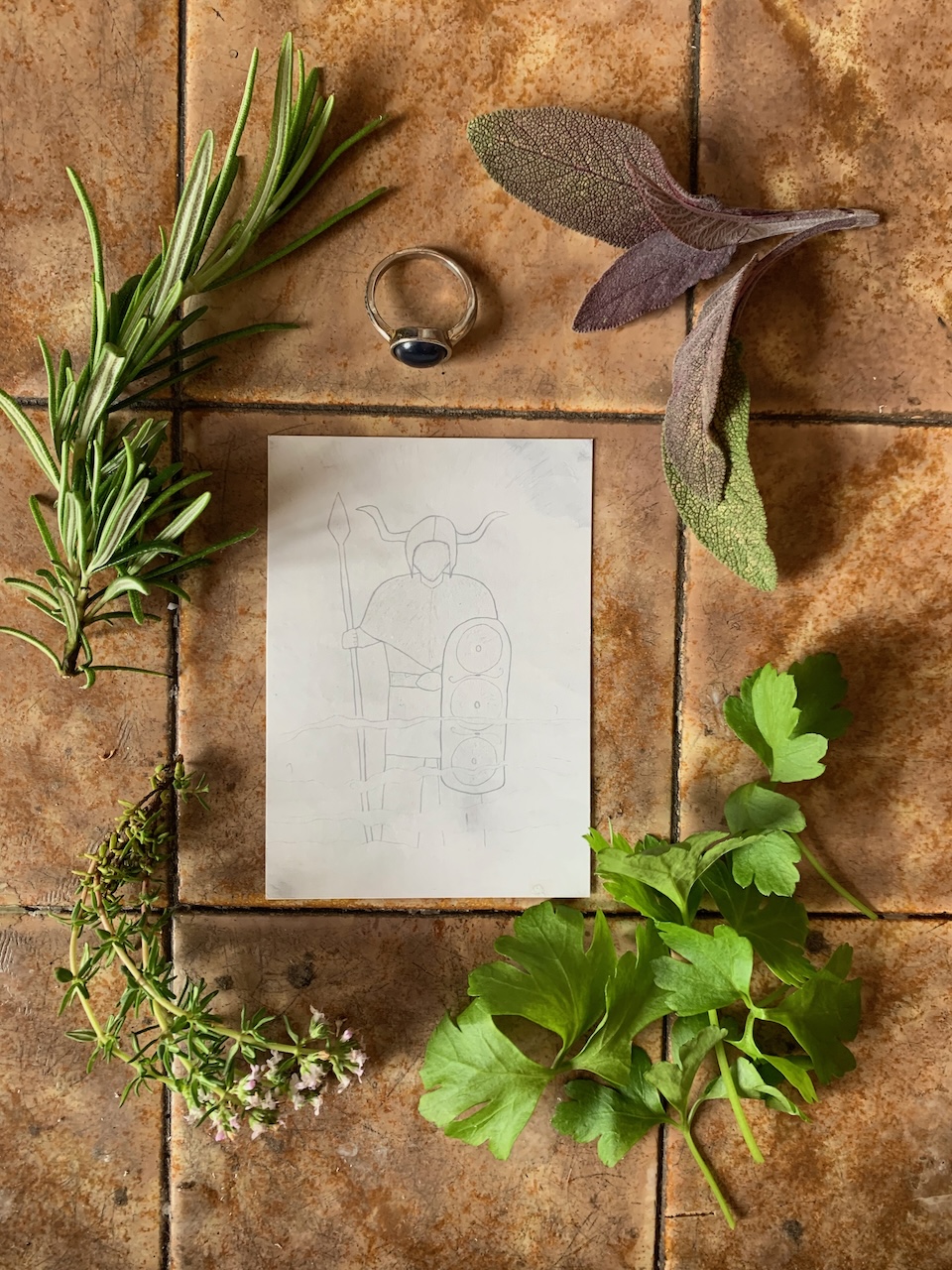
On Nos Galan Mai we got married in life. An amusing side story – how I got the ring. Many years ago I was told to get a ring as an offering for the river Defwy, a river in Wales that is also a Brythonic river of the dead, and found a fitting ring with a black stone in a charity shop. It turned out I never visited. Gwyn admitted it was a trick as I would never have got the ring otherwise. It turns out it fits perfectly on my wedding finger – He knew I’d marry Him then!
After Gwyn fought his yearly battle with Gwythyr on Calan Mai and died and returned to sleep in His tomb in His Castle of Cold Stone I married Him in death. This took place as the finale of a shamanic burial ritual. I have rewritten the Yorkshire folk ballad, Scarborough Fair (in which a woman completes impossible tasks to win a fairy lover), loosely based on my experiences.
The Land of the Fair
Chorus:
Are you going to the Land of the Fair Parsley, sage, rosemary and thyme Remember me to one who lived there For she once was a true love of mine
Verses:
Tell her to build us a coffin of wood Parsley, sage, rosemary and thyme From no tree that ever has stood And she will be a true love of mine
Tell her to dig the deepest of graves Parsley, sage, rosemary and thyme Without a pick axe or a spade And she will be a true love of mine
Tell her to seal our burial tomb Parsley, sage, rosemary and thyme Without hammer or nails return to the womb And she will be a true love of mine
I can’t say anything else about our sacred marriage in life and death only that as the final result of it Gwyn has become ‘the Heart of the my Heart’. He is within me, me within Him, like in the mystical unions of the Brides of Christ.
My heart has been opened to Gwyn, through this opening to others, to the nuptial spirituality of the Mystics of the Sacred Heart and fellow godspouses.
I am now happily married as a nun of Annwn and Bride of Gwyn.
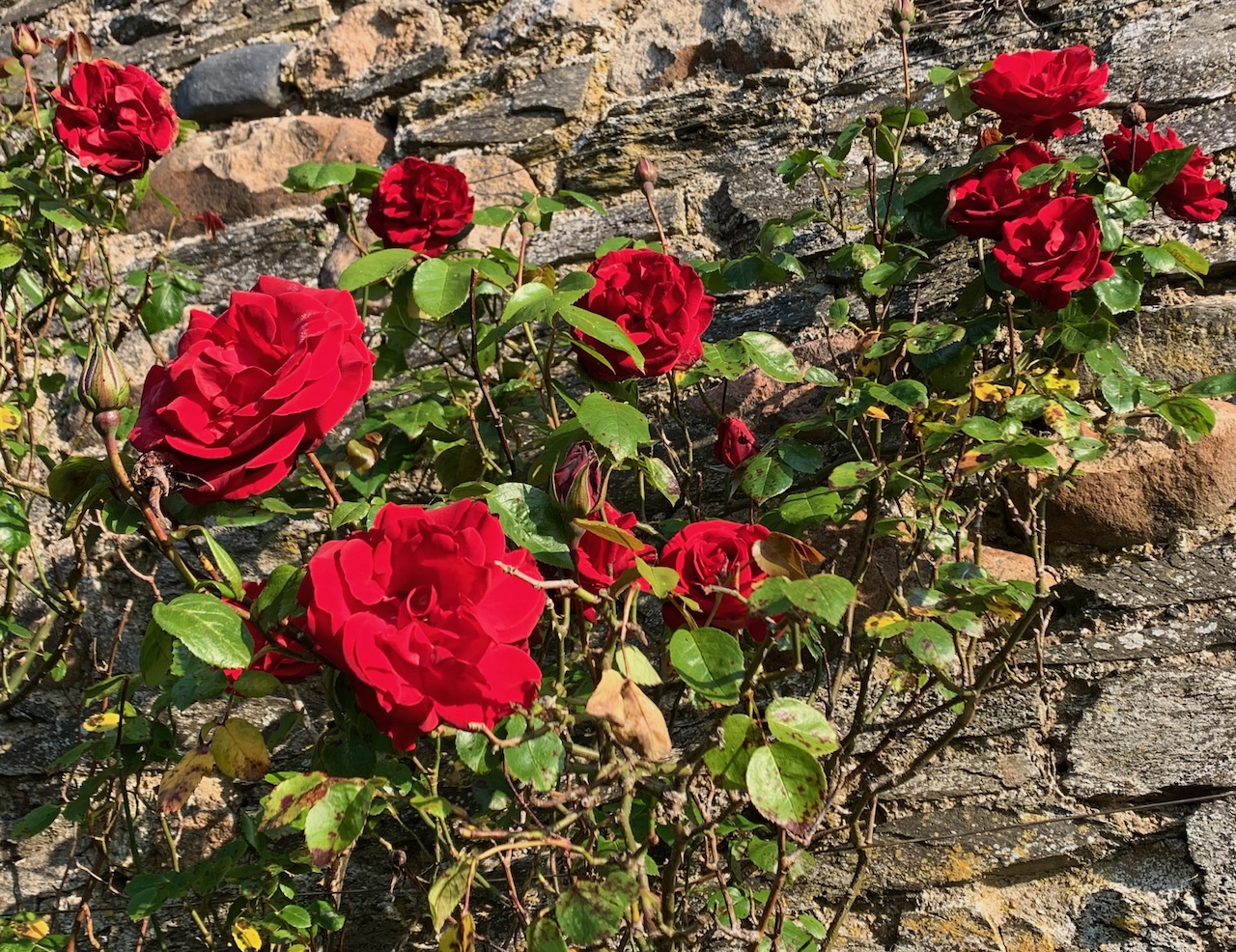
Oh Heart of the Void distant from Your Queen of Roses
Oh Heart of the Void distant from Your Queen of Thorns
Oh Heart of the Void distant from where the roses grow
Oh Heart of the Void distant from where the thorn trees grow
~
A devotional song for Gwyn ap Nudd for the period when He lies dead / sleeping in His Castle of Cold Stone in the deepest reaches of Annwn in the depths of the Abyss.
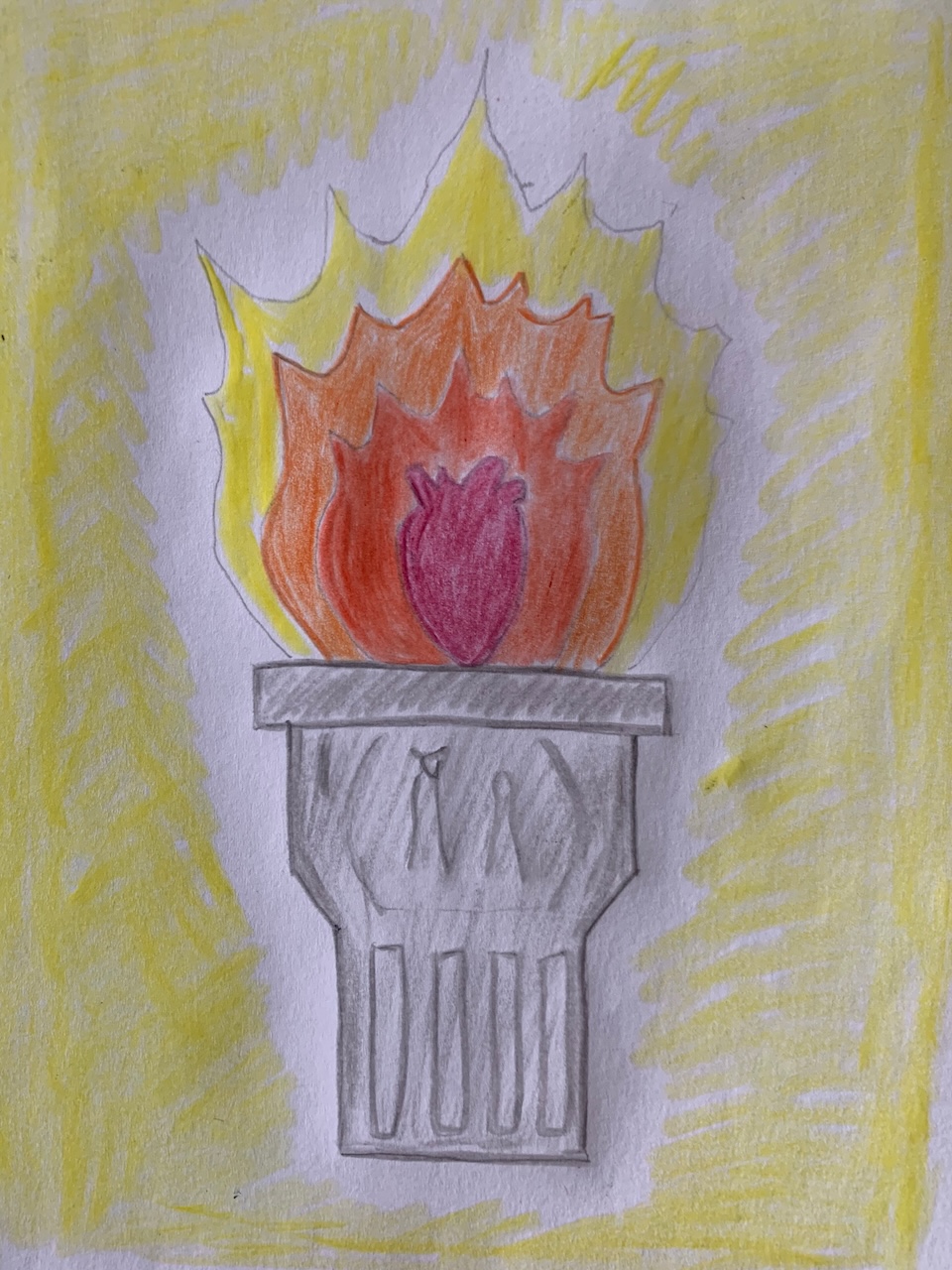
Artwork by Morgannah based on my recent writings about the Heart of Annwn as the Sacred Heart of Gwyn.
In The Way of the Gods Edward Butler speaks of the ‘fractal quality’ of Egyptian cosmogony. He says: ‘There is one way in particular in which I believe that Egypt can still guide us, namely in the coexistence there of a numerous incommensurable cosmogonies, in a system which lacked any overarching structure integrating them, and which was yet highly stable over vast spans of time… If we can grasp how the Egyptians sustained the belief in many different cosmogonies without reducing them to mere images of some single, superior truth, we can scale up that model to apply to the vast number of incommensurable cosmogonies at the heart of the world’s many sacred traditions traditions, and arrive at a genuine solution to the problem of religious pluralism…. Egyptian cosmogony… has a fractal quality, because everything which comes to be does so in the manner in which the cosmos itself came to be, and continues every day to come to be.’ (1)
A fractal is: ‘an irregular geometric structure that cannot be described by classical geometry because magnification of the structure reveals repeated patterns of similarly irregular, but progressively smaller, dimensions.’ (2) The term was coined by the mathematician Benoit Mandelbrot and comes from the Latin fractus ‘broken or fractured’. (3) Fractals occur in mathematics, physics, architecture, decorative art, and natural phenmomena. Examples include tree branches, lungs, lightning, clouds, crystals, and snowflakes. (4)
*
Butler’s identification of cosmogonies as fractal can be applied more broadly to myth and can help us gain a better understanding of British mythology.
Unfortunately, here in Britain, we don’t have knowledge of any of our ancient creation myths. They are merely hinted at in medieval Welsh literature in which Taliesin, who claims to be have been born or created in various ways, is often represented as a microcosm of the macrocosmic world. In some sources he is (re)born from the womb of Ceridwen, the Goddess of the Cauldron, who takes the form of a crested black hen. (5) In others he is created by five enchanters, Math, Gwydion, Eurwys, Euron and Modron ‘from nine forms of consistency’ (fruit, God’s fruit, primroses, flowers, blossom of trees and shrubs, earth, sod, nettle blossom and ‘the ninth wave’s water’) (6) and by God from ‘seven consistencies’ (fire, earth, water, air, mist, flowers, and ‘the fruitful wind’). (7) This suggests the world was seen as originating from the womb of Ceridwen and as being created by the Gods. These stories, like the Egyptain cosmogonies, are incommensurable. This speak of the fracturing of the crochan, womb or cauldron, of Ceridwen, who I see as Old Mother Universe, with the Big Bang, at the beginning of time. Such a beginning perhaps explains the fractal nature of our myths.
Another myth that might be read as fractal is that of Merlin. Many versions of the stories of Merlin Emrys / Merlin Wyllt are located across Britain and in Brittany. Similarly with the story of King Arthur which has been told and retold since the medieval period with his court at Camelot having numerous locations including Caerleon, Celliwig, and Cadbury Castle. He and his knights are also said to be sleeping in various underground caverns.
*
It is little known that Arthur’s fractal mythos as the Sleeping King is a purloined one. This can be read from the fragments portraying Arthur’s raid on Annwn, his defeat of the Head of Annwn and his theft of His cauldron through which he claims leadership of His hunt and His role as the Sleeping King.
In Culhwch ac Olwen Arthur and his men ‘go North’ (then presumably into Annwn) to rescue Gwythyr ap Greidol and a group of northerners from the fortress of Gwyn ap Nudd, the Head of Annwn. In this fragment Arthur wins by negotiating. (8) In other fragments there is carnage, ‘Shields shattered, spears broken, / violence inflicted by the honoured and fair’. (9) Of the ‘three full loads of Prydwen’ (Arthur’s ship) to go into Annwn ‘save seven’ none return. (10) (Lllen)Lleog thrusts his sword into the cauldron and makes off with it (11) and in another fragment grabs Arthur’s sword, killing the Head of Annwn’s cauldron keeper and his retinue and likely the Head himself. (12)
Interestingly, in ‘The Spoils of Annwn’, Arthur raids seven fortresses which might be fragments of a fractal – the Head of Annwn’s fort. There is no original. All are incommensurable. Intriguingly we find Caer Wydyr ‘the Glass Fort’. Our texts are redolent with the imagery of shattering. Shattered shields, shattered forts. The Head of Annwn Himself is conspicious by His absence whereas Arthur’s presence is lauded and sung through all.
Following his victory over the Head of Annwn and theft of His cauldron Arthur usurps the hunt for Twrch Trwyth ‘the King of Boars’. The twrch was originally a human chief turned into a boar because of his sins by God. This is a Christian overlay obscuring that it was a hunt for human souls – the Wild Hunt. Thus Arthur became known as the Leader of the Hunt.
Finally, Arthur lays claim to the Head of Annwn’s role as the Sleeping King. The battle between Gwyn and Gwythyr likely has its origins in an ancient British seasonal myth wherein Gwyn, Winter’s King, is killed by Gwythyr, Summer’s King, on Calan Mai. When Gwyn dies he returns to His fortress in Annwn to sleep until His return to the world on Nos Galan Gaeaf later in the year. Arthur’s retreat to beneath the Isle of Avalon is a mirror image of Gwyn’s.
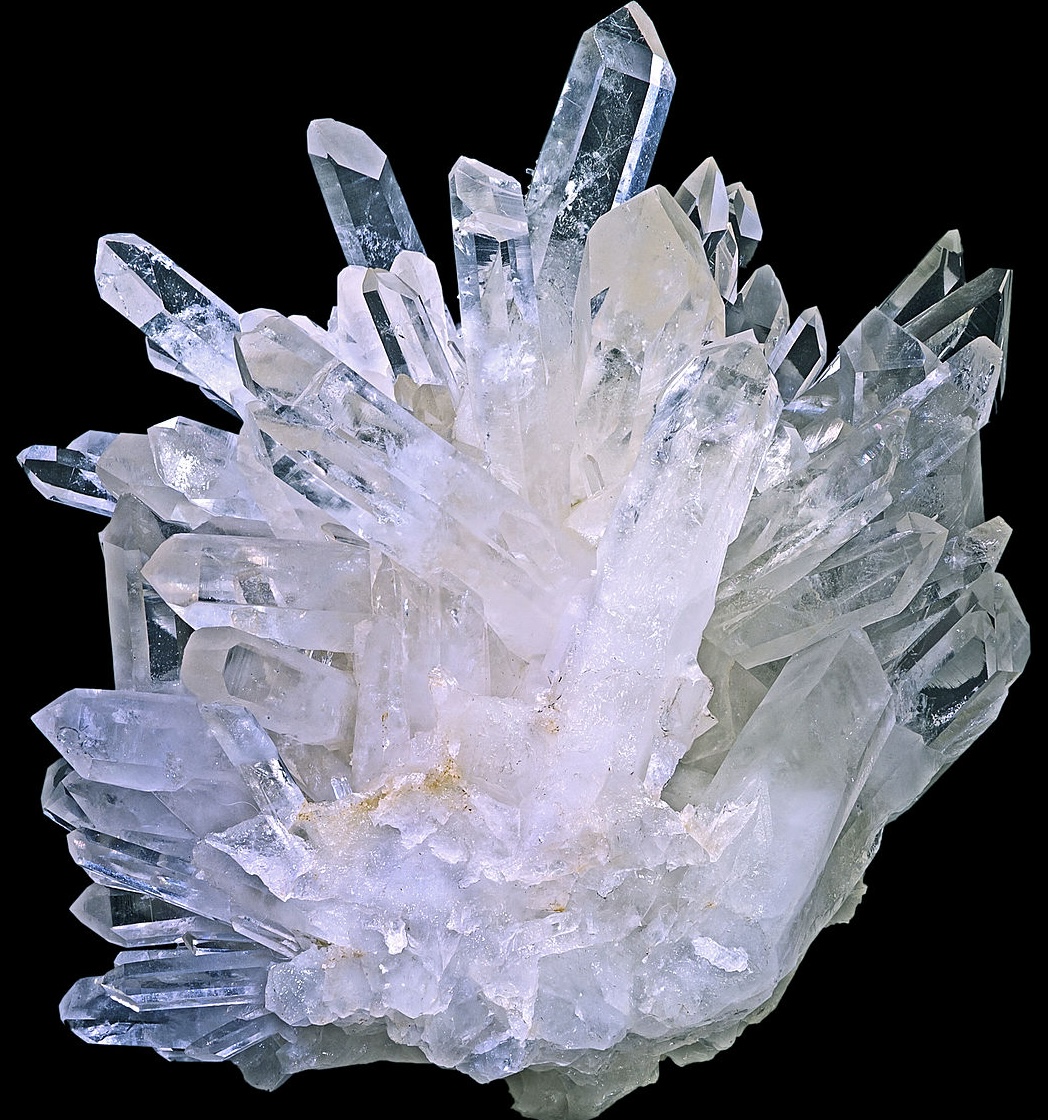
As Christianity rose to popularity the fractal mythos of Arthur replaced the fractal mythos of Gwyn. Their fractals might be seen to be like two crystals, their reflections reflecting one another, composed of fragmentary tales.
*
For the past couple of years Gwyn has been appearing to me with a jewel in His forehead. In a meditation with the Monastery of Annwn on His birth at the end of last year He said: ‘There are as many stories of my birth as facets to my jewel’.
When I first came to polytheism it was with the preconception that the Gods had one true story that could be found by piecing together the fragments into one whole or peeling them away to reveal some singular truth. Now I know better. Myths are, in their essence, fractal. There is no one truth or original.
This has been pushed home as, over the past two years, in our meditation and group at the monastery Gwyn has revealed Himself and His stories to us as monastic devotees in many diverse and sometimes contradictory ways. Yet there have also been many reflectings suggestive of their fractal nature.
I don’t think it’s a coincidence that Gwyn has revealed Himself to be associated with so many fractal things – trees, clouds, jewels, snowflakes. There is a similar beauty in the incommensurability of His myths and mysteries. Every year I look forward to different stories of our Sleeping King.
*Image of quartz crystal from La Gardette mine, Bourg d’Oisans, Isère, France, courtesy of Wikipedia commons.
(1) Butler, E., The Way of the Gods, (Indica 2022), p100 – 104 (2) https://www.dictionary.com/browse/fractal (3) https://iternal.us/what-is-a-fractal/ (4) Ibid. (5) ‘The Story of Taliesin’ in Hughes, K. From the Cauldron Born, (Llewellyn Publications, 2013), p32 and ‘The Hostile Confederacy’ in Haycock, M. (transl), Legendary Poems from the Book of Taliesin, (CMCS, 2007), p313 (6) ‘The Battle of the Trees’, Ibid. p180 (7) ‘The Song of the Great World’, Ibid. p516 (8) Davies, S. (transl.), The Mabinogion, (Oxford University Press, 2007), p207 (9) Hill, G. (transl), ‘The Conversation between Gwyn ap Nudd and Gwyddno Garanhir’, Awen ac Awenydd (10) ‘The Spoils of Annwn’ Haycock, M. (transl), Legendary Poems from the Book of Taliesin, (CMCS, 2007), p435 (11) Ibid. p146 (12) Davies, S. (transl.), The Mabinogion, (Oxford University Press, 2007), p208
‘Your absence is like the spinning of the void. You are gone to its bottommost depths with Your Castle of Cold Stone.’ ~ You are Gone
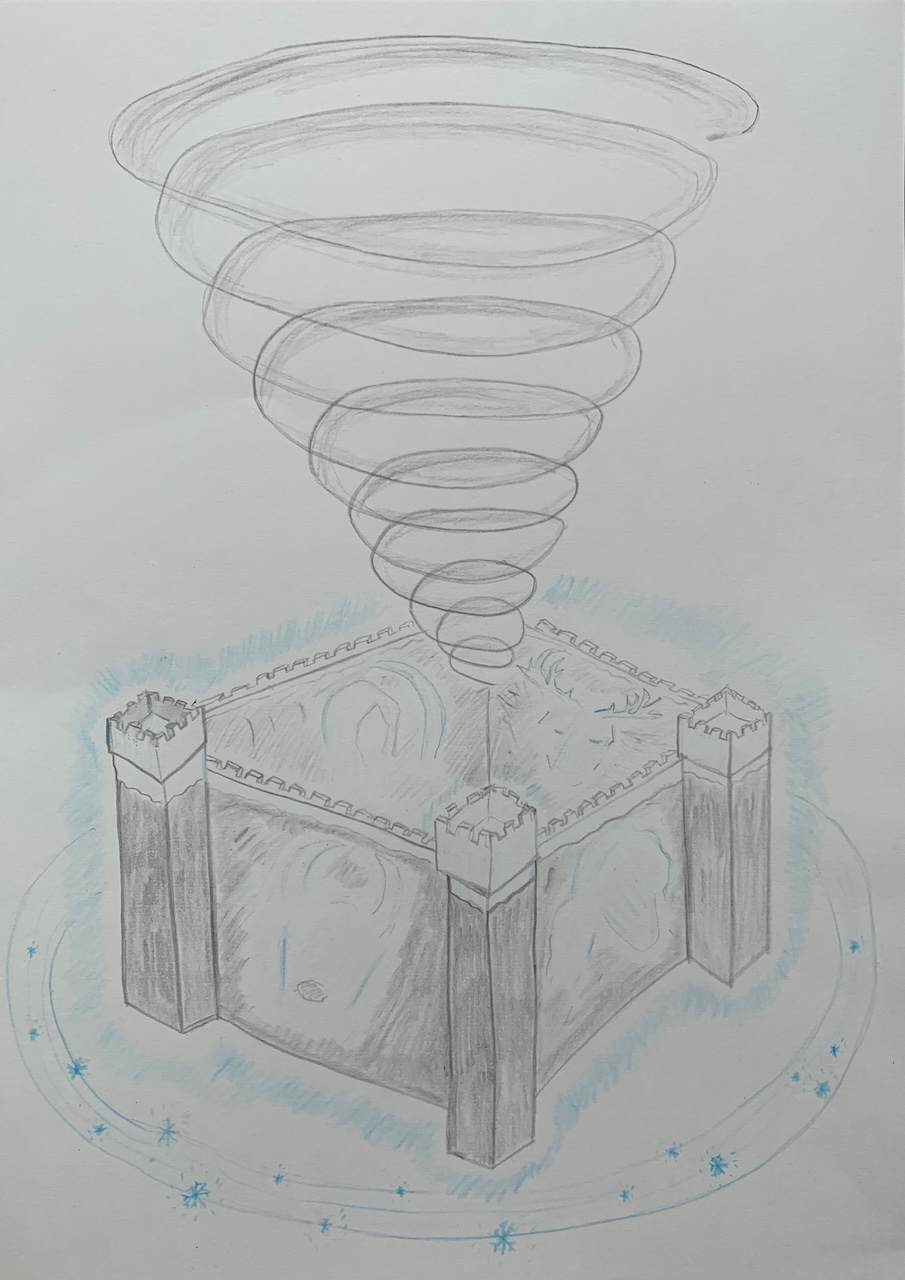
In the myth I live by after my patron God, Gwyn ap Nudd (Winter’s King) is defeated by His rival, Gwythyr ap Greidol (Summer’s King) He ‘dies’ and retreats to sleep for the summer in Caer Ochren, the Castle of Cold Stone.
For a long while I had been using Meg Falconer’s image of Caer Ochren from King Arthur’s Raid as my altar art for this period but this year I received the calling to create my own. This image depicts Gwyn’s fortress sinking into the Abyss with grief at His passing with snow and frost on the towers and winds showing that, contrarily, it is winter in Annwn. I was planning to show Gwyn’s tomb in the interior of the fort but, instead, it came through to me that He wanted me to show intimations of His faces on the walls. These appeared to me like projections of light but in ice showing that whilst He dreams His representations in myths and stories are still manifesting to us in the world.
When I founded the Monastery of Annwn just over two years ago I feared it would always be a rule of one. To my utter surprise for such a niche interest (Brythonic Polytheistic Monasticism centring on the Annuvian Gods) the monastery is thriving with a dozen members, most of whom participate regularly in group rituals, meditations and check-ins, or on our online forum. Several of us are living by vows and the Rule of the Heart.
Only a few months ago I thought it would be impossible to support myself as a nun of Annwn but I have received glimmers of hope with my soul guidance sessions off to a good start and my Patreon membership growing a little.
This month my spiritual mentor suggested instead of trying to logically plan my next steps ahead for the future we should open a space for dreaming. She challenged me to dream my biggest dream and set it down without thinking about the ‘real world’ limitations that might prevent it happening.
Immediately I knew this was to make the Monastery of Annwn a physical reality. I’d already had lots of flashes of inspiration so I set them down then journeyed to the Spirit of the Monastery to ask for guidance for the future.
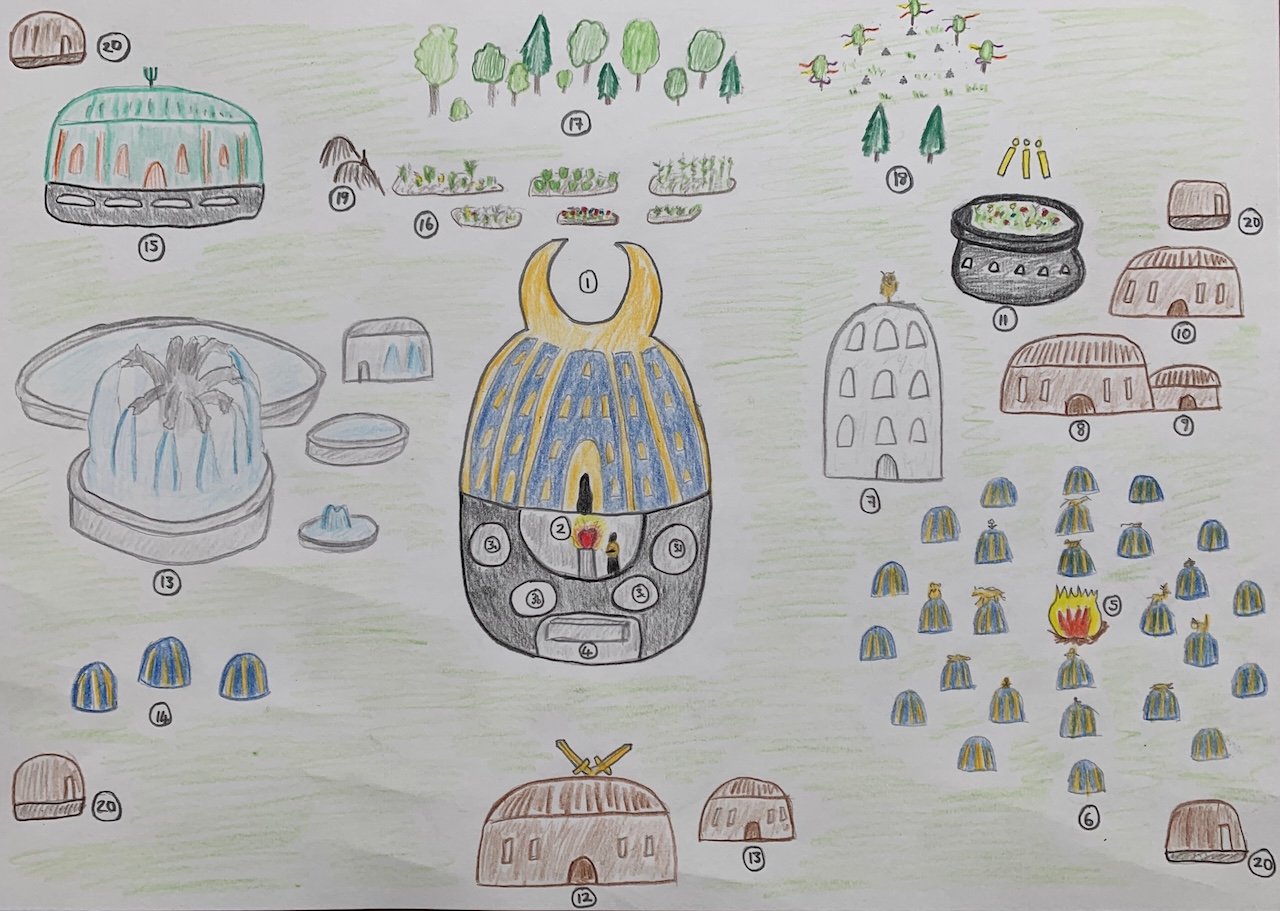
Below is my dream Monastery of Annwn at this point in time. I see it as a centre for worship of the Gods and Goddesses of Annwn, a sanctuary for healing and retreat, and a place for learning about the Brythonic tradition from a polytheistic perspective. It combines above ground, underground, indoor and outdoor spaces.
My hope is that it would sustain itself by growing its own food and making money from healings, retreats, running workshops and courses on Brythonic myths and Deities and polytheistic monasticism and sales of inspired works from monastic devotees.
(1) The Monastery of Annwn – The central temple space containing shrines to the Gods and Goddesses of Annwn and space for worship and ecstatic dance. (2) The Chamber of the Heart – At its centre is the Altar of the Heart where monastic devotees can venerate the Heart of Annwn. There will always be a monastic devotee keeping the beat of the heart day and night. (3) Underground Caves – For communion a) Orddu’s Cave b) Cave of the Spirits of Annwn c) Cave of Bardic Incubation d) Cave of the Unknown. (4) Gwyn’s Tomb – This will be where Gwyn symbolically lies in His tomb during the summer and monastic devotees will be able to visit and spend time in silence with Him. In winter the coffin will be removed and this will be a space of initiation involving death and rebirth prior to taking vows. (5) The Hearth of Annwn – A space where monastic devotees gather. (6) Huts of the Monastic Devotees – There are three circles. The first two circles are hut for monastics who have made lifelong vows. On top of each hut is a representation of one of their tutelary spirits. The third circle is for novices and for those who are in the process of discernment.* (7) Crazy Owl’s Library – A library containing books on Brythonic lore and monastic and mystery traditons along with mythology from around the world. (8) Gwyn’s Feasting Hall – Here meals are served. (9) Ceridwen’s Kitchen – Here nutritious food made with local ingredients is cooked. (10) Gwyn’s Guest House – A bunkhouse for guests. (11) Awen Arts – An arts centre with an art gallery and performance space for poetry, singing and music and spaces for crafts and crafting. It will also contain a shop selling inspired works by monastic devotees. (12) The Training Hall of Gwyn and Gwythyr – A hall for training in martial arts and other kinds of movement including dance and yoga. (13) Giant’s Gym – For strength training and rehabilitation. (14) The Healing Fountains of Anrhuna – A complex of healing waters including fountains, spas and pools and a shower house and baths for daily use. (15) Healing Huts – Huts for shamanic healing and various therapies. (16) The Dream Temple of Nodens – A temple for Nodens with underground dream incubation chambers and healing hounds. (17) Creiddylad’s Garden – Here vegetables, salad, herbs and fruit are grown. (18) Gwyn’s Wildwood – A woodland space for meditation, communion and celebration. (19) The Blessed One’s Burial Ground – A natural burial ground for monastic devotees whose graves will be marked with small cairns. Potentially this might be expanded to provide space for others who support our aims. (20) Ceridwen’s Compost Toilets – Four sets spaced around the monastery. (21) Ceridwen’s Compost Heap – For recycling all waste from the garden and feasting hall.
Potentially, off scene, there will be ‘herds of Annwn’ – pigs and cattle for meat and milk and horses for horse riding and equine therapy.
*
Daily Routine
Communal worship will take place in the monastery mornings and evenings. Rather than breaking up the day with regular communal prayers like the Benedictines** prayer will be integrated into daily activities. Each will open with prayers of praise and petition and end with prayers of thanksgiving. For example, prayers to Creiddylad for gardening, prayers to Gwyn and Gwythyr for martial arts, prayers to Anrhuna for healing work. Meals will be preceded by prayers of thanksgiving to the spirits of the land.
Additional rituals will take place for Holy Days and on the dark, new and full moons.
Week Days
5am Communal worship in the monastery – morning prayers and songs for Gwyn ap Nudd and His family, the Spirit of the Monastery, the spirits of place and ancestors.
5.30am Communal silence in the monastery (the only thing that will be heard is the beat of the Heart of Annwn).
6am Breakfast.
6.30am Communal practice in the monastery – Readings from Brythonic texts followed by meditation and contemplation or a shamanic journey.
7.30am Study in small groups in the library – Brythonic texts and Lectio Divina.
8.30am Exercise – Run, walk, strength training, martial arts, gentle movement (ie. yoga or chair yoga).
9.30am Shower and snack.
10am Study and practice in small groups – Brythonic lore, meditation, journeywork, spiritwork, divination, plant and tree spirit medicine, shamanic healing.
12 noon – Lunch.
12.30pm Devotional creativity or healing work.
2.30pm Manual labour – cleaning, laundry, groundskeeping, gardening.
5pm Baths.
5.30pm Tea.
6pm Free time for private prayer and study and group discussions.
8pm Communal worship in the monastery – evening prayers and songs for Gwyn ap Nudd and His family, the Spirit of the Monastery, the spirits of place and ancestors.
8.30pm Retire for evening prayers to Nodens as God of Dreams.
9pm Bed.
Saturday
5am Communal worship in the monastery – morning prayers and songs for Gwyn ap Nudd and His family, the Spirit of the Monastery, the spirits of place and ancestors.
5.30am Communal silence in the monastery (the only thing that will be heard is the beat of the Heart of Annwn).
6am Breakfast.
6.30am Communal practice in the monastery – Readings from Brythonic texts followed by longer meditation and contemplation or shamanic journey.
9am – Snack.
9.30am – Ecstatic dance.
11.30am – Shower.
12 noon – Lunch.
12.30 – Free time in which some individuals and groups may choose to spend time in the woods or gardens or go for a longer walk in the local area.
5pm Baths.
5.30pm Tea.
6pm Free time for private prayer and study and group discussions.
8pm Communal worship in the monastery – evening prayers and songs for Gwyn ap Nudd and His family, the Spirit of the Monastery, the spirits of place and ancestors.
8.30pm Retire for evening prayers to Nodens as God of Dreams.
9pm Bed.
Sunday
5am Communal worship in the monastery – morning prayers and songs for Gwyn ap Nudd and His family, the Spirit of the Monastery, the spirits of place and ancestors.
5.30am Communal silence in the monastery (the only thing that will be heard is the beat of the Heart of Annwn).
6am Breakfast.
6.30am Communal practice in the monastery – Readings from Brythonic texts followed by longer meditation and contemplation or shamanic journey.
9am – Snack.
9.30am – Personal spiritual development.
12 noon – Lunch.
12.30 – Pilgrimage walk involving prayers and offerings to local spirits.
4pm – Community gathering for sharing news and developments.
5pm Baths.
5.30pm Tea.
6pm Free time for private prayer and study and group discussions.
8pm Communal worship in the monastery – evening prayers and songs for Gwyn ap Nudd and His family, the Spirit of the Monastery, the spirits of place and ancestors.
8.30pm Retire for evening prayers to Nodens as God of Dreams.
9pm Bed.
*The Huts of the Monastic Devotees were inspired by Danica Swanson’s ideas around a ‘cottage cluster monastery’ and the bee hive huts of monastics associated with the south-western Irish seaboard. **Matins / vigils (nighttime), lauds (early morning), prime (first hour of daylight), terce (third hour), sext (noon), nones (ninth hour), vespers (sunset), compline (end of the day).
If you would like to see the Monastery of Annwn become a physical reality please like or comment.
to the Altar of the Heart I come to make my offering again.
This time You accept it and say:
“May its fire light the way to the worship of my family.”
I wrote the words above a few years ago when I offered my heart to Gwyn on an altar in meditation (I’d tried once before and that time He rejected it!).
Since then my heart has been with Gwyn in the Otherworld. I first saw it again around six months ago in a shamanic journey in an icy pool thawing out.
In a meditation for Gwyn’s Feast with the Monastery of Annwn last September Gwyn returned my heart and said that the Heart of Annwn now beats in my chest as it beats in the chests of all living creatures.
When I returned to those words in my prayer book and looked at the image it was no longer my heart on the altar but Gwyn’s and I received the gnosis that if I succeed in founding a physical monastery He wants an altar to His heart.
This happened after I finished my ‘Mystics of the Sacred Heart’ series. It seems that an exchange of hearts of sorts has happened between us after all.
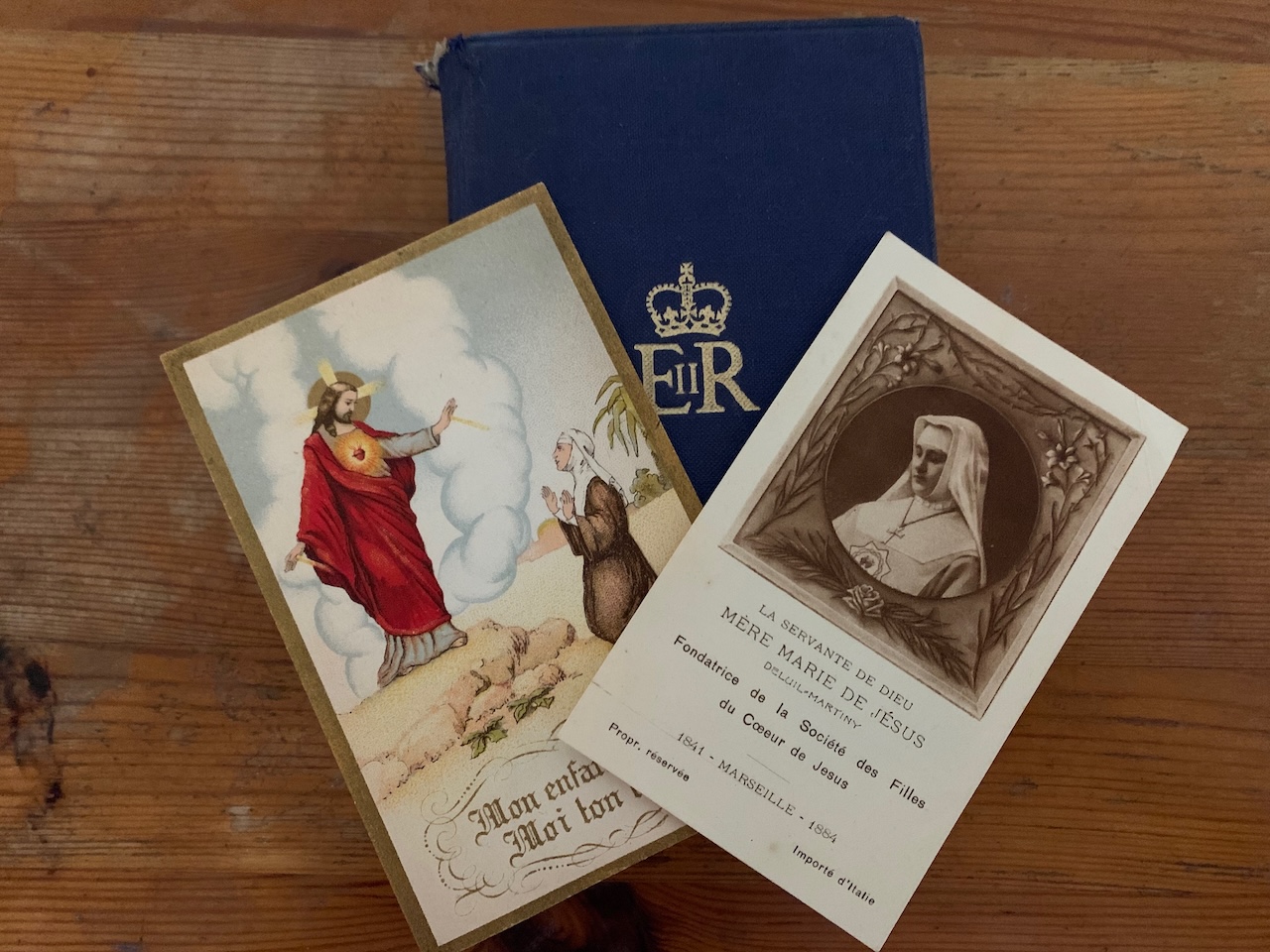
As a remarkable coincidence at the time of writing this series, whilst I was cleaning, I stumbled across the Bible of my grandmother on my mother’s side, Peggy Allen. My grandmother was sent away to boarding school at a Catholic convent in France when she was 12 years old. Tucked within the pages of her Bible I found two prayer cards relating to the Sacred Heart of Jesus.
The first features a prayer from Thérèse de l’Enfant Jésus called Au Sacré-Cœur with an image of the saint and Jesus showing His Sacred Heart. In England she is known as Therese of Liseux (1841 – 1884) ‘the Little Flower of Jesus’.
The other depicts Blessed Marie Deluil-Martiny (1841 – 1884) a French religious sister who was the Founder of Association of the Daughters of the Heart of Jesus. She was murdered in the convent by a gardener.
Although my grandmother was not religious when I knew her she was obviously familiar with the tradition of the Sacred Heart when growing up.
Might my draw to Gwyn’s Sacred Heart be partially based on ancestral memories?
The devotion to the Sacred Heart only reached popularity amongst Catholics in the 17th century and this was due to the influence of Margaret Mary Alacoque (1647 – 1690).
Margaret lived in France and entered a Visitation convent at Paray-le-Monial aged 24. There Jesus appeared to her four times revealing His love of humanity through visions of His Sacred Heart. These are recorded in her diary.
I. The Flaming Heart
In her first vision she reports that she reposed ‘upon His Sacred Breast’ and ‘for the first time, He opened to me His Divine Heart.’
Jesus said: ‘My Divine Heart is so inflamed with love for men, and for you in particular that, being unable any longer to contain within Itself the flames of Its burning Charity, It must spread them abroad by your means…’
This was followed by an exchange of hearts. ‘After this, He asked me for my heart, which I begged Him to take. He did so and placed it in His own Adorable Heart, where He showed it to me as a little atom which was being consumed in this great furnace, and withdrawing it thence as a burning flame in the form of a heart, He restored it to the place whence He had taken it.’
Jesus then said: ‘My well-beloved, I give you a precious token of My love, having enclosed within your side a little spark of its glowing flames, that may serve you for a heart and consume you to the last moment of your life… I now give you that (name) of the beloved disciple of My Sacred Heart.’ (20)
I relate to the imagery of the flaming heart because a few years ago I offered my heart to Gwyn on ‘the Altar of the Heart’ and it burst into flames and He told me that its fire would light the way to the worship of His family.
II. Wearing the Heart
Margaret’s second striking vision is the source of the representation of the Sacred Heart in Catholicism today: ‘The Divine Heart was presented to me in a throne of flames, more resplendent than a sun, transparent as crystal, with this adorable wound. And it was surrounded with a crown of thorns, signifying the punctures made in it by our sins, and a cross above.’
Margaret was told: “This Heart of God must be honored under the form of His heart of flesh, whose image He wanted exposed, and also worn on me and on my heart.’ (21)
This led to Margaret wearing and creating and distributing images of the Sacred Heart which after her death were used to ward off the plague in Marseilles.
This isn’t something Gwyn has called me do… yet…
III. First Friday Devotion
Jesus appeaerd again to Margaret with His breast like a furnace. ‘Opening it, He showed me His loving and lovable Heart as the living source of those flames. Then he revealed to me all the unspeakable marvels of His pure love, and the excess of love He had conceived for men from whom He had received nothing but ingratitude and contempt.’
To make up for their ‘ingratitude’ He asked her to ‘receive Holy Communion on the First Friday of each month’ and tells her that ‘every night between Thursday and Friday I will make you partaker of that sorrow unto death which it was My will to suffer in the Garden of Olives.’ (22) This is the source of the Catholic Holy Hour between 11 and 12 midnight every Thursday.
IV. The Feast of the Heart
In her fourth vision Jesus opens His heart to Margaret again and asks her to inaugurate ‘the first Friday after the octave of Corpus Christi’ as ‘a feast in honor of My Heart.’ This usually takes place in the month of June.
I was called to start celebrating a feast for Gwyn on the 29th of September over ten years ago and began with just one friend. Many Gwyn devotees celebrate His feast on this day and we hold a group rite at the Monastery of Annwn. I feel it is the power of Gwyn’s heartbeat that has drawn us together.
V. Disciple of the Sacred Heart
More controversially, when Margaret dedicated her life to Jesus, ‘she went to her cell, bared her breast, and, imitating her illustrious and saintly foundress, cut with a knife the name of Jesus above her heart. From the blood that flowed from the wound she signed the act in these words: ‘Sister Margaret Mary, Disciple of the Divine Heart of the Adorable Jesus’. (24)
Margaret’s visionary fervor and discipleship quickly spread following her death but the devotion to the Sacred Heart was not approved until seventy years later.
 The Sanctuary of Vindos