Food Noise, Noise, and Meditation

A few months ago, I learnt how the new weight loss jabs not only help people to lose weight but dampen ‘food noise’. I hadn’t heard of ‘food noise’ before and quickly found out that the term was coined in the 2000s and relates to ‘food-related intrusive thoughts’ – the constant chatter about food that goes on in a person’s mind even when they’re not hungry. I recognised it immediately as something I used to experience (along with ‘alcohol noise’) and still experience to a certain degree. It has been labelled in eating disorder communities as ‘the eating disorder voice’.

Other the past few years, I had worked out that my food and alcohol related thoughts were just a couple of the varieties of the many types of noise generated by my over-thinking mind and had learnt to quieten them with meditation. Thus, I was shocked and intrigued to find out that an injection can mimic the effects of a practice I had taken a number of years to develop and still struggle with. This got me researching how the weight loss jabs work and how they affect the same neural pathways that are affected by meditation.

The medications in the weight loss injections are called GLP-1 receptor agonists. They are synthetic variants of GLP-1, an essential gut hormone, which lowers blood sugar, reduces appetite, and brings about feelings of satiety. Variants include semaglutide (Ozempic and Wegovy) and tirzepatide (Mounjaro). 

When a person eats a meal, GLP-1 is released, and travels through the bloodstream and the vagus nerve to the brain, where it causes appetite suppression. It also goes to the pancreas, which produces insulin, lowering blood sugar. 

GLP-1 ‘effectively shuts down areas in the brain involved in feeding response, homeostatic controls, energy balance and decision-making about food—as well as the liking and wanting of food and impulsive behaviours associated with eating.’ Thus, it dampens cravings and food-related thoughts.

Researchers have identified that GLP-1 shuts down the Default Mode Network – the background setting of the brain which drives mind-wandering, ruminating on the past, planning for the future, and self-reflection. This is responsible for us getting stuck in negative thought loops and food-related thoughts.

Like GLP-1, meditation, which involves training the mind to concentrate on one object of thought of a time, also shuts down the Default Mode Network. It not only stops ‘food noise’ but all other types of noise as well. 

GLP-1 has also been shown to have an effect on the reward pathways that are not only associated with addiction to food but with other addictions. ‘Neurons that produce dopamine—a chemical with pivotal involvement in mo­tivation and pleasure—project to the nu­cleus accumbens, a midbrain structure im­portant for experiencing reward… Like other brain structures, the nucleus accumbens has GLP-1 receptors. Studies have shown that in ani­mals, dopamine release peaks after they eat a sweet meal of sucrose—and after they are exposed to cocaine or opioids.’ GLP-1 dampens this effect, meaning the peak to such rewards is no longer received, weakening these pathways.

Meditation strengthens our ability to recognise cravings as just thoughts and not to act on them, thus weakening the neural pathways of food addiction. Both could thus be helpful for people with binge eating disorder and bulimia.

It’s notable, here, that restrictive eating disorders, such as anorexia, re-wire the brain to get the dopamine hit from restricting food intake and / or over-exercising to lose weight. Meditation can also help with addiction to restricting and excessive exercise.

It has been shown that people who use weight loss injections usually gain weight afterwards if they do not continue to follow a healthy lifestyle. Combining taking a GLP-1 receptor agonist with learning meditative techniques can help people to lose weight and keep the weight off.

SOURCES

Cook, Geoff, Quieting “Food Noise”: How GLP-1s and Mindfulness Rewire the Default Mode Network (DMN) and Reward Circuits, NIH, https://pubmed.ncbi.nlm.nih.gov/41502834/
Young, Lauren, ‘Ozempic Quiets Food Noise in the Brain—But How?, Scientific American, https://www.scientificamerican.com/article/ozempic-quiets-food-noise-in-the-brain-but-how/
On the Need for Noise and the Stigma around Silence

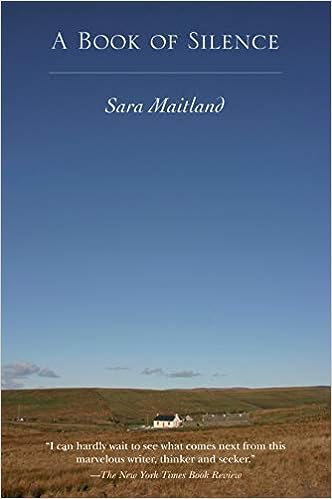
I have recently returned to Sara Maitland’s A Book of Silence and it has raised a number of thoughts about the need for noise and the stigma around silence in our current society. 

I first read this book in 2015 which was timely as had I ended up burnt out on noisy social media and attending noisy protests and learnt from this book that ‘noise’ shares the same roots as ‘noxious’ and ‘nausea’. 

Throughout my life I have struggled with noise. I was brought up in a bookish household and always preferred reading to the noise of the radio or television. When I started school I was horrified by the noisiness of the other pupils, always talking, shouting, preferred to play alone or flee to the silence of the library. I will never forget the time I first stayed over at another girl’s house. She had the television in her room on not only all evening but kept it on all night because she couldn’t sleep without it. I didn’t get a wink of sleep. When I was involved with horses I didn’t understand the need for the noise of a radio and was horrified by the people who left radios on for their horses in their stables all night based around their personal need for human noise. It’s only since giving up alcohol I have realised how much it played a role in my being able to tolerate the noise of being with groups of people at events and gatherings.

During my involvement with community groups and people in general I have noticed an awkwardness around silence and the need to fill it with noise. If someone is quiet or silent this is seen as a bad thing. Something is wrong. That person needs to be ‘brought out of themself’ – to be noisier.

This present need for noise is beyond my understanding and Maitland goes some way to explain it but I’d like to share first some of the questions she raises about the nature and definition of the opposite of noise – silence. 

Maitland notes that the OED dictionary of silence is the absence of noise and speech but notes also that silence can mean ‘without language’. Until I returned to this I had always thought of reading and writing as silent activities and of a library as a silent place. 

This then got me thinking about the spaces where we read. I have experienced social media, such as Facebook and Twitter, to be incredibly noisy. Discord too. Old style forums less so. My own room with a book quietist. So it seems here we are dealing with levels of noise grading down to quiet but perhaps not with silence itself if silence is indeed the absence of language.

I found Maitland’s personal conception of silence very interesting. She speaks of it as ‘a separate ontological category’ ‘not a lack of language but an otherness different from language. Not an absence of sound but the presence of something which is not sound.’ Silence is presence. ‘God is silence’.

Maitland is a Christian so her identification of God with silence is based on that tradition. Her words got me thinking about my own relationships with the Gods and how they relate to noise and language and silence. My patron God, Gwyn ap Nudd, is renowned for being quite noisy. He hunts the souls of the dead with a noisy pack of hounds and holds noisy revels at His feast. Like many other pre-Christian Gods and, really, all Gods (including the Judaeo-Christian God who is paradoxically silence yet He speaks His Word) Gwyn is known through language – through myth, through stories, through folklore. Yet, for me, He is both the storm of the hunt and the calm in the midst of the storm. He encourages me to spend time in silent meditation, focusing purely on my breath or on the sights and sounds in nature around me.

Maitland goes on to say our ‘desire to break the silence with constant human noise is… an avoidance of the sacred terror of that divine encounter’. It is a flight from ‘the Great Chthonic Terror’. We have attempted to defeat silence not by magic but ‘our rules – our own laws not the gods… enshrined in language.’

I agree that much of our need for noise and the stigma around silence is a flight from the divine, from the bigger than us, from what terrifies us. We break the silence because we are afraid of the Deities who might break us. 

Maitland’s ‘otherness’ and ‘Great Chthonic Terror’ I am tempted to identify with the Annuvian, the ‘Very Deep’, the unknown and unspeakable domain of the 80% of the universe that is dark matter and the unused 90% of our brains.

Maitland notes that silence has long played a strong role and initiatory function within various spiritual and religious traditions particularly for monastics. She speaks of her three year period in silent seclusion at Weardale as ‘a novitiate’ and of herself as a ‘silence novice’. 

As a nun of Annwn I have been led to cut down on noise and spend more time in quiet engagement with language reading and writing or in silence. Contrary to the stigma this has been massively beneficial to my mental health.