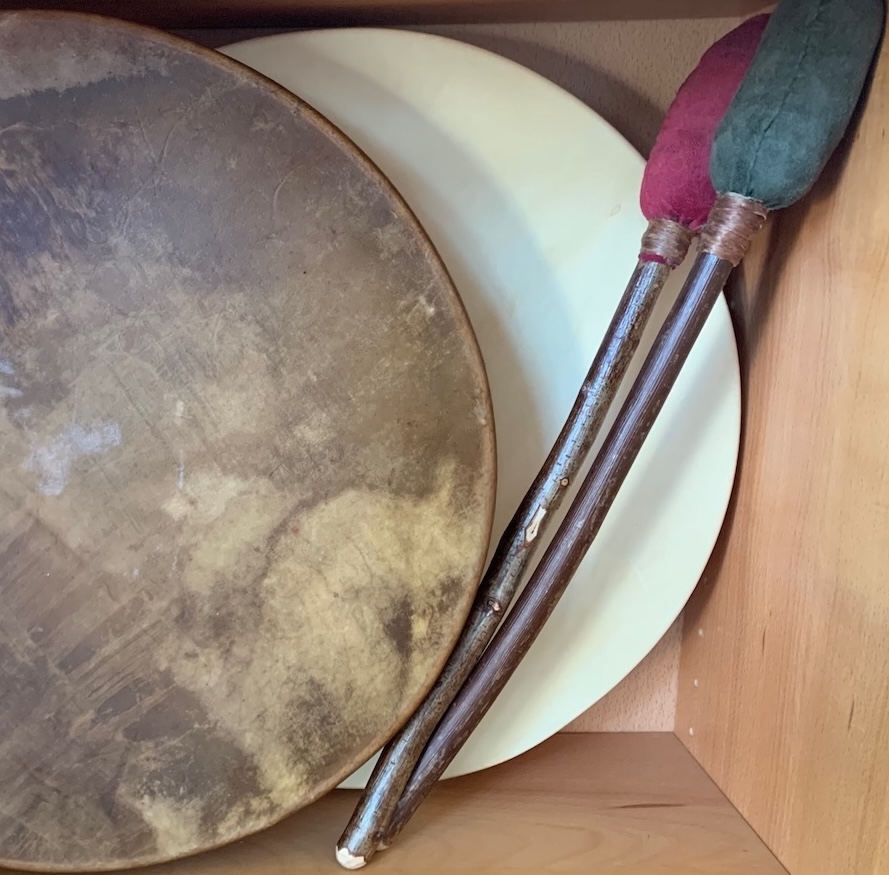
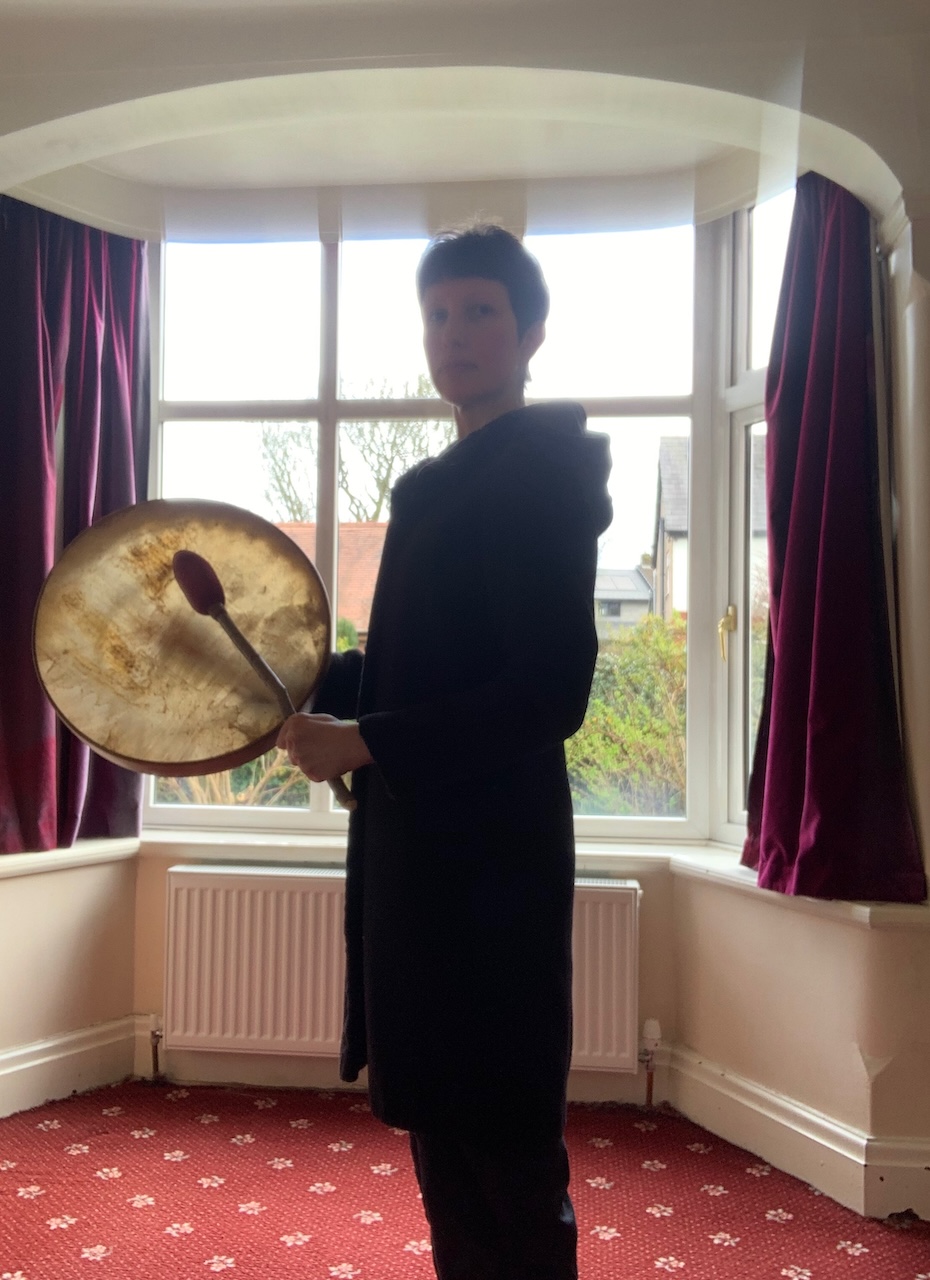
Sanctuary Shamanic Circle

ONLINE

Second Tuesday of the month 1 – 2pm
Third Wednesday of the month 10 – 11am

Entry FREE (donations optional)

~Learn about shamanism in a safe inclusive space.
~Explore the spirit worlds and build relationships with spirit guides.
~Journey for yourself and others for guidance and healing.
~Work with the fae and British Gods and Goddesses.
~Become part of a like-minded community.
~Experience spiritual growth and personal transformation.

For further details contact: sisterpatience22@gmail.com

The Return of the Hooded Man

Oh Hooded Man, my old friend,
what have you come to say?
In solitude and silence cloaked
dark and familiar on a spring day?

~

After two years of solitude focusing on my writing my shamanic work has led me out into the community again. I’ve really enjoyed guiding individuals and groups into the Otherworlds in one-to-one sessions and shamanic circles. Offering shamanic healings is magical work that fits perfectly with my calling as a nun of Annwn dedicated to Gwyn and makes my soul sing.

However, I’ve discovered that, as an autistic person and introvert who needs a set routine (my natural circadian rhythyms work best on 4.30am get-ups and 8.30am bed times) I can only cope with such intense interpersonal interaction in the daytime. I tried shifting my timings half an hour to 5am and 9pm to make it easier to attend and run groups in the evenings. Yet when I did, I found I was getting overstimulated, unable to sleep, then when I slept, waking up early with my mind whirring desperately trying to process the events. As a knock-on effect I was coming to dread late groups and that was causing additional sleep loss. Running a shamanic circle each month locked me into a monthly cycle of anxiety and sleep deprivation. Thus, although it was sad, it was also a relief when due to not having enough numbers to pay for the room, I was forced to close Penwortham Shamanic Circle. 

As an alternative to evenings I thought about running weekend groups as I wanted to provide opportunities to practice shamanism to working people. As an experiment I tried attending a seasonal creative workshop on a Sunday but in spite of it being really thoughtfully put together and well run struggled with the shift in routine. It made me realise how much I need weekends after working with clients during the week. Once-upon-a-time my Saturday wind-down was drinking a bottle of wine and writing drunken poetry but more recently I’ve replaced that with playing the heartbeat of Annwn for Gwyn for an hour then entering deep relaxation through an hour of body scan meditation or Yoga Nidra. This provides me with a much-needed nervous system resest before I spend Sunday continuing to recharge by praying, meditating, cleaning and going for a local walk or a swim. Attending an event on a Sunday made me stressed all Saturday and unable to benefit from my wind-down then resentful on Sunday as I couldn’t have my alone time. This made me realise that weekends aren’t going to work for me either.

I’ve been trying to force myself to do things against need for solitude and routine for several reasons. One is that I have been trying to follow as role models shamanic practitioners who have succeeded in making a living from their work by running evening shamanic circles and weekend workshops. Another is, although I’m not naturally a community builder, I have mistakenly stepped into the role of attempting to build community in the hope this will establish a foundation for my one-to-one work. The last is financial insecurity – feeling that if I can provide more opportunities for more people I will be more likely to make a living from my shamanic services.

By trying to copy others I’ve not only gone against my own nature but forgotten there are other models available. In the Brythonic tradition the awenyddion ‘people inspired’ (our native soothsayers / spiritworkers / shamans) appear to be hermits, edge dwellers, who were occasionally consulted by the community for prophecies spoken through possession by spirits. One of my spirit guides, who I consider to be an ancestor of spirit, Orddu, lived alone in a cave in Pennant Gofid ‘the Valley of Grief’ in ‘the uplands of Hell’ and was referred to as a gwrach ‘witch’ likely on account of her practicing spiritwork / shamanism inspired by Gwyn and the spirits of Annwn. Myrddin Wyllt is another prophetic figure who lived a hermitic life as a wildman in the forest of Celyddion and only occasionally appeared to prophecy.

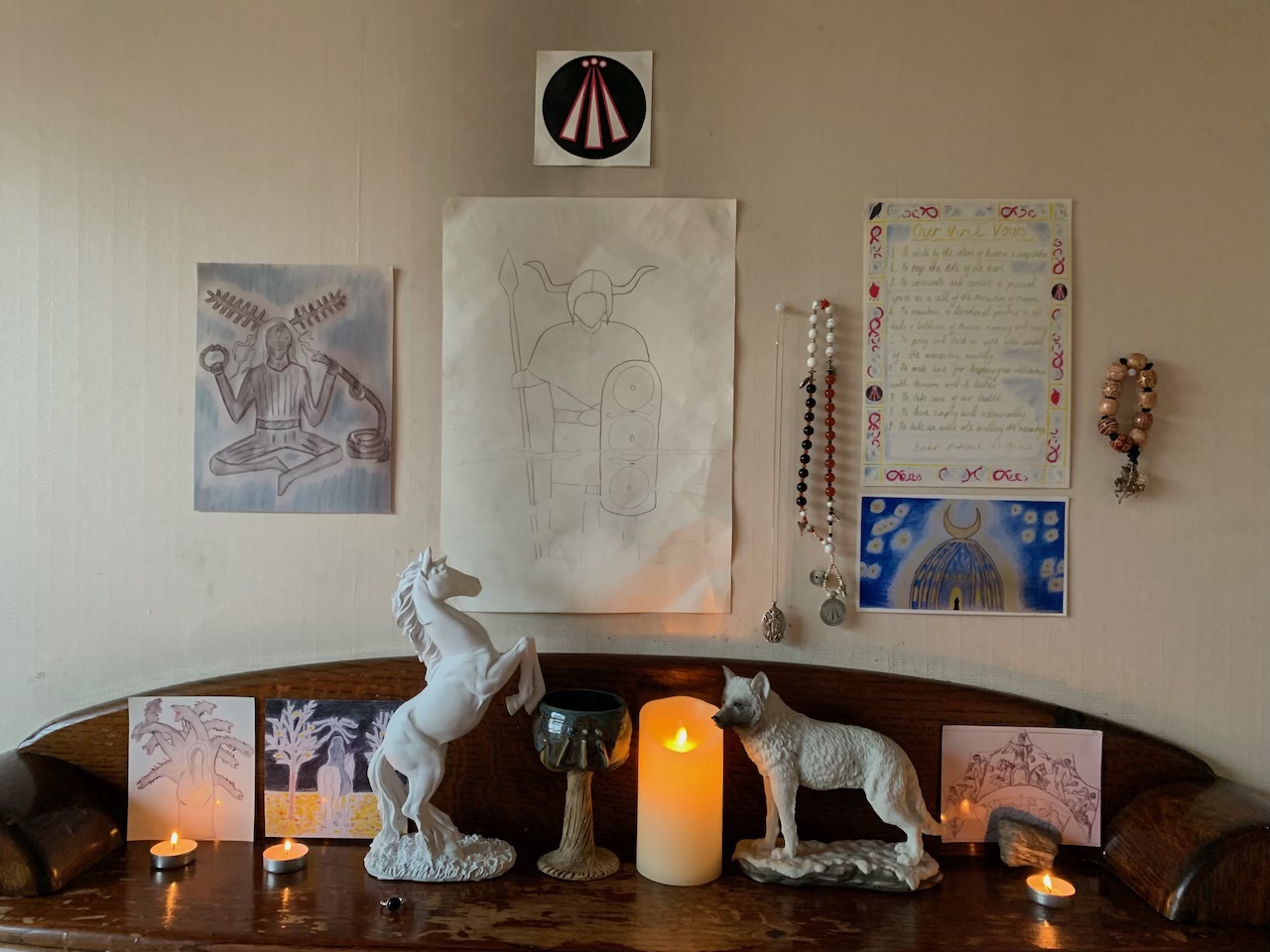
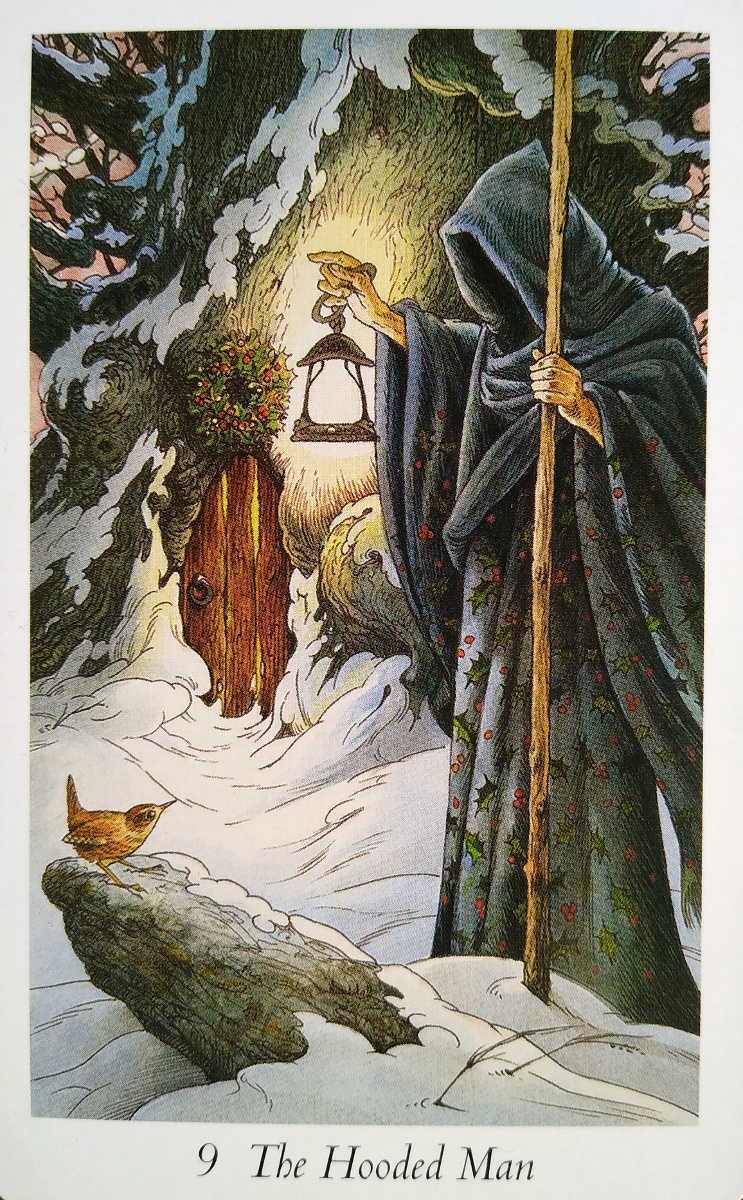
I have a print-out of the Hooded Man from the Wildwood Tarot on my wall to remind me to honour my need for solitude. He’s been absent from my tarot readings of late and it’s unsurprising he has reappeared at this point in time. I have taken this as a sign that I need to better balance my monastic need for solitude and routine with my outward-facing vocation of doing shamanic work.

The Gift of Shamanism

The gift of shamanism lies in each and every one of us. It’s a gift from the Gods, from the spirits, from the spirit world. Over the past six months I have been gifting my time and energy to help others access this magical gift.

As part of my training towards becoming a shamanic practitioner I offered a course of six one-to-one weekly ‘Introduction to Shamanism’ sessions to newcomers covering journeying safely in the Lower World, Upper World and Middle World and meeting animal spirit guides and spirit teachers. I also covered the basics of shamanic healing. 

It’s been a gift for me to watch others grow from having little to no knowledge of shamanism and doubts about their ability to journey to making their first connections with their guides and beginning to explore the spirit world.

I have witnessed eight people begin to find their ways around the worlds and build relationships with their guides in ways that have been fun, loving and spine-tinglingly powerful. The process has been moving and surprising as I’ve come to see the spirit world in new ways through other people’s eyes and observed their tenacity and the ingenuity of the answers from their helpers.

Each six-week long journey has had its own magic and been healing in its own right. Each person has met guides in each the worlds and has the confidence and ability to journey alone and to access basic healing from the spirits.

Shamanism is our birth right and it has been near-lost to the British Isles since the coming of Christianity and its denegration of our native Gods and spirits as devils and more recently the hegemony of the reductivist worldview wherein spirits are not seen to exist, which has led to industrialism and capitalism.

It cheers me greatly that so many people in my local area from different walks of life are interested in shamanism and are claiming this innate gift back.

With my eight case studies complete I am offering my six week ‘Introduction to Shamanism’ at student rates (£15 per hour or £70 for six) HERE.

To read the testimonials from my volunteer clients click HERE.

A Nun with a Drum – Contemplating being a Lay Monastic

They strive to lead their lives in the world but not of the world
~ Carmelite Sisters of the Most Sacred Heart Los Angeles

When I took my monastic vows as a nun of Annwn in October 2022 I was leading a very solitary life centring on devotion to my Gods and on my writing. My only connections with the outside world were online – with fellow members of the Monastery of Annwn and with the Pagan and Polytheist blogosphere. 

Things changed after I realised my book, The King of Annwn, wasn’t destined to be professionally published and I received the gnosis I must give my ambition to be a professional writer up for good. 

In spring 2024 in a shamanic journey I was shown I must ‘re-root the monastery’. It took me a while to work out what that meant. I took it literally and tried returning to horticultural volunteering but ran into physical limitations with knee problems and Raynaud’s.

I also began training as a shamanic practitioner and have now realised that is where my true calling lies. Over the past six months I have been providing shamanic guidance and running shamanic circles in my local community and have recently begun to offer shamanic healings. 

In some ways that I’m able to go out and work shamanically with individuals and groups of people has come as a surprise as I’m autistic and an introvert and usually find social interaction draining. In other ways it hasn’t because from the very first time I did a shamanic journey I felt a sense of potency and calling and a deep connection with the spirit world that I wanted to share.

Fifteen years since that first shamanic journey, following completing my apprenticeship to my patron God, Gwyn, a ruler of Annwn, the Brythonic Otherworld), I have finally proved ready to guide and heal others.

This has opened the possibility of leading a more outward-facing life than I guessed when I first took my vows. Of serving not only the Gods but other people.

For this I’ve looked for inspiration to other groups of monastics and have found my deepest sense of kinship with the Lay Carmelites. This an order of the Discalced Carmelites who were founded by St Teresa of Avila in 1562. 

Their charism is contemplative prayer, community, and ministry. Their rule of life is characterised by six obligations: meditation, morning and evening prayer, mass, Mary, meetings, mission. (1)

These come very close to what included in the Monastery of Annwn nine vows: keeping morning and evening prayers to the Gods and Goddesses of Annwn, deepening our relationships with Them through prayer, meditation and trance, checking in and praying with other members, and building the monastery. (2)

I particularly like what the Carmelite Sisters of the Most Sacred Heart Los Angeles have to say about secular Carmelites being those who are called to ‘devotion to prayer’, ’an intimacy with Jesus Who dwells within the soul’, a ‘heart-to-heart encounter with God’ and cultivating a ‘friendship’, ‘a conversing’, a ‘listening to Him which becomes the normal way of life.’ (3)

This fits with my striving to make all my daily activities offerings to Gwyn with my shamanic work fitting so well with Him being a God of the Otherworld. 

They also refer to Lay Carmelites being ‘In the world but not of the world.’ (4) That also fits with my life being centred around my Gods first and foremost rather than on money, career or social life, with my service to other people being one of the ways I serve my Gods.

I’m now two-and-half years into living by vows and am now contemplating the possibility that when I take my lifelong vows in autumn 2026 they might be as a lay nun as opposed to a nun who is leading a near-hermitic life.

“You’re a nun with a drum,” Gwyn told me when I asked if I could bring monasticism and shamanism together. His joking words now summarise my path.

(1) ‘The 6 M’s on being a Carmelite’, Life as an OCDS Carmelite, https://ocds-carmelite.blogspot.com/2009/01/6-ms-on-being-carmelite.html
(2) ‘Our Nine Vows’, The Monastery of Annwn, https://themonasteryofannwn.wordpress.com/our-nine-vows/
(3) ‘Can a Lay person be a Carmelite?’, Carmelite Sisters of the Most Sacred Heart Los Angeleshttps://carmelitesistersocd.com/2013/lay-carmelite/
(4) Ibid.

Autism and Coping with Overload

Introduction

Over the past few years, since my late diagnosis of autism in 2021, I have been researching its affects on the brain, body and nervous system in order to gain a deeper understanding of the ways being autistic has impacted my life. 

Looking back it has brought many benefits such as being incredibly focused on my special interests, creativity, intuition and the ability to think outside the box. However it has also has its costs. My struggles with sensory and information overload have made it impossible to hold a regular job and being unable to handle publicity played a role in my failing to make a living from my writing.

This led me to seeing myself as a failure and not understanding why. My autism diagnosis coupled with more recent learnings has revealed the reasons I find everyday life overwhelming and helped me develop better coping strategies. I’m sharing my insights here in the hope they will help others.

What is autism?

The term ‘autism’ was coined by psychiatrist Eugen Bleuler in 1911. It is composed of the Greek autós ‘self’ and ism ‘a doctrine or theory’ and was used ‘to describe a schizophrenic patient who had withdrawn into his own world.’ (1)

It was first used as a diagnostic category in 1943 in a paper by a physician called Leo Kanner in a paper titled ‘Autistic Disturbances of Affective Contact.’ Here he speaks of eleven children with shared symptoms –  ‘the need for solitude; the need for sameness. To be alone in a world that never varied.’ (2)

The Diagnostic and Statistic Manual of Mental Disorders 5 uses two criteria  to diagnose autism – ‘Persistent deficits in social communication and social interaction’ and ‘restricted, repetitive patterns of behavior, interests, or activities.’ (3)

Part One: The Causes of Overload

Autism and Neurodevelopmental Differences in the Brain

Autism is a neurodevelopmental disability that has its basis in differences in the brain that began developing in utero. In The Autistic Brain autistic authorTemple Grandin speaks of some of the ‘anomalous growth patterns’ that she has discovered in her brain through neuro-imaging and how these relate to her life experiences. She tells us that her ‘cerebellum is 20 percent smaller than the norm’ explaining her lack of balace and motor coordination. (4) Her left ventricle is 57 per cent longer than her right extending into her parietal cortex – a disturbance which she associates with her poor working memory and lack of maths skills. Having more connections between her inferior fronto-occipital fasciculus (IFOF) and inferior longitudinal fasciculus (ILF) explains her excellent visual memory.

Most interestingly for me she notes: ‘My amygdalae are larger than normal. The mean size of the three control subjects’ amygdalae was 1,498 cubic millimeters. My left amygdala is 1,719 cubic millimeters, and my right is larger still — 1,829 cubic millimeters, or 22 percent greater than the norm. And since the amygdala is important for processing fear and other emotions, this large size might explain my lifelong anxiety… Enlarged amygdalae are also often seen in people with autism. Because the amygdala houses so many emotional functions, an autistic can feel as if he or she is one big exposed nerve.’ (5) 

I found this incredibly relatable as my sensory sensitivities and emotional responses to them have often made me feel like ‘one big exposed nerve’ too. Likewise my fear of being overwhelmed by sensations and emotions and having shutdowns and meltdowns has resulted in struggles with anxiety. These insights inspired me to learn more about the amygdala and its function.

The Amygdala and Emotional Responses

An excellent description of how sensory experience is processed and delivered to the amygdala and how this brings about an emotional response is provided by Bessel van der Kolk in The Body Keeps the Score. 

‘Sensory informationabout the outside world arrives through our eyes, nose, ears, and skin. These sensations converge in the thalamus, an area inside the limbic system that acts as the “cook” within the brain. The thalamus stirs all the input from our perceptions into a fully blended autobiographical soup, an integrated, coherent experience… The sensations are then passed on in two directions—down to the amygdala, two small almond-shaped structures that lie deeper in the limbic, unconscious brain, and up to the frontal lobes, where they reach our conscious awareness… The central function of the amygdala, which I call the brain’s smoke detector, is to identify whether incoming input is relevant for our survival… If the amygdala senses a threat… it sends an instant message down to the hypothalamus and the brain stem, recruiting the stress-hormone system and the autonomic nervous system (ANS) to orchestrate a whole-body response. Because the amygdala processes the information it receives from the thalamus faster than the frontal lobes do, it decides whether incoming information is a threat to our survival even before we are consciously aware of the danger. By the time we realize what is happening, our body may already be on the move.’ (6)

Van der Kolk not only describes brilliantly how the amygdala brings about our emotional responses but explains why we respond to situations which are threatening or overwhelming with extreme reactions such as outbursts of anger, panic attacks and in the case of autistic people meltdowns and shutdowns before the conscious mind comes on board. 

Intense World Syndrome

Van der Kolk links his insights into the amygdala to responses to trauma and in particular to PTSD. These connections also seem valid for autistic people for whom living in a world of sensory and information overload can be traumatic.

This is described in the ‘Intense World’ paper, published in 2007, as ‘intense world syndrome’. The authors say ‘excessive neuronal processing may render the world painfully intense’ resulting in autistics retreating ‘into a small repertoire of secure behavioral routines that are obsessively repeated.’ ‘Impaired social interactions and withdrawal may not be the result of a lack of compassion, incapability to put oneself into someone else’s position or lack of emotionality, but quite to the contrary a result of an intensely if not painfully aversively perceived environment.’ (7) For an autistic person sensory overload is traumatic and leads to them withdrawing from the world.

Sensory Gating Deficits

Another factor relating to overload in autistic people is differences in sensory gating. In Plant Intelligence and the Imaginal Realm Stephen Buhner describes ‘sensory gating channels… as tiny apertures or gates or doors in specific sections of the nervous system’s neural network… like a series of locks on the river of incoming sensory flows.’ (8) He speaks of how, as we grow up, these channels, for most people, narrow and close. Those with ‘gating deficits’ (such as autistics) remain open and they are more likely to suffer from sensory overload which can lead to ‘a breakdown in cognitive integrity.’ (9) 

Part Two: Coping with Overload

Self-Awareness and Befriending Inner Experience

In The Body Keeps the Score van der Kolk describes methods of coping with trauma that can also be harnessed by autistics to help cope with extreme emotional responses to sensory overload. Fundamental is restoring the balance between the rational and emotional brains, the pre-frontal cortex ‘the watch tower’ and the amygdala ‘the smoke detector’ or ‘alarm system.’

He says: ‘the only way we can consciously access the emotional brain is through self-awareness, i.e. by activating the medial prefrontal cortex, the part of the brain that notices what is going on inside us and thus allows us to feel what we’re feeling… and learning to befriend what is going inside ourselves.’ (10)

He tells us that ‘those who cannot comfortably notice what is going on inside become vulnerable to respond to any sensory shift either by shutting down or by going into a panic—they develop a fear of fear itself… The price for ignoring or distorting the body’s messages is being unable to detect what is truly dangerous or harmful for you and, just as bad, what is safe or nourishing. Self-regulation depends on having a friendly relationship with your body. Without it you have to rely on external regulation—from medication, drugs like alcohol, constant reassurance…’ (11)

Van der Kolk here describes my personal experiences perfectly. For most of my life I’ve been alienated from my body and the confusion of sensations and emotions that it throws at me and I’ve always felt out of control. Due to not being self-aware I have struggled in social situations with family, friends and work colleagues due to not being able to read people or control my reactions. I’ve been subject to outbursts of anger and panic attacks and depended on alcohol to tolerate socialising and to down-regulate afterwards. 

Becoming more self-aware and befriending my inner experiences has led to a more conscious and caring attitude towards my body and to feeling more in control.

Movement and Meditation as Medicine

Van der Kolk tell us: ‘If you want to manage your emotions better, your brain gives you two options: You can learn to regulate them from the top down or from the bottom up… Top-down regulation involves strengthening the capacity of the watchtower to monitor your body’s sensations. Mindfulness meditation and yoga can help with this. Bottom-up regulation involves recalibrating the autonomic nervous system. We can access the ANS through breath, movement, or touch.’ (12)

He says: ‘In contrast to the Western reliance on drugs and verbal therapies, other traditions from around the world rely on mindfulness, movement, rhythms, and action. Yoga in India, tai chi and qigong in China, and rhythmical drumming throughout Africa are just a few examples. The cultures of Japan and the Korean peninsula have spawned martial arts, which focus on the cultivation of purposeful movement and being centered in the present… These techniques all involve physical movement, breathing, and meditation.’ (13)

Van Der Kolk’s words really resonated with me because I have have been led my a combination of guidance and intuition to these practices. When I was diagnosed with anxiety in 2004 I was put on Venlafaxine and advised to take up exercise. I started going to the gym and learning a martial art – Taekwondo. Both forms of movement have helped me to regulate my stress levels. 

Since then physical exercise has been a massive help in self-regulating. I’ve been through periods of long-distance walking and running, practicing martial arts, cycling and my current passion is strength training.

Meditation is something I’ve found much harder. As someone who is incredibly imaginative and has a busy mind I’ve always been good at visualisation meditations but meditation in the more traditional sense of focusing on one thing or simply witnessing thoughts has been more difficult. 

I dismissed these practices as ‘Eastern’ and ‘not for the Western mind’ until I started practicing yoga in 2023 as a result of a sports injury and advice from my PT. One of my teachers, Bre, of Breathe and Flow, said if we find something difficult it’s often the thing we need most. So it was with yogic meditation.

As I have persevered I have found that focused meditation helps slow down my thoughts and calm my mind and training my witness helps prevent me from become so caught up in overwhelming sensations and emotions.

Disovering that by changing our breathing patterns through breathwork I can also change my emotions and my thoughts has been a life-changer.

Rhythmic drumming has also been helpful. As someone who has been practicing shamanism for many years being able to use various drumbeats such as the journeybeat to shift into trance and a slow heartbeat to calm my nervous system have helped me to cope with being overwhelmed.

Moving Up and Down the Polyvagal Ladder

Another discovery that has changed my life is learning about polyvagal theory. I first came across this on a Radical Embodiment course with my supervisor Jayne Johnson and Alex Walker. Introduced by Stephen Porges in 2004 it posits three states of the nervous system – social engagement (ventral vagal), flight or fight (sympathetic) and freeze (dorsal vagal). 

Coming to understand and be aware of these states has aided me to become able to move through them. When I feel anxiety and a shift towards flight or fight checking in with my nervous system to see what it needs to feel safe. When I feel myself getting burnt out and moving towards shutdown / freeze cutting down on social activities and taking time alone to rejuvenate.

Mastering the Gates

Buhnen mentions that having open sensory gating is not always a bad thing. In face ‘gating remains very open, especially among young children, artists, schizophrenics and specialists of the sacred such as shamans and Buddhist masters, and those ingesting psychotropics.’ (14) ‘In cultures that recognize the importance of this capacity, this group of people are trained to use their enhanced perceptual capacities for the benefit of the group.’ (15)

He speaks of how we can intentionally shift gating by ‘1) having a task that demands a greater focus on incoming sensory data flows, or 2) regenerating a state similar to that which occurred during the first few years of life, or 3) by altering the nature of the gating channels themselves by shifting consciousness.’ (16)

Focusing on a single task, whether it’s writing a poem or article, gardening, or lifting weights, has always been a great way of staying present and not getting overwhelmed by troubling sensations and emotions. Over the years training in both shamanism and meditation has enabled me to get better at recognising and shifting between states of consciousness. 

A yogic practice that I began learning in August last year on a course in meditation with the Mandala Yoga Ashram has been particularly helpful. This is Antar Mouna ‘Inner Silence’. In the first stage you focus on sensations – sound, touch, inner sight, taste and smell. You practice focusing on, for example, louder sounds, softer sounds, all the sounds, then shifting to touch, then all the sensations at once so you’re in a sea of sensations. Fundamental is not attaching any place or meaning to the sensations but simply experiencing them as they arise in themselves. I believe this to be a form of mastering sensory gating. It has been very useful in helping me to shift my attention away from and be less bothered by noise from my neighbours.

Slowing the World Down

So far I’ve mentioned things autistic people can do to cope with overload. It would also be of benefit if the world was a less overwhelming place. Grandin cites autistic author Donna Williams: ‘the constant change of most things never seemed to give me any chance to prepare myself for them… Stop the world, I want to get off…  stop the world, at least slow it down… The stress of trying to catch up and keep up… often became too much and I found myself trying to slow everything down and take some time out.’ (17)

Like Williams I’ve also found it difficult to keep up, in the workplace, in the blogosphere, on social media with quicker and quicker platforms appearing. As the world is not slowing down I’ve been left with no choice but to get off. I’ve abandoned hope of regular work, left social media, and cut down from reading around 50 different blogs and websites to a small select few.

Monasticism – Embracing Withdrawal

When Bleuler defined autism he depicted withdrawal into oneself as a disorder. Withdrawal is often associated with mental health issues and withdrawn persons are invariably encouraged to ‘come out of themselves’.

In contrast to this, within monastic traditions, withdrawal from the world is advocated as a positive movement and a necessary condition of attaining greater self-knowledge and knowledge of the Gods and of the universe.

For me being able to withdraw, having a safe home, a room I have made into a sanctuary, being able to spend time in prayer and meditation with my Gods and guides is essential for enabling me to go out into the world and do the shamanic work in person and online I eventually hope to make a living from.

I believe the world would be a better place if there were more quiet spaces, more sanctuaries, more monasteries to provide the opportunity for withdrawal. If withdrawal was embraced and not pathologised.

Shamanic and meditative techniques are time-tested methods of dealing with overload and trauma and it is in helping others to practice them and providing safe spaces to do so that is where my current passion lies as a nun of Annwn.

Footnotes

(1) https://www.news-medical.net/health/Autism-History
(2) Grandin, Temple; Panek, Richard, The Autistic Brain, (Ebury Publishing, 2014), p12
(3) Ibid., p121
(4) Ibid., p36
(5) Ibid., p41 – 42
(6) Kolk, Bessel van der. The Body Keeps the Score, (Penguin Books, 2014), p60 – 61
(7) Grandin, Temple; Panek, Richard, The Autistic Brain, (Ebury Publishing, 2014), p97 – 100
(8) Buhner, Stephen Harrod. Plant Intelligence and the Imaginal Realm, (Inner Traditions, 2014) p31-33
(9) Ibid. p 33
(10) Kolk, Bessel van der. The Body Keeps the Score, (Penguin Books, 2014), p206
(11) Ibid, p97
(12) Ibid., p63-64
(13) Ibid., p207-208
(14) Buhner, Stephen Harrod. Plant Intelligence and the Imaginal Realm, (Inner Traditions, 2014), p48
(15) Ibid. p43
(16) Ibid. p59
(17) Grandin, Temple; Panek, Richard, The Autistic Brain, (Ebury Publishing, 2014), p98
The Sanctuary of Sister Patience

In September during our Monastery of Annwn celebration of Gwyn’s Feast I received a missive in the meditation wherein we joined Gwyn feasting in His hall. One of His hounds approached me with a scroll in his mouth. I unrolled it and read the words ‘The Sanctuary of Sister of Patience’. I was then instructed to step up to Gwyn’s cauldron, dip a pen in it, then sign the scroll in blue and red with ‘the Blood of the Dead and the Waters of the Deep.’ 

Thus I signed a contract to create the Sanctuary of Sister Patience. So here it is. Founded on the Cell of Sister Patience. A stepping stone towards building the Monastery of Annwn. 

Right now it is the sacred spaces I keep for my Gods at home and here online. It also the sanctuary I carry within me when I facilitate meditations and rituals for the monastery and one-to-one and group shamanic sessions.

Long term I would like to find a physical place to set up a sanctuary where people can come to pray, meditate and journey with a healing room for shamanic healings.

As a final note I would like to acknowledge the inspiration of Danica Swanson at the Black Stone Sanctuary who opened the sacred doorway to polytheistic monasticism to me.

The Chasing of Rhiannon and the Nature of Horse

Tonight I’m giving a talk on animal spirit guides for a local group. One of the topics I am covering is what the story of the Chasing of Rhiannon can teach us about the nature of Horse and ways of approaching Horse and the Gods and spirits in general. I’m also sharing it here.

Rhiannon is the medieval Welsh name of the ancient British Horse Goddess Rigantona ‘Great Queen.’ She appears in the The First Branch of The Mabinogion. This is my retelling of the episode of Her first meeting with Pwyll, Prince of Dyfed.

Pwyll goes to sit on Gorsedd Arberth, a sacred mound in Pembrokeshire, where it is said that if you sit there all night you will either get injured or see something wonderful. Pwyll sits the long night through and at dawn, luckily for him, he sees something wonderful – a beautiful woman in a shining golden dress of brocaded silk on a big, tall, pale white horse. 

As she rides away Pwyll says to one of his men, “Quick, go after her!”

He runs and he runs and he runs but he cannot catch her. 

“Quick, get on a horse!” 

He rides and he rides and he rides but he cannot catch her because the faster he rides the further she gets away and finally she disappears over the horizon and is gone.

Pwyll is bitterly disappointed yet, determined to see her again, he sits on the mound a second night. And at dawn she appears again – a beautiful woman in a shining golden dress of brocaded silk on a big, tall, pale white horse. 

As she rides away Pwyll says to his best rider on his fastest horse, “Quick, go after her!’

He rides and he rides and he rides but he cannot catch her because the faster he rides the further she gets away and finally she disappears over the horizon and is gone.

Pwyll is even more disappointed, yet determined to catch her the next time, he sits on the mound a third night. And at dawn she appears again – a beautiful woman in a shining golden dress of brocaded silk on a big, tall, pale white horse.

As she rides away this time Pwyll himself goes after her on his fastest horse. He rides and he rides and he rides but he cannot catch her because the faster he rides the further she gets away. 

Just as she is about to disappear over the horizon, he shouts, “Maiden, for the sake of the man you love, wait for me.” 

She stops, turns. “I will wait gladly,” she says, “it would have been better for the horse if you had asked a while ago.” 

When Pwyll catches up to her, she draws back her veil, reveals her name, “Rhiannon.”

This story might firstly be seen to relate to Horse as a prey animal. If we chase a horse it will always run faster than us, the faster we chase, getting further away. If we stop, speak quietly, it too will stop, turn, be curious, approach, reveal to us its unique nature.

On another level it relates to the elusive nature of the Horse Goddess and to the Gods and spirits in general. Often, if we chase too hard, try too hard, they evade us. If we stop, ask direct questions, They will turn, respond, reveal Their identities and names.

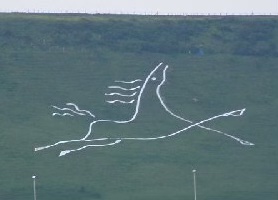
Folkestone White Horse (Wikipedia Commons)

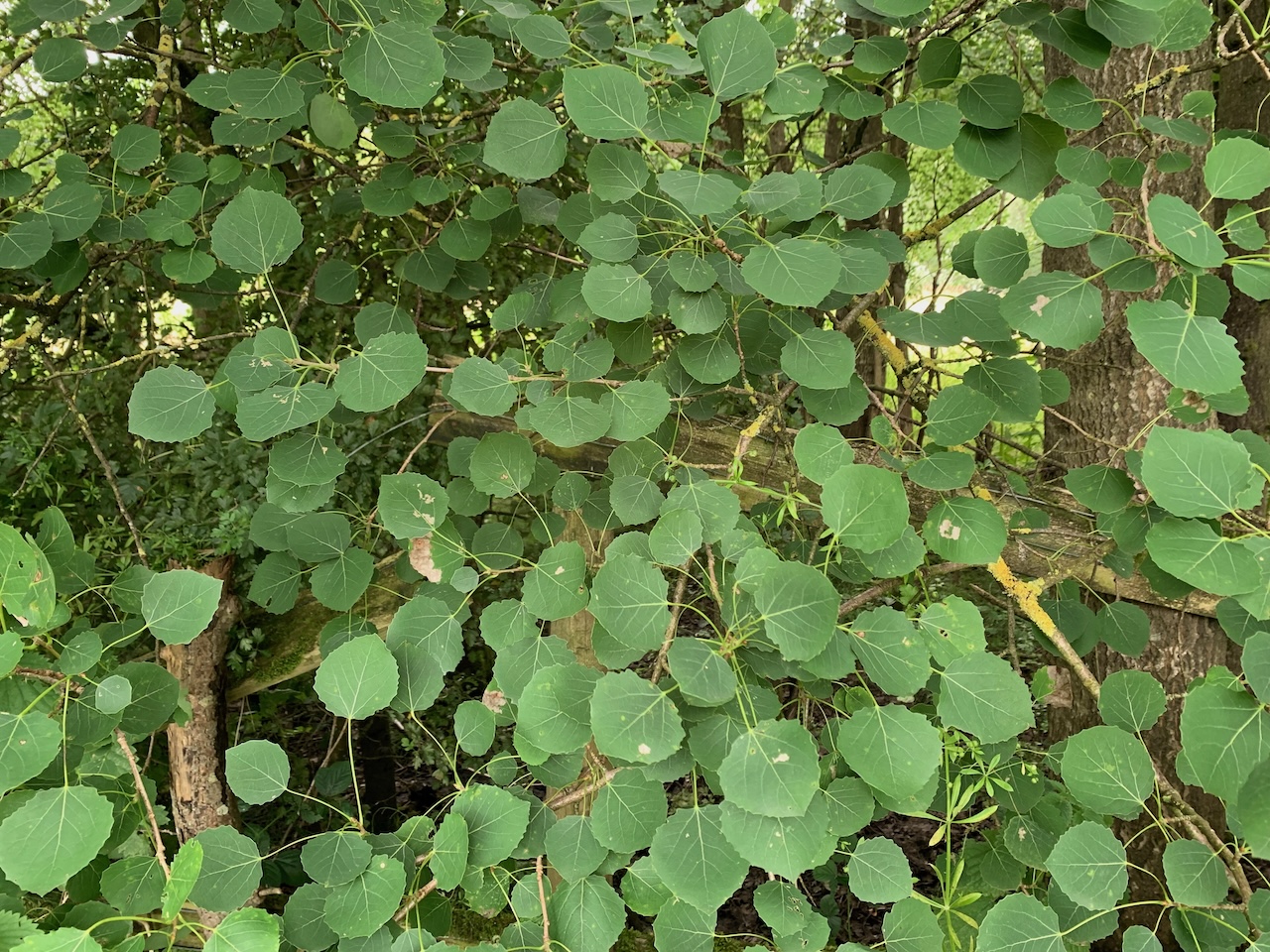
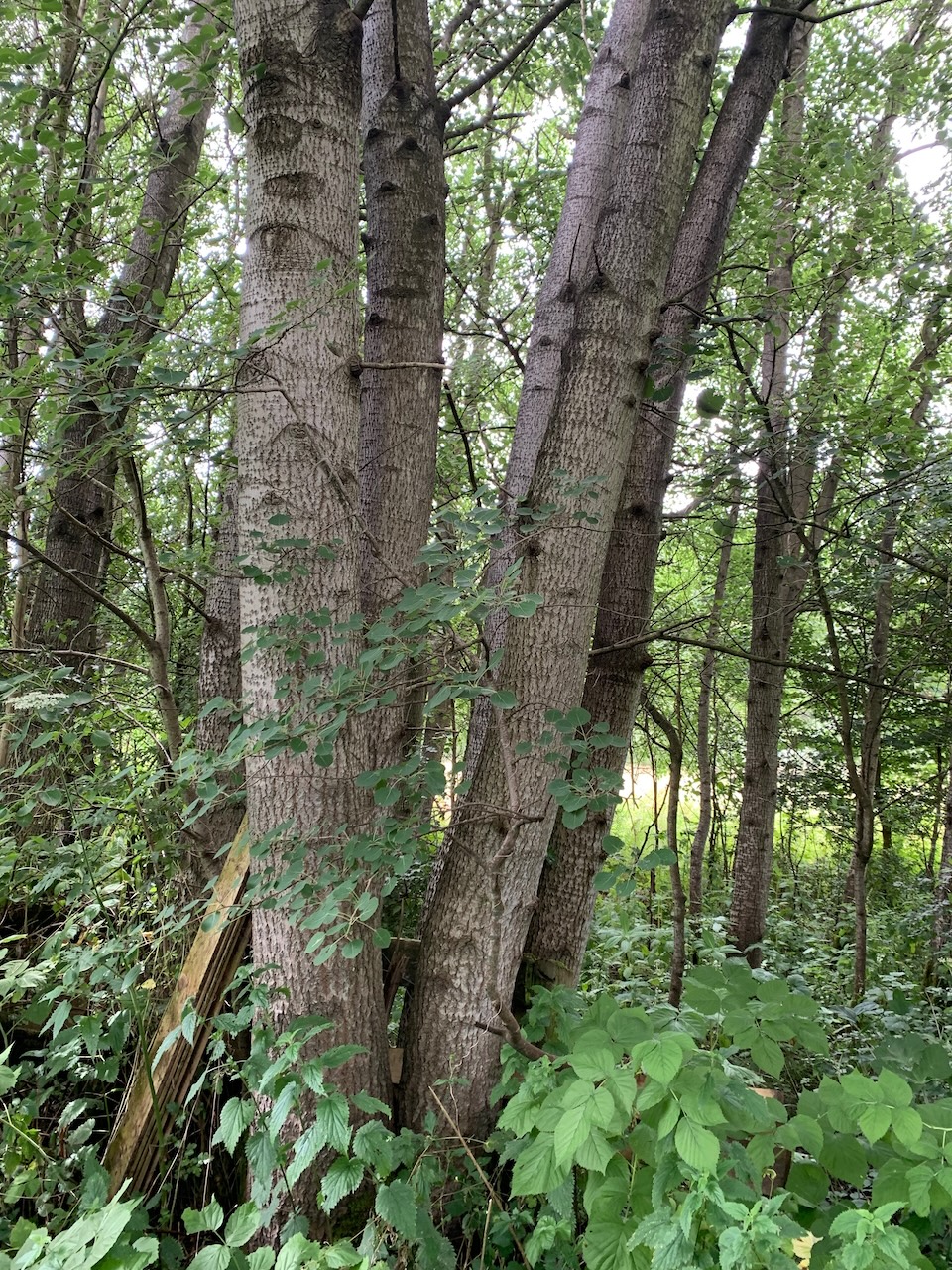
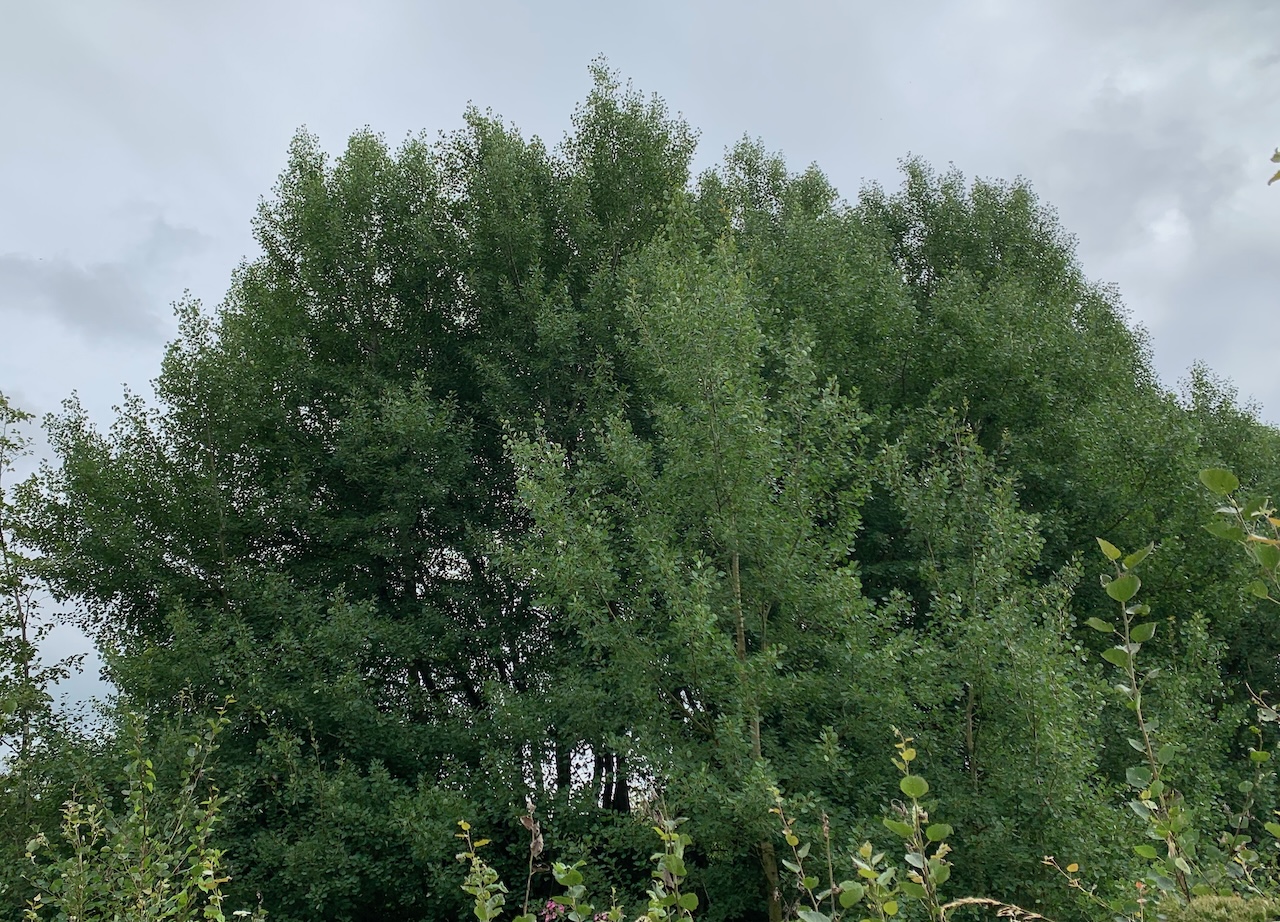
Aspen – Tree of the Woman’s Tongue

“Can you hold your tongue for a year and a day?” My patron God, Gwyn, challenged me. 

“No,” turned out to be my answer, “no – I cannot.”

No coincidence that this year I have been connecting more deeply with aspen. Because of the talkative rattling of is leaves it is known in Welsh as coed tafod merchen ‘tree of the woman’s tongue’ and coed tafod gwragedd ‘tree of the wife’s tongue’. Similarly in Scotland it is known as ‘old wives’ tongues’. 

The English, ‘aspen’ derives from the Germanic asp perhaps relating to its snake-like bark or to snake’s tongues. Its Latin name, Populus tremens, refers to its leaves which are said to quake restlessly as it provided wood for the cross Jesus was crucified on.

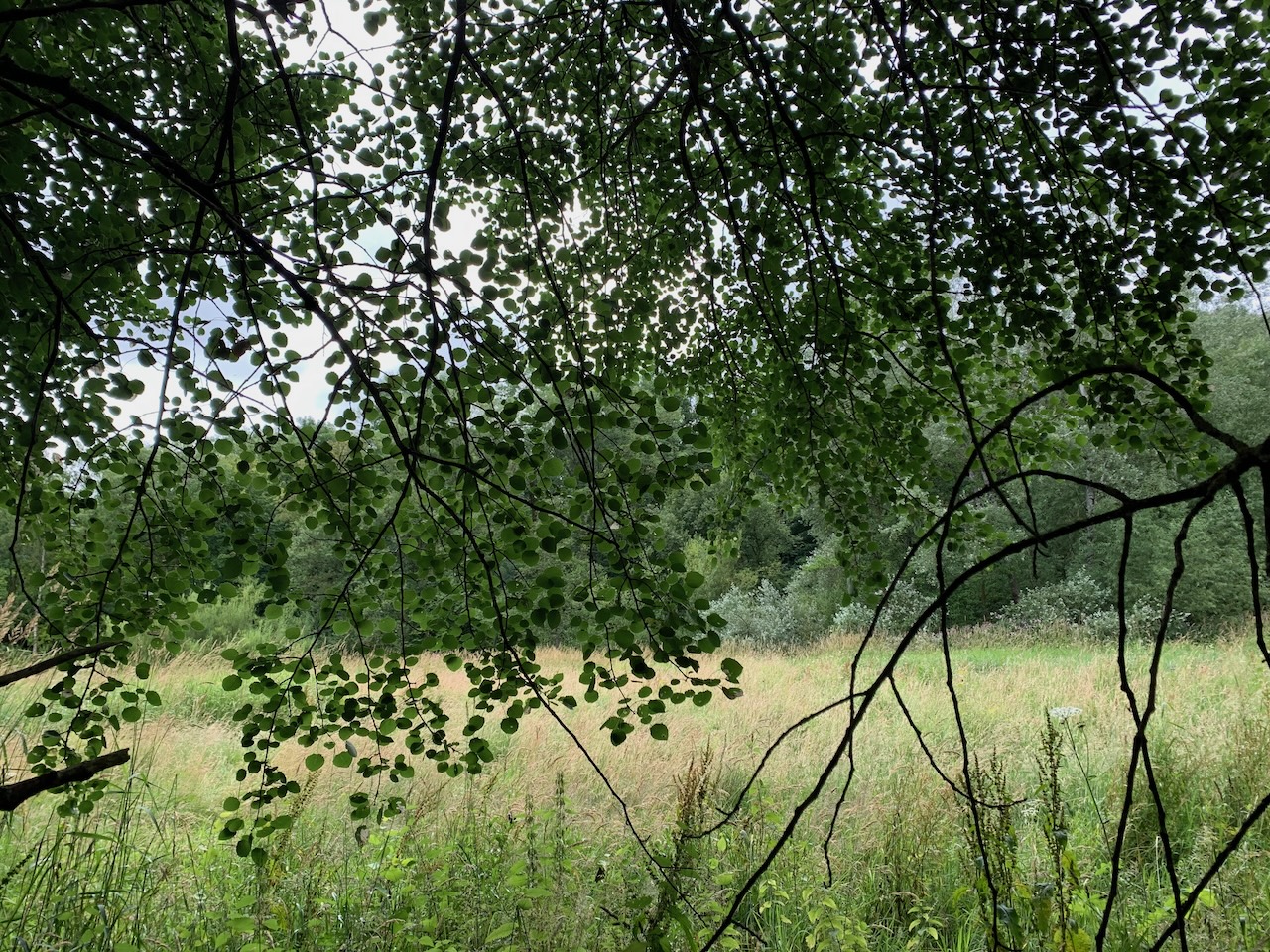
An ominous tree, associated with prophecy, until recently it existed at the peripheral edges of my vision. Small stands in local woodlands, on the edges of roads and paths, just one considerable colony at Fishwick Bottoms.

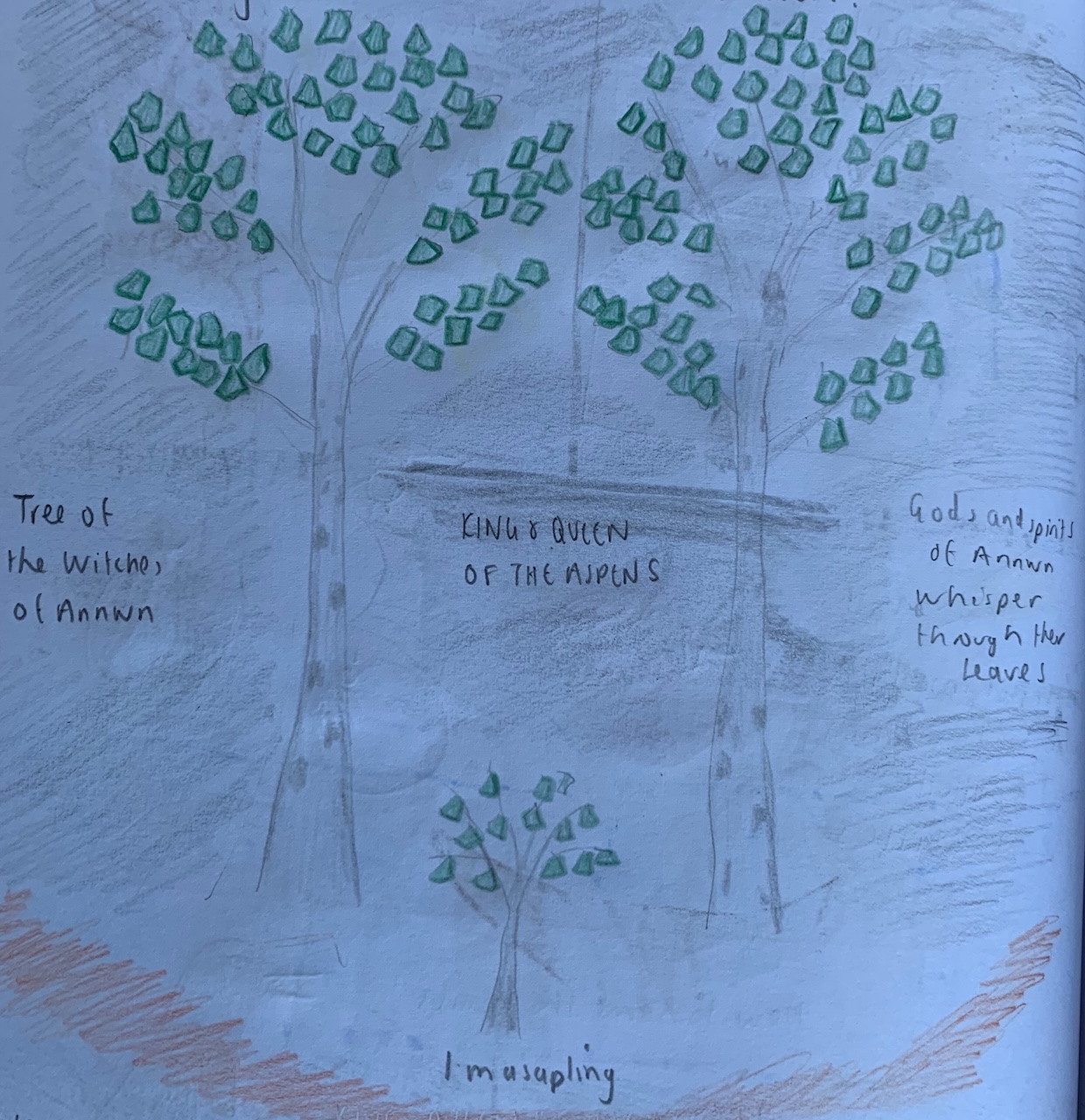
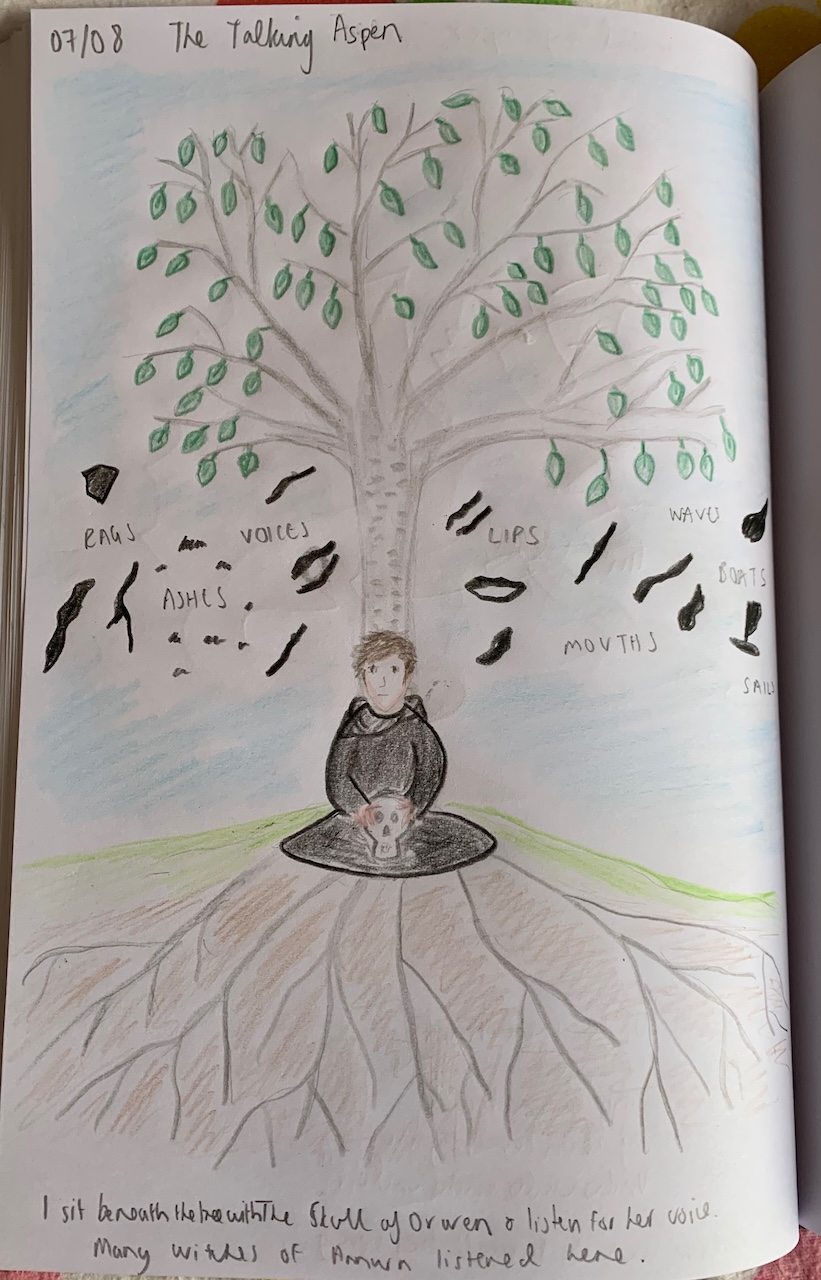
I’ve spoken to it in passing and sat beneath its leaves and listened to its chatter. I’ve journeyed to it, met the King and Queen of the Aspens, learnt that it was the favoured tree of Orddu, Orwen and and their ancestors, the Witches of Annwn who have become spiritual guides for me in the traditions of the Old North.

Orddu showed me that the woodland in Pennant Gofid, ‘the Valley of Grief’ was an aspen wood that had been there since the end of the Ice Age. We walked together as she pointed out the fungi and buzzing flies in areas of decay. Afterwards I learnt that aspen supports numerous detrivore species of fungi, up to 155 on a rotting log and saxoproxylic Diptera favour the microhabitats created by decaying sap under its bark.

Aspen is usually a sociable tree that grows in colonies yet Orddu introduced me to a single Talking Aspen she and her ancestors sat under to read the prophecies from its leaves. I was instructed to sit beneath it with her mother, Orwen’s skull, to listen to the wagging tales of old and dead witch’s tongue.

I was shown, in autumn, how the Witches of Annwn fly as birds of aspen. 

“In winter, when the aspen is silent,” Gwyn asked me, “can you hold your tongue?”

“No,” turned out to be my answer, “no – I cannot.”

Like old women, old wives, old witches, this middle-aged nun of the aspened suburbs and wife of the King of Annwn cannot hold her tongue. 

Aspen needs to tremble. Tongues need to wag. Words need to be typed. I need to write for the sake of my well being, for my Gods, for those who find inspiration in my work in spite of giving up all hope I will make a living from it.

Over my period of silence I’ve found a new way forward as a shamanic guide providing one-to-one shamanic sessions in my local community and am planning to start a shamanic circle here in Penwortham in the New Year.

Step by step my Gods and spirits are showing me my path as a nun of Annwn. Part of this is reclaiming my relationship with my abandoned creativity and embracing it as a way to health and healing for myself and others.

*Information about aspen in this document comes from ‘The Biodiversity and Management of Aspen Woodlands: Proceedings of a one-day conference held in Kingussie, Scotland, on 25th May 2001.’

Core Shamanism and its Advantages and Disadvantages

Shamanism was conceptualised and reintroduced to Western Europe in the 1970s by an American anthropologist called Michael Harner. Harner travelled to the Amazon in the late 1950s and 1960s and lived with the Shuar and Conibo peoples to study their religion. When he reached the point he could find no more information one of the Conibo elders told him he must experience it directly by drinking ayhuasca. The visions he experienced served as proof of the existence of a spiritual reality. He was initiated into both tribes as a shaman and trained in their practices. He then travelled the world visiting shamanic peoples and learning from them.

From this process Harner extracted the core of world-wide indigenous shamanisms without the cultural rites and trappings and made it accessible to Westerners. Harner-style shamanism is therefore also referred to as core shamanism.

Harner claimed that at the core of all shamanic cultures is the belief in three worlds. The Middle World is unique because it has both a physical reality (this world) and a spiritual reality (which might be seen as the other side of this world). Then there is the Lower World, below, where we find natural landscapes and nature spirits such as animals, plants and trees. We might also find mythic and folkloric beings, Gods and Goddesses and ancestors (who are most often from ancient shamanic cultures). In the Upper World, above, we find ethereal and heavenly landscapes and the spirits of clouds, the sun, the moon, the stars, along with the Gods and spirits associated with the heavens in world religions including the Christian God and angels. We also find ascended ancestors such as Christian saints, Hindu gurus, Buddhist boddhisatvas and wise elders such as philosophers and magicians.

It was Michael Harner who brought the shamanic journey to the forefront of shamanism and backgrounded the traditions of inviting the spirits to be here with us or into our bodies. A core shamanic journey has a set framework and structure.

First and foremost one always journeys with an intention. This is the focus of the journey and keeps it on track, preventing the practitioner from getting side-tracked or lost. The intention can be to ask for guidance on a problem, for healing, to find something that has been lost, or simply to explore or spend time with the spirits. It is essential that the intention is held to throughout the shamanic journey.

The shamanic journey always begins at a departure point. This is somewhere in the physical world that is meaningful to the practitioner. To get to the Lower World it must be a place from where one can descend and can be a natural feature such as a cave, a pool, a spring, a tree root, or a manmade feature like a tunnel or a subway. For the Upper World one can take flight from a hill or mountain, or a church tower, or go up a chimney, or travel upwards on smoke or up a ladder. In the Middle World we merely need to enter a trance state to travel its spiritual otherside.

It is through Michael Harner the shamanic journey came be primarily associated with a drum. Harner trialled many different methods of entering a shamanic trance and reached the conclusion that a drumbeat is the quickest, safest and most effective. A beat of 4 – 7 beats per second shifts the mind very quickly into the theta state (gamma – highly focused, beta – everyday busy mind, alpha – meditative, theta – daydream-like, delta – sleep). It offers both a safe way to journey and come back. To signal the end of a journey a call-back beat is sounded – 4 rounds of six sharp beats. This is followed by a minute or so of rapid fire beats. This tells the person who is journeying to thank whoever they are communicating with, then turn around and retrace their steps to their departure point following the same route as they went in. This method brings them back, well-grounded, into their body.

There are also a number of core concepts and practices. One of the concepts is that each of us has a power animal. This is drawn from the northern Native American cultures and is seen to be a spirit animal who is with us throughout our life and is the source of our personal power. Our relationship with our power animal is usually deeper and more personal than with other animal spirit guides who tend to come and go. Power animals are most often found in the Lower World.

Another core concept is the spirit teacher who is usually found in the Upper World. This teacher, again, unlike other human and spirit teachers, tends to be with us throughout most of our lives supporting us and offering guidance through life’s lessons.

One of the best known core practices is soul retrieval. This is based on the notion that when we experience traumatic events a part of our soul is shocked out of us and takes refuge in spiritual reality. We also send parts of our souls away in order to fit in with consensus reality in the physical world – these are often parts that are child-like or wild and might prevent us from attaining material success and financial security. Because those parts are long lost or because we sent them away it takes a shaman’s skill to bring them back. Spontaneous soul retrieval can also occur when we make positive changes in our lives that appeal to lost soul parts, calling them to return. Other core practices include extraction – the removal of harmful energies, depossession – the removal of harmful entities, and psychopomping.

Core shamanism has its advantages and disadvantages. Its main advantage is that it is not tied to one culture or religion, thus making it universal and available to everyone. It also allows practitioners from across varying traditions to practice together.

The disadvantage of this, however, is that the practices take place without the cultural rites for interacting with local and communal spirits such as prayers and offerings, there is no mythic framework or roadmap of the spiritual reality, neither are there traditions of initiation or tribal elders to oversee the initiatory and learnng processes.

Yet the universality and proliferation of core shamanism is overall a good thing as it is giving people back their birth right – the ability to journey to the spiritual reality and commune with helping spirits in order to gain guidance, healing and inspiration.

Evidence for Shamanism in Britain

One of the main types of evidence for shamanic beliefs in Britain is burials with gravegoods. The fact that the ancient Britons buried their dead with accompaniments is suggestive of the belief they took their belongings with them into an Otherworld which was seen to be very much like Thisworld. 

The earliest is the so-called Paviland Red Lady (who was actually a male warrior). His bones were stained with red ochre and he was laid out with ivory rods and sea shells. Later burials in burial mounds have been found accompanied with weapons, jewellery, cauldrons and eating and drinking vessels, games, chariots and horses. 

Another type of evidence is ritual depositions in liminal places which provided access to the Otherworld. Many of these are watery – we find weaponry such as swords and spearheads deposited in lakes, rivers, springs, pools and bogs. Deposits were also made in places leading underground such as caves, crevices and beneath the roots of trees (such as bog oaks here in Lancashire). Ritual pits and shafts were also dug purposefully for depositions of coins and pottery. This demonstrates the Britons had a reciprocal relationship with the spirits of the Otherworld.

Wooden idols which might represent threshold guardians who oversaw the boundaries between the worlds have been found across Britain. These include the Ballachullish Goddess, the Kingsteignton Idol, the Dagenham Idol and the Somerset God Dolly. The Roos Carr Figures, eight wooden warriors with quartzite eyes and removable phalluses and their serpent-headed boats may have been modelled on mythic figures who made voyages to the spiritual reality.

In Deal, Kent, a remarkable chalk figurine was found in a chamber at the bottom of a ritual shaft suggesting communion with an Otherworld Deity.

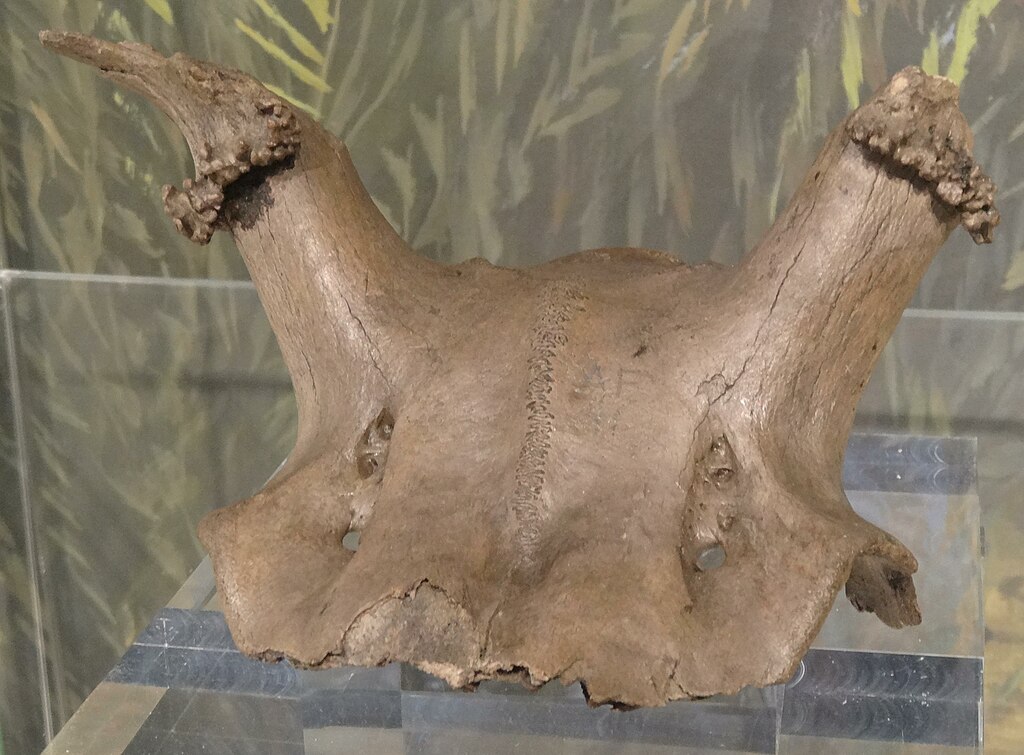
At Starr Carr, in North Yorkshire, 21 antlered frontlets dating to around 9,000 years ago were found. It has been suggested they were used in a shamanic ceremony to bring luck in the hunt before being deposited as offerings to the deer spirits.

Across the world cave art is cited as evidence of shamanic experiences. Here in Britain our oldest example is from Cresswell Crags, dating back to 13,000 – 11,000 years ago with carvings of a deer, a bison, a horse and birds and bird-headed figures.

Writing at the time of the Roman Invasions (we have no written evidence from the Britons themselves because they wrote nothing down), Julius Caesar, said the Gauls, whose traditions derived from Britain, believed ‘the soul does not die but crosses over after death from one place to another.’

We find a possible reference to a native British shamanic tradition that survived into the 1100s in the writings of Gerald of Wales. He records the existence of ‘soothsayers’ known as awenyddion, ‘persons inspired’ who are possessed by ‘ignorant spirits’ or ‘demons’ and who speak in ‘nugatory’ ‘incoherent’ language (ie. the language of prophecy as they give voice to the spirits of the Otherworld).

In medieval Welsh literature we discover the name of the British Otherworld, Annwn, from An ‘very’ and dwfn ‘deep’, again suggesting it lies underground. There are many stories about human interactions with Annwn and its spirits and Deities. In The Mabinogion, Pwyll, Prince of Dyfed mistakenly allows his hounds to feast on a stag which has been killed by the hounds of Arawn, a King of Annwn. To make up for his misdeed he takes Arawn’s place in Annwn for a year and a wins his battle against his rival, Hafgan, and wins Arawn’s favour. Someone who does not behave so respectfully is King Arthur. In ‘The Spoils of Annwn’ he voyages to the Otherworld, steals its magical animals and treasures, including the King of Annwn’s cauldron, and kills the cauldron keeper and, potentially, the King of Annwn himself. Annwn was later known as Faery and we have many stories from the Victorian times until now of sightings of the fairies and people lured into their dances and into their realm.

Within the Welsh bardic tradition, Taliesin, a shapeshifting bard is viewed to have shamanic qualities. Bards to this day channel the spirit of Taliesin and his forebears. 

The British witchcraft tradition is also deeply shamanic with its records of spirit flights and pacts and relationships with familiar spirits (although some stories were projected on women, often Catholics, who did not participate in such practices.)

Sadly, within the shamanic communities here in Britain, much of this evidence remains little known and explored and it is more common for people to look to other traditions, going abroad to take ayhuasca, or looking to the indigenous shamanic cultures of other lands, rather than exploring the lands and lore that are on our doorstep.

*Antlered frontlet courtesy of Wikipedia Commons.