Why I failed to write a Brythonic creation myth

In my attempted novel, In the Deep, I tried to imagine a story for the origins of Vindos / Gwyn, His kingdom in Annwn, and for the creation of the world. This was based on a combination of my readings of Brythonic and other Celtic and Indo-European and world myths and my personal gnosis. 

I worked for a year and a half on a story that had meaning for me and I felt Gwyn wanted me to write as the awen kept on flowing. Yet it didn’t speak to many humans and, in retrospect, although coherent, contained a lot of flaws.

Looking back, I feel it was a process I needed to go through. I genuinely believe I saw faces of Gwyn, such as the Boy in the Serpent Skins, that were meaningful for me and needed to journey with Him and write those tales.

Yet there were elements of the story I could never quite make work. My personal gnosis led me to perceive parallels between Tiamat in the Enuma Elish and a ‘found’ Goddess I know as Anrhuna who takes the form of a nine-headed dragon and is Gwyn’s mother and the Mother of Annwn.

In the Deep was written as an inversion of Enuma Elish ‘When on High’ reimagining what might have been a wider Indo-European origin myth centring on the slaying of a dragon from the side of the Deep rather than the victors.

It opens with a battle between the Dragons of the Deep (Annwn) and the Children of Don wherein Lugus / Lleu slays Anrhuna, the Dragon Mother. By cutting off Her nine heads He releases the dragon children of the nine elements*. He then cuts open Her womb and tears out Kraideti / Creiddylad (the Girl who will Bring Life) and Vindos / Gwyn (the Boy who will Bring Death). Lugus takes Kraideti to the stars and flings Vindos into the Abyss. Uidianos / Gwydion steals the magical jewels from Anrhuna’s foreheads and with them commands the dragon children to create the world. 

Although I’ve been able to picture the dragon slaying scene quite vividly I’ve never quite managed to see or write the creation of the world. I’ve ‘seen’ Uidianos and a circle of enchanters with their wands conjuring with the elements to form a world but can’t seem to connect it with the dragons.

The role of Gwydion as demiurge I derived from His creation of Taliesin in ‘The Battle of the Trees’ from ‘nine forms of consistency’ – ‘fruit’, ‘fruits’, ‘God’s fruit in the beginning’, ‘primroses’, ‘flowers’, ‘the blossoms of trees and shrubs’, ‘earth’ / ‘sod’, ‘nettle blossoms’, and ‘the ninth wave’s water’. 

In ‘The Song of the Great World’ Taliesin is created by God from ‘seven consistencies’ – ‘fire and earth, / and water and air, / and mist and flowers, / and the fruitful wind’. Like the the microcosmic Adam** his creation may be seen to mirror the creation of the world by God in this poem. It seems possible Gwydion was earlier seen as creating Taliesin and the world.

In ‘A British Myth of Origins’ John Carey suggests the Fourth Branch of The Mabinogion might contain an origin myth with Math’s kingdom whilst He has His feet in the lap of a virgin, Goewin, representing a timeless paradisal state. Gwydion’s scheming with Gilfaethwy to bring about her rape represent a fall. Gwydion and Gilfaethwy’s transformation by Math into a deer and a pig and a wolf, and their bearing of offspring, may explain the origin of animals.

Carey also suggests the story of Taliesin shapeshifting into various animals after stealing the awen from the cauldron of Ceridwen and the animal transformations of figures such as Mongan in the Irish myths function ‘as a device to connect the present with its origins, whether the beginnings of history or the transtemporal eternity of the Otherworld.’

It’s my personal intuition that Ceridwen may be a creator Goddess. That Her crochan ‘cauldron’ or ‘womb’ could be the vessel from which the universe was born. This is another strand that I attempted to weave into my book. 

If we look back beyond medieval Welsh mythology to the Roman sources we find no evidence whatsoever of a creation myth. Instead Strabo reports that the Gallic peoples (who according to Caesar derived their beliefs from the Britons) believe ‘men’s souls and the universe are imperishable’. Several authors speak of the belief that the soul is immortal. According to Caesar it ‘does not die but crosses over after death from one place to another’ showing existence in an ‘otherworld’ (potentially Annwn). Diodorus Siclus claims the Gauls ‘subscribe to the doctrine of Pythagoras that the human spirit is immortal and will enter a new body after a fixed number of years’. The key doctrine of Pythagoras is metempychosis and we find this throughout the Taliesin material wherein he speaks of his transformations. 

It seems possible we don’t have a Brythonic creation myth as the universe was viewed as ‘imperishable’ and the eternal soul as shifting through different shapes, potentially crossing from this world to Annwn and back again.

One of the things that has stood out to me whilst returning to the Taliesin material is that rather than telling of creation as given he instead poses riddles.  ‘How is the sun put into position? / Where does the roofing of the Earth come from?’ ‘Where do the day and the night come from?’ He mocks Christian scribes for not knowing ‘how the darkness and light divide, / (nor) the wind’s course’.

Taliesin seems to be claiming to know yet he leaves the answers a mystery. Could it be that our Brythonic ancestors treated these issues as mysteries rather than having clear cut myths and stories and explanations? 

If so could my failure to create a myth that works be based on the fact there have never been any direct answers and these things should be left mysterious?

If so it seems this book idea has played itself out for what it is but can go no further. I fulfilled my promise to Gwyn to write Him an origin story (something He didn’t ask for but that I did as an act of devotion to Him). It just didn’t turn out to be a novel sellable to humans. Which is ok. 

Where to go from here I’m not sure. I still want to write, I still need to write, in service to my Gods and to give voice to the awen from Annwn and within. To provide content for my patrons who continue to support me. But it might be that now I’ve become a nun of Annwn, Sister Patience, what I write will change.

It seems possible I will be taking a more meditative approach with a focus on mystery, which feels fitting for a nun dedicated to a God of the Deep.

*Stone, earth, water, ice, mist, wind, air, fire, magma.
**In her notes to ‘The Battle of the Trees’ Marged Haycock adds some references to medieval Christian texts where Adam is said to be created from ‘eight consistencies’ – ‘land, sea, earth, clouds of the firmament, wind, stones, the Holy Spirit and the light of the world’ or ‘earth (flesh), fire (red, hot blood), wind (breath), cloud (instability of mind), grace (understanding and thought) blossoms (variety of his eyes), dew (sweat), salt (tears).’

Introducing the Boy in the Serpent Skins

Who would go
with the boy in the serpent skins
draped over one shoulder fastened with a bone pin

to the world of dead dragons at the bottom of the Otherworld?

Who would go with him clambering over the corpses where his hands
and feet are always bloody because the aftermath of the battle is endless?

Who would follow him down the trails of the scales of dead serpents
to where they have sloughed off their skins, one, then another?

Who would face what lies beneath, the glistening organs,
the hearts, the lungs, the livers hung up in caves,
the bowels woven into a pattern on a loom,
the heart strings strung on a harp?

Who would walk amongst those who took the pickings?

Who would run ragged through the caves of a hundred claws?

Who would refuse to admit defeat to the jaws that hang on the walls?

Who would take off all their masks and skins and expose not only raw flesh
and organs but what lies underneath
and hope it is a soul?

~

Vindos/Gwyn ap Nudd first appeared to me as the Boy in the Serpent Skins during some journeywork I was doing to find out more about his boyhood as part of the process of writing my novel-in-progress In the Deep.

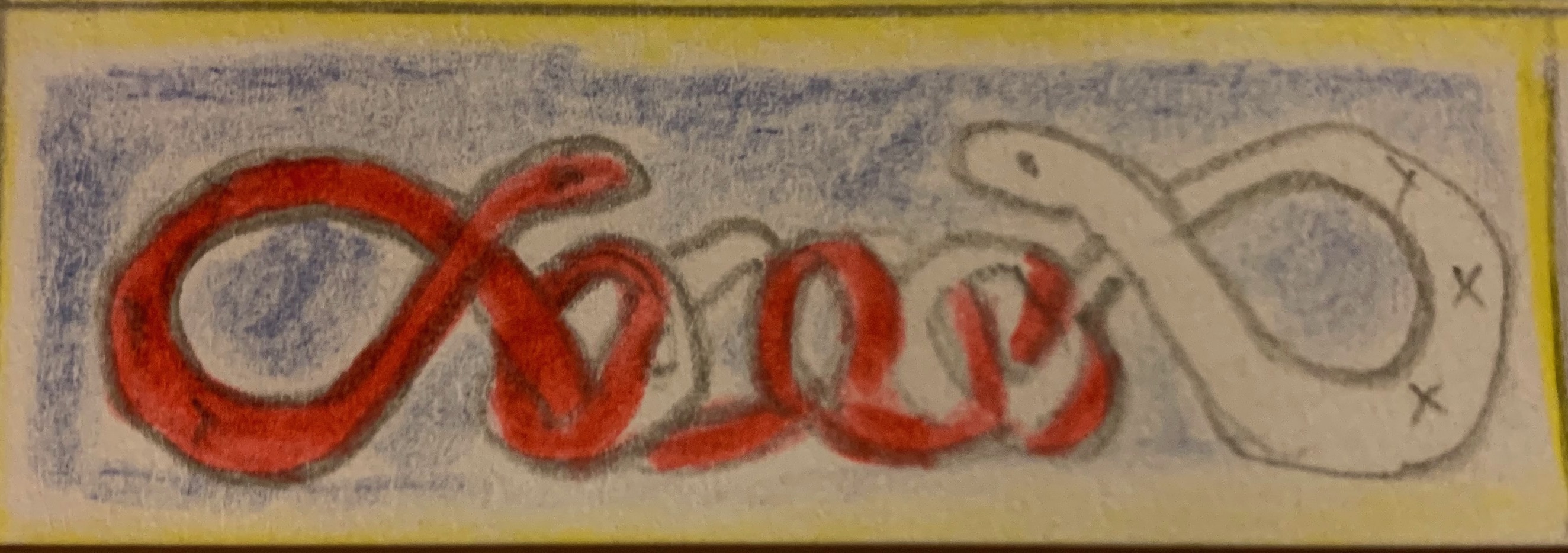
The book begins in Annwn, ‘the Deep’, prior to the creation of the world. After his Dragon Mother is slain by the Children of the Stars and he is flung into and escapes the Abyss, the boy finds himself alone except for the corpses and ghosts of dead dragons and the devouring serpents who lie beneath. 

Over the past six months I have been journeying with him to find out more about this phase in his life and how it has been shaped by the challenges of the serpents and his descent and initiation into their savage and visceral culture. This has provided the raw material for a good part of the story of In the Deep.

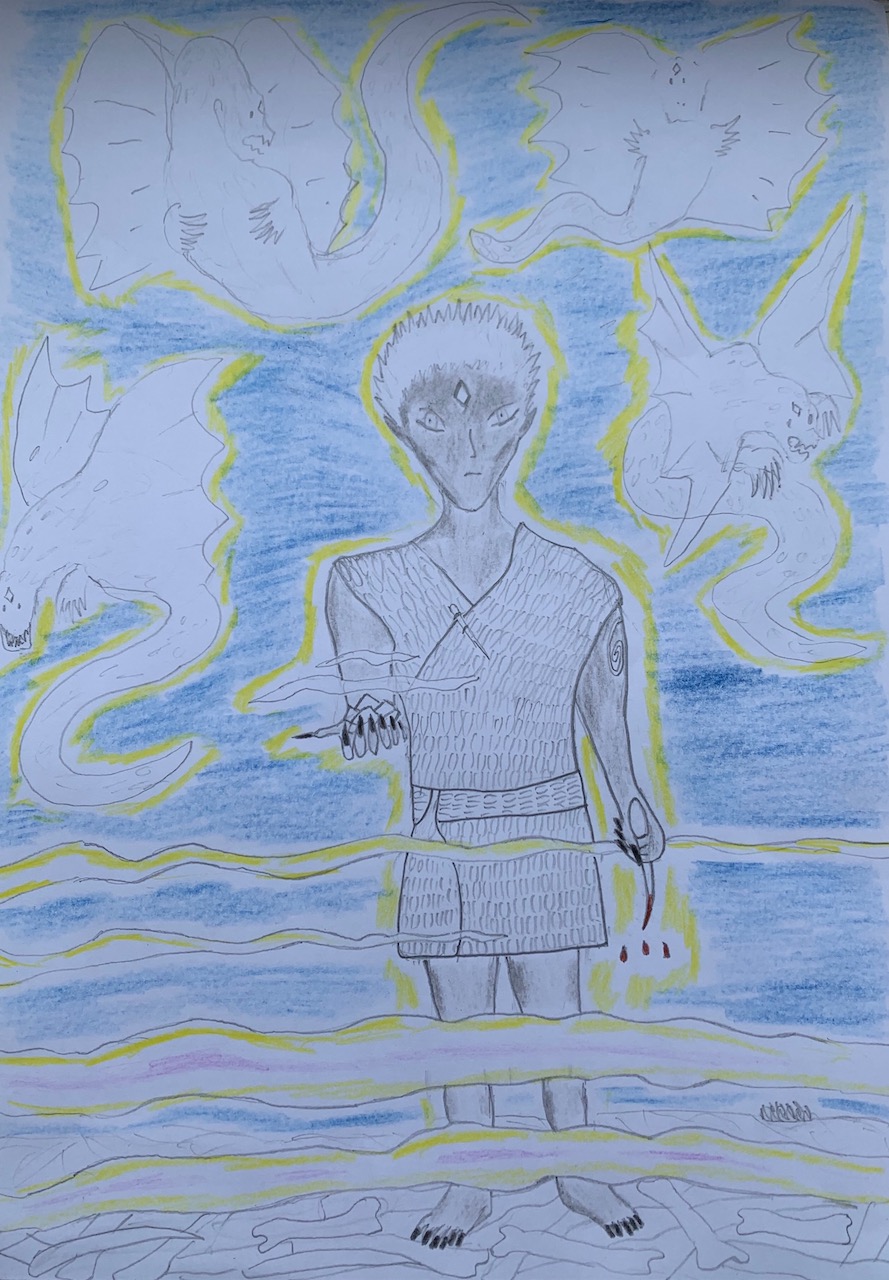
In the image beneath he is pictured as he appears to me with grey skin, white hair and a white jewel in his forehead*, wearing white serpent skins fastened with a bone pin. He has seven fingers and toes with claws.** He carries a handful of white dragon jewels in his right hand and in the left a serpent’s tooth. Above him are the four winged ghost serpents with whom he forms a bond and come to serve him as his messengers – Tero, Goro, Fero and Kilya.

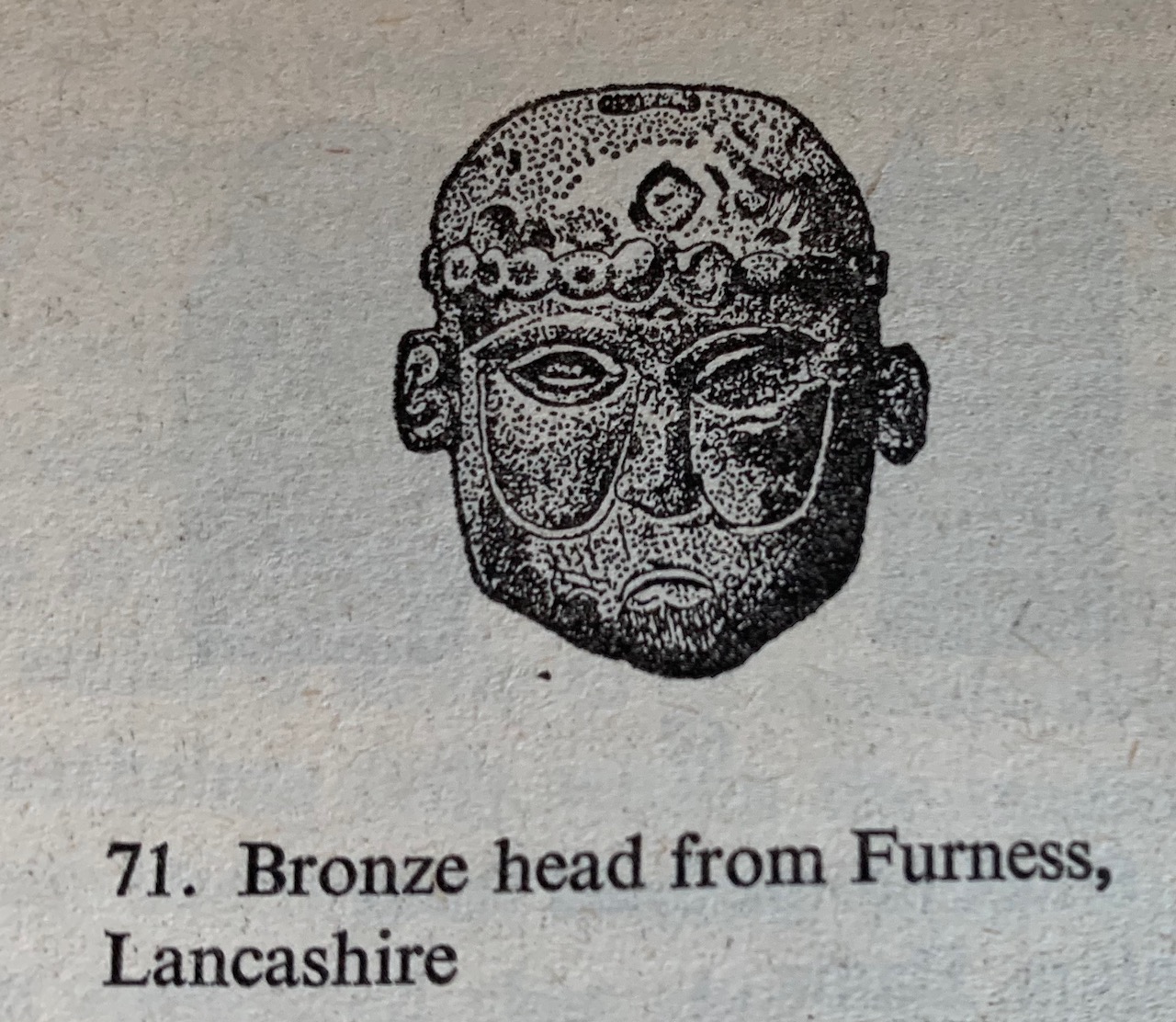
*I had thought this was an appearance unique to me until by coincidence I was re-reading Pagan Celtic Britain by Anne Ross and came across an image of a bronze head with a jewel in its forehead from Furness, Lancashire, not far from me!

**This is not unknown in Celtic mythology. In The Tain Cu Chullain is described thus – ‘Each foot had seven toes and each hand seven fingers, the nails with the grip of a hawk’s claw or a gryphon’s clench.’ Cu Chullain’s former name was Setanta and he might have been known in northern Britain as Setantios, a possible deity of the Setantii tribe here in Lancashire. 

You can support my work in return for exclusive excerpts from In the Deep HERE.

What Ails Me?

Hail is cold grain
and showers of sleet
and sickness of serpents
.’
– Hagalaz (rune)

I.
I come to You
my mind a wasteland,
the poles, the solstices of my world
out of kilter and something awakening beneath the ice

to ask the somewhat selfish question – “What ails me, my Lord?”

It echoes down through the centuries reminding You of Your father’s wound
and the wound You suffer every year battling against Your rival,

the wound to my navel after my dedication to You,
the pit of snakes in my belly button,

the heroes flung into it,
sucked dry. 

II.
“What ails me, my Lord?”

I’m back at high school again
with serpents twining around my chair legs,

staring down into the depths of the ink well I never used.

I’m chewing my pen, ink is dripping from the side of my mouth,
from my finger tips and I’m raising my hand
to ask for more paper, bleeding words,

rising to the challenge of the exam,

exulting in the quiet of the other pupils,
this scratching of pens the one thing I can succeed in.

III.
“What ails me, my Lord?”

I think of the serpents who twist around my arms
and sit deep in my belly and I wish I could tie around my ankles
to hang like You over the Abyss to gain the wisdom that explains this…

the way by lack of courage or confidence I am always climbing
the first three rungs on my ladder and then falling
back down into my pit of snakes.

IV.
“What ails me, my Lord?”

I’m back at the surgery again
and the nurse is wondering if I’m dead,
tapping my veins, trying to awaken them to life.

I’m explaining the junctions and showing which ones work.

Where blue flows to red and is tested then
incinerated by the fiery serpents.

V.
“What ails me, my Lord?”

My beast looks too much like an ink spodge test,

then I see my father splattered on the settee like a murder victim
from a third rate horror movie doing nothing as always.

I cannot find his wound or his serpents.

Instead I sink into mine and awaken them again,
the wounds made by all the surgeons, all the psychiatrists

by all the snakes fighting back, by all the horror movies and I hear

Your laughter, Your divine laughter, in my veins like poetry,
not the canned laughter of the television
he sits in front of.

VI.
“By asking the question you have opened the door.

Although all our blood and poetic truths
cannot save the world or heal
our ailments

by this opening
your serpents might return
to health and an answer might come through.”

*This poem is addressed to my patron God, Gwyn ap Nudd.

I wrote this poem last year. It is based on drawing the Hagalaz rune at one of the Way of the Buzzard journey circles over four years ago. I had a powerful experience that led me to investigating ‘the sickness of serpents’ not only in the Norse but the Brythonic traditions. It lies behind my series of books in which I explore the relationship between Vindos/Gwyn and the serpents of Annwn. The poem references gnosis received whilst writing these stories.

There is also an allusion to a series of blood tests I had last year relating to slightly raised liver function levels. Two ended up as four as on one occasion they did the wrong test and on another my blood coagulated in transit. It made me start wondering ‘does something want my blood?’ 

At the time I was writing about the conflicts in Annwn between the red and white serpents. As an answer, when I was sitting in the waiting room, on the white board a young girl had drawn a tower block with a huge winged serpent towering over it, which she was colouring it in red. I found out, after testing, blood gets incinerated and received the answer ‘the fiery serpents’. 

One of the results of the blood tests was that I have low iron levels. I have felt a lot better since eating more red meat particulary liver (sympathetic magic?) and believe this was behind me feeling tired and low most afternoons.

The final check relating to my raised liver functions is an ultrasound this Thursday so I will finally find out ‘what ails me’ (physically at least). If I do have minor liver damage it likely relates to having used alcohol to self-medicate the anxiety that comes from my autism since my late teens. I only started addressing this after making my lifelong dedication to Gwyn in 2019.

New Life

It’s been a few days now since I left my ecology job behind along with my somewhat misguided dream of finding a suitable career in the environmental sector. 

Returning to my vocation, to being a good awenydd, ‘person inspired’, after a time during which my path had lost its meaning, invigorated with new life. I’d turned away because I thought I’d lost my inspiration after several years of writing nothing of note without realising even unworthy notes fuel the Cauldron.

I didn’t realise my research into the British and Irish and wider myths along with my first attempt to bring them together in The Dragon’s Tongue would eventually lead to the trilogy of books which I am near-certain will be right.

It’s going to be called ‘The Forgotten Gods’ trilogy. The impetus behind it is a long-standing sadness that people in Britain know the names of the Greek, Roman and Norse Gods but nothing of the ancient British Gods and Goddesses. Zeus, Athena, Hermes, Mars, Venus, Pluto, Thor, Odin, Loki are all well known but no-one knows of Nodens, Vindos, Rigantona, Brigantia, Bel, Belisama, Lugus, Ambactonos, or Gobannos.

The first book, In the Deep, is an attempt to re-imagine an ancient British creation myth based on the stories about a primordial conflict between the deities of Annwn (the Otherworld) and the Children of Don in British and Irish mythology.

The second book, The Gates of Annwn, tells of how the Roman Invasions and the coming of Christianity led to the ancient British Gods becoming overwritten by new Gods, demonised, and forgotten, of how the people of Britain turned to Christianity, believing their souls went to Heaven or Hell rather than to Annwn.

The third book, The Black Dragon, which I haven’t written yet and will be the apocalyptic finale will tell of the return of the Gods and provide a vision of the future.

I’ve never felt more alive, since I finished Gatherer of Souls at least, as I have whilst I’ve been writing these books, becoming the Cauldron and in it walking with my Gods in their stories, with Vindos/Gwyn through His Dreams as He sleeps through the Summer.

There’s such excitement and magic in writing a story, not knowing where it’s going, being somehow in control and somehow not. Learning when a plot choice is right, when it is not, divining the guidance of the Gods. Being one with Them in the act of co-creating.

On a more mundane level I’ve had some ideas about how I might reach a wider audience with Their stories and make a little income to support myself whilst I devote my time to writing them by making some videos of excerpts from my books.

I’m looking into how to use Photo Booth on my Mac and planning on re-opening my Patreon with the aim of sharing video excerpts of readings from my books and poetry read around my local landscape along with general news and views.

Vindolanda: The Land of White Springs

29 miles east along Hadrian’s Wall from Carlisle lies the ruins of the Roman village of Vindolanda. I was drawn there because the name Vindolanda, usually translated ‘White Fields’ or ‘White Lands’, derives from *Windo ‘fair, white, blessed’ and this is the root of Gwyn ap Nudd’s name. Gwyn may have been known as Vindos in Iron Age Britian. There are no known dedications to Vindos but it seems possible he was venerated at Vindolanda and Vindogladia.

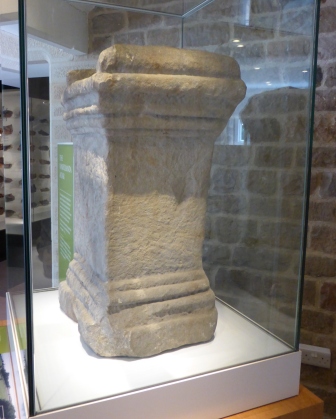
Evidence for the place-name Vindolanda comes from the Vindolanda Altar, which was found at the edge of the settlement. It reads, ‘Pro domu divina et Numinibus Augustorum Volcano sacrum vicani Vindolandesses curam agente…V S L…’ ‘For the Divine House and the Deities of the Emperors, the villagers of Vindolanda (set up) this sacred offering to Volcanus, willingly and deservedly fulfilling their vow, under the charge of…’

P1170197 - Copy

Here we find the name Vindolandesses ‘villagers of Vindolanda’. The altar was set up for Volcanus, Roman god of volcanoes and blacksmithing. As there isn’t any evidence of volcanic activity in the area, I assume the villagers chose Volcanus because iron smelting and forging took place at Vindolanda.

Surprisingly there is no information on display about what was there before the Roman invasion. When I asked a member of staff, she said it was farmland and told me the name Vindolanda derives from the land being coloured white by natural springs running from above the village and Barcombe Hill.

Near the wells and water tanks above the ruins is a notice which mentions ‘many springs and good steams’ and states ‘the most powerful source lay near here’. The stone aqueduct which carried the water into the village is still visible, but its source appears to have run dry.

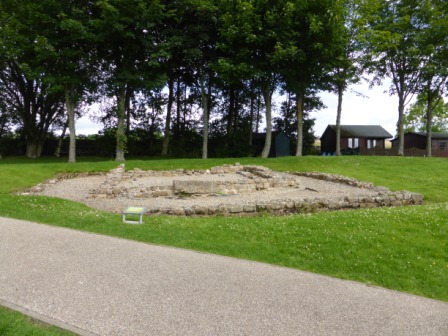
Adjacent to the wells and tanks stands the remains of a Romano-Celtic temple ‘used by soldiers to celebrate both local and Roman gods’. No individual deities are named. Gwyn is associated with the White Spring beneath Glastonbury Tor and I’ve experienced his presence at Whitewell here in Lancashire.

P1170043

It’s my intuition he could have been worshipped as Vindos in this temple beside the source of the white springs. My excitement at potentially discovering one of Vindos/Gwyn’s most ancient sacred sites was tempered with sadness that the springs had run dry.

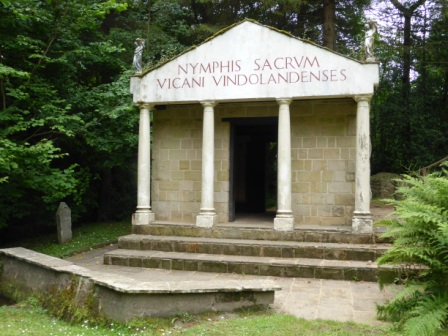
Below the village near to Chainley Burn is a reconstructed shrine with the painted inscription, ‘NYMPHIS SACRUM VICANI VINDOLANDENSES’ ‘The villagers of Vindolanda (dedicated this temple) sacred to the Nymphs’. This is based on an ornate temple still standing in the 18th century. There is plenty of evidence Vindolanda was a place of water worship.

P1170179

*

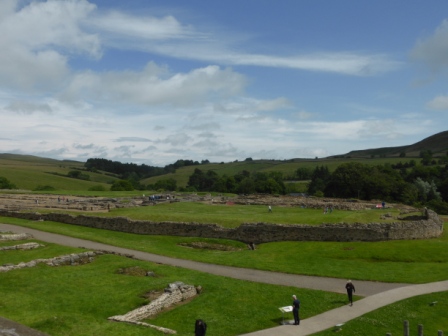
 Nine forts have existed at Vindolanda, built between 85AD and 370AD. Archaeological evidence suggests it was occupied long into the Dark Ages. It has been the home of soldiers from many different cultures; the 9th cohort of Batavians (Netherlands), the 1st cohort of Tungrians (Belgium), the 4th cohort of Gauls (France), the 2nd cohort of Nervians (Belgium) and Vardullian Cavalry (Spain). These men were removed from their homelands and stationed across the Empire. Defeated Britons were sent to fight for Rome in other countries.

P1170110

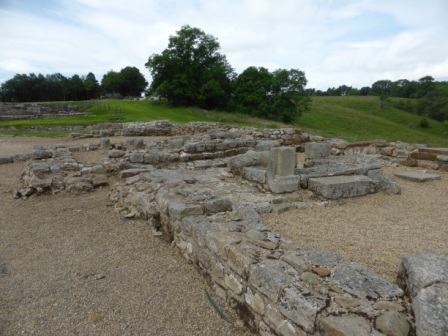
Rows of houses, storehouses, a tavern and mausoleums lie outside the walls of the fort which, when they were built in 211AD, were two storeys high with impressive guard towers (much of the stone has since been stolen). Inside are more houses and stores, bathhouses, workshops, horrea ‘granaries’, the principia ‘headquarters’ (where regimental officers and clerks maintained records) and the praetorium ‘house of the commanding officer’.

One of the buildings was a temple to Jupiter Dolichenus, an ancient weather god from the south-east of modern Turkey, who is depicted holding bolts of lightning whilst standing on a goat. His temple was destroyed then set on fire in 370AD when paganism was replaced with Christianity and a Christian church built within the fort. This is significant as it provides an exact date for the conversion of the people of Vindolanda to Christianity. It seems likely other Roman-ruled populaces on Hadrian’s Wall were converted around the same time.

P1170143

Within the museum are a large variety of finds perfectly preserved by the peaty soil. 6,000 shoes (but only one pair!) of all shapes and sizes were found in the ditches surrounding the fort, along with armour, weaponry, tents, a drawstring bag, cavalry standard and equipment for horses.

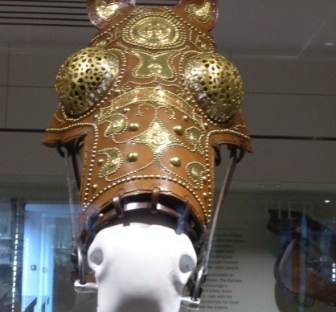
I was particularly impressed by the chamfron; a horse’s ceremonial face-mask made from leather with bronze fittings and protection for the eyes. Gwyn speaks of Carngrwn as a ‘white horse gold-adorned’. I could imagine Carngrwn wearing similar headgear. Could his depiction in The Black Book of Carmarthen have originated from the Land of White Springs and its tradition of elaborately decorated saddlery?

*

Most famous of all are the Vindolanda tablets. These inscriptions on wood date back to 121AD and provide some fascinating insights into the lives and viewpoints of the soldiers of Vindolanda.

‘…the Britons are unprotected by armour. There are very many cavalry. The cavalry do not use swords, nor do the wretched Britons (Brittonculi) mount in order to throw their javelins.’

‘…order (accommodation) to be given to…, but also a lodging where horses are well (looked after). Farewell, brother dearest to me’

‘Tomorrow nice and early in the morning come to Vindolanda, so that (you can join the counting of the census)’

Pieces of writing not on display are summarised on the surrounding walls:

Tranquilius ‘Who supplied some undergarments to the Cerialis household’

Claudius Super ‘A centurion, apologising to Cerialis for failing to attend Sulpicia Lepidina’s birthday celebrations’

Flavius Genialis ‘A predecessor prefect to Cerialis, who appears to have had a nervous breakdown at some point’

Lucius ‘A cavalry troop commander (decurion), receives a letter from a friend reporting on a gift of 50 oysters from a place called Cordonovi

Virrilus ‘A veterinary surgeon (veterinarius), who is reminded by Chrauttius that he hasn’t yet sent the castrating shears that he promised’

There is a small collection of statues and altars of gods and goddesses. These include statues of Priapus, Maponus and statuettes of Venus and Dea Nutrices and altars to the Veteres and an unknown god which frustratingly simply reads ‘Deo’.

They represent only a small portion of the dedications found at Vindolanda. I hoped to find an altar to Mogons ‘great one’ inscribed ‘Mogonti et Genio Loci’, as Vindos may have been viewed as the genius of the place. However, it was not on display.

That’s only a small complaint. The people who work at Vindolanda have done a superb job in their excavations of the Roman forts and preservation of the objects and remains of the people who lived there. No inscriptions to Vindos have been found, but their work is ongoing and no-one knows what might be recovered next…

*

Vindos god of the Land of White Springs
where the springs flow no longer
yet memories flow from
Annwn’s wells

soldiers from a thousand distant lands
have whispered your name

water holds their peaty memories

I do not wield a stylus on birch
nor chisel on altar

to engrave your greatness here forever

I let my words fall on the wind
spiralling downward
to join
the well-springs

Gwyn ap Nudd and the Spirits of Annwn: Remembering the Underworld Gods

I recently came across an article through the Caer Feddwyd Forum (1) called ‘The Underworld Gods’ by medieval scholar, Will Parker. It brought to my awareness the existence of an inscription in Chamalieres in central France, which took the form of a prayer or invocation addressed to an entity or group of entities known in Ancient Gaul as the andedion, ‘the Under-world God(s)’ or ‘Infernal One(s)’ (2).

Parker links the andedion to the Irish andee ‘non-gods’ and suggests a similar group of deities would have been worshipped in Iron Age Britain. Through etymological links between the ‘elements Clt. dio(n) (Ir. dé) ‘god(s)’ and ‘the suffix ande-/an-‘ he connects them to Annwn ‘not world’, Britain’s indigenous otherworld or underworld. Parker goes on to identify the andedion and andee with the spirits of Annwn and their ruler, Gwyn ap Nudd.

This is of interest to me because Gwyn is my patron god. Parker’s insights make it possible to trace a trajectory from Iron Age beliefs concerning underworld gods, through Gwyn’s appearances in medieval literature and later folklore to those who worship him today.

Gwyn ap Nudd ‘White Son of Mist’ is a Brythonic deity. His veneration dates back, at least, to the Iron Age, where he appears as Vindonnus ‘White or Clear Light,’ in a trio of Gallo-Brythonic inscriptions in Essarois. Here he is equated with Apollo, another hunter deity (3). It is likely he was worshipped across Britain as Vindos ‘White’ (4). It has also been conjectured that Gwyn and his hunting dog, Dormarth ‘Death’s Door’ occupied the astrological positions of Orion and Sirius to the ancient Britons.
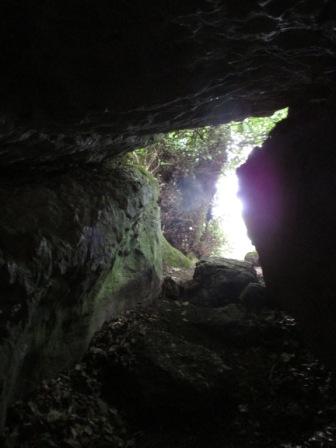
Cave, SilverdaleParker suggests Late Bronze Age ‘ritual shafts’ and ‘offering pits’ containing depositions including human and animal bones, grain, pottery and metalwork express a ‘quid-pro-quo’ relationship between the ancient Britons and the underworld gods. If he is correct, it is possible that Vindos / Gwyn, Dormarth and other kindred spirits were involved in these rites.

Gwyn’s first literary appearances are in medieval Welsh texts; ‘How Culhwch Won Olwen’ (11th C) in The Mabinogion and ‘The Dialogue of Gwyddno Garanhir and Gwyn ap Nudd’ (13th C) in The Four Ancient Books of Wales. These texts have roots in an older, oral tradition and contain fragments of tales from across Britain that predate Christianity. A significant number of these, including two featuring Gwyn, are from ‘The Old North’ (5). This is important to me because I connect with Gwyn in Lancashire.

Parker argues that superstitions about the underworld gods carry over into The Mabinogion. This is evidenced in the disappearance of livestock, children and crops. Pwyll’s encounter with Arawn, a King of Annwn, is the catalyst for the unfolding drama of the first four Mabinogi. Parker says these stories show the spirits of Annwn could not ‘be simply dismissed or ignored. Instead, a complex narrative had to be constructed in which, through a series of symbolic ritual manoeuvres, their power was drawn out, confronted and finally neutralised.’ The attempts of medieval scholars to disempower these deities can be seen at work in the development of Gwyn’s mythology.

In ‘The Dialogue of Gwyddno Garanhir and Gwyn ap Nudd,’ (6) Gwyn is presented as a divine warrior returning from battle to the Tawe near the vale of Neath. Gwyddno, ruler of Cantre’r Gwaelod, speaks of and addresses him with reverence and respect. ‘Bull of conflict was he, active in dispersing an arrayed army, / The ruler of hosts, indisposed to anger, / Blameless and pure was his conduct in protecting life.’ Other epithets Gwyddno uses include ‘hope of armies’ and ‘hero of hosts.’ ‘Host’ may refer to the spirits of Annwn.

Gwyn introduces himself as ‘Gwyn, the son of Nud, / The lover of Creurdilad, the daughter of Lud.’ He names his horse as ‘the torment of battle’ and refers to Dormarth as ‘truly the best of dogs,’ ‘handsome,’ ‘round bodied’ and ‘ruddy nosed.’ References to his possession of a ‘polished ring’ and ‘golden saddle’ are also suggestive of his status.

The title ‘Bull of Conflict’ refers to Gwyn’s role as a psychopomp. At the end of the poem he describes his travels across Britain gathering the souls of fallen soldiers. He appears to be berating this task. ‘I have been where the soldiers of Prydain were slain, / From the East to the North; / I am alive, they in their graves! / I have been where the soldiers of Prydain were slain / From the East to the South / I am alive, they in death!’

This poem contains important clues about Gwyn’s identity as a divine warrior and huntsman, whose role was to gather the souls of the dead and take them to Annwn.

In ‘How Culhwch Won Olwen’ in The Mabinogion, Gwyn is depicted as a huntsman and advisor to King Arthur. His place in Arthur’s court list and apparent subjection to both Arthur and God may be read as attempts by medieval scholars’ to explain and downgrade his position.

That ‘Twrch Trwyth will not be hunted until Gwyn son of Nudd is found’ (7) hints at his role as leader of the hunt, and knowledge of otherworldly beings. The Twrch was a king reputedly turned into a swine by God. When Gwyn does not reveal his location it is possible he is defending his own.

The advice of Gwyn and Gwythyr ap Greidol ‘Victor Son of Scorcher’ is also needed by Arthur to find Pennant Gofid in the ‘uplands of hell,’ which Evans and Bromwich say is ‘clearly situated in North Britain’ (8). When they reach this location, Gwyn and Gwythyr advise Arthur in his defeat of the ‘The Hag of Pennant Gofid,’ another otherworldly entity. The parcity of their advice, which leads to several failed attempts by Arthur’s men before the Christian King is forced to step in to slay her, may also suggest that Gwyn and Gwythyr are acting as tricksters.

A pair of lines fundamental to understanding Gwyn’s mythos, and which continue to intrigue and perplex me, are the following; ‘God has put the spirit of the demons of Annwfn in him, lest the world be destroyed. He will not be spared from there’ (9).

Taken literally, this seems to mean that at some point during the period of Christianisation God put the spirit of the demons of Annwn ‘in’ Gwyn’s person to prevent the world’s destruction. Or it may mean that he granted Gwyn rulership of them for this purpose. However, it is probable that the agency of God was brought in as a cover to excuse the prevalent belief in the existence of these spirits and their ruler.

Even if we assume God’s agency is a cover for existing beliefs, the notion that Gwyn somehow contains ‘the spirit of the demons of Annwn’ is a fascinating one. In a conversation via e-mail, Heron (10) told me the word ‘spirit,’ in Welsh, is ‘aryal,’ which can mean ‘ferocity,’ ‘essence’ or ‘nature’. He referred me to Evans and Bromwich, who say ‘Gwyn’s partaking of the ‘nature of the devils of Annwfn’ indicates a recognition on the part of the redactor of the tale that Gwyn ap Nudd belonged to a sinister and forbidden mythology’ (11). Within this mythology he may already be seen to embody the nature of these entities, or to hold power over them.

That the destruction of the world is at stake suggests Gwyn’s role was extremely significant. If it is assumed this notion has older roots, some of the offerings of the ancient Britons may be explained as attempts to placate these spirits and their ruler due to their destructive capacity. It is also possible Gwyn was invoked as the only being who could hold them in check.

Fears and superstitions surrounding Gwyn and the spirits of Annwn may lie behind the story of his abduction of Creiddylad. After Creiddylad, who is both Gwyn’s lover and sister, elopes with Gwythyr, Gwyn seizes her back. It might be assumed he takes her to Annwn, and that this suggests an underlying fear of being abducted by Gwyn and his forces.

Gwythyr amasses his armies and attacks Gwyn. Gwyn triumphs and captures a number of Gwythyr’s allies, who are mainly rulers of the Old North. During their captivity Gwyn slaughters Nwython, cuts out his heart and feeds it to his son, Cyledr, who goes mad. This could be read as a clear example of Gwyn’s ferocity and hints at existing superstitions about what goes on in Annwn.

Evans and Bromwich say the concentration of the names of people Gwyn kidnaps suggest ‘that north Britain was the ultimate place of origin for the Creiddylad episode, and that this incident was one of the surviving fragments of tradition emanating from there’ (12). It is therefore likely it originates in earlier beliefs held about Gwyn and his host by the Northern Britons.

Arthur eventually comes North to Gwythyr’s aid and frees his noblemen. Afterward he makes peace between Gwyn and Gwythyr by placing a dihenydd ‘fate’ on them. This dictates that they must fight for Creiddylad’s hand every Calan Mai ‘May Day’. An added condition, which seems particularly unfair, is that Creiddylad must remain in her father’s house, and no matter who wins neither can take her until Judgement Day. It is likely Arthur’s agency was brought in to explain an earlier myth, which was already prevalent in the Old North.

Whilst, on one level, this myth may be about fears of abduction to the underworld, it is more frequently interpreted as a seasonal drama comparable with Hades’ capture of Persephone. In this reading, Creiddylad is a maiden goddess who embodies the powers of spring and fertility. Creiddylad’s abduction by Gwyn may explain the failure of these powers at Calan Gaeaf, the first day of winter. Gwythyr and Arthur’s rescue of her at Calan Mai, the first day of summer, may explain their resurgence.
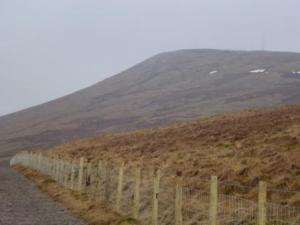
Winter Hill

Winter Hill

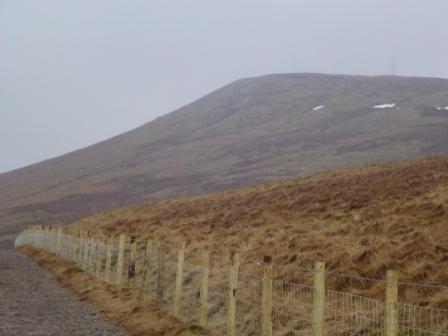
Gwyn is also seen as the Winter King. It is possible his white, shining qualities relate to snow and cold, associations which could date back to the Ice Age. Elen Sentier links Gwyn with the reindeer goddess Elen of the Ways (13) and the Boreal forest. He may also be connected with the North wind. The 14th C Welsh poet Dafydd ap Gwilim refers to ‘Tylwyth Gwyn, talaith y gwynt’ ‘the family of Gwyn, the province of the wind’ (14). The pervasiveness of a myth featuring Gwyn in Northern Britain could have a basis in its harsh winters.

In a later text, The Life of St Collen (14th C), Gwyn is referred to as ‘the King of Annwn and the Fairies’ and is supposedly banished by the saint from Glastonbury Tor (15). The transition from belief in Gwyn as a King of Annwn to King of the ‘Tylwyth Teg’ or ‘Fair Folk’ is a significant one. The original natures of Gwyn and the spirits of Annwn are covered over by their reduction to diminutive form. However, hints at their mythos can still be found in the majority of folktales.

Gwyn retains his status as leader of the Wild Hunt in the folklore of Wales and Somerset. There he is seen to appear on horse back with a pack of white, red-eared hounds, riding out on Nos Calan Gaeaf and through the winter months, chasing down the souls of the dead. To hear his hounds is an omen of death. The other riders are seen often seen as captive souls and may represent the spirits of Annwn.

In the North West of England, however, the hunt is assigned either to the Norse god Odin, or to Christian angels. In Cumbria it is Michael, and in Lancashire and Yorkshire Gabriel is said to lead a pack of black, red-eyed dogs, the Gabriel Ratchetts.

Coincidentally, Preston born writer Francis Thompson is famous for a poem called ‘The Hound of Heaven.’ Anybody who has felt like Gwyn’s hounds are on their tail might find these lines hauntingly familiar; ‘I fled Him, down the nights and down the days; / I fled Him, down the arches of the years; / I fled Him, down the labyrinthine ways / Of my own mind; and in the mist of tears / I hid from him, and under running laughter.’ (16)

More recently, Gwyn’s significance as an ancient god has been attested by contemporary scholars such as Geoffrey Ashe, in King Arthur’s Avalon (2007) and Nicholas R. Mann in The Isle of Avalon (1996) and Glastonbury Tor (2012). He is also the subject of a full length book called Gwyn: Ancient God of Glastonbury and Key to the Glastonbury Zodiac (2007) by Yuri Leitch.

This increase in interest suggests we are approaching a time when Gwyn and the spirits of Annwn are taken seriously as Brythonic deities again. However, the main focus of these books is Gwyn’s role at Glastonbury, with only a small mention of his place in Wales and other areas of Britain. Disappointingly there is no mention of Gwyn’s activities in the North. In this respect I have only my own experiences and conjectures to go on.
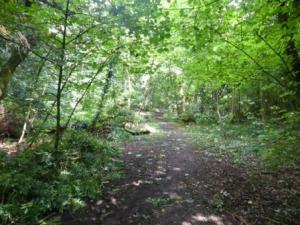
Fairy Lane

Fairy Lane

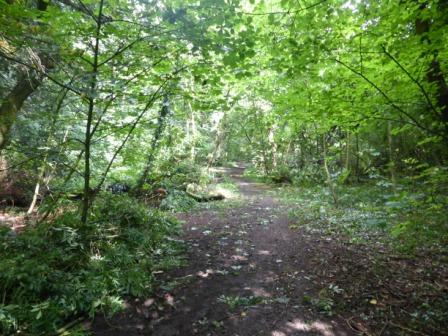
I first met Gwyn on Fairy Lane in my hometown of Penwortham, where he challenged me to journey with him to Annwn. Since then I have worked with him as a guide to the otherside of my local landscape and its hidden myths. His interest in my locality surprised me at first. However, it seems less surprising when looked at in the context of his role as an ancient underworld god of Britain, particularly in relation to the history and folklore surrounding this site.

Penwortham has been inhabited since 4000BC. The Riversway Dockfinds, a collection of animal bones, 30 human skulls, two dug out canoes and the remains of a timber structure suggest the existence of a lake village on Penwortham Marsh. Nearby is Castle Hill, a point of military and religious importance. There is a church dedicated to St Mary on the summit of Castle Hill, which means it was likely to have been a pre-Christian sacred site.

That the church is dedicated to St Mary and she was also the patron saint of a healing well at the foot of Castle Hill suggest the presence of an earlier female deity with healing powers, who has been Christianised as Mary. Three human skulls found in the wall of the church (17), which may have served an apotraic function suggest superstitious beliefs in chthonic spirits were also once popular but not openly acknowledged.

The survival of the legend of Penwortham Fairy Funeral attests to these superstitions. In the earliest version in Bowker’s Goblin Tales of Lancashire (1878), it is set on Church Avenue on Castle Hill. Two men walking home to Longton encounter a procession of fairies carrying a coffin. Robin, one of the men, looks into the coffin and sees his own miniature corpse. Frightened by the sight, they follow the fairies into St Mary’s graveyard. Robin attempts to prevent the burial by reaching out to grab the leader of the fairies. The procession vanishes and Robin, driven mad, topples to his death from a haystack a couple of months later (18). In later versions, this story takes place on Fairy Lane, which runs through Penwortham Wood at the foot of Castle Hill.

This legend may be interpreted to hint at older beliefs in underworld gods. Church ways are often identified with spirit paths. It is possible that prior to Christianity people believed chthonic spirits to have been actively involved in bearing the deceased to the underworld. The ringing of bells to drive them away and superstitions surrounding lych gates are testaments to fear of such entities. The movement of the legend to Fairy Lane may be seen as an attempt to sever their connection with the church. It is also possible it represents a shift in the energy of the area.

Gwyn ap Nudd and the spirits of Annwn (more frequently referred to as fairies today) are frightening beings. However, they play an essential role in maintaining the relationships between the worlds, the seasons, and the living and the dead. Like death itself and the cold dark of winter they will never go away. Their roles and identities, covered over or ignored for many centuries, can be recovered and understood.

Like Pwyll’s meeting with Arawn, my relationship with Gwyn has changed my life. He guides me to visions in Annwn and the physical world I would not be able to access without him. He teaches me to walk the spirit paths and inspires me to learn the song lines of this land’s ancestral heritage.

As late summer arrives, harvesters take to the fields and leaves begin to fall I sense the spirits of Annwn stirring, the first hint of the breath of winter on the wind. Monday is the date of the commemoration of the beginning of the First World War. When I help lay candles in front of Preston cenotaph for each of the 1956 soldiers who lost their lives I will remember that care of the souls of the battle dead was once believed to be Gwyn’s role.

(1) http://www.caerfeddwyd.co.uk/
(2) http://www.mabinogi.net/sections/Appendix/The_Underworld_Gods.pdf
(3) James MacKilliop, Dictionary of Celtic Mythology, (1998), p375
(4) Robin Herne, Old Gods, New Druids, (2009), p48
(5) A collection of Kingdoms in the North of England and Southern Scotland from 500AD and 800AD.
(6) Transl. William F. Skene, ‘The Dialogue of Gwyddno Garanhir and Gwyn ap Nudd,’ The Four Ancient Books of Wales, (2007), p210-211
(7) Transl. Sioned Davies, ‘How Culhwch Won Olwen,’ The Mabinogion, (2007), p199
(8) Ed. Rachel Bromwich and Simon Evans, Culhwch and Olwen, (1992), p169
(9) Transl. Sioned Davies, ‘How Culhwch Won Olwen,’ The Mabinogion, (2007), p199
(10) https://www.blogger.com/profile/02055792516386371373
(11) Ed. Rachel Bromwich and Simon Evans, Culhwch and Olwen, (1992), p133
(12) Ibid. p150
(13) Elen Sentier, Elen of the Ways, (2013), p26-28
(14) Dafydd ap Gwilim, Poems, (1982), p132 – 133
(15) http://www.maryjones.us/ctexts/collen.html
(16) Francis Thompson, The Hound of Heaven and Other Poems, (2000), p11
(17) Rev C. Nelson, St Mary’s Church, Penwortham, Lancashire, Archaeological Watching Brief and Explanation, (2011), p48
(18) http://www.gutenberg.org/files/39712/39712-h/39712-h.htm#THE_FAIRY_FUNERAL

Many thanks to Heron and Lee at Caer Feddwyd for bringing Will Parker’s article to my attention.