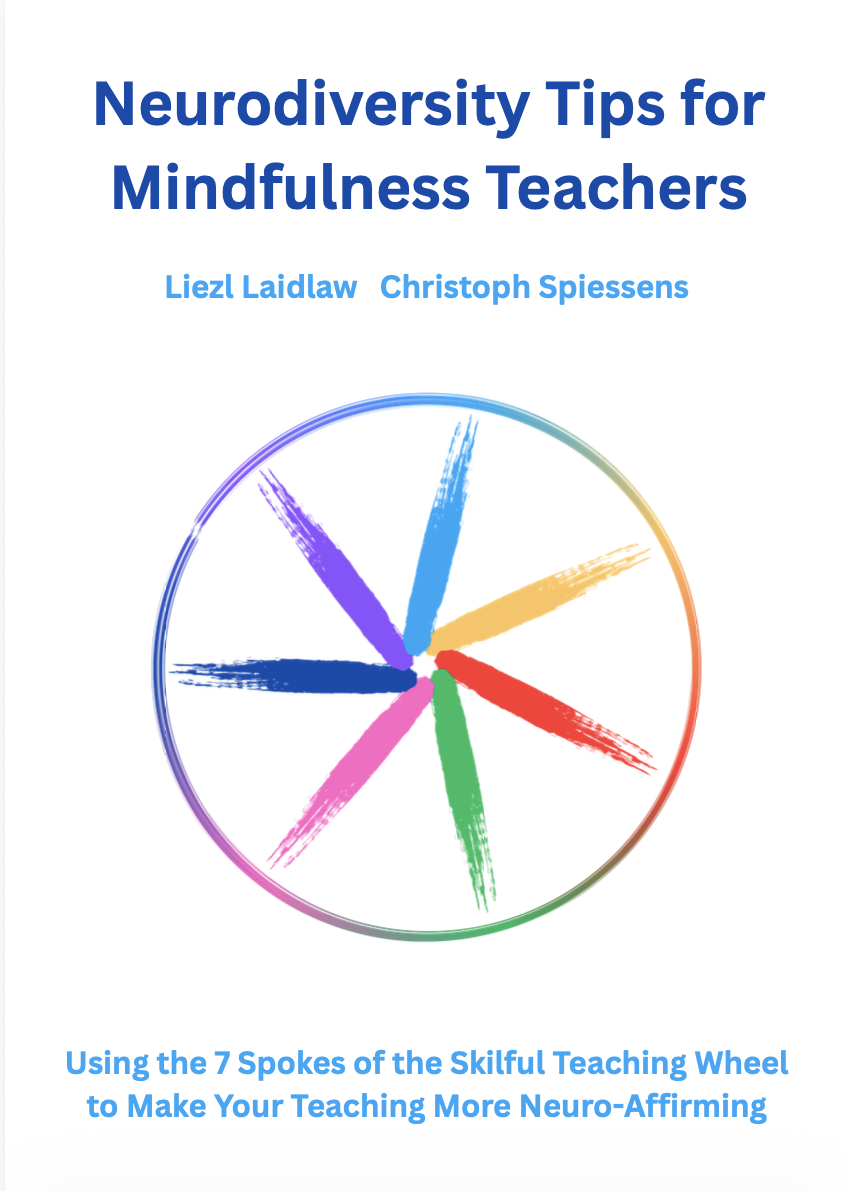
I’ve recently read an excellent booklet called Neurodiversity Tips for Mindfulness Teachers by Leizl Laidlaw and Christoph Spiessens. In this booklet, they present ‘7 Spokes of the Teaching Wheel’ with the aim of making mindfulness teaching more neuro-affirming. Whilst the target audience is mindfulness teachers, I found many of the tips relevant for my practice as an autistic shamanic practitioner who works with neurodivergent individuals.
The booklet is well laid out, well explained and accessible, in line with their values. It begins with a definition of neurodiversity and why awareness of the needs of neurodivergent (ND) communities is important. I particularly liked what they had to say about the benefits of authentic expression of one’s own neurotype for ND teachers. This is followed by a glossary listing neurotypes and neurological differences such as ADHD and alexisomia.
The 7 spoke wheel is then introduced with its practical guidelines. The first spoke is ‘Compass’. Its focus is ‘safety’ and it offers direction and alignment. It emphasises the importance of communicating an ND-inclusive approach from the beginning in terms of creating ‘clear, welcoming, and informative course information’ and providing different options for pre-course meetings, then goes into disclosure and access needs and pre-course conversations.
The second spoke is ‘Considering’ and its focus is ‘autonomy’. Here it is emphasised that ‘neurodivergent people are experts on their own experience’ and ‘differences are not pathologies’. The section on ‘programming and pacing’ outlines some considerations that are incredibly important for me as an autistic person. The absence of these, in the past, has led to me becoming extremely agitated in group settings and not returning. ‘Keep things predictable’. ‘Give clear time boundaries’. I cannot list the times I’ve been in a meeting or a workshop and there has been no timetable, or it has not been adhered to, and the conversation has steered away from the main focus onto an entirely irrelevant tangent. This is incredibly draining for autistic brains, which thrive on routine and predictability.
The third spoke is ‘Connecting’ and its focus is ‘respect’. Here we find guidelines for disclosing one’s own neurotype and being respectful of others by ensuring to name sarcasm and to avoid involuntary microagressions. This prevents neurodivergent individuals from feeling stupid because they don’t get a joke (this often happens to me as an autistic person – I’m always the last to get it!).
The fourth spoke is ‘Congruence’ and is about ‘explaining’. It involves being open about one’s own needs and ‘what’s happening in real time’ as well as being aware of what is happening for others. The fifth spoke is ‘Conducting’ and focuses on ‘adjustments’ such as being careful with metaphors, providing alternative anchors and alternatives to visualisation. The sixth spoke, ‘Conveying’, covers accessibility. For the seventh spoke, ‘Community’, ‘the unifying theme is difference’. This provides tips on helping everybody to feel safe and affirming each person’s unique contribution.
This book was helpful for me as an autistic shamanic practitioner who works with neurodivergent clients. Through it, I have discovered some neurological differences that I identify with or have seen in others that I was beforehand unable to name. One of these was: ‘Alexisomia: difficulty recognising or describing bodily sensations, such as hunger, tension, or comfort/discomfort’. Another was: ‘Misophonia: Strong emotional or physical reactions to specific everyday sounds. Examples include chewing, throat sounds, tapping, rustling, or repetitive environmental noises.’
I have learnt a lot about providing and maintaining a supportive space for neurodivergent clients and checking in about and accommodating for their needs. I have already noticed that not all people can visualise or understand metaphorical language and this booklet has expanded my awareness of this. It has also made me more aware of the need to provide alternative anchors during the grounding meditation that I provide to ensure that the client is present and in their body before undertaking a shamanic journey to the spirit realm.
In terms of congruence, I’ve learnt that it’s better to be authentic and to let a client know that I am autistic and that I struggle with processing large amounts of information (for example if someone is talking abut their ancestral lines I easily get confused) and ask them to slow down and repeat themselves rather than pretending I have understood and managed to take everything in. Also, if I’m having an off day, explaining that I’m struggling with autistic overwhelm or burnout and I may need to ask them to repeat their words.
I’d recommend this booklet to all shamanic practitioners and to others who practice and teach in the spiritual communities on the basis of its value for raising awareness of neurodiversity and for providing practical tips that can help us, together, to shape more neuro-affirming spaces.
You can purchase a copy of the PDF on the website of Christoph Spiessens HERE.
 The Sanctuary of Vindos
This looks like an excellent resource for those in many situations working with Neurodivergent individuals.