Spirits of the Sewers

Introduction

A couple of weeks ago, I shared a post about ‘Spirits of the Water Sources’. Today, I’m going to be looking at the other side of our relationship with water  spirits – those who have been assigned to carrying away our waste. 

In this article, I will cover the history of latrines and sewers in Britain and discuss how people related to, or failed to relate to, the spirits of these facilities. I will then share a little about the sewers of my locality and their spirits.

Prehistoric Latrines

It’s difficult to know what the earliest hunter-gatherer people did with their excrement. Because they were highly mobile and of small numbers, it’s possible to imagine that, when they set up camp, they chose a suitable place on the land and everything disintegrated and returned to nature. 

There is potential evidence for latrines from the Neolithic settlement at Skara Brae. Each dwelling contains a small cell with running water beneath that might have been used as a toilet (although its exact use is debated). 

This is the first instance I know of in which water is used to carry waste away from a settlement. My guess is that, in these times, for an animistic culture, certain areas of land and certain water courses were seen as less sacred than others. These lesser places and waters were delegated as latrines.

It’s possible there were rites for setting up a latrine in which the spirits of the land or waters were invoked, asked for permission, and thanked. Also, perhaps, for when the latrine was used as well.

Romano-British Latrines and Sewers

When the Romans conquered Britain and built their fortresses, these included latrines. Back in Rome, they had their own complex drainage and sewer system, the Cloaca Maxima. This was associated with a goddess named Cloacina, ‘the Purifier’, to whom offerings of coins were made in the drains.

The latrines at Roman forts in Britain consisted of long, open rooms with wooden or stone benches with keyhole-shaped openings. At Housesteads, there were twenty seats and at Vindolanda, where the oldest wooden toilet seat can still be viewed, sixteen. Using the toilet was a social occasion.The waste was flushed away with rainwater from a cistern or with hot water from the baths. It then ran into sewers and into the nearest watercourse.
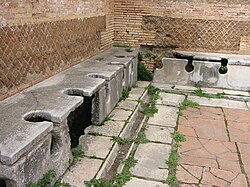
Roman toilets, from Ostia, Rome, as no British images available.

There is no evidence that Cloacina was venerated in Britain. However, coins and other objects such as gaming counters and beads have been found in the drains of Roman fortresses such as Eboracum and Vindolanda. Some of these are likely to be accidental losses but some might have been offerings to local purification deities who presided over the sewers and the drains.

Medieval Privies 

When Christianity replaced animistic beliefs, there was a shift in perception away from our bodies, bodily functions and waste products being part of the course of nature and the spirits who dealt with them being purifiers worthy of respect. Instead, they became viewed as sinful and corrupt.

In the Bible, in Kings 10:27, when the Temple of Baal is destroyed, it is turned into a latrine and this act of desecration is seen to rob it of its sanctity. Going to the toilet became shameful and was done in private, in privies.
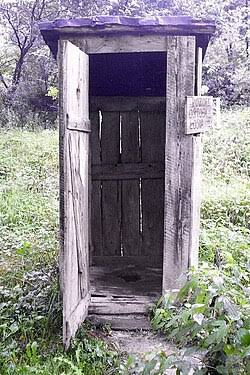
Outhouse

During the medieval period, privies were the most common form of latrine. These were outhouses built on the land of farms or in the backyards of houses. In towns and villages, a number of people shared a privy. It was a basic building with a hole in the floor and a cesspit beneath to collect waste. This was collected by night soil men, who took it to spread on the fields.

In medieval castles, there were garderobes, toilets built into the castle walls, from which the waste dropped down a chute into the moat or a cesspit. People also used chamber pots during the night, which they emptied into cesspits or water courses or added to the manure on their middens.

Only the monasteries had sewers. The toilet block, known as a reredorter (from rere ‘rear’ and dorter ‘dormitory’) was behind the sleeping quarters and was built over a flowing stream or a sewer channel, which led to a nearby river.

Waste was a dirty thing to removed from sight and mind by the men of the night. The purificatory spirits were no longer invoked. Yet, still, they served. As did those were called to dig out the cesspits and fertilise the fields.

Industrial Stink and the Sewage System

As the towns grew, in the industrial period, as an increasing number of people moved to dwell them in them in order to work in the mills and factories, human waste became a major problem. More people came to share limited latrines and the cesspits spilled and contaminated the water sources.

People emptied their chamber pots into the rivers or drains on the streets. Roads and water courses ran black with filth. It reeked. Diseases, such as cholera and typhoid, ran rife. Life expectancy was as low as nineteen.

The growing popularity, amongst the rich, of the flushing toilet didn’t help. The earliest flush toilet was designed for Queen Elizabeth by her godson, John Harrington, in 1596. In 1775 Alexander Cumming produced the widely recognised design with the U-bend to keep solids and their odour in their place.

In 1948 the Public Health Act was instituted to tackle sanitation issues. It was decreed that every house should have a water closet. Unfortunately, the use of flush toilets led to the water courses being overwhelmed more quickly.

The first sewers were constructed in Liverpool, between 1848 and 1862, in accordance with a programme created by James Newlands. Following the 1858 ‘Big Stink’ of London, Joseph Bazelgette constructed a sewer system with six main interceptors, incorporating stretches of London’s already culverted or ‘lost’ rivers to take the waste to the Thames estuary. Manchester and Preston developed sewers around this time.

Building of London sewage system in the 1860s

The development of Preston’s sewers was carried out by Preston Corporation Waterworks in tandem with the installation of piped drinking water. Water sources culverted underground such as the River Syke and the Moor Brook were used to carry surface run-off, industrial waste and sewage into the river Ribble. This was compounded by waste from other mill towns just as dirty, such as Blackburn and Darwen, coming down the river Darwen, and from Wigan coming down the river Lostock. 

The pollution and the works would have had a major impact on the water sources and their spirits, whose presence was unacknowledged and unappeased.

Wastewater Treatment Works

The waste was removed from the towns only to pollute the rivers. Thus, it was soon realised that it needed to be treated before it was discharged. 

The earliest wastewater treatment works was set up in 1864, at Beckton, in London. This used settling tanks to remove solids before discharging the liquids. In 1887, chemical methods to separate liquid and sludge were developed.

In 1894, Davyhulme Sewage Works opened outside Manchester. This pioneered the Active Sludge Process, invented by Edward Ardern and William Lockett, in 1914. In the first stage, bacteria and protozoa, powered by oxygen, break down pollutants. In the second stage, clarification, the biological flocs settle and are pumped back into the process whereas clear liquid remains. This is repeated until all the flocs have been processed and the water is clear. This technique is still used worldwide to this day.

At a modern wastewater treatment plant there are typically four stages. The first is screening to remove items like nappies, sanitary towels and cotton wool. The next, primary treatment, or sedimentation, is where the sludge settles to the bottom in large tanks and oils and grease are skimmed from the top. Secondary treatment is biological breakdown via the Active Sludge Process. Tertiary treatment involves filtering out any last remaining particles and disinfection by UV light or chemicals like chlorine to kill harmful bacteria. The effluent is then tested and released back into the watercourses. The solids are made into ‘cake’ for fertiliser or used to generate electricity.

In 1893, a sewage farm was developed at Freckleton to take the sewage from Preston and Fulwood and the waste was spread on the fields. The site was later replaced by the Preston Wastewater Treatment Works at Clifton Marsh. This currently receives the waste from Preston, my home town of Penwortham, and the surrounding area. The Walton-le-Dale Wastewater Treatment Works was established in 1891 and still caters for that area.

Preston Wastewater Treatment Works

When my house was built, in the 1940s, it would have been constructed with sewers leading, via Penwortham Pumping Station at Crookings Lane, to the Preston Waste Water Treatment Works.

What kind of purificatory spirits govern the processes of sedimentation, biological breakdown, filtering and disinfection is a question unasked and unanswered.

Storm Spills and the Preston Interceptor Tunnel

The development of better wastewater treatment has led to our rivers being cleaner. We’re still not there yet. In 2010, Preston’s 19th century sewage system was still emitting storm spills into the Ribble at times of heavy rain. 

This resulted in £114m project delivered by KMI+ for United Utilities to build a 3.5km interceptor tunnel capable of carrying and storing 40 million litres of water. This tunnel is famously wide enough to drive a car down. New storm tanks were also built to hold the water at Preston Waste Water Treatment works.

What new spirits abide in these tunnels and holding systems?

Journeying with the Spirits of the Sewers

The history of the sewers is intrinsically bound up with our rivers. The goddess of the river Ribble is called Belisama, ‘Most Shining One’. I see her tributaries as her daughters. Many of these rivers and brooks, such as the river Syke and the Moor Brook have been culverted to form drains and sewers. 

Additional tunnels have been built, subverting, changing the older courses. Do the same spirits flow in these channels or have new ones become? Is there a purificatory deity who presides over the drains and sewers of this watershed?

I took these questions when I journeyed to the spirits of my local sewage system. I didn’t get that much an answer. Journeying down our toilet, with my guides, we came out into a sewer where the sewage was flowing slowly. Every now and then its reluctant flow was punctuated by the splash of another flush, another push. The spirit was equally sluggish and uncommunicative. 

Contrastingly, we met a male brown rat and then ran into a female and her young in a nest of toilet paper. A larger rat-headed more humanoid spirit appeared and said, “As your population grows, as our sewers grow, we grow too.”

When I asked if there was a purifier present, the rat spirit just laughed and told me, “There is no purifier, no purity, nothing is pure in these sewers.”

We traversed the tunnels and arrived at the water treatment works. There, I gained a sense of the liveliness of the bacteria going about their work and the steady rhythms of the machines – the scrapers ceaselessly rotating, gathering the sludge that settles at the edges, pushing it to the centre for removal. I intuited the mechanical agency of the spirit but received no messages.

However, at the end, the message from Belisama and her daughters was loud and clear. “Your waste does not belong to the waters but to the land.”

SOURCES

Smith, P. ’Sanitation and Public Health’ in ‘Reforming Preston,’ Preston History, https://prestonhistory.com/subjects/reforming-preston-section-5/
Smith, P. ‘On this day… 16th September 1893, Preston History, (20230, https://prestonhistory.com/2023/09/16/on-this-day-16-september-1893/
‘Flushed Away: Sewers through History’, Science Museum, (2021), https://www.sciencemuseum.org.uk/objects-and-stories/everyday-wonders/flushed-away-sewers-through-history
‘The History of Water Treatment in the North West’, United Utilities, (2021), https://www.unitedutilities.com/corporate/responsibility/stakeholders/catchment-systems-thinking/beyond-water-series-alt/conventional-treatment-works/
‘Preston Unsatisfactory Intermittent Discharge (UID) Scheme, Peri, https://www.peri.ltd.uk/projects/preston-unsatisfactory-intermittent-discharge-scheme.html#impressions
‘Preston Tunnel,’ Longwood Engineering, https://longwoodengineering.co.uk/case-study/preston-tunnel/

Spirits of the Water Sources

Introduction – The Miracle of Water

The recent heat waves, here in the UK and across Europe, and the drought in southern England, have got me thinking about how deeply I appreciate our water sources and the continuing miracle of having water on tap. 

Here, in the Penwortham and Preston area, we’ve had piped water for around two centuries. And it has come at the great cost of our natural water sources being drained, ruptured, subverted, closed off, drying up. 

The Wells and Springs of Penwortham and Preston

There were once numerous wells and springs in Penwortham and Preston. On Castle Hill, Penwortham, St Mary’s Well and St Anne’s Well. In Preston, Lady Well, Spa Well (on Spring Row, near Spar Bath where springs were abundant), Main Sprit Weind Well, Ashton Quays Well, and the Dolphin Fountain.

Their abundance has its basis in our underlying geology. Deep beneath is a primary aquifer composed of Permian and Triassic sandstone which is nationally recognised as a high-quality drinking water source. Above, flanking the river Ribble and its tributaries, are secondary aquifers formed from bedrock blanketed by river alluvium and glacial meltwater sand and gravel. These provide pockets of groundwater and interact with river base flows. Contrastingly, the surrounding soil is clay, and acts as an aquitard.

The spring and well waters of Penwortham and Preston flowed from secondary aquifers. St Mary’s Well, which was renowned for its clear pure water as a holy well with healing qualities, ran dry after the aquifer was shattered when the river Ribble was moved 500m south, close to Castle Hill, during the building of the Riversway Docklands. The wells of Preston were drained, covered, and built over after piped water was introduced.

In my locality, on the 1840 OS map, there are three wells close to Fish House Brook in the area now known as Greencroft Valley. By the time of the 1890 OS map, they have disappeared. It was common for local farms and houses, such as Malt Kiln Farm and Hurst Grange, to have their own wells.

1840s OS map

Covered well at Hurst Grange Park now part of the path

As far as I know, the source of Fish House Brook was never used for drinking water. This is likely because it was dark and peaty, flowing off Penwortham Moss somewhere near the present-day southern end of Bank Parade.

The continuing presence of groundwater close to the surface was recently revealed around 10 years ago during the demolition of the Maltings and building of the new houses on Maltings Way and Birch Tree Drive. They broke the secondary aquifer, which continues to leak to this day, down the woodland bank in Greencroft Valley and into Fish House Brook. This has led to the water-logging of the soil and the death of many trees, mostly birch.

Preston Corporation Waterworks

The industrialisation of Preston and some of Penwortham began in the 18th century with Preston’s first cotton mill being opened in 1777. As the town grew, more water than local wells could provide was needed. In 1815, an Act of Parliament led to the formation of the Preston Improvement Commissioners to tackle civil infrastructure and organise a reliable public water supply. Water was first piped from Alston Springs. In 1835, Grimsargh Reservoir and Upper Dilworth reservoir were built to provide further supplies. The waterworks consisted of aqueducts, pumping stations and a network of pipes. 

Present-day Valley Road pumping station providing water to Penwortham

In 1844, due to concerns about the cleanliness of the water, Preston Corporation took over the waterworks. Around this time, the local wells were closed. Following the cholera outbreak in London, in 1854, St Mary’s Well was capped. The local supply was soon replaced with piped water.

Further reservoirs were built around Longridge – Alston 3 (1842), Spade Mill 1 (1862), Alston 2 (1899), Alston 3 (1931), Spade Mill 2 (1936). In 1932, Stocks Reservoir, in Bowland, was built to supply regional districts including Blackburn and the Fylde coast and began also to feed Preston.

Stocks Reservoir (Wikipedia Commons)

In 1959, Preston Corporation Waterworks was subsumed into Preston and District Water Board. It was then amalgamated into North West Water in 1974. In 1995, North West Water merged with NORWEB to become United Utilities. 

The Alston and Spade Mill reservoirs fell out of use until 2020. Due to increasing demand, the 9.7km Alston and Spade Mill pipeline was built to reconnect the four reservoirs into the network of pipes supplying the region, providing 38,000 million of litres a day – enough for 90,000 homes.  

Spirits of the Water Sources

From the times the first hominids walked the land until the last couple of centuries, water sources such as springs, wells, streams and rivers, have been viewed as sacred. They were seen as inspirited as evidenced by the names of deities, such as Belisama ‘Most Shining One’, goddess of the river Ribble, and folkloric legends of spirits of the wells and well maidens who tended them. These may have given rise to the common name ‘Lady Well’. Many of the well spirits were replaced with Christian saints with similar qualities.

During the industrial period, this sense of sanctity was lost. Water was commodified. People were severed from their connection with local water sources. We became used to having water on tap. Paid for. Paying the companies who had engineered its delivery rather than offering to its true source.

Sadly, most of the old sources are covered over, dried up. Fish House Brook, my closest water source, now emerges from its culvert through a concrete pipe. Still, it is still possible to visit, to pray, to sing, to commune, to make offerings.

Present-day source of Fish House Brook

When I consulted the Spirit of Fish House Brook on the matter she said:

‘You have broken our ability
to self-regulate, to filter.
You like straight lines.
We like to meander.
Your pipelines 
are like catheters –
lead to blockage and disease.’

Spirits of the Taps and Pipelines

We have three sets of taps in our house and one tap outside. All have their own personalities. Our kitchen tap drips. The bath taps are cranky. They grunt and groan. A bath or shower is never quite the right temperature. The taps of our new sink are far more congenial and friendly. The outdoor tap, to which the hose pipe is attached, is prone to surge and spit and leak.

My journeys to the pipes have been characterised by a feeling of the frustration of waters used to flowing, never stopping, by their own will and volition, getting contrarily pumped along, on demand, or forced to wait. 

There’s a sense of irritation at our clumsiness, at our ineptitude. An “Is it any wonder we burst your pipes?” “Is it any wonder you get infections like the cryptosporidium at the Franklaw Water Treatment Plant at Garstang?”

When I wonder who the ‘we’ are, my logical mind reminds me of the reservoirs and underground sources, but the waters spirits tell me they are “one”. I might call them “the spirits of the north west waters,” if I wish.

The pipes, like the taps, have their spirits too, their personalities. Bound up with them are their makers, their users, the places their materials come from. We have old lead pipes, hopefully, now, with another mineral deposit to be safe.

When I have a drink, a bath or a shower, something I have been doing automatically and without much thought since I was very young, I now do my best to give a word of thanks to the spirits of the waters, the taps, the pipes. To our artificial water sources and the still-living waters that flow within.

SOURCES

Dillon, P. ‘The Story of St Mary’s Well,’ Stories from the Land, (2014) https://peterjohndillon.wordpress.com/2014/02/23/the-story-of-st-marys-well-penwortham/
Whittaker, G.  ‘Waterworks and a high death rate, Victorian Preston,’ Blog Preston, (2023), https://www.blogpreston.co.uk/2023/04/waterworks-and-a-high-death-rate-victorian-preston/
‘16.5 million project to tap into north pennine water supplies gets underway in Lancashire, United Utilities, (2021) 

The Seeds of Willowherb

One of the signs that the end of summer is approaching in my locality is the seeds of willowherb. Willowherb species (Epilobium and Chamerion) have been present in Britain since the Late Glacial Interstadial (13,000 years ago) and began spreading vigorously again at the end of the last Ice Age. 

There are eight species of willowherb native to Britain: broad-leaved willowherb (Epilobium montanum), spear-leaved willowherb (Epilobium lanceolatum), pale willowherb (Epilobium roseum), great willowherb (Epilobium hirsutum), hoary willowherb (Epilobium parviflorum), marsh willowherb (Epilobium palustre), square-stalked willowherb (Epilobium tetragonum), and rosebay willowherb (Chamerion angustifolium). 

As the Latin names, such as montanum ‘of the mountain’ and palustre ‘of the marsh’ suggest, this ubiquitous plant has evolved to survive in many habitats. 

American willowherb (Epilobium ciliatum) was introduced in 1891 and New Zealand willowherb (Epilobium brunnescens) in 1904.

Of these species, three are common in my locality of suburban Penwortham: broad-leaved willowherb, great willowherb and rosebay willowherb. 

Broad-leaved willowherb is one of the smaller, most versatile, well-known and well-spread of the willowherbs. Growing from 20 – 60cm, it is typically found on mountains, in woodlands, on walls and on rocks. It grows all over our garden – in cracks in the paving stones, in flower beds; ever the opportunist, it even crashes into the pots of other plants. 

Its leaves have short stalks. They are opposite, oval to lanceolate, and are characterised by a broad base. The flowers are on terminal racemes. They are pink, with four notched petals. The stigma has four lobes. They measure 6 – 9mm. The stem is rounded and almost hairless. The seed pods are downy capsules 4 – 8cm long. When the capsules split, they release thousands of tiny seeds, (1mm long and 0.5mm wide) borne on tufts of long, silk white hairs called comas. These act as parachutes carrying them away on the wind to new destinations. 

Great willowherb is much larger, growing from 80 – 150cm. It is found on riverbanks, in fens, marshes and damp meadows, preferring neutral soils. Near me, it grows on the edges of ditches and streams in the Meadows, on the edges of the meadow areas in Greencroft Valley and in the meadows themselves. It also scattered around Preston Junction Nature Reserve.

Its leaves are lanceolate and clasping. Its flowers, on terminal racemes, are a deep purple-pink and notched. The stigma, again, has four lobes. They measure 15 – 23mm. The stems are round and downy. The seed pods are 5 – 9cm long. 

Rosebay willowherb is the giant of them all. It can grow up to 2m high. It is most often found on wasteland and locally occurs on former and current railway banks. It occurs in abundance at Preston Junction Nature Reserve. It is one of the few native plants that stands its ground to Himalayam Balsam.

Contrastingly, its lanceolate leaves are arranged alternately and spirally on its round, hairless stems. Its flowers, rose-purple, 20 – 30mm, grow in racemes on spikes. Its four-lobed stigmas bend down. Its seed pods are 4 – 10cm and can release as many as 80,000 hair-borne seeds from just one plant! 

The wispy white seed-fluff replacing the passionate pinks marks the end of summer. Willowherb, a perennial, will then enter dormancy. Its seed will go on. 

Willowherb is versatile and enduring and quite often a pioneer species. Famously, during the Second World War, rosebay willowherb colonised sites of bombings, leading to it becoming known as bombweed or singerweed. It is also known as fireweed because it springs up red in the wake of fires. 

With global heating accelerating at a staggering rate and wildfires raging across the world, including here in the UK, it is looking like we will be seeing more of fireweed, more of its seeds, through summer and its end.

“I will go on,” says this plant whose seed bank is now huge, “I will go on.”

*If you enjoy my writing please consider supporting me on Patreon HERE.*

Black Poplars at the Source

Beside the source of the brook in Greencroft Valley stand two black poplars. There aren’t any known British myths about black poplars but, in Greek myth, they are associated with Hades (the Underworld) and death. 

In Homer’s Odyssey, poplars, described in different translations as ‘tall’ and ‘dusky’, so likely black, with willow, form Persephone’s Grove. Springs, throughout world myth, are seen as entrances to the Underworld.

In another story from ancient Greece, Phaethon, son of the sun God, Helios, drives his father’s chariot too close to the sun. His blazing end brings deep grief to his sisters, who are transformed into black poplar trees. The amber sap is said to be their tears. Thus its associations with death and sorrow. 

In more recent folklore the red male catkins are referred to as ‘Devil’s Fingers.’

This leads me to believe that there might have once been parallel British myths about black poplar, connecting it with springs at the entrance to Annwn and with the groves of Annwn’s Queen. Perhaps there was once a story in which the red male catkins were the bloody fingers of Annwn’s King?

I will admit that I’m not sure if these trees are true black poplars (Populus nigra) or hybrids because black poplars are rare. Plus, I’m not referring to the true source of Fish House Brook but to the outflow pipe that the culverted brook emerges from. The original source would have lain further south, somewhere on Penwortham Moss, which has been drained and replaced by housing. The brook is culverted under the gardens on the other side of my street, Bank Parade, also giving its name to Burnside Way. I feel this relates to my founding of the Sanctuary of Vindos / Gwyn ap Nudd, a King of Annwn, very near to the ‘black poplars’ at the ‘source’.

In a shamanic journey I visited the poplars for advice on descending to the ancestors in preparation for some ancestral healing work. I was shown the left tree represented my mother line and the right my father line. I slid down the roots of the left into a cavern where a group of spirits were drinking from cups from the same source. I was told that on the new and full moons I must consecrate a cup of water and make an offering:

“To the Gods,
spirits and ancestors –
we all drink from the same source.”

I felt this related to keeping the source clean – something I have been trying to do as a volunteer in Greencroft Valley with the Friends group I set up (now part of Guardians of Nature).

Omen of a Mossy and Spidery New Year

Yesterday I went for a New Year’s Eve walk with a friend around Longton Brickcroft Nature Reserve. The first thing I saw, on the gate on the way on in, was a small patch of moss with a tiny spider stringing a thread between the sporophytes. I think the moss is Creeping feather-moss (Amblystegium Serpens), but I’m not sure about the spider. The presence of palps shows its a male and I suspect it belongs to the Linyphiidae ‘Money Spiders’, likely one of the species impossible to identify without a microscope.

It felt like an omen of a mossy and spidery New Year.

A Mossy Holiday

A two week holiday has given me the chance to start exploring and recording the mosses and liverworts in my local area. Equipped with a x 10 hand lens and the FSC Field Guides to common species in woodlands and gardens, backed up by the British Bryological Society’s Mosses and Liverworts of Britain and Ireland a Field Guide, I have made some interesting discoveries and managed to identify more bryophytes than hoped.

I started with my garden and firstly discovered that the moss which is everywhere is Rough-stalked feather-moss (Brachythecium rutabulum) in various stages of growth. It came as no little surprise that Springy turf-moss (Rhytiadelphus squarrosus) is in my lawn. I was excited to find the unmistakable Big-shaggy-moss (Rhytiadelphus triquestrus) on a stony area. The fourth moss, growing in a damp area beneath the shed (which is not on the FSC Field Guides, but I have identified from the key in the BBS Field Guide by its capsules) is Clustered feather-moss (Rhynchostegium confertum).

In Greencroft Valley the most abundant species of moss is Common feather-moss (Kindbergia praelonga). My guess is the acrocarpous moss covering two Elders and seen on the trunks of other trees may be Common smoothcap (Atricham undulatum).

Beside the brook I spotted Common pocket-moss (Fissidens taxifolius) alongside some fascinating plants I cannot name.

I then decided to go to Castle Hill as some of the woodland on its banks is ancient. By the steps up the hill from Well Field, past where St Mary’s Well once was, I found more Common pocket-moss, and Cypress-leaved plait-moss (Hypnum cuppreseforme) on a fallen branch.

On the wall on Church Avenue and on the old stone cross halfway down was the evocatively named Grey-cushioned grimmia (Grimmia pulvinata). It is named after a German scientist called Johann Friedrich Carl Grimm yet, to me, the name ‘grimmia’ is particularly evocative of this unmistakable mossy creature. By this point I had started getting to grips with taking photos through my hand lens.

On a stone on the side of Church Avenue was this unidentified acrocarpous moss.

In Church Wood the most abundant moss was Common feather-moss (here with capsules present).

Another unidentified moss was found on the pathway on the fallen branch of a tree.

Although I didn’t identify as many different mosses as I had hoped to in Church Wood it was a treat to find Great scented liverwort (Conocephalum conicum) on a damp bank.

So far I have been delighted to discover so many mosses within walking distance of my home in a couple of days. I am planning to continue to explore and record the bryophytes of my local area and on the Manchester Mosslands in the New Year.

My Green Chapel

I watch through the window
of the only house on this street not lit 
by party lights, the only one where ivy grows,
the one that seems shrouded by darkness and by sorcery.

The steady sound of hoofbeats has been coming to the North
since before the beginning of time, the beginning of myth,
the court of Arthur, and still he comes, the one we call Gawain.

He does not expect a woman this time crowned in holly and ivy.

He cowers away from the blood-red berries of my eyes 
and averts his gaze from the scars on my arms, 
imagining some distant rite of passage
even I can no longer remember.

I have been sharpening my axe
for a long, long time, waiting for the day
my Lord will no longer have the time to play this game.

I commend his courage, speak of the mathematical percentages
of the people who would take the Green Knight’s challenge,
those who would return to meet their fate.

“You’re the only one,” I laugh aloud.

His eyes are big as portals to the Otherworld. 

One day I will step through them and he will follow.

But not today because the blade of my axe just nicks
his neck, a small cut, which will leave a scar beside the others.

I straighten up with a blood-red stare and send him on his way
because my Lord and I have no more time for games.

Allotment C23

A plot of land in the bend of Fish House Brook,
tell me, my gods, is this my allotted place?

A place to dig, to sow, to watch life grow,
leaving the battlefield and the ravens behind me

like the servicemen returning from the First World War?

Is it time to leave the heroes to be pecked apart
and join, instead, with the labouring poor?

To set aside the books of heroic poetry –
the verses on shattered shields and clashing spears,

the blood and bones to the soil return with spade
and hoe to feed the future generations?

Tell me, my gods, is this my allotted place?
A plot of land in the bend of Fish House Brook

my Bremetennacum Veteranorum as I enter my later years?

As you might have guessed, after a year’s wait, I am finally the proud tenant of an allotment. This has come about after a difficult year during which I’ve felt like I’ve been kicked in the teeth by the universe in many ways, one of them being the landslide on Castle Hill cutting off my access to the yew tree where I dedicated myself to Gwyn on Fairy Lane.

I now feel my gods have gifted me with an alternative. It is happily within a bend of Fish House Brook, which begins near my house and runs through Greencroft Valley, where I run a friends group, before joining the Ribble at Fish House Bridge on the other side of the allotments. In this I see the guiding hand of Belisama, goddess of the Ribble, along with the land spirits and Gwyn and his ‘family’ – the Tylwyth Teg or ‘fairies’.

Whereas I had been considering moving away to find a job in conservation this has led me to decide to remain rooted in Penwortham, even if it means a longish commute. I am beginning a month of cotton grass planting on Little Woolden Moss near Manchester next week, which will be my first paid contract, and a couple of paid traineeships have come up in Bolton, so possibilities are opening up.

Having spent the last decade working with the heroic poetry of the Old North, not least in my latest collection ‘Co(r)vid Moon’ whose main characters are battlefield ravens, I’m sensing a shift away from the medieval courts, where I never belonged with the Taliesins, toward a poetry of the land, to where I belong, alongside other labouring poets.*

Although I’m far from retirement age I see this as a step in maturing and and stepping up to take responsibility for leading a sustainable life as I head toward the big 40 this November.

Since I took this photograph I have been clearing the paths, weeding, digging and putting manure on the beds, and chitting my first early potatoes.

I can now call myself an allotmenteer 🙂

*For example Ted Hughes and Alice Oswald whose work is based on their lived experience of working the land. (Although, of course, I do not claim to be as good!).

Landslip

Fairy Lane, January 2021

Landslip, landslide,
we live in treacherous times,
the very land we hold so dear to us
with the grounds of life as we know it is
being pulled from beneath our feet.

Orange mesh and ‘Do Not Enter’ signs
at the entrances to Fairy Lane do not deter me
slipping by fay-like to bear witness
to another cataclysmic event.

For a long while railings, gravestones,
have been falling away and no-one speaks
of gathering up the bones of the dead.

This has been a place of peace with its
holy well, monastery, church, and chapel,
but has also been a place of penitence.

Black Roger sent to the ends of the earth.

(I sometimes wonder if I am a penitent
and whether I have served my time).

The weather gods have been cruel
this year with their freeze-thaw-rain
dichotomy opening fresh wounds.

The steps leading down to the yew
where I first met Gwyn ap Nudd and to him
made my dedication defying the transcendent gaze

of the Christian God who has never set foot on this earth
(except perhaps in his son whose feet in ancient times
may have walked here in Blake’s poetry)

are now twisted like something out of Labyrinth.

He has thrown my world out of kilter again –
a consequence of being devoted to a wild god…

When I see trees upside-down I think how natural
it is for us to fall whereas trees are born upright
and to go root over crown is certain death.

Yet as we grow older falls hurt more
and we come to wonder which will be the last.

~

I wrote this poem after being called to bear witness to yet another cataclysmic event in my local area. It was three days until the January full moon, on which I made my life-long dedication to my patron god, Gwyn ap Nudd, beside the leaning yew tree on Fairy Lane two years ago. (I made my initial dedication to him at the White Spring beneath Glastonbury Tor on the January moon in 2013.)

It’s a place I visit often, so I was surprised, when I got there, to find orange mesh across the entrance from the A59 and to read a notice stating that the footpath was closed due to a landslip. I walked to the second entrance by the Ribble where, again, I found the orange mesh, but it didn’t extend into the woodland.

Following the intuition that the place was safe now and my gods wanted me to see what had happened I slipped past. Usually the council will fence things off at the tiniest reason. This was not small. It was catastrophic. A whole swathe of land had slipped away from the side of Church Avenue, which runs along Castle Hill – a pen ‘prominent headland’ – shaped a bit like Pendle. It had piled up on Fairy Lane with the debris of huge ivy-clad trees in their prime, fallen root over crown.

Furthermore the steps leading down to the leaning yew had been skewed and looked dangerous.

In some ways, that this had happened, was not a surprise. The whole bank, with its leaning trees, has always looked precarious. There have been landslips before, bearing away railings and graves. Due to falling gravestones the castle mound and parts of the graveyard have been closed off for several years.

There are several reasons for the instability of the land. When the river Ribble was moved five hundred yards south from her original course to run beside Castle Hill, the sandstone bedrock was shattered. The aquifer beneath the hill was broken, leading to the holy well at the hill’s foot drying up. The building of the adjacent by-pass and its vibrations are likely causing the damaged land to slip.

The final contributor to this is the recent weather with its dangerous patterns of freezing, thawing, and heavy rain. No doubt all these factors have come together to cause these landslip.

Yet as well as physical reasons there are spiritual reasons too. The conversion of the hill and well from a pre-Christian to Christian sacred site and the severing of the links between the people and the gods of the land have led to the mindset that makes moving a river, shattering an aquifer that feeds a holy well, and building a by-pass beside a sacred place acceptable. Within a culture that saw the river as a divinity and the hill as the body of a goddess and abode of the dead and their god these would have been seen as acts of desecration that would bring about the wrath of the gods. And so their anger is seen in the decline of this once (and still on occasion) beautiful and enchanting place.

My first thought, when I arrived at the scene, was that this was linked somehow to my Gwyn dedication. Had I done something wrong? Was I on the wrong track? Might it be linked to the series of workshops on Gwyn and his family I am planning with other Gwyn devotees for Land Sea Sky Travel?

I received the gnosis that the landslip had nothing to do with me or my actions and would have happened anyway. I was already in two minds about visiting the yew on my dedication day as I am at my conservation internship on that day and don’t really want to go at night without a friend to accompany me (due to lockdown).

What it means to have the place I met Gwyn and made my life-long dedication cut off I haven’t cogitated yet. It seems to fit with two bridges over the Ribble being declared dangerous and closed. The land, the gods, displaying their anger, the council attempting to protect us, connections being severed.

This event has also made me aware the yew, leaning precariously on an ash, won’t be there forever…

The River Did Not Burst Her Banks

You did not burst your banks today…

River goddess your fearsome torrent pouring
from here to the sea how many times do I have to stand in you,
no, to drown in you, to know you are never the same?

What rites would you have me keep, Riga Belisama, as I walk beside you?

Long have I kept this piece of your humble mudstone close to my heart
(which I must give back should I ever leave), renewed your waters,
lit your candle, created for you a little temple

and cleared Fish House Brook – just one of your dirty daughters
running from one of the estates to the sea.

I have seen your many colours –
red, blue, green, grey as concrete bollards.

What is a river without a goddess or a goddess without a river
meandering, twisting, to the sea, like our own blue blood to our heart?

Sometimes I see you as a goddess but most often you are being a river,
fulfilling your purpose, delivering water, divine water-bearer.

To be one with your flow on days like this is a blessing,
to walk so close to the edge knowing I could be carried away

by your rush of waters, by your rush of deadly words,
but you did not burst your banks today.

I wrote this poem after my daily walk beside the Ribble yesterday during Storm Christoph. Contrary to the flood warnings the river did not burst her banks but came very close, the water lapping at the edge, at high tide. It’s not often we can walk so close to a force of nature, to a mighty goddess, whose might could destroy us if we take a false step – an experience awe-inspiring and humbling.

We were lucky, here in Penwortham, that the river did not burst her banks. Upriver Brockholes Nature Reserve has been forced to close due to the access road flooding. People from Didsbury and Northenden in Manchester, Maghul in Merseyside, and Ruthin and Bangor-on-Dee in North Wales have been evacuated. This must be a doubly awful experience during a pandemic. The combination of the virus with flooding feels like an ominous portent of decline and I fear worse is to come.

The first time I saw major floods on the Ribble was 2015 and she has flooded almost every winter since. In response, the Environment Agency and Lancashire County Council have implemented the Preston and South Ribble Flood Management Scheme, which will raise the current flood walls from 1.2 metres to up to 2.2 metres, with a glass screen at the top so people can see the river, and build new ones.

Some of the trees on the banks, such as the row of elms near the Continental pub, will be dug up to make way for the defences. Five new trees will be planted for each tree removed, but it will be forty to fifty years until they are the size of the original ones. Local people have asked for the old trees to be made into benches.

More positively, some of the area, which is now Preston Junction Nature Reserve, rather than housing, due to the Save the Ribble campaign, is going to be kept as flood plain. There are plans for the creation of a new wetland habitat with ponds with dipping platforms, species-rich wildflower meadows and grasslands, wet woodlands, and orchard trees.

My local stretch of the Ribble, where I have been walking for nearly forty years, is going to change dramatically. How long the defences will keep people’s homes safe I don’t know. As this past year has shown, our safety from the forces of nature, small and large, is very much illusory. The climate and the world are changing. The river will burst her banks again. Yet, on her banks, we find the very first snowdrops, who have weathered the floods. A small sign of hope in these apocalyptic times.