Introduction
A couple of weeks ago, I shared a post about ‘Spirits of the Water Sources’. Today, I’m going to be looking at the other side of our relationship with water spirits – those who have been assigned to carrying away our waste.
In this article, I will cover the history of latrines and sewers in Britain and discuss how people related to, or failed to relate to, the spirits of these facilities. I will then share a little about the sewers of my locality and their spirits.
Prehistoric Latrines
It’s difficult to know what the earliest hunter-gatherer people did with their excrement. Because they were highly mobile and of small numbers, it’s possible to imagine that, when they set up camp, they chose a suitable place on the land and everything disintegrated and returned to nature.
There is potential evidence for latrines from the Neolithic settlement at Skara Brae. Each dwelling contains a small cell with running water beneath that might have been used as a toilet (although its exact use is debated).
This is the first instance I know of in which water is used to carry waste away from a settlement. My guess is that, in these times, for an animistic culture, certain areas of land and certain water courses were seen as less sacred than others. These lesser places and waters were delegated as latrines.
It’s possible there were rites for setting up a latrine in which the spirits of the land or waters were invoked, asked for permission, and thanked. Also, perhaps, for when the latrine was used as well.
Romano-British Latrines and Sewers
When the Romans conquered Britain and built their fortresses, these included latrines. Back in Rome, they had their own complex drainage and sewer system, the Cloaca Maxima. This was associated with a goddess named Cloacina, ‘the Purifier’, to whom offerings of coins were made in the drains.
The latrines at Roman forts in Britain consisted of long, open rooms with wooden or stone benches with keyhole-shaped openings. At Housesteads, there were twenty seats and at Vindolanda, where the oldest wooden toilet seat can still be viewed, sixteen. Using the toilet was a social occasion.The waste was flushed away with rainwater from a cistern or with hot water from the baths. It then ran into sewers and into the nearest watercourse.
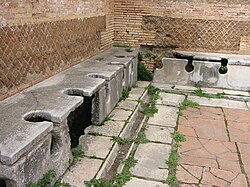
There is no evidence that Cloacina was venerated in Britain. However, coins and other objects such as gaming counters and beads have been found in the drains of Roman fortresses such as Eboracum and Vindolanda. Some of these are likely to be accidental losses but some might have been offerings to local purification deities who presided over the sewers and the drains.
Medieval Privies
When Christianity replaced animistic beliefs, there was a shift in perception away from our bodies, bodily functions and waste products being part of the course of nature and the spirits who dealt with them being purifiers worthy of respect. Instead, they became viewed as sinful and corrupt.
In the Bible, in Kings 10:27, when the Temple of Baal is destroyed, it is turned into a latrine and this act of desecration is seen to rob it of its sanctity. Going to the toilet became shameful and was done in private, in privies.
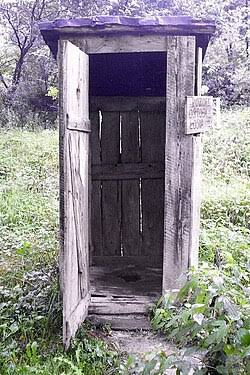
During the medieval period, privies were the most common form of latrine. These were outhouses built on the land of farms or in the backyards of houses. In towns and villages, a number of people shared a privy. It was a basic building with a hole in the floor and a cesspit beneath to collect waste. This was collected by night soil men, who took it to spread on the fields.
In medieval castles, there were garderobes, toilets built into the castle walls, from which the waste dropped down a chute into the moat or a cesspit. People also used chamber pots during the night, which they emptied into cesspits or water courses or added to the manure on their middens.
Only the monasteries had sewers. The toilet block, known as a reredorter (from rere ‘rear’ and dorter ‘dormitory’) was behind the sleeping quarters and was built over a flowing stream or a sewer channel, which led to a nearby river.
Waste was a dirty thing to removed from sight and mind by the men of the night. The purificatory spirits were no longer invoked. Yet, still, they served. As did those were called to dig out the cesspits and fertilise the fields.
Industrial Stink and the Sewage System
As the towns grew, in the industrial period, as an increasing number of people moved to dwell them in them in order to work in the mills and factories, human waste became a major problem. More people came to share limited latrines and the cesspits spilled and contaminated the water sources.
People emptied their chamber pots into the rivers or drains on the streets. Roads and water courses ran black with filth. It reeked. Diseases, such as cholera and typhoid, ran rife. Life expectancy was as low as nineteen.
The growing popularity, amongst the rich, of the flushing toilet didn’t help. The earliest flush toilet was designed for Queen Elizabeth by her godson, John Harrington, in 1596. In 1775 Alexander Cumming produced the widely recognised design with the U-bend to keep solids and their odour in their place.
In 1948 the Public Health Act was instituted to tackle sanitation issues. It was decreed that every house should have a water closet. Unfortunately, the use of flush toilets led to the water courses being overwhelmed more quickly.
The first sewers were constructed in Liverpool, between 1848 and 1862, in accordance with a programme created by James Newlands. Following the 1858 ‘Big Stink’ of London, Joseph Bazelgette constructed a sewer system with six main interceptors, incorporating stretches of London’s already culverted or ‘lost’ rivers to take the waste to the Thames estuary. Manchester and Preston developed sewers around this time.

The development of Preston’s sewers was carried out by Preston Corporation Waterworks in tandem with the installation of piped drinking water. Water sources culverted underground such as the River Syke and the Moor Brook were used to carry surface run-off, industrial waste and sewage into the river Ribble. This was compounded by waste from other mill towns just as dirty, such as Blackburn and Darwen, coming down the river Darwen, and from Wigan coming down the river Lostock.
The pollution and the works would have had a major impact on the water sources and their spirits, whose presence was unacknowledged and unappeased.
Wastewater Treatment Works
The waste was removed from the towns only to pollute the rivers. Thus, it was soon realised that it needed to be treated before it was discharged.
The earliest wastewater treatment works was set up in 1864, at Beckton, in London. This used settling tanks to remove solids before discharging the liquids. In 1887, chemical methods to separate liquid and sludge were developed.
In 1894, Davyhulme Sewage Works opened outside Manchester. This pioneered the Active Sludge Process, invented by Edward Ardern and William Lockett, in 1914. In the first stage, bacteria and protozoa, powered by oxygen, break down pollutants. In the second stage, clarification, the biological flocs settle and are pumped back into the process whereas clear liquid remains. This is repeated until all the flocs have been processed and the water is clear. This technique is still used worldwide to this day.
At a modern wastewater treatment plant there are typically four stages. The first is screening to remove items like nappies, sanitary towels and cotton wool. The next, primary treatment, or sedimentation, is where the sludge settles to the bottom in large tanks and oils and grease are skimmed from the top. Secondary treatment is biological breakdown via the Active Sludge Process. Tertiary treatment involves filtering out any last remaining particles and disinfection by UV light or chemicals like chlorine to kill harmful bacteria. The effluent is then tested and released back into the watercourses. The solids are made into ‘cake’ for fertiliser or used to generate electricity.
In 1893, a sewage farm was developed at Freckleton to take the sewage from Preston and Fulwood and the waste was spread on the fields. The site was later replaced by the Preston Wastewater Treatment Works at Clifton Marsh. This currently receives the waste from Preston, my home town of Penwortham, and the surrounding area. The Walton-le-Dale Wastewater Treatment Works was established in 1891 and still caters for that area.

When my house was built, in the 1940s, it would have been constructed with sewers leading, via Penwortham Pumping Station at Crookings Lane, to the Preston Waste Water Treatment Works.
What kind of purificatory spirits govern the processes of sedimentation, biological breakdown, filtering and disinfection is a question unasked and unanswered.
Storm Spills and the Preston Interceptor Tunnel
The development of better wastewater treatment has led to our rivers being cleaner. We’re still not there yet. In 2010, Preston’s 19th century sewage system was still emitting storm spills into the Ribble at times of heavy rain.
This resulted in £114m project delivered by KMI+ for United Utilities to build a 3.5km interceptor tunnel capable of carrying and storing 40 million litres of water. This tunnel is famously wide enough to drive a car down. New storm tanks were also built to hold the water at Preston Waste Water Treatment works.
What new spirits abide in these tunnels and holding systems?
Journeying with the Spirits of the Sewers
The history of the sewers is intrinsically bound up with our rivers. The goddess of the river Ribble is called Belisama, ‘Most Shining One’. I see her tributaries as her daughters. Many of these rivers and brooks, such as the river Syke and the Moor Brook have been culverted to form drains and sewers.
Additional tunnels have been built, subverting, changing the older courses. Do the same spirits flow in these channels or have new ones become? Is there a purificatory deity who presides over the drains and sewers of this watershed?

I took these questions when I journeyed to the spirits of my local sewage system. I didn’t get that much an answer. Journeying down our toilet, with my guides, we came out into a sewer where the sewage was flowing slowly. Every now and then its reluctant flow was punctuated by the splash of another flush, another push. The spirit was equally sluggish and uncommunicative.
Contrastingly, we met a male brown rat and then ran into a female and her young in a nest of toilet paper. A larger rat-headed more humanoid spirit appeared and said, “As your population grows, as our sewers grow, we grow too.”
When I asked if there was a purifier present, the rat spirit just laughed and told me, “There is no purifier, no purity, nothing is pure in these sewers.”
We traversed the tunnels and arrived at the water treatment works. There, I gained a sense of the liveliness of the bacteria going about their work and the steady rhythms of the machines – the scrapers ceaselessly rotating, gathering the sludge that settles at the edges, pushing it to the centre for removal. I intuited the mechanical agency of the spirit but received no messages.
However, at the end, the message from Belisama and her daughters was loud and clear. “Your waste does not belong to the waters but to the land.”
SOURCES
Smith, P. ’Sanitation and Public Health’ in ‘Reforming Preston,’ Preston History, https://prestonhistory.com/subjects/reforming-preston-section-5/
Smith, P. ‘On this day… 16th September 1893, Preston History, (20230, https://prestonhistory.com/2023/09/16/on-this-day-16-september-1893/
‘Flushed Away: Sewers through History’, Science Museum, (2021), https://www.sciencemuseum.org.uk/objects-and-stories/everyday-wonders/flushed-away-sewers-through-history
‘The History of Water Treatment in the North West’, United Utilities, (2021), https://www.unitedutilities.com/corporate/responsibility/stakeholders/catchment-systems-thinking/beyond-water-series-alt/conventional-treatment-works/
‘Preston Unsatisfactory Intermittent Discharge (UID) Scheme, Peri, https://www.peri.ltd.uk/projects/preston-unsatisfactory-intermittent-discharge-scheme.html#impressions
‘Preston Tunnel,’ Longwood Engineering, https://longwoodengineering.co.uk/case-study/preston-tunnel/
What an incredible post. I’ve only recently been working with the spirits of my manure pile (I’ve got a pony) and it’s been really fascinating.
But I’ve never thought to engage with the spirits of waste and purification in this manner.
Thank you SO much for not only the inspiration but all the great information.
‘I’ve only recently been working with the spirits of my manure pile (I’ve got a pony) and it’s been really fascinating.’
I used to love doing the midden when I worked with horses. Looking back each midden did have a spirit!