Getting to Know River Deities

For many thousands of years, the people of Britain were animists and polytheists who believed the land was sacred, inspirited, alive with Gods and spirits. Prominent landforms, in particular rivers, were venerated as Deities.

Some of the Brythonic names of our river Deities were recorded by the Roman geographer, Ptolemy, in his Geography (2 CE). These include Sabrina (from sabra ‘boundary’) for the river Severn, Clota ‘the Pure One’ for the river Clyde, and Belisama ‘Most Shining One’ for the river Ribble. ‘Old Father Thames’ is a later folkloric name for the Thames, which might derive from Tamesis ‘river’.

The river Ribble, whose Goddess is Belisama, ‘Most Shining One’

Votive offerings of metalwork from the Bronze Age and stretching into the medieval period provide evidence for the veneration of river Deities. Famous examples include the Battersea Shield and Waterloo helmet from the river Thames and hundreds of Bronze Age swords and spears from the river Trent.  Metalwork, such as a Bronze Age spearhead, has also been found in the river Ribble.

Up until the 19th century, people were directly dependent on rivers for drinking and washing water, food, and transport. Springs, flowing into streams, into rivers, provided clean, pure water for drinking. Clothes were taken to chosen watercourses (such as Swill Brook) to be washed. Fishing and fish garths provided an important source of food. With the land being wooded, or wet and boggy, it was far easier to travel by canoe.

Rivers and their Deities were perceived to be both nurturing and cleansing and dark and destructive. This is seen in Belisama’s veneration as a shining and mighty Goddess who is reputed to take a life every seven years. The river Dart is viewed to be even more dangerous, taking a life every year. “River of Dart, oh River of Dart, every year thou claimest a heart.” Some believe these folkloric sayings date back to human sacrifice and others that they reflect the dangers of accidents or the pull of suicide. Having lived near the Ribble most of my life, I have seen Her taking lives with increasing frequency.

River Deities might be seen as the ‘mothers’ or ‘fathers’ of Their watershed and Their tributaries as Their offspring. This is how I perceive Belisama and Her ‘daughters’ – rivers such as the Darwen and the Douglas and my local streams, such as Fish House Brook, Penwortham Brook and Mill Brook.

Over fifteen years ago, before I learnt Belisama’s name, I was called to walk the Ribble Way from the source, Ribble Head, to the estuary at Longton Marsh. Looking back, I feel this was a form of introduction. As I learnt more about Paganism, I began paying greater attention as I walked and cycled my local stretch from Riversway Docklands to Brockholes Nature Reserve, to meditate on Her banks, to pray to Her and make offerings of songs and poetry. 

It was a while until She appeared to me in an anthropomorphic form as a shining and mighty Goddess. I find this is the case even now. Often I hear Her song. But she’s usually too busy being a river to make a visionary appearance. 

Belisama gifted me a poem, an address to the city called ‘Proud of Preston’ written in her voice and this was made the Preston Guild Poem in 2012. I wondered if this meant She was destined to be my patron Goddess, that I was destined to be Belisama’s bard. But it turned out not. Vindos claimed me. 

I have spent many an hour walking the Ribble, pausing, watching the wildlife. Herons standing patient, single-legged, each with their own territory. Cormorants shooting straight as bullets or standing like pirates on abandoned jetties. Flocks of black-headed gulls. Raucous herring gulls swooping to snatch up chips. Goosander diving. Widgeon whistling. Mute swans. Pink-footed geese and Bewick’s and whooper swans returning. 

I am lucky enough to live on a tidal stretch of the Ribble where I can observe the tides moving both out and in. I’ve observed flooding on Avenham Park, the nearby fields, and Penwortham Holme and the building of the flood defences.

Paying attention as I walk and cycle is a continuing service to Belisama. I regularly provide a greater service to one of Her daughters, Fish House Brook, who flows through Greencroft Valley. She is named for the Fish House, near where she meets the Ribble, where many fish were once caught. Sadly, Her earlier name is unknown but perhaps it relates to silver fishes. 

I litter pick the valley that She runs through. When I first started doing this, Her course was dammed with fallen branches filled with litter, including food waste, which was heaving with maggots and other leech-like things. Clearing this away was disgusting but worth the effort as She flowed free and clean again. 

Unfortunately there have been issues with waste water being mis-piped into drain water that have led to Her pollution, but slowly, through collaboration with United Utilities, this has been improved and Her waters are clearer.

Now Greencroft Valley is better cared for and fewer people drop litter, we have decided to leave branches in Fish House Brook to ‘slow the flow’ as increased rain fall over the winter leads to higher risks of flooding. 

This is the story of my relationship with Belisama and Her daughters. If you would like to get to know the Deity of your local river you could try a similar process. Firstly, find out the name of the main river of your watershed. It could be that research turns up the name of its Deity, or it can be derived from the etymology. For example, there are no ancient records for the river Lune, which first appears in the Domesday Book (1086), buts its etymology, from *lǭn ‘healthy’ or ‘pure’ is suggestive of a name such as ‘the Healthy One’.

Next, begin walking the river, or the tributaries that are nearest to you. Pay attention with both your outer and inner senses. Notice the speed and patterns of the water, their timbre, their sound, how they change in different weather. Get a sense of their language. How they speak to you. Get to know the wildlife, the distinguishing features, the calls of the birds, their life cycles. Take time to sit and meditate. Pray. Make offerings. Create and offer art. Where safe you could also remove litter from the river and its banks. 

Nurture your relationship and you will be nurtured in turn as reciprocity is re-established, flowing from the source, through many bends, out to the estuary.
Spirits of the Sewers

Introduction

A couple of weeks ago, I shared a post about ‘Spirits of the Water Sources’. Today, I’m going to be looking at the other side of our relationship with water  spirits – those who have been assigned to carrying away our waste. 

In this article, I will cover the history of latrines and sewers in Britain and discuss how people related to, or failed to relate to, the spirits of these facilities. I will then share a little about the sewers of my locality and their spirits.

Prehistoric Latrines

It’s difficult to know what the earliest hunter-gatherer people did with their excrement. Because they were highly mobile and of small numbers, it’s possible to imagine that, when they set up camp, they chose a suitable place on the land and everything disintegrated and returned to nature. 

There is potential evidence for latrines from the Neolithic settlement at Skara Brae. Each dwelling contains a small cell with running water beneath that might have been used as a toilet (although its exact use is debated). 

This is the first instance I know of in which water is used to carry waste away from a settlement. My guess is that, in these times, for an animistic culture, certain areas of land and certain water courses were seen as less sacred than others. These lesser places and waters were delegated as latrines.

It’s possible there were rites for setting up a latrine in which the spirits of the land or waters were invoked, asked for permission, and thanked. Also, perhaps, for when the latrine was used as well.

Romano-British Latrines and Sewers

When the Romans conquered Britain and built their fortresses, these included latrines. Back in Rome, they had their own complex drainage and sewer system, the Cloaca Maxima. This was associated with a goddess named Cloacina, ‘the Purifier’, to whom offerings of coins were made in the drains.

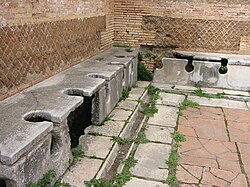
The latrines at Roman forts in Britain consisted of long, open rooms with wooden or stone benches with keyhole-shaped openings. At Housesteads, there were twenty seats and at Vindolanda, where the oldest wooden toilet seat can still be viewed, sixteen. Using the toilet was a social occasion.The waste was flushed away with rainwater from a cistern or with hot water from the baths. It then ran into sewers and into the nearest watercourse.

Roman toilets, from Ostia, Rome, as no British images available.

There is no evidence that Cloacina was venerated in Britain. However, coins and other objects such as gaming counters and beads have been found in the drains of Roman fortresses such as Eboracum and Vindolanda. Some of these are likely to be accidental losses but some might have been offerings to local purification deities who presided over the sewers and the drains.

Medieval Privies 

When Christianity replaced animistic beliefs, there was a shift in perception away from our bodies, bodily functions and waste products being part of the course of nature and the spirits who dealt with them being purifiers worthy of respect. Instead, they became viewed as sinful and corrupt.

In the Bible, in Kings 10:27, when the Temple of Baal is destroyed, it is turned into a latrine and this act of desecration is seen to rob it of its sanctity. Going to the toilet became shameful and was done in private, in privies.

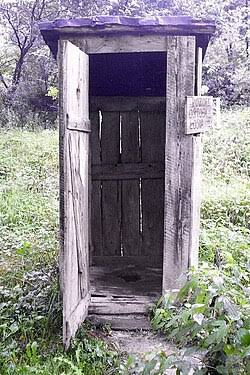
Outhouse

During the medieval period, privies were the most common form of latrine. These were outhouses built on the land of farms or in the backyards of houses. In towns and villages, a number of people shared a privy. It was a basic building with a hole in the floor and a cesspit beneath to collect waste. This was collected by night soil men, who took it to spread on the fields.

In medieval castles, there were garderobes, toilets built into the castle walls, from which the waste dropped down a chute into the moat or a cesspit. People also used chamber pots during the night, which they emptied into cesspits or water courses or added to the manure on their middens.

Only the monasteries had sewers. The toilet block, known as a reredorter (from rere ‘rear’ and dorter ‘dormitory’) was behind the sleeping quarters and was built over a flowing stream or a sewer channel, which led to a nearby river.

Waste was a dirty thing to removed from sight and mind by the men of the night. The purificatory spirits were no longer invoked. Yet, still, they served. As did those were called to dig out the cesspits and fertilise the fields.

Industrial Stink and the Sewage System

As the towns grew, in the industrial period, as an increasing number of people moved to dwell them in them in order to work in the mills and factories, human waste became a major problem. More people came to share limited latrines and the cesspits spilled and contaminated the water sources.

People emptied their chamber pots into the rivers or drains on the streets. Roads and water courses ran black with filth. It reeked. Diseases, such as cholera and typhoid, ran rife. Life expectancy was as low as nineteen.

The growing popularity, amongst the rich, of the flushing toilet didn’t help. The earliest flush toilet was designed for Queen Elizabeth by her godson, John Harrington, in 1596. In 1775 Alexander Cumming produced the widely recognised design with the U-bend to keep solids and their odour in their place.

In 1948 the Public Health Act was instituted to tackle sanitation issues. It was decreed that every house should have a water closet. Unfortunately, the use of flush toilets led to the water courses being overwhelmed more quickly.

The first sewers were constructed in Liverpool, between 1848 and 1862, in accordance with a programme created by James Newlands. Following the 1858 ‘Big Stink’ of London, Joseph Bazelgette constructed a sewer system with six main interceptors, incorporating stretches of London’s already culverted or ‘lost’ rivers to take the waste to the Thames estuary. Manchester and Preston developed sewers around this time.

Building of London sewage system in the 1860s

The development of Preston’s sewers was carried out by Preston Corporation Waterworks in tandem with the installation of piped drinking water. Water sources culverted underground such as the River Syke and the Moor Brook were used to carry surface run-off, industrial waste and sewage into the river Ribble. This was compounded by waste from other mill towns just as dirty, such as Blackburn and Darwen, coming down the river Darwen, and from Wigan coming down the river Lostock. 

The pollution and the works would have had a major impact on the water sources and their spirits, whose presence was unacknowledged and unappeased.

Wastewater Treatment Works

The waste was removed from the towns only to pollute the rivers. Thus, it was soon realised that it needed to be treated before it was discharged. 

The earliest wastewater treatment works was set up in 1864, at Beckton, in London. This used settling tanks to remove solids before discharging the liquids. In 1887, chemical methods to separate liquid and sludge were developed.

In 1894, Davyhulme Sewage Works opened outside Manchester. This pioneered the Active Sludge Process, invented by Edward Ardern and William Lockett, in 1914. In the first stage, bacteria and protozoa, powered by oxygen, break down pollutants. In the second stage, clarification, the biological flocs settle and are pumped back into the process whereas clear liquid remains. This is repeated until all the flocs have been processed and the water is clear. This technique is still used worldwide to this day.

At a modern wastewater treatment plant there are typically four stages. The first is screening to remove items like nappies, sanitary towels and cotton wool. The next, primary treatment, or sedimentation, is where the sludge settles to the bottom in large tanks and oils and grease are skimmed from the top. Secondary treatment is biological breakdown via the Active Sludge Process. Tertiary treatment involves filtering out any last remaining particles and disinfection by UV light or chemicals like chlorine to kill harmful bacteria. The effluent is then tested and released back into the watercourses. The solids are made into ‘cake’ for fertiliser or used to generate electricity.

In 1893, a sewage farm was developed at Freckleton to take the sewage from Preston and Fulwood and the waste was spread on the fields. The site was later replaced by the Preston Wastewater Treatment Works at Clifton Marsh. This currently receives the waste from Preston, my home town of Penwortham, and the surrounding area. The Walton-le-Dale Wastewater Treatment Works was established in 1891 and still caters for that area.

Preston Wastewater Treatment Works

When my house was built, in the 1940s, it would have been constructed with sewers leading, via Penwortham Pumping Station at Crookings Lane, to the Preston Waste Water Treatment Works.

What kind of purificatory spirits govern the processes of sedimentation, biological breakdown, filtering and disinfection is a question unasked and unanswered.

Storm Spills and the Preston Interceptor Tunnel

The development of better wastewater treatment has led to our rivers being cleaner. We’re still not there yet. In 2010, Preston’s 19th century sewage system was still emitting storm spills into the Ribble at times of heavy rain. 

This resulted in £114m project delivered by KMI+ for United Utilities to build a 3.5km interceptor tunnel capable of carrying and storing 40 million litres of water. This tunnel is famously wide enough to drive a car down. New storm tanks were also built to hold the water at Preston Waste Water Treatment works.

What new spirits abide in these tunnels and holding systems?

Journeying with the Spirits of the Sewers

The history of the sewers is intrinsically bound up with our rivers. The goddess of the river Ribble is called Belisama, ‘Most Shining One’. I see her tributaries as her daughters. Many of these rivers and brooks, such as the river Syke and the Moor Brook have been culverted to form drains and sewers. 

Additional tunnels have been built, subverting, changing the older courses. Do the same spirits flow in these channels or have new ones become? Is there a purificatory deity who presides over the drains and sewers of this watershed?

I took these questions when I journeyed to the spirits of my local sewage system. I didn’t get that much an answer. Journeying down our toilet, with my guides, we came out into a sewer where the sewage was flowing slowly. Every now and then its reluctant flow was punctuated by the splash of another flush, another push. The spirit was equally sluggish and uncommunicative. 

Contrastingly, we met a male brown rat and then ran into a female and her young in a nest of toilet paper. A larger rat-headed more humanoid spirit appeared and said, “As your population grows, as our sewers grow, we grow too.”

When I asked if there was a purifier present, the rat spirit just laughed and told me, “There is no purifier, no purity, nothing is pure in these sewers.”

We traversed the tunnels and arrived at the water treatment works. There, I gained a sense of the liveliness of the bacteria going about their work and the steady rhythms of the machines – the scrapers ceaselessly rotating, gathering the sludge that settles at the edges, pushing it to the centre for removal. I intuited the mechanical agency of the spirit but received no messages.

However, at the end, the message from Belisama and her daughters was loud and clear. “Your waste does not belong to the waters but to the land.”

SOURCES

Smith, P. ’Sanitation and Public Health’ in ‘Reforming Preston,’ Preston History, https://prestonhistory.com/subjects/reforming-preston-section-5/
Smith, P. ‘On this day… 16th September 1893, Preston History, (20230, https://prestonhistory.com/2023/09/16/on-this-day-16-september-1893/
‘Flushed Away: Sewers through History’, Science Museum, (2021), https://www.sciencemuseum.org.uk/objects-and-stories/everyday-wonders/flushed-away-sewers-through-history
‘The History of Water Treatment in the North West’, United Utilities, (2021), https://www.unitedutilities.com/corporate/responsibility/stakeholders/catchment-systems-thinking/beyond-water-series-alt/conventional-treatment-works/
‘Preston Unsatisfactory Intermittent Discharge (UID) Scheme, Peri, https://www.peri.ltd.uk/projects/preston-unsatisfactory-intermittent-discharge-scheme.html#impressions
‘Preston Tunnel,’ Longwood Engineering, https://longwoodengineering.co.uk/case-study/preston-tunnel/

Sunless Solstice

I.
It’s a sunless solstice
on my bridge over the Ribble
but yet the river flows

as if she has done so
since the beginning of time

in spite of the stopping and 
starting of the ice floes.

II.
I remember how once-upon-a-time
I held the sun in my hand
like the monster with the monstrous

CLAW

and wonder if I am the monster from
beneath the bridge who stole
the girl whose bike lights shine above.

III.
As the streetlights light up one-by-one

I ask Belisama – Great Goddess of the Ribble,
Old One, Shining One, Mighty One,

how many suns and how many stars,
how many daughters have swum
down your river to the GREAT BEYOND?

Will they ever be returned like Peter Pan

and the Lost Boys from Never Never Land,
like Pryderi, like Mabon, like the unnamed girls

whose names never reached the tongue-tip of song?

IV.
A sunless solstice, bike lights shine bright,
past Tinkerbell’s Nursery
I cycle on.

King Fishing

I.

Your azure blue splash.

The quickness
of your dive.

Your kiss of fire.

Your splendour.

Your spine-snapping
savagery.

II.
Your body weight
in fish eaten

every day

fishing for
each of your young.

Your aeronautics.

III.
You were here
before someone wounded
the Fisher King

red dripping into blue

the blood from
his groin

like blood
from his queen’s
menses

flowing into the sea

(when male and female
had to bleed).

IV.
You were here
before the fae danced
in your colours

in the hall
of the King of Annwn
like devils

burning red
and cooling blue.

V.
You sat on your perch
and you watched

the gods –

some say
you advised
the Fisher King.

VI.
His wound

is beginning to heal
with the demise

of industry.

The red rivers
are flowing blue.

VII.
You are no longer
a myth

we cannot reach

on boats
of fish bones

sailing for halcyon days

because
they are here
like you

on this river.

VIII.
The Fisher King
is fishing.

The red world
is turning
blue.

This poem is the third of three pieces about creatures who build their nests in sandy banks and can be seen at Brockholes Nature Reserve. I wrote it a couple of weeks ago when I was applying for a paid traineeship on the Kingfisher Trail – a 14 mile recreational route following the rivers of the Croal-Irwell Valley connecting ‘the rural West Pennine Moors to the urban communities of Bolton, Bury, and Salford’ (HERE). Although I didn’t get the job (of 300 applicants I made the top three) I intend to walk the trail.

In this poem I link the kingfisher to Nodens/Nudd, an ancient British god of hunting, fishing, healing and dreams, from whose mythos the story of the Fisher King may have arisen (although Brân is a candidate too) and to his son, Gwyn ap Nudd, a King of Annwn/Faery, whose people make merry in red and blue costumes in his feasting hall.

Coincidentally, around the same time, Gwilym Morus-Baird published a video on ‘Gwyn ap Nudd and St Collen’ (HERE) where he discusses the symbology of Gwyn’s people wearing red and blue, which might have alchemical significance. Intriguingly he linked this to the two streams, Y Gwter Las and Y Gwter Goch which flow into Llyn y Fan Fach, the location of a story where a fairy bride is given away by a Fairy King-like figure.

The River Did Not Burst Her Banks

You did not burst your banks today…

River goddess your fearsome torrent pouring
from here to the sea how many times do I have to stand in you,
no, to drown in you, to know you are never the same?

What rites would you have me keep, Riga Belisama, as I walk beside you?

Long have I kept this piece of your humble mudstone close to my heart
(which I must give back should I ever leave), renewed your waters,
lit your candle, created for you a little temple

and cleared Fish House Brook – just one of your dirty daughters
running from one of the estates to the sea.

I have seen your many colours –
red, blue, green, grey as concrete bollards.

What is a river without a goddess or a goddess without a river
meandering, twisting, to the sea, like our own blue blood to our heart?

Sometimes I see you as a goddess but most often you are being a river,
fulfilling your purpose, delivering water, divine water-bearer.

To be one with your flow on days like this is a blessing,
to walk so close to the edge knowing I could be carried away

by your rush of waters, by your rush of deadly words,
but you did not burst your banks today.

I wrote this poem after my daily walk beside the Ribble yesterday during Storm Christoph. Contrary to the flood warnings the river did not burst her banks but came very close, the water lapping at the edge, at high tide. It’s not often we can walk so close to a force of nature, to a mighty goddess, whose might could destroy us if we take a false step – an experience awe-inspiring and humbling.

We were lucky, here in Penwortham, that the river did not burst her banks. Upriver Brockholes Nature Reserve has been forced to close due to the access road flooding. People from Didsbury and Northenden in Manchester, Maghul in Merseyside, and Ruthin and Bangor-on-Dee in North Wales have been evacuated. This must be a doubly awful experience during a pandemic. The combination of the virus with flooding feels like an ominous portent of decline and I fear worse is to come.

The first time I saw major floods on the Ribble was 2015 and she has flooded almost every winter since. In response, the Environment Agency and Lancashire County Council have implemented the Preston and South Ribble Flood Management Scheme, which will raise the current flood walls from 1.2 metres to up to 2.2 metres, with a glass screen at the top so people can see the river, and build new ones.

Some of the trees on the banks, such as the row of elms near the Continental pub, will be dug up to make way for the defences. Five new trees will be planted for each tree removed, but it will be forty to fifty years until they are the size of the original ones. Local people have asked for the old trees to be made into benches.

More positively, some of the area, which is now Preston Junction Nature Reserve, rather than housing, due to the Save the Ribble campaign, is going to be kept as flood plain. There are plans for the creation of a new wetland habitat with ponds with dipping platforms, species-rich wildflower meadows and grasslands, wet woodlands, and orchard trees.

My local stretch of the Ribble, where I have been walking for nearly forty years, is going to change dramatically. How long the defences will keep people’s homes safe I don’t know. As this past year has shown, our safety from the forces of nature, small and large, is very much illusory. The climate and the world are changing. The river will burst her banks again. Yet, on her banks, we find the very first snowdrops, who have weathered the floods. A small sign of hope in these apocalyptic times.

The Defwy – A Brythonic River of the Dead

In the sixth verse of ‘The Spoils of Annwn’ Taliesin berates ‘pathetic men’ (monks) for their lack of knowledge of the answers to riddles which in his day must have been well known. He says they do not know ‘who made the one who didn’t go to the meadows of Defwy’.

The meadows of Defwy are clearly in Annwn. Marged Haycock notes it has been suggested Defwy is a river-name from def-/dyf- ‘black’ ‘as in Dyfi’ and may be ‘a river between this world and the next’. Taliesin also sings of this river in a list of fine things in ‘The Spoils of Taliesin’: ‘Fine it is on the banks of the Dyfwy / when the waters flow’.

Rivers dividing Thisworld and the Otherworld, the realms of the living and the dead, are found in many world cultures. In Greek mythology the Styx ‘Hatred’ divides Thisworld and Hades, the dead must cross the Acheron ‘Woe’ to reach their destination, and surrender their memories to the Lethe ‘forgetfulness’ to be reborn. There are another two rivers: Cocytus ‘Lamentation’ and Phlegyton ‘fire’. All originate from Oceanus ‘Ocean’. Each is a deity. Each flows through both worlds: the Styx is a stream in Arcadia, the Acheron and Cocytus flow through Thesprotia, the Lethe through Boetia, and the Phlegethon near to Avernus.

In Norse mythology eleven rivers called Elvigar ‘Ice Waves’ arise from Hvergelmir ‘Boiling Bubbling Spring’ in Niflheim ‘Mist-World’. Amongst them is Gjǫll, which flows past Hel’s Gate and separates the living from the dead. There are forty-two rivers in total. Some flow into the ‘fields of the gods’. Others ‘go among men’ before falling into Hel. Midgard, Thisworld, is encircled by an impassable ocean where Jörmungandr, the world-serpent, lives.

Unfortunately in Brythonic tradition we possess far less lore about the cartography of Annwn. Whether it was simply lost or actively erased by Christian scribes is impossible to know. Much of what we have is obscured by Taliesin’s riddling. In ‘The Hostile Confederacy’ he speaks of:

‘the connected river which flows (around the world)
I know its might,
I know how it ebbs,
I know how it flows,
I know how it courses,
I know how it retreats.
I know how many creatures
are under the sea’

It seems the Britons shared with the Greeks and the Norse a concept of a river/ocean encircling the world. To me this speaks of an intuitive knowledge of the oceanic currents of our ‘global conveyor belt’ which flow through the world’s oceans maintaining its ecosystems.

Another riddle suggests we once possessed knowledge of many rivers thisworldly and otherworldy:

‘how many winds, how many waters,
how many waters, how many winds,
how many coursing rivers,
how many rivers they are’

It’s my intuition that, like the Greek and Norse rivers, the rivers of Annwn flow through Thisworld and the Otherworld too. In ‘The Conversation of Gwyn ap Nudd and Gwyddno Garanhir’, Gwyn, a ruler of Annwn and gatherer of souls, says he is:

‘Hurrying to battles in Tawe and Nedd.

Not the Tawe here in this land
But the one far away in a distant land
Where the tide ebbs fiercely on the shore.’

The Tawe is a river in Thisworld that flows through ‘a distant land’ – Annwn – too. It seems likely the Defwy, which might be identified with the Dyfi, appears in both worlds.

Afon_Dyfi_-_geograph.org.uk_-_242012

Afon Dyfi – the Defwy here in this land?

It is notable that Gwyn speaks to Gwyddno of his ‘sorrow’ at seeing ‘battle at Caer Vandwy’, ‘Shields shattered, spears broken / Violence inflicted by the honoured and fair’. Caer Vandwy ‘The Fortress of God’s Peak’ is mentioned in the same verse as ‘the meadows of Defwy’ with the legendary Ych Brych ‘Brindled Ox’.

Gwyn is speaking of a devastating battle between his people ‘the honoured and fair’ (the dead) and Arthur and his men who Taliesin accompanied on their raid on Annwn to plunder its spoils, which included the Brindled Ox and cauldron of Pen Annwn ‘Head of the Otherworld’ (Gwyn).

Even the impervious Taliesin describes this part of the raid of a ‘sad journey’ and says ‘save seven none returned from Caer Vandwy’. Arthur set out with ‘three loads full of Prydwen’ (his ship).

It seems Gwyn is sorrowful because the dead, who should be free of sorrow, were forced to fight and die again and he had again to gather their souls – a task he performs at battles in both worlds.

On a journey to the Defwy with Gwyn I saw people approaching the river, some to kneel and pray, some to cry, some to pour into it great jugs of tears. He told me that the Defwy is the place where the dead discard their sorrowful memories so they can move on to the lands of joy.

He also said the living can come here to do the same, but discarding one’s sorrows is a dangerous process, a form of death, and that they can never be regained because they flow away into the ocean to be reborn in new shapes walking abroad in forms unrecognisable to us.

In ‘The Hostile Confederacy’ Taliesin says in Annwn ‘There is one that knows / what sadness is / better than joy’. I believe this is Gwyn, who knows too well the sorrow of the dead who leave their memories at the Defwy in order to travel onward into his joyful realm.

Taliesin is, of course, ‘the one who didn’t go to the meadows of Defwy’, the one who continues to evade death, who claims to know all, remember all, yet in spite of this feels little sorrow, little guilt, for the catastrophes that he has witnessed and played a role in.

Knowing neither sorrow nor death will this mysterious glib-tongued entity, who was created by the magician-gods from fruit, blossoms and flowers, earth and water, ever truly know life or joy?


Dôn and Returning to the Source

Creatures by Greg Hill

On the cover of Greg Hill’s poetry collection, Creatures, is an image of a sculpture by Fidelma Massey called ‘Water Mother’. The first ekphrastic poem bears the same name. Rivers flow through the book with rain and turning tides.

When I reviewed Creatures in November 2014 I didn’t think I’d ever meet a mother goddess; I decided not to have children at an early age and don’t have a nurturing bone in my body.

However I’ve long been drawn to local rivers, streams and wells, above ground and those unseen, been haunted by the songs of their spirits whether rippling in sunshine, hurtling through darkness, rattling against culverts or running free.

I’ve seen a water dragon shrink and die because we shattered her aquifer, heard the screams of her daughters, stood before the empty greyness of her ghost.

In retrospect it’s not that surprising I should meet a water mother: the primal source from whom every river flows and returns. The fountainhead of all water. She who gives and draws back into the abyss.

***

Her name is Dôn. I met her last October in a vision where I was surrounded by hills filled with people. Somehow the hills became the folds of my coat and I was privileged with custodianship of these people whilst together we witnessed a primordial creation scene.

A dark orb appeared, then pupil-like, placenta-like, emerged the diaphanous form of a goddess. After her appearance the orb came to life: amoeba, green moving swards of vegetation, trees, people, marching through a labyrinthine kingdom back into the void carrying houses and entire civilisations.

Sometimes people get stuck, I heard them knocking, felt they wanted to shout out through me. From a huge crow watching above I received the gnosis my patron, Gwyn, carries the lost ones under his wings, that I too bear some responsibility for them; albeit by carrying their stories.

At the end the goddess’s name rang through the hills, from the spiralling abyss of the deep, echoing in the minds of her people, in the vow I’d made to Gwyn who flies between them: Dôn Dôn Dôn. I had the feeling of being part of her family.

***

Little is known about Dôn from Brythonic tradition. The rivers Don in south Yorkshire and Aberdeenshire bear her name suggesting she is a water goddess. In The Mabinogion we find her children: Gwydion, Gilfaethwy, Arianrhod, Gofannon, Amaethon, Eufydd and Elestron.

To learn more it is necessary to turn to Irish parallels and Danu, mother goddess of the Tuatha Dé Danaan (‘Tribe of the Goddess Danu’). Danu derives from proto-Celtic *Dānu ‘fluvial water’ and is associated with the ‘Indo-European heartland’ of the river Danube. Liz Greene says her ‘dark face was Domnu, which means “abyss” or “deep sea”.

The Tuatha Dé Danaan arrived in dark clouds from islands in the north and took the kingship of Ireland from the Fir Bolg. In turn they were defeated by the sons of Míl Espáne who took the surface whereas the Tuatha were forced underground into the sídhe (‘mounds’) becoming the aos sí (‘people of the mounds’).

Will Parker suggests the Tuatha’s arrival from the north is based on a migratory route from Greece via Scandinavia and says Neolithic Grooved Ware and Bronze Age Bell Beaker cultures show Indo-European influence.

There are no records of how the Children of Don arrived. In the Fourth Branch, Dôn has fallen into the background and her son, Gwydion, is lord of Gwynedd. Similarly we find out little about Beli, grandfather of Brân and father of Caswallon and Lludd, who become rulers of Britain.

In contrast with the Irish myths, the sons of Beli do not defeat the children of Dôn. Instead, Dôn and Beli marry and their children are seen as one family belonging to the House of Dôn.

After the death of Nudd / Lludd Llaw Eraint (‘Lludd of the Silver Arm’), like the Tuatha Dé Danaan, the Children of Dôn retreat into the Brythonic ‘underworld’ Annwn (‘not-world’ ‘the deep’). Gwyn ap Nudd appears as Annwn’s ruler and later as a Fairy King.

***

I’ve been devoted to Gwyn for three years and have gradually been getting to know him and Annwn. My explorations have led me through the deep memories of the landscape to his realm where history and myth blur and are never wholly separate

My initial work (which remains important) involved recovering the memories of my locality. Now I am being led deeper into the underworld where Nudd / Nodens, keeps the matter of dream and Dôn presides over the waters of creation and destruction.

Although earlier worlds and their children have sunk into Annwn they remain in our sacred landscape: in the hollow hills, in deep lakes and the sea, in our flowing rivers and their names.

Although barrow mounds have been ploughed over, rivers culverted, lakes drained, they are still with us in Annwn’s memory which will not let us forget their presence and what we’ve done.

Old bonds split and severed by centuries of Christianity, industrialisation, commodification, hyper-rationalism can be reknit and renewed by swimming back down the labyrinthine ways to where we’re unified with our ancestors, the old gods, their primal source: the water mother Dôn.

SOURCES

Liz Greene, The Astrological Neptune and the Quest for Redemption, (Weiser, 1996)
Robert Alexander Stewart Macalister, Lebor Gabála Érenn, (Dublin University Press, 1937)
Sioned Davies (transl.), The Mabinogion, (Oxford University Press, 2007)
Will Parker, The Four Branches of the Mabinogi, (Bardic Press, 2005)

Ribble Rising

After a month’s heavy rain across northern England, rivers have risen to record levels. Following 100mm of downpour in one night in Lancashire, the river Ribble (from Gallo-Brythonic Riga Belisama ‘Most Shining’ or ‘Most Mighty Queen’) burst her banks at Ribchester and Whalley, forcing people from their homes.

Yesterday the Ribble ran high between Penwortham and Preston swelling under Penwortham Bridge carrying trees, branches, tyres and other debris out to the sea with an urgent roar.

A playground in Middleforth with an overflowing storm drain was underwater.

Several riverside footpaths were submerged.

The Ribble had flooded the bottom of Miller Park completely, almost covering the fountain and pagoda.

The Pavillion Cafe was cut off like a stranded lake dwelling.

P1130527

As dusk approached, Victorian lamps illuminated the submerged pathway.

P1130534


Luckily at the most dangerous point: high tide at around 11pm, the Ribble did not break over the flood walls. Avenham and Miller Parks and the flood plains of Central Park managed the rest and no-one was evacuated.

It would have been a very different story if the Riverworks project, which intended to create a barrage on the Ribble and build on its floodplains had gone ahead. We have Jane Brunning and other ‘Save the Ribble‘ campaigners to thank that we have Central Park instead.

This morning, I walked along the old railway track to see Central Park’s flooded fields.

The floods had receded from Avenham and Miller Park and the Ribble sunk back to her normal course.

P1130579

Last night Belisama heard our apologies, songs and prayers. Today she received gratitude and thanks. This was the highest I have ever seen the Ribble rise. It was really quite terrifying and gave me a fuller understanding of why, before flood-walls, our ancestors revered and feared her as a Mighty Queen.

With temperatures increasing ten times faster than in known history and water levels rising globally I fear this will not be the last time the Ribble bursts her banks. It is a clear message everything possible must be done to slow climate change and adjustments must be made to accomodate rising rivers and returning wetlands.

Having Central Park saved us here. My thoughts are with those not so lucky in Ribchester, Whalley and in York from where 2,200 people have been evacuated.

Song for the Nine

This is a song for the nine
who stood against fracking:
the nine who stood firm
the nine who stood
against the tyrants’ gall.

This is a song for the nine
who stood for land and people:
Little Plumpton,
Roseacre,
democracy and hope.

This is a song for the nine
who stood for Lancashire:
clean rivers,
unfractured land,
our children free from harm.

This is a song for the nine
the nine we will remember
for standing firm
standing for us
in centuries of song.

~

This song came to me near whole and of its own accord the morning after Cuadrilla’s proposal to frack at Little Plumpton was refused by Lancashire County Council’s Development Control Committee 9-4 (2 abstained).

I e-mailed it to Peter Dillon, who was also involved in the protests. He told me that night he’d dreamt of a tune. With a few tweaks it fit the wording perfectly and  wasn’t far off the tune I had when the song came to me.

I’ve sent a copy with a thank you e-mail to the nine at Devcon today. We may be singing it somewhere in Preston soon.

Penwortham By-Pass Protected

A few days ago I received a letter from Lancashire County Council announcing that the route for the new stretch of by-pass in Penwortham running from the Booths roundabout to the A59 at Howick has been protected.

Plans for Penwortham By-passLast year I attended public consultations and found out the plan to build this piece of by-pass is founded on a longer term plan to build further sections linking to a new bridge over the river Ribble then to the M55 at Swill Brook.

Penwortham Link RoadThe reason there has never been a Junction 2 on the M55 (which opened in 1975) was to leave room for this new piece of by-pass. This plan has been dormant for many years and re-risen as a result of the City Deal Programme:

‘The Preston, South Ribble and Lancashire City Deal is an ambitious programme of work that builds on the strong economic performance of the area over the last ten years and will help ensure the area continues to grow by addressing major transport issues to deliver new jobs and housing. Over a ten-year period the deal will generate more than 20,000 jobs, over 17,000 homes and more importantly grow the local economy. With the funding certainty it brings, we are able to deliver these transport improvements sooner we would otherwise be able to. This means new homes and jobs can come sooner and we can reduce congestion on existing roads and improve areas for communities and road users.’

I attended a Penwortham Town Council Meeting on Monday the 7th of October where I raised concerns about the impact of the new section of by-pass on the local environment in Penwortham and the longer term plan for the Ribble bridge. This would destroy part of the Ribble’s natural coast line and Lea Marsh, a Biological Heritage Site which is home to two rare salt marsh grasses; long-stalked orache and meadow barley.

At this meeting the Town Council voted against the new route in favour of the ‘rescinded route’ which would run through Longton and would not link to a new bridge. In light of their vote I was shocked (but not surprised) when I received the letter from LCC saying the new route had been protected. LCC are preparing to submit a planning application in spring 2016 and have promised further public consultations. Should permission be granted the by-pass could be completed and opened by 2018.

The results of the questionnaire to local residents about the by-pass are revealingly vague:

‘the questionnaire you received back in September 2014 was sent to 13,000 residents… Over 1,250 residents and others interested in the road replied and only a small number were against completing Penwortham bypass by whichever choice of route. This suggests a strong degree of consensus among the local community that the bypass should be completed. As part of our consultation, the County Council presented its preferred route…’

By careful rewording relating to the completion of by-pass in general  LCC have covered up the fact that there was a large amount of opposition to the new route and they have over-ridden the vote of Penwortham Town Council and the opinions of local residents.

The letter describes the benefits of the new route including the long term plans to link to the new Ribble bridge and aims to address ‘legitimate concerns’. It also speaks of plans to improve Liverpool Road ‘the local centre of Penwortham’. This seems like a decoy and tantamount to sweeping the dust under the carpet. The destructive impact of the new by-pass can be redeemed by promoting the use of buses, walking and cycling in the town centre (???). This looks like extremely skewed logic to me.

It’s clear the destruction of local fields, the natural coastline of the Ribble and Lea Marsh need to be prevented. Is there a way to oppose the building of the new stretch of by-pass that would persuade LCC to change their minds before planning permission is granted in spring 2016? I’d be very interested to hear your thoughts on what can be done.

Natural Coastline of the river Ribble with Lea Marsh in the background

Natural Coastline of the river Ribble with Lea Marsh in the background